A comparative study of primary care physicians in the
Netherlands and Germany
Author: Simon Schacht
University of Twente P.O. Box 217, 7500AE Enschede
The Netherlands
[email protected]
This paper aims at providing insight into the effects an implementation of Electronic
Health Record (EHR) systems can have on the work of General Practitioner (GP), as
well as on the treatment of medical patients. Several institutions want to implement the
EHR system in order to improve the quality and coherence of the care processes, to
smoothen the transmission of medical data, automate guidelines as well as record
possible mistakes. The research has been based on a secondary literature review and a
qualitative study of ten Dutch and 14 German GP interviews. These interviews have
been conducted within the Twente Region in the Netherlands where an EHR system has
already been implemented, and Frankenberg in Germany where no system has been
introduced yet. The main findings suggest that Dutch and German GP’s have a rather
diverse understanding to what extent EHR can be beneficial. Dutch post-transition
respondents reported overall improved satisfaction due to quality improvements,
simplified procedures and enhanced communication. Contingent upon the fact that
German GP’s are mostly not using ICT yet, fear or problems attached to EHR in regard
to privacy-related issues, increased costs and time inefficiencies are present. The
implemented EHR within the Twente region meets GP’s expectations and they
appreciate the benefits of EHR systems but would like to see steady improvements in the
system, such as a tool that filters significant data. On the contrary, German GP’s face
larger problems in regard to a possible implementation of EHR systems since diverse
Information Systems are being used and existing data sources (e.g. pharmacy systems)
rely on different server. The results of this paper are of high importance in regard to the
future implementation of EHR systems, highlighting the areas that still need
consideration in order to fully being able to take advantage of EHR.
1
stSupervisor: Dr. Ir. T. A. M. Spil
2
ndSupervisor: Dr. A. B. J. M. Wijnhoven
Keywords
Electronic Health Records, Medical Records, General Practitioner, E-Health, Primary Care
Permission to make digital or hard copies of all or part of this work for personal or classroom use is granted without fee provided that copies are not made or distributed for profit or commercial advantage and that copies bear this notice and the full citation on the first page. To copy otherwise, or republish, to post on servers or to redistribute to lists, requires prior specific permission and/or a fee.
1. INTRODUCTION
The steady increase of German total population at the age of sixty-five and older (Anderson & Hussey, 2000), as well as the public pressure for improving the quality and coherence of the care process is leading to growing health care expenditures (McDonald, 1997; Mongan, Ferris & Lee, 2008), underlining the relevance of implementing electronic health records in the near future. According to Kalra and Ingram (2006), physicians ‘need to document increasing volumes of information, as patients receive more complex and data-intensive care’ (Kalra & Ingram, 2006, p. 137), which leads to more detailed records in order to minimize the risk of litigation. Furthermore, interviewing patients in order to gain the clinical findings and anamnesis is time-consuming as well as mostly inefficient and is only applicable to those without any disturbance of their consciousness. Nowadays, any kind of health care system tends to ‘form loosely or even rather closely coupled regional networks’ resulting in miscommunication between health care centers, hospitals and family practices (Blobel, 2006, p. 186). Ozmon (2007) is even going one step further and posits that the increased living standards, especially in the western world, followed by the compulsive consumerism introduces additional pressure on both the health care providers and systems in general. In order to counteract towards the previous mentioned issues, it is highly advisable to implement electronic health records with its purpose to support the continuity of care for an individual’s lifetime and ‘ensures confidentiality at all times’ (Iakovidis, 1998, p.106). It has been argued that especially within general practitioners offices, many operating cycles such as communicating medical evidence needs to be improved in order to provide the patients with a higher quality of health care. This topic is further of high importance, especially in Germany, since it has been in-depth discussed in the past years without achieving a visible change in regard to the implementation of electronic records. The implementation of EHR has proven to be a balancing act since one needs to focus on possible drawbacks as well. According to Berg (2001) and Walsh (2004), not only risks and dangers during the implementation can occur, but also overloaded practitioners assistants might be an outcome of the usage of EHR. Research by Schuring and Spil (2003) has described to what extent professionals expect and perceive a certain performance of a system and introducing this gap within this paper is an important step towards analyzing whether German general practitioners’ are willing to implement electronic health records in their daily routines. This paper will only deal about the primary care of patients, which is defined as the ‘health care provided by medical professional with whom a patient has initial contact and by whom the patient may be referred to a specialist for further treatment’ (MedlinePlus, Medical Dictionary, 2005).
Therefore, the research question for this paper is:
To what extent can electronic health records facilitate the general practitioners’ work and therefore improve patients’
treatment?
This paper is structured as follows: The next section will deal with an extensive literature review, which is further sub-divided into three main parts, namely: (1) ICT and Healthcare, (2) E-Health and (3) the topic of Electronic E-Health Records. Part three compromises the comparison of the researched countries, namely the Netherlands (Twente Region) and Germany (Frankenberg/ Hessen) with the aim to provide the reader with relevant background information about the underlying environment. This includes variables such as the country, culture, business ethics and people’s behavior. The
methodology as well as results section will be structured similar to the previous part since it is inevitable to focus on the both countries separately. The conclusion finalizes the work by summarizing the main findings, followed by a discussion including limitations of this study as well as recommendations for future research.
2. LITERATURE REVIEW
This research has been conducted in order to identify the relevant factors clarifying the extent to which an implementation of EHR is appropriate for the region of Frankenberg (Eder), Germany. The research will be in the form of a critical literature review and a qualitative analysis that is based on interviews, which have been conducted with both Dutch and German general practitioners. Literature has been obtained by making use of extensive search on scientific databases, such as Scopus, ScienceDirect and Google Scholar while searching with the following keywords: Electronic Health Records, General Practitioners, Primary Care, ICT, Healthcare and e-Health. As one can see from the following literature review, the topic of EHR has been discussed widely in the literature and several researchers have been conducted extensive research. Griener (2005) explained that EHRs are not an innovative change of recording medical, they are rather an outcome of the pressures undertaken by the health care providers to change the way of thinking and to exercise things in an ‘unusual way’. To increase the value of this paper, peer reviewed articles have been primarily chosen, which have recently been published and received a significant amount of citation.
2.1 ICT and Healthcare
The Information and Communication Technology (from now on ICT) is according to Gagnon et al. (2009) defined as ‘the digital and analogue technologies’ that could ‘capture, process, store and exchange information via the electronic communication’ (Gagnon et al., 2009, p.1). ICT can be seen as an umbrella term, which contains not only any kind of communication device, such as smartphones, but also several applications and services associated with them, such as video teleconferences. Previous research has shown that making use of ICT can lead to a competitive advantage signaling new opportunities for both commerce and healthcare. Due to the high importance of ICT in the field of healthcare (Butter et. al, 2008), the European Commission (EC) contributes positively towards making use of the well-grounded Information Technology in healthcare. This can be reached not only via Electronic Health Records, but also with the help of intelligent prosthetics and robotized surgery (Butter et al., 2008). Research by Gund et al. (2012) detects that the majority of people working in the healthcare sector are positively tempered towards ICT tools, especially in regard to the great improvements of communication as well as patient involvement during the treatment. Furthermore, certain standards are needed to ensure that patients and healthcare workers can experience a joined-up health service across regional borders (Kalra & Ingram, 2006). Healthcare professionals ‘need to share healthcare information with a growing range’ of physicians’ at the same time (Kalra & Ingram, 2006, p.138) and in order to be capable of informing others, a well-working ICT is urgent needed.
2.2. E-Health
p.2). This kind of medical informatics can lead to a large change in the decision-making of empowered patients, especially for those who are visiting their general practitioners (Health-EU, 2010). Whereas Eysenbach (2001) speaks about the ‘emerging field of informatics’ (Eysenbach, 2001, p.2), Scott (2009) states that e-Health is rather a ‘revolution in healthcare’ (Scott, 2009, p.495), which assists GP’s in their communication internally (within the office) as well as externally (outside the office). E-Health and its related applications will improve the communication between patient and GPs, which might be a solution for the steady decrease of healthcare professionals, especially in rural deprivation (Ekroos & Jalonen, 2007). Furthermore, according to Coach (2003), not only the better communication could be an outcome of e-Health, but also the improved connection of different actors through the Internet (and therefore within the Intranet) (Coach, 2003). The German medical researcher Eysenbach defines e-Health rather as ‘a new way of working, an attitude, and a commitment for networked, global thinking’ than as a ‘technical development’ with its long-term goal to ‘improve health care locally, regionally, and worldwide by using information and communication technology’ (Eysenbach, 2001, p.1). In compliance to the previous written statement by Eysenbach in 2001, Rose and Blume (2003) go one step further and question the extent to which the workload management within a GP’s office could be improved through e-Health and whether it is a win-win situation that results in a reduction of the overall expenditure. According to Rose and Blume (2003) it would be advisable to make use of a specified coding or configuration in order to standardize the procedure for people with different ethical or cultural background. Introducing e-Health in Germany could lead to a more secure system while being able to monitor a ‘larger part of population by less healthcare professionals’ (Ekross & Jalonen, 2007, p.22). The issue of e-Health is rather broad compared to other healthcare systems and therefore the thesis is aimed at only focusing on the Electronic Health Records (EHR) in the Netherlands, more precisely within the Twente region. Then again, this analysis will be compared with the current situation in the author’s hometown Frankenberg (Eder), which is located in the middle part of Germany.
2.3 Electronic Health Records
The already well-working electronic medical record system (EMR) is rather configured for a group of physicians than a whole region, with the aim to take care of a patient. It is defined as a system where ‘providers’ record detailed encounter information such as patient demographics, encounter summaries and lab-related histories (Ludwick & Doucette, 2009). That is why it is highly advisable to introduce EHR, which has been defined as followed:
‘An EHR is a patient record that resides in a computer system specifically designed to support care providers by providing accessibility to complete and accurate patient data, medical alerts, reminders, clinical decision support systems, links to
medical knowledge and other aids.’ (Dick, Steen & Detmer, 1997)
Generally speaking, it is important to focus on the balancing act while thinking about EHR since according to Poissant, Pereira, Tamblyn and Kawasumi (2005) time efficiency and information quality are seen as the major advantage of using EHR for GPs. However, if one fails to implement the system successfully or GPs do not use it sufficiently, it could lead to major drawbacks. Thus, the following section is subdivided; the first part includes
the arguments towards using EHR, followed by a section that analyses the extent to which it is not advisable to make use of it.
2.3.1. Information Quality
Information Quality is one of the major determinates in regard to EHR since it affects the perceived usefulness (Green & Pearson, 2011), as well as the perceived usability (Zhou & Zhang, 2009). Patients’ desire is to receive the best treatment possible that is based on valuable information, regardless whether it is their family physicians or locum doctor. Thus, one can measure the quality of information by accessing the following three variables, namely: (1) Timeliness (2) Relevance (3) Consistency (Delone, 2003). According to Juran (1999), information quality is defined as the fitness of use and the trustworthiness of patients, and can be obtained through communicating values in terms of privacy and GP’s policies.
2.3.2. Service Quality and Perceived Risks
Service quality is of high importance for every person and therefore plays an inevitable role in regard to a patient’s treatment process. Research by Zeuthaml, Berry and Parasuraman (1996) has documented a positive relationship between intention and behavior, which means that a positive intention leads almost automatically to a positive behavior. Apart from that, especially honesty as well as reliability is crucial for elderly people, leading to the desire of receiving a high quality of services including not only the general treatment process, but also the whole progress of work. A significant increase in service claims against GP’s (WAZ, 2013), shows that a double-recheck that can be made through the EHR, is important in order to make sure that not only medication will be correct, but also that surgeries will occur as planned (Emmrich, 2014). More than a decade ago, Pringle (2001) had already discovered the risk of litigation and according to the author more detailed records are needed to demonstrate competence and to advocate the use of healthcare capabilities.
2.3.3. Trustworthiness
A key component of the relationship between patient ⟷ GP is a base of trust, since research by Thom, Kravitz, Bell, Krupat and Azari (2002) indicate that a low level of trust leads to a high amount of unfulfilled inquiries. Furthermore, this study has proven that especially the trust will have a high impact on the use of medication since ‘new medication was more frequent among patients with higher trust’ (Thom et al., 2002, p. 476). According to Cvetkovich (2013), trust is further subdivided into cognitive, behavioral and emotional trust. In this regard, sufficient existence of trust can lead to a reduction of ‘uncertainty about individuals, and provide positive models for future cooperation.’ (Cvetkovich, 2013, p. 37), which would be beneficial for the relationship between physician and patient in terms of the possibility of looking into medical data within the EHR. The following part will elaborate the advantages and disadvantages of EHR systems, in order to underline why these systems are a valuable source of information.
2.3.4. Advantages of EHR
The advantages of EHR systems can be subdivided into four distinct areas, namely: (1) Quality Improvements, (2) Enhanced communication, (3) Enhanced future patient healthcare, as well as, (4) an enhanced patients medical understanding. The following paragraph will elaborate each of these characteristics in detail.
shows, simple so-called central station desktops for computerized order entry are rather inefficient. EHR systems therefore tend to improve the safety as well as quality of the care process (Poissant et al., 2005), due to the fact that logistic-related issues can be handled more efficiently, which will then lead to an overall reduction of expenditure (McDonald, 1997). Furthermore, Blumenthal and Tavenner (2010) assume that EHRs will improve caregiver’s decisions and patients’ outcomes, since decision can be based on quickly provided medical history. The review of chosen treatments from the past, can better explain urgent medical situations in line with previous clinical professional prescriptions (Karla & Ingram, 2006). In this regard, physicians can stay on top of things and use the different diagnoses and perspectives towards the treatment process (Ludwick & Doucette, 2009). Not to forget, personal adjusted reminders, that can be installed, may diminish the rate of failure, since for instance the drug administration could be completed more efficiently (McDonald, 1997). Secondly, the implementation of EHR can lead to an enhanced communication. This is due to the fact that reports are automated and information is quickly available. Physicians do not need to struggle anymore, to find the right data during a treatment process, which has previously lead to extra-waiting time for the patient (McDonald, 1997). Since information can be exchanged fluently, duplication of data can be avoided if the information is captured properly within the EHR (Karla & Ingram, 2006). According to McDonald (1997), one of the major goals is to solve movement and communication problems, to increase the speed of information and the coherence of the care process with the long-term goal to achieve to a certain extent automated guidelines as well as care pathways. Thirdly, the future patient healthcare can be improved, since physicians can check if the medication is correct based on the previous treatment as well as if surgeries occur as planned (WAZ-Der Westen, 2014). The history of medical data might indicate any diseases or health problems in the future. Last but not least, patients can obtain a better medical understanding. If a knowledge transfer based on a wide EHR network is set up, doctors can inspect previous diseases and the history of medication. This in turn, can lead to a better understanding of the patient, since processes are increasingly transparent and can be traced back. Finding can thus be reviewed in their completeness and patients can understand their medical diseases better due to the graphical layouts of the EHR (Makoul, Curry & Tang, 2001).
2.3.5. Disadvantages of EHR
The disadvantages of EHR systems can again be split into four different main themes. These distinct areas are (1) Privacy-related issues, (2) Time inefficiency, (3) Difficult Implementation Process and (4) Technical Disturbances. The first drawback deals with privacy-related issues and is probably the most cited disadvantages while reading about EHR systems. An example from the USA by Rivkin-Haas (2001) has shown that electronically saved data can often easily be hacked by IT-specialist. An office clerk has downloaded more than 1.000 patient data and made profit out of it by selling to outsiders. This example suggests, that privacy breaches are real and present a certain risk associated with EHR systems (Jacques, 2010; Rivkin-Haas, 2011). In this regard, there is a challenge to recognize the different kind of risks towards privacy-related issues (Dickson, 2011). Not only could a loss of personal data lead to the reduction of trustworthiness of EHR but also collide with national law. As for example in Germany, paragraph five of the Federal Data Protection Act prohibits that data is used without the permission of the patient (Translation, § 5 BDSG). Secondly, there is a certain time inefficiency related
to the usage of EHR systems. Increased time for documentation is one of the most commonly stated barriers to successful implementation of an EHR (Poissant et al., 2005; Miller & Sims, 2004). More detailed records are needed to demonstrate competence and to cover the increasing risk of litigation (Pringle, 2001). Thus, a flexible framework for recording the consultation process and accommodate the individuality of the clinician needs to be provided (Kalra, 2006). Ludwick and Doucette (2009) state that there increasing medical errors can happen due to short-term physician office performance. Not to forget, the increased amount of data could lead to an information overload (Poissant et al., 2005; Miller & Sims, 2004). Thirdly, the implementation process of EHR systems is quite difficult (Ash, Stavri & Kuperman, 2003). At the beginning, a high amount of initial cost and uncertain financial benefits needs to be tackled (Poissant et al., 2005). These high investment costs, are also due to the fact that it is difficult and time-consuming to transfer existing data into the new system, since data often exists on isolated electronic data systems (McDonald, 1997). Furthermore, Miller and Sim (2004) found that physicians need to invest time and thus can see less patients. In this regard, Cherry, Carter, Owen and Lockhart (2008) found that staff tends to focus more on the computer since they are concerned more about accurate data than on patients care leading to a reduced face-to-face communication. Lastly, technical disturbances are an issue, since software can lack an efficient way to view the overall picture of patient progress, care and poor system navigability (Smith, Smith, Krugman & Oman, 2005). Research by Iakovidis (2008) has shown that it will be a major challenge to include storage, maintenance as well as communication within the databases since they are not yet constructed to be capable of managing heterogeneous as well as geographically distributed database systems. Since EHR networks work on Internet connections, a loss of a connection can also lead to major disadvantages if no paper-written documentation is at hand.
2.4. Conclusion of the literature review
The advantages and disadvantages are summarized within table 1, to enable the reader to reconcile a short image of the main findings within the literature review. It becomes clear, that it is highly important to provide enough security in order to protect patient’s privacy accurately (Blumenthal & Tavenner, 2010). Thus several technical tools need to be implemented which increase the security of data (Makoul et al., 2001), as well as reduce the failure rate by making use of project management processes as well as schedules (Ludwick & Doucette, 2009). Only this way, the advantages of EHR systems can fully evolve.
Advantages Disadvantages
• Quality Improvements • Privacy-related issues
• Enhanced Communication
• Time inefficiencies
• Enhanced future patients healthcare
• Difficult Implementation
• Enhanced patients medical understanding
• Technical Disturbances
Table 1. Main findings of the literature review.
3. RESEARCH METHODLOGY
interview sets took approximately 30 – 45 minutes per interview and had slightly different main objectives as well as interview protocols. The secondary data consists of ten interviews from GPs, followed by five interviews of the related GP assistants. The primary data consists of 14 interviews of German primary care physicians. In order to ensure the anonymity of the interviewed physicians, shortcuts such as DGP1-9 for Dutch interviewees will be used and the shortcuts GGP 1-14 for German respondents. The main goal of the secondary data was to review the Dutch GP’s experiences of operating and implementing an EHR system; whereas it was of high importance in terms of the primary data, to examine the extent to which German GP’s approve of the adoption of an EHR system. The primary data focuses on the author’s hometown Frankenberg (Eder), whereas the secondary data, which has been conducted by UT-students, deals with the situation in the Twente region.
The following paragraph is further subdivided into three parts, namely (1) Interview Method, (2) Interview Content, (3) Interviewees and (4) Interview Process; in order to elaborate certain research methodology related factors in more detail.
3.1. Interview Method
As mentioned above, both types of data have been conducted in different countries; therefore, two different languages have been used. Furthermore, the interviews were based on slightly different interview protocols and a different number of interviewees took part in the studies. Therefore, it is of high importance to evaluate data based on a model that can integrate both researches correctly. The method used within this thesis is called PRIMA (Spil & Michel-Verkerke, 2012). This kind of model is based on a variety of different models, such as the TAM (Venkatesh, Morris, Davis & Davis, 2003) as well as the Information System Success Model introduced by Delone (2003). As one can see from image 1, PRIMA consist out of five characteristics that are further subdivided into two dimensions, namely the innovation and the domain dimension (Spil & Michel-Verkerke, 2012).
Image 1.Prima-Model by Spil and Michel-Verkerke (2012).
The main objective of the PRIMA model is to determine the intrinsic quality of innovative products such as the implementation of EHR and to what extent those innovative products are feasible in terms of the above-mentioned factors. Any new inventions should lead to a positive outcome with a valuable well-working system. If physicians do not exhibit this valuable meaning, they do not see the point of implementing this certain invention. Therefore, the analysis will be based on
the PRIMA model to help physicians to do the right decision in order to work more efficiently in the long-term perspective. A profound comparison as well as research of both interviews are the main objectives of the thesis, which can be achieved while focusing on the five PRIMA-characteristics, which are the following: (1) Process, (2) Relevance, (3) Information Needs, (4) Means and People and (5) Attitude.
3.2. Interview Contents
In order to have the opportunity to review both interview contents, the protocols of both the Dutch and German interviews can be found in the appendix. At the beginning of each interview the reader has introduced himself, followed by an explanation of EHR and has answered general questions beforehand in order to minimize the amount of misunderstanding during the interviews. The questions have been based on the five PRIMA characteristics as one can see in image 2, in order to receive valuable results for the analysis.
Image 2.PRIMA-Model with integrated questions.
3.3. Interviewees
Based on the UTAUT model (Venkatesh et al., 2003), the German interview data does no only include the name and gender of the physician, but also the amount of working years as general practitioners in order to also be able to evaluate underlying facts such as the experience. Especially in Frankenberg (Eder) are several physicians, who are already >50 years old but have been working as a specialist doctor before their time as family doctor. This is one of the major moderators that will influence the determination of GP’s behavior. Research by Eastin (2002) and the well-based study by Rogers in the early 1980s have shown that experience will have almost automatically a positive influence regarding an adoption, regardless whether it is a technology-driven or human-driven adoption.
3.4. Processing Interviews
Important to take into account is that the thesis mainly focuses on GP’s attitude towards EHR since those are the one who are: (1) allowed to make any changes within the system, (2) look into the system with the patient and (3) are eligible to share patients data with other GP’s or specialists. Nevertheless, the data of Dutch GP’s assistants will be taken into account in order to check to what extent the staff will have an impact on the adoption and whether it is rather an office-wide decision to
PRIMA
Innovation Dimension
Process
Product
Domain Dimension
User Domain
End-User Adoption Measurement
Information Technology Domain
Quality of Implemented System
Process
• Perceived Compatability
• Which technical tools do you use for your daily work?
Relevance
• Perceived usefulness / usability
• To what extent is your current system reliable?
Information Needs
• Information Quality
• To what extent do you recognize a mitigation for your both administrative and medical procedures?
Means and People
• Service Quality
• Which benefits or drawbacks can the patient obtain through safe medical data?
Attitude
• Trust
adopt/ not adopt to the change or whether it is an individual-driven decision. The interviewees have been processed in the same way according to the PRIMA method, starting with a look at the success factors and followed by and extensive analysis on the basis of the above-mentioned literature.
4. CONTEXT
The German and the Dutch current market situation will be compared in order to examine whether EHR systems could be implemented, as it already happened within the Twente region. In order underline differences and similarities, both countries will be discussed independently and information has been based on the conducted interviews.
4.1 Current Situation in the Twente Region
The Twente Region is located within the eastern part of the Netherlands, precisely within the province of Overijssel. This region consists out of about fourteen municipals, including Enschede, which is the capital of the region, as well as Hengelo and Almelo. Approximately 620.000 inhabitants live within this area and there are about 600 GP’s. As mentioned above, ten of these GP’s have been interviewed during spring 2014, and the proceedings will be used for the further analysis of this paper. Due to not only the close geographical distribution of the whole district, the EHR system has been implemented in. Thus, DGP3 mentioned that ‘everything works digitally’ now, meaning that amongst others letters of referral will be sent via e-mail and that his iPhone is equipped with medical related Apps that will help him to determine any kind of contraindications during patients visit. In regard to this, DGP6 underlines that he uses ICT for ‘everything’, including among others making appointments, home visits and looking-up (medical) information as well as monitoring patient’s data. DGP4 further mentions that, with the help of the Dutch Citizen Service Number, information can be easily obtained if the patient has given the permission to look into the medical records. DGP5 also describes the current situation as positive and efficient since security is given through the UZI card and Digipass, which enables easy access to information since data will be saved systematically. Furthermore, DGP4 states that all GPs located in the Twente region are making use of only five different Information Systems, which shows that one can work more efficiently compared to the past time. The majority of physicians do make use of some similar databases modules, such as the SOAP-status, which represents a so-called red line for the GP as well as compromises the following data: (1) Subjective, (2) Objective, (3) Assessment and (4) Plan. Nevertheless, one can see that GP’s located in the Twente region are still working with different databases, which leads to different treatment processes due to the fact that some have implemented an early warning system whereas others have not. The current situation is thus definitely not the final goal of the whole change towards implementing EHR. According to DGP7, certain easy-to-follow instructions are missing that could clearly define the way to implement medical data correctly into the system. Additionally, doctors still use their paper archives in order to tackle possible system crashes.
4.2 Current Situation in Frankenberg (Eder)
The German region that will be observed more closely is located in the middle part of Germany and the hometown of the author. The district is called Waldeck-Frankenberg and about 55.000 inhabitants do live there (within Frankenberg (Eder)). The region encompasses about 462.000 qm2 and approximately
45 GP’s are working within this area out of which 14 have been interviewed. The interviews showed that EHR has not been implemented within this region at all. The GGP’s are using
eleven different Information systems, to be more precise only four out of 14 GGP have been using either the same or a similar system, whereas the other ten GGP use a completely different system. Only two out of 14 interviewees stated that he uses the system for communication purposes. The only system that all fourteen GGP’s share, is based on handling laboratory-related issues, where the physician can both enter as well as search for medication and where accounting processes are handled. Even if the digitalization of medical data is taking place as well, only one out of 14 GGPs stated that he makes use of ‘online services’ during his daily routine.
4.3 Conclusion on both regions
The main facts about the current situation in the Twente Region as well as Frankenberg have been summarized in table 2, in order to ensure a fact-based analysis in the further course of this paper. The clearly visible main differences is, that the Twente Region has already implemented an EHR system and that all respondents use online applications, whereas the GP’s in Frankenberg still make use of a diversified range of information systems.
Twente Region (The
Netherlands)
Frankenberg (Germany)
Population 627.000 50.000-55.000
GP’s 600 45
Area 1.503.000 qm2 462 .000 qm2
Interviewees 10 14
EHR
Implementation
Yes No
Information Systems
5 11
[image:6.595.306.541.298.475.2]Online Usage 10/ 10 1/ 14
Table 2. Comparison of the current situation.
5. RESULTS
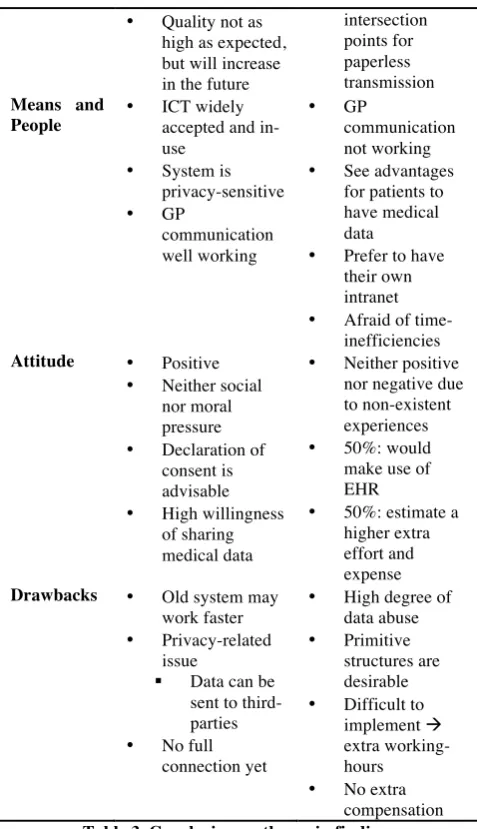
As discussed above, results will be analyzed and compared based on the PRIMA method, in order to receive relevant and fact-based results. A first overview of the underlying outcomes is provided in table, which will be further discussed throughout the following section.
Twente Region (The Netherlands)
Frankenberg (Germany)
Relevance • High desire for implementation
• Helps define diseases
• Early-warning systems
• Medical data must be in the correct order
• Realized relevance of EHR
• ICT is not commonly used
Information Quality/ Needs
• Increased amount of information
• Internet causes ‘non-sense’ information
• Medical data is rarely
transmitted via internet (1 of 14)
• Quality not as high as expected, but will increase in the future
intersection points for paperless transmission
Means and People
• ICT widely accepted and in-use
• System is privacy-sensitive
• GP
communication well working
• GP
communication not working
• See advantages for patients to have medical data
• Prefer to have their own intranet
• Afraid of time-inefficiencies
Attitude • Positive
• Neither social nor moral pressure
• Declaration of consent is advisable
• High willingness of sharing medical data
• Neither positive nor negative due to non-existent experiences
• 50%: would make use of EHR
• 50%: estimate a higher extra effort and expense
Drawbacks • Old system may work faster
• Privacy-related issue
§ Data can be sent to third-parties
• No full connection yet
• High degree of data abuse
• Primitive structures are desirable
• Difficult to implement à
extra working-hours
[image:7.595.49.288.69.484.2]• No extra compensation
Table 3. Conclusion on the main findings.
5.1 The Netherlands
5.1.1. Relevance
Both DGP1 and DGP2 have indicated a high desire to implement EHR in the Netherlands, combined with LSP, which is a National Switch Point for the exchange of information. According to DGP1, an EHR would definitely help to define the patient’s anamneses more efficiently and one could re-check the extent to which the treatment undertaken by a specific physician is in line with the previous documented medical diseases. Furthermore, according to DGP3, it is only applicable if the documented medical data is in the correct order and if it is the case, one could reduce the communication errors in the long-term. Apart from that, early-warning systems, which are individually implemented into the system, can have a large impact on the treatment process due to the fact that one can easily receive information about any primary diseases. Nevertheless, one should not only focus on the given Information Systems, but also on the fact that the face-to-face communication is still ‘very important’ for both the patient and the physician since one can observe for instance patients. According to DGP10, EHR makes a good contribution to the daily practice care; however, the system needs to become more stable in the future in order to easily realize updates.
5.1.2. Information Quality and Needs
Not all information that is written down in the system is useful for the treatment process. According to the majority of the interviewees (78%), the amount of information has increased since the implementation of EHR. However, due to the widespread use of the World Wide Web, there is according to DGP1 a lot of ‘non-sense’ that might lead to misunderstandings and different expectations. DGP3 has been working with the system in the past and is sure that the quality is not as high as expected, but it will increase in the future due to the steady reduction of mistakes since all information needs to be combined into the system first. On the contrary, DGP6 prefers the system only during an emergency case, which has not further been defined, since he does not need such a system for the daily routine. Especially for DGP9 it is inevitable to focus on the layout of the EHR, so that the main diagnosis will be presented at the top in order to reduce the search-time during a treatment process. Apart from that, he was the only one who has questioned the issue of having ‘too much information’ within the records. The information needs are completely satisfied for DGP2 since he receives at least 90% of the important reports via e-mail and the prescription will be sent automatically to the pharmacy so that on the one hand the patients will receive their medication on-time and on the other hand communication errors can be reduced steadily. According to DGP4, both the information quality and safety will be on a high level due to the opportunity of securing patients data through using the log-in function of DigiD as well as the UZI card.
5.1.3. Means and People
All interviewed GP’s are using at least a computer within their office in order to process their patient’s treatment into the health records, which automatically predicts a well-working Internet connection. Three out of ten stated that they are using iPads or will be using them in the near future. Nevertheless, especially DGP9 intimates that even though he is making use of the new tablets, he still does notes with pen and paper due to the fact that there is still not an appropriate app existent to work online with the desktop version. All respondents feel confident working with the system and have not used any manuals or training session due to the easy-to-follow instructions and self-explaining buttons or items (DGP3). Three out of the ten interviewed GP’s have raised concern regarding the privacy and whether the system can be hacked by an outside person. According to DGP6, the system is rather privacy-sensitive, which gives to the opportunity for outsider to hack the system, leading to major problems. Nevertheless, DGP3 is sure that further improvements will be taken concerning the security of system. According to DGP5, it was even much easier and faster to steal any paper-written record in the past compared to the current electronic records. Both DGP1 and DGP6 conclude that the communication between the GPs located in the Twente region is well working and efficient. However, on the contrary, the communication between specialists and GP’s, regardless of the location needs to be improved in order to achieve improved work processes during a commitment to a hospital. Furthermore, an improved relationship between specialist and GP would lead to a situation at which a GP can easily check to what extent the ‘decision made by me’ (DGP1) was successful.
5.1.4. Attitude
only two out of ten GPs feel to a certain extent either social or moral pressure to make use of the electronic version. Apart from that, many patients think that their data is not kept securely and that all their privacy-issues should not be implemented into the system. However, according to DGP9, the privacy argument is rather weak since if the patient has nothing to hide, then one cannot be afraid to share medical data. Another bottleneck is that patients first have to hand in a declaration of consent before GPs can have a look into the medical data and share this data with other caregivers in the future. Research has shown that there are at least 30% of the inhabitants living in the Twente region who have not given their permission until now (DGP5). DGP4 concludes the attitude section and determines that the willingness of sharing medical data will be much lower in Amsterdam compared to the Twente region since those patients are quickly willing to share medical data. However, at the end, he is sure that the ‘old system works faster’ since printing out and sending letters via post is much faster and less time-consuming compared to the EHR. Finally, for DGP 8 it is a pleasant way of working since he has been using ICT before and therefore it is rather ‘fun’ entering the data into the system.
5.1.5. Closing
Resuming, the Dutch physicians have rated the utility as well as availability of materials between 7-9 on a scale from 0 to 10 (0: negative; 10: positive). The majority of physicians have stated that there might be a privacy-related issue, however, the company who is running the system will guarantee the privacy. Nevertheless, one gets the impression that the system is not as implemented as one might think it is. Physicians would prefer a system, which is on the one hand not too cumbersome as well as concise and on the other hand full of informative data. Furthermore, physicians would like to keep the data internal, meaning that the documented data will not be sent to third-parties, such as health insurance providers, in order to safe medical records as sufficient as positive. Therefore the vision stays the same, namely to connect as many GPs as possible in the near future in order to increase the degree of uniformity and to achieve a steady reeducation of communication errors in the long-term perspective.
5.2 Germany
5.2.1. Relevance
As mentioned earlier, the current situation between both regions is quite different since within Frankenberg one finds an increased amount of GGP that are above the age of 50, followed by several physicians’ offices that have rare or no internet access at all and last but not least a non-existent communication between each other (2/14). That is why it was interesting to notice that all GGP make use of both telephone and the fax machines. At least twelve out of 14 are utilizing a scanner to digitalize medical data received from specialist. A curiosity is that only five of the interviewed GGPs are using a laptop or Internet forums and only one GGP keeps his iPad at hand while examining as well as documenting patients diseases. On the contrary, the use of smartphone is widely existent in this region and the research has shown that at least twelve out of 14 GGPs have realized the relevance of health records. Another evidence issue, which underlines the importance of the topic, is the situation that the GGP would like to: (1) increase the speed of information, (2) to connect their fax machine with their desktop PC, (3) Optimize the agreement on deadlines, (4) quicker discovery of possible contradictions, (5) to have recourse to previous (permanent-)diagnosis and (6) Optimize waiting room list and communication with staff. The in-depth relevance will be analyzed in-line with the PRIMA model in the next section.
5.2.2. Information Quality/ Needs
In order to analyze the Information quality and needs, the 14 GGP’s were asked to elaborate their information transformation, both from GP ⟷ GP and GP ⟷ Specialist. The majority is using the fax to inform their colleagues, regardless of whether they are GPs in the same town or a specialist located further away. Only one out of 14 has mentioned that he makes use of the Internet to transmit data. Interesting to notice is that care providers have been investigated this issue some years ago already, however, they have failed to implement a well-working system to reduce the transformation time as well as costs. Nowadays, there is no LSP, as it is implemented in the Twente region, and they have been searching for a point of intersection, but it is costly and therefore hard to realize. One GGP is even delivering medical data via the telephone in order to save working time since it is very cumbersome to first receive the letter, followed by the scan and sending it via the mail to the next doctor. The respondents agreed on that the information quality could be improved through the saving the following data: (1) Name of the patient, (2) Age/ Gender/ Ethnic background, (3) Family Doctor’s Name, (4) All documented medical data and (5) Date of the last treatment process. Apart from that, two GGP’s would like to know whether their patient is equipped with a living will and which work the patient occupies.
The next part of the interview dealt with the question to what extent the transmission of documented information can be improved in order to both save time and achieve a higher quality. The majority of the GGP’s felt that it is desirable to connect the switch points so that one gains a paperless transmission of data or to at least build-up a certain intranet to achieve an interaction via the internet. However, at this early stage of the interview, four out of the interviewed GGP’s have mentioned the word ‘data privacy’ the first time, which underlines the ambivalent opinion in regard to this important topic.
5.2.3. Means and People
In regard to this section, it was inevitable to focus on the patient and to what extent patients benefit from the implementation of the EHR. Surprisingly, all interviewed GGP’s see a big advantage for patients to have medical data that is saved within the system. Especially patients who need to go to an emergency physician’s office would receive a better treatment due to the fact that foreign diagnosis, medical data and medication are saved on the database. If anything, the GGP would prefer to have their own intranet so that there is no opportunity for specialist doctors to look into the system. One GGP has stated that it is highly irrelevant for an ophthalmologist to know that the patient suffers for example a borderline-schizophrenia. Nevertheless, going through the saved data can take more time for both the patient and doctor, which will lead to longer working times. This in turn would lead to an increase of salaries as the majority of GGP has mentioned it. Two out of 14 respondents have questioned the situation at which technical problems arise, leading to the fact that one needs to first document everything with a pen and paper, which then needs to be digitalized at the end. Therefore, it is highly advisable to first build-up a well-working system with easy-to-follow instructions so that possible drawbacks can be easily addressed. An important consideration for the GGPs is the costs for implementation since the doctors should not impose those.
5.2.4. Attitude
structure, (3) The steady decrease of the amount of GP’s automatically leading to extra work and (4) the administrative burden. Half of the respondents are willing to make use of an EHR, whereas the rest estimates a higher extra effort and expense in regard to the implementation due to the already existent workload. Therefore, it was difficult for the respondents to define the advantages and disadvantages due to the non-existent background. However, again half of the respondents were sure that an EHR could lead to an improved communication with the pharmacy since a double-check of certain medication and contradictions could take place. Nevertheless, according to GGP 4, one needs to take into account that GGPs are not allowed to send their patients to one specific pharmacy due to the sense of justice.
5.2.5. Closing
The last part of the interview has shown that GGP’s were a bit annoyed by the topic of EHR since it has been widely discussed in the previous ten years without any final implementations. GGPs would prefer to recognize the advantages first in more detail so that they do not get the feeling that they just implement medical data ‘for fun’, as it was mentioned by GGP7. If an implementation takes place, patients need to know the facts of the system by heart and they should define the amount of saved data. According to GGP9, it would be nice to implement a certain USB-stick within the health insurance card so that only the patient ‘caries around his/her medical data’. According to GGP5, the majority of the collected data by GP’s is rather subjective; therefore, he does not see the point of passing on or store this data. To recap, one can say that the majority of respondents see the big advantages of having saved medical data, regardless whether it is during an emergency case or not, in order to be better informed of possible contradictions and to gain a profound overview of the patients data. However, already half of the GGP’s face the problem of having a high amount of patients and the extra time for implementing data into the system is simply not available. The gained impression, especially at the end of each interview, has shown that the practical experiences are not existent within this region, which makes it hard for GGP’s to provide a final decision. If a well-working system that is less time-consuming, to a certain degree safe, easy to handle, reliable and leads to more efficient treatment process, the majority of the respondents would make use of EHR.
6. CONCLUSION
As a short reminder, the aim of this research has been to answer the question whether electronic health records can facilitate the general practitioners’ work and therefore improve patients’ treatment. Even if several benefits can be obtained throughout the use of EHR systems, the analysis of literature and interview data sets revealed several shortcomings:
First of all, (1) Privacy related issues have been often mentioned by literature and the GP’s in the Netherlands and Germany. The threat of hacking the system is present, and DGP’s even underlined that patient’s think that their data is not kept securely. Furthermore, privacy laws in both countries hamper the fast and easy implementation of EHR.
Thus, the general practitioners in Germany fear the (2) cost of implementation, which can be quite high and may bear uncertain financial benefits as indicated in the literature.
In the long run, literature further indicated that (3) time inefficiencies can exist due to an increased time for documentation and the possibility of information overloads. Especially the GGPs fear that they need longer working hours
when using EHR and that technical disturbance may occur. The Dutch GPs, on the other hand, all feel confident while working with the system and described a self-explaining and easy usage. After elaborating the mentioned negative effects of EHR, positive outcomes such as:
(1) Quality improvements have been highlighted by literature and the GP’s. The Dutch GP’s and the literature state that data can help GP’s to decide on the best treatment possible for their patients, enable practitioners to better explain urgent medical situations, to reduce the duplication of data, to install reminders and that patients can easily understand their medical history. German GPs are more restrained, but highlight the relevance of EHR and that it might especially be useful for people going to an emergency office or to know whether there is a living will.
Secondly, (2) communication can be enhanced, internally as well as externally of GP’s offices. DGP’s mention that it is still important to engage in face-to-face communication but underline that the communication between GP’s is well working and efficient through the system. In Germany, on the other hand, practitioner’s still use fax to inform their colleagues and some additionally scan important medical data. The GGP’s mentioned that it is desirable to connect switch points in order to enable a paperless transmission.
The results of the research thus indicate that the implementation of EHR systems can bear several advantages as well as disadvantages. Notwithstanding, it is important to point out that mostly the German practitioners believed that there are more problems and disadvantages attached to EHR compared to their Dutch colleagues. This personal attitude may be based on the fact, that the German practitioners are not used yet to work with ICT where everything works digitally. Therefore, it is also highly difficult and time-consuming to implement EHR in Germany, since many practitioners have not even connected their offices to the Internet. The Dutch practitioners ranked the system on a scale of 7-9 out of ten in regard of availability and utility of materials and mentioned that they can work more efficiently compared to the past time. In general, the research showed that EHR has a positive value in regard to the PRIMA-model analysis and should therefore be implemented within Germany. Concluding, EHR brings many advantages and adds value but still needs to be improved in regard to security issues and the possibility to filter data according to the needs of GP’s.
7. DISCUSSION
overall reduction of expenditures and Dutch GP’s mentioned that no additional trainings or workshops are needed to understand the program. Lastly, (3) time inefficiencies have been especially mentioned by German GP’s. When considering this argument, one needs to keep in mind that EHR systems are build to handle logistic-related issues more efficiently, and enable the user to find data more easily and faster. The research showed that at least twelve out of 14 GGP’s are using a scanner to digitalize data from specialists and one GGP even stated that he tries to deliver data via telephone in order to save time. Therefore, this argument can be mitigated, also since time should not play a role while considering the improvement of patient’s healthcare. The trends of the underlying research are quite different since in the Netherlands GP’s use online applications, whereas in Germany the physicians are still restrained and are not sure yet if online applications would facilitate their work. As mentioned before, the implementation of EHR in Germany may take quite some time and the advantages should be clearly pointed out for practitioners and patients. In this regard, it is also important for German GP’s to somewhat stay ahead in the technological age, especially in relation to medical improvements. It is of high importance to build-up cross-boarder relationships between for example Dutch and German practitioners, enabling a smooth and valuable sharing of knowledge.
7.1 Limitations
The literature review as well as qualitative study is subject to several limitations. First of all, this paper has been limited in time and scope due to a fixed timeframe. Furthermore, the literature review is based on secondary literature written in English, which may as well narrow down the lenses through which the topic has been regarded. The qualitative data section is restrained due to the fact that only about 4% of all GP’s in both regions have been interviewed, limiting the significance of the results. In regard to this, only primary care physicians and no GP assistants have been questioned and the GGP’s had an average age about 50. Since two different data sets have been used, the author also did not have any personal contact towards interviewees of the Dutch data and both sets have been conducted in two different languages.
7.2 Recommendation for future research
Further research is necessary to investigate whether the work of physicians can be facilitated by the implementation of EHR systems. First of all, the study should be extended on more areas within Germany and Netherlands and it would be interesting to test the implementation and further work with EHR throughout several real-life case studies. Since specialist doctors can also be called during emergencies, it is further attractive to involve them within the study and to see whether they would approve of EHR systems. Also, nursing staff, patients and pharmacies should be questioned in order to receive an overall picture of the situation. As there are several different variations of EHR and Information systems, it is also of importance to test which combination is most suitable for GP’s. Lastly, an important point is to evaluate the costs for running the system such as overtime cost and set-up in order to give physicians an incentive to integrate the system in the near future. Inventions need to be made in regard to saving GP’s time for the implementation of data into the system. Based on the many advantage of EHR systems that became visible throughout the study, I believe that it is highly important to further investigate this topic in the future.
8. ACKNOWLEDGMENTS
Foremost, I would like to express my sincere gratitude to my supervisor Dr. Ir. Ton Spil, Academic Staff, Industrial Engineering and Business Information Systems, University of Twente, for the continuous support of my Bachelor’s Degree and especially for his patience and immense knowledge throughout the thesis. His well-based guidance at all the time helped me to improve the thesis steadily. Furthermore I would like to thank the 14 German physicians that took part in the interviews since they were open for discussions and enabled a positive interaction. Last but not least, I appreciate the previous analysis of my fellow students of the University of Twente, which provided me with the opportunity to have a look into their interviews of Dutch physicians.
9. REFERENCES
Anderson, G.W. & Hussey, P.S. (2000). Population aging: acomparison among industrialized countries, Health Affairs, 19, no.3:191-203.
Ash, J. S., Stavri, P. Z., & Kuperman, G. J. (2003). A Consensus statement on considerations for a successful CPOE implementation. Journal of the
American Medical Informatics Association, 10(3),
229-234.
Berg, M. (2001) ‘Implementing information systems in health care organizations: myths and Challenges’, International Journal of Medical Informatics, Vol. 64, pp.143-156.
Blumenthal, D. & Tavenner, M. (2010). The “meaningful use” regulation for electronic health records. New England
Journal of Medicine, 363(6), 501-504.
Blobel, B. (2006). Advanced and secure architectural EHR approaches. International Journal of Medical
Informatics, 75(3), 185-190.
Butter, M., Rensma, A., van Boxsel, J., Kalisingh, S., Schoone, M., Leis, M., ... &Korhonen, I. (2008). Robotics for healthcare. Final report. Leiden: TNO, Quality of Life.
Canada's Health Informatics Association (COACH), authors What is eHealth? [2004 June 24]. http://www.ehealthconference.com/Default.asp?id=3 &.
Cherry, B., Carter, M., Owen, D. & Lockhart, C. (2008). Factors Affecting Electronic Health Record Adoption in Long-Term Care Facilities. Journal for healthcare quality, 30(2), 37-47.
Cvetkovich, G. (2013). Social trust and the management of risk. Routledge.
Dick, R.S., Steen, E.B. & Detmer, D.E. (1997) ‘The Computer Based Patient Record: An Essential Technology for Health Care’, Washington, D.C.: National Academy Press.
Delone, W. H. (2003). The DeLone and McLean model of information systems success: a ten-year update. Journal of management information systems, 19(4), 9-30.
Dickson, R Gary. “Welcome to the Brave New World of Electronic Health Records” (Paper, delivered at the Saskatchewan CBA Mid-Winter Conference, 4 February 2011)
Easting, M.S. (2002). Diffusion of e-commerce: an analysis of the adoption of four e-commerce activities. Telematics and Informatics 197, 251-267.
Emmrich, Julia (2014). ‘Immer mehr Patienten klagen über Behandlungsfehler der Ärzte.’ WAZ-Der Westen (06.05.2014). Retrieved on May 8th from:
http://www.derwesten.de/politik/immer-mehr- patienten-klagen-ueber-behandlungsfehler-der-aerzte-id9317387.html
Ekroos, N. & Jalonen, K. (2007). E-health and diabetes care. Journal of Telemedicine and Telecare, Vol.13, p.22-23.
European Commission (2010) Health-EU website, Retrieved May 1,2014, http://ec.europa.eu/health/index_en.htm Eysenbach,G. (2001). What is e-health? Journal of Medical
Internet Resources, 3(2),20.
Eysenbach,G., Anderson, J. & Rainer, M. (2003) The Impact of Cyber Healthcare on the Physicial Patient Relationship. Journal of Medical systems, Vol.27,1. Gagnon, M.P., Légaré, F., Labrecque, M., Frémont, P., Pluye,
P., Car, J., Pagliari, C., Desmartis, M., Turcot, L. & Gravel, K. (2009). Interventions for promoting information and communication technologies adoption in healthcare professionals. Cochrane Database of Systematic Reviews 2009, Vol.1. Green, D. T., & Pearson, J. M. (2011). Integrating website
usability with the electronic commerce acceptance model. Behaviour& Information Technology Vol. 30, No. 2, 181–199.
Griener, G. (2005). Electronic health records as a threat to privacy. Health Law Rev, 14, 14-7.
Gund, A., Lindecrantz, K., Schaufelberger, M., Patel, H., & Sjöqvist, B. A. (2012). Attitudes among healthcare professionals towards ICT and home follow-up in chronic heart failure care. BMC medical informatics
and decision making, 12(1), 138.
Iakovidis, I. (1998). Towards personal health record: current situation, obstacles and trends in implementation of electronic healthcare record in Europe. International
journal of medical informatics, 52(1), 105-115.
Jacques, L. B. (2010). Electronic health records and respect for patient privacy: A prescription for compatibility.
Vand. J. Ent. & Tech. L., 13, 441.
Juran, J. M. (1999). Quality and Income. McGraw-Hill. Kalra, D. (2006). Electronic health record standards. Yearb Med
Inform, 136-144.
Kalra, D., & Ingram, D. (2006). Electronic health records. In
Information technology solutions forhealthcare (pp.
135-181). Springer London.
Ludwick, D. A., & Doucette, J. (2009). Adopting electronic medical records in primary care: lessons learned from health information systems implementation experience in seven countries. International journal of
medical informatics, 78(1), 22-31.
Makoul, G., Curry, R. H., & Tang, P. C. (2001). The use of electronic medical records communication patterns in outpatient encounters. Journal of the American
Medical Informatics Association, 8(6), 610-615.
McDonald, C. J. (1997).The barriers to electronic medical record systems and how to overcome them. Journal of
the American Medical Informatics Association, 4(3),
213-221.
MedlinePlus, Medical Dictionary (2005). Retrieved on May 3,
2014: from:
http://www.nlm.nih.gov/medlineplus/mplusdictionary.
Miller, R. H., & Sim, I. (2004). Physicians’ use of electronic Medical records: barriers and solutions. Healthaffairs,
23(2), 116-126.
Mongan, J.J., Ferris, T.G. & Lee, T.H. (2008). Options for Slowing the Growth of Health Care Costs. The New
England Journal of Medicine, Vol. 358, No.14, p.p.
1509-1516.
Oh, H., Rizo, C., Enkin, M., & Jadad, A. (2005). What is eHealth (3): a systematic review of published definitions. Journal of medical Internet research, 7(1).
Ozmon, J.(2007) ‘Consumerism: forcing medical practices toward patient-centered care’, The Journal of medical practice management, Vol. 23, No. 1, pp. 44-46 .
Poissant, L., Pereira, J., Tamblyn, R., & Kawasumi, Y. (2005). The impact of electronic health records on time efficiency of physicians and nurses: a systematic review. Journal of the American Medical Informatics
Association, 12(5), 505-516.
Pringle, M. (2001). Ensuring patient safety. The British Journal
of General Practice, 51(472), 876.
Rivkin-Haas, E. (2011). Electronic Medical Records and the Challenge to Privacy: How the United States and Canada Are Responding. Hastings Int'l & Comp. L. Rev., 34, 177.
Rogers, E. M. (2010). Diffusion of innovations. Simon and Schuster.
Rose, D., & Blume, S. (2003). Citizens as users of technology: An exploratory study of vaccines and vaccination. In N. Oudshoorn & T. Pinch (Eds.), How users matter (Chapter 5, pp. 103–131). Cambridge, Massachusetts: The MIT Press.
Scott, J. (2009). Impact of the E-Health Act, The Advocate, 67. Smith, K., Smith, V., Krugman, M., & Oman, K. (2005).
Evaluating the impact of computerized clinical documentation. Computers Informatics Nursing,
23(3), 132-138.
Spil, T. A., Katsma, C. P., Stegwee, R. A., Albers, E. F., Freriks, A., & Ligt, E. (2010, January). Value, participation and quality of electronic health records in the Netherlands. In System Sciences (HICSS), 2010
43rd Hawaii International Conference on (pp. 1-10).
IEEE.
Spil, T.A.M, Schuring, R.W. & Michel-Verkerke, M.B. (2004) ’Electronic prescription system: do the professionals use it?’ ,International Journal of Healthcare Technology and Management, Vol.6, pp.32-55. Thom, D. H., Kravitz, R. L., Bell, R. A., Krupat, E., & Azari, R.
(2002). Patient trust in the physician: relationship to patient requests. Family practice, 19(5), 476-483. Walsh, S.H. (2004). ‘The clinician’s perspective on electronic
health records and how they can affect patient care’, British Medical Journal, Vol. 328, pp.1184-7.
Venkatesh, V., Morris, M. G., Davis, G. B., & Davis, F. D. (2003). User acceptance of information technology: Toward a unified view. MIS quarterly, 27(3).
Zeuthaml, V., Berry, L., & Parasuraman, A. (1996). The behavior consequences of service quality.Journal of Marketing 60, 31-46.