ISSN Online: 2161-7589 ISSN Print: 2161-7570
DOI: 10.4236/ojg.2017.712118 Dec. 11, 2017 1767 Open Journal of Geology
Sorbent Mineralogy in the Most Basin and Their
Utilization for Reclamation Works
Michal Řehoř
1, Petr Vráblík
2, Jaroslava Vráblíková
2, Lukáš Žižka
1 1Research Institute for Brown Coal in Most, Most, Czech Republic2Department of Natural Sciences, Faculty of Environment, J. E. Purkyně University in Ústí nad Labem, Ústí nad Labem, Czech Republic
Abstract
The contribution is focused on the relation between sorptive efficiency, min-eral structure, and reclamation extraction of clay sorbents originating from the Most Basin. Clay sorbents are an important accessory raw material that occurs on several localities in the North Bohemian Brown Coal Basin, which are briefly described in the first part of the paper. The results from clay sor-bents were obtained by mineralogy survey based on a diffract analysis with a D 5000 Siemens X-ray diffractometer. Localities, where zeolites and mont-morillonites were found, are the main subjects of the research. The results show that parameters of clay sorbents mined in these localities are suitable for reclamation works. A successful reclamation with the use of bentonites is demonstrated on Strimice dump.
Keywords
Sorption, Bentonite, Geology, Restoration
1. Introduction
The Most Basin (formerly North Bohemian Brown Coal Basin) represents the largest supply of brown coal in the Czech Republic. The surface brown coal quarries caused considerable damage to the surrounding landscape. Rapid adap-tation and step by step incorporation of these anthropogenic formations into territory’s ecosystem is in the interest of both the region’s inhabitants and the mining companies. Successful reclamation works require fertilization of sterile and phyto-toxic sites. Natural clayey sorbents are possible solution in this case. Clays are often used in agricultural applications, in engineering and construction applications, in environmental remediations, in geology and in many other
How to cite this paper: Řehoř, M., Vráblík, P., Vráblíková, J. and Žižka, L. (2017) Sor-bent Mineralogy in the Most Basin and Their Utilization for Reclamation Works. Open Journal of Geology, 7, 1767-1773.
https://doi.org/10.4236/ojg.2017.712118
Received: November 11, 2017 Accepted: December 8, 2017 Published: December 11, 2017
Copyright © 2017 by authors and Scientific Research Publishing Inc. This work is licensed under the Creative Commons Attribution International License (CC BY 4.0).
http://creativecommons.org/licenses/by/4.0/
DOI: 10.4236/ojg.2017.712118 1768 Open Journal of Geology miscellaneous applications [1]. Bentonite deposits are significant source of those sorbents. Bentonites have the potential to be used as a low cost sorbent since it is naturally available and has high surface area [2]. Bentonite is a naturally occur-ring clay with very high expansion capability (swelling capacity), high ion ex-change capacity and very low permeability to water (hydraulic conductivity) [3]. The contribution describes main mined deposits at Cerný vrch by Branany and Rokle u Kadane. High-quality commercial bentonites normally contain over 80% of montmorillonite, which is expected to give various bentonite products similar sealing properties. However, the other minerals in bentonite may vary substantially within, and especially between, different quarries [4]. The article also deals with already performed bentonite application using bentonite from the Cerný vrch locality.
2. Materials and Methods
DOI: 10.4236/ojg.2017.712118 1769 Open Journal of Geology claystone of the Libous mine and perhaps—with many limitations—the brown claystone of the Libkovice strata at the Bílina mine can be used in overburden layers as claystone sorbents. A more favorable situation is in the horizon of bed-rock (vulcano-dettriric strata), where more deposits of bentonite with excellent sorption qualities can be found (especially Cerný vrch and Rokle). The petro-graphic and mineralogic pattern of stratipetro-graphic horizons lying in the way of the advancement of specific open pit mines in the North Bohemian Basin is dealt with in the framework of the grant task. The results from clay sorbents were ob-tained by mineralogy survey based on a diffract analysis with a D 5000 Siemens X-ray diffractometer. This device can be used for identification and characterization of powders, thin films, single crystals, polycrystalline and amorphous materials, for phase identification/quantification, crystallinity determination, structure determination and refinement, and for measurements under non-ambient conditions.
3. Results and Discussion
3.1. Basic Characteristics of the Potential Sorbents of the
Most Basin
A potential sorbent usable for reclamation works in the region of the North Bo-hemian Basin is the caolinitic-illitic claystone of the overburden Libkovice strata of the Bílina mine (limited utility), the montmorillonitic overburden claystone of the Libous mine and the bentonites of the Cerný vrch and Rokle localities. Just out of intrest, numerous deposits of zeolites in nearby Ceské Stredohorí Moun-tains can also be mentioned. These have great mineralogic significance, but none of them has the character of a minable locality according to contemporary eco-nomic criteria. The localities are usually active quarries, where appropriate vul-canite is the utility mineral and zeolite mining is economically impossible.
3.1.1. Overlying Kaolinite-Illite Claystone of the Libkovice Strata of the Bílina Mine
They form the upper horizon of the tertiary level in the Bílina mine. This rock type consists mainly of clays, and claystone to dusty claystone of brown to grey-brown colour. It is fine-grained, and its mineralogic complexion is domi-nated by quartz, caolinite, and illite. They have very good chemic-pedologic qualities. Their sorption abilities can be marked as medium. They can be imme-diately used for forest reclamation; a systematic areal compost application is recommended.
3.1.2. Overlying Montmorillonite Claystone of the Libous Mine
DOI: 10.4236/ojg.2017.712118 1770 Open Journal of Geology abilities can be described as excellent. They can be immediately used for forest reclamation. A compost or industry fertiliser application to single plants is rec-ommended.
3.1.3. Bentonites
The only significant deposits of bentonite in the North Bohemian Basin are concentrated in the vicinity of Branany village (Cerný vrch hill locality) and in Kadan town (Rokle locality). Bentonites can be defined as montmorillonite clay-stone. It is fine-grained, with its mineralogic complexion dominated by mont-morillonite; caolinite and quartz are normal ingredients, with some traces of il-lite, siderite, and feldspar. They have excellent chemical and pedological qualities and very high sorption ability, and their reclamation utility is excellent. Applica-tion in large reclamaApplica-tion acApplica-tions is limited by its economic demands.
3.2. Characteristics of the Main Localities of the Bentonites in the
Most Basin
3.2.1. Cerny vrch Bentonite Locality
The Cerny vrch bentonite locality can be found about 1 km from classic recently mined Branany deposit. Together with Rokle near Kadan town, they are the most significant deposits in the Most Basin today. The locality is bound to the vulcanodetritic strata of the coal seam subjacent bed. It consists mainly of clayed tuffs; a marginal eroded vulcanic rock was the mother rock. High quality blue to blue-green betonite occurs in the deposit (especially in its base). Most of the de-posit consists of yellow-green to yellow-brown bentonite. The raw material can be used as bleaching clay (the best quality bentonite) and foundry purposes; re-cently it has also been used in the production of cat litter. The Cerný vrch de-posit verges into the Strimice dede-posit, and the mined locality is usually referred to as Cerný vrch by the owner (Keramost, j.s.c.). The mined bentonites consist of montmorillonite, with the main ingredients being caolinite, siderite, illite. Quartz can also occur in a lower rate. The situation in the locality is shown in
Figure 1.
The second most important bentonite deposit, in Rokle is about 3 km south at Kadan town near the slopes of the Doupov Mountains (Figure 2).
DOI: 10.4236/ojg.2017.712118 1771 Open Journal of Geology
[image:5.595.261.485.275.445.2]Figure 1. Bentonite doposit No.1 in Rokle [8].
Figure 2. Bentonite deposit No. 2 in Rokle [8].
Table 1. Properties of bentonites samples [9].
locality of bentonite
sample N (%) Cox (%) CaCO
3
(%) pH/H2O
Receivable
nutrients (mg∙kg−1) Capacity mmol (%) Absorbtion
P K Mg S T V Cerny vrch 0.05 0.53 8.86 8.31 2 321 998 38 38 100
Rokle 0.05 1.07 5.65 7.99 1 288 876 24 24 100
3.2.2. Strimice Dump Reclamation—An Example of the Application of Bentonite
DOI: 10.4236/ojg.2017.712118 1772 Open Journal of Geology
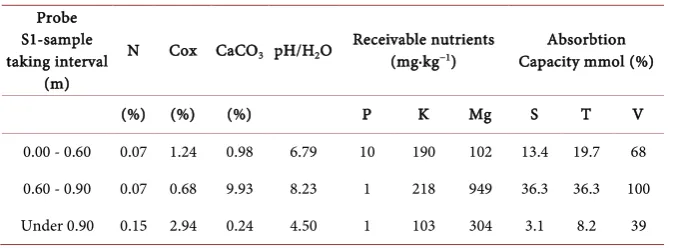
Table 2. Properties of the soil profile reclaimed with bentonites. Probe
S1-sample taking interval
(m)
N Cox CaCO3 pH/H2O Receivable nutrients (mg∙kg−1) Capacity mmol (%) Absorbtion
(%) (%) (%) P K Mg S T V
0.00 - 0.60 0.07 1.24 0.98 6.79 10 190 102 13.4 19.7 68 0.60 - 0.90 0.07 0.68 9.93 8.23 1 218 949 36.3 36.3 100 Under 0.90 0.15 2.94 0.24 4.50 1 103 304 3.1 8.2 39
of clay and bentonite and the original material in the dump. Mineralogy of up-per layer is defined by quartz, kaolinite, illite, and montmorillonite with a mix-ture of spars and muscovite. The chemical status of the upper relatively favour-able with neutral soil reaction, medium content of humus, low content of nitro-gen and phosphorus, and medium to high content of magnesium and potassium. The soil is quite coarse, and sandy to loamy, therefore it is suitable for reclama-tion. The middle layer contains larger amount of montmorillonite. The soil reac-tion is lightly alkaline with increasing calcite content. The nitrogen and humus content is low. Middle layer is a bit higher on nutrients than the upper layer. This soil is not suitable for reclamation, because it contains yellow clay with pieces of coal. The results shown in Table 2 confirm successful reclamation of the Střimice dump thanks to the chosen method.
4. Conclusion
The potential deposits of claystone sorbents in the North Bohemian Basin will be found and evaluated in the frame of the recently commenced research works. These rocks would otherwise end up in mine dumps, but nevertheless they may sometimes be raw materials with exceptional qualities. A suitable application of claystone sorbents will make the technical restoration in the North Bohemian Basin more effective and it can also be used in the sanitation of the old ecologic burdens in the Czech Republic (especially in the cases of involving contaminated mine waters). The kaolinite-illite claystone of the Libkovice strata, motnorillonite claystones and bentonites were tipped as potential claystone sorbents in the first stage of the mapping works. The occurrence of these rocks, their brief character-istics, and their application possibilities in the reclamation are described in the article. The experiences from the single large application of claystone sorbent in the Strimice dump so far are also set out here.
Acknowledgements
DOI: 10.4236/ojg.2017.712118 1773 Open Journal of Geology
References
[1] Murray, H.H. (2007) Applied Clay Mineralogy. Indiana University, Indiana, Elsevi-er, 179 p.
[2] Hermosin, M., Martin, P. and Cornej, J. (1993) Adsorption Mechanisms of Monobutyltin in Clay Minerals. Environmental Science & Technology, 27, 2606-2611. https://doi.org/10.1021/es00048a044
[3] Egloffstein, T.A. (2001) Natural Bentonites—Influence of the Ion Exchange and Partial Desiccation on Permeability and Self-Healing Capacity of Bentonites Used in GCLs. Geotextiles and Geomembranes, 19, 427-444.
https://doi.org/10.1016/S0266-1144(01)00017-6
[4] Karnland, O., Olsson, S. and Nilsson, U. (2006) Mineralogy and Sealing Properties of Various Bentonites and Smectite-Rich Clay Materials. Technical Report TR-06-30. Clay Technology AB, Stockholm, 112 p.
[5] Cermák, P. (1998) Methodical Bases for Evaluation of the Anti-Erosion Resistance of Dump Soil with Vegetation or Other Preparation in SHP. Research Report, In-stitute of Soil Improvement and Soil Protection, Prague, 9 p.
[6] Fisera, E. (1990) Evaluation of Soil in the North Bohemian Basin in Terms of Suita-bility. Research Report, Mining Projects of Teplice, 15 p.
[7] Hrasko, T. and Bedrna, J. (1988) Applied Soil Science. Nature, 1. Edition, Bratislava, 474 p.
[8] Řehoř, M. (2006) Author’s Own Photo Documentation.Photo Archive of Research Institute for Brown Coal in Most.
[9] Řehoř, M., et al. (2002) Use of Accessory Material Acquired in Opencast Mining of Brown Coal Deposits for Reclamation of These Sites. Abstract, Mining University in Ostrava.
![Figure 1. Bentonite doposit No.1 in Rokle [8].](https://thumb-us.123doks.com/thumbv2/123dok_us/41819.504140/5.595.261.485.70.238/figure-bentonite-doposit-no-in-rokle.webp)