CONCRETE CYLINDRICAL SHELL ROOFS PRESTRESSED WITHIN THE SHELL SURFACE
by A.G. Park
'"
Supervised by J.C. Scrivener
Thes presented by A.G. Park for the degree Doctor of Philosophy
CIVIL ENGINEERING
JUNE 1974
Department of Civil Engineering University of
Christchurch New Zealand
p.6 p.9 p.lO p.48 p.92 p.92 p.102 p.103 p.123 p.124 p.127 p.129 p.145
Fig. 2.1(c): Fig. 2.2: Line 9: Line 19: Line 14: Line 16:
Table of Cable replace and replace Table of Cable
replace Fig. 5.17:
Line 19:
Line 23: Line 3: Line 6:
replace 11m 1 with "m and "m with "m '
12 12 1
replace "n
l - 8.3%" with "n12 -8.3%" replace "sin(mrjz)" with II
(ll1Tj2) II
replace II
.35dll
with 1/
.35djC l " replace liE " with liE 11
.... D s replace liE
"
with liE Iis D
Data:
Cable Force 1 11410 lb" with "2160 lbll
Cable Force 3 "2160 Ib" with "410 Ib" Data:
Anchorage Force 3 "2160 Ibn with "0 Ibn replace "+ outwardsll
with 11- outwards"
and
replace" inwards" with "+ inwards" The crack referred to is not shown on Fig 5.l4(b). Referring to Fig. 5.14(b) the crack extends one sixth of the arc distance into the shell from the bottom left hand corner of the extrados (as drawn) and from top hand corner of the intrados.
replace "3rd" with "1st"
i
ABSTRACT
Cylindrical shells, constructed of precast concrete
elements prestressed together by means of cables within the
curved surface, are shown to have satisfactory and predictable
behaviour under static load. By careful choice of prestressing
layout, cracking can be delayed until a considerable surface
load has been applied. An existing elastic analysis method
for effects of prestress, based on the D.K.J:. equation, is
adapted to improve its accuracy and efficiency. A method is
given for calculating the effect of the stiffness of the
traverse on the distribution of anchorage force to the shell.
This can be particularly important when the anchorage is
placed close to the shell edge.
Circular cylindrical shell roof models without edge
beams and prestressed within the curved surface with both
straight and draped cables were tested to failure. Four of
the five shells were constructed from precast elements. Strain
and deflection measurements were obtained for all shells and
confirmed the reliability of the analysis method.
A flexural beam type ultimate load analysis is devised
which accurately predicts the ultimate loads of a range of
shells including the model shells tested. This analysis is
developed into a design technique.
Some approximate methods are developed for the working
load analysis of cylindrical shells prestressed within the
ACKNOWLEDGEMENTS
I wish to make grateful acknowledgement for help
received during the course of this project and extend my
thanks to the following people.
Professor H.J. Hopkins, Head of the Civil Engineering
Department, under whose overall guidance this study was made~
Dr. J.C. Scrivener, supervisor for the study, for his
encouragement and constructive guidance throughout this project,
and for his many helpful suggestions during the preparation of
this thesis;
The Technical Staff of 1he Civil Engineering Department
for their assistance in the ~xperimenta1 programme, in
particular Messrs. J.S. Sheard and J.G.C. Van Dyk.
I wish to gratefully acknowledge financial aid from
the New Zealand Portland Cement Association in the form of
the 1970 N.Z.P.C.A. Scho1arshipi and to the University Grants
Committee for experimental equipment and materials under
Research Grant 68/271.
Finally, I wish to thank my wife, Diane, for her const~nt
TABLE OF CONTENTS
Abstract
Acknowledgements
Table of Contents
List of Figures
List of Tables
Notation
1.
INTRODUCTION AND OBJECTIVES
1.1 Introduction
1.2 Historical Background
1.3 Objects of This Research
2.
ELASTIC ANALYSIS
2.1 Range of Applicability of D.K.J. Equation
2.2 Surface Loading
2.2.1 Dead load
2.2.2 Radial load
2.3 Prestressing in Shell Surface
2.3.1 Anchorage force - 1st method
2.3.2 Anchorage force - 2nd method
2.3.3 Line loads - 1st method
2.3.4 Line loads - 2nd method
2.3.5 Convergence of generator line load
technique
2.3.6 Convergence of anchorage loads
2.3.7 Convergence of line loads
2;3.8 Line loads due to a parabolic cable
in a circular curve
2.4 Edge Beams
2.5 Effect of Traverse on the Distribution of
Anchorage Forces
Page
i
ii
iii
viii
xi
xii
1 1
2
3
5 7 8
10
10
10.
11
1112
12
14
18
19
21
26
2.5.1 Assumptions 2.5.2 Theory
2.5.3 Determination of
e
2.5.4 Summary of method 2.5.5 Simplification2.5.6 Effect of change in
e
2.5.7 Comparison with experiment 3. ULTIMATE LOAD BEHAVIOUR3.1 Beam Type Failure 3.1.1 Assumptions
3.1.2 Flexural failure modes
3.1.3 Analysis of "under-reinforced II shell
3.1.4 Accurate determination of f
su
3.1.5 Limitation of maximum steel content to prevent brittle fracture 3.1.6 Limitation of minimum steel content to
prevent steel fracture 3.1.7 Effects of non-prestress steel
3~1.8 Discussion
3.2 Yield Line Mechanism 3.3 Shear Failure
3.4 Buckling
4. DESIGN, CONSTRUCTION AND TESTING OF MODEL SHELLS 4.1 Choice of Model Dimensions
4.2 Design Loading and Stresses 4.3 Choice of Shell Element 4 • 4 Formwork
4.4.1 Shells 1, 2 and 3 4.4.2 Shells 4 and 5 4.5 Reinforcing Steel
4.5.1 1st Shell
4.5.2 Other shell meshes
4.5.3 Traverse meshes 4.6 Prestressing Steel
4.7 Concrete Mix and Casting 4.7.1 Concrete Mix
4.7.2 Casting
4.7.3 Curing and stripping 4.7.4 Variation of thickness 4.7.5 Test specimens
4.8 Prestressing System
4.8.1 Solid bearing block
4.8.2 Adjustable bearing block 4.8.3 Load cells
4.8.4 Jack
4.8.5 Anchorages
4.9 Joining, Prestressing and Grouting 4.9.1 Joining
4.9.2 Prestressing 4.9.3 Grouting 4.10 Strain Measurement
4.10.1 Strain gauges 4.10.2 Strain recording 4.11 Deflection Measurement 4.12 Reaction Frame
4.13 Loading Technique 4.14 Testing Procedure
4.15 Evaluation of Young's M.odulus 4.16 Analysis of Strain Data
'"
4.16.1 Prestressing 4.16.2 Surface loading
4.16.3 Symmetry and reliability 4.17 Analysis of Deflection Data
4.17.1 Prestressing 4.17.2 Surface loading
4.17.3 Symmetry and reliability
5. AND THEORETICAL RESULTS
5.1 Elastic Behaviour 5.1.1 Prestressing 5.1.2 Surface loading 5.2 Post Elastic Behaviour
5.2.1 5.2.2 5.2.3 5.2.4 5.2.5 5.2.6 5.2.7 5.2.8
Change in neutral axis position Cracking patterns
Recoverability from overloads Deflections
I
Experimental failure mechanisms o
Comparisons between $k = 30 shells Comparisons between 8'-0" shells
Comparison of shells with and without edge beams
5.3 Ultimate Load Behaviour 5.3.1 1st shell
5.3.2 Shells 2 and 3 5.3.3 4th shell
5.3.4 5th shell
6. APPROXIMATE METHODS FOR THE ELASTIC DESIGN OF PRESTRESSED CYLINDRICAL SHELLS
6.1 Dead and Live Loads 6.2 Anchorage Load
6.2.1 Nl at midspan 6.2.2 Nl near traverse
6.2.3 M2 due to anchorage load 6.3 Draped Cable Loads
6.3.1 Nl due to cable drape 6.3.2 M? due to cable drape
""
6.4 Discussion
vii
7. CONCLUSIONS 161
7.1 Model Tests 161
7.2 Elastic Behaviour 162
7.2.1 Prestressing 162
7.2.2 Surface loading 163
7.2.3 Simplification 164
7.2.4 General 164
7.3 Post Elastic Behaviour 165
7.4 Ultimate Load Behaviour 166
7.5 Major Cpnclusions 167
REFERENCES 168
APPENDIX A. "D.K.J." COMPUTER PROGRAM Al
LIST OF FIGURES
Page
2.1
positive shell axes, displacements, actions
6
and surface loads
2.2
Accuracy of D.K.J. equation
9
2.3
Effect of repeated application of sigma factor
9
2.4
Effect of Fejer arithmetic mean and
convergence factor
17
2.5
Comparison of triangular and rectangular
pulse expansions
17
2.6
Prestress force distribution using Rish's
method
20
2.7
Comparison of line load expansions
20
2.8
Curvilinear shell coordinate system
20
2.9
Cartesian shell coordinate system
20
2.10 Forces acting on an elemental length of cable
24
2.11
positive edge beam actions and displacements
24
2.12 Distribution of actions for apoint load on a
semi-infinite beam
30
2.13 Variation of
.~and
~with
Sx
30
2.14 Comparison of experimental and theoretical Nl
distributions near traverse
32
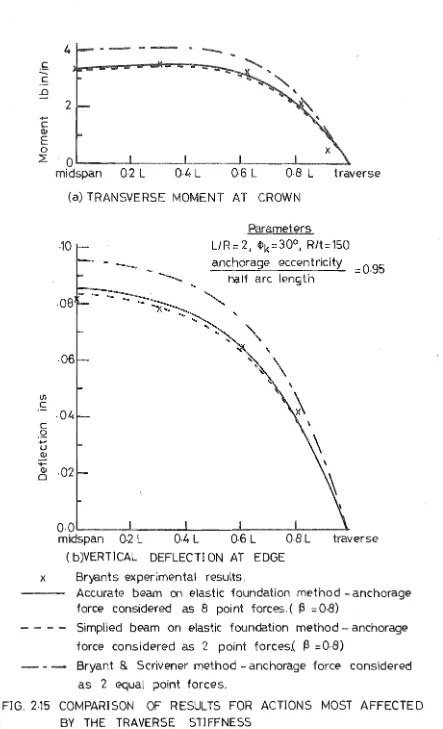
2.15 Comparison of results for actions most affected
by the traverse stiffness
36
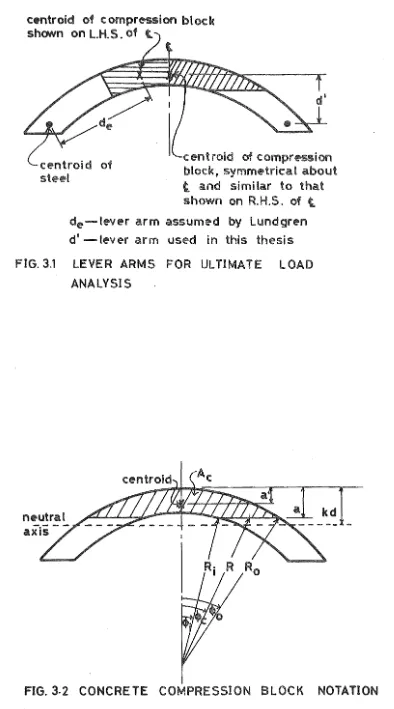
3.1
Lever arms for ultimate load analysis
40
I
3.2
Concrete compression block notation
40
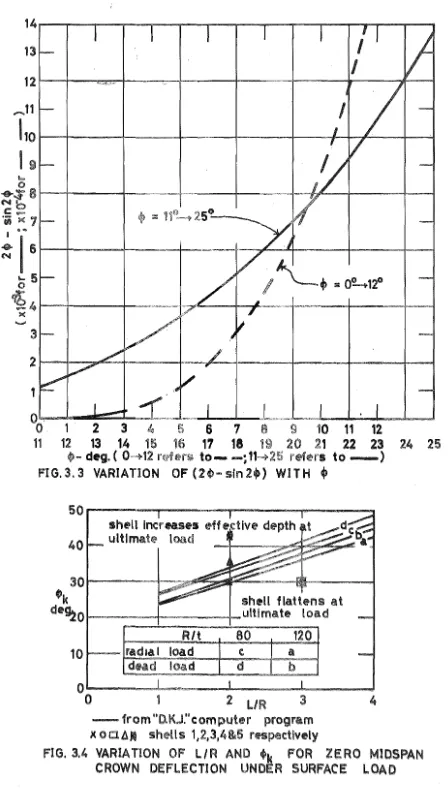
3.3
Variation of
(2~- sin 2
~LJwith
~45
3.4
Variation of L/R and
~k
for zero midspan crown
deflection under surface load
45
4.1
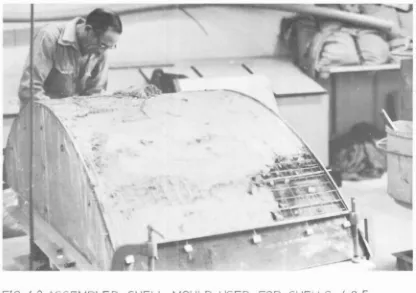
Assembled shell mould used for shells 1, 2 and
3
65
4.2
Assembled shell mould used for shells 4 and 5
65
4.3
1st shell reinforcing mesh
68
4.4
Typical shell cross-section
68
4.6 4.7 4.8 4.9 4.10 5.1 5.7 5.8
Prestressing system, 2 tor. load cell, and roller support
4th shell prior to testing showing data logger and strain gauge layout
Reaction frame used for shells 1, 2 and Reaction frame used for shells 4 and 5 Loading sequence for shells
3
- Prestressing experimental and theoretical actions and displacements
- Surface loading experimental and theoretical
l.X 75 75 88 88 91
99 -100
5.12 actions and displacements 106-111
5.13
5.14
Midspan variation of longitudinal strain with depth below crown
Crack patterns of failed shells
116 118-119 5.15 Typical surface load versus deflection curve
5.16 Radial deflection across transverse centr~ line 5.17 Horizontal deflections
5.18 Failed 5th shell
5.19 Comparison of deflections for shells with and without edge beams
5.20 Comparison of theoretical moment resistance and experimental failure moment
5.21 Failure mechanism of 5th shell in centre segment 6.1 Accuracy of beam theory results
6.2 Nl at midspan due to unit dead load
121 122 123 123 128 131 135 139 140 6.3 - Midspan Nl due to anchorage load
6.5 142-143
6.6 6.7
6.8 6.9
Variation of midspan Nl with change in R/t Va.riation of M at· crown for change in anchorage eccentricity
M2 ratio envelope
Variation of crown M2 ~t midspan for change in anchorage eccentricity and L/R ratio
6.10 Midspan M2 ratio envelopes
6.11 L
146
147 147 151 152 Variation of crown M2 at 78 from traverse for change in anchorage eccentricity and L/R ratio 153 6.12 M2 ratio envelopes at L/8 from traverse 154 6.13 Variation in M2 distribution for change in R/t 156 6.14 Comparison of results from "D.K.J." program and
A.l comparison of "D.K.J." computer program with results given by Billington
A.2 Comparison of "D.K.J." computer program with results given by Gibson
B.l Load-strain curve for prestressing steel B.2 Load-strain curve for cold drawn wire B.3 Load-strain curve for spot welded wire
results
A2 results
4.1
4.2
4.3
4.4
5.1
6.1
6.2
B.l
B.2
B.3
B.4
B.5
LIST OF TABLES
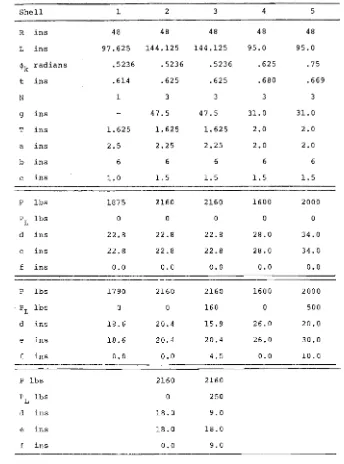
Dimensions of shells tested
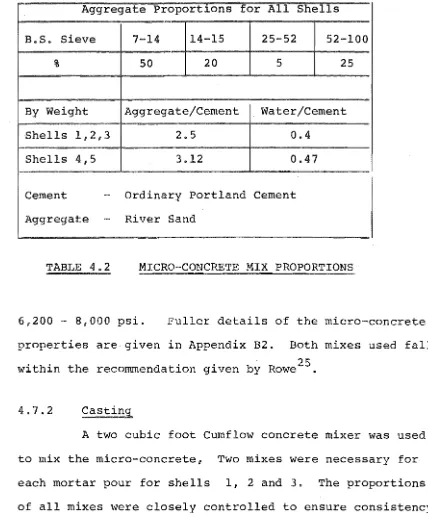
Micro-concrete mix proportions
Typical shell thickness measurements
Typical repeatability of strain measurements
Data used in calculating the theoretical moment resistance of the shells
Influence of traverse on maximum Nl values
Variation of maximum M2 values along shell
due to anchorage
Mortar mix code
Mortar compression tests on
4"
x 2" cylindersYoung's modulus and Poisson's ratio values from strain gauged 4" x 2" cylinders
Tensile tests on 4" x 2" cylinders
Beam flexure test results
xi
60
70
72
93
129
144
149
B6
B7
B8
B8
NOTATION
Each notation is defined where i t first appears in the text. For convenience of reference the more important are listed below:
a constant defining parabola a depth of compression block
a' depth to centroid of compression block
nth Fourier coefficient in the x direction a . nth Fourier coefficient for the ith strip
n~
am mthFourier coefficient in the
y
direction A,B,C,Db b
c
c
c'
c
d
d
d
d'
e
constants of integration for beam on elastic foundation theory i
area of concrete in compression prestressed steel area
non prestressed steel area
concrete area in compression required to balance tendon force T
t breadth of edge beam
effective width of traverse
distance 0f a point force from the end of a semi-infinite beam
parameter describing parabolic cable
coefficient for rectangular stress block depth concrete compressive force
I
anchorage eccentricity as an arc distance from the crown
depth to centroid of prestressing steel from the top of the crown
thickness of traverse vertical lever arm slanted lever arm
f
fc
f I
C
f' S
concrete yield strain
steel strain due to surface loading at ultimate moment
steel strain due to prestressing
steel strain at ultimate moment
nominal steel yield strain
Young's modulus
drape of prestressing cable as an arc length
allowable average concrete compressive stress
concrete cylinder strength
ultimate prestress steel stress
steel stress at ultimate moment
nominal steel yield stress
concrete tensile strength
line loads/unit length in curvilinear coordinates
xiii
F F' F'
x' y' z line loads/unit length in Cartesian coordinates
g parameter describing parabolic cabl~
gi(x) equation of ith strip
h parameter describing parabolic cable
I moment of inertia of shell cross-section
I
z moment of inertia of traverse
k reaction/unit length, for unit deflection in
beam on elastic foundation theory
k positive integer
kd neutral axis depth from top of the crown
L shell span
m positive integer
M general expression for a moment
m
l longitudinal moment/unit length
m
12 twisting moment/unit length
m
M
o
M'
o
Mil o
n
N
Q
r
R R.
].
R
o
t
t
T
corrective moment, which with point force Q is applied to the end of a semi-infinite beam °to remove redundant forces which occur when i t is "cut" from an infinite beam
redundant moment on the end of a semi-infinite beam, when i t is "cut" from an infinite beam
moment due to corrective actions :t.10
ultimate moment positive integer principal normal
longitudinal normal force/unit length shear force/unit length
transverse force/unit length prestressing force
prestressing anchorage force
dimensionless constant used by Boland
and Q o
point force of equal magnitude to redundant shear force Vi
o
positive constant
shell reactions/unit length radius of shell middle surface radius of shell intrados
radius of shell extrados shell thickness
parameter describing parabola unit tangent
tendon force
u displacement in x direction v displacement in y direction
V general expression for shear force V' redundant shear force
o
V"
o shear force due to corrective actions Mo
w radial displacement
and Q o
x,y,z
x,y' ,z'
X,Y,Z
a,S,y
is
e,~,<p,1!! K
]l
shell axes - Cartesian coordinates
shell axes - curvilinear coordinates
surface loads/unit length in x,y,z directions
positive constant?
strain
variables in beam on elastic foundation theory
curvature
coefficient of friction
Poission's ratio
xv
coefficients used in modifying Fourier coefficients
CHAPTER ONE
INTRODUCTION AND OBJECTIVES
1.1 INTRODUCTION
Prestressing offers two main advantages to the designer of cylindrical shells.
First, the large edge beams traditionally used on cylindr-ical shells may be reduced in size, or, if the shell is
prestressed within the curved shell section itself, eliminated completely. This removes the main architectural objection to cylindrical shells. However, by reducing or eliminating the edge beams the inherent stiffness of the shell is reduced. This may lead to excessive cracking, although with careful choice of prestress cable layout, flexural cracking can be avoided until a reasonable load has been applied. For many cases i t is
possible to retard crack appearance until after design working load, thus effectively waterproofing the shell and eliminating the need for any external membrane. A further advantage is that while the section is uncracked, the whole cross-section is effective in resisting deflections.
Secondly, shells can be made of precast elements and joined by means of the prestressing cables. With high labour costs, as in New Zealand, precasting offers considerable advantages that make the use of cylindrical shells a viable economic proposition. Precast elements could be made in a repeatable mould in a
large slope. By the use of top moulds, shells with larger included angles could be constructed more easily than with in situ pouring of shells. Precasting should ensure faster erection on site, thus making construction progress less dependent on weather conditions. Also a reduced amount of skilled site labour would be required.
1.2 STORICAL BACKGROUND
The elastic analysis of circular cylindrical shells, prestressed within the shell surface, has been solved. de Litterl in 1963 and Berndt2 in 1966 described a method for the analysis of circular cylindrical shells with straight prestressing cables and in 1969 Bryant and scrivener3 gave a different method which can be used for both straight and draped cables. Both these techniques use a Fourier type analysis and require the summing of approximately 10 Fourier terms to obtain reliable results. The accuracy of results from these techniques was confirmed by the authors with tests on elastic models.
2
The series of tests carried out by Bryant6,52 on an
were symmetrical. Bryant obtained accurate and repeatable experimental results for his series of tests. He found that his theory accurately predicted the longitudinal stresses away from the traverse and also the frequent changes in sign of the transverse moments. Transverse stresses away from and shear stresses close to the traverse were predicted to within 10%. At the crown, vertical deflections were given to within 3% of experimental results, but near the edges the agreement was between 5% and 25%.
Up to the present time, very few tests have been carried out on concrete cylindrical shells, prestressed within the
4
shell surface. In 1961 Bouma et al reported a series of tests on eleven intermediate length cylindrical shells, one of which was prestressed both in the edge beams and in the shell surface. They found that while prestressing can improve working load behaviour, consideration of the effect of over-loads must be made, particularly with regard to the shell membrane reinforcement, or premature failure may occur.
Scrivener and Megget5 in 1967 carried out what appears to be the only reported test on a single cylindrical shell, pre-stressed within the curved surface and not having edge beams. This shell (L/R
=
2, $k=
300 ) had ungrouted straight cables,which were designed to balance the tensile midspan edge stresses due to dead load. Scrivener and Megget found that despite the lack of edge beams, the shell had acceptable deflection and strain levels at normal working loads. The shell was found to recover to near its original state on removal of overloads of up to twice the working load.
1.3 OBJECTS OF THIS RESEARCH
4
was to carry out a systematic series of model tests to obtain reliable data on the behaviour of concrete cylindrical shell roofs, without edge beams, prestressed within the shell
surface. Results from these tests were to be used:
i) To determine whether shells can be designed by an elastic analysis to behave satisfactorily up to design working load.
ii) To ascertain the effect which cracking of the concrete and elongation of the steel has on the behaviour of the shells.
iii) To study the ultimate load behaviour and failure mechanism, and how these are altered with changes
in shell p~rameters.
The second part of the research was to develop an exist-6
ing computer program written by Bryant , so that circular cylindrical shells, with or without edge beams, could be analysed elastically for surface loading and for prestress loading - prestress loading to be either from straight or draped cables in either the edge beam or shell surface.
CHAPTER TWO
ELASTIC ANALYSIS
The elastic shell equation used throughout this thesis
1 k · 7 .
is the commonly used Donne -Karman-Jen lns equatlon:
l2(1-v
where
and E = Young's modulus
R = shell radius t = shell thickness
v
=
Poisson's ratiox,y,z
=
Coordinate directions, defined in Figure 2.l(a) X,Y,Z = Surface loads in x,y,z directionsu,v,w
=
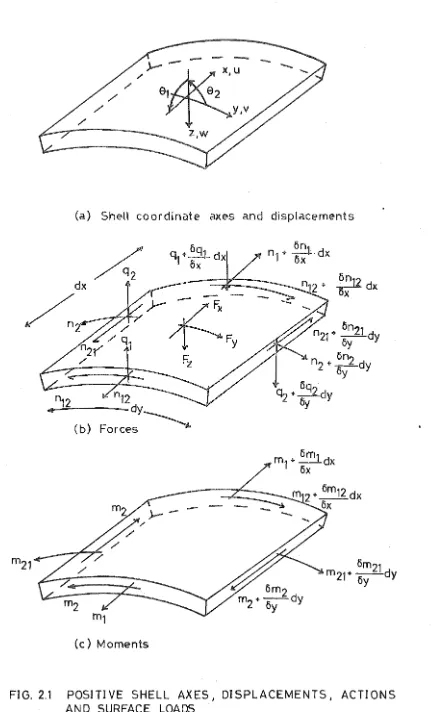
Displacements in x,y,z directionsShell forces and moments are also defined in Figure 2.1 for future reference.
The D.K.J. equation is derived using Navier's hypothesis, small deflection theory and assuming linear - elastic thin
shell action. In addition the effects of radial shear forces on the shell deflection are ignored.
If the curved ends are assumed to be supported on kni edge supports, with complete rigidity in their own plane, v
=
w = 0, and complete flexibility in planes perpendicular to their middle surface, m(a) Shell coordinate axes and displacements
dx
~2
n12 ...,...:.:::..---dy
(b) Forces
~
(c) Moments
6n1 nl + ---+- dx
Ox
[image:23.558.68.501.51.763.2]standard texts " , • McNamee gives a particularly clear presentation as does Billington9 who shows the deriva-tion of the D.K.J. equaderiva-tion from general shell theory.
Elastic theoretical results used in this thesis were obtained by use of a computer program "D.K.J." described in Appendix A, which is based on the D. K .. J. equation. An indication that the accuracy of the D.K.J. computer program is good is given in Figures A.l and A.2 where results from the "D.K.J." computer program are compared with results
, b 'II' 9 d G'b 22 A b ' f d ' . f glven y B1 1ngton an 1 s o n . r1e escr1pt1on 0
the loading formulations used is given in sections 2.2, 2.3.2, 2.3.4, and 2.4.
2.1 RANGE OF APPLICABILITY OF D.K.J.
Due to the dropping of terms during the formulation of the D.K.J. equation, the range of applicability of the equation is limited. There is, however, some confusion between different texts as to this limit. Billington9 suggests that i t is reasonable to use the D.K.J. equation for short (L/R <}) and intermediate
(~
< L/R <2~)
shells, but that the more rigorous methods of Holand12 orA.S.C.El~
11
should be used for larger shells. Hamaswamy recommends that the D.K.J. equation be used for short
(L/R~
1. 6)shells and that for intermediate (1.6
~
L/R.;S TI) length shells an "exact" theory (Holand, Flugge, Dischinger) should be used.12
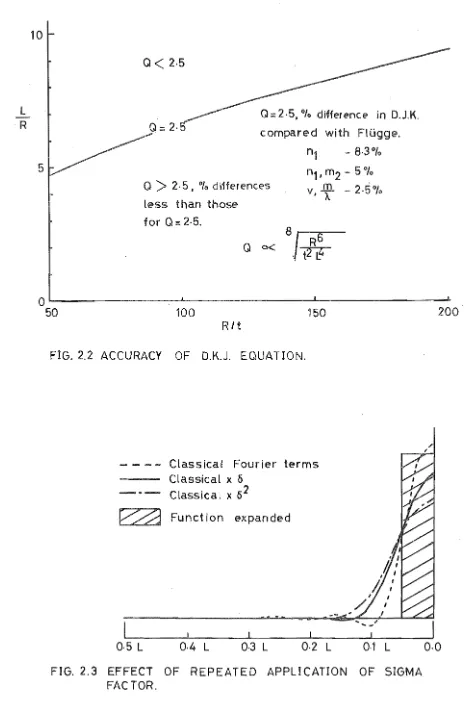
8
compared with Flugge theory. Differerices from the Flugge theory are given for the first Fourier term (the second coefficient showing similar trends) and are plotted against a dimensionless constant Q,
nTI a
=
n
=
1,2,3 ...and hence Q is proportional to
J
As Q is reduced the percentage differences from the Flugge theory increase as does the rate of increase in
differences. The minimum value of Q for which differences are given by Holand is 2.5. These differences are given on Figure 2.2. Figure 2.2 also shows the range of L/R and R/t for which Q is greater than 2.5. In this range
the differences between results using D.K.J. theory and Flugge theory are less than the differences given on Figure
2.2 for Q = 2.5, and should be acceptable for design purposes.
2.2 SURFACE LOADING
In order that the governing differential equation may be solved, loading must be expressed in the form:
x
=
EX cos yy sin 0'. X ) 0)
y = EY sin yy cos a.x ) (2.1)
0
}
Z
=
EZo cos yy cos ax }a.
=
L
nTI,
y=
a constantL
R
10
5
a<
2·5Q
=
2.5, 0/0 difference in D.J.K.compared with Flugge.
Q>
2.5, % differencE'Sless than those for Q::: 2·5.
Q 0<
n1 - 8·3°/0
n1 J m2 - 5 %
m '
v -
-
2.5%, A
o~---~~---~---~
50 100 150 200'
Rit
FIG. 2.2 ACCURACY OF D.K.J. EQUATION.
0·5 L
Classical Fourier terms Classical x 6
Classical x 62
Funct ion expanded
0·4 L 0·3 L 0·2 L 0·1 L
FIG. 2.3 EFFECT OF REPEATED APPLICATION OF SIGMA FACTOR.
[image:26.558.46.522.49.758.2]10
2.2.1 Load
At any position on the shell cross-section, distance y around the arc from the crown, the dead load force P per unit area can be resolved into two components Y and Z where:
Y
=
P sin <1>, Z == P cos ¢ and ¢:= Y/RThis is the same form as equations (2.1) if ¢ == Y/ R := YY . In order that uniform dead load is obtained along the shell Y, Z must be expressed in the form (4P/nn) sin (nn/z) . Hence for dead load:
x
:= 0.0Y ==
-
4p L .1 ns~nT . nn sin Y... cos nnxr;-n R
Z ==
-
4P L ns~nT 1 . nn cos Y... cosr;-
nnxn R
2.2.2 Radial Load
At all points on the shell for a uniform radial pressure P , X := Y == 0 and Z == P . In a similar manner to dead load:
Z == 4p
L1.
sin nn cos nnxn n
T
r;-2.3 PRESTRESSING IN SHELL SURFACE
cos YY _ 1
A number of methods, some approximate, have been
proposed for the analysis of cylindrical shells prestressed within the shell surface. Approximate methods where the line loads (forces from friction and cable drape) have been replaced by equivalent loads along the shell edge have been
d 1 4 14 h 15 d ' 16
favourable circumstances, their overall accuracy is
doubtful and the use of a more accurate method is preferable. For the more accurate methods, described in the following sections, there are two fundamentally different techniques for representing both the anchorage force and the line loads.
2.3.1 Anchorage Force - 1st Method
Berndt2 and de sitterl solve the problem of the . anchorage force on the end of the shell in two steps.
In the first stage the shell is considered as being simply supported along the straight edges and the anchorage force is expanded along the curved end as a Fourier series P(y) :
P(y) == - - cos a 2p d cos a y
R¢K n n
where a
n n == 0,1,2 . . .
d == anchorage eccentricity The boundary conditions are:
i) Curved ends
w=v=m =0 1 n
l = P(y) ii) Straight edges
m 2 = n 2 == 0
The second stage consists of removing the unwanted actions, n
12 and r 2 ' along the straight edges by a complementary function solution with the shell simply supported on the curved ends.
2.3.2 Anchorage Force - 2nd Method
12
at the curved ends and that the anchorage force is introduced to the shell as a shear force over a short longitudinal
length of the shell adjacent to the traverse. The analysis technique is a particular case of that used for draped cables described in Section 2.3.4.
2.3.3 Line Loads - 1st Method 2
The method used by Berndt and also investigated
, 6
by Bryant is to substitute the line loads by statically equivalent surface loads which are then developed as a double Fourier series:
sin Ct x cos
ex x
sin myy cos myy
n,rn are odd integers
Berndt reports that he found good agreement between model test results and results using his method of analysis. ' However, Bryant found that the above method did not give satisfactory convergence for some shell actions and so he developed the following method.
2.3.4 Line Loads - 2nd Method
The method described in this section is largely a summary of a paper by Bryant and scrivener3.
First the shell is divided up into a number of transverse strips of width L/ 2m , m being an integer, throughout which the line load intensities are considered constant. A number of equally spaced shell generators are then considered along the cable profile and the line loads divided between them. For each transverse strip the line load is divided between
generators the line load components F , F , F
z are replaced
x y
by the actions The anchorage load is consid-ered to be a shear load (n
12) spread into the shell along
two generators adjacent to the anchorage and treated similarly to the line loads.
These actions, n
12, n2, r 2, are then expanded as a Fourier series along each generator in order that a Levy type solution may be applied. If gi (x) is the equation along a generator for a line load component (value f (x.) )
~
of the ith transverse strip.
n1TX
1 n1TX.
where a sin n1T 1
ni
=
-
n 4m cos L n=
1, 3, 5 .•. and x.~
=
distance of strip i from the centreline.Then from the sum of all strips
m 8 cos n1TX
f(x) = E gi (x)
=
-
E asin i';"l 1T n n
m
f (xi) where a = a
ni n == 1,3,5 n E
i=l
For each Fourier term the analysis is carried out as follows:
i) The shell is considered as a complete tube and
solved for each pair of symmetrical (one from each side of the centreline) generators. This is done by assuming that the loaded generators divide the tube into two shells and hence the generator loads can be considered as edge loads at the junctions of the
required points anywhere on the tube.
ii) All the complete tube solutions are then added
together and the required shell "cut" from the
tube, unwanted edge sections being removed by an
ordinary complementary function solution.
Bryant and scrivener3 have compared results obtained
14
by the above generator line-load method with experimental
results obtained for a number of cable layouts on a prestressed
aluminium model shell. Good correlation was obtained.
2.3.5 Convergence of Generator Line Load Technique
From the results of trial runs, Bryant and
Scrivener found that if 10 Fourier terms (n==1,3 ••• 19) were
summed for an anchorage load spread 0.05L into the shell
along two closely spaced gen~rators, a reasonable
approxi-mation of the anchorage load was obtained. For draped cables
they found that a generator spacing of R<Pk/6, m == 20 transverse
strips and 6 Fourier terms were required to give the same order
of accuracy as that obtained for the anchorage load.
An attempt, as described below, was made by the present
author to improve the convergence of the solution by using
different methods for modifying the classical Fourier coe
icients. However it was found that little improvement in
the convergence could be obtained from that using the
param-eters and method suggested by Bryant and Scrivener. The
greatest variation between methods occurred in the vicinity
of the cable near the traverse. Away from this area there
was negligible difference between many of the methods. For
the anchorage force a triangular shear pulse was considered
and Scrivener. Expressions for the rectangular and triangular pulses are:
Rf!'ctangular pulse'
I
trav..rs~..
,
•
a
I
a
~-~J."'"
t E - - - L 12
---'lllOt
-Llr~ ~
Triangular pUI se
I
t;~
______________
~;;,_a~~,~,s.
ILl2
-Llr~
f(x)
n=l, 3 •••
and for anchorage force p
f(xi ) ==
L/R
8 r f (x. ) 1
f (x) = 1 cos n1T (1 ) sl'n n1T
2
2"
- -
2r(n1T) r
n
=
1, 3 •••Three methods of modifying the Fourier coefficients were tried. All of these methods distort the original function and hence a balance must be reached between this distortion and the reduction in Gibbs oscillations. The methods used were:
Sigma Factor This method is described by Lanczos 17 and involves multiplying the Fourier coefficients by a factor ok'
sin klT/n
°
=
. k klT/n
where n == the number of Fourier terms to be considered k = kth Fourier term.
The effect of multiplying by the sigma factors is essentially to replace a function f(x) by f(x) where
f (x) =
2n~ f,~f
(x+
t) dtThis new function smooths the original function by taking
at each point the arithmetic mean between the limits
±~/n.Multiplication by the sigma factors can be repeated on the
new function, i.e. if the sigma factors were to be applied
16
twice, the classical Fourier coefficients would be multiplied
by
At each step the convergence becomes stronger, but
the operation of local smoothing distorts the function and
stronger convergence is obtained, not to the original function
but to a modified function.
The reduction in Gibbs
oscilla-tions and distortion of the function is shown in Figure 2.3
for a rectangular anchorage block, where it can be seen that
for
cr~
the slope of the graph is less than cr
k
•
As a steep
slope is required in order that the line load is applied as
near the end of the shell as possible, any use of the sigma
factor beyond cr
k
is not advisable.
Fejer Arithmetic Mean
Again described by Lanczos
17,
this method involves taking the arithmetic mean of the partial
sums of the Fourier coefficients up to the nth term.
If S
=
fo 0
cr
n
=
Lim. cr
=f (x)
n
S 'i'
• . • n-"' 1 n
This is equivalent to multiplying each Fourier term by Pk(n)
where Pk(n)
=
(1 -
~)
The summation converges to f(x) from below as shown in
Figure 2.4, for a rectangular anchorage pulse.
Figure 2.4
also shows that the Gibbs oscillations can sometimes be
- - - - Classical Fourier terms _ - - F ejer ari t hmet ic mean ---. - Convergence factor
Function expanded
-
--0·5 L 0·4 0·3 0·2
0·1
FIG.2.4 EFFECT OF FEJER ARITHMETIC MEAN AND
CONVER~ENCE FACTOR.
0·5 L
Classical Fourier terms Function expanded
Classical x (j factor Funct ion expanded
0·4 L 0·3 L t:)·2 L 0·1 L
0·0
0·0
FIG.2.5 COMPARISON OF TRIANGULAR AND RECTANGULAR
18
Convergence Factor This method is presented by Baryl8.
Each Fourier term is multiplied by l/loge k except when
k = 0 or 1. Figure 2.4 shows that although the convergence
factors eliminate the Gibbs oscillations, the slope at the
discontinuity is less than that given by the other methods.
2.3.6 ~nvergence of Anchorage Loads
As the distance over which the anchorage pulse is
assumed to act is decreased, the rate of convergence of the
Fourier series decreases.
The best method of applying the anchorage force using
a rectangular pulse is to use the classical Fourier
coeff-icientsand a pulse spread O.05L into the shell. This is
the same as suggested by Bryant and Scrivener. For a
triang-ular pulse the best method is to use the CJ
k x classical
Fourier coefficients, spreading the pulse again 0.05L into
the shell. These two expansions are compared in Figure 2.5.
There is little difference between the two expansions although
CJ
k x Classical Fourier coefficients would appear to be better
as with this expansion the total anchorage force is applied
to the shell closer to the traverse. Computer results from
the D.K.J. program show negligible difference between the
two expansions, except near the anchorage line close to the
traverse.
The above discussion is for 10 Fourier terms; however,
similar behaviour occurs for different numbers of terms. If
less than IO-terms are used the Gibbs oscillations will be
greater and the slope at the discontinuity less. The choice
of method would depend on whether the force is to be applied
near the end of the shell or whether the oscillations are to
' h
19 ,t'
'th th
t
.
f
d
b
R1S
, 1n connec 10n W1
e pres ress1ng 0
e ge earns,
has suggested a method for reducing the number of Fourier
terms required.
The prestressing force is applied as a
triangular shear pulse spread O.2SL into the shell, which
gives an almost perfect parabolic distribution after 4 Fourier
terms as shown in Figure 2.6.
Using a simplified form of.the characteristic equation
. ,an edge correction is then made to return the prestress force
to the corners of the shell by applying corrective shear forces
to both the edge beam and shell edge.
The corrective shear
forces increase linearly to the traverses, from zero at the
quarter points, and their effect on the prestress force
distribution in the shell is shown in Figure 2.6.
It would appear that this technique could also be used
for prestressing in the shell surface if the generator line
load method is used.
However, the technique was not tried
out as it was felt it would give no more accuracy than the
present D.K.J. computer program and that a reduction in the
number of Fourier terms summed would make only a slight
difference in computation time required.
2.3.7
Convergence of Line Loads
Similar trends between different Fourier expansions
occur for line loads as for the anchorage loads.
The best
methods are the classical Fourier coefficients used by Bryant
and Scrivener or 0kx classical Fourier coefficients.
These
are compared in Figure 2.7 for a line load at L/4 , similar
trends occurring for line loads at other positions along the
shell length.
0·5 L 0·25 L 0·0
20
VIZ
I
Anchorage shear pulseII 1 II
Prestress force distribution in shell
rue
to anchorage shear pulse.Prestress force distribution in shell due to cor r ective shear force.
FIG. 2·6 PRESTRESS FORCE DISTRIBUTION USING RISH'S METHOD.
VZ/J
Function expanded
- - - Classical Fourier terms
- - - Classical x c1 fact or .
...
..
II'-
...
..
....
'"..
..
,
I..
-
,
-
I
II
0·5 L 0·4 L 0-3 L 0·2 L 0·1 L 0·0
FIG. 2·7 COMPARISON OF LINE LOAD EXPANSIONS .
... x -
0
"
"v
... -
-_..L
2
FIG. 2·8 CURVIUt\IEAR SHELL COORDINA TE SYSTEM
z'
coefficients) or whether a better convergence of the line
load, but spread
o~era greater length of shell, is desired.
However, as the effect of line loads is of a secondary order
compared with the anchorage load, the difference between the
effects from the two expansions will be small, except close
to the line load.
2.3.8
Line Loads Due to a Parabolic Cable In A Circular Curve
The line loads derived in this section occur when a
cylindrical shell of constant radius is prestressed with a
cable which is parabolic in the developed shell surface.
Using the curvilinear coordinate system of Figure
2.8the parametric equations of the parabola in the developed
shell surface can be written:
t
x
=
2a
Y
=
e-=
e-2
ax
where
t 2
4a
e
=
a
=
d+f
4f
L2 •
Bryant and Scrivener have used curvilinear coordinates to
calculate the line loads due to a parabolic cable in a
circular curve, however it is simplerto use the Cartesian
coordinates of Figure 2.9 and thus the parametric equations
become:
x
=
2a
ty'
=
Rsin$
where $
=
¥..
R 2
4ae -
t4aR
Z I =
-R cos $
=
A point on the cable can be defined by a position vector
r(t)
=(2
t
a ' Rsin$, - Rcos$),
therefore
dr
1
and
d2
r 1
----,;r = -
(0, -coscp
+
c sin
cp,-sin
cp-coscp ) ,
dt"
2a
e =unit Tangent - T
Kreyszig
20
(pp271) defines the
unit tangent, T , as
dr
T
=
dt
I~I
1
(1, -tcoscp, - t sincp )
=2a
11
+
t
2
1
(1, -tcos<jl
- t sincp ) •
=
,
.1
1
+
t
2
Curvature - K
dT
dT
dt
KN
=ds
=
dt
0:d'S
th~refore
KN
=
Now
K =therefore
I
ddTSI
N
=Principal Normal
K
=
Curvature
K =
2a
I
t 2C2
+c 2
+1
(1+t 2
):%Principal Normal -
NdT
ds
N =IdTI
ds
=
2
~
:.>.2
'2{-t,-[cos<p -
c
sin<p - t
2
c sin<p],
(l+t ) (t c +0' +1)
2 ,.
sin<p + c cos <p+ t c cos <p ] }
Line Loads in
x, y', ZlCoordinates
Consider a
small length of cable Os
shown in Figure 2.10.
oe
==-
os
=
0 KR s
The resultant force due to the cable curvature is
poe
and
it is directed along the principal normal.
poe
This can be written as
aforce/unit length in the
xdirection
Similarly, forces directed along the unit tangent/unit'
length in the
xdirection
ds
=
«(Jj
+
V,PK)ax '
where
w
=
wobble factor
Now
therefore
Also
therefore
=
force/unit length to bodily move the cable.
ds
dx =
ds
dt
dt
=2a
Ox
dt
ax
and
x=
2a
tds =
,Adx) 2+
(~)2
+(dz
i)2
dt.
at
a t
dt
==
1-
'1'+t
2
/
p
I I
I
____ centre of curvature
~ for
oS
1\
I \
109\
~\
\
\
\ \
55
-\
\
P
FIG. 2·10 FORCES ACTING ON AN ELEMENTAL LENGTH OF CABLE.
/
I I
: I
; - - 1
-" I
(a) Forces and moments
Wb
(b) Displacements
poe
the curvature force
PK
ds
2ag
Pdx:=
h2
and tangential force
and h
=:/1 + t
2
(w+v PK)
~
:: (,('0+
2 ha3g
'VP) h •Resolving these forces in the x, y',
z'
directions
Fx
=: -2 a tP +
w+
~
vP
h
3
}:1
F '
= -
2a .
p(cos
cp-
c sin<p- t
2c 2 sin
<P) -('w+~
v P)tcos
<py h
F
1==_2aP (sin<p+ccos<p+t
2c·
2cos<p)
-(w+~vp)tsin<P
z
h3
~The forces F,
xLine Loads in x, y,
ZCoordinates
F' F'
y ' Z
can nowbe resolved into components along the curvilinear
coordinate directions.
F
=:F
:::-
2 atP
P +
(w+
~
vP)h
3
x
x
h
F
=:F
y'cos
cp
+F' sin
<pY
z
=:
2a P
-
(w+ 2 a g
vP) t
t;!
h
3
F
z
=:F z' cos
<p- F ' sin
<p =:-2acP
h
-y
These are the same forces obtained by Bryant and Scrivener
except that in their paper they have'mistakenly multiplied the
forces by h .
At the traverse, the anchorage force component in the x
direction is
=
Anchorage force
26
2.4 EDGE BEAMS
The effect of edge beams on a cylindrical shell can be
considered by means of a complementary function solution9,lO.
In order to obtain compatibility with the shell edge,
all loading on the edge beam must also be expanded as Fourier
series. For a prestress cable draped parabolically in the
edge beam, the loading on the edge beam can be expressed in
the form,
PB
4 PA
I n'ITx
=
- - E cos'IT n n
MB
4 PA 1 n'ITx
::: - - E cos
r:;-'IT n n
VB
32 PA f 1 n'ITx
::: E
-
cosn L
n
where P
A ::: prestress anchorage force acting on edge beam
P
B ::: normal force along edge beam due to prestressing
MB ::: moment along edge beam due to prestressing
e
=
anchorage eccentricity at endVB ::: shear force along edge beam due to prestressing
f ::: cable drape.
positive actions and displacements at the centroid of
the edge beam are shown in Figure 2.11. The solution requires
that compatibility of displacements and actions along the
shell-edge beam junction be maintained. In order to do this, a
translation matrix is used to obtain the actions and
displace-ments of the edge beam at the junction. A rotation matrix is
then applied to obtain the actions and displacements in the
same coordinate system as that of the shell, at the shell
2.5 EFFECT OF TRAVERSE ON THE DISTRIBUTION OF ANCHORAGE FORCES
The distribution of prestress anchorage force along the
end of the shell will depend on the properties of the traverse.
For instance if a traverse is made stiffer, the forces will be
spread into the shell over a greater arc length. Hence rather
than assuming that the anchorage force is spread equally down
two generators at some arbitrary distance close to the
anchor-age, an analysis technique is presented below which takes into
account the effect of the traverse stiffness on the
distribu-tion of anchorage forces to the shell. The effect of the
traverse is particularly important when the cable is near the
edge of the shell as the transverse moment and radial
deflec-tion may be significantly affected.
The following analysis technique, based on the theory
of beams on elastic foundations, is a means of calculating
the distribution of anchorage prestress force, including the
effect of the traverse (beam) on the end of the shell (elastic
foundation). In Section 2.5.7 the method is shown to give
good correlation with experimental results.
2.5.1 Assumptions
The basic assumptions made are that both in-plane
shear force between the traverse and the shell, and curvature
of the shell are neglected. The first approximation is not
serious as the in-plane shear force between shell and traverse
due to prestressing is generally small, and the second
approx-imation is reasonable if the anchorage force distribution is
spread over a relatively short arc length, as would occur in a
majority of shells.
2.5.2 Theory
The theory for beams on elastic foundations has been
For a beam on an elastic foundation, the reaction from
the foundation/unit length
== -ky
==W
where y
==deflection of beam and foundation
k
==reaction/unit length when y
== 1.
Now for a beam
W == EIZd
4y
dx
4therefore
The general solution is
y == eSx(A cos Sx +
Bsin Sx)
+e-Sx(CcosSx+Dsin Sx)
.4/~
where S
== 4EIZ
Considering the case of an infinite beam with a single
point load,
P,the boundary conditions are:
i)
At points infinite from the load, y
== 0.0 ,2B
therefore A
== B == 0and y
==e -Sx (C cos S x + D sin S x)
ii)
At point where the load is applied, i. e.
x ==
0,~~
== 0,therefore C::::; D and y
==C -Sx (cos a x + sin S x)
eNow for
x
== 0,dx3
d3y ==3
and shear force, Vx==O
==-EIZ(~)
==
dx
p
- '2 •
Therefore
C
== PBS3
EI Zpa
-ax
a x + sin Sx)
y
- - e
(cos
2k
M == -EI
d
2
y
dx
2
and the moment
P
-Sx
.
==
-n
e
(sl.n
Bx - cos S x) •
Using the notation
~ ==e
-Sx
('1os ax + sin ax)
e =
e
-j3x
cos j3x
~
=
e
-j3x
sin j3x
y
::::Pj3
2kcj>(ex)
P
M
::::413
'¥(ex)
(2.2)
....
V
'2
P
a (ex)
Considering the case of a moment,
Mo' being applied
at the end of a semi-infinite beam it can be shown that:
y
)~
(ex)
) ) )M
::::Moa(ex )
)....
(2.3)
)
)
V
-6 Mo cj> (ex)
)Using the above two cases, the distribution of y, M,
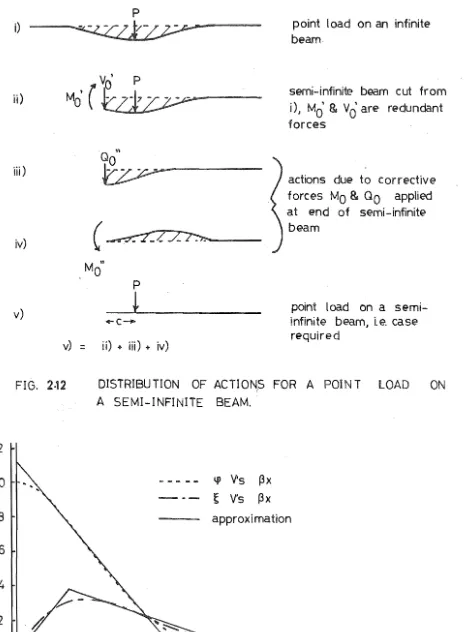
Vcan be found for a point load on a beam of semi-infinite
length, as shown diagrammatically in Figure
2.12.Referring
to Figure
2.12,the redundant forces M
Iand
V Iat the
o
0end of a semi-infinite beam when it is "cut" from an infinite
beam, can be found from equation
(2.2).Le.
M'
o
P
=413
and
VI o::::
~
[a
(ec)]
From equations (2.2) and (2.3), the actions
V"and M
II 0 0 'due to corrective forces
and
Mo
applied at the end of
the semi-infinite beam can be found.
Le.
MA
oM
o
and
V IIo
Hence by equating
M' +M"=Oo
0and
Vo
I + V" 0=
0be shown that
Q
o = P (2 [8
Uk)]
+
'¥ (ec) )
Mo
=-~
('¥(j3c)
+
8 (ec)
) ) )
••• (2.4)
1-2
1.0
·8
IP
or
·6
~.4
.2
0·0
ii)iii)
IV)
(
M
\Io
v)
p
p
..-c-point load on an infinite beam·
semi-infinite beam cut from
j), MO' & Vo are redundant forces
actions due to corrective forces MO
&
00 applied at end of semi-infinitebeam
30
v) = ii) + iii) + iv)
pOint load on a semi-infinite beam, i. e. case required
FIG.
2·12
DlSTRIBU TION OF ACTION;S FOR A POIN T
LOAD
ON
A SEMI-INFINITE BEAM.·
....
-
-
...-
q> V's ~xg
V's ~xapproximation
"".... ...
_
...__
-~--...-I I I I
J
0·0
1·0
2·0
3-0
4·0
5·0
px
[image:47.560.48.513.62.694.2]Thus for a point load distance c from the end of a
semi-infinite beam, x-c W =-ky
=
P:{<P[S<c-x)]}Q
f3
+
+
{<Ii
••... (2.5)
i.e.
W is a function of <P and ~. These two functionsare plotted in Figure 2.13 for variation in S x.
The distance from a point force over which bending occurs
is given by Timoshenko as
'is,
however for practicaldeform-ations and forces a value of
~S
would seem reasonable. Thismeans that abeam may be considered semi-infinite if part of
it lies further than
~f3
from the point force. If a pointforce is applied to a beam at a distance greater than
~S
from both ends of the beam (i.e. an "infinite" beam) the last
two terms of equation (2.5) can be ignored.
To calculate the distribution of prestress anchorage
force from the traverse (beam) to the shell (elastic foundation),
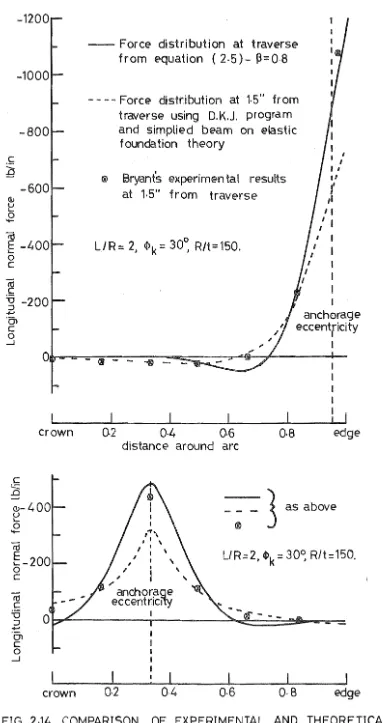
equation (2.5) is used. Typical force distributions are shown
in Figure 2.14, both for an anchorage force close to and away
from the edge. When the anchorage is near the edge the
maxi-mum force/unit arc length is greater than when the anchorage
is away from the edge. Also the maximum force/unit arc
length occurs at the edge of the shell and not at the
anchor-age.
The technique can be used in a generator - line load
type computer program by summing the force distribution over
discrete arc lengths of the shell. The resultant forces are
then applied to the shell as point loads at the centroids
-800
.~
-g
-200...
'01 c o ...J fd crown E1...-200
o cen
c o ...J crown- Force distribution at traverse from equation (2.5) - ~: 0·8
- - - - Force distribution at
1·5"
from traverse using D.K.J. program and simplied beam on elasticfoundation theory
® Bryant's experimen tal results
at
1.5"
from traverseLlR:2,
4>k:::30~
R/t=150.I
I I
I I I
I I
! I
t
,1
I I
I I I I I I anchorage eccentricity I
0·2 0·4 0.6 0·8 edge distance around arc
,
'"
,
I ,
anchoraqe eccentricity
I
0·2
0.4
-; -3
as aboveLlR=2, 4>k:::
30~ R/t=150.-
~..
0·6 0·8 edge
FIG.
2·14 COMPARTSON OF EXPERIMENTAL AND THEORETICAL N1 DISTRIBUTIONS NEAR TRAVERSE [image:49.558.70.453.54.777.2]2.5.3 Determination of
S
E
t
=
Young's modulus of traverse k force for unit deflection/unit lengthAssuming the shell acts as a column,
P
k
=
/0tE s
Es ~ Young's modulus of shell I
z
=
2nd moment of area of the traverse For a solid traverse,bd3
I
z
=
lC2
where d=
thickness of traverseb = effective width of traverse.
40
By considering the A.C.!. recommendations for the effective widths of L-beams, b has been defined by:
Hence
and if
b ~ 6 x d ~ 1
16
x anchorage eccentr~c~ty. .
~
1/2 x depth of traverse at anchorageE
=
Et s
J
3t=
L
bd 3.•. (2.6)
2.5.4 Summary of Method
i) Calculate
S
from equation (2.6) ii) Calculate Mo .and Qo from equation (2.4)
2.5.5 Simplification
The above method involves the summing of
non-linear relationships in order to find the distribution of
prestress force around the arc on the end of the shell.
The following procedure, which has been found to give
satisfactory results, is suggested in order to simplify
calculations.
i) Calculate f3 from equation (2.6).
ii) Calculate Mo and Q o from equation (2.4).
34
iii) Approximate ~ and ~ curves to the triangular shapes
shown in Figure 2.13.
iv) Sum the forces on each side of the anchorage
2.5.6
separately, and calculate the centroid of each
force block.
v) Use the two forces calculated, acting at their
respective centroids, to find the effect of the
prestress anchorage force on the shell.
When the anchorage is further than 1.9 from f3
the shell edge, the
p
two equal forces,
2
the anchorage.
above simplification gives
d · t f 1.9 f
, at a 1S ance 0
±:nr
romEffect of Change in f3
If the relative stiffness of a traverse is increased,
f3 will decrease. Except near the edge, the only effect that
a decrease in f3 will have is to spread the anchorage force
over a larger arc length, the distribution curve remaining
a similar shape. However, near the edge, as well as
spread-ing over a larger distance, the curve will change shape.