An investigation into a programme of enquiry-based
continuing professional development for professional
development leaders
PERRY, Emily <http://orcid.org/0000-0003-3413-1159>
Available from Sheffield Hallam University Research Archive (SHURA) at: http://shura.shu.ac.uk/9836/
This document is the author deposited version. You are advised to consult the publisher's version if you wish to cite from it.
Published version
PERRY, Emily (2014). An investigation into a programme of enquiry-based
continuing professional development for professional development leaders. Masters, Sheffield Hallam University.
Copyright and re-use policy
See http://shura.shu.ac.uk/information.html
An investigation into a programme of
enquiry-based continuing professional
development for professional
development leaders
Emily Perry
February 2014
MA Education
Supervisor:
Mark Boylan
Teacher Education
i
Abstract
Professional development leaders are practitioners whose role includes the
planning and delivery of continuing professional development to teachers. There
is little formalised support for professional development leaders, even though their
role is critical to school improvement. This dissertation describes an action
research project in which a programme of enquiry-based continuing professional
development for professional development leaders was developed, delivered and
evaluated. Participants video-recorded themselves delivering continuing
professional development, then analysed their practice in critical friendship groups
using web-based video observation technology. Data was collected from
participant questionnaires and interviews before, during and after the programme.
Analysis of the data, using a range of techniques including a framework based on
the Clarke and Hollingsworth model of teacher growth, led to an evaluation of the
programme. The programme was found to be effective in stimulating participant
learning about effective CPD and about the use of video, but less effective in
ii
Contents
Abstract ... i
Contents ... ii
List of Tables and Figures ... iii
List of Appendices ... iv
Chapter 1: Introduction ... 1
Chapter 2: Literature review ... 5
2.1 Introduction ... 5
2.2 Effective Continuing Professional Development ... 5
2.3 Video Observation in Continuing Professional Development ... 8
2.4 Models for the Evaluation of Continuing Professional Development... 10
2.5 Summary ... 14
Chapter 3: Methodology ... 16
3.1 Introduction ... 16
3.2 Research strategy... 16
3.3 Development and delivery of the Expert Episodes programme ... 19
3.4 Data collection ... 25
3.5 Ethical issues ... 28
3.6 Data analysis ... 31
3.7 Summary ... 35
Chapter 4: Findings and Discussion ... 36
4.1 Introduction ... 36
4.2 Findings ... 36
4.3 Discussion ... 44
Chapter 5: Reflection and Next Steps ... 51
5.1 Introduction ... 51
5.2 Reflection ... 51
5.3 Next steps ... 56
References ... 57
iii
List of Tables and Figures
Figure 2.1: Guskey’s levels of CPD impact ... 11
Figure 2.2: Coldwell and Simkins’ model of CPD evaluation ... 12
Figure 2.3: Clarke and Hollingsworth model of teacher professional growth ... 13
Figure 3.1: Action research cycle ... 16
Figure 3.2: Action research structure of Expert Episodes programme ... 19
Table 3.1: Project timeline ... 20
Table 3.2: Expert Episodes programme ... 21
Table 3.3: Face-to-face days ... 23
Table 3.4: Data collection ... 25
Table 3.5: Data analysis methods ... 32
Table 4.1: Data analysis ... 36
Table 4.2: Participants’ backgrounds ... 37
Table 4.3: Analysis of intended learning outcomes ... 38
Table 4.4: Themes emerging from video analysis ... 39
Table 4.5: Analysis of evaluation form ratings scales ... 40
Table 4.6: Clarke and Hollingsworth analysis of evaluation forms ... 41
Table 4.7: Comparison of intended learning and reported change ... 41
Table 4.8: Reported changes in the personal domain ... 42
Table 4.9: Analysis of follow-up interviews and questionnaires ... 43
Figure 4.1: Mike’s change sequence ... 45
Figure 4.2: Liz’s change sequence ... 46
Figure 4.3: Jack’s change sequence ... 47
Figure 5.1: Change sequence relating to identity ... 52
Figure 5.2: Change sequence relating to beliefs about effective CPD ... 54
iv
List of Appendices
Appendix A: Letter of invitation ... 61
Appendix B: Precourse tasks ... 64
Appendix C: Face-to-face day 1 ... 65
Appendix D: Face-to-face day 2 ... 66
Appendix E: Mid-programme meeting agenda ... 67
Appendix F: Protocol for video observations ... 68
Appendix G: Evaluation form ... 70
Appendix H: Follow-up questionnaire ... 72
Appendix I: Background information survey ... 75
Appendix J: Intended learning outcomes form ... 76
Appendix K: Follow-up interview protocol ... 77
Appendix L: Ethical review form ... 78
Appendix M: Participant consent form ... 81
Appendix N: Teacher consent form ... 85
Appendix O: Sample intended learning outcomes form ... 88
Appendix P: Sample video analysis forms ... 89
Appendix Q: Sample completed evaluation form ... 94
Appendix R: Extract from notes of video of follow-up interview ... 95
Chapter 1: Introduction
In this dissertation an action research project is described in which a programme
of enquiry-based continuing professional development for professional
development leaders is developed, delivered and evaluated. Professional
development leaders are practitioners whose role includes the planning and
delivery of continuing professional development to teachers. There is little
formalised support for professional development leaders, with few opportunities to
enquire individually or collectively into the practice and pedagogy of continuing
professional development. The Expert Episodes programme, which was funded
by the national network of Science Learning Centres, aimed to fill this gap.
Participants video-recorded themselves delivering continuing professional
development, and used a web-based video observation technology, to share and analyse their “episodes”, with the aim of generating understanding of their practice
and the use of video in continuing professional development.
The importance of continuing professional development for teachers is now widely acknowledged. As Adey (2004, p3) says, “the continuing professional
development of teachers remains the most important force in the quest for educational improvement”, and consequently in recent years there has been a
great deal of academic interest and financial investment in professional
development designed with the aim of improving student learning (Loucks-Horsley
et al. 2010). For example, in England in 2004 the national network of Science
Learning Centres was established, with the aim of providing high quality
continuing professional development for science teachers, thereby improving their
subject and pedagogical content knowledge, and ultimately increasing pupil
attainment, engagement and progression into scientific career pathways (Science
Learning Centres 2011).
In the literature, there is no agreed term for the group of professionals whose role
involves the planning, delivery and evaluation of continuing professional
development (CPD) to teachers, and there is a lack of research into their roles
(Lange and Meaney 2013) and skills (van Driel et al. 2012). This seems surprising
when compared to the numerous models which have been suggested for the
2
CPD, such as its subject content or delivery model (for example, the programme
length, use of online environments or ongoing support), and ignore the key issue
of the quality of the professional development leader.
These factors could be seen to imply a downplaying of the importance of the role
and a lack of clarity over the practice of professional development leaders. This may be because their role is often combined with others. For example, “hybrid teacher leaders” (Margolis 2012) combine the role with teaching, as in the new
Specialist Leaders of Education in England (Department for Education 2013).
Many professional development leaders working in higher education combine the
role with teacher education and seem comfortable being identified as teacher
educators, while many other professional development leaders are freelance
consultants, who also carry out curriculum development and related tasks. In this
project, I use the term professional development leaders to refer to all practitioners
whose role involves the planning, delivery and/or evaluation of CPD to teachers.
As someone who moved from the first order role of classroom teaching into the
second order (Murray and Male 2005) role of professional development leader, I
feel that we should build a stronger knowledge base about this key group of
education professionals. Through observation of changes in my own professional
identity as I made the transition from teacher to professional development leader,
and through my own previous research into the skills and characteristics of
professional development leaders, it seems that the role of a professional
development leader is different from both teacher and teacher educator. There is
a need for research into professional development leaders as a particular subset
of practitioners.
For me there is a further imperative, since I now carry out what might be called a
third order role: to commission and quality assure the professional development
leaders who work for the national network of Science Learning Centres. I need to
ensure that appropriate and effective ways of supporting our professional
development leaders are available. Meanwhile, as the English government
promotes the delivery of school-based CPD, teachers are increasingly being
tasked with the delivery of professional development. It is even more important,
3
leader, so that we can identify teachers who could take on the role, and support
them appropriately.
In this dissertation, an action research project is described in which a programme
of CPD for professional development leaders was implemented and evaluated.
The Expert Episodes programme brought together a group of professional
development leaders to collaboratively enquire into their practice. My objectives in
developing the programme were to:
improve our understanding of the skills and pedagogies used by professional development leaders;
trial a model of CPD for professional development leaders;
trial the use of video-observation and -sharing technology.
The rationale for the first two objectives was described above. The final objective,
centring on the use of video, arose from the increasing number of schools which
are purchasing video-observation technology. The programme provided an
opportunity for professional development leaders to better understand the
experience, benefits and drawbacks of being video-recorded, thereby enabling
them to work with teachers to use video effectively in CPD.
The value of the Expert Episodes programme was recognised by the national
network of Science Learning Centres through a financial grant which supported
my time delivering the programme and gave bursaries to the participants. The
network agreed that the programme could provide a useful case study into ways of
supporting professional development leaders and could improve our expertise in
the use of video observation. I hope that the programme will have wider
applications beyond the national network of Science Learning Centres. The
enquiry-based, video-observation model used in the programme could be
extended to other groups of professional development leaders as well as teacher
educators and teachers.
In planning Expert Episodes, I drew on key research into the meaning and
structure of effective CPD, its evaluation, and the use of video observation in CPD.
4
methodology of the project, including a justification of action research as a
strategy. It goes on to describe the data collected and the analysis techniques
used in order to evaluate the programme. The final chapters explore the findings
of the data analysis, using them to evaluate the impact of the programme on the
participants and on my own learning. Finally, next steps for me and for the further
5
Chapter 2: Literature review
2.1 Introduction
In this chapter three themes relating to continuing professional development
(CPD) are examined: the features of effective CPD, the use of video observation
in CPD, and CPD evaluation. First, research into the characteristics of effective
CPD is examined, in order to identify key components which should be built into
CPD programmes. Next, the potential of video observation as a tool for CPD will
be evaluated. Finally, three models for the evaluation of CPD will be explored.
The literature reviewed here focuses on CPD for teachers. Since there is little
research into CPD for professional development leaders, I made an assumption:
what is effective for teachers is also effective for professional development
leaders. The three themes explored here therefore form the foundations of Expert
Episodes: its planning, delivery structure and evaluation.
2.2 Effective continuing professional development
There is a “conceptual vagueness” (Fraser et al. 2007, p155) about the meaning
of professional development in the literature, with definitions ranging from the self-evident: “the process whereby a person’s professionality and/or professionalism may be considered to be enhanced” (Evans 2008, p30), to the optimistic: “effective
professional development is the process of professional learning which results in great pedagogy” (National College for Teaching & Leadership 2012). Van Driel’s more balanced view links an improvement in teachers’ skills with an impact on pupils: “[CPD is] those processes and activities designed to enhance the
professional knowledge, skills and attitudes of teachers so that they might, in turn, improve the learning of their students” (van Driel et al. 2012, p129).
With this lack of an agreed definition, it might be expected that there would be a
related vagueness over what makes CPD effective. In fact, there is no shortage of authors listing "characteristics…that make it effective for increasing teacher
learning and changing practice, and ultimately for improving student learning"
(Desimone 2009, p183). Van Driel claims that enough research exists to provide
6
"focus, active and inquiry-based learning, collaborative learning, duration and
sustainability, coherence and school organisational conditions" (van Driel et al.
2012, p131). These provide useful pointers for the development of a CPD
programme, and will be elucidated here in turn.
Focus
Effective CPD should be focussed on classroom impact. Not surprisingly, there is
little disagreement about this in the literature; after all, teachers would be unlikely
to engage in CPD which was not aimed at improving pupil outcomes. How this
classroom focus manifests itself in practice may take different forms in different
CPD programmes. For example, Joyce and Calhoun (2010) indicate the need for
CPD to be planned with teacher learning objectives linked to student outcomes,
while Guskey (2009) suggests that effective CPD should incorporate the
dissemination of research-based teaching strategies.
Active and enquiry-based learning
CPD delivery should be based on active learning techniques. One way to deliver active learning is through “participant-driven enquiry” (Hamilton 2013, p45). This
is gaining ground as a CPD strategy with increasing acceptance that, as McNiff (2002, p9) says, “professionals already have a good deal of professional
knowledge and are highly capable of learning for themselves”. To counter this,
though, Guskey (2009) reminds us of the importance, even in teacher-led CPD, of
using ideas which come from outside experts, perhaps since this limits the
perpetuation of organisational myths and practices and/or brings with it the
research evidence base mentioned above.
Collaborative learning
Although Guskey (2009) points out that none of the successful models he
7
highlight the value of teachers working together. Van Driel suggests a number of
strategies for collaboration, such as involving teachers in the focus and design of
their CPD, or bringing teachers together to form professional learning communities (Wells 2013). This “embedded” professional development (Hamilton 2013) is
another example of participants leading the process, and many enquiry-based
models of CPD highlight the importance of collaboration (McNiff 2002).
Duration and sustainability
To be effective CPD should take place over a “substantial amount of time” (van
Driel et al. 2012, p133), although van Driel fails to suggest what this might mean.
Adey (2004) suggests a contact time of thirty hours. While it may be the case that, as van Driel contests, “one-shot, short-term” programmes are less effective than “long-term interventions combined with enduring follow-up support” (2012, p133),
this cannot be to say that all long-term CPD programmes have classroom impact
and all short-term programmes do not. If well-delivered (Guskey and Yoon 2009),
single workshops can have impact on classroom practice (Lauer et al. 2013). As
Joyce and Calhoun (2010) indicate, the choice of delivery model should stem from
deciding what will best achieve the intended outcomes and duration is one of the
factors involved in that choice.
Coherence
By coherence, van Driel means two things: the aims of the CPD should fit with school, local and national policies, so that it is not an “isolated endeavour” (2012, p133), and the delivery model should be “congruent with teachers’ knowledge and beliefs” (2012, p133), so that it reflects participants’ daily experiences and
problems. As Hamilton (2013) points out, CPD which is embedded in teachers’
school lives means that they can make sense of teaching and learning in their own
contexts. The literature on adult learning reinforces this: adults learn when there is
8
believe that we need to focus on teachers as individuals more than we do at the moment when we consider their CPD needs and wants” (Dillon 2010).
School organisational conditions
The final condition for effective CPD is that it should be supported by school
leaders. This is highlighted in many models of CPD evaluation (see below), but
van Driel (2012) suggests it is neglected in most studies of effective CPD.
However, it is surely the case that the impact of CPD will be enhanced by school
support in the form of time, funding or colleagues, since it is inevitably “intertwined” with its context (Lange and Meaney 2013, p535).
It is interesting to consider that ineffective programmes of CPD are rarely reported
in the literature. As van Driel (2012) points out, it would be instructive to
investigate what makes these programme ineffective, particularly if they were built
on these six core features. Of particular relevance to the Expert Episodes
programme is the lack of focus on the professional development leaders who deliver CPD. Van Driel suggests that future research should “pay more attention to issues related to the role of people who plan and deliver” CPD (2012, p.155),
and this is one of the key drivers of the Expert Episodes programme.
The six features described here will be used to check on the development and
effectiveness of the Expert Episodes programme.
2.3 Video observation in continuing professional development
In this section, the use of video observation in CPD is reviewed, with an eye to
considering how effectively it could be used as a tool for effective CPD, making
reference to the six core features described above. Although research into the
9
through video, teachers’ skills in lesson observation in general are enhanced
(Sherin and van Es 2009).
Reported uses of video observation as a tool for continuing professional
development include live (synchronous) observations, video clubs and online
review. The least reported use of video is in synchronous observation, where participants watch a live feed from a classroom, thereby “bringing theory to life”
(Mitchell et al. 2010, p22) with real examples of classroom strategies, and
providing a (rarely taken) opportunity for live coaching and feedback.
Asynchronous observation of lessons has been reported more frequently, with
uses including self-reflection, coaching and peer review, and sharing good
practice with colleagues (Preston 2013). This last holds a potential problem: schools may be keen to build banks of idealised “best practice”, but this top-down dissemination does not promote the development of teachers’ reflective skills. Indeed, it has been found that the use of “authentic” video clips, with key features
chosen by participants, was most likely to be of value in CPD (Newton and
Sorensen 2010).
Iris Connect (Preston 2013) found that the most frequent use of video observation
is self-review, with nine out of ten teachers in their survey reporting having used
the technology in this way. Teachers may thereby be using video as a way to “manage their own professional development” (Newell 2012, p6), leading,
apparently, to increased confidence to take risks in the classroom (Preston 2013).
However, this seems an isolated approach to CPD, at odds with the idea of
teachers working in collaboration.
Video clubs are a more collaborative approach to CPD in which participants
collectively review clips of classroom practice. The reported benefits of this “collaborative reflection” (Sherin and Han 2004, p165) include developing
teachers’ ability to write reflections on their teaching, and a longer-term shift in the
focus of observation from the teacher to the learning of the pupils in the class
(Rosaen et al. 2008).
The role of the facilitator is acknowledged by one or two researchers into video
10
the facilitator, including choosing the video clip, setting up the structure of the
discussion, deciding when and how often to watch the clip, when to push
participants to move from description to interpretation, and meta-commenting, which he describes as giving “a succinct articulation of an issue the teachers are discussing” (Coles 2013, p180). He suggests that there is a lack of research into
the role of the facilitator in professional development, reinforcing both my view and
that of van Driel (2012).
Referring back to the six core features described above, video observation is
naturally focussed on classroom practice. Its use, if structured correctly, can be
active and collaborative, with participants working together to enquire into their
practice in a sustained professional learning community. If built on authentic video clips, it can be coherent with teachers’ beliefs, and, since investment in the
technology is required, it is likely to be supported by participants’ schools. With
the other benefits described above, this shows that, with appropriate delivery
structures in place, video observation could provide CPD which contains all six
core features.
2.4 Models for the evaluation of continuing professional development
In the final section of this chapter, I consider models for the evaluation of CPD. A
number of models of evaluation have been described in the literature; just three will be considered here: Guskey’s, which is probably the most widely used model, Coldwell and Simkins’, which builds on Guskey’s, and the Clarke and
Hollingsworth model of teacher growth, which suggests a new way of evaluating
CPD.
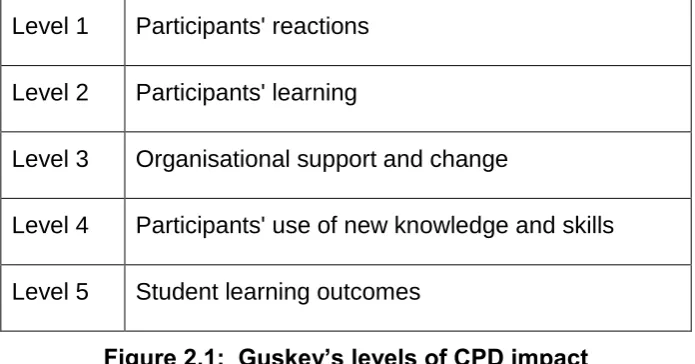
Guskey's (2000) model of CPD evaluation is based on five levels (Figure 2.1). In
order to evaluate the effectiveness of CPD, data is gathered to assess whether
the programme led to change at any of the levels. For example, at level 1,
participants can be asked whether they felt the CPD was useful and enjoyable. At
levels 2 and 4 respectively, participants may be asked to explain what they
11
highest level, evidence can be gathered of changes in pupil outcomes. Guskey
suggests that impact at one level is a pre-requisite for the next.
Level 3 is somewhat contentious (Coldwell and Simkins 2011). It is relatively
straightforward to establish whether or not a CPD participant effected any change
in their school as a result of the CPD, but within level 3 is also the idea of
organisational support. This is not so much a measure of impact as one of van Driel’s (2012) six core features. It may therefore act as facilitator or blocker to the
higher levels of impact (Coldwell, Simkins and Maxwell 2009), but is not an
evaluative measure.
Level 1 Participants' reactions
Level 2 Participants' learning
Level 3 Organisational support and change
Level 4 Participants' use of new knowledge and skills
[image:17.595.131.479.279.461.2]Level 5 Student learning outcomes
Figure 2.1: Guskey’s levels of CPD impact
Guskey’s model has credibility due to its wide use, but its linearity suggests a
simplified view of the change process. It is possible to imagine scenarios where
each level is not dependent on the previous: participants could use their new
knowledge without having organisational support or effecting change in their
colleagues (Coldwell and Simkins 2011). Perhaps most importantly, participants
seem to be treated here as passive recipients of new learning, rather than active
agents of change.
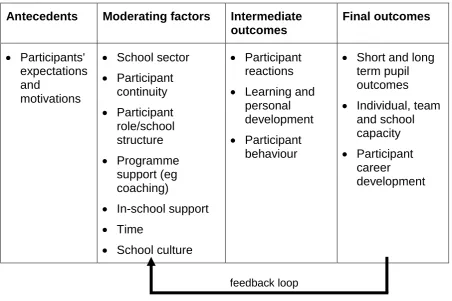
Coldwell and Simkins (2011) propose a more complex model which brings into
play further factors. Rather than Guskey's level 3 being a stepping-stone towards
classroom impact, they situate it as one of a series of moderating factors which
may impact on outcomes at any stage (Figure 2.2). Interestingly, these
12
duration, coherence with school policies, and organisational support. Coldwell and Simkins also acknowledge the importance of participants’ motivation for taking part in CPD, which they call antecedents. This links to van Driel’s features of
focus and coherence.
Antecedents Moderating factors Intermediate outcomes
Final outcomes
Participants' expectations and
motivations
School sector
Participant continuity
Participant role/school structure
Programme support (eg coaching)
In-school support
Time
School culture
Participant reactions
Learning and personal development
Participant behaviour
Short and long term pupil outcomes
Individual, team and school capacity
[image:18.595.79.532.162.463.2] Participant career development
Figure 2.2: Coldwell and Simkins’ model of CPD evaluation
In this model, intermediate outcomes still form staging posts on the way to
classroom impact, but the final outcomes are divided into three sections: short-
and long-term pupil outcomes, participant's career development, and changes in
the teaching capacity of the participant and their school. Importantly, these last
outcomes can cycle through a feedback loop to further effect or hinder change.
In order to evaluate the impact of the CPD, data can be gathered about
intermediate and/or final outcomes.
Coldwell and Simkin's model improves on Guskey’s by acknowledging the role of
the participants in change, through the highlighting of their motivations, roles and
behaviour throughout the process, and shows how moderating factors can
enhance or hinder change at any stage. However, the process described is still
13
In order to move beyond these linear models of CPD, Clarke and Hollingsworth
[image:19.595.82.540.213.500.2](2002) developed their interconnected model of teacher professional growth
(Figure 2.3). This model contains four domains of change which are linked by two processes: enactment and reflection. Multiple and complex “change sequences”
(Clarke and Hollingsworth 2002, p958) can be drawn through the domains to
indicate the processes of learning as a result of CPD.
Figure 2.3: Clarke and Hollingsworth model of teacher professional growth
This model focuses attention away from the mechanism of CPD delivery and
towards its impact on individuals. It highlights a number of features of the change
process, including:
the importance of reflection as a change process;
the non-linearity of change;
a lack of guarantee that input (in the external domain) will lead to classroom outcome (in the domain of consequence);
external source of information or stimulus
external domain
professional experimentation domain of practice
knowledge, beliefs, attitudes personal domain
salient outcomes domain of consequence
reflection
14
the importance of participants’ knowledge, beliefs and attitudes, reflecting van Driel’s core feature of coherence and Coldwell and Simkins’
antecedents.
The model also shows that participants can feed back into the external domain
themselves, thereby providing an example of the core feature of collaboration, with
teachers working together. Other core features of effective CPD can also be
located in the model: active learning might be found in professional
experimentation, school support in the external domain, a focus on the classroom
in the domain of consequence, and duration through a series of iterative cycles
between the domains of change, which may or may not lead ultimately to an
improvement in pupil outcomes.
While this model is not in itself evaluative, it suggests three possibilities for the
collection of data with which to carry out an evaluation. First, CPD programmes
can be categorised based on their intended impacts in each domain of change
(van Driel et al. 2012). Next, the model allows for a sophisticated analysis of CPD
through the identification of change sequences followed by participants (Clarke
and Hollingsworth 2002). Through this analysis, it may be possible to identify
facilitators and blockers to particular pathways of change. Finally, data can be
gathered from CPD participants on their learning, which is classified against each of the four domains in order to analyse where exactly a programme’s impacts
were felt. This is the process was used to evaluate Expert Episodes.
2.5 Summary
This chapter explored three themes in continuing professional development: the
core features of effective CPD, the use of video observation and the evaluation of
its impact. In the first section, a research synthesis by van Driel was used to
identify six core features of effective CPD: focus, active and enquiry-based
learning, collaboration, duration, coherence and organisational support. Next, the use of video observation in CPD was described, and van Driel’s core features
15
Coldwell and Simkins’ more complex model, to Clarke and Hollingsworth
interconnected model of teacher growth. A number of ways of analysing the
impact of CPD using this non-linear model were suggested.
In the next chapters, the development, delivery and evaluation of Expert Episodes
16
Chapter 3: Methodology
3.1 Introduction
In this chapter the methodology of the project carried out for this dissertation is
described. Firstly, action research, the research strategy which underpinned the
development, delivery and evaluation of the programme, will be explained and its
choice justified, considering its benefits and limitations compared with other
strategies. Next, the Expert Episodes programme is described, looking at its
content and delivery structure. Following this, the evaluation methodology is
explored, looking at both data collection and data analysis. Included here is a
discussion of the ethical issues involved in the project. The findings of the data
analysis and their implications are discussed in Chapter 4.
3.2 Research strategy
The aim of the Expert Episodes project, as described in Chapter 1, was to trial and
evaluate a programme of professional development for professional development
leaders. Since the project is situated in my own practice, it lends itself to the
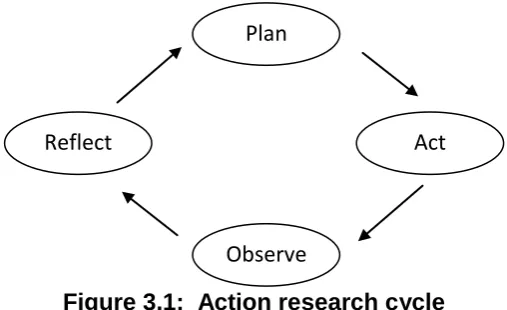
enquiry-based structure of action research (Bolton 2010), which begins with a question or problem about one’s own practice, and moves through a cycle of
[image:22.595.177.431.525.680.2]implementation and evaluation (Figure 3.1).
Figure 3.1: Action research cycle
Action research is “research done by people on their own work, to help them improve what they do” (Cohen, Manion and Morrison 2011, p346). Here, I am
aiming to improve the work I do with teams of professional development leaders Plan
Observe
17
by finding ways to support them better. Action research lends itself to small-scale
interventions and an examination of their effects (Cohen, Manion and Morrison
2011), which again matches the structure of this project: an intervention with a
small number of participants and a short timescale. It allows the use of a range of
methods of data collection and analysis (Loucks-Horsley et al. 2010), thereby
providing freedom to collect whatever data might be useful in evaluating the
programme. Finally, action research is increasingly used as a model of teacher
professional development, whereby teachers are empowered to enquire into and
solve problems in their own practice (McNiff 2002). It seemed that using action
research here could promote the strategy to participants as a way in which they
could work with teachers.
Action research has some limitations. For example, its small scale does not
necessarily produce findings which are generalisable, since participants may not
be typical, and so any findings may not be transferable to other situations (Riggall
2009). There is also a bias inherent in practitioner-led research: the researcher is
bound up in the project so that subjectivity is unavoidable, and, since participants
have an ongoing relationship with the researcher, they may be unwilling to
express negative views (Riggall 2009).
Other research methodologies, including large-scale data collection, experimental
methods and other enquiry-based strategies could have been used instead of
action research. These are now discussed, looking at why they were not chosen
over action research. Firstly, this research is not suited to large-scale data
collection methodologies such as surveys (Cohen, Manion and Morrison 2011), in
which data is gathered from a large number of participants, nor to longitudinal
studies (Cohen, Manion and Morrison 2011), in which data is gathered over a long
period of time. Either of these would have been appropriate for research into the
identities of professional development leaders, or into how their skills change over
time, but in this case, with a single small-scale, practice-based intervention under
investigation, an approach based on an evaluative enquiry is more appropriate.
However, it is possible to imagine experimental approaches to the research
(Cohen, Manion and Morrison 2011). For example, two cohorts of professional
18
Expert Episodes programme, and one group to act as a control without
participation. Their experiences over the duration of the programme could then
have been compared in order to assess the impact of the Expert Episodes
programme on participants’ practice. Alternatively, in a procedure similar to that of
single-case experimental research (Cohen, Manion and Morrison 2011), data from
the participants, such as course evaluations, could have been compared before
and after participation in the programme.
Case studies are the in-depth exploration of a single instance of a situation
(Cohen, Manion and Morrison 2011), with the aim of generating knowledge which can be generalised. They “observe effects in real contexts” (Cohen, Manion and
Morrison 2011, p289) so that their causes can be determined. In common with
action research, case studies use mixed methods of data collection and analysis, providing detailed insights into participants’ situations. However, a case study
gives only a snapshot of the participants and does not link intervention to
evaluation, nor provide a structure which suggests routes to further development.
These strategies could have been effective, but they lose sight of some key
issues. Firstly, they suggest the need for an impartial observer as researcher.
This is clearly not the case here: I am the programme leader as well as the
researcher and am bound up in the programme in such a way as to make
impartiality impossible. Perhaps more importantly, what is needed here is not just
to understand whether or not the programme had an impact, but to try to draw out
the reasons for this by exploring the experiences of the participants in the
programme. It therefore lends itself to an enquiry-based strategy such as action
research in which rich data can be generated and analysed.
For this project, then, a small-scale pilot intervention aimed at improving the
practice of professional development leaders, leading to the further development
of CPD programmes, action research provided a number of benefits. These
included the opportunity to use mixed methods of data collection and analysis, its
cyclical, improvement-driven structure and the opportunity to examine the impacts
of the programme on a range of levels, including my own practice and that of the
19
“gaining a better understanding and seeking to create improvements” (Riggall
2009, pvi), both key aims in the development and delivery of Expert Episodes.
The action research cycle (Figure 3.2) is therefore used as to structure the
[image:25.595.94.518.174.412.2]following sections as I move through the stages of act, observe and reflect.
Figure 3.2: Action research structure of Expert Episodes programme
3.3 Development and delivery of the Expert Episodes programme
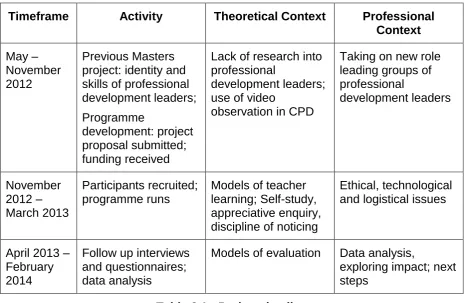
In this section, the “act” stage of the action research cycle is described: the
development and delivery of the Expert Episodes programme. The programme
ran for around eighteen months (Table 3.1). Each phase was informed by key
theories from the literature (Theoretical Context) and by my role in the national
network of Science Learning Centres and my learning as a Masters student
(Professional Context).
Plan: next steps
Observe: data collection
and analysis
Act: programme development and
delivery anddelivery
20
Timeframe Activity Theoretical Context Professional Context
May – November 2012
Previous Masters project: identity and skills of professional development leaders;
Programme
development: project proposal submitted; funding received
Lack of research into professional
development leaders; use of video
observation in CPD
Taking on new role leading groups of professional development leaders November 2012 – March 2013 Participants recruited; programme runs
Models of teacher learning; Self-study, appreciative enquiry, discipline of noticing
Ethical, technological and logistical issues
April 2013 – February 2014
Follow up interviews and questionnaires; data analysis
Models of evaluation Data analysis,
[image:26.595.72.538.100.403.2]exploring impact; next steps
Table 3.1: Project timeline
The content and structure of the Expert Episodes programme were devised so
that participants could gain understanding on three levels. Firstly, by observing professional development leaders “in action”, it was hoped that they would
generate knowledge about what makes them effective. Secondly, using video
observation technology to do this would enable participants to evaluate its
usefulness in CPD. Finally, by enquiring into their own practice, participants would
be better equipped to support teachers in enquiry-based CPD. The intended
learning outcomes (Joyce and Calhoun 2010), therefore, of Expert Episodes, as
they related to the participants, were to:
improve their understanding of the skills and pedagogies used by effective professional development leaders;
trial and evaluate the use of video observation and sharing technology to
support practitioners in developing their practice;
21
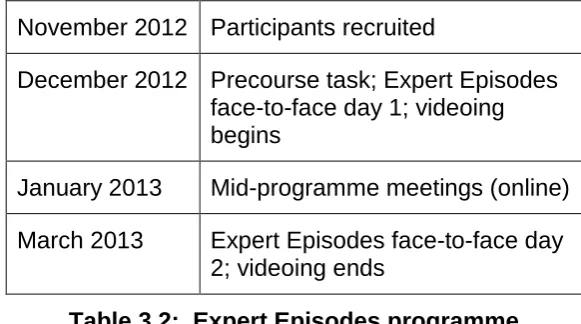
Participants worked together over four months (Table 3.2), building a community of enquiry (Kennedy 2005) in which they collaborated as “coaches and modellers of ideas, strategies and techniques” (Hamilton 2013, p45).
November 2012 Participants recruited
December 2012 Precourse task; Expert Episodes face-to-face day 1; videoing begins
January 2013 Mid-programme meetings (online)
[image:27.595.157.448.144.306.2]March 2013 Expert Episodes face-to-face day 2; videoing ends
Table 3.2: Expert Episodes programme
Participants were expected to engage not only with recording, observing and
analysing videos of their CPD delivery, but also with theories of enquiry-based
CPD and teacher learning. By combining these two key strands, it was hoped that the programme would achieve van Driel’s core features of focus on practice,
collaboration and enquiry-based learning. The duration seemed sufficient for each
participant to record at least one video clip and coherence was achieved by allowing participants’ to bring their own problems and interests to the video
analysis, rather than prescribing what was to be observed. The final core feature,
organisational support, was promoted through the Science Learning Centre
bursaries.
3.3.1 Participant recruitment
A letter of invitation (Appendix A) was sent to colleagues within the national
network of Science Learning Centres. The aim was to attract between six and ten
participants, based partly on the reported effectiveness of this group size (Newton
and Sorensen 2010), and pragmatically on the amount of bursary funding. Seven
participants joined the programme. Further information on the participants can be
22
3.3.2 Precourse tasks
Pre-course tasks (Appendix B) were:
completion of an intended learning outcomes form;
the choosing of a metaphor for the role of a professional development leader;
reading an extract relating to one of three enquiry-based CPD strategies.
The aims of these tasks were respectively to encourage participants to reflect on
why they had chosen to take part in the programme and what they were hoping to
gain from it, to think about their professional identity, perhaps articulating
something previously unconsidered (Bolton 2010), and to become more aware of
either the discipline of noticing (Mason 2002), appreciative enquiry (Shuayb et al.
2009) or self-study (Samaras 2011).
3.3.3 Face-to-face-days
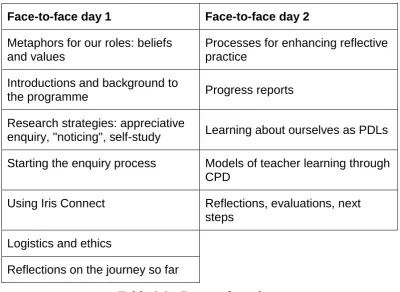
The programme contained two face-to-face days (Table 3.3), aimed at bringing
participants together to share experiences and thereby build the community of
enquiry. The first face-to-face day (Appendix C) included discussion of precourse
tasks, opportunities to trial the video observation technology, to consider ethical
and logistical issues and to reflect on what aspects of practice might benefit from
exploration through video.
The second day (Appendix D) ended the formal CPD activity of the programme. It
included opportunities to reflect on the processes used in the programme, to carry
out a brief analysis of video feedback forms (see below), and to engage with Clark
and Hollingsworth's model of teacher professional growth (Clarke and
Hollingsworth 2002), through a simple mapping activity where CPD activities were
23
Face-to-face day 1 Face-to-face day 2
Metaphors for our roles: beliefs and values
Processes for enhancing reflective practice
Introductions and background to
the programme Progress reports
Research strategies: appreciative
enquiry, "noticing", self-study Learning about ourselves as PDLs
Starting the enquiry process Models of teacher learning through CPD
Using Iris Connect Reflections, evaluations, next steps
Logistics and ethics
[image:29.595.104.505.69.361.2]Reflections on the journey so far
Table 3.3: Face-to-face days
Both face-to-face days were attended by all seven participants.
3.3.4 Mid-programme meetings
Between the two face-to-face days, two online meetings were held (Appendix E).
These gave participants the opportunity to share logistical and technological
issues of video observation, and discuss key themes emerging from the
observations. Each meeting was attended by three participants.
3.3.5 Video observation
The video observation system chosen for Expert Episodes was Iris Connect. Iris
Connect has been purchased by over six hundred schools in the UK (Iris Connect
2013), and is being used by schools and teachers for CPD activities including self-
and peer-observation, coaching, and sharing best practice (Preston 2013). Using
Iris Connect, one can record, share and review videos of classroom practice,
24
Underpinning the video observation were three enquiry-based strategies: noticing
(Mason 2002), appreciative enquiry (Shuayb et al. 2009), and self-study (Samaras
2011), which were introduced to participants through pre-course readings and
discussion on the first face-to-face day. Each of these strategies was promoted as
a way of enhancing the processes of reflection in the context of video analysis. Firstly, the “discipline of noticing” (Mason 2002) involves the identification of “salient events” (Newton and Sorensen 2010), in order to consider their causes
and implications. It was hoped that this strategy would support the development of participants’ “professional vision” (Sherin and Han 2004, p179), so that they could identify useful issues in the videos. Next, appreciative enquiry “builds on people’s basic strengths” (Steyn 2012, p320). Beginning with the identification of
good practice (Zandee and Cooperrider 2007), I hoped that participants would
focus on identifying and interpreting the positives in their videos, rather than getting caught up in negatives. Finally, self-study is a way of enquiring into one’s
own practice, through reflection and generating strategies for improvement
(Dinkelman 2003). Self-study is well-matched to video observation as a way of gathering evidence about one’s own practice, and I hoped that introducing the
strategy to participants would help them to feel their enquiry was legitimate
research.
The participants were divided into two critical friendship groups. After a participant
had analysed their own video, their critical friends did the same, in order to “provide optimal feedback, enhance self-reflection…and ease anxiety” (Samaras
2011, p75). The intention was that the critical friend would not only comment on their observations of the video, but also on the participant’s own comments on the
video, thereby moving from evaluative commenting (Coles 2013) towards
interpretation. To support the analysis of the videos, I wrote two semi-structured
questionnaires, one for the video owner and one for their critical friends, which
were contained within the Iris Connect website. The protocol (Appendix F), which also details the questions in the questionnaires, aimed to structure participants’
25
3.3.6 Follow-up activity
Two follow-up activities took place after the programme: an interview, about a
month after the second face-to-face day, and a questionnaire, eight months later.
The aim of these two activities was to provide data for the evaluation of the
programme, so more information is provided about them in the next section, but
they supported longer-term impact by giving participants a chance to reflect on
their experiences of the programme.
3.4 Data collection
The next sections form the “observe” stage of the action research cycle, in which
data was collected to evaluate the Expert Episodes programme. A range of data
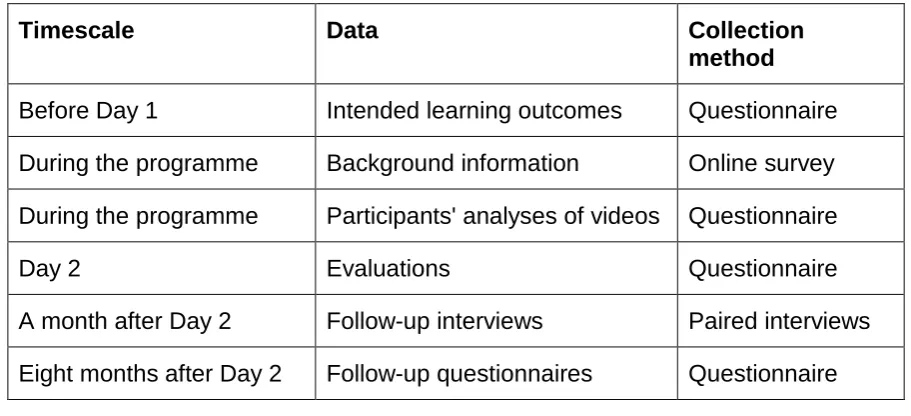
was collected before, during and after the programme (Table 3.4).
Timescale Data Collection
method
Before Day 1 Intended learning outcomes Questionnaire
During the programme Background information Online survey
During the programme Participants' analyses of videos Questionnaire
Day 2 Evaluations Questionnaire
A month after Day 2 Follow-up interviews Paired interviews
[image:31.595.76.532.360.568.2]Eight months after Day 2 Follow-up questionnaires Questionnaire
Table 3.4: Data collection
Data was collected using three methods: questionnaires, interviews and an online
survey. The aim was to provide participants with a number of occasions on which
to express their views, providing a crosscheck of their opinions (Onwuegbuzie and
Leech 2007). Most data was qualitative, although a small amount of quantitative
data was also collected. Data was collected from before the start of the
programme to around eight months after its end, allowing participants time to
reflect on their views and to cross-check initial findings (Onwuegbuzie and Leech
26
throughout from all participants, thereby avoiding the bias inherent in choosing the
views of particular participants.
Another layer of information could have been added by gathering data from teachers involved in participants’ CPD sessions. Teachers could have been
interviewed, or their evaluation forms collected, from sessions before and after
participation in Expert Episodes, and this data compared to look for changes in
practice. However, this could have presented a threat to the participants, leading
them to feel that their effectiveness was under scrutiny. I preferred to allow
participants to bring their own views to the programme, thereby showing that I
valued their professional judgement.
All data was collected in writing apart from the follow-up interviews, which were
video-recorded. The advantages and disadvantages of writing and video
recording are discussed next.
3.4.1 Written data
It was hoped that providing time and space for writing individually would lead
participants to be more honest and reflective (Bolton 2010). The evaluation forms
(Appendix G) were completed during a face-to-face session in order to ensure a full response rate, which may however have restricted some participants’
responses to the questions, through feeling pressurised to complete quickly or conform to other participants’ views (Vicsek 2010). When questionnaires are
completed away from the face-to-face environment, there is less likelihood of a full
response rate (Bell 2007), and this was the case with the follow-up questionnaire
(Appendix H), which was returned by only five of the seven participants. The
background information survey (Appendix I) was completed online, the advantage of this being that responses could be collated and compared easily. Participants’
analyses of the video-recorded CPD episodes formed an integral part of the
Expert Episodes programme, and were not deliberately structured to provide
evaluative data. However, they were analysed for key learning points and so are
27
A mixture of closed and open responses was used (McNiff 2013). Closed
response questions were used in the background information survey and in the
evaluation forms, which contained a few ratings scale questions. The scale used
(very good, good, satisfactory, poor) may bias responses towards the positive, and
is open to interpretation (Bell 2007): what is the difference between good and very
good? Do all participants have the same understanding of good? However, this
scale is used on all Science Learning Centre evaluation forms, and so its use
seemed appropriate here. A final issue here is the validity of the data when
participants may feel reluctance to provide negative feedback to someone they
know (Cohen, Manion and Morrison 2011), and so this may further bias responses
towards the positive.
The more open questions aimed to gather useful information without restricting participants’ ability to write freely. However, the use of such prompts may force
participants into responses which do not represent their true opinions and feelings
(Cohen, Manion and Morrison 2011). Space was therefore left for a question
which asked participants to provide any other relevant information. Responses to
semi-structured questions can be difficult to interpret. Questions may be
misinterpreted or meanings of responses obscured by abbreviation or a lack of
nuance. In some cases, in order to clarify what they had written, participants were
able to follow up their written texts in face-to-face discussions, such as with the
intended learning outcomes form (Appendix J).
3.4.2 Video recordings
The follow-up interviews were carried out with pairs of participants. These
interviews were semi-structured (Ribbins 2007), with questions (Appendix K) being
sent to participants in advance so that they had an opportunity to consider their
responses before the interview. There was a pragmatic reason for choosing
paired interviews rather than individual: it was easier to schedule three paired
interviews than six or seven individual interviews. More importantly, though, I
hoped that by having more than one person in the interview, a free-flowing
discussion would take place, with my contributions being limited (Parker and
no-28
one would feel threatened by dominant members and unable to express minority
opinions (Smithson 2000).
The interviews were video recorded. A number of sessions in the programme
were also video recorded: selected discussions from the two face-to-face days
and the two online meetings. Although these videos were not analysed formally,
they were used in places to provide supporting quotes from participants. I used
video to record the interviews and discussions because I did not trust my ability to
take comprehensive notes capturing the discussions, but needed a record of what
was being said. Audio recording provided an alternative but audio does not capture people’s body language and movements, and this, I found in previous
research, makes analysis difficult, especially in situations where one speaker may
interrupt or speak over another (Cohen, Manion and Morrison 2011).
A problem with video is the amount of data gathered; a degree of selectivity is
inevitable in the choice of what to analyse, thereby leading to potential loss of
alternative viewpoints (Cohen, Manion and Morrison 2011). Videos were not
transcribed in full; after review, only sections relevant to the evaluation were
transcribed (Ribbins 2007). The recording of the sound in one of the interviews
suffered a technical problem, and so this video was inaudible. However, I made
notes following the meeting, and used these for analysis in the same way as the videos, so these participants’ contributions are not entirely overlooked. One
participant was unable to attend any of the interviews, and, although he was
invited to email any comments, he did not respond. Interview data is therefore
drawn from six participants.
3.5 Ethical issues
In this section, ethical issues surrounding the collection and analysis of data for
the evaluation of the Expert Episodes programme are described (Appendix L).
The project was multi-layered in terms of the video recording of both participants
and teachers, and in terms of my role as professional development leader,
29
3.5.1 Participants
Participants were invited to take part Expert Episodes via a letter (Appendix A)
which aimed to help them consider the benefits of taking part. The aim was to
attract between six and ten participants. If more than this number had volunteered
to participate in the programme, participants would have been chosen firstly to
ensure a mix of backgrounds, and secondly to support easy travelling to the
face-to-face meetings. Any additional volunteers would have been added to a waiting
list for further cohorts of the programme. Potential participants were sent a
consent form (Appendix M) which contained further details of the Expert Episodes
programme and the evaluation study. Seven volunteers returned consent forms
and so all were able to participate.
Some participants may have felt at risk from the peer review of their CPD
sessions, leading to reduced confidence in their ability to deliver CPD. This might
especially be the case here, since not only was I running the project, but I also
have a degree of power in the commissioning of participants for CPD delivery.
Participants were therefore given control over what they recorded and shared, and
were able to direct the focus of the video analysis towards particular aspects of
their practice. Critical friendship groups were asked to use the principles of
appreciative enquiry (Steyn 2012), so that they looked for positives in the
participants’ practice rather than focussing on areas for development. Participants
were also asked to respect confidentiality within the CPD programme and not discuss individuals’ delivery or opinions outside the participant group. In this dissertation, participants’ names have been changed.
Video clips were stored in the secure Iris Connect website, for which all users hold
licenses. The owner of the video has control over which users they share it with,
and in this case, videos were shared only within critical friendship groups. It was
made clear to participants that they should not store videos on their own
computers. All other data is stored on secure, password-protected servers owned
by Sheffield Hallam University.
Technical issues with video recording were another potential threat to the
confidence of the participants. Although time was spent on the first face-to-face
30
required support to put right, and these did in some cases hinder participants’
engagement with the programme.
It was possible that participants may also have felt some threat from admitting to
teachers that they were engaged in a programme aimed at developing their
practice. Participants were therefore given detailed information sheets to hand out
as part of the teacher consent process (see below), and encouraged to explain
that they too were engaged in reflective enquiry into their practice, thereby
modelling how this process might work for teachers. It was hoped that this would
in fact enhance their credibility with teachers.
3.5.2 Teachers
Teachers in the sessions which participants wished to record were informed of the
purpose of the Expert Episodes programme and of the research study. Signed
consent forms (Appendix N) were collected before recording began, and if
teachers did not give consent, the participant did not record the session.
It was hoped that teachers would see the benefits of participation, leading to a
greater appreciation of their CPD and of their professional development leader.
However, they may have felt threatened by being recorded, leading to a negative
impact on their CPD. To minimise this threat, the letter of consent aimed to make
it clear that videos would be uploaded to a secure environment, only watched by
participants in the programme, and that the focus of the recording was the professional development leader and not the teachers’ experiences or opinions,
except as they related to the CPD session.
One particular issue is that consent for the research study was obtained by a third
party: the professional development leader, rather than by the researcher. I
hoped that the detailed teacher consent form would support participants in
explaining the potential benefits of the research study, and, on the first
face-to-face day of Expert Episodes, we spent time discussing the ethics of the research
study, so that participants felt confident to discuss these with teachers. I also
offered, where needed, to attend recording sessions in order to explain these
31
3.5.3 Myself
My participation in Expert Episodes operated on three levels: the professional
development leader for the programme, a participant exploring the use of video
and the researcher carrying out the evaluation. These multiple roles lead to some
tension and uncertainty for my relationship with the participants (Busher and
James 2007).
A particular issue was my role as someone who commissions and quality assures the participants’ CPD delivery for the national network of Science Learning
Centres. As mentioned above, this may have threatened them, but equally, by
opening up my own practice to scrutiny, not just through delivering the
programme, but also through allowing my own CPD sessions to be recorded and
analysed, I could have lost credibility. I hoped that, by modelling the process of
reflective analysis of my practice, I would instead gain respect, thereby reinforcing
my relationships with the participants. At times, though, this felt a difficult
balancing act.
Equally, since the programme had been funded by the national network of
Science Learning Centres, I felt under some pressure to ensure a successful
outcome, so that I did not lose credibility with my colleagues. I hoped to alleviate
any potential damage here through making it clear that this project was a pilot with
the specific aim of further development before any further roll-out to other
participants.
3.6 Data analysis
Data was analysed to draw out information on the impact of the programme.
Three techniques were used: frequency tallying, identification of themes, and a categorisation framework based on Clarke and Hollingsworth’s (2002) model of
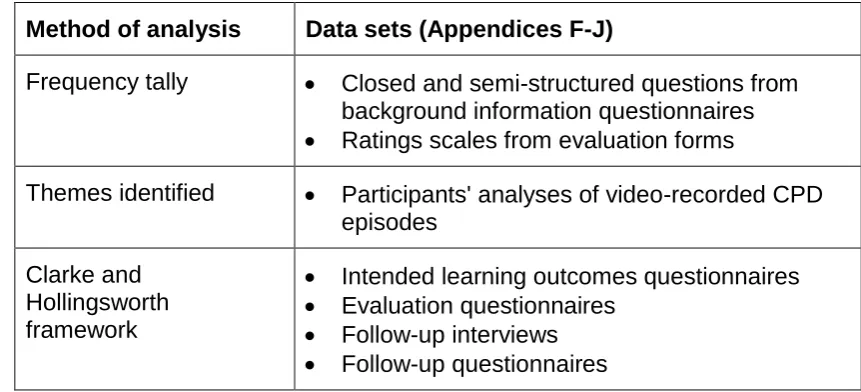
interconnected teacher growth (Table 3.5). Using different techniques, a more
reliable picture of the data could be built up with each piece of data providing a
32
Method of analysis Data sets (Appendices F-J)
Frequency tally Closed and semi-structured questions from background information questionnaires
Ratings scales from evaluation forms
Themes identified Participants' analyses of video-recorded CPD episodes
Clarke and Hollingsworth framework
Intended learning outcomes questionnaires
Evaluation questionnaires
Follow-up interviews
[image:38.595.85.516.71.267.2] Follow-up questionnaires
Table 3.5: Data analysis methods
Each method of analysis is described below. The findings from the analyses are
presented in Chapter 4.
3.6.1 Frequency tally
Two data sets contained closed questions where responses were tallied. With the
background information questionnaires, responses to the closed questions were
tallied to give the frequency of each response. Similar responses were grouped
into ranges, and the data tabulated to show the frequency of each range. With
closed, numerical questions such as these, there is little room for interpretation,
although the choice of ranges could be questioned, since, in this situation, they
provided little differentiation between participants (see Section 4.2 for the results
of this analysis). With the evaluation forms, the ratings questions were simply
tallied for frequency of response to each of the categories. Finally, frequency
tallies were also used to further analyse some of the data categorised using the
Clarke and Hollingsworth framework (see below).
By tallying in this way, data becomes detached from its participant, and this limits
the ability to track data from specific individuals. However, the aim here was to
provide a simple overview of the characteristics and opinions of the participants as
33
3.6.2 Themes identified
The proformas from each uploaded video (a sample can be found in Appendix P)
were analysed to identify the features of practice which were being noticed. After
these features were identified, they were grouped and categorised. The
categorisations used here were open to some interpretation. Not every comment
fit readily into one category and some could have been placed into more than one.
However, again the aim was to generate an overview of what features were being
noticed by the participants, not a detailed analysis of why these features were
considered important, and so this method of analysis seemed appropriate.
3.6.3 Clarke and Hollingsworth framework
The interconnected model of teacher professional growth (Clarke and
Hollingsworth 2002) (Figure 2.3) provided a novel way to explore participants’
learning. A framework based on the model was used to analyse four data sets:
intended learning outcomes forms, evaluation forms, follow-up questionnaires and
the follow-up interviews.
For the analysis, each of the four domains of change was related to particular
aspects of participant learning, providing four coding categories (Samaras 2011). Firstly, in the personal domain, change was related to participants’ knowledge,
beliefs and attitudes, such as improvements in understanding of a particular
pedagogical concept, increased confidence, or greater reflection on practice.
Changes in the domain of practice were shown by the use of new activities in the
delivery or evaluation of CPD, such as a different technique for organising
teachers into groups, or, as would be hoped here, the adoption of new CPD
strategies, like enquiry-based models or video observation. The external domain
was used to represent input from and output to other sources, including other
participants or academic readings. It was also used when participants themselves
fed back into the external domain, for example by asking about their own videos.
In the domain of consequence, for teachers, salient outcomes refer to observable
changes in the classroom, whether positive or negative. With professional