Manuscript version: Author’s Accepted Manuscript
The version presented in WRAP is the author’s accepted manuscript and may differ from the published version or Version of Record.
Persistent WRAP URL:
http://wrap.warwick.ac.uk/120903
How to cite:
Please refer to published version for the most recent bibliographic citation information. If a published version is known of, the repository item page linked to above, will contain details on accessing it.
Copyright and reuse:
The Warwick Research Archive Portal (WRAP) makes this work by researchers of the University of Warwick available open access under the following conditions.
Copyright © and all moral rights to the version of the paper presented here belong to the individual author(s) and/or other copyright owners. To the extent reasonable and
practicable the material made available in WRAP has been checked for eligibility before being made available.
Copies of full items can be used for personal research or study, educational, or not-for-profit purposes without prior permission or charge. Provided that the authors, title and full
bibliographic details are credited, a hyperlink and/or URL is given for the original metadata page and the content is not changed in any way.
Publisher’s statement:
Please refer to the repository item page, publisher’s statement section, for further information.
How Do Expectations About the Macroeconomy Affect Personal
Expectations and Behavior?
∗Christopher Roth
Johannes Wohlfart
June 23, 2019
Using a representative online panel from the US, we examine how individuals’
macroeco-nomic expectations causally affect their personal ecomacroeco-nomic prospects and their behavior.
To exogenously vary respondents’ expectations, we provide them with different
profes-sional forecasts about the likelihood of a recession. Respondents update their
macroeco-nomic outlook in response to the forecasts, extrapolate to expectations about their
per-sonal economic circumstances and adjust their consumption plans and stock purchases.
Extrapolation to expectations about personal unemployment is driven by individuals with
higher exposure to macroeconomic risk, consistent with macroeconomic models of
imper-fect information in which people are inattentive, but understand how the economy works.
JEL Classification: D12, D14, D83, D84, E32, G11
Keywords: Expectation Formation, Information, Updating, Aggregate Uncertainty, Macroeconomic Conditions.
∗ Christopher Roth, Institute on Behavior and Inequality (briq), Bonn, e-mail:
[email protected]; Johannes Wohlfart, Department of Economics, Goethe University Frankfurt,
e-mail: [email protected]. We would like to thank the editor, Olivier Coibion,
as well as two anonymous referees for thoughtful comments that improved the paper
consid-erably. We thank Goethe University Frankfurt and Vereinigung von Freunden und F¨orderern
der Goethe Universit¨at for financial support. Johannes Wohlfart thanks for support through
the DFG project “Implications of Financial Market Imperfections for Wealth and Debt
Ac-cumulation in the Household Sector”. We received ethics approval from the University of
Oxford. The online Appendix is available athttps://goo.gl/MTJ8hG and the experimental
1
Introduction
Households’ expectations about their future income affect their consumption and
fi-nancial behavior and should be shaped by perceptions of both idiosyncratic and aggregate
risk. Policymakers attach an important role to the macroeconomic outlook of households,
and low consumer confidence about the aggregate economy is central to many accounts
of the slow recovery of consumption after the Great Recession. However, aggregate risk
only accounts for a small fraction of the total income risk faced by households.
Macroe-conomic models of imperfect information therefore predict that households are typically
uninformed about news that are relevant for the macroeconomic outlook (Ma´ckowiak and
Wiederholt, 2015; Reis, 2006; Sims, 2003). This raises two questions: First, are relevant
pieces of news about the macroeconomy, such as professional forecasts about economic
growth, part of households’ information sets? Second, do households adjust their
expec-tations about their own economic situation and their behavior in response to changes in
their expectations about aggregate economic growth?
In this paper, we use experimental methods to test for the causal effects of
house-holds’ expectations about future macroeconomic conditions on their personal economic
prospects and behavior.1 We propose a randomized information experiment embedded
in an online survey on a sample that is representative of the portion of the US
popula-tion that is employed full-time. Our experiment proceeds as follows: first, we elicit our
respondents’ prior beliefs about the likelihood of a recession. We define a recession as a
fall in US real GDP around three months after the time of the survey. Subsequently, we
provide our respondents with one of two truthful professional forecasts about the
likeli-hood of a recession taken from the micro data of the Survey of Professional Forecasters
(SPF). Respondents in the “high recession treatment” receive information from a very
pes-simistic forecaster, while respondents in the “low recession treatment” receive a prediction
from a very optimistic forecaster. Thereafter, we measure our respondents’ expectations
1 Identifying this causal channel is important as research shows that people’s personal
situation affects their macroeconomic expectations (e.g., see Kuchler and Zafar (2018)).
about the evolution of aggregate unemployment and their personal economic situation
over the 12 months after the survey, and elicit both their consumption plans as well as
their posterior beliefs about the likelihood of a recession. We re-interview a subset of our
respondents in a follow-up survey two weeks after the information provision.
Our experimental design allows us to study whether people adjust their personal job
loss and earnings expectations and their economic behavior in response to changes in
their macroeconomic outlook. Moreover, the setup enables us to shed light on different
predictions of macroeconomic models of imperfect information, which parsimoniously
explain many stylized facts in macroeconomics (Carroll et al., 2018; Ma´ckowiak and
Wiederholt, 2015) and dramatically change policy predictions relative to standard models
(Wiederholt, 2015). In such models, people are imperfectly informed about the state of
the economy, due to either infrequent updating of information sets (Carroll, 2003; Mankiw
and Reis, 2006; Reis, 2006) or receiving noisy signals (Ma´ckowiak and Wiederholt, 2015;
Sims, 2003; Woodford, 2003). For example, an adjustment of our respondents’ beliefs
in response to the information implies that they are imperfectly informed about the
professional forecasts, even though those forecasts are relevant for their economic outlook.
We document several findings on people’s recession expectations and their relationship
to people’s personal economic outlook and behavior: first, we find that our respondents
have much more pessimistic and dispersed prior beliefs about the likelihood of a
reces-sion compared with profesreces-sional forecasters. Respondents update their beliefs about the
likelihood of a recession in the direction of the forecasts, putting a weight of around one
third on the forecast. Among those with a college degree, learning rates are significantly
higher for respondents who are less confident in their prior beliefs, in line with Bayesian
updating. For those without a college degree, there is no such heterogeneity. The findings
for highly educated respondents are in line with models of imperfect information in which
people are initially inattentive but update rationally after receiving new information.
Second, we explore the degree of extrapolation from recession expectations to personal
economic expectations. We find that a negative macroeconomic outlook has a negative
their perceived chance of becoming personally unemployed. A back-of-the-envelope
cal-culation suggests that 11.3 percent of our respondents would need to become unemployed
in case of a recession for their expectations to be accurate on average. This effect is large,
but still relatively close to the increase in the job loss rate by 7 percentage points during
the last recession. However, there is no significant average effect on people’s expected
earnings growth conditional on keeping their job. In the two-week follow-up survey,
dif-ferences in expectations decrease in size, but mostly remain economically and statistically
significant.
Third, we characterize heterogeneity in the effect of recession expectations on
per-sonal expectations. The negative effect on perceived job security is driven by individuals
with a higher exposure to past recessions, such as people with lower education and lower
earnings, as well as men. Individuals who are more strongly exposed to macroeconomic
risk (e.g. those with previous unemployment experience, those living in counties with
higher unemployment, or those working in more cyclical industries) more strongly
up-date their expectations about personal unemployment. Similarly, we provide evidence
of updating of earnings expectations conditional on working in the same job for groups
that should not be constrained by downward rigidity in wages. Thus, the updating of
personal expectations is data-consistent in terms of size and heterogeneity, indicating
that our respondents have an understanding of their actual exposure to recessions. The
assumption that people understand the true model of the economy is a key feature of
imperfect information models.
Fourth, we provide evidence of adjustments in behavior in response to the
informa-tion. We find that a more pessimistic macroeconomic outlook causes a significantly lower
planned consumption growth, in line with recent evidence that recessions can entail shocks
to permanent income (Krueger et al., 2016; Yagan, 2018). Furthermore, we document
surprisingly large effects of our treatment on active adjustments in people’s stockholdings
between the main intervention and the follow-up survey, measured with self-reports.
about economic growth and inflation.2 There was substantial disinflation during most
past recessions (Coibion and Gorodnichenko, 2015b) and many macroeconomic models
predict a co-movement of inflation and unemployment in response to shocks. However, our
fifth main finding is that exogenous changes in beliefs about the likelihood of a recession
do not decrease people’s inflation expectations.
We contribute to a growing literature that uses survey experiments to study the
expec-tation formation process and the importance of information rigidities. This literature has
mainly focused on expectations about inflation (Armantier et al., 2016, 2015; Binder and
Rodrigue, 2018; Cavallo et al., 2017; Coibion et al., 2018a) and house prices (Armona
et al., 2018; Fuster et al., 2018), documenting that consumers and firms update their
expectations in response to the provision of publicly available information. Our paper
is the first to exogenously shift households’ expectations about future GDP growth to
assess whether people extrapolate from expectations about aggregate conditions to their
personal economic outlook, and whether these expectations causally affect consumer and
financial behavior. A key contribution of our paper is to document that updating of
personal expectations in response to a revised macroeconomic outlook is driven by those
groups who are actually more strongly exposed to macroeconomic risk, suggesting that
households have a basic understanding of their exposure to business cycle fluctuations.
A larger literature uses observational data to study how people’s macroeconomic
ex-pectations are formed (Das et al., 2018; Goldfayn-Frank and Wohlfart, 2019; Kuchler
and Zafar, 2018; Malmendier and Nagel, 2011, 2016; Manski, 2017; Mian et al., 2018;
Tortorice, 2012), and how these expectations shape household behavior, such as the
ef-fect of home price expectations on housing-related behavior (Bailey et al., 2018a,b) or
the effect of inflation expectations on consumption behavior (Bachmann et al., 2015;
D’Acunto et al., 2018a). A literature in finance uses survey data to study the extent to
2 We build upon work examining how beliefs about unemployment correlate with beliefs
about interest rates and inflation (Carvalho and Nechio, 2014; Dr¨ager et al., 2016;
Kuchler and Zafar, 2018). Andre et al. (2019) measure respondents’ beliefs about how
which optimism and pessimism about stock returns and the macroeconomic outlook can
explain households’ investment behavior (Das et al., 2018; Greenwood and Shleifer, 2014;
Malmendier and Nagel, 2011; Vissing-Jorgensen, 2003). In a different context, namely
managerial decision-making, Coibion et al. (2018b) provide causal evidence showing that
higher inflation expectations lead firms to raise their prices, increase their utilization of
credit, and reduce their employment.
Our paper also contributes to a literature that uses observational data to study the
im-portance of information rigidities in macroeconomics (Carroll, 2003; Coibion and
Gorod-nichenko, 2012, 2015a; Mankiw et al., 2003).
The rest of the paper is structured as follows: Section 2 describes the design of the
main experiment and provides details on the data collection. In Section 3, we present
evidence on belief updating in response to the professional forecasts. Section 4 presents
the results on the causal effect of expectations about a recession on people’s personal
economic outlook, behavior and other macroeconomic expectations. We provide various
robustness checks in Section 5. Section 6 concludes.
2
Experimental design
In this section we describe the survey administration, present our experimental design
and explain the structure of the main survey and the follow-up survey. The full
experi-mental instructions for all experiments (including robustness experiments 1, 2, and 3) are
available athttps://goo.gl/1C9vLK. Figures A.1 and A.2 show detailed timelines of the
experiment and the relevant reference periods for behavioral outcomes and expectations.
2.1
Survey
We collect a sample of 1,124 respondents that is representative of the full-time
em-ployed US population in terms of gender, age, region and total household income through
the widely used market research company “Research Now”. We only invite people who
both have a paid job and work full-time. The data were collected in the summer of
2017. We conducted the follow-up survey approximately two weeks after the main survey
recontact rate of 65 percent.
2.2
Baseline experiment
Prior beliefs: Likelihood of a recession First, we ask subjects to complete a ques-tionnaire on demographics, which includes questions on gender, age, income, education,
and region of residence. Subsequently, we give our respondents a brief introduction on
how to probabilistically express expectations about future outcomes, and also explain
several relevant economic concepts, such as “recession” and “GDP”. Then, we ask our
respondents to estimate the likelihood that there will be a fall in US real GDP in the
fourth quarter of 2017 compared to the third quarter of 2017. The survey was conducted
in the summer of 2017, so this corresponds to a fall in real GDP three to six months after
the survey.3 Thereafter, we ask our respondents how confident they are in their estimate.
Information treatment: Professional forecasters The Federal Reserve Bank of Philadelphia regularly collects and publishes predictions by professional forecasters about
a range of macroeconomic variables in their Survey of Professional Forecasters (SPF)
(Croushore, 1993). The SPF is conducted in the middle of each calendar quarter, and
forecasters have to estimate the likelihood of a decline in real GDP in the quarter of the
survey as well as each of the four following quarters. The average probability assigned to
a drop in GDP in the quarter after the survey has had high predictive power for actual
recessions in the past. In our survey we randomly assign our respondents to receive
one of two forecasts taken from the microdata of the wave of the SPF conducted in the
second quarter of 2017, the most recent wave of the SPF available at the time of our
survey. To make the forecast more meaningful to respondents, we tell them that it comes
from a financial services provider that regularly participates in a survey of professional
forecasters conducted by the Federal Reserve Bank of Philadelphia.
In the “high recession treatment”, respondents receive a forecast from the most
pes-3 One concern could be that quarterly GDP also fell outside actual recessions in the
past, so eliciting beliefs about this outcome could not really capture beliefs about the
likelihood of a recession. However, a fall in US real GDP in the fourth quarter happened
simistic panelist in the SPF, who assigns a 35 percent probability to a fall in US real
GDP in the fourth quarter compared to the third quarter of 2017. In the “low recession
treatment”, respondents receive information from one of the most optimistic forecasters,
who expects a fall in US real GDP with a probability of 5 percent.4 In order to make
the treatment more meaningful to our respondents, we provide them with a figure that
contrasts their prior belief with the prediction from the professional forecaster (see Figure
A.3 for an illustration of the treatment screen).
Personal expectations, economic behavior, and macroeconomic expectations After the information provision all respondents are asked to estimate the likelihood that
the unemployment rate in the US will increase over the 12 months after the survey, as well
as a qualitative question on how they expect unemployment to change. This is followed
by questions on personal economic expectations, other macroeconomic expectations and
their consumption plans. While we elicit most expectations probabilistically, we also
include some qualitative questions with categorical answer options.5
We first ask our respondents whether they think that their family will be better or
worse off 12 months after the survey. Subsequently, we elicit people’s density forecast
about their earnings growth conditional on working at the same place where they
cur-rently work. We ask our respondents to assign probabilities to ten brackets of earnings
growth over the next 12 months, which are mutually exclusive and collectively exhaustive.
Respondents could not continue to the next screen if the entered probabilities did not
sum up to 100 percent. The elicitation of a subjective probability distribution allows us
to measure both mean expected earnings growth and uncertainty about earnings growth.6
4 The professional forecasts correspond to SPF panelists’ beliefs about a drop in real
GDP two quarters after this wave of the SPF was conducted.
5 The question framing we use to elicit people’s expectations closely follows the New
York Fed’s Survey of Consumer Expectations (SCE). The question framing was
opti-mized after extensive testing (Armantier et al., 2017) and follows the guidelines on the
measurement of subjective expectations by Manski (2017).
6 Means of density forecasts are easy to interpret, while point forecasts could capture
distri-Thereafter, respondents estimate their subjective probability of job loss and their
subjec-tive probability of finding a new job within three months in case they lose their job over
the next 12 months. In addition, we elicit density forecasts of inflation over the next 12
months using the same methodology as for earnings expectations.7
Subsequently, we ask our respondents some qualitative questions related to their
con-sumption behavior. First, we ask them whether they think that it is a good time to
buy major durable goods. Second, our respondents are asked how they plan to adjust
their consumption expenditures on food at home, food away from home and leisure
ac-tivities during the four weeks after the survey compared to the four weeks prior to the
survey. Thereafter, our respondents answer a qualitative question on how they expect
firm profits to change over the next 12 months, and they estimate the percent chance that
unemployment in their county of residence will increase over the next 12 months. Finally,
we re-elicit beliefs about the likelihood of a fall in real US GDP in the fourth quarter of
2017 compared to the third quarter of 2017. At the end of the survey, our respondents
complete a series of additional questions on the combined dollar value of their spending
on food at home, food away from home, clothing and leisure activities over the seven days
before the survey, the industry in which they work and their tenure at their employer, as
well as a set of questions measuring their financial literacy (Lusardi and Mitchell, 2014).
Moreover, we ask them a series of questions on their assets, their political affiliation as
well as their zipcode of residence.
2.3
Follow-up survey
We designed our main survey to minimize concerns about numerical anchoring and
experimenter demand. First, instead of eliciting posterior beliefs about the likelihood
of a recession immediately after the information provision, respondents first answer a
butions (Engelberg et al., 2009).
7 We ask our respondents about inflation, as done in the New York Fed’s Survey of
Consumer Expectations, instead of changes in the general price level, as done in the
Michigan Survey of Consumers. Asking consumers to think about prices results in more
range of other questions and only report posteriors at the end of the survey, roughly
10 minutes after the information. Second, we elicit both probabilistic and qualitative
expectations to ensure the robustness of our findings to different question framing and
numerical anchoring. While we believe that these design features already address some
concerns regarding numerical anchoring, we further mitigate such concerns by conducting
a two-week follow-up survey in which no additional information is provided. We chose to
have a two-week gap between the main study and the follow-up to balance the trade-off
between testing for persistence and maximizing the recontact rate in the follow-up.
In the follow-up survey, we re-elicit some of the key outcomes from the main survey,
such as the likelihood of increases in national- and county-level unemployment,
expecta-tions about firm profits, as well as personal economic expectaexpecta-tions, such as subjective job
security and earnings expectations. We re-elicit our respondents’ estimated likelihood of
a fall in real GDP in the fourth quarter of 2017 compared to the third quarter of 2017.
Moreover, we collect data on our respondents’ consumer and financial behavior in the
time between the main intervention and the follow-up. First, we ask our respondents
about their combined spending on food at home, food away from home, clothing and
leisure activities over the seven days before the follow-up.8 Second, we ask them whether
they bought any major durable goods and whether they actively increased or reduced
their stockholdings during the 14 days prior to the follow-up. Finally, we elicit our
re-spondents’ beliefs about their employers’ exposure to aggregate risk and about the most
likely causes of a potential recession, as well as their personal unemployment history.
2.4
Discussion of the experimental design
In our experiment we provide respondents with different individual professional
fore-casters’ assessments of the likelihood of a recession. An alternative experimental design
8 We chose to have a one-week time horizon as this mitigates concerns about
measure-ment error due to imperfect memory and as we were constrained by the time window
between the main survey and the follow-up. One caveat is that our measure includes
categories that are quite lumpy, such as clothing, and therefore may vary greatly across
would provide the average professional forecast to respondents in the treatment group,
while giving no information to individuals in a pure control group. We believe that our
design provides important advantages for studying the causal effect of recession
expecta-tions on personal economic expectaexpecta-tions and behavior.
The variation in recession expectations in the alternative design would stem from
differences between individuals whose beliefs have been shifted, and those who still hold
their prior beliefs. Thus, the alternative design identifies the causal effect of recession
expectations on outcomes of individuals who hold unrealistic priors ex-ante, as the
treat-ment only shifts beliefs for this group. This could threaten the external validity of results
obtained under the alternative design. By contrast, our design also generates variation in
recession expectations among individuals with more realistic priors, and therefore
identi-fies average causal effects of recession expectations for a broader population. In addition,
receiving a forecast may not only shift the level of individuals’ beliefs but may also have
side-effects, such as reducing the uncertainty surrounding the level of their beliefs or
priming respondents on recessions and professional forecasts. In our design, the only
difference between the two treatment arms is the percent chance assigned to the event
of a recession by the professional forecast our respondents receive, while side-effects of
receiving a forecast should be common across treatment arms.9
There are two disadvantages of not having a pure control group. First, a pure control
group would allow us to assess whether the questions and procedures of the experiment
per se induce a change in subjects’ beliefs about a potential upcoming recession. While
this would give an indication of the external validity of our findings, we note that such
changes in expectations should be common across treatment arms and do not threaten
the internal validity of our results. Second, a pure control group would provide us with a
potentially more meaningful benchmark to interpret the magnitudes of the experimentally
estimated causal effects of subjects’ recession expectations on their macroeconomic and
9 Moreover, since in the alternative design the treatment intensity is correlated with the
level of the prior belief, heterogeneous effects across groups would conflate differences
personal expectations as well as their behavior.
Under which conditions will our experimental design generate variation in
respon-dents’ recession expectations? As further discussed in online Appendix D.2 we require
i) that respondents do not fully “de-bias” the signals and thereby perfectly learn about
the average professional forecast and ii) that respondents believe that the professional
forecasts provide a relevant signal about the future state of the economy that is not yet
fully incorporated into their information sets.
2.5
Data
Representativeness Table A2 in the online Appendix provides summary statistics for our sample. Around 80 percent of our respondents indicate that they are the main earner
in their household. Moreover, Table A3 displays the distributions of a range of individual
characteristics among respondents in full-time employment in the 2015 American
Com-munity Survey (ACS) and in our data. Our sample matches the distributions of gender,
age, region and total household income very precisely. In addition, the composition of
our sample is quite close to the composition of the population in full-time employment
along non-targeted dimensions, such as industry and hours worked. One caveat is that
our sample has higher labor earnings and is more educated than the US population in
full-time employment, similar to the New York Fed Survey of Consumer Expectations.
We address this issue by conducting heterogeneity analyses according to education and
by demonstrating the robustness of our results to re-weighting (Section 5).
Definition of variables First, we generate a variable measuring the perceive chance of becoming personally unemployed over the next 12 months as the product of people’s
per-ceived probability of losing their main job within the next 12 months and their perper-ceived
probability of not finding a new job within the following three months. For each
respon-dent we calculate the mean and standard deviation of expected inflation and expected
earnings growth using the mid-points of the bins to which the respondent has assigned
probabilities.10 Moreover, we create an index of people’s planned change in non-durable
10We elicit probabilities over eight closed bins between -12 percent and 12 percent and
consumption from the four weeks prior to the main survey to the four weeks after the
survey, using their qualitative spending plans for food at home, food away from home,
and leisure activities. Finally, we create a measure of people’s actual changes in spending
on food at home, food away from home, clothing and leisure based on their self-reported
spending during the seven days before the main survey and the seven days before the
follow-up survey.11 The questions on expected firm profits, the expected financial
situa-tion of the household and the change in stockholdings between main survey and follow-up
were elicited on five- and seven-point scales. We code these variables such that higher
values refer to “increase” or “improve” and lower values refer to “decrease” or “worsen”.
These qualitative outcome variables are normalized using the mean and standard
de-viation separately for the main survey and the follow-up survey. For the quantitative
measures we do not normalize outcome variables as they have a natural interpretation.
Integrity of the randomization Our sample is well-balanced for a set of key char-acteristics and pre-treatment beliefs about the likelihood of a recession (Table A5). The
means do not differ significantly across treatment arms for any of these variables and
we cannot reject the Null hypothesis that the partial correlations of the variables with a
dummy for being in the high recession treatment are jointly zero. Moreover, we observe
no differential attrition in our main survey across treatment arms, and participation in
the follow-up survey is not related to treatment status in the main experiment. The
sample of individuals in the follow-up is balanced across the two treatment arms in terms
of key covariates (Table A6). There are marginally significantly more individuals with a
college degree and more men in the low recession treatment arm in the follow-up sample,
but we cannot reject the Null hypothesis that the correlations of the covariates with the
high recession dummy are jointly zero. To rule out any concerns, we include a set of
11We take the difference in log spending from the follow-up and the baseline survey,
so this variable measures the percent change in spending. We deal with outliers by
setting spending growth to missing for respondents in the top and bottom two percent
of observed spending growth. We obtain qualitatively similar results if we instead use
control variables in all of our estimations.
Data quality We provide evidence that our expectations data on earnings and inflation are of high quality by comparing our data with a panel survey by the New York Fed that
was launched as a predecessor to the Survey of Consumer Expectations (SCE) (Armantier
et al., 2013). For example, for inflation expectations, 80 percent of our respondents
assign positive probability to more than one bin (89.4 percent in the Fed survey) and the
average number of bins with positive probability is 4.24 (3.83). Although a larger share
of our respondents assign positive probability to non-contiguous bins (6.9 percent vs 0.9
percent), this still accounts for a very small fraction of our sample. Only 0.4 percent,
6.5 percent and 0.3 percent of our respondents enter a prior probability of a fall in real
GDP of 0 percent, 50 percent and 100 percent, respectively, which may indicate mental
overload (de Bruin et al., 2000; Manski, 2017).
3
Updating of recession expectations
3.1
Prior beliefs
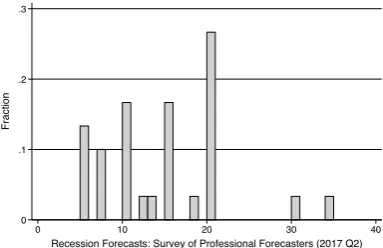
Stylized facts Respondents in our sample have a much more pessimistic macroeco-nomic outlook than experts (Figures 1 and A.4 and Table A4). The median professional
forecaster in the second quarter of 2017 reports a likelihood of a recession in the fourth
quarter of 2017 of just 15 percent. By contrast, our median respondent assigns a
proba-bility of 40 percent, as pessimistic as professional forecasters were for the last time in the
second quarter of 2009. While there is a large dispersion in beliefs about the likelihood of
a recession among consumers, the dispersion of beliefs is much smaller in the sample of
professional forecasters, ranging from four professional forecasters estimating a 5 percent
chance of a recession to one forecaster assigning a 35 percent chance.
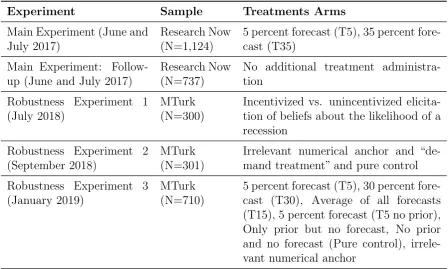
We confirm these patterns using robustness experiment 1 (described in more detail
in Table A1), which was conducted with an online convenience sample from the online
labor market Amazon Mechanical Turk (MTurk), which is widely used in experimental
economics research (Cavallo et al., 2017; D’Acunto, 2018; Kuziemko et al., 2015; Roth et
Section C.1. The median professional forecaster in the second quarter of 2018 reports
a likelihood of a recession in the fourth quarter of 2018 of 10 percent, while the
me-dian respondent in our MTurk sample assigns a probability of 45 percent (Figure A.8).
The distribution of recession expectations in the MTurk sample is remarkably robust
to incentivizing the consumers’ forecast using a quadratic scoring rule (see A.9).12 A
Kolmogorov-Smirnov test confirms that the distributions of incentivized and
unincen-tivized beliefs are not statistically distinguishable (p=0.319).
The finding of greater pessimism and a higher dispersion of beliefs among consumers
than among professional forecasters is in line with previous findings on inflation
expec-tations (Armantier et al., 2013; Mankiw et al., 2003) and with qualitative expecexpec-tations
on aggregate economic conditions over a longer time period from the Michigan Survey of
Consumers (Das et al., 2018).13
Correlates of recession expectations Neither education nor age are related to peo-ple’s recession expectations, but females have a significantly more pessimistic
macroeco-nomic outlook than men (Table A7). Interestingly, Democrats are much more pessimistic
compared to Independents, while Republicans are much more optimistic, consistent with
evidence on partisan bias in economic expectations (Mian et al., 2018). People who
have been personally unemployed in the past are significantly more pessimistic about
aggregate economic conditions, in line with Kuchler and Zafar (2018), who find that
individuals who lose their jobs become significantly less optimistic about the aggregate
economy. Taken together, it is reassuring that the correlations between covariates and
recession expectations are in line with previous literature.
3.2
Updating of recession expectations
Do our respondents update their recession expectations upon receiving the professional
forecasts? Figure 1 shows our first main result:
12Respondents in the incentive condition are told that they can earn up to $1 depending
on the accuracy of their forecast.
13In section E.1 in the online Appendix we confirm the external validity of these findings
Result 1. The information provision strongly shifts expectations towards the professional forecast in both treatment arms, and cross-sectional disagreement within the treatment
arms declines. This implies that the respondents were initially not fully informed about
the forecasts and that the forecasts are relevant to the respondents’ economic outlook.
Figure A.5 displays scatter plots of prior and posterior beliefs. Observations along the
horizontal lines indicate full updating of beliefs towards the professional forecast, while
respondents along the 45 degree line do not update at all. We observe more updating
of beliefs among respondents in the low recession treatment, where the average absolute
distance of prior beliefs to the signal of 5 percent is greater than in the high recession
treatment, which provides a forecast of 35 percent. 11.5 percent of respondents in the
low recession treatment and 19.5 percent of respondents in the high recession treatment
do not update their beliefs at all, while 68.6 percent (47.8 percent) of respondents either
fully or partially update their beliefs towards the signal (see Table A24). The remaining
respondents either “over-extrapolate” from the signal or update in the opposite direction.
However, part of these observed changes in beliefs could be caused by typos or by
re-spondents changing their beliefs because taking a survey on macroeconomic topics makes
them think more carefully about the question. Finally, the cross-sectional disagreement
in posterior beliefs as measured through the interquartile range and standard deviation
declines within both treatment arms compared to prior beliefs (Table A4).
Magnitudes We quantify the degree of updating of recession expectations by estimat-ing a Bayesian learnestimat-ing rule that we derive in online Appendix D.1. We define updatestimat-ingi
as the difference in people’s posterior and prior expectations, and the “shock” as the
dif-ference between the professional forecast and the prior belief, i.e. (35 - priori) for people
in the “high recession treatment” and (5 - priori) for people in the “low recession
treat-ment”. We assume that people’s prior beliefs about the probability of a recession follow
a beta distribution and that the loss function is quadratic. Under these assumptions,
people should follow a linear learning rule, updatingi = α1shocki, where α1 lies in the
interval [0,1] and depends negatively on the strength of the respondent’s prior belief.
problems: First, the prior is measured with error, thereby leading to attenuation bias in
the estimated learning rate α1. Second, self-reported expectations could differ between
the prior and the posterior for reasons that are unrelated to the treatment but potentially
correlated with the prior. Most importantly, people who hold higher priors and are subject
to a more negative shock, should mechanically display more negative changes in their
expectations since the probability of a recession is bounded to be in the interval [0,100],
leading to an upward bias in the estimate of α1. Controlling linearly for people’s prior
belief removes attenuation bias and mechanical correlations between people’s updating
and the shock, while not changing the interpretation of the estimated coefficient α1 as
the learning rate. Moreover, we include a vector of additional control variablesXi, which
increases our power to precisely estimate treatment effects and which allows us to control
for the slight imbalance in the follow-up sample.14 Specifically, we estimate the following
equation using OLS:
updatingi =α0+α1shocki+α2priori+ΠTXi+εi (1)
whereεi is an idiosyncratic error. We report robust standard errors throughout the paper.
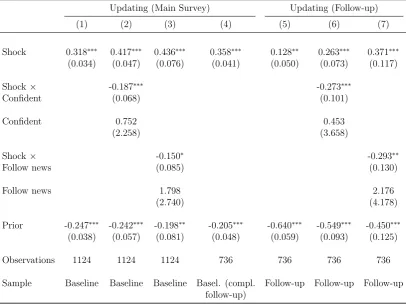
We estimate a highly significant learning rate equal to about one third of the shock to
individual beliefs (Table 1). Our estimated learning rate from professional forecasts is in
the range of estimates in related literature (Armantier et al., 2016; Coibion et al., 2018a;
Fuster et al., 2018). Thus, our information treatment generates a difference of about 10
percentage points in people’s average posterior beliefs across treatment arms. The size
and significance of the estimated learning rate implies that the respondents found that
the forecasts contain some relevant information that was not already incorporated into
their priors. Online Appendix D.2 provides a more detailed discussion of the estimated
learning rate in the context of different corner cases and estimates in related literature.
14The controls are as follows: age, age squared, a dummy for females, log income, a
dummy for respondents with at least a bachelor degree, dummies for the respondent’s
Census region of residence, a measure of the respondent’s financial literacy as well as
Are changes in expectations consistent with Bayesian updating? First, Bayesian updating predicts that respondents should adjust their expectations partially or fully
to-wards new signals that they find informative, i.e. that learning rates should lie in the
interval [0,1]. Our estimated learning rate of one third is in line with this prediction.
Second, Bayesian updating implies that respondents who are less confident in their prior
belief should react more strongly to new signals. We examine this prediction by
con-structing a dummy indicating whether the respondent is at least “sure” about his or her
prior estimate. Consistent with Bayesian updating, the estimated learning rate is
signifi-cantly lower for respondents who are more confident in their prior belief (Table 1 column
2). Moreover, respondents who report that they usually do not follow news on the
na-tional economy place significantly higher weight on the signal (column 3), consistent with
the idea that information acquisition prior to the experiment increases the strength of
people’s prior belief.15 In robustness experiment 3 described later we also find support
of two more predictions of Bayesian updating: i) receiving a forecast makes respondents
more confident in their beliefs; ii) changes in confidence are positively related to the
individual-level learning rate (Table A19).
Heterogeneous updating across demographic groups Individuals with lower ed-ucation update more strongly from the forecasts, while there are no significant differences
according to income, gender, industry, personal unemployment experiences, the
unem-ployment rate in the county of residence and financial literacy (Table A10). Heterogeneity
15We examine whether individuals put differential weight on signals that are more
opti-mistic or more pessiopti-mistic than their prior belief. We interact the individual-specific
shock with a dummy variable taking value one if shock < 0, and zero otherwise.
There is no asymmetric updating from relatively positive and relatively negative
sig-nals. Similarly, the weight put on the prior does not differ systematically between the
two treatment arms (p=0.443), indicating that our respondents do not differentially
weigh signals that are more or less positive in absolute terms. Finally, we find no
sig-nificant differences in learning rates according to the prior. Results are available upon
in learning rates could stem from differences in trust towards experts, differential ex-ante
informedness about the professional forecasts across groups,16 or different learning rules.
One way in which learning rules could differ across individuals is that less sophisticated
individuals could find it more difficult to rationally learn from the information. As shown
in Table A11, the heterogeneity in learning rates according to confidence in the prior is
fully driven by individuals with a college degree, while those without a college degree weigh
the new information independently of their confidence in their priors. The coefficients
on the interaction terms between the shock and confidence in the prior are significantly
different between the two groups (p < 0.01). Thus, while learning from information is
consistent with Bayesian updating for more sophisticated individuals, less sophisticated
individuals seem to follow simpler learning rules. Similarly, heterogeneity in learning
rates by news consumption is fully driven by highly educated respondents.
Do changes in recession expectations persist? Following Cavallo et al. (2017) we employ a two-week follow-up survey in which no treatment information is administered.
The medium-run learning rate (calculated using the follow-up) amounts to about 40
per-cent of the short-run learning rate (Table 1 column 5), in line with respondents receiving
new relevant signals about the macroeconomy between the two surveys or imperfect
memory (see also Figures 1 and A.6). Moreover, learning rates still differ significantly by
confidence in the prior and news consumption prior to the main survey.
Implications for macroeconomic models Our results presented in this section have several implications for macroeconomic models. The finding that respondents use the
professional forecasts to persistently update their beliefs implies i) that the professional
forecasts were not fully incorporated into our respondents’ information sets before the
sur-vey and ii) that our respondents consider the information relevant for their expectations
about the future. This finding suggests that there exist costs of information acquisition,
16According to theories of rational inattention, individuals with greater exposure to
macroeconomic risk and individuals with lower cost of acquiring information should
hold stronger prior beliefs about the likelihood of a recession. We cannot disentangle
as in micro-founded sticky information models (Reis, 2006).17 Our experiment sets these
costs to zero for a particular piece of news about aggregate economic growth.
Conditional on acquiring information, we observe heterogeneity in learning rates across
groups. This is in line with the idea that our respondents perceive the piece of information
with individual-specific noise, as in models of noisy information (Ma´ckowiak and
Wieder-holt, 2015; Sims, 2003). In addition, we also observe heterogeneity in learning rules: On
the one hand, highly educated respondents put lower weight on the information when
they hold stronger priors, in line with the predictions of Bayesian updating. Rational
learning from new information is a key feature of both sticky and noisy information
mod-els, so these models may be able to proxy the expectation formation of more sophisticated
individuals in a reasonable manner. On the other hand, less highly educated respondents’
learning from the information does not seem to be well captured by Bayesian updating,
highlighting a role for cognitive limitations and heterogeneity in belief formation
mecha-nisms in macroeconomic models. These findings are consistent with recent evidence that
individuals with cognitive limitations display larger biases in their expectation formation
(D’Acunto et al., 2019a,b,c). Our findings are inconsistent with more traditional models
of full-information rational expectations (Muth, 1961) or models with no heterogeneity.18
Finally, in line with the model and time series evidence in Carroll (2003), our findings
imply that households exhibit some trust towards experts in the context of expectations
17Our evidence on information acquisition costs in the context of expected economic
growth complements findings from experimental studies of households’ expectations
about inflation (Armantier et al., 2016; Cavallo et al., 2017) and house prices (Armona
et al., 2018; Fuster et al., 2018) or firm expectations (Coibion et al., 2018a).
18Our findings suggest that in a setting where individuals observe one specific piece of
information once, more highly-educated respondents’ learning from information may
be well approximated by Bayesian updating. However, in general, salience could also
matter for how much weight individuals put on information. For instance, D’Acunto
et al. (2018b) document that the price changes of more frequently purchased goods
about general economic conditions.
4
The causal effect of recession expectations
4.1
Empirical specification
In the previous section we established that our respondents durably update their
be-liefs about the likelihood of a recession in response to professional forecasts. This provides
us with a first stage to examine the causal effect of recession expectations on expectations
about personal economic outcomes. Specifically, we examine whether people’s subjective
economic model, as measured through the size and heterogeneity of extrapolation to
ex-pectations about their personal situation, is in line with empirical facts. As a first step,
we examine how these expectations, expi, are correlated with our respondents’ posterior
beliefs about the likelihood of a recession, posteriori:
expi =β0+β1posteriori+ΠTXi+εi (2)
whereXiis a vector of the same control variables that we included in our previous
estima-tions. The OLS estimate ofβ1 cannot be given a causal interpretation. For example, it is
possible that people who are generally more optimistic or pessimistic respond differently
to both the question on the posterior as well as the questions related to the evolution of
other economic outcomes. It is also conceivable that the direction of causality runs from
the personal situation to macroeconomic expectations, as suggested by recent evidence
in Kuchler and Zafar (2018). Finally, the estimate of β1 could be biased towards zero
because of measurement error in the posterior belief. To deal with omitted variable bias,
reverse causality and measurement error, we instrument our respondents’ posterior beliefs
with the random assignment to the different professional forecasts, where highrecessioni
is an indicator taking value one for individuals who received the pessimistic professional
forecast, and value zero for respondents receiving the optimistic forecast. Specifically, we
use two-stage least squares and estimate the following equation:
expi =β0+β1posterior\ i+Π TX
where
\
posteriori = ˆα0+ ˆα1highrecessioni+ ˆΘ T
Xi
We have a strong and highly significant first-stage on people’s post-treatment beliefs
about the likelihood of a recession based on the random assignment of the different
professional forecasts (F-Stat = 75.16; see Table 2).
4.2
Do recession expectations affect personal expectations?
Consistent with the evidence on updating of recession expectations, the experimental
vari-ation successfully shifts the respondents’ expectvari-ations about aggregate unemployment.
Posterior beliefs about a recession significantly affect people’s subjective probability that
the national unemployment rate will increase. In the IV specification a one percentage
point higher likelihood of a recession causes a 0.895 (0.536) percentage point increase in
the perceived chance that national (county-level) unemployment will increase (Panel B
of Table 2; columns 1 and 3). We find similar effects using the categorical measure which
is immune to numerical anchoring (column 2). The results on national and county-level
unemployment expectations are significant and of similar size in OLS and IV estimations.
Do recession expectations affect people’s beliefs about their personal economic
out-comes? Table 2 shows our second main result:
Result 2. People extrapolate from their recession expectations to their own households’ financial prospects and to expectations about personal unemployment. The estimated effect
sizes are large, but still close to job transitions during the last recession.
People who think that a recession is more probable are also more likely to hold pessimistic
beliefs about their own household’s financial prospects and expect lower earnings growth
in their job. They also report lower levels of subjective job security. The estimated effects
in the IV specifications are very similar in size to the OLS estimates, but the effects on
expected earnings growth become statistically insignificant (Panel B). The effect size on
subjective job security is substantial, yet in line with job losses during the last recession:
a one percentage point increase in the likelihood of a recession leads to an increase in
consider moving from a situation with zero risk of a recession to a situation in which a
recession will happen with certainty. 11.3 percent of our respondents would then need to
become unemployed for their expectations to be accurate on average. For comparison,
the job loss rate increased by 7 percentage points during the Great Recession 2007-09,
and most laid-off workers remained unemployed for several months (Farber, 2011). Thus,
although the magnitude of our estimated effect is relatively large, it is still close to the
increase in unemployment during the last recession.19
4.3
Heterogeneous extrapolation to personal expectations
Actual differences in risk exposure across groups Actual exposure to macroe-conomic risk should affect the extent to which people extrapolate from news about the
macroeconomy to their personal expectations. Therefore, we examine changes in
un-employment rates over the Great Recession for different demographic groups using data
from the Merged Outgoing Rotation Groups of the Current Population Survey (CPS).
The unemployment rate increased much more strongly among individuals without a
col-lege degree and among males (Figure A.10), consistent with previous literature (Hoynes
et al., 2012). There were similar changes in unemployment rates for individuals aged 25
to 44 and those aged 45 to 55. Moreover, the increase in unemployment during the Great
Recession was concentrated among workers who were previously employed in “cyclical
in-dustries” such as manufacturing, construction and services, while industries such as health
and education were less affected (Takhtamanova and Sierminska, 2016). Therefore, we
expect respondents with lower education, male respondents and respondents working in
more cyclical industries to update their expectations regarding personal unemployment
more strongly in response to a change in their macroeconomic outlook.
Who extrapolates from macroeconomic to personal expectations? In order to test whether extrapolation to expectations about personal economic outcomes is driven
by respondents who are more strongly exposed to macroeconomic risk, we interact the
19Figure A.18 displays local polynomial regressions of people’s expectations about
per-sonal economic circumstances on theirprior beliefs about the likelihood of a recession.
posterior belief with dummies for several dimensions of heterogeneity, heti. Specifically,
we estimate the following IV specification:20
expi =β0+β1posterior\ i+β2posterior\i×heti+β3heti+ΠTXi+εi (4)
where
\
posteriori = ˆγ0+ ˆγ1highrecessioni+ ˆγ2highrecessioni×heti + ˆγ3heti+ ˆΘ T
Xi
\
posteriori×heti = ˆδ0+ ˆδ1highrecessioni + ˆδ2highrecessioni×heti+ ˆδ3heti+ ˆΞ T
Xi
Our third main result is as follows:
Result 3. People extrapolate from their macroeconomic outlook to their expected chance of personal unemployment. These effects are driven by those individuals most strongly
exposed to macroeconomic risk. Thus, updating of personal expectations is data-consistent
in terms of size and heterogeneity, indicating that households have an understanding of
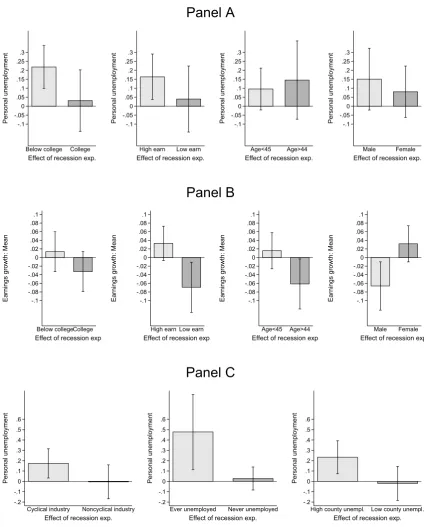
their exposure to macroeconomic risk.
For example, the perceived chance of becoming unemployed responds strongly for people
with lower education, while there is no such effect for people with high education (Figure
2 and Table A12). We find qualitatively similar patterns if we instead examine
hetero-geneity according to the level of earnings. While these differences across groups are large
in terms of magnitudes, they are statistically insignificant, potentially due to low power.
We find no strong differential response across age groups or gender.
Moreover, the effects of an expected economic downturn on personal unemployment
expectations are driven by individuals working in “cyclical industries”, those with previous
unemployment experiences and those living in counties with higher unemployment (Figure
2 and Table A13).21 These differences are large in magnitude and statistically significant
20The IV specifications account for differential first stage effects of the “high recession”
treatment on posterior recession expectations across groups, and are able to isolate
differential second stage effects of posterior beliefs on personal outcomes. Reduced form
specifications would conflate differential first and second stage effects across groups.
for previous unemployment experiences (p < 0.1) and county-level unemployment (p <
0.1), and insignificant for industry of employment (p = 0.18). The effects are driven
by job loss expectations for individuals with a personal unemployment history, and by
conditional job finding expectations for those living in areas with high unemployment
(Table A13). This is in line with the idea that high county-level unemployment could make
it more difficult to find re-employment in case of job loss, while a personal unemployment
history could proxy for being “marginal”. Overall, the effects on personal unemployment
expectations are driven by those with larger exposure to macroeconomic shocks.
Further, individuals with higher earnings, older individuals and men expect a reduced
earnings growth conditional on keeping their jobs as a result of an economic downturn
(Figure 2 and Table A14). The effects for these subgroups are significantly different from
zero and significantly larger than the effects on individuals with lower earnings (p <0.05),
younger individuals (p < 0.1), and women (p < 0.05). These patterns are in line with
higher trend growth in earnings among men and individuals with higher earnings, as well
as downward rigidity in wages. Accordingly, an economic downturn could lead to lower,
but still non-negative earnings growth at the top of the distribution, while individuals
at the bottom of the distribution are affected through job loss, potentially because their
wages cannot fall, e.g. due to binding minimum wages.
Finally, there is no heterogeneity in the effect of beliefs about the likelihood of a
re-cession on the perceived chance that national unemployment will increase (Table A15).
Hence, while more exposed groups drive the results on extrapolation from recession
ex-pectations to their personal economic outlook, they expect changes in aggregate
unem-ployment similar to less exposed groups.
4.4
Do the effects persist over time?
Table A9 shows that most of our results on updating of expectations decrease in size,
but remain economically and statistically significant in the two-week follow-up survey.
non-cyclical industries, while construction, manufacturing, services, retail and
whole-sale, transportation and finance are classified as cyclical industries, in line with
The table shows reduced-form estimates obtained from regressing the different outcome
variables on an indicator for the “high recession”-treatment and controls.22 People who
receive more pessimistic forecasts about the likelihood of a recession still report a
sig-nificantly higher probability of an increase in unemployment. For expectations about
national- and county-level unemployment, the effect sizes in the follow-up are about 50
percent and about 42 percent of the original effect sizes in the main study, respectively.
The treatment effects for all personal outcomes are not statistically distinguishable from
the treatment effects in the main experiment. However, the coefficients are less precisely
estimated in the follow-up and are about 50 percent (financial prospects) and about 25
percent (personal unemployment expectations) smaller than in the main study.
This reflects a substantial degree of persistence, given that our intervention was mild
and that people likely received other relevant signals about macroeconomic conditions and
their personal situation between the two surveys. Indeed, 65 percent of our respondents
agree that they followed news about the economy in the time between the main survey
and the follow-up survey.23 An alternative explanation for the reduced effect sizes is that
survey respondents could forget about the forecasts and revert back to a default level
of their expectations. In addition, we are naturally less powered to detect significant
treatment effects in the smaller sample of respondents who completed the follow-up.
Taken together, the persistence of the treatment effects suggests that our information
treatment leads to true belief updating, while concerns about numerical anchoring,
short-lived emotional responses to the treatment, or experimenter demand are mitigated.
22We present reduced form results rather than instrumental variable estimates as the
first-stage for an IV regression where we instrument posterior beliefs with random
treat-ment assigntreat-ment would suffer from weak instrutreat-ment problems in the smaller follow-up
sample, i.e. the first-stage F-stat is 6.37, below 10.
23If all respondents received the same perfectly informative signal between the main
survey and the follow-up, they would put a weight of 100 percent on the new signal,
4.5
Do macroeconomic expectations affect behavior?
According to a standard Euler equation, an innovation to expected future economic
resources should induce households to immediately adjust their consumption. Recent
evidence indicates that earnings reductions during recessions are large (Farber, 2011),
that recessions can accelerate pre-existing adverse trends in the labor market situation of
subgroups (Charles et al., 2016; Hershbein and Kahn, 2016), and that recessions can have
scarring effects that induce workers to permanently drop out of the labor force (Yagan,
2018). Combined, these findings suggest that economic downturns can entail substantial
shocks to people’s permanent income. Therefore, we expect individuals to revise their
consumption plans when they change their expectations regarding a recession.
In this section, we examine whether updating of recession expectations leads people
to adjust their behavior. First, we examine whether updating of recession expectations
affects our measures of planned and actual changes in non-durable spending around the
main intervention. We focus on non-durables, as for this category, consumption plausibly
equals expenditure. Second, we examine whether updating of recession expectations
leads our respondents to report a more negative climate for durables purchases or to
postpone the actual adjustment in their stock of durables (Bertola et al., 2005). Third,
we analyze whether updating of recession expectations leads households to actively adjust
their stockholdings. Given the well-documented inertia in household portfolios (Bilias et
al., 2010; Calvet et al., 2009), the reaction of stock purchases should be small.
We estimate the same IV specification 3 as for our previous analysis, except that our
independent variable is now the difference between posterior and prior beliefs about the
likelihood of a recession, as our outcome variables refer to changes in individual behavior
instead of levels of expectations. In addition we control for people’s prior belief. Table 3
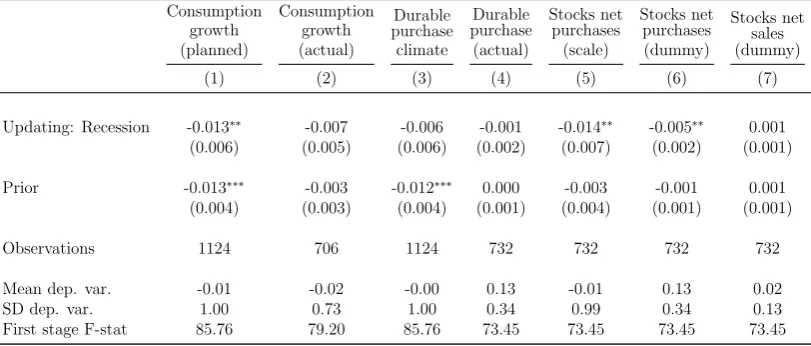
shows our fourth main result:
Result 4. People’s macroeconomic outlook causally affects their consumption plans and stock purchases.
Specifically, becoming more pessimistic about the aggregate economy has a significantly
1). A 10 percentage point increase in the perceived likelihood of a recession leads to a
decrease in planned consumption growth by 13 percent of a standard deviation. This is
in line with the effect size of 11 percent of a standard deviation on the expected change
in the financial situation of the household in Table 2 column 4. While there seem to be
increases in actual consumption growth, these effects are noisily measured and statistically
insignificant (column 2). This noisy measurement could arise from i) the fact that our
measure includes some categories that are quite lumpy and at the weekly frequency vary
a lot across individuals (such as clothing), ii) imperfect memory about actual spending
and iii) the smaller sample size in the follow-up compared to the main survey. We find no
evidence that macroeconomic expectations affect people’s assessment of the consumption
climate for durable goods (column 3), or their actual durables purchases (column 4).
Moreover, increased pessimism about the economy strongly affects people’s self-reported
net purchases of stocks between the main survey and the follow-up (column 5). The large
reaction despite inertia in household portfolios may be due to the fact that respondents
in both treatment arms were extremely pessimistic before the treatment, and thus the
information provision implied a shift towards a lower subjective probability of a recession
that was strong enough to trigger adjustments in portfolios. Consistent with this
expla-nation, the effect is fully driven by higher net purchases of stocks in the treatment arm
that received the more optimistic forecast, while there is no significant difference for net
sales of stocks (columns 6 and 7).24 A 10 percentage point increase in the likelihood of a
recession reduces the likelihood of purchasing stocks by 5 percentage points.
Thus, a higher expected probability of a recession reduces planned consumption
growth and should, for a given income, increase saving. Higher saving and lower net
purchases of stocks should be reflected in a reduction of the risky portfolio share.25
Sur-24Only 12 individuals in our sample report net sales of stocks, while 54 individuals
(41 individuals) in the more optimistic (pessimistic) treatment report net purchases
of stocks. This corresponds to a 36 percent higher fraction of respondents with net
purchases in the “low recession treatment” compared to the “high recession treatment”.
25Given that our variables on consumption plans and stock purchases are categorical,
vey measures of consumers’ expected stock returns behave procyclically and co-move with
expectations about general economic conditions, even though this is at odds with theory,
market measures of expected returns, and the actual equity premium in the US (Amromin
and Sharpe, 2013; Greenwood and Shleifer, 2014). Moreover, consumers’ subjective risk
surrounding future returns behaves countercyclically. This suggests that higher and less
uncertain expected returns could be driving our results. Alternatively, a higher
per-ceived probability of a recession could increase perper-ceived consumption risk or reduce the
expected level of consumption, both of which lead to a lower risky portfolio share in
standard portfolio choice problems with CRRA utility.
4.6
Expectations and news consumption
An increase in macroeconomic risk should lead rationally (in-)attentive economic
agents to allocate more of their attention to macroeconomic news (Ma´ckowiak and
Wieder-holt, 2015; Sims, 2003). However, we find no evidence that expectations about the
like-lihood of a recession causally affect people’s consumption of news about the general
economy as measured in the follow-up survey (Table A22).26
We also study whether updating of recession expectations between the main survey
and the follow-up survey is affected by people’s consumption of news between the
sur-veys. Columns (2) and (3) shows that news consumption between the two surveys is
uncorrelated with people’s updating defined as the difference between the posterior belief
in the follow-up and the prior belief in the main survey.
4.7
Subjective beliefs about the macroeconomy
Our design also allows us to shed light on how expectations about different
macroeco-nomic variables are causally related. Many macroecomacroeco-nomic models incorporate a Phillips
Curve, a negative relationship between unemployment and inflation. An implicit
assump-tion in most models is that agents form their expectaassump-tions according to the true model.
and the conditional amounts by which people adjust.
26We find no significant heterogeneity in treatment effects on respondents’ news
con-sumption by proxies for people’s exposure to macroeconomic risk or proxies for people’s