1 23
Current Psychology
A Journal for Diverse Perspectives on
Diverse Psychological Issues
ISSN 1046-1310
Curr Psychol
DOI 10.1007/s12144-017-9717-2
Exploring the Role of Messenger Effects and
Feedback Frames in Promoting Uptake of
Energy-Efficient Technologies
1 23
Exploring the Role of Messenger Effects and Feedback Frames
in Promoting Uptake of Energy-Efficient Technologies
Rebecca Hafner1&David Elmes1&Daniel Read1
#The Author(s) 2017. This article is an open access publication
Abstract The persuasive potential for varying messenger types and feedback frames to increase pro-environmental choice was explored in a 2 (feedback frame: financial vs. environmental) × 5 (messenger type: neighbour, government, industry, utilities vs. control) factorial design experiment. Using the context of home heating choice, 493 non-student participants were given information on either the financial or environmental benefits of selecting an energy-efficient heat pump versus a standard boiler, as described by one of four messenger types (versus a no-messenger control). Likelihood of selecting the‘green’technology was assessed, as well as any carry-over effects on real-life behavioural in-tentions. Additionally, we assessed the messenger attributes that appeared to be most important in this context, in terms of whether sources that were perceived to be trustworthy, knowledgeable, or a combination of both dimensions, would hold greater sway over preference formation. Overall, no ev-idence was found for any impact of messenger type on either preference formation or behavioural intentions. However, message content (i.e. how information on the benefits of pro-environmental choice was framed), was found to have substantial impact on behaviour; with the financial versus en-vironmental decision frame being significantly more likely to encourage uptake of the energy-efficient versus standard tech-nology. We suggest that the level of processing required for the kinds of large-scale purchase decisions we consider here may explain the lack of any messenger effect on choice be-haviour. Implications for the development of behaviour
change interventions designed to promote consideration of energy-efficient technologies in this context are discussed.
Keywords Messenger effects . Persuasion .
Pro-environmental choice . Decision-making . Feedback frames . Behaviour change . Energy-efficient technologies
Introduction
Reducing the emission of greenhouses gases is one of the major environmental challenges faced by society, and a criti-cal component of this involves developing strategies to reduce energy consumption in the domestic built environment. Current Government objectives expect emissions from homes to fall by over a third of 2011 levels by 2022 (Committee on Climate Change2011a, b). Yet in order to achieve this we need a widespread shift in occupant behaviour at the societal level, which focuses not only on frequently repeated behav-iours (such as regularly changing thermostat settings, and closing windows), but also on consumer purchases decisions (Steg et al.2015). As early as 2008, the International Energy Agency (IEA) concluded thatBa huge step-change in the atti-tudes to energy efficiency and consumer purchases by hun-dreds of millions of people worldwide^is needed (pp. 501). Yet to date, this step-change has not occurred. Heating (space heating, water heating and cooking/catering) is identified as the area of highest energy consumption in the UK (Department of Energy and Climate Change 2012). Given that, it is imperative that we develop strategies to encourage the retrofit of technologies designed to reduce thermal energy demand if we are to achieve government decarbonisation ob-jectives (Committee on Climate Change2011a, b).
Yet consumers are known to underinvest in energy efficient technologies even when cost-benefit analyses show clear
* Rebecca Hafner
1 Warwick Business School, University of Warwick, Coventry CV4
7AL, UK Curr Psychol
financial benefits (Creyts et al.2010). This means uptake of such technologies is typically slower than one might expect following rational choice models (Jaffe and Stavins 1994; Steg and Vlek2009). This gap between cost-effective invest-ments in energy-efficient appliances and levels of actual in-vestments in practice has been referred to as theBenergy effi-ciency gap^(Jaffe and Stavins1994). Developing methods to identify and overcome the most prominent psychological bar-riers to behaviour change in this context in order to reduce the energy efficiency gap has been the focus of much research interest in the environmental field in recent years (Ölander and Thøgersen 2014; Steg and Vlek 2009; Noppers et al.2014; Noppers et al.2015). However, whilst frequently repeated, habitual behaviours have received much attention, strategies for encouraging behaviour change in the context of large scale‘green’consumer pur-chase decisions remain underrepresented in the literature (Gardner and Stern 2002; Abrahamse et al. 2005; although see Noppers et al.2014,2015).
The current research was subsequently designed to add to the literature focusing on these kinds of large-scale consumer purchase decisions, often referred to as ‘efficiency behav-iours’(Gardner and Stern2002). We combine the messenger effects and feedback frames literatures, with a view to explor-ing the comparative impact of variations in these aspects of the decision frame on consumer choice behaviour in this context. The central aim of the presented research was to identify the ways in which the choice set might most effectively be struc-tured in order to promote consideration of new, energy effi-cient heating technologies. Specifically, we aimed to explore whether variations in messenger source type, or in message content, in terms of how feedback information on the benefits of‘choosing green’is framed, could form useful strategies in the development of behaviour change interventions in this context. A detailed rationale is presented below (Rationale
section), following an introduction to the messenger effects and feedback frames literatures.
Messenger Effects
‘Messenger effects’are frequently identified within the litera-ture as one of the most robust effects known to impact on likelihood of future behaviour change (Dolan et al.2010). Although variously referred to as‘source effects’(Chaiken
1980; Pornpitakpan 2004), or ‘communicator effects’ (Chaiken 1979), in the current research we hereby adopt Kassin’s (Kassin 1983; see also, Dolan et al.2010) use of the term ‘messenger effect’, to reflect the notion that the weight decision makers give to information depends on their reaction to the messenger source. We assume this terminology as it relatively self-explanatory, and thus may be more easily and readily understood by a wide readership, including those who may be less familiar with the research area. Extant
research in psychology and consumer behaviour has exam-ined the influence of a wide range of factors on the persuasive power of a messenger source, which determine the extent to which a source may be deemedcredibleand thus hold influ-ence over the subjects’ attitudes or behaviour (McCroskey
1969; Simons et al.1970). Three commonly identified key components of source credibility are expertise, trustworthi-ness, and attractiveness (Giffin, 1967; Petty et al. 1983; Yalch and Elmore-Yalch1984; Pornpitakpan2004); wherein the term‘expertise’refers to the degree to which a source is perceived to be capable of making correct assertions; and
‘trustworthiness’refers to the degree to which assertions are perceived to be from a reliable, believable source (Sternthal et al.1978). Attractiveness may be manifested either in terms of physical attributes of the source (physical attractiveness) or by similarity of values (ideological similarity). Together these factors have been found to explain a substantial proportion of the variance in source credibility effects, otherwise referred to as the global evaluation of the believability of the message source (Wilson and Sherrell1993; Griffin, 1967).
Of particular interest for the current research, which looks to inform future behaviour change intervention development, are the strands of messenger research which have focused on dimensions of trustworthiness and expertise. Many historical examples have demonstrated that‘expert’versus‘non-expert’ sources produce more positive and favourable attitudes towards the advocated position, as well as producing more behavioural compliance. For example, Crisci and Kassinove (1973) investigated the impact of perceived expertise (‘Dr.’ vs.‘Mr.’) on parents’behavioural compliance with a psychol-ogists recommendations in two different settings (school vs. clinic). Following a period of individual testing, parents were advised to purchase a book by one of the two messenger types. Level of compliance with this advice was found to be a direct product of perceived source expertise, whilst setting had no effect; demonstrating the importance of perceived expertise on behavioural interventions (see also, Kelman and Hovland
1953; Warren1969; Watts and McGuire1964; Crano1970; Ross 1973). These effects have since been demonstrated across a wide variety of contexts. For example, Webb and Sheeran (2006) found that interventions designed to change important health behaviours were more successful when de-livered by someone perceived as an expert, such as a health educator or researcher (see also Woodside and Davenport
1974; Pornpitakpan 2004; Cialdini 2007). Whilst within a commercial setting, messages conveyed by those perceived as being high in expertise are shown to lead to more positive attitudes towards the advertisement (Braunsberger1996).
fact that they perceived the former source did not have any direct intention of persuading them. Similarly, McGinnies and Ward (1980) demonstrated that trustworthy vs. untrustworthy messengers were more influential in guiding behaviour. Crucially, this was found to be the case whether or not the communicator was presented as an expert, providing evidence for the differential weights attributed to the trustworthiness and expertise dimensions of a source. However, other research has found that perceived trustworthiness may not be as influential as expertise in determining the persuasive appeal of a messenger source. For example, Hovland and Weiss (1951) found that a source who stood to profit from persuasion was perceived as less trustworthy and thus was less effective in changing attitudes than a disinterested source who did not stand to gain from the outcome. However, impor-tantly, these effects were only found to occur when the source was also perceived to be an expert. I.e. when the messengers were not perceived to have expertise in the field, both were equally ineffective in changing attitudes, regardless of per-ceived trustworthiness.
Notably, in their meta-analytic review of 250 studies in the field, Wilson and Sherrell (1993) found that task involvement was a key factor determining the relative impact of various dimensions on messenger effectiveness. This relates to the extent to which participants are required to actively process the communicated information. In high involvement condi-tions, subjects are typically required to think about the pre-sented information in order to retrieve details for use in later tasks, whilst in low involvement conditions, subjects are not required to actively engage in such a process. The authors note that of the twelve reviewed studies which included a direct manipulation of involvement, characteristics of the message source were only found to have a significant impact on atti-tude or behaviour change in low-task involvement conditions. Wilson and Sherrell (1993) suggest this is consistent with the Elaboration Likelihood Model (ELM) of persuasion (see Petty and Cacioppo1986), given that various dimensions of mes-senger influence only appeared to be only brought into play in circumstances in which subjects were not motivated to process message content, making them more susceptible to focusing on accompanying peripheral message cues.
We suggest that this finding is also closely aligned with Craik and Lockhart’s (1972) historic distinction between the
Blevels of processing^associated with the assimilation of in-formation, in which a‘low level of processing’refers to initial analysis of physical or sensory features (i.e. in this case focus on peripheral message cues), whilst a‘high level of process-ing’concerns the extraction of meaning. We note substantial parallels between this aspect of early memory research and the messenger effects literature, and hereby adopt the term‘levels of processing’to reflect Wilson and Sherrell’s (1993) obser-vation that the prevalence of messenger effects can be largely predicted by the extent to which one is actively required to
extract meaning from the message content. Further, we extend this line of reasoning in order to explore whether a highly consequential decision scenario with long-lasting implications for the chooser reflects the high-involvement conditions or high level of processing described above; as well as exploring the subsequent impact of this on the prevalence of any such messenger effects.
Messenger Influence in pro-Environmental Behaviour Change
Although messenger effects have been subject to much re-search interest, relatively little is known about messenger ef-fects in the context of pro-environmental behaviour change. The American Psychological Association (APA) (2009) theo-rized that mistrust in messages conveyed by government offi-cials may be a key factor preventing action to combat envi-ronmental issues such as climate change (see also Brann and Foddy1987; MacGregor et al.1994; Foddy and Dawes2008). Similarly, the Department for Food and Rural Affairs (DEFRA) (2008), found that distrust of government and in-dustry played a key role in preventing pro-environmental be-haviour change; with one quarter of people surveyed stating they simply did not believe their behaviour contributed to climate change, despite government appeals to the contrary.
However, although subject to some theoretical debate, and although the subject of message content has received consid-erable attention from policy makers looking to increase the persuasive appeal of pro-environmental behaviour change campaigns (Climate Change Communication Advisory Group 2010; Northern Ireland Environment Link 2012; Stern2007; DEFRA,2008; APA,2009); empirical research on the specific topic of determining the most effective mes-senger source type in this area is relatively limited. Only one study, as far as we are aware, has made any attempt to deter-mine the impact of varying degrees of messenger credibility on choice behaviour in an environmental context. In this his-toric example, Craig and McCann (1978) found that messages delivered by trustworthy sources were associated with more requests for energy conservation information, as well as great-er engreat-ergy savings in practice, in contrast to sources that wgreat-ere perceived to be low in measures of trustworthiness. However, this study contrasted a limited number of messenger types (Public Service Commission versus Con Edison–a US elec-tricity provider); both of which are predominately relevant to US energy market. As such, the relevance of this research is somewhat limited in terms of determining impact of varying messenger types on current UK energy consumers. In addi-tion, Craig and McCann (1978) only compared two messen-ger types, and as such there is no research, as far as we are aware, which has aimed to contrast a variety of different mes-senger types within the specific context of pro-environmental choice and behaviour change. The current research was
subsequently designed to address this lacuna, and to explore the relative effectiveness of a variety of different messenger types in communicating information designed to promote pro-green choice (in this case, uptake of a new, more energy-efficient home heating system).
The APA ( 2009) and DEFRA ( 2008) suggest that the trustworthiness of messengers typically used in this context may be central to determining recipients’behaviour. Yet, as previously reviewed, there remains some debate as to whether this source characteristic is as important as perceived expertise when it comes to persuasive appeal. We subsequently aimed to explore the drivers of any messenger effects identified in this context, in order to answer the question of which criteria (if any) appears to hold more influence on choice behaviour in this context.
The messenger type most commonly used in behaviour change campaigns are government officials. For example, the UK Department of Health’s (DH)‘Five a Day’campaign provided consumers with information on the longer term ben-efits of eating more fruit and vegetables, as communicated directly by government medical officers. The programme was officially adopted by the UK government in 2003, and was notoriously ineffective in changing behaviour; vegetable consumption actually fell by 11% in 2008 in comparison to the previous five years (DH,2010). Other campaigns, such as the‘Stoptober’campaign first launched by the DH in 2010, have had more success. However, as well as presenting infor-mation from government medical officers on the many detri-mental long term consequences of smoking; this campaign also used British comedians, such as Al Murray, who ap-peared on TV commercials encouraging people to sign up. The 2013 campaign saw 65% of people who took part suc-cessfully quit for 28 days (DH,2014).
Within the domain of environmental behaviour change, efforts to reduce energy consumption or pollution are also typically conveyed by government officials; something the APA ( 2009) and DEFRA ( 2008) regard as a key factor contributing to the lack of engagement with such programmes. In an experiment assessing the impact of varying messenger types on attitudes towards the transportation of hazardous materials on public highways, MacGregor et al. (1994) found that messages conveyed by government officials and industry experts were most likely to be perceived as un-trustworthy, and were most likely to result in the formation of negative attitudes. In the current research we aimed to deter-mine the most effective messenger types in encouraging
‘green’behaviour in the context of new technology adoption. A number of key messenger types were incorporated, on the basis of previously reviewed research, namely; a government official from the Department for Food and Rural Affairs (DEFRA); a neighbour; an company representative from in-dustry expert Which?; and a representative from the partici-pants’utility company.
Feedback Frames
In addition to exploring whether variations in messenger type might prove useful in the development of behaviour change interventions in the context of new technology adoption, we also aimed to explore the impact of variations in message
content, in terms of how the benefits of the desired action are framed within the initial choice scenario. This has been referred to in the literature as‘feedback frame’manipulation (Dogan et al.2014). Indeed, one of the key barriers to pro-environmental behaviour change concerns the fact that the benefits of‘choosing green’are often far removed, and may involve a trade-off between a comparatively larger upfront initial investment, with more-temporally distant benefits (APA,2009; Gifford et al.2009). For instance, when consid-ering the decision to install household energy efficiency im-provements, such as photovoltaic panels, the homeowner may face a trade-off between a substantial upfront outlay, with reduced future energy bills and CO2emissions. Yet, research
has shown that decision makers tend to put less value on future outcomes than on near term ones, and the rate at which the future is discounted is often extremely high–well out of line with normative factors such as risk, prevailing interest rates, and inflation. For instance, Allcott and Wozny (2012) showed that car buyers’consistently underweight future fuel costs, leading to decreased investment in vehicles with greater fuel efficiency. Consequently, discounting of future benefits remains a key barrier to pro-environmental behaviour change, and is one explanation for continued underinvestment in en-ergy efficient technologies (APA,2009; Steg and Vlek2009; Frederick et al.2002).
As such, the question remains as to how we might most effectively present or frame the future benefits of pro-environmental action in order to encourage behaviour change in desired directions. For instance, in the case of energy effi-cient technology installation, one might receive feedback in-formation on the financial implications of action, in terms of reduced future energy bills, or on the environmental implica-tions of action, in terms of reduced CO2emissions. A growing
effective in producing intention to adopt the behaviour (versus a no-feedback control).
Consequently, varying feedback frames have been shown to have substantial potential for changing behaviour in desired directions. Bolderdijk et al. (2012) suggest that in the case of encouraging pro-environmental behaviour, environmental in-formation which appeal to biospheric values may prove more effective than economic appeals which appeal to egoistic values, ‘due to a desire to be seen as ‘green’ rather than
‘greedy^ (pp. 413). Supporting this, Griskevicius et al. (2010) found that subjects were more likely to purchase
‘green’products when the social costs of action were made highly salient (i.e. when choices were made in public versus private). This is attributed to the expected impact of decision outcomes on one’s own reputation and social standing, other-wise referred to as‘socio-altruistic’ motivations (Stern and Dietz1994). As this research shows, tapping into biospheric motivations subsequently appears to be a useful strategy for promoting pro-environmental behaviours in some instances. However, only one study, as far as we are aware, has made any attempt to explore the effects of feedback frames on choice behaviour involving large-scale purchase decisions. In this experiment, Hafner et al. (2017) found that financial feedback information was as effective as normative information in pro-moting selection of‘green’technologies. The current research was designed to build upon this, by exploring the interaction between feedback frames and messenger source type on chooser behaviour, with a view to determining the conditions under which new technologies might most effectively be pre-sented in order to encourage selection. I.e. whether there is a particular messenger type that may increase the effectiveness of either forms of message content, in order to maximise the behaviour change potential of future interventions.
Rationale
The current research is the first of its kind to explore the interaction between messenger types and feedback frames on chooser behaviour. By combining these two literatures, we aimed to provide insight into the most effective way in which new energy-efficient products might be presented or framed in order to increase initial attractiveness and, ultimate-ly, likelihood of selection. Following on from previous re-search (Dogan et al. 2014; Hafner et al.2017), we varied feedback frames by exploring whether information on the fi-nancial or environmental benefits of‘choosing green’would be more likely to lead to selection of the energy efficient technology. In addition, we varied the messenger source used to deliver this savings information, using one of four key messenger types (neighbour, a Government representative from DEFRA, an industry expert from Which?, and a utility company representative), versus a no-messenger control. We hoped to explore whether any previously established
messenger effects would generalise to the context of technol-ogy adoption, and thus could be used to promote pro-environmental behaviour change in this context, as well as determining the comparative influence of source characteris-tics of expertise and trustworthiness in driving any such ef-fects. In addition, we were particularly interested in exploring any interaction between messenger type and feedback frame, as the presence of any such effect could help to maximise the behaviour change potential of future behaviour change inter-ventions, by establishing the most effective pairing of mes-sage delivery source and mesmes-sage content.
Method
The impact of varying messenger types and feedback frames on preference for a standard (a gas boiler) versus energy-efficient technology (a heat pump) was explored in a hypo-thetical choice experiment. The precise figures used to de-scribe the two options are based on approximate costs and carbon emissions of alternate heating system types as provid-ed by (Arbon and Kilbane-Dawe2016). In this respect the options provide a fairly accurate reflection of comparative heating system costs and benefits as available at the time of conducting this research, although we recognise that these are rapidly changing in the UK market place. Previous research (Dogan et al.2014) referred to the framing of financial bene-fits of pro-environmental behaviour as a‘financial feedback frame’, and the framing of environmental benefits as an‘ en-vironmental feedback frame’, and we utilise this terminology throughout.
Participants
Four hundred ninety three participants (137 male, 356 female, age ranges 18–74, median age = 34) took part in the study in return for cash payment via online recruitment service Prolific Academic. We used a sample of UK-based only participants with English as a first language, such that all participants would be similarly familiar with the options contained within the presented choice set and with language used within the choice frames. We also used non-students only, in order to increase the likelihood that participants would have some ex-perience or familiarity with making home-improvement pur-chase decisions on this financial scale. Substantiating this, the vast majority (419 or 85%) of participants surveyed stated they were responsible for paying the energy bills in their homes. This provides some assurance of a level of financial responsibility amongst our sample, as well as establishing a degree of familiarity with making decisions in the context of domestic energy usage.
Procedure
Participants were asked to imagine the following scenario:
BImagine you need to upgrade the heating system in your house. You have two options.
Option A is a standard condensing boiler, which is fuelled by gas. This option costs £1200 including installation.
Option B is an energy efficient heat pump, which cap-tures ambient heat from the air and transfers it inside a building using mechanical energy. This option costs £4000 including installation.^
Messenger Type Manipulation
Participants were then presented with information on the ben-efits associated with choosing the energy efficient heating system. These were either framed in term of financial or en-vironmental savings, details of which are provided below (Feedback Frame Manipulationsection). In order to present this information, participants were assigned to one of five possible messenger conditions as follows:
Neighbour:BYou are discussing which option to choose with a neighbour. Based on their recent experiences they tell you the following information:^
DEFRA Government Official: BA leaflet is posted through your door with information from Government Officials at the UK's Department of Food and Rural Affairs (DEFRA). The leaflet provides information on different heating system options. It tells you the following information:^
Industry expert:BA company representative from indus-try expert 'Which?' is knocking on doors discussing dif-ferent heating system options with local residents. They tell you the following information:^
Utilities:BYour utility (gas and electric) provider is call-ing all of their customers to discuss different heatcall-ing sys-tem options. They call you, and tell you the following information:^1
Whilst participants in the control group were simply given the information on either the financial or environmental ben-efits of‘choosing green’as part of the presented experimental scenario, with no directly identified messenger source.
Feedback Frame Manipulation
Participants were randomly assigned to receive information about the potential benefits associated with selecting the ener-gy efficient system framed either in terms of financial or en-vironmental savings as follows:
Financial feedback frame:"If you choose the standard gas boiler your energy bills will be approximately £150 per month. If you choose the energy efficient heat pump your bills will be £100 per month. This means that if you select the energy efficient heat pump your energy bills will be reduced by one third.
Given this information, which option are you likely to choose?^
Environmental feedback frame: "The carbon dioxide (CO2) emissions from the standard gas boiler are ap-proximately 210g per kilowatt-hour. Whilst the CO2emissions from the energy efficient heat pump are approximately 140g per kilowatt-hour. This means if y o u s e l e c t t h e e n e rg y e f f i c i e n t s y s t e m y o u r CO2emissions will be reduced by one third.
Given this information, which option are you likely to choose?^
Option preference for the standard versus energy efficient heating system formed our primary dependent variable (DV1). However, as well as discerning the impact of our ex-perimental manipulations on option preference, we also aimed to provide a measure of any impact on later behavioural in-tentions. This element of design parallels early choice research (e.g. Iyenger and Lepper2000, Study 1), which explored the impact of variations in the presented choice set upon both initial preference formation and behavioural intentions, in terms of likelihood of purchasing the displayed product. Consequently, we aimed to ascertain whether the alternate framing techniques would have any impact on behavioural intentions, in terms of reported likelihood of later selecting such a product in real life. This was done by asking people to consider the following question, after completing the main option preference task:
BHow likely is it that you would consider installing an energy efficient heat pump when you next need to re-place your home heating system in real life?^(DV2) This was assessed on a 5 point Likert-scale ranging from 1 (Not at all likely) – 5 (Extremely likely). Finally, in order to explore the source dimensions which were most important to consumers in this context, we also assessed the extent to which the various messenger
1We recognise that these circumstances may not reflect the actions of the
sources were perceived to be both trustworthy and knowl-edgeable (DV’s 3 and 4). Both of these attributes were assessed using 5 point Likert-scales ranging from 1 (Not at all)– 5 (Extremely).
Results
Option Preference
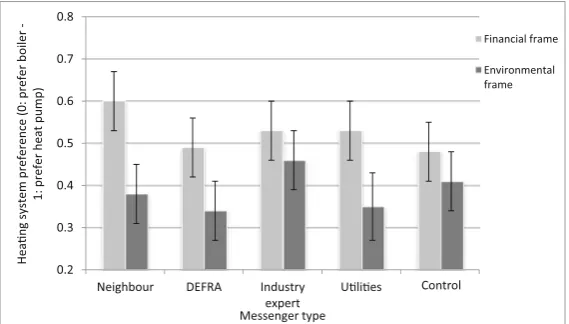
A 2 (feedback frame: financial vs. environmental) × 5 (mes-senger type: neighbour, government, industry, utilities vs. con-trol) analysis of variance (ANOVA) on heating system prefer-ence revealed no main effect of messenger condition on heating system preference (0–prefer boiler vs. 1 prefer heat pump):F(4483) = .47,p= .76,η2= .004. However, a signif-icant main effect of feedback frame was identified:
F(1483) = 9.72, p= .002, η2= .02. Specifically, regardless of messenger type, participants were found to be significantly more likely to select the energy efficient system if they were given financial vs. environmental information (M = .53,
SD= .50 vs.M= .39,SD= .49 respectively) as part of the initial choice scenario. No interaction was found between messenger condition and feedback frame:F(4483) = .48,
p= .75,η2= .004. Results are displayed in Fig.1.
Behavioural Intentions
We then explored whether messenger type had any impact on behavioural intentions (DV2). Once again a 2 (feedback frame: financial vs. environmental) × 5 (messenger type: neighbour, government, industry, utilities vs. control) between subjects ANOVA revealed no main effect of messenger type:
F(4483) = 1.49, p= .21,η2= .01. However, paralleling the option preference analyses, a significant main effect of feed-back frame type was found:F(1483) = 4.47,p= .04,η2= .01. Specifically, participants who were given financial versus
environmental information on the benefits of‘choosing green’ were found to be significantly more likely to state they would consider installing an energy efficient heat pump in real life (M= 3.02,SD= 1.05 vs.M= 2.81,SD= 1.08 respectively). Once again no interaction was found between messenger type and feedback frame:F(4483) = .43,p= .79,η2= .004. Results are displayed in Fig.2.
Although no differences were found in terms of vary-ing messenger types on option preference or behavioural intentions, we were nevertheless still interested to deter-mine whether there may be any variation in perceptions of trust and knowledgeability (DV’s 3 and 4), which may prove informative in the development of future behaviour change interventions.
Trust
A 2 (feedback frame: financial vs. environmental) × 5 (mes-senger type: neighbour, government, industry, utilities vs. con-trol) between subjects ANOVA revealed a significant main e f f e c t o f m e s s e n g e r t y p e o n t r u s t p e r c e p t i o n :
F(4483) = 6.88,p< .001,η2= .05. Least-significant different (LSD) post-hoc tests revealed that the industry expert from Which? was perceived to be significantly more trustworthy than the control (p < .001). In addition, a significant main effect of feedback frame was found: F(1483) = 4.43,
p = .04, η2 = .01. Specifically, an overall increase in trust perception was found in the environmental versus financial frame conditions (M = 3.42, SD = .86 vs. M = 3.58,
SD = .84 respectively). No interaction was found between messenger type and feedback frame:F(4483) = .66,p= .62,
η2
= .005. The results are displayed in Table1below.
Knowledgeability
Paralleling earlier trust analyses, a 2 (feedback frame: finan-cial vs. environmental) × 5 (messenger type: neighbour,
0.2 0.3 0.4 0.5 0.6 0.7 0.8
Neighbour DEFRA Industry expert
Ulies
Heang system preference (0: prefer boiler
-1: prefer heat pump)
Messenger type
Financial frame
Environmental frame
Control
Fig. 1 Bar chart displaying heating system preference across messenger type condition and feedback frame (financial vs. environmental). Standard errors are represented in the figure by the error bars attached to each column
[image:9.595.261.546.547.709.2]government, industry, utilities vs. control) between subjects ANOVA revealed a significant main effect of messenger type on perception of knowledgeability:F(4482) = 7.48,p< .001,
η2
= .06. LSD post-hoc tests revealed two significant contrasts with the control. Specifically, the industry expert from Which? was perceived to be significantly more knowledgeable (p= .034), whilst the neighbour was perceived to be signifi-cantly less knowledgeable (p = .002) than the control. No effect of feedback frame was found on perception of knowl-edgeability:F(1482) = 2.57,p= .11,η2= .005, and no inter-action was found between messenger type and feedback frame: F(4482) = 1.65,p = .16, η2= .01. The results are displayed in Table1below.
General Discussion
The current research explored the potential for varying mes-senger types and feedback frames to increase selection of energy-efficient technologies in the context of home heating choice. Overall, we find no evidence for any impact of mes-senger types in guiding behaviour in this context. However, messagecontentwas found to be highly influential, with fi-nancial versus environmental feedback information leading to a significantly increased likelihood of selecting the energy efficient technology. In contrast to some recent research in the area (e.g. Bolderdijk et al.2012), our results subsequently appear to be in line with research which has recognised the importance of emphasising financial information in order to change behaviour. For instance, research into smart meter de-sign and smart driving aids has consistently found that pro-viding real-time feedback information on the financial impli-cations of current fuel consumption levels leads to reduced consumption and the adoption of more efficient driving styles (e.g. Fischer2008; Birrell and Young2011). Our findings are in line with this research, and suggest that for the kinds of large-scale one-off purchase decision we consider, providing information on potential financial savings that may be achieved by‘choosing green’may be key in guiding behav-iour in desired directions (see also, Hafner et al.2017). We return to a discussion of the theoretical and applied implica-tions of this finding shortly below.
However we first return to the, perhaps somewhat surpris-ing, finding that no evidence was found for any impact of varying messenger types on behaviour in this context. This is made even more striking by the finding that one messenger type (namely, the industry expert from Which?) was perceived to be significantly more trustworthy and more knowledgeable than the control. Yet, no impact of even this most highly cred-ible source was found upon chooser behaviour either in terms of the hypothetical choice task, or later behavioural intentions. So why could this be the case? One explanation relates back to Wilson and Sherrell’s (1993) finding that level of task
1.5 2 2.5 3 3.5
Neighbour DEFRA Industry expert
Control
Likelihood of installing a heat pump in real life
(1: not at all likely -5: exteremly likely)
Messenger type
Financial frame
Environmental frame
Ulies
[image:10.595.261.546.52.217.2]Fig. 2 Bar chart displaying the impact of messenger type and feedback frame (financial vs. environmental) on behavioural intentions. Standard errors are represented in the figure by the error bars attached to each column
Table 1 Sample sizes, mean scores and standard deviations for messenger type and feedback frame on perception of trust and knowledgeability
Messenger type Feedback frame Trust Knowledgeability
Mean SD N Mean SD N
Neighbour Financial 3.28 .83 50 3.16 .82 50 Environmental 3.25 .81 48 2.96 .94 48
Total 3.27 .82 98 3.06 .88 98
DEFRA Financial 3.51 .87 53 3.52 .87 52
Environmental 3.57 .91 56 3.55 .99 56 Total 3.54 .89 109 3.54 .93 108 Industry expert Financial 3.73 .78 49 3.67 .83 49
Environmental 3.94 .91 50 3.78 1.04 50
Total 3.84 .85 99 3.73 .93 99
Utilities Financial 3.36 .91 45 3.16 1.00 45 Environmental 3.63 .72 43 3.51 .88 43
Total 3.49 .83 88 3.33 .96 88
Control Financial 3.21 .85 48 3.27 .96 48 Environmental 3.49 .67 51 3.49 .94 51
[image:10.595.50.290.473.711.2]involvement is critical in determining the impact of messenger effectiveness, and likelihood of adherence to the provided message. Specifically, in line with the Elaboration Likelihood Model (ELM) of persuasion (Petty and Cacioppo
1986), Wilson and Sherrell (1993) find that low–involvement subjects, who are not required to process message content, are more susceptible to messenger effects. It is suggested this is because subjects are more likely to focus on accompanying peripheral message cues in cases where message content is seen as less important. In the current research, participants were highly involved in the task at hand, and were asked to carefully process the information provided on both heating system options prior to making their decisions. In addition, the choice scenario participants were presented with described a one-off purchase with a large financial outlay. Subsequently participants would have been highly invested in the task, giv-en the long lasting implications of their choice, which would have substantial impact on their personal financial circum-stance. As such, we suggest that the increased level of pro-cessing associated with these kinds of large-scale decisions, in which one is highly motivated to extract meaning from mes-sage content (versus the comparatively less consequential de-cisions typically used in messenger research, such as smaller-scale purchase decisions, or engagement in free health-related behaviours; e.g. Crisci and Kassinove 1973; Webb and Sheeran2006; Wilson and Sherrell1993) may go some way to explaining why no evidence is found for any impact of messenger type on behaviour. Indeed supporting this, Kumkale et al. (2010) more recent meta-analyses also finds that messenger effects are only prevalent when one is unable to access a prior attitude about the topic, and when one is not required to construct a preference judgement based upon mes-sage content (see also, Chaiken and Maheswaran1994; Craik and Lockhart1972). Thus, in line with this previous research, we replicate the finding that messenger effects appear to hold little sway in instances requiring the chooser to form prefer-ences after actively processing message content, and in in-stances where choice outcomes are likely to have wide reaching implications for one’s personal circumstances.
By exploring these effects in the novel context of pro-environmental choice, the presented research provides some interesting insight for behaviour change and decision making researchers. We find that in consequential circumstances in which consumers are highly motivated to process message content, one cannot necessarily expect to utilise messenger effects in order to change behaviour. As previously men-tioned, even when messenger sources are perceived as being highly credible in terms of trustworthiness and knowledge-ability (i.e. in this case, the industry expert from Which?), this alone appears to be insufficient to drive behaviour change. However, it may be that this messenger type could be utilised in behaviour change efforts which do not require the chooser to actively process message content; and indeed, identifying
instances where this may be possible remains an interesting avenue for future research to explore. However, with regards to the kinds of large-scale one-off purchases we consider in the presented research, one would naturally expect that mes-sage content; particularly with regard to information on the pros and cons of alternate possibilities; would be subject to a high level of scrutiny from decision makers, due to associated long-lasting and wide reaching implications of one’s actions. Nevertheless in such instances, the current research does
identify one strategy which appears to be a highly successful method for changing behaviour, and for encouraging pro-environmental choice. This relates to the use of financial ver-sus environmental decision framing techniques when describ-ing the benefits of pro-environmental technologies. Specifically, our findings demonstrate that preference for the energy-efficient heat pump versus standard boiler was signif-icantly increased when a financial versus environmental fram-ing technique was used; an effect which was even found to carry over to real-life behavioural intentions, with participants who were given financial feedback information being signif-icantly more likely to state they would later consider installing a heat pump in real life. This latter finding is perhaps particu-larly striking given that participants were aware they were engaging with a purely hypothetical choice task at the outset. As such, one would not necessarily expect to find that infor-mation provided as part of an experimental scenario to have any impact on real-life behavioural intentions. Yet it appears that the assimilation of financial feedback information consti-tuted such an integral part of the decision process that there was significant carry-over to real-life behavioural intentions.
So why could this be the case? One explanation relates back to the alternate value systems which may be evoked when varying aspects of information are made salient within the decision frame (Stern and Dietz1994; Dogan et al.2014). Specifically, it appears that the egoistic value system elicited following financial feedback may be more effective in chang-ing behaviour than the biospheric value system evoked fol-lowing environmental feedback information, in this context. Perhaps the financial scale of the purchase decision involved meant participants were more inclined to approach the choice from an egoistic perspective from the outset. As such, provid-ing financial information may have simply been more in-line with the processing style or value system naturally elicited under this circumstance. However, we note that because no measure of value systems was included in the current research, further research will be needed in order to establish the valid-ity of this suggestion. In addition, it is also important to bear in mind that a potential limitation of the current research con-cerns the fact that our participants were paid for taking part in the study. As such, it may be that our sample were more motivated towards financial gain that the average individual. Consequently, it may be useful for future research to replicate this study using a participant pool who are willing to take part
in the absence of any cash payment, in order to establish whether these findings generalise to a wider population.
Of course, the question also remains as to the extent to which our findings may be context bound, given the kind of large-scale purchase decision we focus on in the current research. It may be that people are only motivated by longer term financial versus environmental benefits in situations involving such significant initial financial outlay. Future research should subsequently look to continue to explore the parameters of these effects, and to determine which decision circumstances and at which level(s) of investment behaviour may be guided using financial framing techniques. It may be that for smaller scale purchases, or for pro-environmental campaigns designed to target regularly repeated habitual (free) behaviours (such as regularly adjusting thermo-stat settings, or closing windows when the heating is on) an environmental framing of the benefits of pro-environmental ac-tion may still be an effective strategy for guiding behaviour. Indeed supporting this suggestion, Bolderdijk et al. (2012), found that environmental-benefit frames were more effective than financial-benefit frames when it came to motivating people to carry out regular tyre-checks. However, it would certainly appear that for the kinds of large-scale purchase decisions we consider here, information on longer term financial benefits of action may prove a critical component of any campaign de-signed to promote uptake of energy-efficient technologies.
The APA (2009) theorized that mistrust in messages con-veyed by government officials might be a key factor preventing action to combat issues of climate change. However, the current research provides evidence to suggest that this may not be the case, as there was a generally increased perception of trustwor-thiness across all messenger types when the message they were delivering involved environmental, as opposed to financial, feedback information. Yet even in light of this increased trust perception, these messengers were still unable to motivate be-haviour change. As such, these findings are consistent with the strand of messenger research which has found that trustworthi-ness alone is not sufficient to alter recipient behaviour (Hovland and Weiss1951; Wilson and Sherrell1993) and suggest that mistrust in messengers may not be a principle factor contribut-ing to the reduced persuasive appeal of many climate change appeals. In fact, it appears that recipients of pro-environmental campaigns may be effectively immune to variations in messen-ger type, due to the level of processing evoked following highly consequential decision circumstances.
In addition, the fact that we still find no evidence for any messenger effect when a less persuasive message content is utilised (i.e. in this case the environmental framing of benefits) highlights that it wasnotthe case that the financial frame overruled any potential effect of messenger type on chooser behaviour. If this were the case then one might expect to find some evidence of a messenger effect when a less persuasive content form was in place. However, even though the industry expert from Which? was perceived to be a highly credible
source, and provided significant contrast with the control on measures of both trustworthiness and knowledgeability, neither this, or any other messenger type was able to incite behaviour change in desired directions when a less persuasive content form was used. As such, our results provide overarching sup-port for the lack of any messenger effect in this context, regard-less of message content. This is in alignment with our earlier suggestion that high motivation to process message content due to the consequential nature of the specific choice scenario utilised meant subjects were simply not susceptible to variations in accompanying peripheral message cues in this instance.
We previously reviewed how discounting of future conse-quences is considered a key barrier to behaviour change in the context of pro-environmental action (APA,2009; Gifford et al.
2009; Hafner et al.2017). Yet our results suggest that by altering the focus of message content to place emphasis on the longer term financial benefits of‘choosing green’we can begin to over-come these effects, decreasing both our tendency to discount future consequences, and the emphasis placed on increased short term outlay. Future research should look to consider how this can be most effectively be incorporated into marketing strategies or behaviour change campaigns in order to maximise potential con-sideration and uptake of new technologies, and the extent to which these effects carry over to real-life choice contexts.
one’s own previous behaviour patterns (see, for example, Schwartz2004; Botti and Iyengar2006).
However, it may be that financial framing of benefits of
‘choosing green’can help to overcome some of these effects in real-world scenarios, by increasing the attractiveness of such options at the outset. This is further supported by our earlier suggestion that the level of processing involved in con-sequential decisions means people are highly motivated to process message content in these circumstances. When one moves to real-life versus hypothetical choice scenarios, the consequences of action are likely to be given greater weight within the decision process. As such, it may be that financial framing of benefits has even greater potential to incite behav-iour change in real-world scenarios, versus hypothetical choice tasks. However, more research is needed in order to establish if this is the case, and to determine the parameters and financial thresholds of any such effects on behaviour. However, it certainly appears that financial framing of benefits may prove a useful strategy for promoting uptake of energy-efficient technologies; ultimately taking us one step nearer in the strive towards behaviour change goals at the societal level.
Funding This research was conducted by i-STUTE (the Interdisciplinary Centre for Storage, Transformation and Upgrade of Thermal Energy); one of six End Use Energy Demand (EUED) centres funded by the UK Research Councils’Energy Programme (RCUK).
Compliance with Ethical Standards
Ethical Approval All procedures performed in studies involving hu-man participants were in accordance with the ethical standards of the institutional and/or national research committee and with the 1964 Helsinki declaration and its later amendments or comparable ethical standards.
Informed Consent Informed consent was obtained from all individual participants included in the study.
Conflict of Interest All authors declare that they have no conflict of interest.
Open AccessThis article is distributed under the terms of the Creative C o m m o n s A t t r i b u t i o n 4 . 0 I n t e r n a t i o n a l L i c e n s e ( h t t p : / / creativecommons.org/licenses/by/4.0/), which permits unrestricted use, distribution, and reproduction in any medium, provided you give appro-priate credit to the original author(s) and the source, provide a link to the Creative Commons license, and indicate if changes were made.
References
Abrahamse, W., Steg, L., Vlek, C., & Rothengatter, T. (2005). A review of intervention studies aimed at household energy conservation.
Journal of Environmental Psychology, 25, 273–291.
Allcott, H., & Wozny, N. (2012).Gasoline Prices, Fuel Economy, and the
Energy Paradox.NBER Working Paper No. 18583. Retrieved
February 03, 2015, from:http://www.nber.org/papers/w18583
American Psychological Association (APA). (2009). Psychology and Global Climate Change: Addressing a Multifaceted Phenomenon
and Set of Challenges.Retrieved September 27, 2016, from:http://
www.apa.org/science/about/publications/climate-change-booklet.pdf Arbon, J., & Kilbane-Dawe, I. (2016). Reducing air pollution from your building – A series of manuals for operators, Designers & Developers.Retrieved July 25, 2016, from:www.camden.gov.uk/ ccm/cms-service/download/asset?asset_id=3151897
Birrell, S. A., & Young, M. S. (2011). The impact of smart driving aids on driving performance and driver distraction.Transportation
Research Part F, 14, 484–493.
Bolderdijk, J. W., Steg, L., Geller, E. S., Lehman, P. K., & Postmes, T. (2012). Comparing the effectiveness of monetary versus moral motives in environmental campaigning.Nature Climate Change, 3, 413–416. Botti, S., & Iyengar, S. S. (2006). The dark side of choice: When choice
impairs social welfare.Journal of the American Marketing Association, 25(1), 24–38.
Brann, P., & Foddy, M. (1987). Trust and the consumption of a deteriorat-ing common resource.Journal of Conflict Resolution, 31, 615–630. Braunsberger, K. (1996). The Effects of Source and Product
Cha rac te ri st ic s on P er sua si on. Di sse rt ati on A bst rac ts
International: Humanities and Social Sciences, 57(6-A), 2575.
Chaiken, S. (1979). Communicator physical attractiveness and persuasion.
Journal of Personality and Social Psychology, 37(8), 1387–1397.
Chaiken, S. (1980). Heuristic versus systematic information processing and the use of source versus message cues in persuasion.Journal of
Personality and Social Psychology, 39(5), 752–766.
Chaiken, S., & Maheswaran, D. (1994). Heuristic processing can bias systematic processing: Effects of source credibility, argument ambi-guity, and task importance on attitude judgment.Journal of
Personality and Social Psychology, 66, 460–473.
Cialdini, R. B. (2007).Influence: The psychology of persuasion. New York: Harper Collins.
Climate Change Communication Advisory Group. (2010).
Communicating Climate Change to Mass Public Audiences
(Working Document). Retrieved April 18, 2017, from:http:// psych.cf.ac.uk/understandingrisk/docs/cccag.pdf
Committee on Climate Change. (2011a). Climate change act.Technical report;Committee on Climate Change. Retrieved February 11, 2016, from:www.theccc.org.uk/about-the-ccc/climate-change-act Committee on Climate Change. (2011b). Climate change act: Homes.
Retrieved November 18, 2016, from:http://www.theccc.org.uk/ sectors/buildings-a-industry/homes
Craig, S., & McCann, J. (1978). Assessing communication effects of energy conservation.Journal of Consumer Research, 5, 82–88. Craik, F., & Lockhart, R. (1972). Levels of processing: A framework for
memory research. Journal of Verbal Learning and Verbal
Behaviour, 11(6), 671–684.
Crano, W. (1970). Effect of sex, response order, and expertise in confor-mity: A dispositional approach.Sociometry, 33, 239–252. Creyts, J., Granade, H. C., & Ostrowski, K. J. (2010). U.S. Energy
Savings: Opportunities and Challenges. McKinsey Quarterly,
January Issue.
Crisci, R., & Kassinove, H. (1973). Effect of perceived expertise, strength of advice, and environmental setting on parental compliance.
Journal of Social Psychology, 89, 245–250.
Department for Food and Rural Affairs (DEFRA). (2008).A Framework
for Pro-Environmental Behaviours.Retrieved September 27, 2016,
from:https://www.gov.uk/government/uploads/system/uploads/ attachment_data/file/69277/pb13574-behaviours-report-080110.pdf Department of Energy and Climate Change. (2012). Estimates of Heat Use in the United Kingdom in 2012.Retrieved November 17, 2016, from: https://www.gov.uk/government/uploads/system/uploads/attachment_ data/file/244735/4_estimates_of_heat_use_in_the_uk_2012.pdf Department of Health. (2010).5 A Day General Information.Retrieved
uk/+/http://dh.gov.uk/en/publichealth/healthimprovement/fiveaday/ index.htm
Department of Health. (2014). Less Smoking,More Joking:Stoptober Campaign Launched.Retrieved October 12, 2016, from:https:// www.gov.uk/government/news/less-smoking-more-joking-stoptober-campaign-launched
Dogan, E., Bolderdijk, J. W., & Steg, L. (2014). Making small numbers count: Environmental and financial feedback in promoting eco-driving Behaviours.Journal of Consumer Policy, 37, 413–422. Dolan, P., Hallsworth, M., Halpern, D., King, D., & Vlaev, I. (2010).
MINDSPACE: Influencing Behaviour through Public Policy.
R e t r i e v e d S e p t e m b e r 2 7 , 2 0 1 6 , f r o m : h t t p : / / w w w. instituteforgovernment.org.uk/publications/mindspace
Fischer, C. (2008). Feedback on household electricity consumption: A tool for saving energy?Energy Efficiency, 1, 79–104.
Foddy, M., & Dawes, R. M. (2008). Group-based Trust in Social Dilemmas. In A. Biel, D. Eek, T. Gärling, & M. Gustaffson (Eds.),
New issues and paradigms in research in social dilemma(pp. 57–
71). New York: Springer.
Frederick, S., Loewenstein, G., & O’ Donoghue, T. (2002). Time discounting and time preference: A critical review. Journal of
Economic Literature, 40, 350–401.
Gardner, G. T., & Stern, P. C. (2002).Environmental problems and
hu-man behavior. Boston: Pearson.
Giffin, K. (1967). The contribution of studies of source credibility to a theory of interpersonal trust in the communication process.
Psychological Bulletin, 68(2), 104–119.
Gifford, R., Scannell, L., Kormos, C., Smolova, L., Biel, A., & Boncu, S. (2009). Temporal pessimism and spatial optimism in environmental assessments: An 18-nation study. Journal of Environmental Psychology, 29, 1–12.
Griskevicius, V., Tybur, J. M., & Van den Bergh, B. (2010). Going green to be seen: Status, reputation, and conspicuous conservation.
Journal of Personality and Social Psychology, 98(3), 392–404.
Hafner, R. J., Elmes, D., & Read, D. (2017). Exploring the comparative impact of normative information and financial/environmental feed-back frames in promoting pro-environmental behaviour.Journal of Environmental Psychology (Under Review).
Hovland, C., & Weiss, W. (1951). The influence of source credibility on communication effectiveness.Public Opinion Quarterly, 15, 635–650. Iyenger, S., & Lepper, M. (2000). When choice is demotivating: Can one desire too much of a good thing?Journal of Personality and Social
Psychology, 79(6), 995–1006.
Jaffe, A. B., & Stavins, R. N. (1994). The energy paradox and the diffu-sion of conservation technology.Resource and Energy Economics, 16(2), 91–122.
Kassin, S. M. (1983). Deposition testimony and the surrogate witness: Evidence for aBmessenger effect^in persuasion.Personality and
Social Psychology Bulletin, 9(2), 281–288.
Kelman, H., & Hovland, C. (1953). Reinstatement' of the communicator in delayed measurement of opinion.Journal of Abnormal and
Social Psychology, 48, 327–335.
Kumkale, G. T., AlbarracÍn, D., & Seignourel, P. J. (2010). The effects of source credibility in the presence or absence of prior attitudes: Implications for the Design of Persuasive Communication Campaigns.Journal of Applied Social Psychology, 40(6), 1325–1356. MacGregor, D., Slovic, P., Mason, R. G., & Detweiler, J. (1994). Perceived risks of radioactive waste transport through Oregon.
Risk Analysis, 14, 5–14.
McCroskey, J. (1969). A summary of experimental research on the effects of evidence in persuasive communication.The Quarterly Journal of Speech, 55, 169–176.
McGinnies, E., & Ward, C. (1980). Better liked than right: Trustworthiness and expertise as factors in credibility.Personality
and Social Psychology Bulletin, 6, 467–472.
Noppers, E. H., Keizer, K., Bolderdijk, J. W., & Steg, L. (2014). The adoption of sustainable innovations: Driven by symbolic and envi-ronmental motives.Global Environmental Change, 25, 52–62. Noppers, E. H., Keizer, K., Bockarjova, M., & Steg, L. (2015). The
adoption of sustainable innovations: The role of instrumental, envi-ronmental, and symbolic attributes for earlier and later adopters.
Journal of Environmental Psychology, 44, 74–84.
Northern Ireland Environment Link. (2012).Effecting Behaviour Change
Through Environmental Messaging.Retrieved April 18, 2017, from:
http://www.nienvironmentlink.org/cmsfiles/files/Publications/ Behaviour-Change–Env-Msging.pdf
Ölander, F., & Thøgersen, J. (2014). Informing versus nudging in envi-ronmental policy.Journal of Consumer Policy, 37, 341–356.
Petty, R. E., & Cacioppo, J. T. (1986).Communication and persuasion:
Central and peripheral routes to attitude change. New York:
Springer-Verlag.
Petty, R. E., Cacioppo, J. T., & Schumann, D. (1983). Central and periph-eral routes to advertising effectiveness: The moderating role of in-volvement.Journal of Consumer Research, 10, 135–146.
Pornpitakpan, C. (2004). The persuasiveness of source credibility: A critical review of five decades’evidence.Journal of Applied
Social Psychology, 34, 243–281.
Ross, J. (1973). Influence of expert and peer upon negro mothers of low socio-economic status.Journal of Social Psychology, 89, 79–84.
Schwartz, B. (2004).The paradox of choice: Why more is less. New York: HarperCollins.
Simons, H. W., Berkowitz, N. N., & Moyer, R. J. (1970). Similarity, credibility, and attitude change: A review and a theory.
Psychological Bulletin, 73, 1–16.
Steg, L., & Vlek, C. (2009). Encouraging pro-environmental behaviour: An integrative review and research agenda. Journal of
Environmental Psychology, 29, 309–317.
Steg, L., Perlaviciute, G., & van der Werff, E. (2015). Understanding the human dimensions of a sustainable energy transition.Frontiers in
Psychology,6, 805.https://doi.org/10.3389/fpsyg.2015.00805
Stern, N. H. (2007).The economics of climate change: The stern review. Cambridge: Cambridge University Press.
Stern, P. C., & Dietz, T. (1994). The value basis of environmental con-cern.Journal of Social Issues, 50, 65–84.
Sternthal, B., Phillips, L. W., & Dholakia, R. (1978). The persuasive effect of source credibility: A situational analysis.Public Opinion Quarterly, 42, 285–314.
Walster, E., & Festinger, L. (1962). The effectiveness ofBoverheard^ persuasive communications.Journal of Abnormal and Social
Psychology, 65, 395–402.
Warren, I. (1969). The effect of credibility in sources of testimony on audience attitudes toward speaker and message. Speech
Monographs, 36, 456–458.
Watts, W., & McGuire, W. (1964). Persistence of induced opinion change and retention of the inducing message contents. Journal of
Abnormal and Social Psychology, 68, 233–241.
Webb, T. L., & Sheeran, P. (2006). Does changing Behavioural intentions engender behaviour change? A meta-analysis of the experimental evidence.Psychological Bulletin, 132(2), 249–268.
Which? (2013). Update: Our Latest Research Reveals the Standing Charge Lottery on Your Energy Bills. Retrieved April 12, 2017, from: http://www.which.co.uk/campaigns/energyprices/standing-charge-lottery-energy-bills
Wilson, E. J., & Sherrell, D. L. (1993). Source effects in communication and persuasion research: A meta-analysis of effect size.Journal of
the Academy of Marketing Science, 21(2), 101–112.
Woodside, A. G., & Davenport, W. (1974). The effect of salesman sim-ilarity and expertise on consumer purchasing behaviour.Journal of
Marketing Research, 11, 198–202.