)
TRilFFIC COIIlTnOL DY COMPUTER
(
/
/
\
/
\
Yesterday Ampex introduced the
RB for data systems that need
a small memory. (1024 words.)
Today we bring you the RVQ for
systems that need to think a bit
bigger.
(4096 words.)
The Ampex RVQ core memory unit is ideal for data systems that need small-to-medium storage capacities. At the
same time, it has the flexibility for random access applications or high speed sequential or buffer operations. It's
designed for rack mounting-a 36 bit word RVQ occupies only 15%" of rack space. It loads or unloads in 4
micro-seconds. Has a complete memory cycle of 6 micromicro-seconds. Remembers words 8 to 36 bits long. And operates
on conventional unfiltered and unregulated AC power. You can tell it's an Ampex model by its reliable, simple
operation. And its ease of maintenance - just flip the front panel down. The RB and RVQ are two of more
than 40 solid state memories made by Ampex. Cycle times range from 24 to 1 microseconds with capacities
up to a million bits or more. For data write: Ampex Corporation, 934 Charter Street, Redwood City, California.
CIRCLE 1 ON READER CARD
o
o
NEW: DDP-19, THE FASTEST MEDIUM-SIZED COMPUTER
FOR REAL-TIME ENGINEERING APPLICATIONS!!
DDP-19
HIGI-I-SPGED CI-lA R ... '\CTE: R ISTI CS
Memory cycle time . 5 microseconds Add: successive opera· tions with instruction and operand access
10 microseconds each Averl!ge multiply
36 microseconds' Divide
57 microseconds I nput·output
200 KC word transfer rate
This new, high-speed DDP-19
(Digital Data Processor)
is a single address, parallel, binary, 19-bit computer with a magnetic core storage of 4096 to 8192 words!DDP-19's fully buffered input permits continuous intake of data! DDP-19's up to 16 pro-gram addressable input/output channels (operable in both
busy
or
interrupt
mode) allow asynchronous connection to any existing system! .DDP-19~s extremely flexible analog input/output units permit
immediate
tie-in to any real-time man-machine simulation! DDP-19's modular construction using 3C's customer-proven S"PAC digital modules provides ampl~ room for expansion! Compiler, assembler, and 'sub-routines are available!VE~SATILE
(It outperforms any com· puter in its price range!)
HIGH-SPEED
(It handles complex on· line data reduction fast· er than any comparable
machin~!)
ECONOMICAL
(It replaces expensive, custom-built systems. and large scale com-puters!)
A few applications of this versatile. high-speed DDP-19 computer include: ..
I
I
L __
.~_ _ _
-
_
• . • use as a control computer for the pre· cision tracking of high-spee~ targets •••.•• use for real-time data acquisition and the presentation of scaled and digitally filtered results • • •
r .. · ..
• •. use in real- time simulation problems in-volving analog and dig ita I equipment and sub systems • • •
For more comprehensive DDP·19 informa. tio'). please call or write to:
May 1962
SYSTEIVIS DIVISION
COMPUTt=:R CONTROL COMPANY, INC.
!':ASTEIIN PL,HlT: 983 CONCORD STREET/FRAMINGHM..-1/M,\SSACHUSETTS l'IESTBlII PLANT: 2251 MRRY AVENUE/LOS ANGELES 64/CALIFORNIA
May 1962
What's new at RCA
,is news in EDP
Opening the Way to a New Generation
of Data Processing Equipments
A future computer up to 100 times faster than today's
computer ... is now within the range of reality.
What makes possible such incredibly fast
computers-for tomorrow? Itis the achievement of new, super-fast
computer circuits based on RCA's tiny
tunnel diode . ..
an ultra-small decision element, simple in construction,
economical to operate.
This advance was born of a far-reaching development
program in which RCA was assigned the task of
producing- computer circuitry that \Vould operate at
speeds hardly imagined five years ago. Today, RCA
has a variety of -major· circuit groups working in the
nanosecond* (billionth of a second) range! In
accom-plishing this, RCA has surmounted many obstacles in
miniaturization and high-frequency wiring techniques.
\
Here is anqther example of RCA's
engineeringprog-ress in EDP ... another step toward
a
new revolution
in data processing, with important implications for
business, industry, government and sciences. It's news
in EDP, it's from RCA Electronic Data Processing,
Cherry Hill, Camden 8, N.
J.
*A nanosecond is to a second what a second is to 30 years!
COMPLETE 301 SYSTEM NOW AVAILABLE FOR AS LITTlE AS $3,315 PER MONTH! Expansible to accommodate increased workloads ... with high-speed magnetic tapes, millisecond random access pr6cessing, large capacity core memory, simul-taneous operations, dual line printers and punched card readers. And more!
G
I.,
'
~l~
~
I
The Most Trusted Name in Electronics
,
RADIO CORPORATION OF AMERICA
®
.
- CIRCLE 5 ON READER CARD
3
"WORLD'SLARGEST PRODUCER OF GREETING ,CARDS."
UWhy we chose the NCR
Computer."-AMERICANGREETINGSCORPORATION,CleVeland,OhiO"We chose the NCR Computer because, after thorou'gh investigation, we be-came convinced it had the most ad-vanced combination of features to meet ,our specific· needs; And, looking to the future, we were convinced that it had the flexibility to adapt to the changing conditions that occur in a growing busi-ness such as ours. '
"Bec'aiJse of its many unique features, our NCR Computer will become a vital electronic nerve-center, enabling ,us to
keep a steady finger on the pulse of our business. For example, it will pene-trate right to greeting card racks on
mo~e than 45,000 dealers' sales floors. We will be able to quickly measure' sales activity by dealer and by card number. As a result, we will be able to stock each rack scientifically according to the needs of each dealer.
"Our NCR Computer will give us a tighter control over merchandise as-signment. It will give us a sharper gauge
of stock control and stock turnover. It will improve customer relations. And, while We will use the computer for all phases of our data processing, our in-vestment will be justified on the Order Processing application alone."
President
American Greetings .Corporation
NCR PROVIDES TOTAL SYSTEMS-FROM ORIGINAL ENTRY TO FINAL
RE~ORT-,
.
THROUGH ACCOUNTING MACHINES, CASH REGISTERS OR ADDING MACHINES, AND DATA PROCESSING
The National Cash Re'gister Co.·1,039 offices In 121 countries·78 years of helping business save money
CIRCLE 6 ON READER CARD
ORTRMRTION
o
volume8,
number5
Staff
Publisher FRANK D. THOMPSON
Vice President & General Manager
GARDNER' F. LANDON
Vice President & Publication Manager
RICHARD W. NIELSON
Editor HAROLD BERGSTEIN
Managing Editor & Art Director
CLEVE BOUTELL
Assistant Editor IRWIN SCHORR
News Editor VALERIE ROCKMAEL
Contr~buting Editor
DR. H. R. J. GROSCH
Technical Consultant DON B. PRELL
Production Manager
MARILEE PITMAN
Circulation Mgr. ALGENE TRAINA
Editorial Advisers
DANIEL D. McCRACKEN ROBERT L. PATRICK
Eastern District
RICHARD W. NIELSON
141 E. 44th St., New York 17, N.Y. MUrray Hill 7-5180
New England District Manager
WARREN A. TIBBETTS
112 West Haven Rd., Manchester, N.H., NAtional 5-9498
Midwest District Manager
JOHN BRENNAN
201 N. Wells St., Chicago 6, III. Financial 6-1026
Western District Manager
& Vice President
HAMILTON S. STYRON
10373 W. Pico Blvd., Los Angeles 64, Cal. BRadshaw 2-2643
o
EDITORIAL OFFICES 10373 W. PI.CO BLVD., LOS ANGELES 64, CALIF.May 1962
the automatic handling of information
Feature Articles
23
27
30
31 34 37 44
47
57
63
68
A Computer Curricula For The High School, by George C. Heller
Computing In The University:
Two Surveys Report on Hardware Installations U.S. Papers Set For IFIP Congress
Traffic Control by Computer .
The Language Proliferation, by Christopher
J.
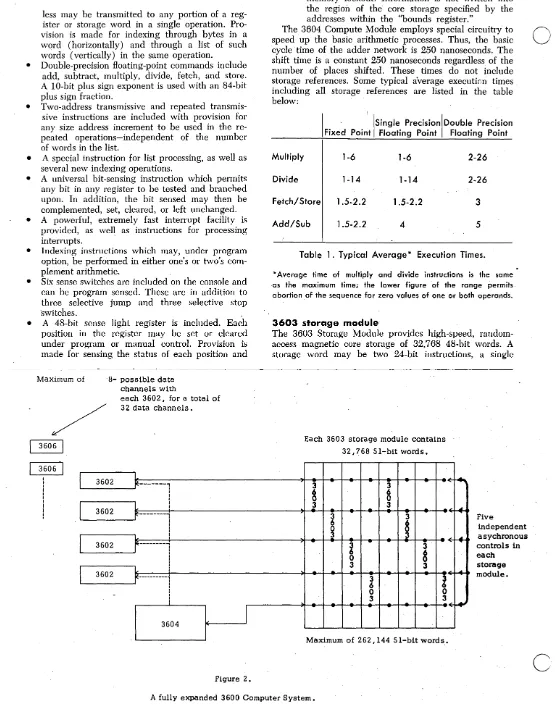
ShawThe CDC 3600: Modularity from 32-262K
A New Home for ALGOL, by Daniel D. McCracken
NMAA's '62 International DP Conference & Exhibit Finke, Fact, and the Changing Face of Honeywell,
by H aroId Bergstein
How to Market A Kludge shrewdly, by Oswald I. Orthmutt
Pitfalls & Safeguards in Real-Time Digital Systems, . Part Two, by W. A. Hosier
Departments
7 Important Dates in Datamation 10 Letters to the Editor
17 Datamation in Business and Science 21 The Editor's Readout
73 News Briefs in Datamation
77
New Literature in Datamation 83 New Products in Datamation93 New Firms and Mergers in Datamation
95
People in Datamation 105 Advertisers' IndexTHIS ISSUE -
40,575 COPIES
Cover
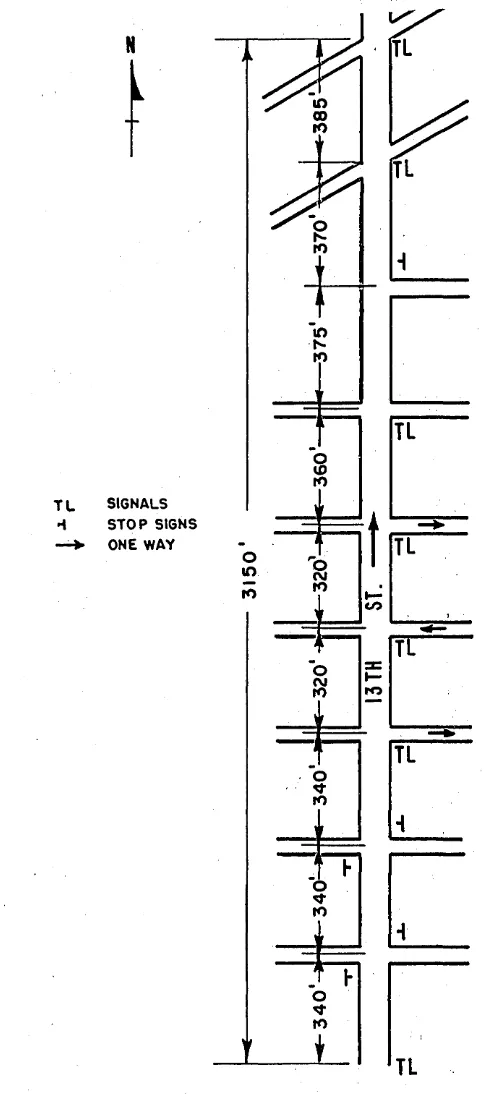
More important than the accuracy and speed of a computer in traffic control, and integ-rally related to' the movement of vehicles is the often forgotten stoplight which Datama-tion art director Cleve Boutell has colorfully illustrated for this month's cover design. A report on an NBS traffic study in Washing-ton, D.C. begins on page 31.
Circulation audited by Business Publications Audit
Member, National Business Publications
DATAMATION is published monthly on or about the tenth day of every month by F. D. Thompson Publica-tions, Inc., Frank D. Thompson, president. Executive Circulation and Advertising offices, 141 East 44th St., New York 17, N.Y. (MUrray Hill 7-5180). Edi-torial offices, 10373 West Pico Blvd., Los Angeles 64, Calif. (BRadshaw 2-0817). Published at Chicago, III. Accepted as controlled circulation at Columbus, O. Form 3579 to be sent to F. D. Thompson Publications, Inc., 201 N. Wells St., Chicago 6, III. Copyright 1962, F. D. Thompson Publications, Inc.
5
• does one computer system take maximum advantage·
of its
comp~ting·speed,peripheralequipment and
storage. capacity at all times and under all
conditions-whereas others do not (and cannot)?
• do· three iobs· that each take an· hour to do· On other
systems take only'l>ihours all told on this system?
• do interrupt conditions that make other systems bog
down have no effect on this system?
• do you get . more throughput. per dollar with this
system than with any other?
• can this equipment lay claim to a totally new concept
in computer system operation?
The Master Control Program (MCP) of a Burroughs
B 5000 Information Processing System is the answer.
It's one of the primary answers to all the questions
above, and it's also the solution to just about every
operational drawback that's ever drained away a
computer user's time, money and patience.
Take the question of interrupts, for example.
Conven-tional systems employ programed interrupt detectiCln.
In the B 5000, interrupt detection is built right into
the hardware. The hardware then switches
electron-ically to the appropriate portion of the MCP for
automatic handling of that specific interrupt
condi-tion. Meanwhile, the current program is processed
further or another program is run instead, if preferred.
In either event, the B 5000's MCP assures that an
interrupt condition does not mean an interruption of
the system itself or the work in progress.
Or consider the paradox of how three jobs that each
take one hour to do on other systems can be
com-pleted in less than half that time by the B 5000. It's
easy-the way the MCP does it. Since some jobs need
a lot of processor time but little input-output time,
whereas some jobs need just the opposite, the MCP
cuts the total processing time of each by running them
concurrently.
The programer needs to write only the
. basic program and the MCP takes over from there,
scheduling and assigning different components when
free. This ability to time-share unused processor and
input-output capacities is one of the main reasons
the B 5000 can give you more throughput per dollar.
Versatile as it is, however, the MCP doesn't fully
account for the fact that the B 5000 is a totally new
concept in system operation. There's the B 5000's
ability to incorporate a second central processor, for
instance-without reprograming.And there's the fact
that the B 5000's basic design concept provides
effec-tive and produceffec-tive use of the higher level languages
of ALGOL and COBOL. Plus enough other reasons
to fill a whole booklet-which we'll be glad to send
to you. It's called The B 5000 Concept and is
avail-able from our main office at Detroit 32, Michigan.
Burroughs-TM
Burroughs Corporation
CIRCLE 7 ON READER CARD
6 DRTRMATION .
c
o
o
• «Electronic Information Display Svstems" is the subject of an
insti-h~te to be held May 21-25 at the
American University, Wash., D.C. • A conference on Self-Organizing Systems will be held on May .22~24 at the Museum of Science and Industry, Chicago. -It is co-sponsored by the Information Systems Branch, Office of Naval Research, and the Armour Re-search Foundation.
• A Symposium on Mathematical Pro-gramming sponsored by the Graduate School of Business of the University of Chicago, the ACM, and USAF Project RAND, will be held June 18-22 at the University of Chicago, Chicago, Ill. • The Ninth Annual Symposium on Computers ·and Data Processing spon-sored. by the Denver Research Insti-tute of the University of Denver is scheduled for June 27-28 at the Elk-horn Lodge, Estes Park, Colorado.
• The 1962 Rochester Conference on Data Acquisition and Processing in
Medicin~ and Biology is set for July 17 and 18 for the Whipple Auditori-um, . Strong Memorial Hospital, Ro--chester, N.Y.
• The Northwest Computing Assoc. will hold its fifth annual conference Aug. 9-11 in Seattle, Washington. The conference is being held in conjunc-tion with the Century 21 exhibit. • The 1962 WESCON will be held Aug. 21-24 in the California· Memor-ial Sports Arena and Statler-Hilton Hotel, Los Angeles.
• The 1962 IFIP Congress is set for Aug. 27 -Sept. 1 in Munich, Ger-many.
• _ The ACM National Conference will be held Sept. 4-7 at the Onondaga County War Memorial Auditorium and Hotel Syracuse, Syracuse, N.Y. • The 3rd annual Symposium on Switching Circuit Theory and Logical Design will be held Oct. 7-12 in Chi-cago, Ill. under the sponsorship of the AlEE Computing Devices Committee. ' • The 1962 Fall Joint Computer Conference will be held Dec. 14-17 at the Bellevue Stratford Hotel, Philadelphia, Penna.
May 1962
•.• THE GROWING TECHNOLOGY - Growth is the key word at International Electric Corporation, the - systems management subsidiary of worldwide International Telephone and Telegraph Corporation. We design, develop and manage complex electronic systems . . . with speCial emphasis in command/control. -We are active today in: digital communications, data display, satel-lite control, oceanic systems, military command/control systems, ballistic missile command/control systems, computer programming, artificial intelligence, commercial data processing and human factors engineering.
We offer positions in these areas:
INFORMATION SYSTEMS ENGINEERS - For design of com-mand/control and advanced communication systems. Experience in traffic, antenna and propagation theory, and mathematics as applied to communications and space technology.
OPERATIONS ANALYSTS - To establish systems requirements in satellite control, air traffic control, ASW and command/control. Also, assignments in man/machine communications and information retrieval.
AEROSPACE ENGINEERS - For integration of digital command/ control systems with complex weapons systems.
DIGITAL SYSTEMS ENGINEERS - Engineers with management ability to direct sub-systems engineering effort on a global com-mand/control system. Experience is desired in message traffic control, data processing syste!l1S, data display and mUlti-sequencing techniques. COMPUTER PROGRAMMERS - For real time programming analysis and development. To develop compilers, problem-oriented computer language and advanced programming systems.
For consideration, write to Manager, Professional Staffing, Dept. DA, enclosing resume.
INTERNATIONAL ELECTRIC CORPORATION
ITT
A SUbsid.iary of International Telephone and Telegraph Corp. _Route 17 & Garden State Parkway, Paramus, N. J.
An Equal Opportunity Employer
CIRCLE 8 ON READER CARD
Storage Systems are our business - We can build a memory system to fit your needs from in-stock standard parts - memory stacks, printed circuit cards, power supply unit, 19" standard racks - and deliver it complete in 45 days. These are available in each of three basic internal logic types - random access, sequential non-inter-laced,' sequential interlaced - with cycle times as fast as 1.5 p.s. In addition to fast delivery, we offer you much more - a highly competent team of research, development and application engineers, backed by the finest production facilities in the industry. • For new data file on memory products, write to Indiana General Corporation, Electronics Division, Keasbey, New Jersey.
in-stock modules
45-day memory delivery •••
8
INDIANA GENERAL
~
TC CORES MEMORY CORES
CIRCLE 9 ON READER CARD
MINIATURE TWT MAGNET MEMORY MOTORS SUB-ASSEMBLIES PLANES
DRTRMRTICN
o
o
May 1962
~: .... : .... ,., . .. ;:.:, .. ,.; . ..:.,.: .. ;:, .•. : .. v:.::,.:":::; .... ~.:,:.,.: .. :.:;.;.,:.~" ... : .. "
,,~f
computer
_.~~~u;!!-
tape
ACCESSORIES
In addition to providing you with a complete line of quality
control panels and wires, MAC Panel is also a dependable
source for your computer tape accessory needs. Same MAC
Panel quality, of course . . . and all shipments made the
same day orders are received.
PLASTIC REELS
AHractive and easy to use reels of high impact plastic to insure proper alignment on magnetic tape units. Holds 2400 feet of magnetic tape for 727, 729 and 7330 tape units. Colors available: Gray, Blue, Red and Yellow.
Weight: 8 ounces per reel.
PLASTIC CONTAINERS
Holds plastic reel above. Clear plas.;. tic container is equipped with "posi-_ tive lock" hub device that prevents
motion thereby reducing plastic dust and particles caused by friction. Weight: 1 pound, 6 ounces per con-tainer.
READ OUT RINGS
~he read out ring is a device which upon remova!' from the reel prevents accidental loss of master informa-tion and only allows data to be read. When the ring is in piace on the reel, reading, writing or erasing can be done by the tape unit as called for during processing. Polyethylene Plastic: 3' ounces per dozen.
/
The new Model CTP Friden Com-putyper® is the world's most versa-tile billing machine. (It reads and punches tape or cards, and writes a complete invoice in one operation!) But because it can do so many jobs automatically, it is really an auto-mation work-center.
Examples?
BILLING: The Computyper writes and computes your invoices auto-matically. Then, by reading its owri by-product punched-paper tape, it prepares an accounts,receivable reg-ister or other statistical reports. By-product cards from this operation enable the CTP (or tabulating ma-chines) to prepare statements auto-. matically. .
INVENTORY: While doing your billing, the Computyper automati-cally updates your inventory figures. PURCHASE ORDERS: The Com-putyper writes your purchase orders, then it uses its own by-product tape to prepare voucher checks, re-ceiving reports, purchase commit-ment analyses-all automatically.
SALES ORDERS: The Computyper prepares your sales orders, then-controlled by its own by-product tape-it produces work orders, bills of lading, shippi~g memos ... auto-matically, of course.
There are other applications, too. And all the operator has to do to switch jobs is to change program panels. This takes only seconds be-cause the programming is already done for you by Friden.
Get the full story on how the CTP Computyper can smooth out your
data processing problems. Call your local Friden Systems man, or write: Friden, Inc., San Learidro, Calif. THIS IS PRACTIMATION: prac-tical automation by Friden - for business and industry.
Friden
Sales. Service and Instruction Throughout the U. S. and WorldCIRCLE 11 ON READER CARD
10
0 0 0 0 0 0
0 0 0 0
0 0 0
0 0
ncino or nona?
Dear Sir:
With the advent of faster machines and thin film memories, technical arti-cles refer to very small time units as "nanoseconds." In some instances the term "nonasecond" is used.
According to Webster, NANO is a combining form· from the Greek "nanos," meaning dwarf. A nanosecond would then be defined as an abnor-mally small second. <
On the other hand, the term nona-second seems appropriate to describe a billionth of a second: a billionth of a second is 1 x 10⁻⁹ seconds and the
Latin root "nona" means nine. Are the terms nanosecond' and nona-second synonymous and do they both define one-billionth of a second?
J.
M. GILLYC-E-I-R, Inc. Arlington, Virginia (Editor's Note: To the best of our knowledge there has been no stand-ardization on either nonasecond or nanosecond although the latter is
more commonly used. As a third al-ternative, try "gigacycle" which has been accepted as an international standard for one kilomegacycle, or one billion cycles.)
an
open letter to CODASY.LHon. Thos. D.Morris Asst., Secty. of Defense Pentagon, Wash. D. C.
In a relatively new field such as com-puter software for business use there· are wide ranges of opinion and hence it was to be expected that COBOL would be criticized. Unfortunately, however, the issues are clouded by the fact that many 'persons involved represent companies which may have financial interests in decisions reached. Since the Department of Defense (DOD) has adopted policies which have elevated COBOL· to a unique position, I believe that the DOD has an obligation to all concerned to put COBOL on a firm basis. My sugges-tion would be that the DOD ask a group of the best qualified persons to take short leaves of absence from their present work and to prepare an unbiased report on COBOL,
sup-CATAMATICN
o
o
ported solely by the DOD in this effort.
In particular, I, suggest such a group be composed of five persons chosen with the advice of the Joint Users Group or the National Coun-cil of the' ACM preferably from among computer users. I would like to see them prepare a report on: 1) Compatibility in specific detail of
presently specified COBOL Proc-essors.
2) Current acceptance of COBOL in competition with other languages -facts regarding manufacturer ef-forts and user efef-forts.
3) Technical comparison of COBOL with other languages in both basic principles and major details. 4) Technical criticism of the
speci-fications of COBOL with regard to internal consistency and com-pleteness.
In order to ensure that the mem-bers act without any pressure, it should be previously understood that only one final joint report will be issued.
CHARLES
J.
SWIFT,Los Angeles, Calif.
credit and apologies
Dear Sir,
The article "BALGOL At Stanford" in the December, 1961 issue of Data-mation generated considerable
inter-est at Lockheed since the computer program and comparisons reported ,appear to have originated here and no credit was given to LMSC in the article.
L. H. AMAYA,
Manager,
Lockheed Missiles & Space Co. Sunnyvale, Calif.
(Editor's Note: Sincere apologies are tendered to Mr. Amaya by Datamation and from Professor George Forsythe at Stanford who furnished us your report as part of the Stanford article under the erroneous assumption that it was available for public consump-tion sans credit. Also see Business &
Science, page 19).
NEXT MONTH IN DATA'MATION
Three state-of-the-art surveys on air line reservation systems, com-puting in the medical sciences and the pros and cons of equipment leasing will share the heated edi-torial glow in our June issue. An-other Grosch exclusive and a help-ful treatment by Bob Patrick titled, "'let's Measure Our Own Perform-ance," will also be featured. On the lighter side will be Part III in . our series on the 'Maintenance, Care and Coddling of sick Kludge machines.
May 1962
UNPRECEDENTED RELIABILITY!
Here is the first
plotter ever built
to operate around
the clock-non-stop!
Sure, Gerber's new plotter is as accu· rate as any you've ever seen. Plots to ±.002". Repeats to ±.001".
But even more important, the Model GP·30·D operates at pinpoint precision 24 hours a day, seven days a week. No inaccurate plots, no. need for test decks every few hours. Absolutely no drift.
In short, it will plot-accurately and reliably-the most exact data that can , be collected and reduced on the finest
computers!
And reliability is just one of the many new features built into this new plotter. Here are a few more:
Maximum slewing speed : 20" per second.
Plotting speeds: • 90 points per minute for closely spaced points from 18M,
cards. '
• 42 points per minute' when plot"' ting'at random. '
• 90 poin~s per-minute with paper tape input . ,
Digital Logic: No digital to analogue conversion used. The digital logic is all solid state, plug·in cards, which actually make up a special purpose computer.
No potentiometers: Magnetic·type dis· creet shaft encoders eliminate all drift and warm·up time.
Drive system: Precision ball screws driven by % hp. motors.
For' plotting accuracy and reliability, there is no "or equal". Write for full : details. Ask about Gerber's engi. neering help, too, for Special Project Development.
New Optional Feature-Scal· ing! A digital thumbwheel "switch now. makes Gerber'S GP·30·D infinitely scalable. ,
THE
GER~ER, S~IENTIFIC';
INSTRUMENT CO.
P. O~:Box305. Hartford, Conn • • Tel. 289-2731
Branch sales and service offices at: Washington. D. C. RE 7.6992 • Los Angeles. Gallf. MU 1.5745
San Francisco. Calif. SK 1·7264 • Toronto. Canada AX 3·7011
SBC's complete computing services:
AT
YOUR
COMMAND
The Service Bureau Corporation offers
you
com-plete computing services and facilities in 70 offices
and data processing centers located throughout
the country. No job is too small or too large. At
SBC, you'll find the largest, most experienced data
processing staff in the country ... the widest choice
of punched card and electronic equipment ... and a
growing group of Programmed Applications.
~:~Broad in scope,
these established computer
pro-grams are designed to cut costs and save time for
a wide range of applications, including:
Multicom-ponentDistillation· Multiple Regression • Piping
Flexibility · Project Control Methods
(PERT) •Rocket Fuel Evaluation • Traffic Study Analysis
• Transportation Problem • Hydraulic Network
Analysis • Survey Data Processing.
At your service,
in SBC's network of data
proc-essing centers, is a complete line of the latest IBM
Welcome to the Spring Joint Computer
Confer-ence.
Be sure to visit the SBC Booth #414, the
Fairmont Hotel, San Francisco. Representatives
of The Service Bureau Corporation will be glad
to discuss with you the wide range of SBC
ser-vices and the many benefits offered· by
con-tractual data processing.
computing equipment, including IBM 1401, 7070
and 7090 computers. Conventional IBM
equip-ment is available for peak-load use. Computer
time by the hour allows you to expand your data
processing facilities at economical hourly rates.
Programming assistance is available.
SBC's experienced staff
of engineering, scientific
and computer personnel has unparalleled
back-ground in every kind of data processing problem,
. including engineering and scientific applications,
advanced programming, problem analyses. As an
aid to science, business and industry, SBC is at
work today supplying data processing services to
meet every kind of custOlner need. Check your
local or nearby SBC office for full information on
how contractual data processing service can be
tailored to meet your specific requirements with
• SBC Programming • SBC Computer Rental
Time • SBC Programmed Applications. *
*Programmed Applications -
computer programs
designed and developed by SBC.
The Service Bureau Corporation
®~Bt
425 Park A venue, New York 22, N. Y. a subsidiary of IB~
The Most Experienced Data Processing Service in the World
12 DRTRMRTION
-
--
o
-
-
-May 1962
.,':-: ":~·:~·i'·:.:.:: '.~,:'<:.>:'., ,.-. :: ~ "." " .. :.: : .. ~.:::/:'.~":,
>iel~r~giste~~;
,:Corporati()r1'
, " : . Nrlifles Reservation
:Syste":l...'
\'·Banking.Sy'st~ms.
M~lpar,1 ",corporated
~iliJary.·.System
r
!
, •. , .•. <"" •. , ... ,:, .. ".' ••.• ~: •. <:: •. '.:, .. "'"'''~'OW .•.• , ... , ... "','/.'. • .•• ~ ••• . ,
N.o ....•..••
q~h·e.r
...
r11 .•
~.n.y.f~ct
..
~
••
~~.·r·.·
.... ·
.•
qff~
..
m
you •..
Bry(3nespr8y~n7.~g~.ri.7D;e
in
·.the.
design~n~pr89~fti8n?t
' . jrnag~etic
.. ····.
d9t~.~~p.r(3
..
~.~pr~w~~
Sincel~53JBry9ntn'Wprg9·Yf~9·
'(
m(~retha.~),?90·.rp~9'l8rX~rg9'l~
fqrover·l00.c~
..
st?9'l~r~~.~··~.r~Y'
ot .which are·.
shown<here~1n-c.l.u·d.ed •.
·.a ..
re.·d .. ru
01·sf?r.· •.
R?rpV.~.~~i<31'
da~~.···prq~~~~in~.fqrnpp·}~r~.;:J
, ,fpr
i
n~H~trla.I.)·.·.pr8f~~.~;pn~r:81
SX~1~.r11?·.··.···.·.:
•.
·.t8r .•..
rll~~~9(3ir..~prq·7(:
, i
~npm:ilit(3rY·.9ppl.if(3ti?nS~~?9'l,~
·.r.~.pr~. s.~·.nt
•.
<:IFlIrn.~.·()nl¥,gtg·7r~
••.
·.~
.•
r7;
98rnp.l.e~7·.·
..
·.~·.~·t(3i
.•
~tqra~.~i····~¥~~7·.W~t·
S89'le..h~.\,7·
.
.f.i.?~.dib·~.~.g~'/~8.rn.~
f.lyin~~)~
•. "·.·.· ••
·.·.~~.9'l,.<~h~y
..•. ,.,·.a
r~
•...••
X9Hr
~:~ir!~~~~~~~r~&r;rt"I,'.(~i1~
~9racj9.i~igq.~.I
..•.
··gr()of'.· •••
·.~~~.··~8~r
~rX~.n~.··
••
·.~
..
~
p
r~·$7Dt9tjY~.~·.·.8r·.·
•..•
~.rItr·.····':
9i.r~8~;t():>~?9~~<:Ig B9~9.J~~!.I.~.·~:
L.A~
..
~,Micbig9r1/MArket.4745.Z1~62·43 CP
COMPU,TER PRODUCTS
Disc File and Magnetic Drum Memories for Every Storage APPlication.I'\fiI=i\
A DIVISION OF EX-CELL-O CORPORA TION
@
CIRCLE 24 ON READER CARD .
One of a series
~nterpolation:
the mathematical art
of reading between the lines
It begins with the problem "Given certain isolated
points: What is happening in between?" Men from Napier
and Newton have then proceeded to discover
formulas for the most probable
in~betweenpoints.
Recently mathematicians at the GM Research
Laboratories have been looking at new ways to interpolate
in
three~dimensionalspace. As a result they've c(\me
up with a fresh approach to the mathematical
representation of surfaces. It is called
smooth surface
interpolation.
Their new interpolation formula is the sum of twelve
terms. Each term corresponds to a way you can deform an
elastic plate by bending or twisting its corners.
(Four of the ways are shown in our illustration.)
To develop a surface, those isolated points in space
are first fitted with a crisscross network of curves using a
3~D
extension of shipbuilders' spline interpolation.
Each rectangular element of the network can
then be interpolated with the new formula so it will join
smoothly and without a ripple to adjacent elements.
Result: a completely smooth surface.
A continuously differentiable surface.
A distinct contribution to mathematical theory,
this work has suggested a host of related techniques
and
potential applications to our new advanced
mathematics group. We think it typical of General Motors'
constant effort to seek and find-A BETTER WAY.
General Motors Research Laboratories
Warren, Michigano
o
Announcing:
Collins
Data
Central
A fast, flexible electronic switching center
for your cODlpany's CODlDlunication network
Data Central offers you new advantages and economies because it is designed specifically as a communication process-ing system. Its direct TTY connections save you the cost of line co~version equipment. It gives you micro-second speed in switching messages from incoming to outgoing lines. It can be organized, as no other system can, to meet your own
specific TTY requirements, and it accommodates any change in your requirements.
A unique, solid-state processor gives Data Central its flexibil-ity. This processor has two memories - a conyentional com-puter memory, and a Programmed Logic Unit. This unit performs functions handled by fixed wifing in other processors. By removing fixed wire restrictions, Data Central gives you the freedom you need to organize an automatic switching center
to meet your specific communication needs ... and to change the operation of your center as your requirements vary. All that's required are simple changes in the Programmed Logic.
Here are other features of this versatile switching system:
Conventional TTY operation - Serial, mixed speed on full or half duplex lines.
Store and forward - Messages awaiting free circuits are held in temporary storage.
Multiple priority - Immediate interrupt for no-delay priori ty messages.
Multiple address - From a two-station to all-station broad-cast as each circuit becomes available.
Automatic conversion - Code, speed and format, con-current with switching.
No lost messages - Automatic message accounti.ng, queu-ing and check-off.
Accuracy - Internal parity check. System check optional.
Traffic analysis --.:. Historical files permit message retrieval for analysis, logging and retransmission.
High-speed trunking - Collins Kineplex® high-speed data transmission systems operate under stored program· con-trol of the Data Central processor ..
System balance - Handles peak loads efficiently.
Expandability - Processor memories, storage and input-output devices, and TTY circuits are expandable to meet changes.
Complete customer service - Inc~udes installation, maintenance, programming and training. .
Data processing, too. The Data Central processor is also capable of handling both scientific and business data process-ing assignments. This system is the first 1:9 be made commer-cially available from Collins' new C-8000 Series of communi-cation and data systems. Find out why leading companies are turning to Data Central ... how it can advance your own communication· capabilities. Write: . COMMUNICATION AND DATA SYSTEMS DIVISION, COLLINS RADIO COMPANY, DALLAS, TEXAS.
~#~
FOR THE BEST COMMUNICATION OF BUSINESS INFORMATION . .. CALL COLLINS
COLLINS
~ .
w~rw
CIRCLE 15 ON READER CARD
16
WHAT GOES INTO A SUPERIOR COMPUTER TAPE?
Many things; tangible and intangible, go i,nto the making of EP Computer Audiotape; On the tangible side, only the finest materials and equipment-meticulously selected and constantly tested-are used in producing this extra precision computer tape. In addition, every reel is 100% checked on specially-designed Automatic Certifiers to insure that each of the 112 million test pulses (161 million on high density tapes) reproduce properly ... Less tangible but just as important are our years ofexpe~i~h9~in thisexactirigfield.Experience that tells you Extra Precision Computer Audiotape corisistentlylives up to its name. Once you try this superior computer tape, we're certain thatyou'li agree.
EP COMPUTER AUDIOTAPE/AUDIO DEVICES INC., 444 MADISON AVE., N. Y.
CIRCLE 16 ON READER CARD
DATAMATION
c
-I.
80
86
92
98
103 107
Exceptional New
Opportunities for
DIGITAL
COMPUTER
BUSINESS
SYSTEMS
ANALYSTS
North American Aviation has one of the nation's largest data proc-essing complexes. This outstanding company now has openings for:
BUSINESS
SYSTEMS
ANALYSTS
Your job will be to conduct studies relating to company operating activities and the implementation of computer-based integrated business systems.
Should have knowledge of all business applications with experi-ence in at least two of the follow-ing areas.: Financial, Production Control, Inventory Control or Purchasing.
A degree in Business, Mathe-matics or Sciences is desirable.
ADVANCED
PROGRAMMERS
Two or more years experience with intermediate and/or large scale tape computer systems re-quired. Should have knowledge of machine language coding as well as compiler languages.
A degree in Business, Mathematics or Sciences is desirable.
Send your resume to:
Mr. B. R. Wright, 5701 W. Imperial
Hwy.,
Los Angeles 9, California
All qualified applicants will receive conSidera-tion for employment without regard to race, creed, color, or national origin.
LOS ANGELES
A
DIVISION
~~
North American Aviation
CIRCLE 94 ON READER CARD
)
')
... , ..
DATAMATION'
BUSINESS
&
SCIENCE
1ST 6600
SET FOR LIVERMORE
A firm order for Control Data's first super-scale
6600 will soon be placed by the Atomic Energy
Com-mission for installation in Livermore, California.
Delivery will be scheduled for August, 1963 at a
price tag of approximately 5.8-megabucks.
Bids for this equipment were initiated during the
summer of '61 although the restriction of a general
purpose machine in Livermore's RFD letter whittled
the field down to only a few competitors.
Presently operative at Livermore is RemRand's LARC,
IBM's STRETCH, three 7090s, one 1401 and one 650. The
6600 will add another 256K of core storage to the
facility with its 20 megacycle circuitry approximately
15 times faster than the 1604. Word size is 60 bits
divided into 48 bits for fractional use and 12 for
exponent.
C-E-I-R SCRATCHES
STRETCHES:
"AN AGONIZING REAPPRAISAL"
Long publicized as its bid for the major segment of
time sales in business data proceSSing, C-E-I-R
has finally been 'confronted with the economic
realities of acquiring STRETCH, the world's biggest,
fastest and most aggravating computer. Last month,
C-E-I-R preSident, Dr. Herbert Robinson, announced
cancellation of both orders for his Los Angeles and
Boston offices.
Untangling oneself from a $14-megabuck contract is
not always the most pleasant of chores but according
to Dr. Robinson, "Under the terms of the cancellation,
C-E-I-R is not required to make any payments to
IBM. In exchange for an alleged one megabuck
penalty, C-E-I-R has agreed to furnish its own
software "for certain new lines of IBM equipment on
order by C-E-I-R and which will be made freely
available to IBM." (At press time Datamation has
been unable to determine whether a $500,000 deposit
per STRETCH will be returned to C-E-I-R.)
Primary emphasis will now be placed on the 7094
which C-E-I-R will soon have available in each of
its centers.
For certain classes of scientific problems for
which there is largely all computing and virtually
no I/O, STRETCH offers a significant advantage over
any other announced equipment. However, for popular
O
system is not competitive with a 7094.
job mixes the throughput per buck for a STRETCH
Whereas STRETCH time would have sold from
$1,500-$1,800 per hour, the 7094 will be available from
$400-$632 per hour.
A
N
E
L
E
~
This volume ofdocument production allows Computer users to get full
value from their equipment ... for example, 1,000 inventoried items in
one minute ... 10,000 payroll or dividend checks in an hour ... more
than a mile of material printed six lines to the inch in a single
eight-hour day. With automatic head-of-form and line-skip provisions, Anelex
Complete High Speed Printer Systems are versatile enough for any type
of installation. Be sure your next data processing system includes an
Anelex Printer.
c:
Further Information available on request
c---,
ANELEX
CORPORATION
'
155 Causeway Street, Boston 14, Massachusetts
SVM eOL OF QUA L.ITV
CIRCLE 17 ON READER CARD
18 DRTAMATION
F.
V.I.
/ ' -.... ,
, . for your information:
Lufthansa
;s
your best way
to Munich for the
I.
F.
I.
P.
Congress
August 27th-September 1st, 1962
Organized by the International Feder-ation for InformFeder-ation Processing, the 1962 Congress at Munich offers com-puter scientists and specialists a great opportunity for exchange of the new-est advances in this field.
And Lufthansa offers you the most convenient, most comfortable way to get to and from the Congress. Tradi-tional Lufthansa hospitality and service are not only yours when you fly, but also when you are in Germany. If you need help to plan your trip, or arrange a tour, or facilitate business needs, our experts are at your service. See your Travel Agent or write to Commercial Sales Manager, Lufthansa German Airlines, 410 Park Avenue, N. Y. And when you see your Travel Agent, remember that we fly to more cities in Germany than any other airline ... for business or pleasure .
... E.. ::.·· ..
6·3;.
Your Jet Link to the Common Market from New York, Chicago, San Francisco
and Montreal via Boeing Jets.
'" Renowned Senator Service (First Class),
or traditional Lufthansa hospitality in Economy Class, on every flight.
See your Travel Agent.
LUFTHANSA
G E R M A N A I R L I N E S
CIRCLE 36 ON READER CARD
-
N)rr C(
AI
CI
--
PRe1 10
19
28
37 46 55 64 73
-
N,TI
CI
AI
CI
--
PRe1
10
19
28
)
o
)
o
BUSINESS & SCIENCE
May 1962
A COMPILER
COMPARISON
,
IBM's technical rep Ken Poovey, addressed himself
to this subject at a one day technical symposium of
the ACM held appropriately at Disneyland in Los
Angeles (across the highway from Frontierland and
Fantasyland).
Poovey discussed circumstances in which the high
speed and storage of STRETCH is not always required
particularly for numerous, small problems and ex-
.
plained that the throughput would be limited by I/O
speed which is similar on large computers such as
STRETCH and the 7090.
"We conclude immediately," Poovey added, "that
without multi-programming, the acquisition' of a
STRETCH computer in these circumstances wou.ld be a
blunder."
He said, "Multi-programming on STRETCH is then not
only desirable but necessary if it is to be considered
at all. It is difficult to present tactfully my
doubts of our ability to realize in a practical
length of time or outlay of money, an efficient,
,workable multi-programming system for STRETCH."
While several studies were obviously made to
deter-mine the economic feasibility of STRETCH for C-E-I-R,
it would appear that once a major position is
firmly taken, it becomes close to impossible to affect
an early retreat. In this case, insufficient
atten-tion was paid to a competent extrapolaatten-tion of the
s,tate of the art 'and when sufficient time was not
sold in advance of the installation, a hasty
with-drawal became a financial necessity as well as a
public embarrassment.
It is expected that the two STRETCHES which C-E-I-R
has cancelled will not be made commercially available
by IBM at any price. Although no official statement
has been received as yet from White Plains, the
pre-Christmas clearance of STRETCH machines announced
by T.
J. Watsori in May of last year is finally over.
A time test comparison study of compilers was recently
completed by Lockheed Missiles
&
Space Co. in
Sunny-vale, Calif. Initial figures were released in Nov.,
1960 and have since been updated. With the propensLty
of users to worship the latest surveys of compile
speeds, the fdllowing may prove of more than passing
interest:
Machine Language Time' (seconds)
Compile
Execute
Remarks
IBM 7090 FORTRAN
IBM 7090 FORTRAN
~CDC
1604 FORTRAN
H 800
FORTRAN
GE 225
WIZ
IBM 1620 FORTRAN
IBM 1620 FORTRAN
RPC 4000 FORTRAN
28
27
12
77
156
260
260
38 min.
9
28
54
264
26.5 min. Line printer O/P
38 min. Card O/p*
38 min.
Card O/p*
10.5 hrs. Typewriter O/P
* These runs were made with a revised source program,
which performs approximately 70% of the computation
and gives 50% of the output, as compared to the
original source program.
It's not in your dictionary-but it could be someday.
"Super-phonic" describes the speed with which
ihusiness machines can "talk" data over telephone lines
when Bell System
DATA-PHONEservice
is used.
At this speed, you could transmit every word on
the front page of ,the Wall Street Journal coast to
coast in t",:o minutes, 20 seconds!
It means y<?u can send payroll or production
fig-ures, inventories or sales orders anywhere they are
needed in a small fraction of the time it takes you now.
And for all its super-phonic speed, new
DATA-PHONE
service costs no more per data call than you
pay for a regular telephone call.
Let one of our Communications Consultants
show you
how
DATA-PHONEservice can help you
speed up your data handling, reduce your costs and
bolster your profits.
Just call your nearest Bell Telephone Business
Office and ask for
hi~~
There's no obligation, of
course.
BELL
T~~EPHONE
SYSTEM
~.
: " .CIRCLE 18 ON READER CARD
20 DRTFlMRTICN
C~'
)
o
)
o
DATAMATION
D
a
~
EDITOR'S READOUT
May 1962
A lONG,
VIEW OF A MYOPIC PROBLEMFirst on anyone's checklist of professional problems is the manpower short--age of both trained and even untrained programmers, operators, logical designers and engineers in a variety of flavors.
While both recruiting and training are 'Obviously priority budget items and costly ones at that, there are several other negative and expensive side effects to this problem.
In an employees' market predominated by inexperience, wages have become inflated, discontent with one's job and working conditions is in-creasingly evident, a general lowering of overall capability has occurred and the quality 'Of individual productivity has suffered proportionately.
For an industry just emerging from the embryo state, the gravity of these symptoms are of major consequence and before the slightest im-provement may be evident, the basic problem will undoubtedly grow far worse.
While the number of programmers per computer may tend to decrease, the population of machines will substantially outdistance automatic pro-gramming methods. For example, while there has been only slight im-provement in the race t'O meet software deadlines, there is an alleged 7,000 orders in the IBM household for the 1401 alone and within one year, it may be reasonably assumed that today's population of computers will be doubled and so will the problem.
And since there is virtually nothing which can be done on an individual corporate basis to improve this condition, the profession has boldly faced the reality of its problem and aside from occasional collective mutterings, virtually nothing has been done.
Solutions however, can be found to most problems and the warm body' shortage is no exception. Once again, application of the solution or in an-other sense, its practicality, requires a measure of careful thought.
It has been suggested for example, that the training of high school stu-dents in computer technology might provide the industry with a major segment of relief from its personnel problem but of course, the investment is substantial and the gains to be reaped are, very long range, indeed. One dubiously incisive school of thought quite prominent in the industry, sug-gests that high schools should not be a haven for teaching even the funda-mentals of programming. It is argued that carefully selected groups of college students enrolled in an advanced technical school, learn much more quickly than younger people. It is also argued that high schools should improve their courses in English and basic mathematics to better prepare young minds for the rigors of advanced technical training.
Both arguments are somewhat ludicrous since the current and projected outpoudngs of our finer technical colleges and universities will hardly prove of sufficient quantity (with no judgment as to quality) to relieve the personnel problem. Secondly, high school educators have shown little motivation to revise their triple R curriculum and no matter how lofty is the prestige of our elder statesmen, computing people can do little to affect a change.
More important perhaps is the fact that computing will ultimately exer-cise a substantial effect on almost every functional aspect of our lives and the gross lack of information and preponderance of misconception through-out the country remains unchanged. What better a method of shifting this tide and influencing an increasing number of youngsters toward a career
ED ITOR 'S READOUT C I
==============================================================:1
22
in computing than to teach some semblance of the subject in their early years of education?
Of the very sparse number of efforts in this area (one of the more exten-sive experiments is reported on the following pages) most have indicated considerable success and all have reported surprising interest from the
student body. '
Directly pertinent to the personnel problem however, is the persistent report from teachers of high school computing and from a recent career guidance center at which the ACM was represented, that students as well as 'their career counsellors, are grossly misinformed concerning the re-quirements of entering this field or for that matter, about what ,a computer is, does, and, even looks like.
It has been suggested by several professional observers, that most stu-dents have never seen a photograph of a gp, digital computer nor could many recognize it from previously implanted images recalled from the grotesque representations of popular cartoonists.
Many students are surprised to learn that one does not require a Ph.D. in mathematics from Carnegie or MIT t'0 become a programmer. Others firmly believe that an advanced degree in electronic engineering is a pre-requisite to operating edp equipment.
Finally, many of the young ladies attending senior classes in high scho'0l have been told that programmers are restricted to the male sex, and their consideration of this profession should be heartily discouraged.
The response to published material in this field has been overwhelming. Whenever a specific individual or firm is mentioned, literally hundreds of requests for 'additional information are received from students and their schools. Last year the Reader's Digest described the background of IBM's Bob Bemer as having included set designing in Hollywood and program-ming for the RAND Corp. Both IBM and RAND received a considerable influx of inquiries, some of which asked what specific substitutes for a set designer's background might be useful for programming. Others asked for recommendations on where set designing could be studied with the as-sumption that one could always learn computer programming,
if
necessary. Assuming that there may be some merit in supporting a program of .high school education in computing, the method of implementationbe-comes of principal importance.
Since no pattern of standardization has been developed for internal train-ing programs or at the college level, there would be serious difficulty in establishing a firm, widely accepted high school curriculum at this time~ The goal is certainly a worthy one but nevertheless, far too impractical for the moment.
Within more immediate reason is the prospect of colleges offering eve-ning and summer sessions in computing fundamentals for selected groups df high school instructors. Manufacturers could contribute in a similar fashion at minimum expense and users such as RAND, SDC, MITRE and many of the larger business and scientific institutions might also initiate similar instruction.
To introduce school districts and boards of education to the prospects and advantages of a computing curriculum, several of the professional so-cieties under the support and perhaps guidance of AFIPS might initiate contact and serve as missionary bodies.
In an industry well noted for its frequent sojourns into high speed to-morrows, there must be an attraction in the simple necessity of planning for personnel who can apply next generation hardware
if
and when it be-comes available. Without a substantial inventory of well-trained,career-minded computerites, there is certainly little value in sustaining moread-venturesome dreams. •
DRTAMRTICN
o
)
o
EDITOR'S READOUT
INFORMATION SOURCES
For students seeking professional guidance on computing as 0 career, it may be suggested that they contact their local ACM, IRE or AlEE chapter or write to: Amer-ican Federation of Information Processing Societies, P.O. Box 1196, Santa Monica, California; Association for Computing Machinery, 14 Eost 79th Street, N.Y. 21, N.Y.; IRE, Professional Group on Electronic Computers, 1 East 79 St., N.Y. 21,. N.Y.; AlEE,. Computing Devices Committee, 345 East 47th St., N.Y. 17, N.Y., or the Na-tional Machine Accountants Assoc., 524 Busse Highway, Park Ridge, Illinois.
Encouragement may also be given to contacting mojor computer manufacturers such as IBM, RemRand UNIVAC, Burroughs, RCA, Minneapolis Honeywell, etc., who may be able to provide literature on their equipment and perhaps an occasional machine manual.
Worthwhile literature which students may be referred to include: Digital
Com-puter Programming, by D. D. McCracken, published by John Wiley & Sons, N.Y.; an article on ·salary ranges in computing published in the March, 1961 issue of
Transactions of the IRE Pr~fessional Group on Electronic Computers; two booklets from RemRand titled Programming, A New Profession For You (#155.2)· and How
The Computer System Works For You (#UT1555.1 A). Also meriting attention is a series of institutional ads from IBM titled Mathematics Serving Man (#520-0937).
Another excellent orientation may be found in a booklet by Saul Gorn and Wallace Manheimer, The Electronic Brain and What It Can Do, published by Science Research Assoc., Chicago, Illinois.
While a Bachelor's Degree in mathematics is certainly desirable, it should be
A
. clearly stated to prospective computerites thot it is not a requirement for entrance to the field. Certainly an interest in solving problems, working 'puzzles, playing chess or bridge, etc., might indicate an aptitude for this wor'k. Undergraduate courses in finite differences, numerical analysis, computer programming, etc. in addition to some contact with actuol machines would be helpful. For business data processing, emphasis on business education is obviously preferable.
COMPUTER
CURRICULUM
report of a large-scale
experiment
FOR THE HIGH SCHOOL
by
GEORGE C. HELLER, * National Education Chairman, ACM,
and Education Chairman, Computing Devices Committee, AlEE
D
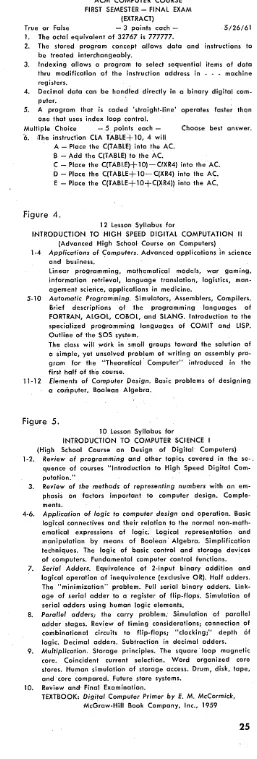
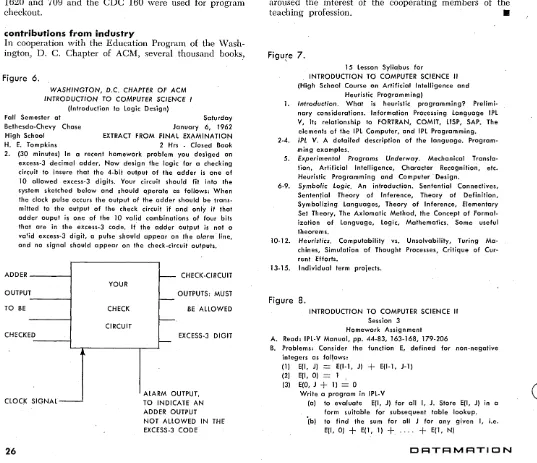
Although many colleges and universities have extensive computer oriented curricula on the grad-uate level and many offer courses for undergrad-uates, only sporadic knowledge exists about the ability of pre-college students to understand and use computers. A large-scale educational experiment initiated during the Fall of 1960 by the Washington, D.C. Chapter of the Association for Computing Machinery (ACM) was in-tended to explore this uncharted territory.During the last two years a computer-oriented program evolved as a direct result of the chapter's extracurricular courses. Currently this program consists of an elementary and an advanced sequence, and includes five separate courses. The elementary sequence, "Introduction to High Speed Digital Computation" offers three programming courses: an introductory course, an advanced course, and a course in programming a second computer. The ad-vanced sequence, "Introduction to Computer Science," includes a cqurse in computer design and a course on artificial intelligence and heuristic programming.
Each of these courses has now been taught to a class of high school students. In addition, the introductory programming course has been repeated several times using essentially the same syllabus.
*
In addition to his by-lined activities, George Heller is em-ployed full time for IBM Federal Systems, Bethesda, Mary-land. The following description of his education activitiesMachines utilized during the course of instruction in-cluded the IBM 709, 7090, 1620, RemRand UNIVAC SS 80, RPC 9000 and CDC 160.
Representatives from various institutions contributing their time included American Research Bureau, American University, C-E-I-R, IBM Federal Systems, Melpar and the U. S. Air Force.
A direct result of the interest of high school teachers in this program was the introduction of a computer oriented mathematics unit in the 12th grade mathematics curriculum in the high schools of Montgomery County, Maryland.
the large-scale experiment
In early January, 1960, the Washington, D. C. Chapter of ACM approached the Superintendent of Schools of Montgomery County,. Maryland, offering to conduct a digital computer course. By September, the ground rules were set and the course was organized.
Students volunteering for this extracurricular course, added three additional class hours per week and an aver-age of four to five additional hours of homework a week to their schedule. Entrance requirements for the course included: grades of A or B in all regular class work; two
represents part one in a two part series. Next month, an
outlook for computing education in high schools will be