• No results found

Characterising the changing behaviour of heatwaves with climate change

N/A
N/A
Protected

Academic year: 2020

Share "Characterising the changing behaviour of heatwaves with climate change"

Copied!
23
0
0

Loading.... (view fulltext now)

Full text

(1)

Characterising the changing behaviour of heatwaves with climate

change

Hugo C. Winter

1

, Simon J. Brown

2

and Jonathan A. Tawn

3

Email:

[email protected]

,

[email protected]

,

[email protected]

1

EDF Energy R&D UK Centre, Interchange, 81-85 Station Road, Croydon, CR0 2AJ, UK.

,

2

Met Office Hadley Centre, FitzRoy Road, Exeter, EX1 3PB, UK.

,

3

Department of Mathematics and Statistics, Lancaster University, Lancaster, LA1 4YF,

U.K.

Abstract

Understanding the impact of future heatwaves and the development of effective adaptation

strategies requires knowledge of both the changes in heatwave temperatures and their

dura-tions. We develop a framework, utilising extreme value theory, which allows for the effect of

a covariate on both the marginal quantiles and the temporal dependence structure of daily

maximum temperatures enabling the changes in heatwave temperatures (marginal effects) to be

identified separately from duration changes (dependence effects). To characterise future

heat-wave changes we use global mean temperature anomalies as a covariate to provide the metric

for climate change. Future daily maximum temperatures and global mean temperature changes

are provided by 13 general circulation models (GCMs) from the CMIP5 archive forced with

predicted future emissions of radiative forcing agents from the RCP8.5 scenario. For Orleans,

central France, we find that for all GCMs temporal dependence is unaffected by greenhouse gas

induced climate change indicating that durations of heatwaves that exceed time varying high

thresholds (i.e., the 1 year level) will not change in the future. However, all GCMs project

significant changes in the temperature margins with events similar to the 2003 European

heat-wave increasing by 1

.

3

o

C to 2

.

7

o

C and (8

.

0

o

C to 18

.

7

o

C) for a 1

o

C (5

o

C) increase in global

temperature. Collectively our results indicate there could be a significant increase in heatwave

risk as the world warms with heatwaves increasing in temperature significantly faster than the

global mean and local average temperatures.

Keywords:

climate change, extremal dependence, heatwaves, Markov chain, time-series extremes

1

Introduction

(2)

heatwaves has often been tailored to the impact of interest which has resulted in a wide range of

du-rations and critical levels being used to define a heatwave, such as crop specific levels and dudu-rations

that vary regionally (Falloon et al. (2014), Wheeler et al. (2000) and Asseng et al. (2013)), which

has made comparison across studies difficult. In addition, different sensitivities to the duration of

heatwaves and/or their temperature complicates efforts to determine future impacts arising from

climate change as information is required for both the changes in duration and temperature.

The role of human activities has been identified in the increases of surface air temperatures that

have been observed (e.g., Stott et al. (2004), Christidis et al. (2011)) and potential future changes

have been widely reported (e.g., Kharin et al. (2013)). However, these studies have generally been

limited by the chosen heatwave metric, be it a temporal mean (such as seasonal mean, Stott et al.,

2004) that is significantly longer than typical heatwaves or significantly shorter (such as daily

max-ima, Kharin et al. (2013), Christidis et al. (2011)). Changes in the behaviour of heatwaves can

manifest themselves in either changes to temperature or duration or both and therefore require

metrics that can capture both. This paper focuses on how future changes in the behaviour of

heat-waves, which might arise from climate change, can be modelled using extreme value theory within

a framework that can separately identify changes in critical levels (such as a return level) and the

durations and magnitudes of the excursions above these changing (relative) critical levels.

Operational definitions of heatwaves are generally split into three different categories (Koppe et al.,

2004) based upon: (i) an air temperature level; (ii) an air temperature level and minimum duration;

(iii) indices based upon air temperature and relative humidity; in this paper we focus on cases (i)

and (ii). Abaurrea et al. (2007) use values that exceed the 95th percentile of June-August daily

maximum temperatures from 1971-2000. A 95th percentile is also used in Stefanon et al. (2012),

but they impose the additional specification of a minimum duration of 4 days. Fischer and Sch¨

ar

(2010) use a local 90th percentile with a minimum duration of at least 6 consecutive days. In each

approach only the exceedances of a threshold are used during the modelling process. In contrast,

Winter and Tawn (2016) model the temperature process above some lower modelling threshold and

then derive the properties of the heatwaves above a range of critical levels. Thus, if their model

is appropriate for their data, they have a more efficient inference of heatwave properties that can

also be derived beyond the range of the observed heatwaves. Relative critical levels are preferred

to absolute critical levels when defining a heatwave since temperature can vary by geographical

location and humans are able to adapt to local climate (Nitschke et al., 2011). Although heatwave

definitions vary, the importance of estimating the duration and severity of events accurately is

universally recognised.

(3)

climate sensitivities produce increases in global mean temperatures that vary between 2

.

0 to 4

.

3

o

C

in the period 2006 to 2090. Such an ensemble of GCMs brings two sources of uncertainty to this

analysis. Each model will have its individual representation of physical processes, some of which

are poorly known and even if they are well known are imperfectly modelled within the GCM. In

addition, due to the non-linear nature of the climate system each realisation of the future climate

will sample the natural internal variability of the climate system, be it with the same or a different

GCM. Thus our ensemble here and the resulting range of results will be a combination of these two

sources of uncertainty.

We present future changes of heatwaves with respect to changes in global mean temperature rather

than for a specific date as this covariate is directly applicable to discussions regarding mitigation

targets and can also take advantage of efforts to formally quantify the uncertainty in future

warm-ing for specific dates (Harris et al., 2013). We calculate annual global mean temperature anomalies,

g

t, with respect to 2006 for each GCM respectively

g

t

= ˜

g

t

˜

g

2006

,

where ˜

g

t

is the global mean temperature. Here ˜

g

t

and

g

t

vary over different GCM ensemble members.

Whilst it would be possible to use a more locally defined metric of future change (such as the

change in mean European temperatures) this would unhelpfully include more unforced naturally

occurring internal variability of the climate system; here we desire to identify the changes that are

being forced by greenhouse gas emissions. Initially the nature of such changes are first identified for

one member of this ensemble, HadGEM2.ES GCM (Martin, 2011), and then the whole ensemble is

used to test whether these changes are consistent across GCMs. Although our ensemble contains

some GCMs with large increases in global mean temperature, this does not generate bias and

actu-ally aids the efficiency of our study as it increases the signal we are seeking to infer, and through the

global temperature anomalies, results can be rescaled to whatever time period or emission scenario

as deemed appropriate by the user. We report, therefore, changes in heatwave behaviour for 1

o

C

and 5

o

C global mean temperature increases to span a wide range of possible combinations of dates,

emissions and climate sensitivities.

Let

{

Y

t

}

denote the time-series of daily maximum temperatures over the June to August

sum-mer period. Our statistical modelling approach is based on, and extends, the methods developed

in Winter and Tawn (2016) who focused on analysing observed temperature extremes at one

loca-tion under an assumploca-tion of staloca-tionarity. If

{

Y

t

}

was a stationary series, the intensity of a heatwave

could be modelled by fitting an extreme value model to exceedances by

{

Y

t

}

of a high modelling

threshold ˜

u

. The most common method is to fit a generalized Pareto distribution (GPD)

P (

Y

t

u > y

˜

|

Y

t

>

u

˜

) =

1 + ˜

ξy/

σ

˜

u

˜

1

/

ξ

˜

+

for

y

0

,

where

c

+

= max(

c,

0) and ˜

σ

u

˜

>

0 and ˜

ξ

are the scale and shape parameters of the GPD respectively

(Coles, 2001).

(4)

from certain points in the time-series (e.g., there are likely to be more exceedances in future years

under climate change). Here we account for non-stationarity

{

Y

t

}

with respect to the covariate

global mean temperature anomalies

g

t

and analyse multiple future potential series at the same

lo-cation. Our strategy for modelling the probabilistic behaviour of extreme temperatures is two-fold.

Firstly, we model the marginal structure using a threshold based approach where the threshold is

a function of the covariate. Once the marginal structure has been modelled, we transform the data

onto common margins, with the variables now identically distributed over time/covariate. We

de-note the resulting series

{

X

t

}

and take this series to have a common Laplace marginal distribution

over

t

. We then model the extremal dependence structure of the

{

X

t

}

series.

For modelling the dependence between successive extremes values of a stationary series

{

X

t

}

it

is helpful to be aware that there are two different types of dependence structure. At lag

τ

the type

of extremal dependence structure is determined by the value of

χ

τ

where

χ

τ

= lim

x

→∞

P(

X

t

+

τ

> x

|

X

t

> x

)

.

(1)

When

χ

τ

= 0 and

χ

τ

>

0 the variables (

X

t

, X

t

+

τ

) are said to be asymptotically independent

and asymptotic dependent respectively. So exceedances by the process of a very high threshold

can cluster locally if the process is asymptotically dependent for at least one

τ

, but occur

in-creasingly independently as

x

→ ∞

when the process is asymptotically independent for all

τ

6

= 0

(Ledford and Tawn, 2003). For asymptotically dependent processes the difference between

χ

τ

and

P(

X

t

+

τ

> x

|

X

t

> x

) for large

x

is a second order effect on the characteristics of clusters of

extremes events. So any clustering can be viewed to be effectively invariant to the value of

x

. For

statistical modelling of heatwaves this means that dependence features of heatwaves don’t change

with the critical level (here taken to be

x

) used to define the heatwave. In contrast for

asymptoti-cally independent processes the difference between

χ

τ

and P(

X

t

+

τ

> x

|

X

t

> x

) for large

x

is the

first order feature of dependence, as

χ

τ

= 0, so dependence features of heatwaves will vary with the

critical level and weaken as the level increases until, in the limit, there is no clustering of extremes.

In practice, this means that the duration and severity of a heatwave event is permitted to change

with critical level, i.e., a heatwave exceeding the 1 year return level will have different dependence

characteristics than a heatwave exceeding the 50 year return level. So to model heatwaves it is vital

to determine the type of extremal dependence structure that the data exhibit.

The main aim of this paper is to provide a coherent extreme value framework for investigating

the effect that climate change will have on the temperature and the duration of heatwave events.

Many previous studies have focused on the occurrence of singular hot days and how this might vary

with climate change while ignoring changes in the persistence of events. There has been limited

past work on marginal and dependence structure modelling for heatwaves. Reich et al. (2014)

modelled heatwaves using a GPD to capture marginal characteristics and a max-stable process

to model dependence in a Bayesian hierarchical framework. Similarly, Shaby et al. (2016) use a

latent switching process to model clusters of large values in heatwaves. Neither of these models

are appropriate for our data as they require consecutive values that are asymptotically dependent

whereas our analysis suggests that our data exhibit asymptotic independence.

(5)

Heffer-nan and Tawn (2004). This approach offers a more flexible way of estimating extremal dependence

properties of Markov chains than previous methods since it captures the full asymptotically justified

class of extremal dependence. In comparison, Smith (1992) applies only for a restricted special case

and our method holds over a much broader tail region than the approach of Bortot and Tawn (1998).

It is important to stress the difference between marginal non-stationarity and non-stationarity

in the extremal dependence structure. Our marginal modelling will remove non-stationarity in the

marginal distribution, however it does not account for non-stationarity between consecutive time

points. In the framework of Markov chains, incorporating covariates into the conditional

distribu-tion of

X

t

+1

|

X

t

will allow assessment of how the dependence between values on successive days

changes with a covariate. A previous study of the effect of covariates on dependence structure

appears in Jonathan et al. (2013) for estimating wave heights in the North Sea as a function of

the wave direction. In the heatwave problem, a change in the marginal characteristics leads to a

change in the overall strength of a heatwave whereas a change in the dependence characteristics

leads to a change in the persistence of events. Both of these factors are important when mitigating

for heatwave events.

This paper has the following structure. Section 2 describes the steps to capture non-stationarity

in the margins to obtain a marginally stationary series. The conditional extremal dependence

ap-proach is outlined and extended to include covariates in Section 3. Methods for simulating clusters

of extreme values to derive heatwave properties are briefly mentioned in Section 4. Results for the

HadGEM2.ES GCM are given in Section 5 and results over the rest of the GCM ensemble are given

in Section 6. Discussion and conclusions are provided in Section 7.

2

Marginal modelling

2.1

Modelling strategy

(6)

2.2

Pre-processing

Eastoe and Tawn (2009) give a framework for transforming marginally non-stationary data such

that constant threshold approaches can be used. Specifically, taking the original non-stationary

time-series

{

Y

t

}

the transformation

[

Y

κ

(

g

t

)

t

1]

(

g

t) =

ψ

(

g

t) +

τ

(

g

t)

Y

t

s

,

yields the approximately stationary standardised sequence

{

Y

t

s

}

, where (

ψ

(

g

t

)

, τ

(

g

t

)) are

location-scale parameters,

κ

(

g

t) is the Box-Cox parameter and

g

t

is the global mean temperature anomaly.

In this paper all covariates are included in a linear manner, i.e.,

κ

(

g

t

) =

κ

0

+

κ

1

g

t

ψ

(

g

t

) =

ψ

0

+

ψ

1

g

t

log

τ

2

(

g

t

) =

τ

0

+

τ

1

g

t

.

Higher-order covariate relationships are possible but not investigated here.

2.3

Marginal tail non-stationarity

In practice the Box-Cox location-scale model may not completely capture all of the non-stationarity

in the extremes and a GPD model is fitted to the upper tail of the margins of the standardised

series

{

Y

t

s

}

such that

F

Y

s

t

(

y

) =

(

1

λ

u

s

(

g

t) [1 +

ξ

(

g

t) (

y

u

s)

u

s

(

g

t)]

1

(

g

t

)

+

if

y

u

s

˜

F

(

y

)

if

y < u

s

,

(2)

where

u

s

is the modelling threshold for the upper tail of the pre-processed margins, (

σ

u

s

(

g

t

)

, ξ

(

g

t

))

are scale and shape parameters that depend on the covariate such that log

σ

u

s

(

g

t) =

σ

0

+

σ

1

g

t

(where

σ

0

depends on the threshold

u

s

but the subscript is dropped for notational simplicity) and

ξ

(

g

t

) =

ξ

,

λ

u

s

(

g

t

) = 1

F

˜

(

u

s

) and ˜

F

(

y

) is the empirical cumulative distribution function of

{

Y

s

t

}

n

t

=1

.

It is assumed that non-stationarity in the body of the distribution is accounted for using the

pre-processing and so the stationary empirical distribution function is appropriate for values that fall

below or equal to the modelling threshold

u

s

. Throughout this study the modelling threshold

u

s

is

set at the 90th percentile. To study the extremal dependence structure it is common to transform

the marginal to a standard form. We transform

Y

t

s

,

t

= 1

, . . . , n

onto Laplace margins as follows

X

t

=

(

log

2

F

Y

s

t

(

Y

s

t

)

if

F

Y

s

t

(

Y

s

t

)

<

0

.

5

log

2

1

F

Y

s

t

(

Y

s

t

)

if

F

Y

s

t

(

Y

s

t

)

0

.

5

,

(3)

where

F

Y

s

t

is given in equation (2). Estimates of all the parameters for our data set are given later.

We subsequently assume that

{

X

t

}

is marginally stationary.

3

Modelling temporal dependence

3.1

Markov modelling

(7)

the distribution at each time step is only affected by the state of the system at the time-step before.

As a consequence, to model the extremes of the transformed stationary time series

X

1

, . . . , X

n

it

is only necessary to model the extremes of pairs (

X

t

, X

t

+1

) for

t

= 1

, . . . , n

1.

The joint tail approach developed in Smith et al. (1997) uses a bivariate extreme value

distri-bution with a parametric dependence structure to model the extremal dependence of (

X

t

, X

t

+1

).

This distribution leads to the variables being asymptotically dependent, and so

χ

1

>

0, where

χ

τ

is

defined by expression (1). Furthermore, the Markov assumption implies that

χ

τ

>

0 for all

τ

. Thus

this model is highly restrictive in applications where the variables are asymptotically independent

at some lag. The semi-parametric conditional extremal dependence approach outlined in Heffernan

and Tawn (2004) allows for a richer class of dependence structures and most importantly allows for

both asymptotic dependence and asymptotic independence; see Winter and Tawn (2016) for details

of how these two methods differ. The additional flexibility of the conditional extremal dependence

approach is useful for our application and is used throughout the rest of this paper.

3.2

Semi-parametric stationary conditional extremal dependence approach

The conditional extremal dependence approach of Heffernan and Tawn (2004) and Heffernan and

Resnick (2007) can be used to model the extremes of pairs (

X

t

, X

t

+1

) for

t

= 1

, . . . , n

1. Heffernan

and Tawn (2004) gave their representation for Gumbel margins, but Keef et al. (2013) showed

that a more comprehensive approach arises for Laplace margins (equation (3)). The desire is to

model (

X

t

, X

t

+1

) using the distribution of

X

t

+1

given that

X

t

is large (defined as exceeding a high

threshold). We want to model the conditional distribution P

{

X

t

+1

x

t

+1

|

X

t

=

x

t

}

for large

x

t.

It is therefore natural to consider asymptotic models for this distribution as

x

t

→ ∞

. Unless

X

t

+1

is suitably normalised the resulting distribution will become degenerate in the limit. Heffernan

and Tawn (2004) identify an appropriate way to normalise

X

t

+1

. Under the weak simplifying

dependence assumptions of Heffernan and Tawn (2004), the specification of Laplace margins ensures

that the upper and lower tails are both modelled by a symmetric distribution with exponential tails

and permits the definition of a single unified class of normalising functions such that the conditional

distribution is

P

[

X

t

+1

αX

t

]

/X

t

β

z, X

t

u

X

> x

|

X

t

> u

X

G

(

z

) exp(

x

)

,

(4)

as

u

X

→ ∞

, where

u

X

is the modelling threshold on Laplace margins,

G

is a non-degenerate

dis-tribution function,

α

[

1

,

1] and

β

(

−∞

,

1). This form of the normalising functions does not

affect the limiting dependence model in Heffernan and Tawn (2004) and simplifies the inference for

variables which are either negatively or weakly associated. If the variables are independent then

α

=

β

= 0 and

G

(

z

) is the Laplace distribution function whereas

α

= 1 and

β

= 0 corresponds

to the situation of asymptotic dependence,

1

α

0 to asymptotic dependence with negative

extremal dependence and 0

< α <

1 or

α

= 0 and

β >

0 corresponds to asymptotic independence

with positive extremal dependence. This representation extends the asymptotic dependence class

of Smith et al. (1997) when

α <

1.

(8)

as

X

t

+1

=

αX

t

+

X

t

β

Z

t

+1

,

(5)

where

Z

t

+1

is a random variable with distribution function

G

and is independent of

X

t. As

G

does

not take any simple parametric form, a temporary working assumption of Gaussianity is made, as

in Keef et al. (2013), i.e., that

Z

t

+1

N(

µ, γ

2

), so

X

t

+1

| {

X

t

=

x

} ∼

N

αx

+

µx

β

, γ

2

x

2

β

for

x > u

X

.

The Gaussian assumption permits easy estimation of the set of parameters (

α, β, µ, γ

) by standard

likelihood approaches. Although it may appear that using a potential incorrect distribution for

G

would bias the inference, standard regression results show this is not the case. Furthermore, Lugrin

et al. (2016) estimate

G

using a Bayesian non-parametric estimate, but that gives gives only small

improvements relative to our much simpler approach.

Once we have our estimates ( ˆ

α,

β,

ˆ

µ,

ˆ

γ

ˆ

), the Gaussian assumption is discarded and a non-parametric

estimate of the distribution for

Z

t

+1

is formed based simply on model (5). Specifically, let

t

1

, . . . , t

n

uX

be the indices of

t

= 1

, . . . , n

where

x

t

> u

X

. Then let

ˆ

z

j

= (

x

t

j

+1

αx

ˆ

t

j

µx

ˆ

ˆ

β

t

j

)

/

γx

ˆ

ˆ

β

t

j

,

(6)

for

j

= 1

, . . . , n

u

X

, where

n

u

X

is the number of

x

t

exceeding the threshold

u

X

. Using this sample

from

Z

t

+1

a non-parametric estimate ˆ

G

of the distribution function

G

is formed using ˆ

z

j

,

j

=

1

, . . . , n

u

X

. Heffernan and Tawn (2004) present a simulation study that shows this inference method

works well.

3.3

Incorporating covariates

The process of incorporating covariates into the marginal parameters was highlighted in Section 2.2.

However, for a more complete analysis of the extremal behaviour it is necessary to ascertain whether

the covariate has an effect on the level of extremal dependence by testing if the covariate has

a significant effect on the dependence parameters. As in Jonathan et al. (2013) covariates are

introduced into the set of parameters (

α, β, µ, γ

) such that

tanh

1

[

α

(

g

t)] =

α

0

+

α

1

g

t

tanh

1

[

β

(

g

t)] =

β

0

+

β

1

g

t

µ

(

g

t) =

µ

0

+

µ

1

g

t

log

γ

(

g

t) =

γ

0

+

γ

1

g

t

.

An inverse tanh link function is used for

β

(

g

t) as well as

α

(

g

t) in this situation, thus constraining

each to be in the range [

1

,

1]. In practice it is very unlikely that

β

(

g

t)

<

1 as this corresponds to

(9)

4

Cluster behaviour estimation

With a marginally stationary time-series obtained by pre-processing techniques we wish to estimate

whether heatwave events become longer and more severe with climate change. We define a critical

level

v

Y

on original margins, which translates to

v

X

on Laplace margins, as some level of interest

above which events are extreme. Such a level will often be related to the

T

-year return level and

denoted

v

Y

T

or

v

X

T

depending on the margin of interest, with

v

Y

T

time dependent but

v

T

X

not. A

cluster is an extreme event that is defined as a set of points which exceed the critical level

v

X

(

v

Y

)

which are locally grouped in time but not necessarily consecutive and are preceded and followed

by a set amount of non-exceedances (Smith and Weissman, 1994). For a cluster to occur the peak

value of the cluster, denoted

M

, must exceed the critical level. We define the duration

D

of a

cluster as the number of exceedances of

v

X

(

v

Y

) in the cluster, i.e.,

D

=

X

t

C

I

X

t

v

X

+

=

X

t

C

I

Y

t

v

Y

+

,

where

I

(

.

) is the indicator function and

C

is a set of values comprising a cluster. One common

measure of temporal dependence linked to clusters is the threshold dependent extremal index

(Leadbetter (1983); Winter and Tawn (2016)), denoted

θ

X

(

v

X

) (

θ

Y

(

v

Y

)) depending on the margin

of interest. The extremal index is defined as the reciprocal of the average duration of a cluster

above

v

X

(

v

Y

). Since we assume stationarity within years the value of

θ

X

(

v

X

) and

θ

Y

(

v

Y

) will be

approximately equivalent. There are varying definitions of the severity or relative severity of any

type of extreme event (e.g., Mishra and Singh (2010)). In this paper we shall refer to the relative

severity

S

of an event as the sum of all excesses of a critical level within an event (cluster) on the

original temperature scale, i.e.,

S

=

X

t

C

Y

t

v

Y

+

.

(7)

In this study we look to estimate P(

D > d

|

M > η

) and P(

S > s

|

M > η

); given a peak value

of a cluster is greater than some critical value

η

, with

η

v

Y

, these represent the probability of

an event that has more than

d

exceedances of

v

Y

or has a relative severity greater than

s

respectively.

Our approach to deriving the properties of clusters of a Markov chain is repeated simulation of

the chain in periods with exceedances of a critical level, i.e., when the process exceeds

v

Y

, with

v

Y

u

Y

. We adopt the tail chain approach of Winter and Tawn (2016), an extension of Smith

et al. (1997), called peak value chain estimation, by simulating the cluster maximum

M > v

Y

and

then simulating forwards and backwards from this peak value using the conditional model. By its

construction, the limiting conditional distribution induces a negative drift in the series so extreme

events are well defined as if we ran these tail chains forward sufficiently no future exceedances of

v

Y

(10)

5

HadGEM2.ES Results

The top left plot of Figure 1 shows the HadGEM2.ES GCM temperature data represented as a time

series which clearly shows marginal non-stationarity over the length of the record, but within each

summer period temperatures are approximately marginally stationary. Figure 1e) shows the

time-series of global mean temperature anomaly from HadGEM2.ES. We use the pre-processing method

of Section 2.2 and test whether the global mean temperature anomaly covariate has a significant

effect on the Box-Cox parameter and the location-scale parameters. The log-link function is used

to ensure the non-negativity of the scale parameter

τ

(

g

t). Incorporating the covariate into the

Box-Cox parameter is found to be significant at the 5% level using a likelihood ratio test and this is also

the case for the location-scale parameters that vary with the covariate. For this model selection we

used backward elimination. Use of AIC would probably have been optimal, but was more

computa-tionally demanding as it required all models to be fitted. The estimates of the Box-Cox parameters

are ˆ

κ

0

= 1

.

018 (0

.

06) and ˆ

κ

1

=

0

.

023 (0

.

001), where standard errors are given in

parenthe-ses. Estimates for the location-scale parameters are given as ˆ

ψ

0

= 28

.

304 (0

.

1) and ˆ

ψ

1

= 0

.

097

(0

.

05) and exp(ˆ

τ

0

)

1

/

2

= 5

.

536 (1

.

008) and exp(ˆ

τ

1

)

1

/

2

= 0

.

960 (1

.

003) respectively. These estimates

show that as global mean temperature anomalies increase the daily maximum temperature data

for Orleans increase in mean value, decrease in variability and are becoming more positively skewed.

A GPD(

σ

u

s

(

g

t

)

, ξ

) is fitted to the upper tail of the standardised data (see Section 2.3) to

as-sess whether there is still any residual marginal non-stationarity in the extremes. Throughout this

study the modelling threshold

u

s

for the GPD is set at the marginal 90th percentile. This choice

was based on a range of diagnostic methods described by Coles (2001), with the most helpful being

parameter stability plots. The covariate does not seem to have an effect on the estimate of the rate

parameter ˆ

λ

u

s

= 0

.

10 (0

.

007) or the shape parameter with ˆ

ξ

=

0

.

241 (0

.

020), the effect having

been removed by the pre-processing, but there remains an effect in the margins for the scale

pa-rameter. Estimates of the scale parameters are exp(ˆ

σ

0

) = 0

.

513 (1

.

07) and exp(ˆ

σ

1

) = 0

.

930 (1

.

03).

These estimates show that as global mean temperature anomalies increase the variability in the

upper tail is decreasing at a faster rate than for the body of the distribution of the daily maximum

temperature data for Orleans.

These estimates are used to transform the non-stationary series (Figure 1a) into the marginally

Laplace distributed series (Figure 1b). This figure shows that the marginal analysis seems to have

produced an approximately marginally stationary series. Furthermore the Q-Q plot, in Figure 1c),

shows that the transformed series is consistent with the required Laplace marginal distribution.

Despite there being some departures from the equality line for large quantiles almost all values lie

in the pointwise 95% tolerance intervals.

Figure

Figure 2: Annual global mean temperature anomalies (oC) for indicated GCMs forced by the RCP 8.5 emissionscenario, taken as covariate.
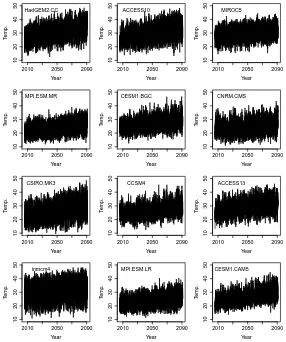
Figure 3: Original June, July and August daily maximum temperature data (the RCP 8.5 emission scenario represented as a time-series
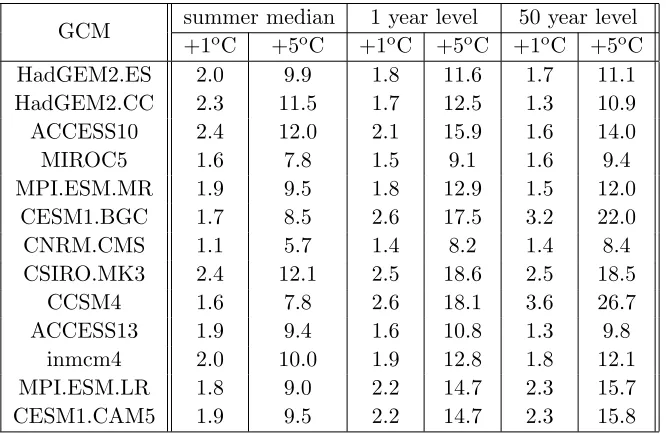
Table 1: Pre-processing and marginal parameter estimates for all 13 GCMs.
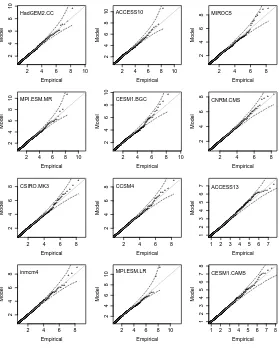
Figure 4: Q-Q plots for transformed GCM temperatures with theoretical Laplace margins
+2

References

Related documents

Although formal hunting status is found significant when individually entered, the variation it explains is not significant enough (or unique enough) to be included in the

RGDP refers to euro area GDP growth, HICP refers to consumer prices inflation, KRIP refers to relative monetary policy rates for the euro area and the US as of Krippner (2013), FX

Consequently, due to the commonality of values shared by the right to communicate and Web 2.0 -- interactive communication, user participation, collaboration -- Web 2.0

Rather than focusing exclusively on incentives and expectations about the base rate of errors, the field interview study examines payoffs of error detection more broadly by

In theory, FRET is a radiationless energy transfer process, so ideally, a single emission spectrum of the output fluorophore should be observed, as illustrated in Fig.2.7

Citrix EdgeSight 2.5 training is available through selected Citrix Certified Instructors as part of a combined EdgeSight for Load Testing, EdgeSight for Presentation Server

Effective demand building requires effort throughout the supply chain – from the farm, mill, brand, retailer to consumer. PRESENTATION TITLE | PAGE PRESENTATION TITLE |