© 2019, IRJET | Impact Factor value: 7.211 | ISO 9001:2008 Certified Journal
| Page 1633
STRUCTURAL BEHAVIOUR OF CONCRETE BEAM USING NON
BIODEGRADABLE MATERIALS
PRABHU. R
1, Er. RAVI .C
21
Student, M.E Structural Engineering, Oxford Engineering College, Tiruchirappalli, Tamil Nadu, India
2Professor & Head, Department of Civil Engineering
,Oxford Engineering College, Tiruchirappalli,
Tamil Nadu, India
---***---Abstract -
The Material which does not decompose intothe soil and causes the soil to pollute is called as NBD materials which are abbreviated as Non Bio Degradable materials. These will prevent the supply of oxygen, nitrogen etc., to the micro-organisms presents in the soil and make it a barren land. In order to prevent such mechanism these materials should be used in a proper way there by making it eco-friendly. Here in this project plastic fibre obtained from cement bags are chipped based on the aspect ratio based added in concrete by using such fibre in the construction helps in clean construction site. In this project Cylinders, Prisms, and Cubes of standard dimensions have been made to introduce NBD Fibers with various mix ratio as 1%, 2%, 3%, 4%. Various tests are conducted to find the property of the NBD Concrete materials. The Main tests such as Compressive Strength for Concrete and Flexural Strength of Concrete have been conducted. On comparing the results of NBD Fiber Concrete with that of Conventional Concrete, 3% additionally Adding of NBD fibers showed Maximum Compressive strength of concrete value at 28 days is 25% increase compared with in Conventional Concrete and Maximum Flexural Strength of Concrete value at 28 days is 55% increase compared with in Conventional Concrete. During Phase II, Mechanical Properties like Split tensile Strength and Durability properties of NBD Fibers will be discussed.
Key Words: NBD Concrete, NBD Fiber, Compressive Strength, Flexural Strength.
1. INTRODUCTION
Concrete is a versatile material for civil engineering building construction. It has ability to get cast in any different type of form and shape. All basic ingredients of concrete are natural origin. But the properties of concrete can be changed by adding some special natural or artificial ingredients.
The Concrete has many advantageous properties such as good compressive strength, durability, impermeability and fire resistance. However the concrete has some better properties like as weak in tension, brittleness, less resistance to cracking, lower impact strength, heavy weight, etc. Some remedial measures can be taken to minimize these more better properties of concrete. The some of the better properties of concrete are due to micro cracks at mortar aggregate interface. The
addition of fibers in concrete would act as crack inhibitors and substantially improve the tensile strength, cracking resistance, impact strength, wear and tear, fatigue resistance and ductility of concrete.
1.1
NON BIODEGRADABLE MATERIALS (NBD):
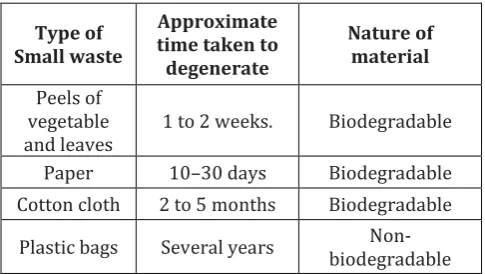
[image:1.595.313.556.457.594.2]The definition of non-biodegradable is the direct opposite of the word biodegradable. When something is biodegradable that means that its components are able to be broken down with the influence of microorganisms after it is discarded into the environment. Non-biodegradable is defined as that the components of the item will not break down over time. An example of a non-biodegradable item would be a tire, Polythene sheets/covers, disposable plastic glasses, syringes, cement bags etc. The nature of decomposition of various materials is given in the following table.
Table -1: Decomposition of Various Waste Materials
Type of Small waste
Approximate time taken to degenerate
Nature of material
Peels of vegetable
and leaves 1 to 2 weeks. Biodegradable
Paper 10–30 days Biodegradable
Cotton cloth 2 to 5 months Biodegradable
Plastic bags Several years biodegradable
Non-1.2 CLASSIFICATION OF FIBRES:
A fibre may be defined as a flexible, macroscopically homogenous body having a high ratio of length to width and a small cross-section. On the basis of their origin, fibres are classified as follows
Natural fibres are those derived naturally from the animal, vegetable and mineral kingdoms. These include cotton, linen, hemp, jute and ramie all obtained from vegetable cellulose; wool, mohair, vicuna from animal; and asbestos from minerals.
© 2019, IRJET | Impact Factor value: 7.211 | ISO 9001:2008 Certified Journal
| Page 1634
substances. Included in this category are: rayon, acetate,azlon based on natural organic polymers; acrylic, aramid, nylon, olefin, polyester, vinyon based on synthetic polymers, and glass, metallic fibres, ceramics based on inorganic substances.
2. PROPERTIES OF CONCRETE MATERIALS
2.1 CEMENT
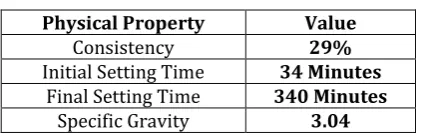
[image:2.595.57.270.311.380.2]The Cement used for this study is Portland Pozzolona Cement as per IS Requirements. The requirements of the properties of all these cements are given the following Indian Standards. IS: 12269 - 1987 (53 Grade), IS: 8112- 989 (43 Grade), IS 269 - 1989 (33Grade). In this Project Work the Ultra Tech Cement PPC is selected.
Table-2: Properties of Cement
Physical Property Value Consistency 29% Initial Setting Time 34 Minutes
Final Setting Time 340 Minutes Specific Gravity 3.04
2.2 FINE AGGREGATES
Fine Aggregates are material passing through an IS sieve that is less than 4.75 mm gauge beyond which they are known as a coarse aggregate. Coarse aggregate form the main matrix of the Concrete, whereas fine Aggregates form the filler matrix between the coarse aggregate. The most important function of the fine Aggregates is to provide workability and uniformity in the mixture. In this project work, Grade I Fine Aggregates of particle size less than 2 mm and greater than 1 mm are chosen.
Table -3: Properties of Fine Aggregates
Physical Property Value Specific Gravity 2.35 Fineness Modules 2.733
2.3 COARSE AGGREGATES
Coarse Aggregates are material passing through an IS sieve that is greater than 4.75 mm gauge beyond which they are known as a coarse aggregate. The most important function of the coarse aggregates is to provide workability and uniformity in the mixture. According to IS 383: 1970 the coarse aggregates is being classified based on the shape. The shapes are Rounded, Irregular, Angular, and Flaky. The Aggregates are available is different size are 40 mm, 20 mm, 10 mm, and 4.75 mm respectively.
In this project work, Coarse Aggregates Shape and Size is Crushed Angular Aggregates in 20 mm size are chosen.
Table -4: Properties of Fine Aggregates
Physical Property Value Specific Gravity 2.80 Fineness Modules 6.13
2.4 NBD FIBERS
A fibre may be defined as a flexible, macroscopically homogenous body having a high ratio of length to width and a small cross-section. On the basis of their origin. Fibers are classified as reinforced plastics falls into two classes:
Short Fibers are also called as discontinuous fibers, with a general aspect ratio (defined as the ratio of fibers length to diameter) between20 to 60.
Long Fibers, is means of continuous fibers, the general aspect ratio is between 200 to 500.
Polypropylene
Polypropylene is a 100% Synthetic Fiber which is transformer from 85% propylene. The monomer of polypropylene is propylene.
Polypropylene is a by-product of petroleum It is available 3 different sizes i.e. 6mm, 12mm,
24mm
In the present investigation 12mm is used.
Fig .1: NBD Fibers from Cement Bags
© 2019, IRJET | Impact Factor value: 7.211 | ISO 9001:2008 Certified Journal
| Page 1635
3. RESULTS AND DISCUSSIONS
3.1 COMPRESSIVE STRENGTH OF CONCRETE
CUBE
Compressive strength is the capacity of the material to withstand axially directed pushing forces. It provides data of forces versus deformation for the conditions of the test method. When the limit of Compressive strength of concrete is reached, brittle materials are crushed. It is calculated using following formula
Compressive Strength
[image:3.595.29.295.305.574.2]Compressive Strength of Concrete Cube = Load / Area Unit of Compressive Strength is N/mm2
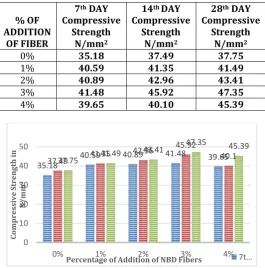
Table -5: Compressive Strength of Concrete
% OF ADDITION
OF FIBER
7th DAY Compressive
Strength N/mm2
14th DAY Compressive
Strength N/mm2
28th DAY Compressive
Strength N/mm2
0% 35.18 37.49 37.75
1% 40.59 41.35 41.49
2% 40.89 42.96 43.41
3% 41.48 45.92 47.35
4% 39.65 40.10 45.39
Chart-1 Compressive Strength of NBD Concrete
3.2 DISCUSSIONS FOR COMPRESSIVE STRENGTH
In 7th day curing Compressive Strength value for
the control mix was 40.59 N/mm2 for adding 1%
of NBD Fiber the Compressive Strength value is 40.89 N/mm2, the Strength was gradually
increased and reduced to 39.65 N/mm2 for 4 % of
addition of NBD Fiber. Strength increment is 1% more than the nominal mix when adding the NBD Fiber upto 4% and this percentage is strength is decreases.
Similarly In 14th day curing Compressive Strength
value for the control mix was 41.35 N/mm2 for
adding 1% of NBD Fiber the Compressive
Strength value is 42.96 N/mm2, the Strength was
gradually increased and reduced to 40.10 N/mm2
for 4 % of addition of NBD Fiber. Strength increment is 1% more than the nominal mix when adding the NBD Fiber upto 4% and this percentage is strength is decreases.
Similarly In 28th day curing Compressive Strength
value for the control mix was 37.75 N/mm2 for
adding 1% of NBD Fiber the Compressive Strength value is 43.41 N/mm2, the Strength was
gradually increased and reduced to 45.39 N/mm2
for 4 % of addition of NBD Fiber. Strength increment is 1% more than the nominal mix when adding the NBD Fiber upto 4% and this percentage is strength is decreased.
Hence the Optimum Amount of NBD Fibers is 3%. The Compression Strength value for NBD Concrete is 19.69% is greater than the Conventional Concrete.
3.3 FLEXTURAL STRENGTH OF BEAMS
Flexural strength is the properties of the hardened concrete which gives details about the capacity of concrete in bending when a load acted at the midpoint of the beam. It is calculated by using the following formula, Flexural Strength = Pa/bd2 (when a > 13.3 cm for 10
specimen)
Where,
P= Applied Load in KN to the specimen. b = Width of specimen in mm
d = Depth in mm of the specimen at the point of failure. a = Distance of the crack from the near to the support in mm
Table -5: Flexural Strength of Concrete
% OF ADDITION
OF FIBER
7th DAY Flexural Strength N/mm2
14th DAY Flexural Strength N/mm2
28th DAY Flexural Strength N/mm2
0% 1.60 1.79 2.42
1% 1.62 2.26 2.72
2% 1.75 2.59 2.87
3% 2.25 2.73 3.76
4% 1.84 2.43 2.62
35.18
40.59 40.89 41.48 39.65 37.49 41.35
42.96 45.92
40.1 37.75 41.49
43.41 47.35 45.39
0 10 20 30 40 50
0% 1% 2% 3% 4%
Com
pre
ss
iv
e
St
re
n
gt
h
in
N
/m
m
2
© 2019, IRJET | Impact Factor value: 7.211 | ISO 9001:2008 Certified Journal
| Page 1636
Chart-2: Flexural Strength of NBD Concrete
3.5 DISCUSSIONS FOR FLEXURAL STRENGTH
In 7th day curing Compressive Strength value for
the control mix was 1.62 N/mm2 for adding 1% of
NBD Fiber the Compressive Strength value is 1.75 N/mm2, the Strength was gradually increased and
reduced to 1.69 N/mm2 for 4 % of addition of
NBD Fiber. Strength increment is 1% more than the nominal mix when adding the NBD Fiber upto 4% and this percentage is strength is decreases.
Similarly In 14th day curing Compressive Strength
value for the control mix was 2.26 N/mm2 for
adding 1% of NBD Fiber the Compressive Strength value is 2.59 N/mm2, the Strength was
gradually increased and reduced to 2.43 N/mm2
for 4 % of addition of NBD Fiber. Strength increment is 1% more than the nominal mix when adding the NBD Fiber upto 4% and this percentage is strength is decreases.
Similarly In 28th day curing Compressive Strength
value for the control mix was 2.72 N/mm2 for
adding 1% of NBD Fiber the Compressive Strength value is 3.76 N/mm2, the Strength was
gradually increased and reduced to 2.62 N/mm2
for 4 % of addition of NBD Fiber. Strength increment is 1% more than the nominal mix when adding the NBD Fiber upto 4% and this percentage is strength is decreased.
Hence the Optimum Amount of NBD Fibers is 3%.
The Flexural Strength value for NBD Concrete is 55.37% is greater than the Conventional Concrete.
4. CONCULSIONS
On performing test Structural Behaviour of Non-Biodegradable Materials are learned and the following conclusions are arrived.
About 18% increase in Compressive Strength is attained when Concrete is addition with 3 % of NBD Fibers on 7-Days
About 23% increase in Compressive Strength is attained when Concrete is addition with 3 % of NBD Fibers on 14-Days
About 25 % increase in Compressive Strength is attained when Concrete is addition with 3 % of NBD Fibers on 28-Days
About 41% increase in Flexural Strength is attained when Concrete is addition with 3 % of NBD Fibers on 7-Days
About 53% increase in Flexural Strength is attained when Concrete is addition with 3 % of NBD Fibers on 14-Days
About 55% increase in Flexural Strength is attained when Concrete is addition with 3 % of NBD Fibers on 28-Days
The Strength Characteristics of Concrete with various percentages of adding NBD Fiber in Concrete have been studied.
The Compressive and Flexural Strength of Concrete was improved by 25 % and 55% with three percentage addition of NBD Fibers and beyond this percentage of addition of fibers in concrete, strength of concrete is gradually reduced.
REFERENCES
1) Awwad.E, Mabsout,M., hamead.,B Farran, M and Khatib, H. (2012b) “ Studies on Fiber-Reinforced concrete using Industrials Fibers “ Journal -The Construction and building Materials, Elsevier Vol.35 October 2012.
2) Awwad,E, Mabsout,M., hamead.,B Farran,M and Khatib,H. (2011) “ Preliminary Studies on the use of Natural Fibers in Sustainable Concrete “ Journal -The Lebanese Association for the Advancement of Science, Vol.12 Issue No. June 2011
3) M.Frigione, (2010) “Recycling of PET Bottles as Fine Aggregate in concrete” Waste management, Scientific World Journal, Volume 30, Issue-6.
4) Marzouk (2007), “Use of Waste Plastic in Concrete Mixture” in Waste Management, International Journal for Innovative Research in Science and Technology, Volume -10, Issue -29, , Page No. 33-38.
5) Ismail and Al-Hasahmi (2005) “Use Of Waste Plastic in Concrete Mixtures as Aggregate Replacement” Department of Environmental Engineering. Scientific Research an Academic Publisher, Volume 2, Page 40.
1.6 1.62 1.75
2.25
1.69 1.79
2.26 2.59
2.73
2.43 2.42 2.72
2.87
3.76
2.62
0 0.5 1 1.5 2 2.5 3 3.5 4
0% 1% 2% 3% 4%
Fl
ex
tu
ra
l S
trengh
t
in
N/m
m
2
Percentage of Addition of NBD Fibers
Flexural Stength of Concrete Beams
© 2019, IRJET | Impact Factor value: 7.211 | ISO 9001:2008 Certified Journal
| Page 1637
6) Al-Manaseer and Dalal (1997), “RecycledAggregates in Concrete of Plastic Aggregates”. Journal of Chemical Engineering, IEB, Volume 19, Issue 8, Page No. 47-52.
7) M. Perez-Pena and B. Mobasher (1994). Mechanical Properties of Fiber Reinforced Concrete Composites, Cement and Concrete Research, 24 (6), 1121-1132.
8) S.Wenjun Qu, Xiaoliang Zhang and Haiqun Huang (2009).Flexural Behaviour of Concrete Beams Reinforced with Hybrid (GFRP and Steel) bars. Journal of Composites for Construction, ASCE. 13(5), 350 – 359.
9) IS 456:2000 Code book for Plain & Reinforced Concrete.
10)IS 10262:2009 Guidelines for Concrete Mix Proportioning
11)IS 383 – 1970: Specification for Aggregates from Natural Sources for Concrete (Second revision)