Abstract — Facial makeup may change the appearance of a face which can degrade the accuracy of an automatic face recognition system. Gradientfaces, an illumination invariant technique, has been found to work well with principle component analysis for human face recognition on images affected by illumination. Experiment results show that by applying the same technique, Gradientfaces, at the pre-processing stage which computes the orientation of the image gradients in each pixel of the face images and uses the computed face representation as an illumination invariant version of the input image, the recognition rates can be improved for a mixture of facial images with makeup and non-makeup. On the Youtube Makeup (YMU) Face database, we have achieved an increase of recognition accuracy from 76.25% to 84.50% in testing data which have images with makeup and non-make-up.
Index Terms—Face recognition, principle component analysis (PCA), gradientfaces, illumination insensitive measure, facial makeup.
I. INTRODUCTION
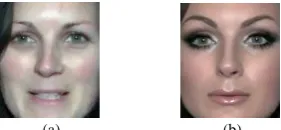
ACIAL makeup is a cost effective and socially acceptable approach which could make a female appears more attractive and boost her sense of confident. However, facial makeup can change the perceived shape and texture of a face [1]. In Figure 1, it shows the effect of makeup on facial appearance. This effect could also severely affect the recognition performance of the current face recognition systems [1, 2]. In the past, a number of works had been done to solve that problem.
[image:1.595.92.233.590.655.2](a) (b)
Fig. 1 Sample images for a subject of the YMU Face Database : (a) without makeup and (b) with makeup
Bruce Poon is with the School of Electrical & Information Engineering, University of Sydney, NSW 2006, Australia (e-mail: [email protected].) M. Ashraful Amin is with the Computer Vision & Cybernetics Research Group, SECS, Independent University Bangladesh, Bashundhara, Dhaka 1229, Bangladesh. (e-mail: [email protected]).
Hong Yan is with the Department of Electronic Engineering, City University of Hong Kong, Hong Kong, China (e-mail:[email protected])
II. RELATED WORKS
Ueda and Koyama [3] suggested that makeup may enhance or disguise facial characteristics. The influence of wearing makeup on facial recognition could be of two kinds: (i) when women do not wear makeup and then are seen with makeup, and (ii) when women wear makeup and then are seen without makeup. Their study is reported which shows that light makeup makes it easier to recognize a face while heavy makeup makes it difficult. Seeing initially a makeup face makes any subsequent facial recognition more difficult than initially seeing that face without makeup.
Scherbaum et al. [4] proposed a computer suggested facial makeup algorithm utilizing morphable face model [5] to find the best makeup for a given human face.
Dantcheva et al. [2] illustrated that non-permanent facial cosmetics can significantly change facial appearance, both locally and globally, by altering color, contrast and texture which in turn decreased in matching accuracy. They proposed the Local Gabor Binary Pattern (LGBP) [6] algorithm which could mitigate the effect of makeup on matching performance. Experimental results showed that LGBP outperformed other algorithms for face recognition on images with the presence of makeup.
Subsequently, Dantcheva et al. [7] proposed a SVM-based makeup detector in the context of face recognition. Output of the makeup detector was used to perform adaptive pre-processing. Experiment results indicated that by applying the proposed pre-processing routine, it could further improve the recognition accuracy of face matchers when matching makeup images against non-makeup images.
Eckert et al. [8] studied the impact of facial cosmetics on face recognition. The popular and efficient face recognition technique Local Binary Patterns (LBP) [9] is used for evaluation. Experimental results confirmed that the ability to identify a person’s face decreased with increasing amount of makeup.
Han et al. [10] proposed the Histogram of Independent Component Pattern (HICP) in facial makeup effect. HICP is an unsupervised face representation learning technique that utilizes Independent Component Analysis (ICA) filter to process face images for representations that similar to those in human visual system. HICP encodes the computed ICA responses to binary pattern, congregates the regional histograms, regulates the high dimensional face representation and lastly compresses the representation for strengthened discriminability. The empirical results
PCA Based Human Face Recognition with
Improved Method for Distorted Images due to
Facial Makeup
Bruce Poon, M. Ashraful Amin, and Hong Yan
demonstrated that the proposed HICP was able to achieve on par with or even better recognition performance than other existing state of the art techniques.
The INface toolbox provided by Struc [11], [12] has a collection of various illumination normalization techniques. In our previous research work [13], we had identified that gradientfaces (GRF) based normalization technique [14] worked best with principle component analysis for human face recognition especially for those images affected by illumination.
Cosmetic effect has affected the recognition performance of the current face recognition systems including our PCA based human face recognition system. This paper presents the improved results on human face recognition utilizing gradientfaces (GRF) based normalization technique in the pre-processing stage for those images with makeup and without makeup. Details of works and experiments are described in the following sections.
III. PROPOSEDTECHNIQUE A. System Structure
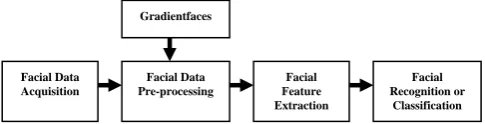
To handle facial recognition for those images with makeup and without makeup, Gradientfaces based normalization technique [14] is added in the pre-processing stage in order to compute the orientation of the image gradients in each pixel of the face images and uses the computed face representation as an illumination invariant version of the input image. A typical facial recognition system with four major generic components and an additional illumination normalization module, Gradientfaces, is shown in Figure 2.
[image:2.595.305.551.61.173.2]
Fig. 2 A generic facial recognition system with illumination normalization
B. Facial Image Acquisition
Youtube Makeup (YMU) Face Database [15] is being utilized in this study. YMU is a publicly available makeup face database with 151 Caucasian female subjects. Each subject has 2 makeup images and 2 non-makeup images. Images are cropped, full frontal with bright illumination. Each image has 130x150 pixels.
The following three groups of face images have been selected from the Youtube Makeup Face Database:
a) Faces with non-makeup images; b) Faces with makeup images and c) Faces with a mixture of makeup and non-makeup images. Typical examples of various facial images are shown in Figures 3, 4 and 5.
Fig. 3 Sample images of the Youtube Makeup Face Database with non- makeup face images
[image:2.595.304.550.207.320.2]
Fig. 4 Sample images of the Youtube Makeup Face Database with makeup face images
Fig. 5 Sample images of the Youtube Makeup Face Database with a mixture of non-makeup (upper row) and their corresponding makeup face images (lower row)
C. Facial Images Preprocessing
In this preprocessing stage, we add the Gradientfaces based normalization technique [14] in order to extract the illumination insensitive measures which will be described as follow:
c.1 Reflectance Model: The reflectance Model used in many cases can be expressed as
I(x, y) = R(x, y) L(x, y) (1) where I(x, y) is the image pixel value, R(x, y) is the reflectance and L(x, y) is the illuminance at each point (x, y). Here, the nature of L(x, y) is determined by the lighting source, while R(x, y)is determined by the characteristics of the surface of object. Therefore, R(x, y)can be regarded as illumination insensitive measure. Separating the reflectance R and the illuminace L from real images is an ill-posed problem. In order to solve the problem, a ―common‖ assumption is that L varies very slowly while R can change abruptly.
c.2 Gradientfaces: In order to extract illumination insensitive measure from gradient, we have the following
Facial Data Acquisition
Gradientfaces
Facial Data Pre-processing
Facial Feature Extraction
Facial Recognition or
[image:2.595.306.549.351.460.2] [image:2.595.48.291.463.525.2]theorem by studying the relationships between the components of gradient domain.
Theorem 1: Given an arbitrary image I(x, y) taken illumination condition, the ratio of y-gradient of I(x, y) (ӘI(x, y)/Әy) to x-gradient of I(x, y) (ӘI(x, y)/Әx) is an illumination insensitive measure.
Proof: Considering two neighboring points
(
x, y
)
and (x+∆ x, y)), according to the illumination model (1), we haveI(x, y) = R(x, y) L(x, y) (2) I(x+∆ x, y) = R(x+∆ x, y) L(x+∆ x, y) (3) Subtracting (2) from (3), we obtain
I(x+∆ x, y)- I(x, y)
= R(x+∆ x, y) L(x+∆ x, y) - R(x, y) L(x, y) Based on the above-mentioned ―common‖ assumption, which means L is approximately smooth, we have
I(x+∆ x, y)- I(x, y)
≈ R(x+∆ x, y) L(x, y) - R(x, y) L(x, y)
≈ (R(x+∆ x, y) - R(x, y)) L(x, y) (4) Taking the limitation of the above equality (4), we can obtain x y x I( , )
L(x, y)
x y x R ( , ) (5)
Similarly, we have
y y x I( , )
L(x, y)
y y x R ( , ) (6)
Dividing (6) by (5), we have
( , ) ( , )
( , ) ( , )
I x y R x y
y y
I x y R x y
x x (7)
According to illumination model (1), R can be considered as an illumination insensitive measure. Thus, the ratio of y-gradient of I(x, y)I(x,y) y to x-gradient of I(x, y)
x y x
I
( , ) is also an illumination insensitive measure. In practical application, the ratio of y-gradient of image to x-gradient of image might be infinitude derived by zero value of x-gradient of image. Therefore, it cannot be directly used as the illumination insensitive measure. These considerations lead us to defining Gradientfaces as follows.
Definition 1: I be an image under variable lighting conditions, then Gradientfaces (G) of image I can be defined as
G = arctan gradient x gradient y I I
, G
[0, 2π ) (8) Where I x-gradient and I y-gradient are the gradient of image I inthe x, y direction, respectively.
c.3 Implememtation: In order to extract Gradientfaces, we
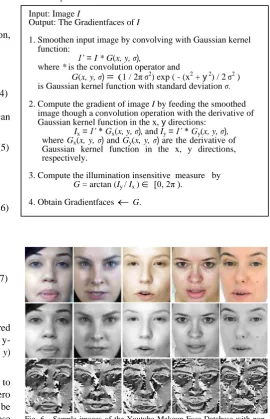
[image:3.595.280.551.237.657.2] [image:3.595.298.551.447.645.2]need firstly to calculate the gradient of face image in the x, y direction. Gradientfaces can then be computed by the definition (8). There are many methods for calculating the gradient of image. However, the numerical calculation of derivative (gradient) is typically ill-posed. To compute the gradient stably, we smoothen the image first with Gaussian kernel function. With a convolution-type smoothing, the numerical calculation of gradient is much more stable in calculation. The main advantage for using Gaussian kernel is twofold: (a) Gradientfaces is more robust to image noise and, (b) it can reduce the effect of shadows. The implementation of Gradientfaces can be summarized in Table I.
Table I Implementation of Gradientfaces
and save your graphic images using a suitable graphics processing program that will allow you to create the images as PostScript (PS), Encapsulated PostScript (EPS), or Tagged Image File Format (TIFF), sizes them, and adjusts the resolution settings. If you created your source files in one of the following you will be able to submit the graphics without converting to a PS, EPS, or TIFF file: Microsoft Word, Microsoft PowerPoint, Microsoft Excel, or Portable
Fig. 6 Sample images of the Youtube Makeup Face Database with non-makeup face images (upper row), corresponding grayscale images (middle row) and the corresponding Gradientfaces processed images (lower row))
As Gradientfaces only works on grayscale images, color images are converted to grayscale images first before applying Gradientfaces. Figure 6 shows the non-makeup images, the grayscale images and the corresponding Gradientfaces processed images from the Youtube Makeup face database.
Input: Image I
Output: The Gradientfaces of I
1. Smoothen input image by convolving with Gaussian kernel function:
I’= I * G(x, y, σ),
where *is the convolution operator and
G(x, y, σ)= (1 / 2πσ2) exp ( - (x2 + y 2) / 2 σ2 ) is Gaussian kernel function with standard deviation σ.
2. Compute the gradient of image Iby feeding the smoothed image though a convolution operation with the derivative of Gaussian kernel function in the x, y directions:
Ix= I’ * Gx(x, y, σ), and Iy= I’ * Gy(x, y, σ),
where Gx(x, y, σ) and Gy(x, y, σ) are the derivative of
Gaussian kernel function in the x, y directions, respectively.
3. Compute the illumination insensitive measure by G = arctan (Iy / Ix )
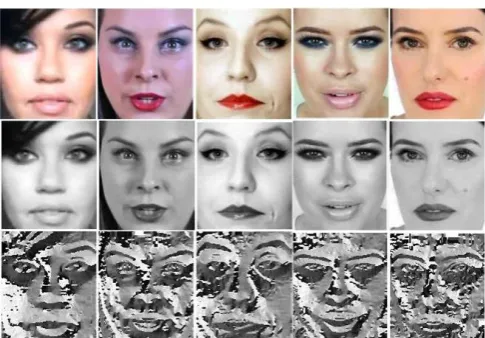
[0, 2π ).Fig. 7 Sample images of the Youtube Makeup Face Database with makeup face images (upper row), corresponding grayscale images (middle row) and the corresponding Gradientfaces processed images (lower row)
Figure 7 shows the makeup images, the grayscale images and the corresponding Gradientfaces processed images from the Youtube Makeup face database. Makeup can make facial images look sharper & brighter. However, Gradientfaces can extract the important illumination insensitive features of face, such as facial shapes and facial objects (e.g., eyes, noses, mouths, and eyebrows) which are key features for face recognition.
D. Facial Feature Extraction using principle component analysis (PCA)
Initial feature of a facial image is the gray intensity of each pixel. Each facial image is converted into a row vector by appending each row one after another. For the Youtube Makeup face database which has facial images geometry normalized and illumination insensitive measures extracted by the Gradientfaces technique has image size of 130 x 150. It will become a 19,500 dimensional feature vector which is very high for any classification technique to be applied in order to learn the underlying classification rules. Therefore, principle component analysis (PCA) is applied to extract more relevant features/signatures [16]. Principal component analysis (PCA) is a simple statistical method to reduce the dimensionality while minimizing mean squared reconstruction error [16].
Let us assume that
M
facial images that are denoted asM
1,
2,...,
have sizea
b
pixels. Using conventional row appending method, we convert each of the images intob
a
N
dimensional column vector. At first the mean image as column vector,
of sizeN
, from all the image vectors of is calculated as:
M
i i
M 1
1
(9)
Then each face difference from the average is calculated using the equation (10).
a
i
i
(10)We then construct the matrix
A
a
1,
a
2,...,
a
M
containing all the mean-normalized face vectors as columns. Using this normalized face vectors we can calculate the covariance matrix
along the feature dimension of sizeN
N
of all the features using the following conventional formula as:T
N
1
(11)Notice that the matrix
T of size19500
19500
needed to be constructed to calculate the matrix
. However, it is virtually impossible for the memory constrains to perform any matrix operation on the
T matrix. Rather, the method described in [17] is employed to construct the matrix
using Equation (12). Instead ofT
, the matrix
T
is constructed as
of sizeM
M
using:
T
M
1
(12)
Then we calculate the eigenvalue and eigenvectors of this covariance matrix using Equation (13).
[
V
,
D
]
eigs
(
)
(13) Here,D
[
d
1,
d
2,...,
d
M]
of sizeM
contains the sorted eigenvalues, such thatd
1
d
2
...
d
M and the corresponding eigenvectors of the matrix
is contained in the matrixV
v
1,
v
2,...,
v
M
which is of sizeM
M
.According to the method proposed in [24], we can acquire the corresponding eigenvectors of the matrix
using
v
v
v
M
V
1,
2,...,
as:
U
A
V
(14) Here notice that, even though each vectorv
i is of sizeM
, the vectorsu
iofU
[
u
1,
u
2,...,
u
M]
are of sizeN
. We can use the matrixU
to project ourN
data onto lowerM
dimensions. The projected data from the originalN
dimensional space to a subspace spanned by
r
principal eigenvectors (for the topr
eigenvalues) contained in the matrix
r expressed as:E. Facial Recognition or Classification
When all the facial images are finally represented with relevant features by projecting onto a lower dimension using PCA, we can use similarity measures between faces from the same individual and different individuals. Assume that the normalized vector formed face test images are kept in the matrix, where each column corresponds to a test face image. For classification, we first normalize the test images vector by subtracting the mean calculated previously (Equation (9)) using:
B
T
(16) Then using Equation (15) we project the normalized test data set as shown in the following equation.Z
r
rB
(17) For each column in the matrixZ
r, we calculate theEuclidean Norm of the difference with the projected vectors of matrix
Y
r. Finally, the test image is identified as theperson with the smallest value among all the Euclidean Norm values.
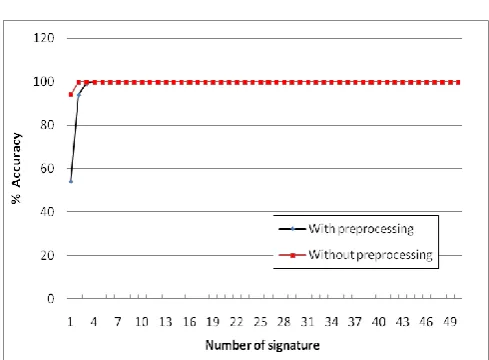
IV. EXPERIMENT RESULTS AND DISCUSSION Figures 8, 9 & 10 show the recognition accuracy with & without Gradientfaces preprocessing for Youtube Makeup Face Database with non-makeup images only, with makeup images only and with a mixture of non-makeup and makeup images.
In Figures 8 and 9, for face database with non-makeup or with makeup images only, addition of Gradientfaces in the pre-processing stage does not improve the accuracy as both PCA and PCA + Gradientfaces achieve up to 100% recognition rate.
[image:5.595.305.549.50.217.2]In Figure 10, for face database with a mixture of non-makeup and non-makeup images, addition of Gradientfaces in the pre-processing stage improves the recognition rate, from 76.25% to 84.50%.
[image:5.595.305.549.250.419.2]Fig. 8 Recognition accuracy with and without Gradientfaces preprocessing for the Youtube Makeup Face Database with non-makeup face images
Fig. 9 Recognition accuracy with and without Gradientfaces preprocessing for the Youtube Makeup Face Database with makeup face images
Fig. 10 Recognition accuracy with and without Gradientfaces preprocessing for the Youtube Makeup Face Database with a mixture of non-makeup and makeup face images
The results are summarized in Table II.
Table II Summary of testing results for Youtube Makeup Face Database Conditions Recognition
accuracy without preprocessing
Recognition accuracy with Gradientfaces for preprocessing
% of improvement
Non-makeup images
100% 100% 0% Makeup
images
100% 100% 0% Mixture of
non-makeup and makeup images
76.25%
84.50%
10.82%
V. CONCLUSIONS
Facial makeup changes the appearance of a face which affects the recognition accuracy of our PCA based human face recognition. With illumination normalization technique in the facial image preprocessing stage to extract the illumination invariant features, it improves the recognition rate, from 76.25% to 84.50%.
[image:5.595.46.291.527.707.2]REFERENCES
[1] A. Dantcheva, C. Chen and A. Ross, ―Makeup challenges automated face recognition systems‖, SPIE Newsroom, pp. 1-4, 2013.
[2] A. Dantcheva, C. Chen and A. Ross, ―Can facial cosmetics affect the matching accuracy of face recognition system?‖, IEEE International Conference on Biometrics: Theory, Application and Systems, pp. 391-398, 2012.
[3] S. Ueda and T. Koyama, ―influence of make-up on facial recognition‖, Perception, vol. 39, pp. 260-264. 2010.
[4] K. Scherbaum, T. Ritschel, M. Hullin, T. Thormählen, V. Blanz and H. –P. Seidel, ―Computer-suggested facial makeup‖, Proc. Eurographics, vol. 30, No. 2, 2011.
[5] V. Blanz and V. Vetter, ―A morphable model for the synthesis of 3D faces‖, In Proc. SIGGRAPH, vol. 2, No. 5, pp. 187-194, 1999. [6] W. Zhang, S. Shan, W. Gao, X. Chen and H. Zhang, ―Local gabor
binary pattern histogram sequence (LGBPHS): A novel non-statistical model for face representation and recognition‖, Proceedings of ICCV,
pp. 786-791, 2005.
[7] C. Chen, A. Dantcheva and A. Ross, ―Automatic Facial Makeup Detection with Application in Face Recognition‖, Proceedings of the 6th IAPR International Conference on Biometrics (ICB), 2013.
[8] M. –L. Eckert, N. Kose and J. –L. Dugelay, ―Facial Cosmetics Database and Impact Analysis on Automatic Face Recognition‖, IEEE 15th International Workshop on Multimedia Signal Processing
(MMSP), pp. 434-439, 2013.
[9] T. Ahonen, A Hadid and M. Pietikinen, ―Face descriprtion with local binary patterns: Applicationto face recognition‖, IEEE Transactions on Pattern Analysis and Machine Intelligence, vol. 28, No. 12, pp. 2037-2041, 2006.
[10] P. Y. Han, A. T. B. Jin, K. E. Yee and L. C. Yaw, ―Histogram of Independent Component Pattern in Face Recognition‖, Proceedings of 2016 International Conference on Information Technology and Applications, 1-4 July. 2016, Sydney, Australia.
[11] V. Struc, N. Pavesic, ―Photometric normalization techniques for illumination invariance‖, In: Y.J. Zhang (Ed.), Advance in Face Image Analysis : Techniques and technologies, IGI Global, pp. 279-300, 2011.
[12] V. Struc, N. Pavesic, ―Gabor-Based Kernel partial-Least-Square Discrimination Features for Face Recongition‖, Informatica (Vilnius), vol. 20, no.1, pp. 115-138, 2009.
[13] B. Poon, M. A. Amin and H. Yan, ―Improved Methods on PCA Based Human Face Recognition for Distorted Images‖, Lecture Notes in Engineering and Computer Science: Proceedings of The International MultiConference of Engineers and Computer Scientists 2016, IMECS 2016, 16-18 March, 2016, Hong Kong, pp. 339-344.
[14] T. Zhang, Y.Y. Tang, B. Fang, Z. Shang, X. Liu, ―Face recognition under varying illumination using gradientfaces‖, IEEE Transactions on Image Processing, vol. 18, No. 11, pp. 2599-2606, 2009. [15] Youtube Makeup (YMU) face database
http://www.antitza.com/makeup-datasets.html
[16] M. Turk and A. Pentland, ―Eigenfaces for Recognition‖, Journal of Cognitive Neuroscience, Vol. 13, No.1, pp. 71-86, 1991.
[17] R. Chellapa, C. L. Wilson and S. Sirohey, ―Human and machine recognition of faces: a survey‖, Proc. IEEE, pp 705-740, 1995. [18] B. Poon, M. A. Amin and H. Yan, ―PCA based face recognition and
testing criteria‖, ICMLC, Vol. 5, pp. 2945—2949, 2009.