121
Multi-turn Dialogue Response Generation in an
Adversarial Learning Framework
Oluwatobi Olabiyi
Capital One Conversation Research Vienna VA
Alan Salimov
Capital One Conversation Research San Fransisco CA
Anish Khazane
Capital One Conversation Research San Fransisco CA
Erik T. Mueller
Capital One Conversation Research Vienna VA
Abstract
We propose an adversarial learning approach for generating multi-turn dialogue responses. Our proposed framework,hredGAN, is based on conditional generative adversarial networks (GANs). The GAN’s generator is a mod-ified hierarchical recurrent encoder-decoder network (HRED) and the discriminator is a word-level bidirectional RNN that shares con-text and word embeddings with the generator. During inference, noise samples conditioned on the dialogue history are used to perturb the generator’s latent space to generate sev-eral possible responses. The final response is the one ranked best by the discriminator. The hredGAN shows improved performance over existing methods: (1) it generalizes better than networks trained using only the log-likelihood criterion, and (2) it generates longer, more informative and more diverse responses with high utterance and topic relevance even with limited training data. This improvement is demonstrated on the Movie triples and Ubuntu dialogue datasets using both automatic and hu-man evaluations.
1 Introduction
Recent advances in deep neural network architec-tures have enabled tremendous success on a num-ber of difficult machine learning problems. While these results are impressive, producing a deploy-able neural network–based model that can engage in open domain conversation still remains elusive. A dialogue system needs to be able to generate meaningful and diverse responses that are simul-taneously coherent with the input utterance and the overall dialogue topic. Unfortunately, earlier conversation models trained with naturalistic dia-logue data suffered greatly from limited contextual information (Sutskever et al., 2014; Vinyals and Le,2015) and lack of diversity (Li et al.,2016a).
These problems often lead to generic and safe re-sponses to a variety of input utterances.
Serban et al. (2016) and Xing et al. (2017) proposed the Hierarchical Recurrent Encoder-Decoder (HRED) network to capture long tempo-ral dependencies in multi-turn conversations to ad-dress the limited contextual information but the
diversity problem remained. In contrast, some
HRED variants such as variational (Serban et al., 2017b) and multi-resolution (Serban et al.,2017a) HREDs attempt to alleviate the diversity problem by injecting noise at the utterance level and by ex-tracting additional context to condition the gener-ator on. While these approaches achieve a cer-tain measure of success over the basic HRED, the generated responses are still mostly generic since they do not control the generator’s output. This is because the output conditional distribution is not calibrated. Li et al. (2016a), on the other hand, consider a diversity promoting training objective but their model is for single turn conversations and cannot be trained end-to-end.
The generative adversarial network (GAN) (Goodfellow et al., 2014) seems to be an
appro-priate solution to the diversity problem. GAN
matches data from two different distributions by
introducing an adversarial game between a
gener-ator and adiscriminator. We explore hredGAN:
conditional GANs for multi-turn dialogue mod-els with an HRED generator and discriminator. hredGAN combines ideas from both generative and retrieval-based multi-turn dialogue systems to
improve their individual performances. This is
with HRED generators and discriminators. We demonstrate the effectiveness of hredGAN over the VHRED for dialogue modeling with evalua-tions on the Movie triples and Ubuntu technical support datasets.
2 Related Work
Our work is related to end-to-end neural network–
based open domain dialogue models. Most
neural dialogue models use transduction frame-works adapted from neural machine translation (Sutskever et al., 2014; Bahdanau et al., 2015).
TheseSeq2Seqnetworks are trained end-to-end
with MLE criteria using large corpora of human-to-human conversation data. Others use GAN’s discriminator as a reward function in a
reinforce-ment learning framework (Yu et al., 2017) and
in conjunction with MLE (Li et al., 2017; Che
et al.,2017).Zhang et al.(2017) explored the idea
of GAN with a feature matching criterion. Xu
et al. (2017) and Zhang et al. (2018) employed GAN with an approximate embedding layer as well as with adversarial information maximization respectively to improveSeq2Seq’s diversity per-formance.
Still, Seq2Seq models are limited in their
ability to capture long temporal dependencies
in multi-turn conversation. Although Li et al.
(2016b) attempted to optimize a pair ofSeq2Seq
models for multi-turn dialogue, the multi-turn ob-jective is only applied at inference and not used for actual model training. Hence the introduction of HRED models (Serban et al.,2016,2017a,b;Xing et al., 2017) for modeling dialogue response in multi-turn conversations. However, these HRED models suffer from lack of diversity since they are only trained with MLE criteria. On the other hand, adversarial system has been used for
eval-uating open domain dialogue models (Bruni and
Fernndez,2018;Kannan and Vinyals,2017). Our work, hredGAN, is closest to the combination of
HRED generation models (Serban et al., 2016)
and adversarial evaluation (Kannan and Vinyals, 2017).
3 Model
3.1 Adversarial Learning of Dialogue Response
Consider a dialogue consisting of a sequence of
N utterances, x = x1, x2,· · · , xN
, where each utterancexi = x1i, x2i,· · ·, x
Mi
i
contains a
variable-length sequence ofMi word tokens such
that xij ∈ V for vocabulary V. At any time
step i, the dialogue history is given by xi =
x1, x2,· · ·, xi
. The dialogue response gener-ation task can be defined as follows: Given a
dialogue history xi, generate a response yi =
yi1, yi2,· · · , yTi
i
, whereTiis the number of
gen-erated tokens. We also want the distribution of the generated responseP(yi)to be
indistinguish-able from that of the ground truth P(xi+1) and
Ti = Mi+1. Conditional GAN learns a mapping
from an observed dialogue history, xi, and a
se-quence of random noise vectors,zi to a sequence
of output tokens,yi,G:{xi, zi} →yi. The
gen-erator G is trained to produce output sequences
that cannot be distinguished from the ground truth sequence by an adversarially trained discriminator
Dthat is trained to do well at detecting the gener-ator’s fakes. The distribution of the generator out-put sequence can be factored by the product rule:
P(yi|xi) =P(yi1) Ti
Y
j=2
P yij|y1 i,· · ·, y
j−1 i ,xi
(1)
P yij|yi1,· · · , yji−1,xi
=PθG y
1:j−1 i ,xi
(2)
whereyii:j−1 = (yi1,· · · , yij−1)andθGare the
pa-rameters of the generator model. PθG y
i:j−1 i ,xi
is an autoregressive generative model where the probability of the current token depends on the
past generated sequence. Training the
genera-tor G with the log-likelihood criterion is unsta-ble in practice, and therefore the past generated sequence is substituted with the ground truth, a
method known as teacher forcing (Williams and
Zipser,1989), i.e.,
P yji|y1 i,· · ·, y
j−1 i ,xi
≈PθG x
1:j−1 i+1 ,xi
(3)
Using (3) in relation to GAN, we define our fake sample as the teacher forcing output with some in-put noisezi
yij ∼PθG x
1:j−1 i+1 ,xi, zi
(4)
and the corresponding real sample as ground truth
xji+1.
With the GAN objective, we can match the noise distribution,P(zi), to the distribution of the
noise input then allows us to generate diverse
re-sponses to the same dialogue history.
Further-more, the discriminator, since it is calibrated, is used during inference to rank the generated re-sponses, providing a means of controlling the gen-erator output.
3.1.1 Objectives
The objective of a conditional GAN can be ex-pressed as
LcGAN(G, D) =Exi,xi+1[log D(xi+1,xi)]+
Exi,zi[1−logD(G(xi, zi),xi)] (5)
whereGtries to minimize this objective against an adversarialDthat tries to maximize it:
G∗, D∗=arg min
G maxD LcGAN(G, D). (6)
Previous approaches have shown that it is benefi-cial to mix the GAN objective with a more tradi-tional loss such as cross-entropy loss (Lamb et al., 2016;Li et al.,2017). The discriminator’s job re-mains unchanged, but the generator is tasked not only to fool the discriminator but also to be near the ground truthxi+1in the cross-entropy sense:
LM LE(G) =Exi,xi+1,zi[−log PθG xi+1,xi, zi
].
(7) Our final objective is,
G∗, D∗ =arg min
G maxD λGLcGAN(G, D)+
λMLM LE(G)
. (8)
It is worth mentioning that, without zi, the net
could still learn a mapping from xi to yi, but it
would produce deterministic outputs and fail to match any distribution other than a delta function (Isola et al., 2017). This is one key area where our work is different from Lamb et al.’s and Li et al.’s. The schematic of the proposed hredGAN is depicted at the right hand side of Figure1.
3.1.2 Generator
We adopted an HRED dialogue generator sim-ilar to Serban et al. (2016, 2017a,b) and Xing et al. (2017). The HRED contains three recur-rent structures, i.e. the encoder (eRN N), con-text (cRN N), and decoder (dRN N) RNN. The conditional probability modeled by the HRED per output word token is given by
PθG y
j i|x
1:j−1 i+1 ,xi
=dRN N E(xji+1−1), hji−1,hi
(9)
where E(.) is the embedding lookup, hi =
cRN N(eRN N(E(xi),hi−1),eRN N(.)maps a
sequence of input symbols into fixed-length vec-tor, and h andh are the hidden states of the de-coder and context RNN, respectively.
In the multi-resolution HRED, (Serban et al., 2017a), high-level tokens are extracted and pro-cessed by another RNN to improve performance. We circumvent the need for this extra process-ing by allowprocess-ing the decoder to attend to different parts of the input utterance during response gener-ation (Bahdanau et al.,2015;Luong et al.,2015). We introduce a local attention into (9) and encode the attention memory differently from the con-text through an attention encoder RNN(aRN N), yielding:
PθG y
j i|x
1:j−1 i+1 ,xi
=
dRN N E(xji+1−1), hij−1, aji,hi
(10)
where aji = PMi
m=1
exp(αm)
PMi
m=1exp(αm)
h0im, h0im =
aRN N(E(xmi ), hi0m−1),h0 is the hidden state of the attention RNN, andαkis either a logit
projec-tion of(hji−1, h0im)in the case ofBahdanau et al. (2015) or(hji−1)T ·h0imin the case ofLuong et al. (2015). The modified HRED architecture is shown in Figure2.
Noise Injection: We inject Gaussian noise at the input of the decoder RNN. Noise samples could be injected at the utterance or word level. With noise injection, the conditional probability of the decoder output becomes
PθG y
j i|x
1:j−1 i+1 , z
j i,xi
=
dRN N E(xji+1−1), hij−1, aji, zij,hi
(11)
wherezji ∼ Ni(0,I), for utterance-level noise and
zji ∼ Nij(0,I), for word-level noise.
3.1.3 Discriminator
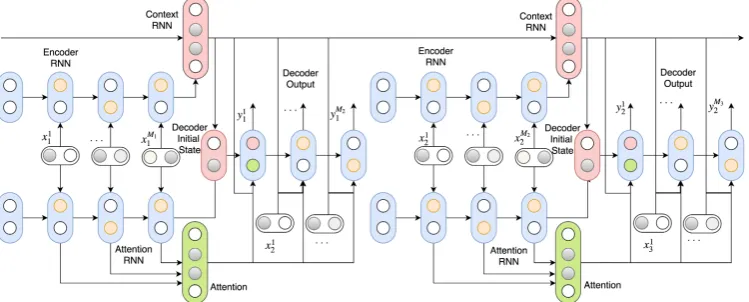
word-Figure 1: Left: The hredGAN architecture - The generator makes predictions conditioned on the dialogue history, hi, attention, aji, noise sample, zij, and ground truth, xji+1−1. Right: RNN-based discriminator that discriminates bidirectionally at the word level.
Figure 2:The HRED generator with local attention -The attention RNN ensures local relevance while the con-text RNN ensures global relevance. Their states are combined to initialize the decoder RNN and the discriminator BiRNN.
level discrimination and expressed as
D(xi, χ) =D(hi, χ) =
J Y
j=1
DRN N(hi, E(χj))
1
J
(12)
where DRN N(.) is the word discriminator RNN,
hi is an encoded vector of the dialogue history
xi obtained from the generator’s cRN N(.)
out-put, andχj is thejthword or token of the input se-quenceχ. χ=yi andJ =Tifor the case of
gen-erator’s decoder output,χ =xi+1andJ =Mi+1
for the case of ground truth. The discriminator ar-chitecture is depicted on the left hand side of Fig-ure1.
3.2 Adversarial Generation of Multi-turn Dialogue Response
In this section, we describe the generation process during inference. The generation objective can be
mathematically described as
yi∗ =arg max
l
P(yi,l|xi) +D∗(xi, yi,l)] L l=1
(13) whereyi,l=G∗(xi, zi,l),zi,lis thelthnoise
sam-ples at dialogue stepi, andLis the number of re-sponse samples. Equation13shows that our infer-ence objective is the same as the training objective (8), combining both the MLE and adversarial cri-teria. This is in contrast to existing work where the discriminator is usually discarded during in-ference.
The inference described by (13) is intractable due to the enormous search space ofyi,l.
There-fore, we turn to an approximate solution where we use greedy decoding (MLE) on the first part of the objective function to generateLlists of re-sponses based on noise samples{zi,l}L
l=1. In
[image:4.595.108.483.265.416.2]Algorithm 1Adversarial Learning of hredGAN Require: A generatorGwith parametersθG.
Require: A discriminatorDwith parametersθD. fornumber of training iterationsdo
InitializecRN Nto zero state,h0
Sample a mini-batch of conversations, x = {xi}Ni=1, xi =
(x1, x2,· · ·, xi)withNutterances. Each utterance mini batchi
con-tainsMiword tokens. fori= 1toN−1do
Update the context state.
hi=cRN N(eRN N(E(xi)),hi−1)
Compute the generator output using (11).
PθG yi|, zi,xi=PθG yij|x
1:j−1
i+1 , z
j
i,xi Mij=1+1 Sample a corresponding mini batch of utteranceyi. yi∼PθG yi|, zi,xi
end for
Compute the discriminator accuracyDacc over N −1utterances {yi}Ni=1−1and{xi+1}Ni=1−1
ifDacc< accDththen
UpdateθDwith gradient of the discriminator loss. P
i
[∇θDlogD(hi, xi+1) +∇θDlog1−D(hi, yi)] end if
ifDacc< accGththen
UpdateθGwith the generator’s MLE loss only. P
i
[∇θGlogPθG yi|, zi,xi]
else
UpdateθGwith both adversarial and MLE losses. P
i
[λG∇θGlogD(hi, yi) +λM∇θGlogPθG yi|, zi,xi
]
end if end for
whereα > 1.0, is the exploration factor that in-creases the noise variance. We then rank theLlists using the discriminator score,D∗(xi, yi,l)]
L l=1.
The response with the highest discriminator rank-ing is the optimum response for the dialogue con-text.
4 Training of hredGAN
We trained both the generator and the discrimina-tor simultaneously as highlighted in Algorithm??
with λG = λM = 1. GAN training is prone to
instability due to competition between the gener-ator and the discrimingener-ator. Therefore, parameter updates are conditioned on the discriminator per-formance (Lamb et al.,2016).
The generator consists of four
RNNs with different parameters, that is,
aRN N, eRN N, cRN N, and dRN N. aRN N
andeRN N are both bidirectional, while cRN N
and dRN N are unidirectional. Each RNN has 3 layers, and the hidden state size is 512. The
dRN N and aRN N are connected using an
additive attention mechanism (Bahdanau et al.,
2015).
The discriminator shares aRN N, eRN N, and cRN N with the generator. DRN N is a
stacked bidirectional RNN with 3 layers and a
hidden state size of 512. The cRN N states are
used to initialize the states of DRN N. The
out-put of both the forward and the backward cells for
each word are concatenated and passed to a fully-connected layer with binary output. The output is the probability that the word is from the ground truth given the past and future words of the se-quence.
Others:All RNNs used are gated recurrent unit (GRU) cells (Cho et al.,2014). The word embed-ding size is 512 and shared between the generator and the discriminator. The initial learning rate is
0.5 with decay rate factor of 0.99, applied when the adversarial loss has increased over two itera-tions. We use a batch size of 64 and clip gradi-ents around 5.0. As in Lamb et al. (2016), we find accDth = 0.99 andaccGth = 0.75 to
suf-fice. All parameters are initialized with Xavier uniform random initialization (Glorot and Bengio, 2010). The vocabulary sizeV is50,000. Due to the large vocabulary size, we use sampled softmax loss (Jean et al., 2015) for MLE loss to expedite the training process. However, we use full softmax for evaluation. The model is trained end-to-end using the stochastic gradient descent algorithm.
5 Experiments and Results
We consider the task of generating dialogue re-sponses conditioned on the dialogue history and the current input utterance. We compare the pro-posed hredGAN model against some alternatives on publicly available datasets.
5.1 Datasets
Movie Triples Corpus (MTC) dataset (Serban et al., 2016). This dataset was derived from the
Movie-DiC dataset byBanchs (2012). Although this dataset spans a wide range of topics with few spelling mistakes, its small size of only about 240,000 dialogue triples makes it difficult to train a dialogue model, as pointed out bySerban et al. (2016). We thought that this scenario would really benefit from the proposed adversarial generation.
Ubuntu Dialogue Corpus(UDC) dataset ( Ser-ban et al.,2017b). This dataset was extracted from the Ubuntu Relay Chat Channel. Although the topics in the dataset are not as diverse as in the MTC, the dataset is very large, containing about 1.85 million conversations with an average of 5 utterances per conversation.
except the top 50,000 most frequent words by an
UNKsymbol.
5.2 Evaluation Metrics
Accurate evaluation of dialogue models is still an open challenge. In this paper, we employ both au-tomatic and human evaluations.
5.2.1 Automatic Evaluation
We employed some of the automatic evaluation metrics that are used in probabilistic language and dialogue models, and statistical machine transla-tion. Although these metrics may not correlate well with human judgment of dialogue responses (Liu et al.,2016), they provide a good baseline for comparing dialogue model performance.
Perplexity- For a model with parameterθ, we define perplexity as:
exp
− 1
NW K
X
k=1
log Pθ(y1, y2, . . . , yNk−1)
(14)
where K is the number of conversations in the
dataset,Nkis the number of utterances in
conver-sationk, andNW is the total number of word
to-kens in the entire dataset. The lower the perplexity, the better. The perplexity measures the likelihood of generating the ground truth given the model pa-rameters. While a generative model can generate a diversity of responses, it should still assign a high probability to the ground truth utterance.
BLEU- The BLEU score (Papineni et al.,2002) provides a measure of overlap between the gen-erated response (candidate) and the ground truth (reference) using a modified n-gram precision. According to Liu et. al. (Liu et al.,2016), BLEU-2 score is fairly correlated with human judgment for non-technical dialogue (such as MTC).
ROUGE - The ROUGE score (Lin, 2014) is similar to BLEU but it is recall-oriented instead. It is used for automatic evaluation of text summa-rization and machine translation. To compliment
the BLEU score, we use ROUGE-N withN = 2
for our evaluation.
Distinct n-gram- This is the fraction of unique n-grams in the generated responses and it provides a measure of diversity. Models with higher a num-ber of distinct n-grams tend to produce more di-verse responses (Li et al.,2016a). For our evalua-tion, we use 1- and 2- grams.
Normalized Average Sequence Length (NASL) - This measures the average number of
words in model-generated responses normalized by the average number of words in the ground truth.
5.2.2 Human Evaluation
For human evaluation, we follow a similar setup as Li et al.(2016a), employing crowd-sourced judges to evaluate a random selection of 200 samples. We presented both the multi-turn context and the gen-erated responses from the models to 3 judges and asked them to rank the general response quality
in terms of relevance and informativeness. ForN
models, the model with the lowest quality is as-signed a score 0 and the highest is asas-signed a score N-1. Ties are not allowed. The scores are normal-ized between 0 and 1 and averaged over the total number of samples and judges. For each model, we also estimated the per sample score variance between judges and then averaged over the num-ber of samples, i.e., sum of variances divided by the square of number of samples (assuming sam-ple independence). The square root of result is re-ported as the standard error of the human judg-ment for the model.
5.3 Baseline
We compare the performance of our model to (V)HRED (Serban et al.,2016,2017b), since they are the closest to our approach in implementation and are the current state of the art in open-domain dialogue models. HRED is very similar to our proposed generator, but without the input utter-ance attention and noise samples. VHRED intro-duces a latent variable to the HRED between the
cRNN and the dRNN and was trained using the
variational lower bound on the log-likelihood. The VHRED can generate multiple responses per con-text like hredGAN, but it has no specific criteria for selecting the best response.
The HRED and VHRED models are both trained using the Theano-based
implementa-tion obtained from https://github.com/
julianser/hed-dlg-truncated. The training and validation sets used for UDC and MTC dataset were obtained directly from the
au-thors1 of (V)HRED. For model comparison, we
use a test set that is disjoint from the training and validation sets.
1UDC was obtained from http:
//www.iulianserban.com/Files/
Model Teacher Forcing Autoregression Human Perplexity −logD(G(.)) BLEU-2 ROUGE-2 DISTINCT-1/2 NASL Evaluation
MTC
HRED 31.92/36.00 NA 0.0474 0.0384 0.0026/0.0056 0.535 0.2560±0.0977 VHRED 42.61/44.97 NA 0.0606 0.1181 0.0048/0.0163 0.831 0.3909±0.0240 hredGAN u 23.57/23.54 6.85/6.81 0.0493 0.2416 0.0167/0.1306 0.884 0.5582±0.0118 hredGAN w 24.20/24.14 13.35/13.40 0.0613 0.3244 0.0179/0.1720 1.540 0.7869±0.1148
UDC
[image:7.595.92.505.67.204.2]HRED 69.39/86.40 NA 0.0177 0.0483 0.0203/0.0466 0.892 0.3475±0.1062 VHRED 98.50/105.20 NA 0.0171 0.0855 0.0297/0.0890 0.873 0.4046±0.0188 hredGAN u 56.82/57.32 10.09/10.08 0.0137 0.0716 0.0260/0.0847 1.379 0.6133±0.0361 hredGAN w 47.73/48.18 8.37/8.36 0.0216 0.1168 0.0516/0.1821 1.098 0.6905±0.0706
Table 1: Generator Performance Evaluation
5.4 Results
We have two variants of hredGAN based on the noise injection approach, i.e., hredGAN with utterance-level (hredGAN u) and word-level (hredGAN w) noise injections.
We compare the performance of these two vari-ants with HRED and VHRED models.
Perplexity: The average perplexity per word performance of all the four models on MTC and UDC datasets (validation/test) are reported in the first column on Table1. The table indicates that both variants of the hredGAN model perform bet-ter than the HRED and VHRED models in bet-terms of the perplexity measure. However, using the ad-versarial loss criterion (Eq. (8)), the hredGAN u model performs better on MTC and worse on UDC. Note that, for this experiment, we run all models in teacher forcing mode.
Generation Hyperparameter: For adversarial
generation, we perform a linear search forα
be-tween 1 and 20 at an increment of 1 using Eq. (13), with sample sizeL = 64, on validation sets with models run in autoregression. The optimum
values ofα for hredGAN u and hredGAN w for
UDC are7.0and9.0respectively. The values for MTC are not convex, probably due to small size of
the dataset, so we use the sameαvalues as UDC.
We however note that for both datasets, any inte-ger value between 3 and 10 (inclusive) works well in practice.
Quantitative Generator Performance: We run autoregressive inference for all the models
(us-ing optimum α values for hredGAN models and
selecting the best ofL= 64responses using a dis-criminator) with dialogue contexts from a unique test set. Also, we compute the average BLEU-2, ROUGE-2(f1), Distinct(1/2), and normalized
Item D(G(.))Utterance
MTC
Context 0 NA perhaps<person>had a word with the man upstairs . Context 1 NA a word ? i ’ m sure by now he ’ s engineered a hostile takeover . Response 0 0.996 <person>, i know what you ’ re saying ,<person>, that ’ s
not what i ’ m saying .
Response 1 0.991 <person>, i know . i was just about to help the guy . Response 2 0.315 <person>, i ’ m sorry .
Response 3 0.203 <person>, i ’ m a little out .
Context 0 NA says he wanted food .<person>. he wanted the gold . Context 1 NA how ’ s he going to want the gold ? he couldn ’ t even know we
had it .
Response 0 0.998 <person>, i know . but it ’ s not him , it ’ s the only way he ’ s got it all figured
Response 1 0.981 <person>, i know . but i have to tell you . these things are really stupid and you think i was wrong ?
Response 2 0.690 <person>, i ’ m sure he did . Response 3 0.314 <person>, i ’ m not sure .
UDC
Context 0 NA The netboot one is suppose to download packages from the net. Context 1 NA like the ones to be installed? or the installed to be run? Response 0 0.993 you don ’ t need to install the whole system , just install the
ubuntu installer
Response 1 0.952 you can install the ubuntu installer from the ubuntu menu Response 2 0.749 I ’ m not sure , I don ’ t know .
Response 3 0.184 you can
Response 4 0.003 you a . 1 . . . .
Context 0 NA DJones: update manager won’t detect 12.04.1 as a new version if you are already running 12.04, because 12.04.1 = 12.04 + lots of package updates
Response 0 0.991 did you try a clean install of the latest version ? Response 1 0.981 try installing the latest UNK and see if it works Response 2 0.615 I ’ m not sure you have a problem . . .
Response 3 0.191 try sudo apt-get remove the package that is not installed Response 4 0.002 try the UNK . 1 . 1 . 1 . 1 . 1 . UNK . deb
Table 2: Example of Discriminator Ranking with hredGAN w
average sequence length (NASL) scores for each model and summarize the results in the middle of Table1. Distinct(1/2) largely agrees with the per-plexity score. Most scores, similar to the perplex-ity, indicate that hredGAN models perform better than (V)HRED on both datasets. However, on the UDC ROUGE and MTC BLEU, VHRED scores slightly better than hredGAN u but still worse than hredGAN w.
[image:7.595.307.526.255.522.2]Movie
Context 0 perhaps<person>had a word with the man upstairs .
HRED i ’ m sorry ,<person>.
VHRED <person<’ t do it .
hredGAN w<person>, i ’ m not gon na be okay . i just don ’ t think it ’ s a good idea .
hredGAN u<person>, i cause it was all the way to you .
Context 1 a word ? i ’ m sure by now he ’ s engineered a hostile takeover .
HRED i ’ m sorry ,<person>.
VHRED <person>’ t do it .
hredGAN w<person>, i know what you ’ re saying ,<person>, that ’ s not what i ’ m saying .
hredGAN u<person>, i have to tell you i ’ m not the same .
Context 0 <person>’ s .
HRED i ’ m sorry ,<person>.
VHRED <person>’ t do it .
hredGAN w<person>, i ’ m sure it ’ s the only thing i ever imagined .
hredGAN u<person>, i ’ ll be right there .
Context 1 can i ask you something about her ?
HRED i don ’ t know .
VHRED: you ’ re not going to be here .
hredGAN wi don ’ t know . i think i ’ ve heard of it .
hredGAN ui ’ m sorry , i can ’ t .
Ubuntu
Context 0 this is Dacs i am in i used ’sudo statx and it let me in
HRED what ’s the problem ?
VHRED I don’t know what you want to do . if you want to do it , you need to do it to do it in the terminal ?
hredGAN wyou don ’ t have to do anything , just type in the terminal and it should be to find the right device
hredGAN uyou can have a look at the output of the command . . .
Context 1 good deal... cat /etc/X11/default-display-manager
HRED what ’s the problem ?
VHRED do you know what you want to do ?
hredGAN wI ’ m trying to figure a command that I can find to find out the file that I can find in the file”
hredGAN uI don ’ t see the point , but I ’ m not sure how to do that .
Context 2 /usr/sbin/lightdm http://paste.ubuntu.com/1286224/ <—- my /etc/X11/xorg.conf
HRED what ’s the problem ?
VHRED is there a way to do that in the terminal ?
hredGAN wdid you just type\” sudo mount -a\” ?
[image:8.595.72.291.78.394.2]hredGAN ui have no idea , i just installed ubuntu and i have no idea how to do that
Table 3: Sample responses of HRED, VHRED and hredGAN.
As hredGAN generators explore diversity, the dis-criminator ranking gives hredGAN an edge over (V)HRED because it helps detect responses that are out of context and the natural language
struc-ture (Table2). Also, the ROGUE(f1) performance
indicates that hredGAN w strikes a better balance between precision (BLEU) and diversity than the rest of the models. This is also obvious from the quality of generated responses.
Qualitative Generator Performance: The re-sults of the human evaluation are reported in
the last column of Table 1. The human
evalua-tion agrees largely with the automatic evaluaevalua-tion. hredGAN w performs best on both datasets al-though the gap is more on the MTC than on the UTC. This implies that the improvement of HRED with adversarial generation is better than with vari-ational generation (VHRED). In addition, look-ing at the actual samples from the generator
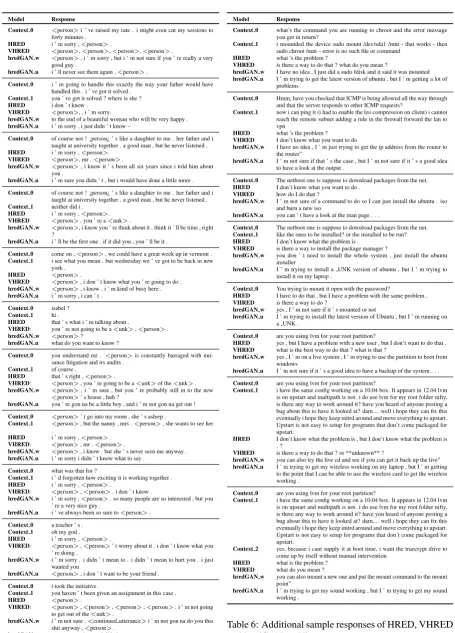
out-puts in Table 6 shows that hredGAN, especially
hredGAN w, performs better than (V)HRED. While other models produce short and generic
ut-terances, hredGAN w mostly yields informative responses. For example, in the first dialogue in Ta-ble6, when the speaker is sarcastic about “the man upstairs”, hredGAN w responds with the most co-herent utterance with respect to the dialogue his-tory. We see similar behavior across other sam-ples. We also note that although hredGAN u’s re-sponses are the longest on Ubuntu (in line with the NASL score), the responses are less informa-tive compared to hredGAN w resulting in a lower human evaluation score. We reckon this might be due to a mismatch between utterance-level noise and word-level discrimination or lack of capacity to capture the data distribution using single noise distribution. We hope to investigate this further in the future.
Discriminator Performance: Although only hredGAN uses a discriminator, the observed
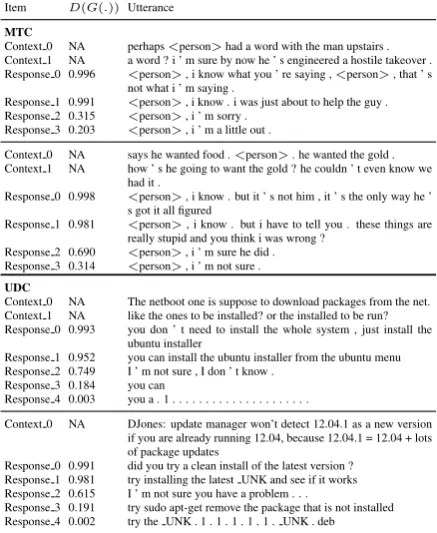
dis-criminator behavior is interesting. We observe
that the discriminator score is generally reasonable with longer, more informative and more persona-related responses receiving higher scores as shown in Table2. It worth to note that this behavior, al-though similar to the behavior of a human judge is learned without supervision. Moreover, the dis-criminator seems to have learned to assign an av-erage score to more frequent or generic responses such as “I don’t know,” “I’m not sure,” and so on, and high score to rarer answers. That’s why we sample a modified noise distribution during infer-ence so that the generator can produce rarer utter-ances that will be scored high by the discriminator.
6 Conclusion and Future Work
In this paper, we have introduced an adversar-ial learning approach that addresses response di-versity and control of generator outputs, using an HRED-derived generator and discriminator. The proposed system outperforms existing state-of-the-art (V)HRED models for generating re-sponses in multi-turn dialogue with respect to
automatic and human evaluations. The
References
D. Bahdanau, K. Cho, and Y. Bengio. 2015. Neural machine translation by jointly learning to align and translate. In Proceedings of International Confer-ence of Learning Representation (ICLR 2015).
R. E. Banchs. 2012. Movie-dic: A movie dialogue cor-pus for research and development. InProceedings of the 50th Annual Meeting of the Association for Computational Linguistics, pages 203–207.
E. Bruni and R. Fernndez. 2018. Adversarial evalua-tion for open-domain dialogue generaevalua-tion. In Pro-ceedings of the 18th Annual SIGdial Meeting.
T. Che, Y. Li, R. Zhang, R. D. Hjelm, W. Li, Y. Song, and Y. Bengio. 2017. Maximum-likelihood aug-mented discrete generative adversarial networks. In arXiv preprint arXiv:1702.07983.
K. Cho, B. Merrienboer, C. Gulcehre, D. Bahdanau, F. Bougares, H. Schwenk, and Y. Bengio. 2014. Learning phrase representations using rnn encoder-decoder for statistical machine translation. In Pro-ceedings of International Conference of Learning Representation (ICLR 2015), pages 1724–1734.
X. Glorot and Y. Bengio. 2010. Understanding the dif-ficulty of training deep feedforward neural networks. InInternational conference on artificial intelligence and statistics.
I. J. Goodfellow, J. Pouget-Abadie, M. Mirza, B. Xu, D. Warde-Farley, S. Ozair, A. Courville, and Y. Ben-gio. 2014. Generative adversarial nets. In Proceed-ings of Advances in Neural Information Processing Systems (NIPS 2014).
P. Isola, J. Y. Zhu, T. Zhou, and A. A. Efros. 2017. Image-to-image translation with conditional adver-sarial networks. InConference on Computer Vision and Pattern Recognition (CVPR, 2017).
S. Jean, K. Cho, R. Memisevic, and Y. Bengio. 2015. On using very large target vocabulary for neural machine translation. In arXiv preprint arXiv:1412.2007.
A. Kannan and O. Vinyals. 2017. Adversarial eval-uation of dialogue models. In arXiv preprint arXiv:1701.08198v1.
A. Lamb, A. Goyah, Y. Zhang, S. Zhang, A. Courville, and Y. Bengio. 2016. Professor forcing: A new al-gorithm for training recurrent networks. In Proceed-ings of Advances in Neural Information Processing Systems (NIPS 2016).
J. Li, M. Galley, C. Brockett, J. Gao, and B. Dolan. 2016a. A diversity-promoting objective function for neural conversation models. In Proceedings of NAACL-HLT.
J. Li, W. Monroe, A. Ritter, M. Galley, J. Gao, and D. Jurafsky. 2016b. Deep reinforcement learn-ing for dialogue generation. In arXiv preprint arXiv:arXiv:arXiv:1606.01541v4.
J. Li, W. Monroe, T. Shi, A. Ritter, and D. Jurafsky. 2017. Adversarial learning for neural dialogue gen-eration. InarXiv preprint arXiv:1701.06547.
C. Y. Lin. 2014. Rouge: a package for automatic evalu-ation of summaries. InProceedings of the Workshop on Text Summarization Branches Out.
C. Liu, R. Lowe, I. V. Serban, M. Noseworthy, L. Char-lin, and J. Pineau. 2016. How not to evaluate your dialogue system: An empirical study of unsuper-vised evaluation metrics for dialogue response gen-eration. In Proceedings of EMNLP, pages 2122– 2132.
M. T. Luong, I. Sutskever, Q. V. Le, O. Vinyals, and W. Zaremba. 2015. Addressing the rare word prob-lem in neural machine translation. InProceedings of the 53rd Annual Meeting of the Association for Computational Linguistics.
K. Papineni, S. Roukos, T. Ward, and W. Zhu. 2002. Bleu: A method for automatic evalution of machine translation. InProceedings of the 40th Annual Meet-ing of the Association for Computational LMeet-inguis- Linguis-tics, pages 311–318.
I. Serban, A. Sordoni, Y. Bengio, A. Courville, and J. Pineau. 2016. Building end-to-end dialogue sys-tems using generative hierarchical neural network models. InProceedings of The Thirtieth AAAI Con-ference on Artificial Intelligence (AAAI 2016), pages 3776–3784.
I. V. Serban, T. Klinger, G. Tesauro, K. Talamadupula, B. Zhou, Y. Bengio, and A. Courville. 2017a. Mul-tiresolution recurrent neural networks: An applica-tion to dialogue response generaapplica-tion. In Proceed-ings of The Thirty-first AAAI Conference on Artifi-cial Intelligence (AAAI 2017).
I. V. Serban, A. Sordoni, R. Lowe, L. Charlin, J. Pineau, A. Courville, and Y. Bengio. 2017b. A hierarchical latent variable encoder-decoder model for generating dialogue. In Proceedings of The Thirty-first AAAI Conference on Artificial Intelli-gence (AAAI 2017).
I. Sutskever, O. Vinyals, and Q. Le. 2014. Sequence to sequence learning with neural networks. In ceedings of Advances in Neural Information Pro-cessing Systems (NIPS), pages 3104–3112.
O. Vinyals and Q. Le. 2015. A neural conversational model. In Proceedings of ICML Deep Learning Workshop.
R. J. Williams and D. Zipser. 1989. A learning algo-rithm for continually running fully recurrent neural networks. Neural computation, 1(2):270–280.
Z. Xu, B. Liu, B. Wang, S. Chengjie, X. Wang, Z. Wang, and C. Qi. 2017. Neural response gener-ation via gan with an approximate embedding layer. InEMNLP.
L. Yu, W. Zhang, J. Wang, and Y. Yu. 2017. Seqgan: sequence generative adversarial nets with policy gra-dient. InProceedings of The Thirty-first AAAI Con-ference on Artificial Intelligence (AAAI 2017).
Y. Zhang, M. Galley, J. Gao, Z. Gan, X. Li, C. Brock-ett, and B. Dolan. 2018. Generating informative and diverse conversational responses via adversar-ial information maximization. In arXiv preprint arXiv:arXiv:1809.05972v5.
Y. Zhang, Z. Gan, K. Fan, Z. Chen, R. Henao, D. Shen, and L. Carin. 2017. Adversarial feature matching for text generation. In arXiv preprint arXiv:1706.03850.
A Ablation Experiments
Before proposing the above adversarial learning framework for multi-turn dialogue, we carried out some experiments.
A.1 Generator:
We consider two main factors here, i.e., addition of an attention memory and injection of Gaussian noise into the generator input.
A.1.1 Addition of Attention Memory
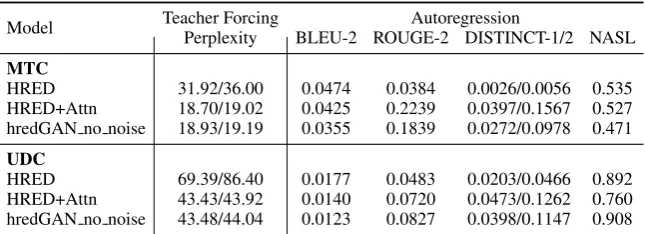
First, we noted that by adding an additional at-tention memory to the HRED generator, we im-proved the test set perplexity score by more than 12 and 25 points on the MTC and UDC respec-tively as shown in Table4. The addition of atten-tion also shows strong performance at autoregres-sive inference across multiple metrics as well as an observed improvement in response quality. Hence the decision for the modified HRED generator.
A.1.2 Injection of Noise
Before injecting noise into the generator, we first train hredGAN without noise. The result is also
reported in 4. We observe accelerated generator
training but without an appreciable improvement in performance. It seems the discrimination task is very easy since there is no stochasticity in the generator output. Therefore, the adversarial feed-back does not meaningfully impact the generator weight update.
Finally, we also notice that even with noise in-jection, there is no appreciable improvement in the auto-regressive performance if we sample with
L= 1even though the perplexity is higher.
How-ever, as we increase L, producing L responses
per turn, the discriminator’s adversarial selection gives a better performance as reported in Table 1.
Therefore, we conclude that the combination of adversarial training and adversarial inference helps to address the lack of diversity and con-textual relevance observed in the generated re-sponses.
A.2 Discriminator:
Before deciding on the word-level discrimination, we experimented with utterance-level discrimina-tion. The utterance-level discriminator trains very quickly but it leads to mostly generic responses from the generator. We also note that utterance-level discriminator scores are mostly extreme (i.e., either low or high). Since we had used a convo-lutional neural network discriminator (Yu et al., 2017) in our experiments, we hope to investigate this further with other architectures.
A.3 Adversarial Training:
Model Teacher Forcing Autoregression
Perplexity BLEU-2 ROUGE-2 DISTINCT-1/2 NASL
MTC
HRED 31.92/36.00 0.0474 0.0384 0.0026/0.0056 0.535
HRED+Attn 18.70/19.02 0.0425 0.2239 0.0397/0.1567 0.527 hredGAN no noise 18.93/19.19 0.0355 0.1839 0.0272/0.0978 0.471
UDC
HRED 69.39/86.40 0.0177 0.0483 0.0203/0.0466 0.892
[image:11.595.138.461.340.457.2]HRED+Attn 43.43/43.92 0.0140 0.0720 0.0473/0.1262 0.760 hredGAN no noise 43.48/44.04 0.0123 0.0827 0.0398/0.1147 0.908
Model Response
Context 0 <person>i ’ ve raised my rate . i might even cut my sessions to forty minutes .
HRED i ’ m sorry ,<person>.
VHRED <person>,<person>,<person>,<person>.
hredGAN w <person>, i ’ m sorry , but i ’ m not sure if you ’ re really a very good guy .
hredGAN u i ’ ll never see them again ,<person>.
Context 0 i ’ m going to handle this exactly the way your father would have handled this . i ’ ve got it solved .
Context 1 you ’ ve got it solved ? where is she ?
HRED i don ’ t know .
VHRED <person>, , i ’ m sorry.
hredGAN w to the end of a beautiful woman who will be very happy .
hredGAN u i ’ m sorry , i just didn ’ t know –
Context 0 of course not ! ¡person¿ ’ s like a daughter to me . her father and i taught at university together . a good man , but he never listened .
HRED i ’ m sorry ,<person>.
VHRED <person>, mr .<person>.
hredGAN w <person>, i know it ’ s been all six years since i told him about you .
hredGAN u i ’ m sure you didn ’ t , but i would have done a little more .
Context 0 of course not ! ¡person¿ ’ s like a daughter to me . her father and i taught at university together . a good man , but he never listened .
Context 1 neither did i .
HRED i ’ m sorry ,<person>.
VHRED <person>, you ’ re a<unk>.
hredGAN w <person>, i know you ’ re think about it . think it ’ ll be time , right ?
hredGAN u i ’ ll be the first one . if it did you , you ’ ll be it .
Context 0 come on ,<person>, we could have a great week up in vermont .
Context 1 i see what you mean . but wednesday we ’ ve got to be back in new york .
HRED <person>.
VHRED <person>, i don ’ t know what you ’ re going to do .
hredGAN w <person>, i know . i ’ m kind of busy here .
hredGAN u i ’ m sorry , i can ’ t .
Context 0 isabel ?
Context 1 hi .
HRED that ’ s what i ’ m talking about .
VHRED: you ’ re not going to be a<unk>,<person>.
hredGAN w <person>?
hredGAN u what do you want to know ?
Context 0 you understand mr . <person>is constantly barraged with nui-sance litigation and irs audits .
Context 1 of course .
HRED that ’ s right ,<person>.
VHRED: <person>, you ’ re going to be a<unk>of the<unk>.
hredGAN w <person>, i ’ m sure , but you ’ re probably still in to the new <person>’ s house , huh ?
hredGAN u you ’ re gon na be a little boy , and i ’ m not gon na get out !
Context 0 <person>’ t go into my room , she ’ s asleep .
Context 1 <person>, but the nanny , mrs .<person>, she wants to see her .
HRED i ’ m sorry ,<person>.
VHRED: <person>, mr .<person>.
hredGAN w <person>, i know . but she ’ s never seen me anyway .
hredGAN u i ’ m sorry i didn ’ t know what to say .
Context 0 what was that for ?
Context 1 i ’ d forgotten how exciting it is working together .
HRED i ’ m sorry ,<person>.
VHRED: <person>,<person>. i don ’ t know .
hredGAN w i ’ m sorry ,<person>. so many people are so interested , but you ’ re a very nice guy .
hredGAN u i ’ ve always been so sure to<person>.
Context 0 a teacher ’ s .
Context 1 oh my god .
HRED i ’ m sorry ,<person>.
VHRED: <person>,<person>’ t worry about it . i don ’ t know what you ’ re doing .
hredGAN w i ’ m sorry . i didn ’ t mean to . i didn ’ t mean to hurt you . i just wanted you
hredGAN u <person>, i don ’ t want to be your friend .
Context 0 i took the initiative .
Context 1 you haven ’ t been given an assignment in this case .
HRED <person>.
VHRED: <person>,<person>,<person>,<person>. i ’ m not going to get out of the<unk>.
hredGAN w i ’ m not sure .<continued utterance>i ’ m not gon na do you this shit anyway ,<person>.
hredGAN u <person>, i guess i didn ’ t .
Table 5: Additional sample responses of HRED, VHRED and hredGAN on Movie.
Model Response
Context 0 what’s the command you are running to chroot and the error message you get in return?
Context 1 i mountded the device sudo mount /dev/sda1 /mnt - that works - then sudo chroot /mnt – error is no such file or command
HRED what ’s the problem ?
VHRED is there a way to do that ? what do you mean ?
hredGAN w I have no idea , I just did a sudo fdisk and it said it was mounted
hredGAN u I ’ m trying to get the latest version of ubuntu , but I ’ m getting a lot of problems .
Context 0 Hmm, have you checked that ICMP is being allowed all the way through and that the server responds to other ICMP requests?
Context 1 now i can ping it (i had to enable the lzo compression on client) i cannot reach the remote subnet adding a rule in the firewall forward the lan to vpn
HRED what ’s the problem ?
VHRED I don’t know what you want to do
hredGAN w I have no idea , I ’ m just trying to get the ip address from the router to the router”
hredGAN u I ’ m not sure if that ’ s the case , but I ’ m not sure if it ’ s a good idea to have a look at the output .
Context 0 The netboot one is suppose to download packages from the net.
HRED I don’t know what you want to do .
VHRED how do I do that ?
hredGAN w I ’ m not sure of a command to do so I can just install the ubuntu . iso and burn a new iso
hredGAN u you can ’ t have a look at the man page . . .
Context 0 The netboot one is suppose to download packages from the net.
Context 1 like the ones to be installed? or the installed to be run?
HRED I don’t know what the problem is .
VHRED is there a way to install the package manager ?
hredGAN w you don ’ t need to install the whole system , just install the ubuntu installer
hredGAN u I ’ m trying to install a UNK version of ubuntu , but I ’ m trying to install it on my laptop .
Context 0 You trying to mount it open with the password?
HRED I have to do that , but I have a problem with the same problem .
VHRED is there a way to do ?
hredGAN w yes , I ’ m not sure if it ’ s mounted or not
hredGAN u I ’ m trying to install the latest version of Ubuntu , but I ’ m running on a UNK .
Context 0 are you using lvm for your root partition?
HRED yes , but I have a problem with a new user , but I don’t want to do that .
VHRED what is the best way to do that ? what is that ?
hredGAN w yes , I ’ m on a live system , I ’ m trying to use the partition to boot from windows
hredGAN u I ’ m not sure if it ’ s a good idea to have a backup of the system . . .
Context 0 are you using lvm for your root partition?
Context 1 i have the same config working on a 10.04 box. It appears in 12.04 lvm is on upstart and multipath is not. i do use lvm for my root folder nifty, is there any way to work around it? have you heard of anyone posting a bug about this to have it looked at? darn.... well i hope they can fix this eventually i hope they keep initrd around and move everything to upstart. Upstart is not easy to setup for programs that don’t come packaged for upstart.
HRED I don’t know what the problem is , but I don’t know what the problem is . ?
VHRED is there a way to do that ? or **unknown** ?
hredGAN w you can also try the live cd and see if you can get it back up the live”
hredGAN u I ’ m trying to get my wireless working on my laptop , but I ’ m getting to the point that I can be able to use the wireless card to get the wireless working .
Context 0 are you using lvm for your root partition?
Context 1 i have the same config working on a 10.04 box. It appears in 12.04 lvm is on upstart and multipath is not. i do use lvm for my root folder nifty, is there any way to work around it? have you heard of anyone posting a bug about this to have it looked at? darn.... well i hope they can fix this eventually i hope they keep initrd around and move everything to upstart. Upstart is not easy to setup for programs that don’t come packaged for upstart.
Context 2 yes, because i cant supply it at boot time, i want the truecrypt drive to come up by itself without manual intervention
HRED what is the problem ?
VHRED what do you mean ?
hredGAN w you can also mount a new one and put the mount command to the mount point”
[image:12.595.70.526.62.696.2]hredGAN u I ’ m trying to get my sound working , but I ’ m trying to get my sound working .