Proceedings of the 55th Annual Meeting of the Association for Computational Linguistics (Short Papers), pages 293–298
Proceedings of the 55th Annual Meeting of the Association for Computational Linguistics (Short Papers), pages 293–298
English Event Detection With Translated Language Features
Sam Wei
School of IT University of Sydney
Sydney, Australia [email protected]
Igor Korostil
TEG Analytics Sydney, Australia
Joel Nothman
Sydney Informatics Hub University of Sydney
Sydney, Australia
{eeghor,joel.nothman,ben.hachey}@gmail.com
Ben Hachey
School of IT University of Sydney
Sydney, Australia
Abstract
We propose novel radical features from automatic translation for event extraction. Event detection is a complex language processing task for which it is expensive to collect training data, making generali-sation challenging. We derive meaningful subword features from automatic transla-tions into target language. Results suggest this method is particularly useful when us-ing languages with writus-ing systems that fa-cilitate easy decomposition into subword features, e.g., logograms and Cangjie. The best result combines logogram features from Chinese and Japanese with syllable features from Korean, providing an addi-tional 3.0 points f-score when added to state-of-the-art generalisation features on the TAC KBP 2015 Event Nugget task.
1 Introduction
Event trigger detection is the task of identifying the mention that predicates the occurrence of an event and assigning it an event type (e.g., attack). Typical training data for event trigger detection in-cludes fewer than 200 annotated documents (Ellis et al.,2015). Yet systems attempt to identify many event types (e.g., 38 for the data used here), mak-ing data sparsity a particular challenge (Ji,2009; Zhu et al.,2014).
Existing approaches use two main strategies for handling data sparsity. One strategy is to use lex-ical databases. Lexlex-ical databases have become a standard feature set for event detection. They make it easy to include synonyms and word-class information through hypernym relations. How-ever, they require substantial human effort to build and can have low coverage. Another approach is to induce word-class information through
cluster-ing. Here cluster co-membership can be used to find synonyms and cluster identifiers provide ab-stracted word-class information.
We propose novel semantic features for English event detection derived from automatic transla-tions into thirteen languages. In particular, we explore the use of Cangjie1 radicals in Chinese and Japanese. Where characters represent con-cepts, they have often been composed of smaller pictographic units, called radicals. For example:
明(bright) is composed of two radicals日,月(sun,
moon) with corresponding Latin letter sequence ”AB”. While this composition is often not produc-tive, we hypothesise that the recurrence of some radicals among related concepts’ logograms may be exploited to identify semantic affinity.
Results suggest that (1) translated language fea-tures are especially useful if the target language has a writing system facilitating easy decomposi-tion into useful subword features; (2) logograms (e.g., Chinese, Japanese), radicals (e.g., Chinese, Japanese) and syllables (e.g., Japanese, Korean) prove beneficial and complementary; and (3) Chi-nese characters are particularly useful, compara-ble to WordNet. Adding the best translated lan-guage features to the final system improves F1 by 3.0 points over a state-of-the-art feature set on the TAC KBP 2015 nugget type detection task.
2 Background
Multilingual resources have been successfully ap-plied to various NLP tasks such as named entity recognition (Klementiev and Roth, 2006), para-phrasing (Bannard and Callison-Burch, 2005), sentiment analysis (Wan, 2008), and word sense disambiguation (Lefever and Hoste,2010).
1https://en.wikipedia.org/wiki/
Cangjie_input_method
Ji (2009) reports significantly improved event trigger extraction via cross-lingual clusters of En-glish translations to Chinese trigger words over large corpora. At runtime, these are used to replace low-confidence event triggers with other high-confidence predicates from the same cluster. We describe an approach leveraging cross-lingual information not only from words, but also at the level of characters and radicals. Like Zhu et al. (2014), we use Google Translate and build bilin-gual feature vectors from the translations as well as original English sentences. While they address event trigger type classification only, we address both trigger detection and classification. We use new translated language features and evaluate with a range of languages.
Li et al. (2012) show that monolingual Chinese event trigger extraction benefits from using com-positional semantics inferred from Chinese char-acters. We use similar Chinese character informa-tion as features for English event trigger detecinforma-tion also using maximum entropy modelling. Further-more, we introduce new radical features that take advantage of semantic compositionality of Chi-nese characters.
2.1 Task
We address the event nugget detection task from the Text Analysis Conference Knowledge Base Population (TAC KBP) 2015 shared task ( Mita-mura and Hovy,2015), which includes trigger de-tection and classification. An event trigger is the smallest extent of text (usually a word or short continuous phrase) that predicates the occurrence of an event (LDC,2015). The task defines 9 event types and and 38 subtypes. Like most task par-ticipants, we formulate event trigger detection as a token-level classification task. We use a max-imum entropy classifier here, with IOB encoding (Sang and Veenstra,1999) to represent multi-word mentions.
For comparison, we implement the baseline and lexical generalisation features from Hong et al. (2015). This was the best-performing system in the TAC 2015 nugget type detection task, with an F1 of 58.3. We do not replicate their semi-supervised techniques here as we want to iso-late the comparison of transiso-lated language features to other generalisation features. Since translated language features leverage off-the-shelf automatic translation, we believe the results here will
gener-alise to semi-supervised learning as well.
Baseline Features (BASE) Our baseline sys-tem uses standard surface features used for event extraction. Features of the current token include the full word token as it appears in the sentence, its lemma, its part of speech (POS), its entity type, and a feature that indicates whether the first char-acter of the token is capitalised. Context features are computed for a window of one token on ei-ther side of the current token. They include lemma bigrams, POS bigrams and entity type bigrams. Finally, grammatical features are computed based on a dependency parse of the sentence. These in-clude dependency relation types for the governor and any dependents, conjoined relation type and lemma, conjoined relation type and POS, and con-joined relation type and entity type.
Lexical generalisation Features (LEX)We in-clude three generalisation feature sets from the lit-erature as a benchmark. The first lexical resource we use is Nomlex (Macleod et al.,1998) – a dic-tionary of nouns that are generated from another verb class, usually verbs. We also use Brown clusters trained on the Reuters corpus (Brown et al., 1992;Turian et al.,2010). Brown clusters group words into classes by performing a hier-archical clustering over distributional representa-tions of the contexts in which they appear. Fi-nally, we use WordNet (Miller,1995) – a lexical database that includes synonym relations and se-mantic type-of/hypernym relationships. These re-lations have been used to extend feature sets be-yond observed tokens which can help with identi-fication of rare or unseen event triggers.
3 Approach
We use machine translation (MT) service to ob-tain translated text. The translation is done at sen-tence level. We cache the translation results on files to ensure the experiments are repeatable. Be-low are example sentences translated from English into Chinese and Spanish.
EN The attack by insurgents happened yesterday.
ZH 叛亂分子的襲擊發生在昨天。 ES El ataque de los insurgentes pas´o ayer.
(1)
3.1 Translated Language Features (TRANS)
We generate three types of logogram features and use stem features for non-logogram languages.
Chinese
Character RadicalSymbol RadicalLatin EnglishWord 打 手一弓 QMN hit
擊 十水手 JEQ strike
投 手竹弓水 QHNE throw
擲 手廿大中 QTKL throw
折(磨) 手竹一中 QHML torture
拆 手竹一卜 QHMY demolish
拷(打) 手十大尸 QJKS torture
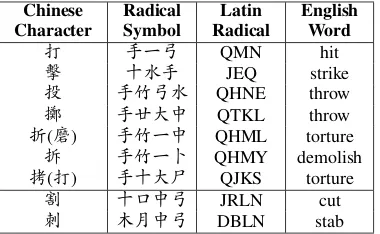
[image:3.595.88.278.62.179.2]割 十口中弓 JRLN cut 刺 木月中弓 DBLN stab Table 1: Attack event triggers. The radical “手” (Q, hand) frequently appears in the attack event triggers. Radicals “中 弓(刀)” (LN, knife) appear frequently when events are asso-ciated with actions that are performed with a knife
English trigger words for attack events and only 160 unique words in their Chinese translations. Therefore if an English trigger word is not in the training data, the model might still recognise the trigger if it has seen the Chinese translation before.
Logogram character features (char) Chi-nese and JapaChi-nese logograms are compositions of one or more characters defining their meanings. Therefore, different words representing the same event often contain similar characters. There are 195 unique Chinese characters for the attack event triggers in the corpus. The most frequently ap-pearing characters are “擊” (strike, attack), “戰” (war, fight), “殺” (kill), “爭” (fight, dispute), and
“炸” (bomb, explode).
Logogram Cangjie features (Cangjie) Chi-nese and JapaChi-nese characters can be further de-composed to smaller components called radicals. Certain radicals are more commonly found for a particular event type (Table1). Cangjie is one of the methods to decompose Chinese characters. It was designed to use on computers with QWERTY keyboards so the radicals can be easily stored, in-dexed and searched by most computer systems. In addition to word and character features, we com-pute Cangjie features for logographic languages.
Stem features (stem) For many languages character and radical features cannot be generated. We generate stem features in addition to the word features where available. We use the NLTK Snow-ball stemmer for German, Spanish, Finnish, Hun-garian, Dutch and Russian; and the NLTK ISRI stemmer for Arabic. By including a range of lan-guages, we hope to separate the effect of syllabic from semantic components of logograms.
3.2 Translation Alignment
Translated language features require each English word to be aligned to one in the translated sen-tence. We use the translation service obtain all possible translations of a given English word, e.g.:
EN attack
ZH 進攻,砰擊,發作,攻擊,攻打,掊擊,抨擊, ... ES acometida, ataque contra, agresi´on, ...
(2)
If one of these is in the translated sentence, then an alignment is made. If not, then we use the most likely word translation (underlined above).
4 Experiments
We use the TAC KBP 2015 English event nugget data (Ellis et al., 2015) for the experi-ments. Development experiments use the train-ing data (LDC2015E73) and the evaluation data (LDC2015R26) is held out for final results. The development corpus contains a total of 158 docu-ments from two genres: 81 newswire docudocu-ments and 77 discussion forum documents. We split this into 80% for training and 20% for development testing. We use Google Translate to obtain sen-tence and word translations into target languages and derive translated language features to help with the English task. Evaluation uses the offi-cial scorer from the shared task, where a trigger is counted as correct if both the trigger span and its event subtype are correctly identified.
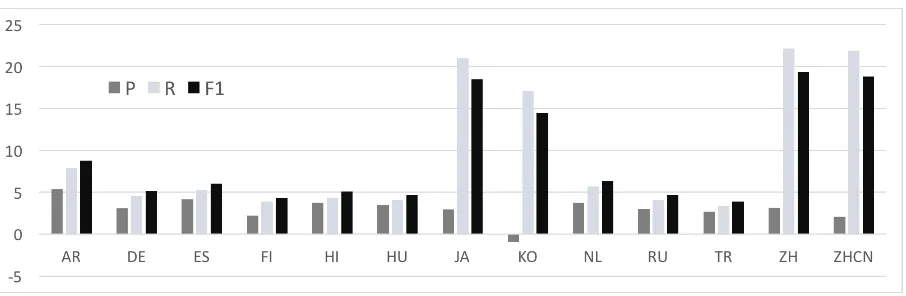
Comparing languages First, we explore how translated language features perform across the thirteen languages. Figure 1 shows how much each target language improves BASE on devel-opment data. We include all word, stem, charac-ter and Cangjie features as available for each lan-guage. Chinese, Japanese and Korean stand out, with improvements as high as 19.17 points f-score due mostly to large increases in recall. These re-sults suggest that languages with writing systems that facilitate easy decomposition into meaningful subword features are particularly useful.
Figure 1: Effect of individual languages on development data, showing the difference in precision, recall and F1 compared to the BASE scores of 55.16, 20.62 and 30.02. AR:Arabic, DE:German, ES:Spanish, FI:Finnish, HI:Hindi, HU:Hungarian, JA:Japanese, KO:Korean, NL:Dutch, RU:Russian, TR:Turkish, ZH:Chinese (Simplified), ZHCN:Chinese (Traditional).
Error analysis We explore characteristic er-rors for BASE+LEX versus BASE+TRANS for the attack event on evaluation data. We ran-domly sample twenty instances where one is cor-rect and the other is incorcor-rect. Of six LEX FN er-rors, two are triggers not seen in the training data, e.g., ‘wages’ (Transfer-Money), and ‘resignation’ (End-Position). In other cases, there seem to be too few training instances, e.g., ‘pardoning’ ( Par-don) only appears once in the training data. The TRANS FN error is due to a bad translation in which ‘strike’ (Attack) is a translated to the ‘work stoppage’ sense instead of the ‘forceful hit’ sense. For both systems, most FP errors correspond to cases with challenging ambiguity. For instance, both systems label ‘appeal’ as Justice.Appeal
event in two sentences where the word ‘appeal’ means ‘ask for aid’, instead of ‘taking a court case to a higher court’. The translation was incorrect in this case. Similarly, ‘report’ appears six times in the training data as three different event types (Broadcast,Correspondence,Move-Person).
Long-tail generalisation Table 2 shows type-level results for BASE+LEX and BASE+TRANS compared to BASE alone. The generalisation fea-ture sets outperform the baseline for all but three of the 38 event types. For Pardon, BASE ob-tains 97 F1 so there is little room for improve-ment. For Execute, LEX features have no ef-fect while TRANS doubles BASE F1. Contact
is the only type where generalisation features are harmful. Ignoring ties, BASE+TRANS performs best on more types (13) than BASE+LEX (11). TRANS appears to help more with long-tail en-tity types that have fewer training instances (e.g.,
Bankruptcy, Appeal, Born). Encouragingly, this
Type Trn Tst BA LX TR
Attack 547 253 29 60 58
Move-Person 390 127 15 37 33
Transfer-Money 366 185 18 35 49
Die 357 157 45 63 66
Broadcast 305 112 14 20 16
Contact 260 77 29 24 23
Transfer-Ownership 234 46 9 20 34
Meet 221 23 15 44 38
Pardon 221 18 97 97 95
Arrest-Jail 208 79 54 70 71
Convict 173 49 71 74 81
End-Position 130 79 18 51 55
Extradite 62 1 0 0 100
Execute 51 15 12 12 24
Release-Parole 45 28 0 87 95
Bankruptcy 30 3 0 50 89
Appeal 25 12 0 57 92
[image:4.595.310.523.269.460.2]Born 13 6 0 22 40
Table 2: Comparing instance count in training (Trn) and test (Tst) to F1 for BASE (BA), LEX (LX) and TRANS (TR).
analysis also suggests that LEX and TRANS can be complementary, with LEX doing particularly well on some types (e.g., Trial-Hearing, Corre-spond) and TRANS doing particularly well on oth-ers (e.g.,Transfer-Money,Release-Parole).
5 Final Results and Discussion
System P R F
BASE 60.4 24.1 34.4
BASE+LEX 66.8 42.6 52.0
BASE+TRANS 59.6 45.8 51.8
BASE+LEX+TRANS 67.9 46.2 55.0 TAC 2015 medians 61.7 40.7 48.8
TAC 2015 #1 75.2 47.7 58.4
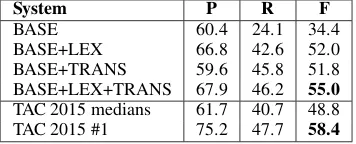
Table 3: Final results comparing translated language fea-tures (TRANS) to benchmark lexical generalisation feafea-tures (LEX). BASE+LEX is our implementation of the core Hong et al. classifier. TAC KPB 2015 #1 corresponds to reported re-sults for Hong et al. including semi-supervised learning. TAC KPB 2015 shared task has 38 runs submitted from 14 teams.
This is 20.6 points higher than the baseline fea-tures alone, and improves both the precision of LEX and the recall of TRANS.
The main appeal of the approach here is that translated character and radical features are easy to obtain using off-the-shelf tools. This provides a simple technique to capture semantic information and leverage the word sense disambiguation en-coded in translation models trained over very large datasets. Given the positive results here, we plan to explore translation and alignment strategies to improve precision. We also plan to quantify the effect of different translation systems and system change over time.
6 Conclusion
We described an event detection system leverag-ing features from off-the-shelf automatic transla-tion to improve generalisatransla-tion to new data. Chi-nese, Japanese and Korean prove especially useful as they provide natural decomposition into infor-mative subword features, i.e., characters (Chinese and Japanese), radicals (Chinese and Japanese) and syllables (Korean). None of the nine other lan-guages explored provide similar levels of natural decomposition and none provided additional ben-efit. The best system includes Chinese, Japanese and Korean character features. These translated language features improve f-score by 3 points on top of the English-only generalisation features from WordNet, Nomlex and Brown clusters.
Acknowledgments
We wish to thank Will Radford and the anonymous reviewers for their helpful feedback. This research is funded by the Capital Markets Co-operative Re-search Centre. Ben Hachey is the recipient of an Australian Research Council Discovery Early Ca-reer Researcher Award (DE120102900).
References
Colin Bannard and Chris Callison-Burch. 2005.
Paraphrasing with bilingual parallel corpora.
In Annual Meeting of the Association for
Computational Linguistics. pages 597–604.
https://doi.org/10.3115/1219840.1219914.
Peter F. Brown, Peter V. deSouza, Robert L. Mer-cer, Vincent J. Della Pietra, and Jenifer C. Lai. 1992. Class-based n-gram models of natural language. Computational Linguistics 18(4):467– 479. http://www.aclweb.org/anthology/J/J92/J92-4003.pdf.
Joe Ellis, Jeremy Getman, Dana Fore, Neil Kuster, Zhiyi Song, Ann Bies, and Stephanie Strassel. 2015. Overview of linguistic resources for the TAC KBP 2015 evaluations: Methodologies and results. In
Text Analysis Conference.
Yu Hong, Di Lu, Dian Yu, Xiaoman Pan, Xiaobin Wang, Yadong Chen, Lifu Huang, and Heng Ji. 2015. RPI BLENDER TAC-KBP2015 system de-scription. InText Analysis Conference.
Heng Ji. 2009. Cross-lingual predicate cluster acquisition to improve bilingual event extrac-tion by inductive learning. In NAACL Work-shop on Unsupervised and Minimally Supervised
Learning of Lexical Semantics. pages 27–35.
http://www.aclweb.org/anthology/W09-1704.
Alexandre Klementiev and Dan Roth. 2006. Weakly supervised named entity transliteration and discov-ery from multilingual comparable corpora. In
International Conference on Computational Lin-guistics and Annual Meeting of the Association
for Computational Linguistics. pages 817–824.
https://doi.org/10.3115/1220175.1220278.
LDC. 2015. Rich ERE Annotation Guidelines
Overview. Linguistic Data Consortium. Version
4.1. Accessed 14 November 2015 from http: //cairo.lti.cs.cmu.edu/kbp/2015/ event/summary_rich_ere_v4.1.pdf.
Els Lefever and Veronique Hoste. 2010. SemEval-2010 task 3: Cross-lingual word sense disambiguation. In International
Work-shop on Semantic Evaluation. pages 15–20.
http://www.aclweb.org/anthology/S10-1003.
Peifeng Li, Guodong Zhou, Qiaoming Zhu, and Li-bin Hou. 2012. Employing compositional seman-tics and discourse consistency in chinese event ex-traction. In Joint Conference on Empirical Meth-ods in Natural Language Processing and
Compu-tational Natural Language Learning. pages 1006–
1016.http://www.aclweb.org/anthology/D12-1092.
Catherine Macleod, Ralph Grishman, Adam Meyers, Leslie Barrett, and Ruth Reeves. 1998. Nomlex: A lexicon of nominalizations. InEuralex International
[image:5.595.93.271.63.135.2]George A. Miller. 1995. Wordnet: A lexical database for english.Commun. ACM38(11):39–41.
https://doi.org/10.1145/219717.219748.
Teruko Mitamura and Eduard Hovy. 2015.
TAC KBP Event Detection and
Corefer-ence Tasks for English. Version 1.0.
Ac-cessed 14 November 2015 from http: //cairo.lti.cs.cmu.edu/kbp/2015/ event/Event_Mention_Detection_and_ Coreference-2015-v1.1.pdf.
Erik F. Tjong Kim Sang and Jorn Veenstra. 1999.
Representing text chunks. In Conference of the European Chapter of the Association for
Computational Linguistics. pages 173–179.
https://doi.org/10.3115/977035.977059.
Joseph Turian, Lev-Arie Ratinov, and Yoshua Ben-gio. 2010. Word representations: A simple and general method for semi-supervised
learn-ing. In Annual Meeting of the Association
for Computational Linguistics. pages 384–394.
http://www.aclweb.org/anthology/P10-1040.
Xiaojun Wan. 2008. Using bilingual knowl-edge and ensemble techniques for unsupervised Chinese sentiment analysis. In Proceedings of the Conference on Empirical Methods in
Natural Language Processing. pages 553–561.
http://www.aclweb.org/anthology/D08-1058.
Zhu Zhu, Shoushan Li, Guodong Zhou, and Rui Xia. 2014. Bilingual event extraction: a case study on trigger type determination. InAnnual Meeting of the
Association for Computational Linguistics. pages