Evaluation of Morphometric Parameters—A Remote
Sensing and GIS Based Approach
Syed Ahmad Ali, Nazia Khan
Department of Geology, Aligarh Muslim University, Aligarh, India. Email: [email protected]
Received November 12th, 2012; revised December 25th, 2012; accepted January 8th, 2013
ABSTRACT
Land and water resources are generally depleting due to rapid increase in population, urbanization and industrialization. The demand has increased tremendously for these resources; hence optimal utilization of them is essential for sustain- able development. In the present study, detailed morphometric parameters of the Banas river basin has been carried out. The river Banas originating from the Khamnor hills of the Aravalli ranges (about 5 kms from Kumbalgarh) is one of the major rivers of the state which, in its entire course, flows through Rajasthan. It flows from Kumbalgarh towards the south upto Gogunda plateau and after cutting the Aravalli ranges at right angles, it flows through Nathdwara, Ra-jsamand and Railmagra. The total area of the Banas river basin is 702.55 km2. Detailed drainage map was prepared from SOI (Survey of India) toposheets (45h/5 and 45h/9) and was updated using IRS-P6, LISS-III (Precision geocoded) data of 7th May, 2010 using ARC GIS software. For detailed study, Shuttle Radar Topographic Mission (SRTM) was used for delineating watershed boundary using SAGA GIS software. GIS techniques has been used for assessing vari- ous morphometric characteristics of the drainage basin, as they provide a flexible environment and a powerful tool for the manipulation and analysis of spatial information particularly for the feature identification and extraction of informa- tion for better understanding. In the present study, the GIS analysis techniques were used to evaluate linear and areal morphometric parameters of the basin. Drainage patterns are mainly dendritic to sub-dendritic with fifth order drainage. Banas river basin possess high drainage density which is indicative of less permeable material, sparse vegetative cover and moderate to high relief.
Keywords: Morphometric Characteristics; SRTM; Drainage Density; GIS
1. Introduction
Groundwater is the main source of water that meets the agricultural, industrial and household requirements. The morphometric analysis is important for any hydrological investigations like assessment of groundwater potential, groundwater management, pedology and environmental assessment [1].
Morphometry is the measurement and mathematical analysis of the configuration of the earth’s surface, shape and dimension of its landforms [2]. This analysis can be achieved through measurement of linear, aerial and relief aspects of the basin and slope contribution Nag and Chakraborty [3], Ali [4].
Morphometric analysis provides quantitative descrip- tion of the basin geometry to understand initial slope or inequalities in the rock hardness, structural controls, re- cent diastrophism, geological and geomorphic history of drainage basin [5]. The morphometric study involves the evaluation of stream parameters through the measure- ments of various stream properties Kumar et al. [6],Ali
et al. [7], Ali et al. [8], Pirasteh et al. [9].
Remote sensing techniques using satellite images are convienient tools for morphometric analysis. The satellite remote sensing has the ability to provide synoptic view of large area and is very useful in analyzing drainage morphometry. The image interpretation techniques are less time consuming than the ground surveys, which cou- pled with limited field checks yield valuable results.
2. Study Area
Evaluation of Morphometric Parameters—A Remote Sensing and GIS Based Approach 21
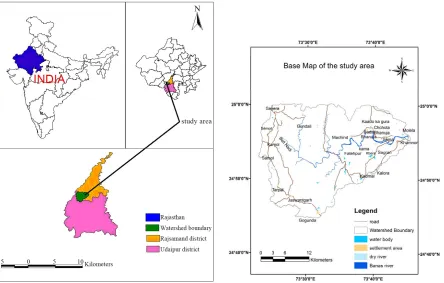
[image:2.595.80.524.85.368.2]Figure 1. Location map of the study area.
minimum is 8.3˚C. Monsoon arrives in the month of July heralded by dust and thunderstorms. It annually receives around 637 mm of rainfall. This scanty amount of rain- fall makes more humid. The humidity reaches to the ex- tent of 90 percent during the month of monsoons.
The river Banas originating from the Khamnor hills of the Aravalli ranges (about 5 kms from Kumbalgarh) is one of the major rivers of the state which, in its entire course, flows through Rajasthan. It flows from Kumbal- garh towards the south upto Gogunda plateau and after cutting the Aravalli ranges at right angles, it flows through Nathdwara, Rajsamand and Railmagra. The river collects the major run-off of Udaipur, Chittorgarh and Bhilwara district by the tributary Berach. This river usu- ally dries up during the summer season. The total length of this river is about 480 kms and its main tributaries are Berach, Khari Dai, Mashi, Dundh and Morel. The river Banas as well as tributaries are ephemeral and flow only in response to heavy precipitation.
3. Geology of the Area
The ultramafic rocks in the Aravalli Supergroup occur only in the belt south of Nathdwara. The ultramafic rocks also occur as thin conformable bands within quartzite, phyllite and mica-schists in the Jharol belt between Gogunda (24˚46':73˚32') and Jharol (24˚24':73˚29'). Li- thologically, the ultramafic rocks are represented by talc- chlorite (antigorite) schist and serpentinite with variable
proportions of actinolite-tremolite, talc-tremolite, asbes- tos and dolomite. Magnetite (as well as chrome spinel) is a common accessory mineral.
4. Materials and Methods
Survey of India (SOI) topographic map on 1:50,000 scale bearing No. 45H/5 and 45H/9 was obtained from Survey of India, Dehradun has been used for drainage map and was updated using IRS P6, LISS III (Precision geocoded) data of 7th May, 2010. The important informa- tion on elevation, watershed boundary, contour lines, major roads, villages or towns and railway networks were extracted from the toposheet and a base map was generated.
The present study utilized digital data of Indian Re-mote Sensing (IRS P6) LISS III (Path-93 and Row-54) of 7th May, 2010 having a spatial resolution of 23.5 metre was procured from National Remote Sensing Centre, Hyderabad and a standard FCC was generated. For de- tailed study, Shuttle Radar Topographic Mission (SRTM) was used for delineating watershed boundary using SAGA GIS software.
5. Morphometric Analysis
Morphometric parameters have been classified into 1) Linear aspect;
2) Areal aspect.
Linear aspect include Stream order (U), Stream num- ber (Nu), Stream length (Lu), Mean stream length (Lsm), Stream length ratio (RL) and Bifurcation ratio (Rb). Areal aspects include drainage density (D), Stream fre-quency (Fs), Drainage texture (Rt), Circularity ratio (Rc), Elongation ratio (Re), Length of overland flow (Lg), Constant of channel maintenance (C) and infilteration number.
5.1. Linear Aspects
Linear aspects include stream order, stream number stream length, mean stream length, stream length ratio, and bifurcation ratio and are discussed below:
5.1.1. Stream Order (U)
Stream Order (U) expresses the hierarchal relationship between the individual stream segments that make up a drainage network. The first step in drainage basin analy- sis is the designation of stream orders, following a sys- tem introduced by [10]. The streams have been ranked following [5] stream ordering system based on hierarchic ranking of streams. In the [11], a stream segment with no tributaries is a first-order stream, a second-order stream is formed by joining of two first-order streams, where two second-order streams join, the stream is designated as third-order, and so forth.
Stream order of the whole Banas river basin is of fifth order (Figure 2(a)).
5.1.2. Stream Number (Nu)
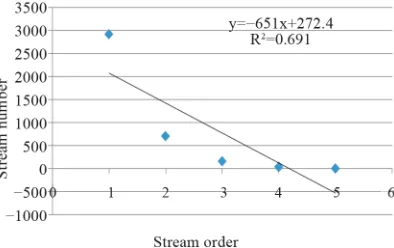
The details of stream characteristics conform to [12] “law of stream numbers” which states that the number of streams of different orders in a given drainage basin tends closely to approximate an inverse geometric ratio. According to Horton’s principle the number of streams is negatively correlated with the order, i.e. stream number decreases with increase in stream order (Figure 2(a)).
Stream number (Nu) here supports Horton’s law i.e.
stream number decrease with increase in stream order in this basin (Figure 3).
5.1.3. Stream Length (Lu)
The stream length characteristics of the basin conform [10] second “law of stream length”, which states that the average length of streams of each order in a drainage basin tends closely to approximate a direct geometric ratio. The numbers of streams of various orders in the basin are counted and their lengths are measured. In gen- eral, the total length of stream segments decreases with
increasing stream order (Figure 2(b)).
(a)
(b)
(c)
[image:3.595.320.523.101.555.2]Figure 2. (a) Stream order, stream number; (b) Stream length; (c) Mean stream length.
[image:3.595.325.522.593.717.2]Evaluation of Morphometric Parameters—A Remote Sensing and GIS Based Approach 23
5.1.4. Mean Stream Length (Lsm) The stream length ratio of the Banas river basin ranges from 0.32 - 0.51. The stream length ratio (RL) between streams of different orders reveals variation in Banas river basin. This may be attributed to variation in slope and topography.
The mean stream length (Lsm) of a channel is a dimen- sional property revealing the characteristic size of com- ponents of a drainage network and its contributing basin surfaces [5]. In general, mean length of channel segments of a given order is greater than that of the next lower
order but less than the next higher order (Figure 2(c)). 5.1.6. Bifurcation Ratio (Rb)
Mean stream length of Banas river basin reveals an in- creasing trend with the increase in stream order (Figure 4).
This is a dimensionless parameter that expresses the ratio of the number of streams of any given order (Nu) to the number in the next lower order [10,13]. [10] considered bifurcation ratio as an index of relief and dissections. [14] demonstrated that bifurcation ratio shows a small range of variation for different regions or for different envi- ronment except where the powerful geological control dominates. If bifurcation ratio is not same from one order to its next order, then these irregularities are attributed to geological and lithological development of a drainage basin [5]. Bifurcation ratio is an important parameter that expresses the degree of ramification of drainage network [15].
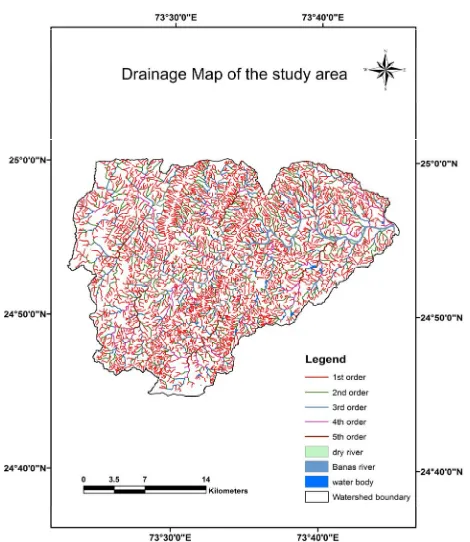
The whole Banas river basin is of fifth order. The drainage pattern of the study area is predominantly den- dritic to sub-dendritic in nature (Figure 5).
5.1.5. Stream Length Ratio (RL)
Stream length ratio (RL) may be defined as the ratio of the mean length of an order to the next lower order of stream segment.
[image:4.595.74.270.302.414.2]Since bifurcation ratio is a dimensionless property, and drainage systems in homogeneous materials tend to dis- play geometrical similarity, it shows a small variation from region to region [16]. The lower values of bifurca-tion ratio are characteristics of the watersheds which have suffered less structural disturbances [17]. Whereas higher bifurcation ratio is the result of large variation in frequencies between successive orders and indicates a mature topography [18].
Figure 4. Plots of stream order vs mean stream length.
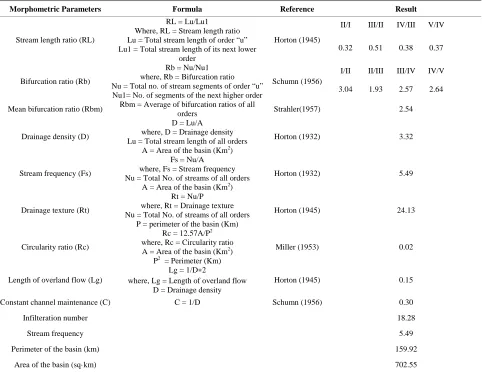
The bifurcation ratio of the Banas river basin ranges from 1.93 to 3.04 and its mean bifurcation ratio is 2.54 which falls under normal basin category (Table 1).
5.2. Areal Aspects
Areal aspects include drainage parameters such as drain- age density, stream frequency, drainage texture, circular- ity ratio, length of overland flow and constant of channel maintenance which is discussed below.
5.2.1 Drainage Density (D)
Drainage density is defined as the cummulative length of all streams in a basin divided by the area of the basin [19]. It is a measure of average length of streams per unit drainage area, and describes the spacing of drainage channels. Drainage density has been interpreted to reflect the interaction between climate and geology [20]. [12] introduced drainage density as an expression to indicate the closeness of spacing of channels. Thus, drainage den- sity is the ratio of total channel segment lengths cumu- lated for all orders within a basin to the basin area [16]. It is considered as an important indicator of the linear scale of land form elements in stream eroded topography. Density factor is related to climate, lithology, relief, in- filtration capacity, vegetative cover, surface roughness
[image:4.595.55.290.438.709.2]Table 1. Results of parameters of morphometric analysis of Banas river basin.
Morphometric Parameters Formula Reference Result
II/I III/II IV/III V/IV
Stream length ratio (RL)
RL = Lu/Lu1 Where, RL = Stream length ratio Lu = Total stream length of order “u” Lu1 = Total stream length of its next lower
order
Horton (1945)
0.32 0.51 0.38 0.37
I/II II/III III/IV IV/V
Bifurcation ratio (Rb)
Rb = Nu/Nu1 where, Rb = Bifurcation ratio Nu = Total no. of stream segments of order “u” Nu1= No. of segments of the next higher order
Schumn (1956)
3.04 1.93 2.57 2.64
Mean bifurcation ratio (Rbm) Rbm = Average of bifurcation ratios of all
orders Strahler(1957) 2.54
Drainage density (D)
D = Lu/A where, D = Drainage density Lu = Total stream length of all orders
A = Area of the basin (Km2)
Horton (1932) 3.32
Stream frequency (Fs)
Fs = Nu/A where, Fs = Stream frequency Nu = Total No. of streams of all orders
A = Area of the basin (Km2)
Horton (1932) 5.49
Drainage texture (Rt)
Rt = Nu/P where, Rt = Drainage texture Nu = Total No. of streams of all orders
P = perimeter of the basin (Km)
Horton (1945) 24.13
Circularity ratio (Rc)
Rc = 12.57A/P2
where, Rc = Circularity ratio A = Area of the basin (Km2)
P2 = Perimeter (Km)
Miller (1953) 0.02
Length of overland flow (Lg)
Lg = 1/D*2
where, Lg = Length of overland flow D = Drainage density
Horton (1945) 0.15
Constant channel maintenance (C) C = 1/D Schumn (1956) 0.30
Infilteration number 18.28
Stream frequency 5.49
Perimeter of the basin (km) 159.92
Area of the basin (sq·km) 702.55
and run-off index. Out of which only surface roughness has no significant correlation with drainage density.
The amount and type of precipitation influences di- rectly the quantity and character of surface run-off. An area with high precipitation such as thundershowers loses greater percentage of rainfall as run-off, resulting in more surface drainage channels. Density of vegetation and rainfall absorption capacity of soils, influence the rate of surface run-off and affects the drainage texture of an area. [21] recognized significance of drainage density as a factor determining the time of travel by water and stated that drainage density values between 0.55 and 2.09 km/km2 correspond to humid regions. [17] found that low drainage density generally results in areas of highly resistant rocks or permeable subsoil material, dense vegetation and low relief. High drainage density results due to weak or impermeable subsurface material, sparse vegetation and mountainous relief. Low drainage density leads to coarse drainage texture whereas high drainage density leads to fine drainage texture.
Banas river basin possess high drainage density i.e.
3.32 km/km2 which is indicative of less permeable mate- rial, sparse vegetative cover and moderate to high relief (Table 1).
5.2.2. Stream Frequency (Fs)
[12] introduced stream frequency (Fs) or channel fre- quency as the ratio of total number of stream segments of all orders to the basin area. [22] found that lower Fs val- ues indicate permeable sub-surface material and low re- lief, whereas higher values are the characteristic of resis- tant sub-surface material, sparse vegetation and high re- lief.
The stream frequency of the Banas river basin is 5.49 (Table 1).
5.2.3. Drainage Texture (Rt)
Evaluation of Morphometric Parameters—A Remote Sensing and GIS Based Approach 25
number of stream segments of all orders divided by the perimeter of the watershed. He also recognized infiltra- tion capacity as the dominant factor influencing drainage texture which includes drainage density and stream fre- quency as well. Drainage texture (Rt) depends upon a number of natural factors such as climate, rainfall, vege- tation, lithology, soil type, infiltration capacity, relief and stage of development [23]. [23] classified drainage den- sity into five different classes of drainage texture, i.e. less than 2, indicates very coarse, between 2 and 4 is coarse, between 4 and 6 is moderate, between 6 and 8 is fine and greater than 8 is very fine drainage texture. The soft or weak rocks devoid of vegetation generally exhibit a fine texture, whereas in massive and resistant rocks coarse drainage texture is developed.
The Banas river basin has a value of 24.137 which falls under very fine drainage texture (Table 1). Sparse vegetation in arid climate causes finer texture than in humid climate.
5.2.4. Circularity Ratio (Rc)
[24] and [5], defined circularity ratio (Rc), as the ratio of the area of the basin (A) to the area of a circle having the same circumference as the perimeter (P) of the basin. Circularity ratio (Rc) is influenced by the length and frequency of streams, geological structures, land use/land cover, climate, relief and slope of the basin [25].
The circularity ratio of the Banas river basin is 0.02 (Table 1). This value is an indicative of the lack of cir- cularity.
5.2.5. Length of Overland Flow (Lg)
[10], defined length of overland flow (Lg) as the length of water over the ground before it gets concentrated into definite stream channels. He considered it as one of the most important independent variables affecting hydro- logic and physiographic development of drainage basins. The average length of overland flow is approximately half the average distance between stream channels and is therefore approximately equals to half of reciprocal of drainage density [10].
The value of Length of Overland Flow of the basin is 0.15 (Table 1).The value is equals to the half of the con- stant of channel maintenance.
5.2.6. Infilteration Number
Infilteration number is the product of the drainage den- sity and stream frequency of the basin. The infilteration number of the basin is 18.28 (Table 1) indicating low infilteration and high run-off.
5.2.7. Constant of Channel Maintenance (C)
[13] has used inverse of drainage density as another pa- rameter called constant of channel maintenance (C), de-
fined in units of square feet per foot. It has dimensions of length and therefore increases in magnitude as the scale of the landform units increases. In short, it measures the number of square feet of watershed surface area required to sustain one linear foot of channel.
The Constant of Channel Maintenance of the basin is 0.30 (Table 1). This low value indicates high structural disturbances, low permeability, steep to very steep slopes and high surface run off.
6. Result and Discussion
The whole Banas river basin is of fifth order. The drain- age pattern of the study area is predominantly dendritic to sub-dendritic in nature. Stream number of the basin decreases with increase in stream order i.e. first order has 2928 number of streams whereas fifth order has 1, sup- ports Horton’s Law. The total length of stream segments decreases with increase in stream order. First order has stream length of 1470.48 kms whereas fifth order has stream length of 36.69 kms. Mean stream length of Ba- nas watershed reveals an increasing trend with the in- crease in stream order i.e. first order has mean stream length of 0.50 kms whereas fifth order has mean stream length of 4.58 kms. The stream length ratio of the Banas river basin ranges from 0.32 - 0.51. The stream length ratio (RL) between streams of different orders reveals variation in Banas river basin. This may be attributed to variation in slope and topography. The bifurcation ratio of the Banas river basin ranges from 1.93 to 3.04 and its mean bifurcation ratio is 2.54 which falls under normal basin category. High drainage density (3.32 km/km2) indicates less permeable material, sparse vegetative cover and moderate to high relief in the basin. The Banas river basin has a value of 24.137 which falls under very fine drainage texture (Table 1).
7. Conclusion
able material, sparse vegetative cover and moderate to high relief. Circularity and elongation ratio shows that the basin has elongated shaped.
8. Acknowledgements
The financial support from UGC in the form of Maulana Azad National Fellowship for minority (2011-2012) is thankfully acknowledged by one of the author (Ms. Na- zia Khan). Thanks are also due to Heena Parveen and Bhuvnesh Kumar Gupta for their help and co-operation during the field work.
REFERENCES
[1] G. Mahadevaswamy, D. Nagaraju, S. Lakshmamma, M. S. Lone, P. C. Nagesh and R. Krishna, “Morphometric Ana- lysis of Nanjangud Taluk, Mysore District, Karnataka, India, Using GIS Techniques,” International Journal of Geomatics and Geosciences, Vol. 1, No. 4, 2011, pp. 721- 734.
[2] J. I. Clarke, “Morphometry from Maps. Eassys in Geo- morphology,” Elsevier Publishing Company, New York, 1966, pp. 235-274.
[3] S. K. Nag and S. Chakraborty, “Influences of Rock Types and Structures in the Development of Drainage Network in Hard Rock Area,” Journal of Indian Society Remote Sensing, Vol. 31, No. 1, 2003, pp. 25-35.
doi:10.1007/BF03030749
[4] S. A. Ali, “Morphometric Analysis of the Hiyunl River Basin at Rishikesh, Garhwal Himalayas, India,” Proceed- ings of the IX Asian Conference on Remote Sensing, Bang- kok, 23-29 November 1988, pp. B-9-1-B-9-8.
[5] A. N. Strahler, “Quantitative Geomorphology of Drainage Basins and Channel Networks,” In: V. T. Chow, Ed.,
Handbook of Applied Hydrology, McGraw-Hill Book
Company, New York, 1964, Section 4-11.
[6] R. Kumar, S. Kumar, A. K. Lohni, R. K. Neema and A. D. Singh, “Evaluation of Geomorphological Characteristics of a Catchment Using GIS,” GIS India, Vol. 9, No. 3, 2000, pp. 13-17.
[7] S. A. Ali, K. Rangzen and S. Pirasteh, “Use of Digital Elevation Model for Study of Drainage Morphometry and Identification of Stability and Saturation Zones in Rela- tions to Landslide Assessments in Parts of Shahbazan Area, Zagros Belt, SW Iran,” Cartography, Vol. 32, No. 2, 2003, pp. 162-169.
[8] S. A. Ali and S. Pirasteh, “Evaluation of Ground Water Potential Zones in Parts of Pabdeh Anticline, Zagros Fold Belt, SW Iran,” Water, Ethiopian Journal of Water Sci- ence and Technology, Vol. 9, No. 1, 2005, pp. 92-97.
[9] S. Pirasteh, S. A. Ali and H. S. Hussaini, “Morphmetric and Structural Analysis in Zagros Mountains, Southwest Iran—An Application of Geo-Information Technology,” Journal of Geomatics, Vol. 1, No. 2, 2007, pp. 39-44.
[10] R. E. Horton, “Erosional Development of Streams and Their Drainage Basins: Hydrophysical Approach to Quan- titative Morphology,” The Geological Society of America,
Vol. 56, No. 3, 1945, pp. 275-370.
doi:10.1130/0016-7606(1945)56[275:EDOSAT]2.0.CO;2 [11] A. N. Strahler, “Hypsometric Analysis of Erosional To-
pography,” Bulletin of the Geological Society of America, Vol. 63, No. 11, 1952, pp. 1117-1142.
doi:10.1130/0016-7606(1952)63[1117:HAAOET]2.0.CO ;2
[12] R. E. Horton, “Drainage Basin Characteristics,” Transac- tions of American Geophysical Union, Vol. 13, 1932, pp. 350-361. doi:10.1029/TR013i001p00350
[13] S. A. Schumn, “Evolution of Drainage Systems and Slopes in Badlands at Perth Amboy, New Jersey,” Bulletin of the Geological Society of America, Vol. 67, No. 5, 1956, pp. 597-646.
doi:10.1130/0016-7606(1956)67[597:EODSAS]2.0.CO;2 [14] A. N. Strahler, “Quantitative Analysis of Watershed Geo-
morphology,” Transactions of American Geophysical Un- ion, Vol. 38, 1957, pp. 913-920.
doi:10.1029/TR038i006p00913
[15] L. M. Mesa, “Morphometric Analysis of a Subtropical Andean Basin (Tucuman, Argentina),” Environmental Ge- ology, Vol. 50, No. 8, 2006, pp. 1235-1242.
doi:10.1007/s00254-006-0297-y
[16] “Handbook of Applied Hydrology,” In: V. T. Chow, Ed., McGraw-Hill Book Company, New York, 1964.
[17] S. K. Nag, “ Morphometric Analysis Using Remote Sens- ing Techniques in the Chaka Sub Basin, Purulia District, West Bengal,” Journal of the Indian Society of Remote Sensing, Vol. 26, No. 1-2, 1998, pp. 69-76.
doi:10.1007/BF03007341
[18] P. D. Sreedevi, K. Subrahmanyam and S. Ahmed, “The Significance of Morphometric Analysis for Obtaining Groundwater Potential Zones in a Structurally Controlled Terrain,” Environmental Geology, Vol. 47, No. 3, 2004, pp. 412-420. doi:10.1007/s00254-004-1166-1
[19] A. N. Strahler, “Dimensional Analysis Applied to Fluvi- ally Eroded Landforms,” Geological Society of America Bulletin, Vol. 69, No. 3, 1958, pp. 279-300.
doi:10.1130/0016-7606(1958)69[279:DAATFE]2.0.CO;2 [20] F. E. Ritter and N. P. Major, “Useful Mechanisms for
Developing Simulations for Cognitive Models,” AISB Quarterly, Vol. 91, 1995, pp. 7-18.
[21] W. B. Langbein, “Topographic Characteristics of Drain- age Basins,” US Geological Survey, Water-Supply Paper, No. 956-C, 1947, pp. 125-157.
[22] G. P. Obi Reddy, A. K. Mji, G. R. Chary, C. V. Srinivas, P. Tiwary and K. S. Gajbhiye, “GIS and Remote Sensing Applications in Prioritization of River Sub Basins Using Morphometric and USLE Parameters—A Case Study,” Asian Journal of Geoinformatics, Vol. 4, No. 4, pp. 35- 50.
[23] K. G. Smith, “Standards for Grading Texture of Erosional Topography,” American Journal of Science, Vol. 248, 1954, pp. 655-668. doi:10.2475/ajs.248.9.655
Evaluation of Morphometric Parameters—A Remote Sensing and GIS Based Approach 27
lumbia University, New York, 1953.
[25] R. Chopra, R. D. Diman and P. K. Sharma, “Morphomet- ric Analysis of Sub-Watershed in Gurdaspur District, Pun-