89
Ranking-Based Automatic Seed Selection and Noise Reduction for Weakly
Supervised Relation Extraction
Van-Thuy Phi1,Joan Santoso2,Masashi Shimbo1andYuji Matsumoto1,3
1Nara Institute of Science and Technology
2Sekolah Tinggi Teknik Surabaya
3RIKEN Center for Advanced Intelligence Project (AIP)
1{phi.thuy.ph8, shimbo, matsu}@is.naist.jp 2[email protected]
Abstract
This paper addresses the tasks of auto-matic seed selection for bootstrapping re-lation extraction, and noise reduction for distantly supervised relation extraction. We first point out that these tasks are re-lated. Then, inspired by ranking relation instances and patterns computed by the HITS algorithm, and selecting cluster cen-troids using the K-means, LSA, or NMF method, we propose methods for selecting the initial seeds from an existing resource, or reducing the level of noise in the dis-tantly labeled data. Experiments show that our proposed methods achieve a better per-formance than the baseline systems in both tasks.
1 Introduction
Bootstrapping for relation extraction (RE) (Brin, 1998;Riloff et al.,1999;Agichtein and Gravano, 2000) is a class of minimally supervised meth-ods frequently used in machine learning: initial-ized by a small set of example instances called
seeds, to represent a particular semantic relation, the bootstrapping system operates iteratively to ac-quire new instances of a target relation. Selecting “good” seeds is one of the most important steps to reduce semantic drift, which is a typical phe-nomenon of the bootstrapping process.
Another approach, called “distant supervision” (DS) (Mintz et al.,2009), does not require any la-bels on the text. The assumption of DS is that if two entities participate in a known Freebase rela-tion, any sentence that contains those two entities might express that relation. However, this tech-nique often introduces noise to the generated train-ing data. As a result, DS is still limited by the
quality of training data, and noise existing in pos-itively labeled data may affect the performance of supervised learning.
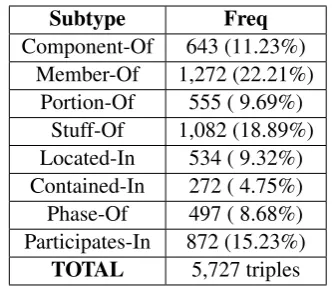
In this study, we propose methods that can be applied for both automatic seed selection and noise reduction by formulating these tasks as rank-ing problems accordrank-ing to different rankrank-ing crite-ria. Our methods are inspired by ranking instances and patterns computed by the HITS algorithm, and selecting cluster centroids using K-means, latent semantic analysis, or the non-negative matrix fac-torization method. The main contributions of this paper are (a) an annotated dataset of 5,727 part-whole relations1, which contains 8 subtypes for the bootstrapping RE system; (b) methods for au-tomatic seed selection for bootstrapping RE and noise reduction for distant supervised RE; and (c) experimental results showing that the proposed models outperform baselines on two datasets.
2 Related Work
2.1 Automatic Seed Selection for Bootstrapping RE
As manually selecting the seeds requires tremen-dous effort, some research proposed methods to select the seed automatically. Eisner and Karakos (2005) used a “strapping” approach to evaluate many candidate seeds automatically for a word sense disambiguation task. Kozareva and Hovy (2010) proposed a method for measuring seed quality using a regression model and applied it to the extraction of unary semantic relations, such as“people” and “city”. Kiso et al. (2011) sug-gested a HITS-based approach to ranking the seeds, based onKomachi et al.(2008)’s analysis of the Espresso algorithm (Pantel and Pennacchiotti,
1We release our annotated dataset at
2006).Movshovitz-Attias and Cohen(2012) gen-erated a ranking based on pointwise mutual infor-mation (PMI) to pick up the seeds from existing resources in the biomedical domain. Given the seed set of a target relation, the goal of the boot-strapping method is to find instances similar to initial seeds by harvestinginstancesandpatterns
iteratively over large corpora, e.g., Wikipedia or ClueWeb.
2.2 Noise Reduction for Distantly Supervised RE
The DS assumption is too strong and leads to wrongly labeled data that affects performance. Many studies focused on methods of noise re-duction in DS.Intxaurrondo et al.(2013) filtered out noisy mentions from the distantly supervised dataset using their frequencies, PMI, or the sim-ilarity between the centroids of all relation men-tions and each individual mention. Xiang et al. (2016) introduced ranking-based methods accord-ing to different strategies to select effective train-ing groups. Li et al.(2017) proposed three novel heuristics that use lexical and syntactic informa-tion to remove noise in the biomedical domain. The data generated by the noise reduction process can be used by supervised learning algorithms to train models.
3 Problem Formulation
LetR∗ be the set of target relations. The goal is to find instances, or pairs of entities, upon which the relation holds. For each target relation r ∈ R∗, we assume there is a set Dr of triples rep-resenting the relation r. The triples in Dr have the form (e1, p, e2), where e1 and e2 denote en-tities, andpdenotes thepattern that connects the two entities. A pair of entities (e1, e2) is called an instance. This terminology is similar to the one used in open information extraction systems, such asReverb(Fader et al.,2011). For example, in triple(Barack Obama,was born in,Honolulu),
(Barack Obama,Honolulu) is the instance, and
“was born in”is the pattern.
The two tasks we address are defined as follows:
Seed Selection for Bootstrapping RE: In au-tomatic seed selection, a set R∗ of target rela-tions and sets of instance-pattern triples Dr =
{(e1, p, e2)}representing each target relationr ∈
R∗are given as input. These triples are extracted from existing corpus or database, e.g., WordNet.
With these inputs, the task is to choosegoodseeds from the instances appearing inDr for each r ∈
R∗, such that they work effectively in bootstrap-ping RE.
Noise Reduction for Distantly Supervised RE:
In noise reduction for distantly supervised RE, the input is the target relationsR∗ and the setsDr of triples2 generated automatically by DS for each relation r ∈ R∗. Because the data is generated automatically by DS,Dr may contain noise, i.e., triples(e1, p, e2)for which relationrdoes not ac-tually hold betweene1 ande2. The goal of noise reduction is to filter out these noisy triples, so that they do not deteriorate the quality of the triple classifier trained subsequently.
Formulation as Ranking Tasks: As we can see from the task definitions above, both seed selec-tion and noise reducselec-tion are the task of selecting triples from a given collection. Indeed, the two tasks essentially have a similar goal in terms of the ranking-based perspective. We thus formulate them as the task of ranking instances (in seed se-lection) or triples (in noise reduction), given a set of (possibly noisy) triples. In the seed selection task, we use thekhighest ranked instances as the seeds for bootstrapping RE. Likewise, in noise re-duction for DS, we only use thekhighest ranked triples from the DS-generated data to train a clas-sifier. Note that the value ofkin noise reduction may be much larger than in seed selection.
4 Approaches to Automatic Seed Selection and Noise Reduction
In this section, we propose several methods that can be applied for both automatic seed selec-tion and noise reducselec-tion tasks, inspired by rank-ing relation instances and patterns computed by the HITS algorithm, and picking cluster cen-troids using the K-means, latent semantic anal-ysis (LSA), or non-negative matrix factorization (NMF) method.
4.1 K-means-based Approach
The first method we describe is a K-means-based approach. It is described as follows: (1)
De-2
To be precise, in each triple(e1, s, e2)generated by DS,
sis not a pattern but a sentence that contains entitiese1and
e2. However, we can easily convert each instance-sentence
triple (e1, s, e2) to an instance-pattern triple(e1, p, e2) by
looking for a patternpthat connects two entities in sentence
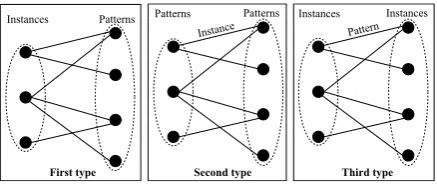
Figure 1: Graph representations of instances and patterns using the HITS algorithm.
termine the number k of instances/triples that should be selected3. (2) Run the K-means clus-tering algorithm to partition all instances in the in-put triples (see Section 3) into k clusters. Each data point is represented by the embedding vec-tor difference between its entities; e.g., the in-stance I = (Barack Obama,Honolulu) corre-sponds to: vec(I) = vec(“Barack Obama”) − vec(“Honolulu”). We use pre-trained vectors published by Mikolov et al. (2013). (3) The in-stance closest to the centroid is selected in each cluster. Given that the number of clusters isk, the same number of instances/triples will be chosen.
4.2 HITS-based Approach
Hypertext-induced topic search (HITS) (Klein-berg, 1999), also known as the hubs-and-authorities algorithm, is a link analysis method for ranking web pages. In HITS, a good hub is a page that points to many good authorities and vice versa; a good authority is a page that is pointed to by many good hubs. These hubs and authorities form abipartitegraph, where we can compute the hubness score of each node.
In our task, let A be the instance-pattern co-occurrence matrix. We can compute the hubness score for each instance on the bipartite graph of instances and patterns induced by the matrix A. Inspired by the way HITS ranks hubs and authori-ties, our HITS-based seed selection strategy can be explained as follows:(1)Determine the numberk
of triples that should be selected.(2)Build the bi-partite graph of instances and patterns based on the instance-pattern co-occurrence matrixA. Figure1 presents three possible ways of building a bipar-tite graph. For the first type of graph, we consider
3
Depending on the task, instances or triples will be se-lected: instances for the automatic seed selection task, and triples for the noise reduction task. As instances are pairs of entities which are included in triples, we can simply con-vert between the instance and the triple, and apply a proposed method to both tasks.
each instance/pattern as a node in the graph. This representation is similar to that used byKiso et al. (2011). In the second graph representation, pat-terns and instances are treated as nodes and edges, respectively. Similarly, instances and patterns are treated as nodes and edges, respectively in the last representation. (3) For the first and third types, we simply retain the top-kinstances with the high-est hubness scores as the outputs (we sort the in-stances in descending order based on their hub-ness scores). For the second type,kinstances as-sociated with the highest scoring patterns are cho-sen (we first sort the patterns in descending order based on their hubness scores).
4.3 HITS- and K-means-based Approach
In the combined method of HITS and K-means algorithms, we first rank the instances and pat-terns based on their bipartite graph and then run K-means to cluster instances in our annotated dataset. However, instead of choosing the instance nearest to the centroid, we retain the one that has the highest HITS hubness score in each cluster.
4.4 LSA-based Approach
Latent semantic analysis (LSA) (Deerwester et al., 1990) is also a widely used method for the au-tomatic clustering of data along multiple dimen-sions. Singular value decomposition (SVD) is used to construct a low-rank approximation of the instance-pattern co-occurrence matrixA. The SVD projection is performed by decomposing the matrix A ∈ RM×N into the product of three matrices, namely an SVD instance matrix I ∈
RM×K, a diagonal matrix of singular valuesS ∈ RK×K, and an SVD pattern matrixP∈RK×N:
A≈ISPT
Our LSA-based seed selection strategy is as follows: (1) Specify the desired number k of triples. (2)Use the LSA algorithm to decompose the instance-pattern co-occurrence matrixA into three matricesI,S, andP. We set the number of LSA dimensions toK = k. (3)We can consider LSA as a form of soft clustering, with each column of the SVD instance matrixI corresponding to a cluster. Then, we select thekinstances that have the highest absolute values from each column ofI.
4.5 NMF-based Approach
an-Subtype Freq
Component-Of 643 (11.23%)
Member-Of 1,272 (22.21%)
Portion-Of 555 ( 9.69%) Stuff-Of 1,082 (18.89%) Located-In 534 ( 9.32%) Contained-In 272 ( 4.75%)
Phase-Of 497 ( 8.68%)
Participates-In 872 (15.23%)
[image:4.595.97.265.60.203.2]TOTAL 5,727 triples
Table 1: Statistics of our part-whole dataset.
other method for approximate non-negative ma-trix factorization. The non-negative data mama-trix A ∈ RM×N is represented by two non-negative factors W ∈ RM×K and H ∈
RK×N, which, when multiplied, approximately reconstructA:
A≈WH
The non-negativity constraint is the main differ-ence between NMF and LSA. Similarly to the LSA-based method, we set the NMF parameterK
tok, the desired number of instances to select. We then select the k instances that have the highest values from each column ofW.
5 Experiments
5.1 Datasets and Settings
We provide an annotated dataset of part-whole re-lations as a reliable resource for selecting seeds. Our dataset was collected from Wikipedia and ClueWeb, and annotated by two annotators. One of its special characteristics is that the part-whole relation is a collection of relations, not a single re-lation (Iris,1989;Winston et al.,1987).
Table 1 gives the frequencies of each sub-type of part-whole relations. There are 5,727 in-stances of 8 subtypes that were annotated with the same labels by both annotators. We use
Espresso+Word2vec(Phi and Matsumoto,2016), which is an improved version for the origi-nal Espresso algorithm (Pantel and Pennacchiotti, 2006). Espresso+Word2vec outperformed the Espresso system for harvesting part-whole rela-tions by utilizing the Similarity Ranker, which uses the embedded vector difference between in-stance pairs of relations. The performance is mea-sured with Precision@N (Manning et al., 2008),
N = 50. In total, 5,000 instances are checked by
Method Average P@50
K-means 0.96
HITS Graph1 0.90
HITS Graph2 0.85
HITS Graph3 0.90
HITS+K-means Graph1 0.92
HITS+K-means Graph2 0.85
HITS+K-means Graph3 0.94
LSA 0.90
NMF 0.89
Random 0.75
Table 2: Performance of seed selection methods.
annotators to ascertain whether they express part-whole relations. We vary the number k of seeds between 5 and 50 with a step of 5 to report the average P@50 of each seed selection method.
For the noise reduction task, we use the training and testing set developed by (Riedel et al.,2010), which contains 53 relation classes. This dataset was generated by aligning Freebase relations with the New York Times corpus. After removing noisy triples from the dataset using the proposed meth-ods, we use the filtered data to train two kinds of convolutional neural networks (CNN) (the CNN model in (Zeng et al.,2014) and the PCNN model in (Zeng et al., 2015)) with at-least-one multi-instance learning (ONE) used in (Zeng et al., 2015), and the sentence-level attention (ATT) used in (Lin et al., 2016). Finally, we report the area under the precision-recall (AUCPR) of each noise reduction method.
5.2 Performance on Automatic Seed Selection Task
[image:4.595.314.518.61.217.2]System Original +HITS +LSA +NMF +Ensemble
CNN+ONE 0.180 0.183 0.173 0.178 0.181
CNN+ATT 0.234 0.235 0.235 0.233 0.236
PCNN+ONE 0.231 0.234 0.233 0.234 0.235
[image:5.595.142.456.62.135.2]PCNN+ATT 0.248 0.253 0.250 0.252 0.255
Table 3: Performance (AUCPR) of each noise reduction method; in bold are the best scores.
the patterns, then select the instances associated with those patterns), as there is a possibility that a pattern can be ambiguous, and therefore, instances linked to that pattern can be incorrect. The K-means-based seed selection method provides the best average P@50 with a performance of 0.96. The HITS+K-means-based method performs bet-ter than using only the HITS strategy, while the LSA-based and NMF-based methods have a com-parable performance.
5.3 Performance on Noise Reduction Task
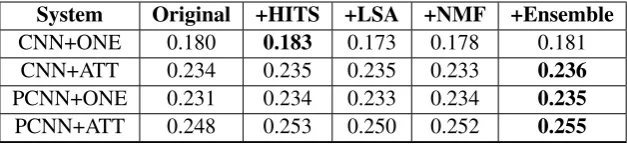
Table 3 presents the performance of noise re-duction methods. Recall that the K-means-based method achieves a high P@50 for the seed selection method. Our assumption is that each cluster may represent a set in which elements have similar semantic properties. However, we observed that as the number of relations is relatively high and there is no distinct def-inition between some relations in the distantly labeled data (e.g., the following three relations are quite similar: /location/country/capital,
/location/province/capital, and
/location/us state/capital, we decided not to perform the K-means-based method for our noise reduction task. The performances of the HITS-based, LSA-based, and NMF-based noise reduction methods are presented in Table 3. We experimentally set the portion of retained data from the distantly labeled data to 90%, given that the performance can be affected if too many sentences are removed from the original data. We also perform experiments with an ensem-ble method that combines the HITS-based and LSA-based strategies to merge rankings from their outputs, with half of the triples coming from the LSA-based method and the other half from the HITS-based method. Table 3 indicates that our proposed methods improved the performance of all CNN and PCNN models. Our ensemble method achieved the best improvements for three out of four systems, except that the HITS-based
method obtained the best score forCNN+ONE.
6 Conclusion
We formulated the seed selection and noise re-duction tasks as ranking problems. In addition, we proposed several methods, inspired by rank-ing instances and patterns computed by the HITS algorithm, and selecting clusters centroids using the K-means, LSA, or NMF method. Experi-ments demonstrated that our proposed methods improved the baselines in both tasks.
Acknowledgments
This work was partly supported by JST CREST Grant Number JPMJCR1513 and MEXT/JSPS Kakenhi Grant Number JP15H02749. We are grateful to the members of the Computational Lin-guistics Laboratory, NAIST and the anonymous reviewers for their insightful comments.
References
Eugene Agichtein and Luis Gravano. 2000.
Snow-ball: Extracting relations from large plain-text
col-lections. InProceedings of the 5th ACM Conference
on Digital Libraries, pages 85–94. ACM.
Sergey Brin. 1998. Extracting patterns and relations
from the world wide web. In International
Work-shop on the World Wide Web and Databases, pages 172–183. Springer.
Scott Deerwester, Susan T. Dumais, George W. Fur-nas, Thomas K. Landauer, and Richard Harshman.
1990. Indexing by latent semantic analysis.
Jour-nal of the American Society for Information Science, 41(6):391.
Jason Eisner and Damianos Karakos. 2005.
Bootstrap-ping without the boot. In Proceedings of the 2005 Human Language Technology Conference and Con-ference on Empirical Methods in Natural Language Processing.
Empirical Methods in Natural Language
Process-ing, pages 1535–1545. Association for
Computa-tional Linguistics.
Ander Intxaurrondo, Mihai Surdeanu, Oier Lopez de Lacalle, and Eneko Agirre. 2013. Removing noisy mentions for distant supervision. Procesamiento del lenguaje natural, 51.
Madelyn Anne Iris. 1989. Problems of the part-whole relation. InRelational Models of the Lexicon, pages 261–288. Cambridge University Press.
Tetsuo Kiso, Masashi Shimbo, Mamoru Komachi, and
Yuji Matsumoto. 2011. HITS-based seed selection
and stop list construction for bootstrapping. In Pro-ceedings of the 49th Annual Meeting of the Associ-ation for ComputAssoci-ational Linguistics: Human Lan-guage Technologies, pages 30–36. Association for Computational Linguistics.
Jon M. Kleinberg. 1999. Authoritative sources in
a hyperlinked environment. Journal of the ACM,
46(5):604–632.
Mamoru Komachi, Taku Kudo, Masashi Shimbo, and
Yuji Matsumoto. 2008. Graph-based analysis of
semantic drift in Espresso-like bootstrapping algo-rithms. InProceedings of the 2008 Conference on Empirical Methods in Natural Language
Process-ing, pages 1011–1020. Association for
Computa-tional Linguistics.
Zornitsa Kozareva and Eduard Hovy. 2010. Not all
seeds are equal: Measuring the quality of text min-ing seeds. InHuman Language Technologies: The 2010 Annual Conference of the North American Chapter of the Association for Computational Lin-guistics, pages 618–626. Association for Computa-tional Linguistics.
Daniel D Lee and H. Sebastian Seung. 1999. Learning the parts of objects by non-negative matrix factor-ization. Nature, 401(6755):788–791.
Gang Li, Cathy Wu, and K. Vijay-Shanker. 2017.
Noise reduction methods for distantly supervised biomedical relation extraction. In SIGBioMed Workshop on Biomedical Natural Language Pro-cessing (BioNLP ’17), pages 184–193. Association for Computational Linguistics.
Yankai Lin, Shiqi Shen, Zhiyuan Liu, Huanbo Luan,
and Maosong Sun. 2016. Neural relation extraction
with selective attention over instances. In Proceed-ings of the 54th Annual Meeting of the Association for Computational Linguistics (Volume 1: Long Pa-pers), pages 2124–2133. Association for Computa-tional Linguistics.
Christopher D. Manning, Prabhakar Raghavan, and Hinrich Sch¨utze. 2008. Introduction to Information Retrieval. Cambridge University Press.
Tomas Mikolov, Ilya Sutskever, Kai Chen, Greg S Cor-rado, and Jeff Dean. 2013. Distributed representa-tions of words and phrases and their
compositional-ity. InAdvances in Neural Information Processing
Systems 26, pages 3111–3119.
Mike Mintz, Steven Bills, Rion Snow, and Daniel
Ju-rafsky. 2009. Distant supervision for relation
ex-traction without labeled data. InProceedings of the Joint Conference of the 47th Annual Meeting of the ACL and the 4th International Joint Conference on Natural Language Processing of the AFNLP, pages 1003–1011. Association for Computational Linguis-tics.
Dana Movshovitz-Attias and William W. Cohen. 2012.
Bootstrapping biomedical ontologies for scientific text using nell. In BioNLP: Proceedings of the 2012 Workshop on Biomedical Natural Language Processing, pages 11–19. Association for Compu-tational Linguistics.
Pentti Paatero and Unto Tapper. 1994. Positive ma-trix factorization: A non-negative factor model with optimal utilization of error estimates of data values.
Environmetrics, 5(2):111–126.
Patrick Pantel and Marco Pennacchiotti. 2006.
Espresso: Leveraging generic patterns for automati-cally harvesting semantic relations. InProceedings of the 21st International Conference on Compu-tational Linguistics and 44th Annual Meeting of the Association for Computational Linguistics, pages 113–120. Association for Computational Linguistics.
Van-Thuy Phi and Yuji Matsumoto. 2016. Integrating
word embedding offsets into the Espresso system for part-whole relation extraction. InProceedings of the 30th Pacific Asia Conference on Language, Informa-tion and ComputaInforma-tion: Oral Papers, pages 173–181.
Sebastian Riedel, Limin Yao, and Andrew McCallum. 2010. Modeling relations and their mentions
with-out labeled text. In Proceedings of the 2010 Joint
European Conference on Machine Learning and Principles of Knowledge Discovery in Databases (ECML PKDD), pages 148–163. Springer.
Ellen Riloff, Rosie Jones, et al. 1999. Learning dic-tionaries for information extraction by multi-level
bootstrapping. In Proceedings of the 16th
Na-tional Conference on Artificial Intelligence and the 11th Innovative Applications of Artificial Intelli-gence Conference (AAAI/IAAI), pages 474–479.
Morton E. Winston, Roger Chaffin, and Douglas Her-rmann. 1987. A taxonomy of part-whole relations.
Cognitive Science, 11(4):417–444.
Yang Xiang, Qingcai Chen, Xiaolong Wang, and Yang
Qin. 2016. Distant supervision for relation
ex-traction with ranking-based methods. Entropy,
Daojian Zeng, Kang Liu, Yubo Chen, and Jun Zhao. 2015. Distant supervision for relation extraction via piecewise convolutional neural networks. In Pro-ceedings of the 2015 Conference on Empirical Meth-ods in Natural Language Processing, pages 1753– 1762. Association for Computational Linguistics.