The Thirty-Third AAAI Conference on Artificial Intelligence (AAAI-19)
Improving Distantly Supervised Relation Extraction with
Neural Noise Converter and Conditional Optimal Selector
Shanchan Wu
Alibaba Group (U.S.) Inc. [email protected]Kai Fan
Alibaba Group (U.S.) Inc.Qiong Zhang
Alibaba Group (U.S.) Inc. [email protected]Abstract
Distant supervised relation extraction has been successfully applied to large corpus with thousands of relations. However, the inevitable wrong labeling problem by distant supervision will hurt the performance of relation extraction. In this paper, we propose a method with neural noise converter to alleviate the impact of noisy data, and a conditional optimal selector to make proper prediction. Our noise converter learns the struc-tured transition matrix on logit level and captures the property of distant supervised relation extraction dataset. The condi-tional optimal selector on the other hand helps to make proper prediction decision of an entity pair even if the group of sen-tences is overwhelmed by no-relation sensen-tences. We conduct experiments on a widely used dataset and the results show significant improvement over competitive baseline methods.
Introduction
The task of relation extraction (RE) is to predict semantic relations between pairs of entities in text. To alleviate the work load of obtaining the training data for relation extrac-tion, distant supervision is applied to collect training data for learning a model. Relation extraction (RE) under distant su-pervision heuristically aligns entities in texts to some given knowledge bases (KBs). For a triplet(e1, r, e2), wheree1
ande2are a pair of entities with relation typerin KBs,
dis-tant supervision assumes that all sentences that contain both entitiese1ande2will express the same relation typerwhich
will be used in training.
Although distant supervision is an effective way to automatically label training data, it always suffers from the problem of wrong labeling. For example, (M arkZuckerberg, f ounder, F acebook) is a relational triplet in KBs. Distant supervision will regard all sentences that contain M arkZuckerberg andF acebook as the in-stances containing relationf ounder. For example, the sen-tence“Mark Zuckerberg uses Facebook to visit Puerto Rico in VR.”does not express the relationf ounderbut will still be regarded as a positive instance containing that relation type. This will introduce noise into the training data.
Tackling the noisy data problem for distant supervision is a non-trivial problem, as there is not any explicit super-vision for the noisy data. Some previous work tries to clean
Copyright c2019, Association for the Advancement of Artificial Intelligence (www.aaai.org). All rights reserved.
the noisy training data. Takamatsu, Sato, and Nakagawa pro-pose a solution to identify those potential noisy sentences and remove them from training data by syntactic patterns during the preprocessing stage. Although the effort of re-moving noise during preprocessing is practically effective, it has to rely on manual rules and hence is unable to scale. Some other work directly makes effort to reduce the impact of the noisy data during the training process. Riedel, Yao, and McCallum make theat-least-oneassumption that if two entities participate in a relation, at least one sentence that mentions these two entities might express that relation. They then propose a graphical model to build relation classifier. There are some following works based on this assumption using probabilistic graphic models (Hoffmann et al. 2011; Surdeanu et al. 2012), and neural network methods (Zeng et al. 2015). The methods based on at-least-one assump-tion can reduce the impact of some noisy sentences. How-ever, it can also lose a large amount of useful information containing in neglected sentences. Lin et al. propose to use sentence-level selective attention mechanism to reduce the noise through a sentence bag. The selective attention mech-anism represents a group of sentences including the same entity pair into a vector representation, and then use it for classification. This method has very significant improve-ment over other previous methods. The selective attention mechanism uses the information of all sentences in the group containing the entity pair. Moreover, it still considers that the label of the group of sentences in the training data is always correct, and it is further used to derive the loss func-tion. However, under distant supervision, it is very likely that none of the sentences in the same sentence group with the same entity pair express the semantic relation decided by KBs. Neitherat-least-onesolution nor selective attention solution is able to handle this situation properly.
com-puter vision such as (Sukhbaatar et al. 2015) have used a “noise” layer on top of the softmax layer to adapt the soft-max output to match the noise distribution. Our noise con-verter is different from theirs as our noise concon-verter is on top of logits rather than softmax, and we take advantage of the properties in the distantly supervised relation dataset and im-pose a reasonable constraint to the transition matrix. One ad-vantage is that we do not need to project the transition matrix to the space representing a valid probability distribution for each update. Another advantage is that the linear transition on hidden vectors can achieve non-linear transition results on probability space. Our noise converter can also theoreti-cally converge to its optimal value. The conditional optimal selector on the other hand helps to make proper prediction decision of an entity pair even if the corresponding group of sentences are overwhelmed by no-relation sentences.
Our main contributions in this paper are: (1)We propose a novel model named neural noise converter to better deal with noisy relational data. (2) We design a conditional opti-mal selector to help make proper prediction among sentence bags. (3)Our experimental results demonstrate the effective-ness of our approach over the state-of-the-art method.
Related Work
In recent years, convolutional neural networks (CNN) have been successfully applied to relation extraction (Santos, Xi-ang, and Zhou 2015; Nguyen and Grishman 2015). Besides the typical CNN, variants of CNN have also been devel-oped to relation extraction, such as piecewise-CNN (PCNN) (Zeng et al. 2015), split CNN (Adel, Roth, and Sch¨utze 2016), CNN with sentencewise pooling (Jiang et al. 2016) and attention CNN (Wang et al. 2016). Furthermore, recur-rent neural networks (RNN) are another successful choice for relation extraction, such as recurrent CNNs (Cai, Zhang, and Wang 2016) and attention RNNs (Zhou et al. 2016).
For relation extraction, the effect of wrongly labeled train-ing data has been attracted attention and some recent works have been proposed to reduce the influence. Among the works, some of them attempt to clean the noisy training data, such as (Takamatsu, Sato, and Nakagawa 2012). The work in (Xu et al. 2013) tries to find possible false negative data through pseudo-relevant feedback to expand training data. Some other works directly make effort to reduce the im-pact of the noisy data during the training process, such as (Riedel, Yao, and McCallum 2010; Hoffmann et al. 2011; Surdeanu et al. 2012; Zeng et al. 2015). Lin et al. propose to use instance-level selective attention mechanism to reduce the noise through a sentence bag. The approach has signif-icantly improved the prediction accuracy for several base-lines of deep learning models.
Out of the NLP domain, in computer vision, recently there are some proposed methods to fit the noisy data. Reed et al. propose a bootstrapping mechanism by augmenting the pre-diction objective with a concept of perceptual consistency to make the model more robust to noise. Sukhbaatar et al. add a linear “noise” layer on top of the softmax layer which adapts the softmax output to match the noise distribution. The main issue in (Sukhbaatar et al. 2015) is that the pa-rameters of the extra layer in their proposed model is not
identifiable, and they circumvent this problem by using a tricky optimization process. Rather than optimizing a global transition matrix, Misra et al. generate the transition matrix in an amortized way for each training instance. In NLP, as far as we know, the only couple of works that are based on neural network noise model are (Fang and Cohn 2016) and (Luo et al. 2017). The key difference is that we do not follow the previous work by directly adapting the softmax output. Instead, we creatively make transition on logits output and we address the identifiable issue by adding extra constraint to the transition matrix.
Methodology
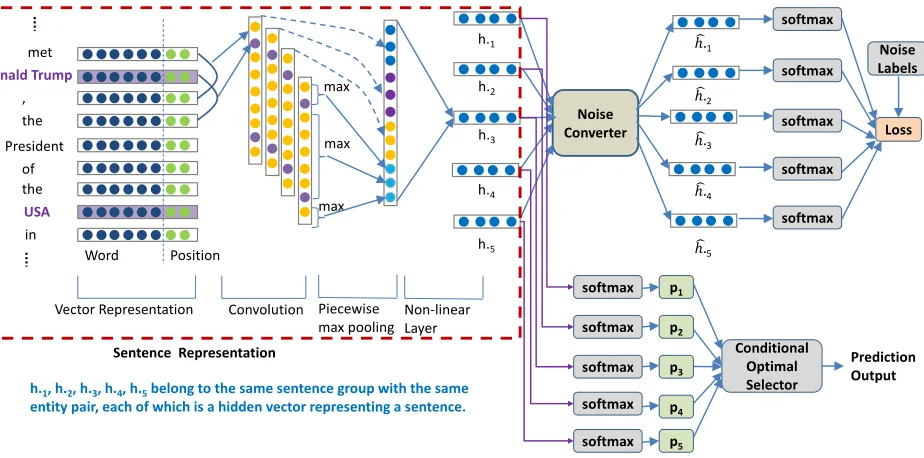
Given a set of sentences{s1, s2,· · · , sN}, with each con-taining a corresponding pair of entities, our model predicts the relation typerfor each entity pair. Figure 1 shows the overall neural network architecture of our model. It primar-ily consists of three parts: Sentence Encoder Module, Neural Noise Converter Module, and Conditional Optimal Selector Module. Sentence Encoder uses a variant of convolutional neural network (CNN) to process a given sentence with a pair of target entities to a vector representation. After con-structing the vector representation of the sentence, Neural Noise Converter Module converts the hidden state with re-spect to the true label to the hidden state with rere-spect to the noise label. Conditional Optimal Selector is a mechanism to make prediction based on a group of sentences with the same entity pair. We describe these parts in details below.
Sentence Encoder
Similar to (Zeng et al. 2015; Lin et al. 2016; Ji et al. 2017), we transform a sentence into its vector representation by piecewise CNN (PCNN, a variant of CNN). First a sentence is transformed into a matrix with word embeddings and po-sition embeddings. Then a convolutional layer, max-pooling layer and non-linear layer are used to construct a vector rep-resentation of the sentence.
Word Embeddings and Position Embeddings Word embeddings are distributed representations of words, which are usually pre-trained from a text corpus and can capture syntactic and semantic meanings of the words. Similar to (Zeng et al. 2014), we use the word position information be-sides the word embeddings. The position information has shown its importance in relation extraction. The position feature values of a word are determined by the distances be-tween this word and the two target entity words. Each rela-tive position value is encoded as a vector which is random-ized at the beginning and updated during the training. Then the word embeddings and position embeddings are concate-nated, and a sentence is then originally encoded as a vector sequenceX = {x1, x2, . . . , x|X|} , wherexi ∈ Rd(d = da+db×2),dais the dimension of a word embedding, and
dbis the dimension of a position embedding.
ConvolutionSuppose matrixAandB has the same di-mensiont1×t2, then the convolution operation betweenA
andBis defined asA⊗B =Pt1 i=1
Pt2
j=1AijBij
softmax
softmax
softmax
softmax
softmax Noise
Converter
! ℎ.1
! ℎ.2
! ℎ.3
! ℎ.4
! ℎ.5
h.1
h.2
h.3
h.4
h.5
softmax
softmax
softmax
softmax
softmax p1
p2
p3
p4
p5
Loss Noise Labels
Conditional Optimal Selector
Prediction Output Sentence Representation
Donald Trump
, the President
of the
USA
in
max
max
max met
Position Word
Vector Representation Convolution Piecewise
max pooling Non-linearLayer
h.1, h.2, h.3, h.4, h.5belong to the same sentence group with the same entity pair, each of which is a hidden vector representing a sentence.
Figure 1: The model architecture. The left side shows the sentence encoder by PCNN. The example sentence is encoded to a hidden vectorh•3. Four other sentences with the same entity pair are encoded ash•1, h•2, h•4, h•5. The noise converter converts
each hidden vector. Softmax and loss function are applied thereafter. The conditional optimal selector is used to make prediction based on the hidden vectors which the noise converter is applied to.
of a sentence, wherexi ∈ Rd represents the vector of the i-th word in the sentence. LetXi:j = [xi : xi+1 : · · ·: xj] be a matrix by concatenating the vectors from thei-th vector to thej-th vector, and letU ={U1, U2, ..., Um}be a list of filter matrixes, where thet-th filter matrix isUt∈Rl×d. The
convolution operation output betweenX andUt will be a new vectorct∈R|X|−l+1, thei-th element of which iscti=
Ut⊗Xi:(i+l−1). Through the convolution operation between X and the list of filter matrixesU ={U1, U2, ..., Um}, we get a list of output vectorsC={c1, c2, . . . , cm}.
Max-pooling and non-linear layerThe max-pooling op-eration is a widely used method to extract the most signifi-cant features inside a feature map. To capture the structure information, PCNN divides a sequence into three parts based on the positions of the two target entities which cut the se-quence into three pieces. Then the piecewise max pooling procedure returns the maximum value in each subsequence instead of a single maximum value. As shown in Figure 2, the output vectorci from convolution operation is divided into three segments, {ci1, ci2, ci3} by Donald Trump and USA. The piecewise max pooling procedure is applied to each of the three segments separately:
pi1=max(ci1), pi2=max(ci2), pi3=max(ci3)
So for each convolution filter, we can get a vectorpi =
{pi1, pi2, pi3}with 3 elements. After that, we can concate-nate the vectors fromp1topmto obtain the final max pool-ing output vectorP∈R3m.
We then apply a non linear layer on the max pooling out-put. We also apply dropout on this layer for regularization during training.
… metDonald Trump , the 3 President-3of the USAin …
Figure 2: An example of relative distances
Neural Noise Converter
For the training data obtained from distant supervision, their labels are usually noisy or incorrect. To incorporate the noise information, we propose a neural noise converter module that can capture the relationship between the underlying true labels and the noisy labels.
We denotey∗andy˜to be the true label and the observed label (i.e., the noisy label) of the sentences, wherey∗,y˜∈ {1, . . . , K}. In addition, we define two probabilistic models
p(y∗|s)andp(˜y|s)to represent the distributions of true and noisy labels, respectively. For notation simplicity, we abuse usingp(y∗=k)as the alternative ofp(y∗=k|s).
A natural way to convert the true label to the noisy one is to build a linear transformation by assuming the existence of an optimal probabilistic transition matrixQ∗ = (q∗uv)∈ RK×K wherequv∗ = p(˜y = u|y∗ = v)(Sukhbaatar et al. 2015). That is to say we can build the following connection
p(˜y=u) = K
X
v=1
quv∗ p(y∗=v). (1)
neural noise converter module, via enforcing a linear trans-formation on the softmax logits which are used to calculate the relation type distribution.
To make it concrete, we define p(y∗) ∼ softmax(h∗), where the hidden vectorh∗is the softmax logits for true la-bels. Similarly, we havep(˜y)∼softmax(˜h)and the hidden vector˜hfor noisy labels. In other words, we have
p(y∗=k) = exp(h
∗
k)
PK
j=1exp(h∗j)
p(˜y=k) = exp(˜hk)
PK
j=1exp(˜hj)
(2)
Unlike the explicit transformation in probability space (Sukhbaatar et al. 2015), we assume an optimal logits tran-sition matrixW∗= (wij∗)∈RK×K, such that
˜
h=W∗h∗. (3)
A special case is that if W∗ is an identity matrix, then it means there is no noise in the observed data. Equivalently, we can rewrite Equation (2) and (3) to obtain the following approximate linear transformation (due to the presence ofZ˜
andZ∗in Equation (4), it is not exact linear) in the log-space of probability,
logp(˜y=k) = K
X
j=1
wkj∗ (logp(y∗=j) + logZ∗)−log ˜Z
(4) whereZ∗andZ˜are two normalizing terms in Equation (2). In this case, we can not analytically provide the total prob-ability rule as Equation (1), but we actually define it in the implicit way. Notice that the biggest issue in (Sukhbaatar et al. 2015) is the identifiable problem ofQ∗, which also
ap-pears in the above definition ofW∗, since there areK2free
parameters involving onlyKequations. To make our model robust and well-defined during optimization, we suggest im-posing some constraint onW∗according to specific tasks.
Structured Transition Matrix
In this section, we take advantage of the properties in the distantly supervised relation dataset to impose the restric-tion on the transirestric-tion matrixW∗. When two entities are
la-beled by some relation type, there should be some sentences with that two entities showing that relation type somewhere in the world, but not necessarily in the sentences extracted by distant supervision. Meanwhile, that pair of entities in the extracted sentences will rarely show relation types other than ‘no-relation’ or the types that are assigned to this pair from the knowledge base used for distant supervision. So the transition matrix should primarily transfer ‘no-relation’ (which is labeled as ‘1’, or negative relation) to positive rela-tions (labeled other than ‘1’), but unlikely between positive relations or from positive relations to ‘no-relation’. Hence, in the situation of this distant supervised relation extraction task, the transition matrix is assumed in the following form in Equation (5), where the values in diagonal are all 1 except
the first one, the rest values except those in the first column and the diagonal are all 0s.
W∗=
w11∗ 0 0 . . . 0
w21∗ 1 0 . . . 0
w31∗ 0 1 . . . 0
..
. ... . .. ...
w∗
K1 0 0 . . . 1
(5)
Besides the identifiable issue, another purpose to introduce the structured constraint is to guarantee the softmax opera-tion invertible with respect toW∗whenh∗is given.
Transition Matrix Estimation
Let pˆ(y∗|θ)be the prediction probability of true labels by the classification model parameterized byθ. Therefore, we can build an extra affine layer with the parameterW (same structure as W∗) on top of the softmax logits layer of the true label prediction, converting the distribution of the true labels to the distribution of the noisy labels, i.e.,pˆ(˜y|θ, W). Due to the mechanism of distant supervision, the collected dataset are naturally divided into several groups with the same observed entity pairs. Thus we can define a customized loss function for the combined noisy model by maximiz-ing the cross-entropy between the observed noisy labels and the model prediction ofpˆ(˜y|θ, W)for the sentences in each group. The equivalent loss function to minimize is
L(θ, W) =−1 G
G
X
g=1
1
|Sg|
|Sg|
X
ng=1
log ˆp(˜y=rg|sng, θ, W)
(6) whereGis the total number of entity pairs in the training data,rg is the observed noisy label in the sentence group
Sg which contains entity pairEg, andsng is the sentence
included inSg.
Our purpose is to learn a model such thatW is close the underlying optimalW∗. Let ˆhbe the model output of the hidden vector before softmax operation for the noisy labels, andhbe the model output of hidden vector before softmax operation for the true labels. Similar to Equation (3) we have ˆ
h =W h, thus resulting the following categorical distribu-tion.
ˆ
p(˜y=k|s, θ, W) = exp(
PK
j=1wkjhj)
PK
i=1exp(
PK
j=1wijhj)
= exp(wk1h1+hkIk6=1)
PK
i=1exp(wi1h1+hiIi6=1)
(7)
loss function and derive a non-negative lower bound,
L(θ, W) =1 G
G X
g=1
1 |Sa|
|Sg|
X
ng=1
log
K X
i=1
exp
K X
j=1
wijhj,ng
−
K X
j=1
wrgjhj,ng
!
≥1 G
G X
g=1
1 |Sg|
|Sg|
X
ng=1
max
1≤i≤K wi1h1,ng+hi,ngIi6=1
−wrg1h1,ng−hrg,ngIrg6=1
≥0
(8)
wherehj,ng is thejth element of the hidden vector for the
sentence sng. Based on Equation (8), when G → ∞ and |Sg| → ∞, an ideal optimization ofL(θ, W)(i.e., loss ap-proaches 0) will pushwrg1h1,ng +hrg,ngIrg6=1towards the
maximumwi1h1,ng +hi,ngIi6=1 among all entity pairs, for ∀sng ∈ Sg. It implies that the distribution of the noisy
la-bel for each sentence can be calculated after an ideal opti-mization. However, we only care about the distribution of underlying real label during inference, i.e.,pˆ(y∗|θ).
In (Sukhbaatar et al. 2015), the total probability rule of the predicted model is explicitly defined inpˆ(˜y) =Qpˆ(y∗), which implicitly defined via neural noise converter. By a de-liberate optimization strategy,Qcan tend to converge to the optimal unknownQ∗ (Sukhbaatar et al. 2015). Using this argument, we want to show that our transition matrixW on hidden vectors can also converge to the true transformation matrixW∗by bridgingW andQ. The total probability rule is always hold, thus we have
ˆ
p(˜y) =softmax(W h) =Qpˆ(y∗) =Qsoftmax(h) (9) By the constraint of the structured transition matrix, the soft-max operation is invertible with respect toW, i.e., givenh, the solution ofWfor Equation (9) is unique. Notice the right sideQpˆ(y∗)is aK-dimensional vector, while the constraint
W has onlyKfree parameters. As long asQis able to con-verge to the optimalQ∗, our structured transition matrix can converge toW∗.
Conditional Optimal Selector
After the model is trained, our prediction is then based on the hidden vectors which are the input to the neural noise converter. For each pair of entities, a typical solution is to represent the group of sentences with that pair of entities as a single vector by some attention mechanism and then apply softmax to get the prediction output. However, it is difficult for a single vector representation to make correct prediction for a group overwhelmed by ‘no-relation’ sentences if only very few sentences with positive relations are included. In this situation, the solution for such a label-imbalance group will tend to make ‘no-relation’ prediction. However, the cor-rect label for the target entity pair should be the positive re-lation type expressed in those few sentences.
Instead of directly computing the label distribution of the group with one single vector representation, we first con-sider to derive all label distributions over sentences, and then select the most representative one for the group label. The
selection criteria is basically based on the portion of pre-dicted ‘no-relation’ type of all sentences within each group. Thus, we call it “Conditional Optimal Selector”. For a pair of entity, if all sentences in the group are predicted to be negative (i.e. ‘no-relation’ type), we make ‘no-relation’ pre-diction for the entire group. Otherwise, if any sentence is predicted to be some positive relation, we will predict the group label based on the sentences with positive relation predictions, regardless of the ‘no-relation’ sentences. To be precise, the probability distribution of the group label can be formally expressed as follows.
if∀si, arg max k
ˆ
p(y∗i =k|si∈ Sg) = 1 :
j= arg max i
ˆ
p(y∗i = 1|si∈ Sg)
else:
j, κ= arg max
(i,k),k6=1
ˆ
p(yi∗=k|si∈ Sg)
ˆ
P(Eg) = ˆp(yj∗|sj),
(10)
Furthermore, one side-product is that the multiple positive relation types can also be learned as the final prediction if the task of multiple labels learning is required.
Model Training
We first pretrain the model by replacingW with an identity matrix for several epochs, and then we setW to trainable parameters.
Since we have fixed value 1 in the diagonal of W (See Equation (5) ), we initialize the variables in the first column in the way with their summation equal to 1, in order to make all elements in the matrix at the same scale.
One advantage of modeling W on hidden vector rather than modeling Q on probability output is that we do not need to projectQto the space representing a valid proba-bility transition matrix for each update. Another advantage is that the linear transition on hidden vectors can achieve non-linear transition results on probability space.
Experiments
In this section, we demonstrate that our method with noise converter and conditional optimal selector can reduce the impact of the wrong labels for relation extraction on dis-tant supervised dataset. We first describe the dataset and the evaluation metrics that are used in our experiments, and then compare with several baseline methods. In addition, we an-alyze our proposed components by ablation study.
Dataset and Evaluation Metrics
To evaluate our model, we experiment on a widely used dataset which is developed by (Riedel, Yao, and McCallum 2010) and has also been tested by (Hoffmann et al. 2011; Surdeanu et al. 2012; Zeng et al. 2015; Lin et al. 2016). We use the preprocessed version1which is made publicly avail-able by Tsinghua NLP Lab. This dataset was generated by aligning Freebase relations with the New York Times corpus
1
(NYT). The Freebase relations are divided into two parts for training and testing. The training set aligns the sentences from the corpus of the years 2005-2006, and the testing one aligns the sentences from 2007. The dataset contains 53 possible relationships including a special relation type ‘NA’ which indicates no relation between the mentioned two en-tities. The resulted training and testing data contain 570,088 and 172,448 sentences, respectively. We further randomly extract 10 percent of relation pairs and the corresponding sentences from the training data as the validation data for model selection and parameter tuning, and leave the rest as the actual training data.
Similar to previous works (Mintz et al. 2009; Lin et al. 2016), we evaluate our model in the held-out testing data. The evaluation compares the extracted relation instances dis-covered from the test sentences against Freebase relation data. It makes the assumption that the inference model has similar performance in relation instances inside and out-side Freebase. We report the precision/recall curves, Preci-sion@N (P@N), and average precision in our experiments.
Parameter Settings
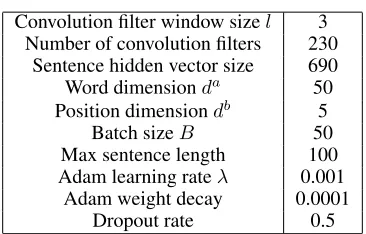
We tune the parameters of maximum sentence length, learn-ing rate, weight decay, and batch size by testlearn-ing the perfor-mance on the validation dataset. For other parameters, we use the same parameters as (Lin et al. 2016). Table 1 shows the major parameters used in our experiments.
Table 1: Parameter settings.
Convolution filter window sizel 3 Number of convolution filters 230
Sentence hidden vector size 690 Word dimensionda 50 Position dimensiondb 5
Batch sizeB 50
Max sentence length 100 Adam learning rateλ 0.001
Adam weight decay 0.0001 Dropout rate 0.5
For the initialization of W, we use the following strat-egy. We define a ratioe, and assign w11 = 1−e, and the
restK−1elements to bee/(1−K). We do evaluation on the validation dataset and picke = 0.1in the candidate set
{0.001, 0.01, 0.1, 0.2, 0.3, 0.5}. We pretrain our model for 2 epochs by settingW as an identity matrix and then fine tune our model for another 18 epochs with trainableW.
Comparison with Baseline Methods
To evaluate our proposed approach, we select several base-line methods for comparison by held-out evaluation:
Mintz (Mintz et al. 2009) is a traditional distant super-vised model.
MultiR(Hoffmann et al. 2011) is a probabilistic, graph-ical model for multi-instance learning that can handle over-lapping relations.
Figure 3: Performance comparison of proposed model and baseline methods. Our model and our implementation of PCNN+ATT both pick the model with the highest accuracy on the validation dataset.
MIML (Surdeanu et al. 2012) is a method that models both multiple instances and multiple relations.
CNN + ATTandPCNN+ATT(Lin et al. 2016) are two methods that first represent a sentence by CNN and PCNN respectively, and then use sentence-level selective attention to model a group of sentences with the same entity pair.
For the above baseline methods, we implement the state of the art methodPCNN+ATT. To make fair comparison, we use the same implementation of the component PCNN in our model and PCNN+ATT, and use the same hyper-parameters. For other methods, we use the results from the source code released by the authors.
For our method andPCNN+ATT, we run 20 epochs in total, and track the accuracy on the validation dataset. The model is saved for every 200 batches during training. We use the saved model that has the highest accuracy on the valida-tion dataset for making predicvalida-tions on the testing dataset.
Figure 4: Performance comparison of proposed model and PCNN+ATT model, and their corresponding ensemble ver-sions.
Table 2: Comparison of P@N for relation extraction for our model PCNN+nc+cond opt (same notation as PCNN+noise convert+cond opt) and PCNN+ATT
P@N (%) 100 200 300 Mean PCNN
+ATT
original report 76.2 73.1 67.4 72.2 our implementation 81.0 72.5 69 74.2 PCNN+nc+cond opt 85.0 82.0 77.0 81.3
ensemble model averages the probability scores for each test instance from the 5 last saved trained single models, and use the average score for prediction. Figure 4 shows the precision/recall curves of the corresponding methods with or without ensemble. We observe that the performance of the ensemble method of our method is still much better than the ensemble method of PCNN+ATT. We further compare the average precision of our method and PCNN+ATT on both single model and ensemble model, achieving 7.0 and 7.3 higher average precision scores respectively.
Ablation Study
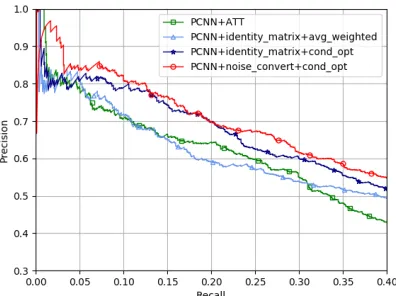
To understand the impact of the neural noise converter and conditional optimal selector in our model, we do two more experiments. The first one is to enforce the transition matrix in our model to be identity matrix, and keep other components and loss function remain un-changed, in order to validate the neural noise converter. We call this method asPCNN+identity matrix+cond opt (or PCNN+IW+cond opt ). Figure 5 illustrates the preci-sion/recall curves of all comparison methods, and Table 4
Table 3: Comparison of average precision for relation ex-traction for our model and PCNN+ATT model
Average Precision (%) Single model Ensemble model
PCNN+ATT 36.5 37.9
PCNN+nc+cond opt 43.5 45.2
Figure 5: Performance comparison of PCNN+ATT model and our models with different components.
Table 4: Comparison of P@N for PCNN+ATT model, and our model with avg weighted, cond opt and our model with both cond opt and noise convert
P@N (%) 100 200 300 Mean PCNN
+ATT
original report 76.2 73.1 67.4 72.2 our implementation 81.0 72.5 69 74.2 PCNN +IW+avg weighted 83.0 74.5 68.3 75.2
PCNN +IW+cond opt 81.0 78.5 77.0 78.8
PCNN+nc+cond opt 85.0 82.0 77.0 81.3
shows the P@N values. We can see that without neural noise converter, our method is still better than the baseline method PCNN+ATT, but with neural noise converter, our method gains significantly more improvement.
In addition, we conduct the second experiment to compare our conditional optimal selector with another selector which uses the average label distribution of all sentences within each group, calledPCNN+identity matrix+avg weighted (or PCNN+IW+avg weighted ). In practice, we only con-sider averaging the distribution in the second condition of Equation (10). In other words, this method uses the aver-age probability of all positive predicted sentences. The re-sults also show in Figure 5 and Table 4. We can see that this method is slightly better than PCNN+ATT , but worse than PCNN+IW+cond opt.
Conclusions
References
Adel, H.; Roth, B.; and Sch¨utze, H. 2016. Comparing con-volutional neural networks to traditional models for slot fill-ing. InNAACL HLT 2016, The 2016 Conference of the North American Chapter of the Association for Computational Linguistics: Human Language Technologies, San Diego Cal-ifornia, USA, June 12-17, 2016, 828–838.
Cai, R.; Zhang, X.; and Wang, H. 2016. Bidirectional recur-rent convolutional neural network for relation classification. InProceedings of the 54th Annual Meeting of the Associa-tion for ComputaAssocia-tional Linguistics, ACL 2016.
Fang, M., and Cohn, T. 2016. Learning when to trust dis-tant supervision: An application to low-resource POS tag-ging using cross-lingual projection. In Proceedings of the 20th SIGNLL Conference on Computational Natural Lan-guage Learning, CoNLL 2016, 178–186.
Hoffmann, R.; Zhang, C.; Ling, X.; Zettlemoyer, L. S.; and Weld, D. S. 2011. Knowledge-based weak supervision for information extraction of overlapping relations. InThe 49th Annual Meeting of the Association for Computational Lin-guistics, ACL 2011, 541–550.
Ji, G.; Liu, K.; He, S.; and Zhao, J. 2017. Distant supervi-sion for relation extraction with sentence-level attention and entity descriptions. InProceedings of the Thirty-First AAAI Conference on Artificial Intelligence, 2017, 3060–3066. Jiang, X.; Wang, Q.; Li, P.; and Wang, B. 2016. Relation ex-traction with multi-instance multi-label convolutional neural networks. InCOLING 2016, 26th International Conference on Computational Linguistics, Proceedings of the Confer-ence, 1471–1480.
Lin, Y.; Shen, S.; Liu, Z.; Luan, H.; and Sun, M. 2016. Neu-ral relation extraction with selective attention over instances. InProceedings of the 54th Annual Meeting of the Associa-tion for ComputaAssocia-tional Linguistics, ACL 2016.
Luo, B.; Feng, Y.; Wang, Z.; Zhu, Z.; Huang, S.; Yan, R.; and Zhao, D. 2017. Learning with noise: Enhance distantly su-pervised relation extraction with dynamic transition matrix. InProceedings of the 55th Annual Meeting of the Associa-tion for ComputaAssocia-tional Linguistics, ACL 2017, 430–439. Mintz, M.; Bills, S.; Snow, R.; and Jurafsky, D. 2009. Dis-tant supervision for relation extraction without labeled data. InProceedings of the Joint Conference of the 47th Annual Meeting of the ACL and the 4th International Joint Confer-ence on Natural Language Processing of the AFNLP, ACL ’09, 1003–1011.
Misra, I.; Zitnick, C. L.; Mitchell, M.; and Girshick, R. B. 2016. Seeing through the human reporting bias: Visual clas-sifiers from noisy human-centric labels. In CVPR 2016, 2930–2939.
Nguyen, T. H., and Grishman, R. 2015. Relation extrac-tion: Perspective from convolutional neural networks. In
Proceedings of the 1st Workshop on Vector Space Modeling for Natural Language Processing, VS@NAACL-HLT 2015. Reed, S. E.; Lee, H.; Anguelov, D.; Szegedy, C.; Erhan, D.; and Rabinovich, A. 2014. Training deep neural networks on noisy labels with bootstrapping.CoRRabs/1412.6596.
Riedel, S.; Yao, L.; and McCallum, A. 2010. Modeling relations and their mentions without labeled text. In Ma-chine Learning and Knowledge Discovery in Databases, Eu-ropean Conference, ECML PKDD 2010, 148–163.
Santos, C. N. D.; Xiang, B.; and Zhou, B. 2015. Classify-ing relations by rankClassify-ing with convolutional neural networks. InProceedings of the 53rd Annual Meeting of the Associa-tion for ComputaAssocia-tional Linguistics and the 7th InternaAssocia-tional Joint Conference on Natural Language Processing of the Asian Federation of Natural Language Processing, (ACL) 2015.
Sukhbaatar, S.; Bruna, J.; Paluri, M.; Bourdev, L.; and Fer-gus, R. 2015. Training convolutional networks with noisy labels.ICLR.
Surdeanu, M.; Tibshirani, J.; Nallapati, R.; and Manning, C. D. 2012. Multi-instance multi-label learning for rela-tion extracrela-tion. In Proceedings of the 2012 Joint Confer-ence on Empirical Methods in Natural Language Processing and Computational Natural Language Learning, EMNLP-CoNLL 2012, 455–465.
Takamatsu, S.; Sato, I.; and Nakagawa, H. 2012. Reducing wrong labels in distant supervision for relation extraction. In
The 50th Annual Meeting of the Association for Computa-tional Linguistics, Proceedings of the Conference, 721–729. Wang, L.; Cao, Z.; de Melo, G.; and Liu, Z. 2016. Relation classification via multi-level attention cnns. InProceedings of the 54th Annual Meeting of the Association for Computa-tional Linguistics, ACL 2016.
Xu, W.; Hoffmann, R.; Zhao, L.; and Grishman, R. 2013. Filling knowledge base gaps for distant supervision of rela-tion extracrela-tion. InProceedings of the 51st Annual Meeting of the Association for Computational Linguistics, ACL 2013, 665–670.
Zeng, D.; Liu, K.; Lai, S.; Zhou, G.; and Zhao, J. 2014. Rela-tion classificaRela-tion via convoluRela-tional deep neural network. In
COLING 2014, 25th International Conference on Computa-tional Linguistics, Proceedings of the Conference: Technical Papers, 2014, 2335–2344.
Zeng, D.; Liu, K.; Chen, Y.; and Zhao, J. 2015. Distant supervision for relation extraction via piecewise convolu-tional neural networks. InProceedings of the 2015 Confer-ence on Empirical Methods in Natural Language Process-ing, EMNLP 2015, 1753–1762.