Semantic Role Labeling Systems for Arabic using Kernel Methods
Mona Diab
CCLS, Columbia University New York, NY 10115, USA
Alessandro Moschitti
DISI, University of Trento Trento, I-38100, Italy
Daniele Pighin
FBK-irst; DISI, University of Trento Trento, I-38100, Italy
Abstract
There is a widely held belief in the natural lan-guage and computational linguistics commu-nities that Semantic Role Labeling (SRL) is a significant step toward improving important applications, e.g. question answering and in-formation extraction. In this paper, we present an SRL system for Modern Standard Arabic that exploits many aspects of the rich mor-phological features of the language. The ex-periments on the pilot Arabic Propbank data show that our system based on Support Vector Machines and Kernel Methods yields a global SRL F1score of 82.17%, which improves the current state-of-the-art in Arabic SRL.
1 Introduction
Shallow approaches to semantic processing are mak-ing large strides in the direction of efficiently and effectively deriving tacit semantic information from text. Semantic Role Labeling (SRL) is one such ap-proach. With the advent of faster and more power-ful computers, more effective machine learning al-gorithms, and importantly, large data resources an-notated with relevant levels of semantic information, such as the FrameNet (Baker et al., 1998) and Prob-Bank (Kingsbury and Palmer, 2003), we are seeing a surge in efficient approaches to SRL (Carreras and M`arquez, 2005).
SRL is the process by which predicates and their arguments are identified and their roles are defined in a sentence. For example, in the English sen-tence, ‘John likes apples.’, the predicate is ‘likes’ whereas ‘John’ and ‘apples’, bear the semantic role labels agent (ARG0) and theme (ARG1). The cru-cial fact about semantic roles is that regardless of the overt syntactic structure variation, the underly-ing predicates remain the same. Hence, for the sen-tence ‘John opened the door’ and ‘the door opened’, though ‘the door’ is the object of the first sentence
and the subject of the second, it is the ‘theme’ in both sentences. Same idea applies to passive con-structions, for example.
There is a widely held belief in the NLP and com-putational linguistics communities that identifying and defining roles of predicate arguments in a sen-tence has a lot of potential for and is a significant step toward improving important applications such as document retrieval, machine translation, question answering and information extraction (Moschitti et al., 2007).
To date, most of the reported SRL systems are for English, and most of the data resources exist for En-glish. We do see some headway for other languages such as German and Chinese (Erk and Pado, 2006; Sun and Jurafsky, 2004). The systems for the other languages follow the successful models devised for English, e.g. (Gildea and Jurafsky, 2002; Gildea and Palmer, 2002; Chen and Rambow, 2003; Thompson et al., 2003; Pradhan et al., 2003; Moschitti, 2004; Xue and Palmer, 2004; Haghighi et al., 2005). In the same spirit and facilitated by the release of the Se-mEval 2007 Task 18 data1, based on the Pilot Arabic Propbank, a preliminary SRL system exists for Ara-bic2(Diab and Moschitti, 2007; Diab et al., 2007a). However, it did not exploit some special character-istics of the Arabic language on the SRL task.
In this paper, we present an SRL system for MSA that exploits many aspects of the rich morphological features of the language. It is based on a supervised model that uses support vector machines (SVM) technology (Vapnik, 1998) for argument boundary detection and argument classification. It is trained and tested using the pilot Arabic Propbank data re-leased as part of the SemEval 2007 data. Given the lack of a reliable Arabic deep syntactic parser, we
1
http://nlp.cs.swarthmore.edu/semeval/
2
We use Arabic to refer to Modern Standard Arabic (MSA).
use gold standard trees from the Arabic Tree Bank (ATB) (Maamouri et al., 2004).
This paper is laid out as follows: Section 2 presents facts about the Arabic language especially in relevant contrast to English; Section 3 presents the approach and system adopted for this work; Sec-tion 4 presents the experimental setup, results and discussion. Finally, Section 5 draws our conclu-sions.
2 Arabic Language and Impact on SRL
Arabic is a very different language from English in several respects relevant to the SRL task. Arabic is a semitic language. It is known for its templatic mor-phology where words are made up of roots and af-fixes. Clitics agglutinate to words. Clitics include prepositions, conjunctions, and pronouns.
In contrast to English, Arabic exhibits rich mor-phology. Similar to English, Arabic verbs explic-itly encode tense, voice, Number, and Person fea-tures. Additionally, Arabic encodes verbs with Gen-der, Mood (subjunctive, indicative and jussive) in-formation. For nominals (nouns, adjectives, proper names), Arabic encodes syntactic Case (accusative, genitive and nominative), Number, Gender and Def-initeness features. In general, many of the morpho-logical features of the language are expressed via short vowels also known as diacritics3.
Unlike English, syntactically Arabic is a pro-drop language, where the subject of a verb may be im-plicitly encoded in the verb morphology. Hence, we observe sentences such as
ÈA®KQ.Ë@ É¿@
Akl AlbrtqAl‘ate-[he] the-oranges’, where the verb Akl encodes the third Person Masculine Singular subject in the verbal morphology. It is worth noting that in the ATB 35% of all sentences are pro-dropped for sub-ject (Maamouri et al., 2006). Unless the syntactic parse is very accurate in identifying the pro-dropped case, identifying the syntactic subject and the under-lying semantic arguments are a challenge for such pro-drop cases.
Arabic syntax exhibits relative free word order. Arabic allows for both subject-verb-object (SVO) and verb-subject-object (VSO) argument orders.4 In
3
Diacritics encode the vocalic structure, namely the short vowels, as well as the gemmination marker for consonantal dou-bling, among other markers.
4
MSA less often allows for OSV, or OVS.
the VSO constructions, the verb agrees with the syn-tactic subject in Gender only, while in the SVO con-structions, the verb agrees with the subject in both Number and Gender. Even though, in the ATB, an equal distribution of both VSO and SVO is observed (each appearing 30% of the time), it is known that in general Arabic is predominantly in VSO order. Moreover, the pro-drop cases could effectively be perceived as VSO orders for the purposes of SRL. Syntactic Case is very important in the cases of VSO and pro-drop constructions as they indicate the syn-tactic roles of the object arguments with accusative Case. Unless the morphology of syntactic Case is explicitly present, such free word order could run the SRL system into significant confusion for many of the predicates where both arguments are semanti-cally of the same type.
Arabic exhibits more complex noun phrases than English mainly to express possession. These con-structions are known as idafa concon-structions. Mod-ern standard Arabic does not have a special parti-cle expressing possession. In these complex struc-tures a surface indefinite noun (missing an explicit definite article) may be followed by a definite noun marked with genitive Case, rendering the first noun syntactically definite. For example,
IJ.Ë@ Ég.P
rjl Albyt ‘man the-house’ meaning ‘man of the house’,Ég.P
becomes definite. An adjective modifying the nounÉg.P
will have to agree with it in Number, Gender, Definiteness, and Case. However, with-out explicit morphological encoding of these agree-ments, the scope of the arguments would be con-fusing to an SRL system. In a sentence such asÉKñ¢Ë@ IJ.Ë@ Ég.P
rjlu Albyti AlTwylu meaning ‘thetall man of the house’: ‘man’ is definite, masculine, singular, nominative, corresponding to Definiteness, Gender, Number and Case, respectively; ‘the-house’ is definite, masculine, singular, genitive; ‘the-tall’ is definite, masculine, singular, nominative. We note that ‘man’ and ‘tall’ agree in Number, Gender, Case and Definiteness. Syntactic Case is marked using short vowels u, and i at the end of the word. Hence,
rjlu and AlTwylu agree in their Case ending5 With-out the explicit marking of the Case information,
5
S
VP VBDpredicate
@YK.
started
NPARG0
NP
NN
KP
president
NP NN
Z@P PñË@
ministers
JJ
ú æJË@
Chinese NP
NNP
ð P
Zhu
NNP
úm. 'ðP
Rongji
NPARG1
NP
NN
èPAK P
visit
JJ
éJÖÞ P
official
PP
IN
È
to NP NNP
Y JêË@
India
NPARGM−T M P
NP
NN
YgB@
Sunday JJ
úæ AÖÏ@
[image:3.612.115.499.58.162.2]past
Figure 1:Annotated Arabic Tree corresponding to ‘Chinese Prime minister Zhu Rongjy started an official visit to India last Sunday.’
namely in the word endings, it could be equally valid that ‘the-tall’ modifies ‘the-house’ since they agree in Number, Gender and Definiteness as explicitly marked by the Definiteness article Al. Hence, these idafa constructions could be tricky for SRL in the absence of explicit morphological features. This is compounded by the general absence of short vowels, expressed by diacritics (i.e. the u and i in rjlu and
Al-byti,) in naturally occurring text. Idafa constructions
in the ATB exhibit recursive structure, embedding other NPs, compared to English where possession is annotated with flat NPs and is designated by a pos-sessive marker.
Arabic texts are underspecified for diacritics to different degrees depending on the genre of the text (Diab et al., 2007b). Such an underspecifica-tion of diacritics masks some of the very relevant morpho-syntactic interactions between the different categories such as agreement between nominals and their modifiers as exemplified before, or verbs and their subjects.
Having highlighted the differences, we hypothe-size that the interaction between the rich morphol-ogy (if explicitly marked and present) and syntax could help with the SRL task. The presence of ex-plicit Number and Gender agreement as well as Case information aids with identification of the syntactic subject and object even if the word order is relatively free. Gender, Number, Definiteness and Case agree-ment between nouns and their modifiers and other nominals, should give clues to the scope of argu-ments as well as their classes. The presence of such morpho-syntactic information should lead to better argument boundary detection and better classifica-tion.
3 An SRL system for Arabic
The previous section suggests that an optimal model should take into account specific characteristics of
Feature Name Description
Predicate Lemmatization of the predicate word
Path Syntactic path linking the predicate and
an argument, e.g. NN↑NP↑VP↓VBX Partial path Path feature limited to the branching of
the argument
No-direction path Like Path without traversal directions Phrase type Syntactic type of the argument node
Position Relative position of the argument with
respect to the predicate
Verb subcategorization Production rule expanding the predicate parent node
Syntactic Frame Position of the NPs surrounding the predicate
First and last word/POS First and last words and POS tags of candidate argument phrases
Table 1:Standard linguistic features employed by most SRL systems.
Arabic. In this research, we go beyond the previ-ously proposed basic SRL system for Arabic (Diab et al., 2007a; Diab and Moschitti, 2007). We exploit the full morphological potential of the language to verify our hypothesis that taking advantage of the interaction between morphology and syntax can im-prove on a basic SRL system for morphologically rich languages.
Similar to the previous Arabic SRL systems, our adopted SRL models use Support Vector Machines to implement a two step classification approach, i.e. boundary detection and argument classifica-tion. Such models have already been investigated in (Pradhan et al., 2005; Moschitti et al., 2005). The two step classification description is as follows.
3.1 Predicate Argument Extraction
[image:3.612.315.541.188.343.2]S
NP
NNP
Mary
VP
VBD
bought
NP
D
a
N
cat
⇒ VP
VBD
bought
NP
D
a
N
cat
VP
VBD NP
D
a
N
cat
VP
VBD
bought
NP
D N
cat
VP
VBD
bought
NP
D N VP
VBD
bought
NP NP
D
a
N
cat
NP
NNP
Mary
NNP
Mary
VBD
bought
D
a
N
[image:4.612.133.491.57.127.2]cat . . .
Figure 2:Fragment space generated by a tree kernel function for the sentence Mary bought a cat.
or Agent and Goal for the FrameNet.
The standard approach to learn both the detection and the classification of predicate arguments is sum-marized by the following steps:
(a) Given a sentence from the training-set, generate a full syntactic parse-tree;
(b) letP and Abe the set of predicates and the set of parse-tree nodes (i.e. the potential arguments), re-spectively;
(c) for each pairhp, ai ∈ P × A: extract the feature representation set,Fp,aand put it inT+(positive
ex-amples) if the subtree rooted inacovers exactly the words of one argument ofp, otherwise put it inT−
(negative examples).
For instance, in Figure 1, for each combination of the predicate started with the nodesNP,S,VP,VPD,
NNP,NN,PP,JJorINthe instancesFstarted,a are
generated. In case the nodeaexactly covers ‘presi-dent ministers Chinese Zhu Rongji’ or ‘visit official to India’, Fp,awill be a positive instance otherwise
it will be a negative one, e.g.Fstarted,IN.
TheT+
and T−sets are used to train the bound-ary classifier. To train the multi-class classifier, T+
can be reorganized as positive T+
argi and negative
Targi− examples for each argumenti. This way, an in-dividual ONE-vs-ALL classifier for each argumenti
can be trained. We adopt this solution, according to (Pradhan et al., 2005), since it is simple and ef-fective. In the classification phase, given an unseen sentence, all itsFp,aare generated and classified by
each individual classifierCi. The argument
associ-ated with the maximum among the scores provided by the individual classifiers is eventually selected.
The above approach assigns labels independently, without considering the whole predicate argument structure. As a consequence, the classifier output may generate overlapping arguments. Thus, to make the annotations globally consistent, we apply a dis-ambiguating heuristic adopted from (Diab and Mos-chitti, 2007) that selects only one argument among multiple overlapping arguments.
3.2 Features
The discovery of relevant features is, as usual, a complex task. The choice of features is further com-pounded for a language such as Arabic given its rich morphology and morpho-syntactic interactions.
To date, there is a common consensus on the set of basic standard features for SRL, which we will refer to as standard. The set of standard features, refers to unstructured information derived from parse trees. e.g. Phrase Type, Predicate Word or Head Word. Typically the standard features are language inde-pendent. In our experiments we employ the features listed in Table 1, defined in (Gildea and Jurafsky, 2002; Pradhan et al., 2005; Xue and Palmer, 2004). For example, the Phrase Type indicates the syntac-tic type of the phrase labeled as a predicate argu-ment, e.g. NP for ARG1 in Figure 1. The Parse Tree
Path contains the path in the parse tree between the
predicate and the argument phrase, expressed as a sequence of nonterminal labels linked by direction (up or down) symbols, e.g. VBD ↑ VP ↓ NP for
ARG1 in Figure 1. The Predicate Word is the surface
form of the verbal predicate, e.g. started for all argu-ments. The standard features, as successful as they are, are designed primarily for English. They are not exploiting the different characteristics of the Arabic language as expressed through morphology. Hence, we explicitly encode new SRL features that capture the richness of Arabic morphology and its role in morpho-syntactic behavior. The set of morphologi-cal attributes include: inflectional morphology such as Number, Gender, Definiteness, Mood, Case, Per-son; derivational morphology such as the Lemma form of the words with all the diacritics explicitly marked; vowelized and fully diacritized form of the surface form; the English gloss6. It is worth noting that there exists highly accurate morphological tag-gers for Arabic such as the MADA system (Habash and Rambow, 2005; Roth et al., 2008). MADA tags
6The gloss is not sense disambiguated, hence they include
Feature Name Description
Definiteness Applies to nominals, values are definite, indefinite or inapplicable
Number Applies to nominals and verbs, values are singular, plural or dual or inapplicable Gender Applies to nominals, values are feminine, masculine or inapplicable
Case Applies to nominals, values are accusative, genitive, nominative or inapplicable Mood Applies to verbs, values are subjunctive, indicative, jussive or inapplicable Person Applies to verbs and pronouns, values are 1st, 2nd, 3rd person or inapplicable
Lemma The citation form of the word fully diacritized with the short vowels and gemmination markers if applicable Gloss this is the corresponding English meaning as rendered by the underlying lexicon.
[image:5.612.376.480.196.281.2]Vocalized word The surface form of the word with all the relevant diacritics. Unlike Lemma, it includes all the inflections. Unvowelized word The naturally occurring form of the word in the sentence with no diacritics.
Table 2:Rich morphological features encoded in the Extended Argument Structure Tree (EAST).
modern standard Arabic with all the relevant mor-phological features as well as it produces highly ac-curate lemma and gloss information by tapping into an underlying morphological lexicon. A list of the extended features is described in Table 2.
The set of possible features and their combina-tions are very large leading to an intractable fea-ture selection problem. Therefore, we exploit well known kernel methods, namely tree kernels, to ro-bustly experiment with all the features simultane-ously. Such kernel engineering, as shown in (Mos-chitti, 2004), allows us to experiment with many syntactic/semantic features seamlessly.
3.3 Engineering Arabic Features with Kernel Methods
Feature engineering via kernel methods is a useful technique that allows us to save a lot of time in the design and implementation of features. The basic idea is (a) to design a set of basic value-attribute features and apply polynomial kernels and generate all possible combinations; or (b) to design basic tree structures expressing properties related to the target linguistic objects and use tree kernels to generate all possible tree subparts, which will constitute the feature representation vectors for the learning algo-rithm.
Tree kernels evaluate the similarity between two trees in terms of their overlap, generally measured as the number of common substructures (Collins and Duffy, 2002). For example, Figure 2, shows a small parse tree and some of its fragments. To design a function which computes the number of common substructures between two treest1 andt2, let us define the set of fragmentsF={f1, f2, ..}and the indicator function Ii(n), equal to 1 if the
tar-get fi is rooted at node nand 0 otherwise. A tree
kernel function KT(·)over two trees is defined as:
VP
VBD
@YK.
NP
NP NN
KP
NP
NN
Z@P PñË@
JJ
ú æJË@
NP NNP
ð P
NNP
úm. 'ðP
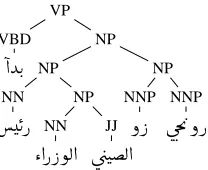
Figure 3: Example of the positive AST structured feature encoding the argument ARG0 in the sentence depicted in Figure 1.
KT(t1, t2) = Pn1∈Nt1 P
n2∈Nt2 ∆(n1, n2), where
Nt1 and Nt2 are the sets of nodes oft1 and t2,
re-spectively. The function ∆(·) evaluates the num-ber of common fragments rooted inn1 and n2, i.e.
∆(n1, n2) = P|F|i=1Ii(n1)Ii(n2). ∆ can be
ef-ficiently computed with the algorithm proposed in (Collins and Duffy, 2002).
3.4 Structural Features for Arabic
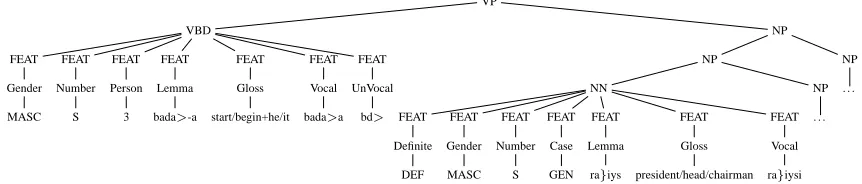
In order to incorporate the characteristically rich Arabic morphology features structurally in the tree representations, we convert the features into value-attribute pairs at the leaf node level of the tree. Fig 1 illustrates the morphologically underspecified tree with some of the morphological features encoded in the POS tag such as VBD indicating past tense. This contrasts with Fig. 4 which shows an excerpt of the same tree encoding the chosen relevant morpholog-ical features.
fea-VP
VBD
FEAT
Gender
MASC FEAT
Number
S FEAT
Person
3 FEAT
Lemma
bada>-a FEAT
Gloss
start/begin+he/it FEAT
Vocal
bada>a FEAT
UnVocal
bd>
NP
NP
NN
FEAT
Definite
DEF FEAT
Gender
MASC FEAT
Number
S FEAT
Case
GEN FEAT
Lemma
ra}iys
FEAT
Gloss
president/head/chairman FEAT
Vocal
ra}iysi NP
. . . NP
[image:6.612.90.521.62.154.2]. . .
Figure 4:An excerpt of the EAST corresponding to the AST shown in Figure 3, with attribute-value extended morphological features represented as leaf nodes.
tures described in Table 2, forming a vector of 10 preterminal-terminal node pairs that replace the sur-face of the leaf. The resulting EAST structure is shown in Figure 4.
Not all the features are instantiated for all the leaf node words. Due to space limitations, in the fig-ure we did not include the Featfig-ures that have NULL values. For instance, Definiteness is always asso-ciated with nominals, hence the verb
@YK.
bd’ ‘start’is assigned a NULL value for the Definite feature. Verbs exhibit Gender information depending on in-flections. For our example,
@YK.
‘started’ is inflected for masculine Gender, singular Number, third per-son. On the other hand, the nounZ@P PñË@
is definite and is assigned genitive Case since it is in a posses-sive, idafa, construction.The features encoded by the EAST can provide very useful hints for boundary and role classifica-tion. Considering Figure 1, argument boundaries is not as straight forward to identify as there are sev-eral NPs. Assuming that the inner most NP ‘minis-ters the-Chinese’ is a valid Argument could poten-tially be accepted. There is ample evidence that any NN followed by a JJ would make a perfectly valid Argument. However, an AST structure would mask the fact that the JJ ‘the-Chinese’ does not modify the NN ‘ministers’ since they do not agree in Number7, and in syntactic Case, where the latter is genitive and the former is nominative. ‘the-Chinese’ in fact mod-ifies ‘president’ as they agree on all the underlying morphological features. Conversely, the EAST in Figure 4 explicitly encodes this agreement includ-ing an agreement on Definiteness. It is worth notinclud-ing that just observing the Arabic word
KP
‘president’ in Fig 1, the system would assume that it is an indef-inite word since it does not include the defindef-initearti-7The POS tag on this node is NN as broken plural, however,
the underlying morphological feature Number is plural.
cle
È@
. Therefore, the system could be lead astray to conclude that ‘the-Chinese’ does not modify ‘pres-ident’ but rather ‘the-ministers’. Without knowing the Case information and the agreement features be-tween the verb@YK.
‘started’ and the two nouns head-ing the two main NPs in our tree, the syntactic sub-ject can be eitherèPAK P
‘visit’ orKP
‘president’ in Figure 1. The EAST is more effective in identifying the first noun as the syntactic subject and the second as the object since the morphological information in-dicates that they are in nominative and accusative Case, respectively. Also the agreement in Gender and Number between the verb and the syntactic sub-ject is identified in the enriched tree. We see that@YK.
‘started’ andKP
‘president’ agree in being singu-lar and masculine. IfèPAK P
‘visit’ were the syntactic subject, we would have seen the verb inflected asH
@YK.
‘started-FEM’ with a feminine inflection to re-flect the verb-subject agreement on Gender. Hence these agreement features should help with the clas-sification task.4 Experiments
differ-ences between different argument types. Tree struc-tures can be used in the learning algorithm thanks to the tree kernels described in Section 3.3. Moreover, to verify if the above feature sets are equivalent or complementary, we can join them by means of addi-tive operation which always produces a valid kernel (Shawe-Taylor and Cristianini, 2004).
4.1 Experimental setup
We use the dataset released in the SemEval 2007 Task 18 on Arabic Semantic Labeling (Diab et al., 2007a). The data covers the 95 most frequent verbs in the Arabic Treebank III ver. 2 (ATB). The ATB consists of MSA newswire data from the Annhar newspaper, spanning the months from July to November, 2002. All our experiments are carried out with gold standard trees.
An important characteristic of the dataset is the use of unvowelized Arabic in the Buckwalter transliteration scheme for deriving the basic features for the AST experimental condition. The data com-prises a development set, a test set and a training set of 886, 902 and 8,402 sentences, respectively, where each set contain 1725, 1661 and 21,194 argu-ment instances. These instances are distributed over 26 different role types. The training instances of the boundary detection task also include parse-tree nodes that do not correspond to correct boundaries (we only considered 350K examples). For the exper-iments, we use SVM-Light-TK toolkit8 (Moschitti, 2004; Moschitti, 2006) and its SVM-Light default parameters. The system performance, i.e. F1on
sin-gle boundary and role classifier, accuracy of the role multi-classifier and the F1of the complete SRL
sys-tems, are computed by means of the CoNLL evalua-tor9.
4.2 Results
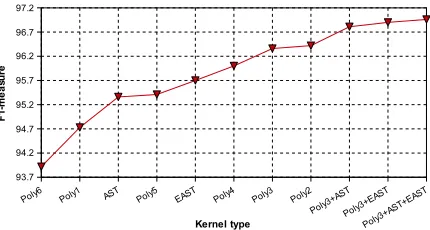
Figure 5 reports the F1of the SVM boundary
classi-fier using Polynomial Kernels with a degree from 1 to 6 (i.e. Polyi), the AST and the EAST kernels and their combinations. We note that as we introduce conjunctions, i.e. a degree larger than 2, the F1
in-creases by more than 3 percentage points. Thus, not only are the English features meaningful for Ara-bic but also their combinations are important,
reveal-8
http://disi.unitn.it/∼moschitti 9
[image:7.612.320.535.62.177.2]http://www.lsi.upc.es/∼srlconll/soft.html
[image:7.612.316.532.215.329.2]Figure 5:Impact of polynomial kernel, tree kernels and their combi-nations on boundary detection.
Figure 6: Impact of the polynomial kernel, tree kernels and their combinations on the accuracy in role classification (gold boundaries) and on the F1 of complete SRL task (boundary + role classification).
ing that both languages share an underlying syntax-semantics interface. Moreover, we note that the F1
of EAST is higher than the F1of AST which in turn
is higher than the linear kernel (Poly1). However, when conjunctive features (Poly2-4) are used the system accuracy exceeds those of tree kernel mod-els alone. Further increasing the polynomial degree (Poly5-6) generates very complex hypotheses which result in very low accuracy values.
Therefore, to improve the polynomial kernel, we sum it to the contribution of AST and/or EAST, obtaining AST+Poly3 (polynomial kernel of degree 3), EAST+Poly3 and AST+EAST+Poly3, whose F1
P3 AST EAST AST+P3 EAST+P3 EAST+AST+ P3
P 81.73 80.33 81.7 81.73 82.46 83.08
R 78.93 75.98 77.42 80.01 80.67 81.28
[image:8.612.340.511.58.213.2]F1 80.31 78.09 79.51 80.86 81.56 82.17
Table 3:F1of different models on the Arabic SRL task.
Again, we note that a degree larger than 1 yields a significant improvement of more than 3 percent points, suggesting that the design of Arabic SRL system based on SVMs requires polynomial kernels. In contrast to the boundary results, EAST highly im-proves over AST (by about 3 percentage points) and produces an F1 comparable to the best Polynomial
kernel. Moreover, AST+Poly3, EAST+Poly3 and AST+EAST+Poly3 all yield different degrees of im-provement, where the latter model is both the richest in terms of features and the most accurate.
These results strongly suggest that: (a) tree ker-nels generate new syntactic features that are useful for the classification of Arabic semantic roles; (b) the richer morphology of Arabic language should be exploited effectively to obtain accurate SRL sys-tems; (c) tree kernels appears to be a viable approach to effectively achieve this goal.
To illustrate the practical feasibility of our system, we investigate the complete SRL task where both the boundary detection and argument role classifica-tion are performed automatically. The curve labeled ”boundary + role classification” in Figure 6 reports the F1 of SRL systems based on the previous
ker-nels. The trend of the plot is similar to the gold-standard boundaries case. The difference among the F1 scores of the AST+Poly3, EAST+Poly3 and
AST+EAST+Poly3 is slightly reduced. This may be attributed to the fact that they produce similar boundary detection results, which in turn, for the global SRL outcome, are summed to those of the classification phase. Table 3 details the differences among the models and shows that the best model improves the SRL system based on the polynomial kernel, i.e. the SRL state-of-the-art for Arabic, by about 2 percentage points. This is a very large im-provement for SRL systems (Carreras and M`arquez, 2005). These results confirm that the new enriched structures along with tree kernels are a promising ap-proach for Arabic SRL systems.
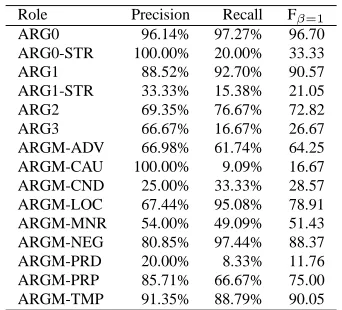
Finally, Table 4 reports the F1of the best model,
AST+EAST+Poly3, for individual arguments in the
Role Precision Recall Fβ=1
ARG0 96.14% 97.27% 96.70
ARG0-STR 100.00% 20.00% 33.33
ARG1 88.52% 92.70% 90.57
ARG1-STR 33.33% 15.38% 21.05
ARG2 69.35% 76.67% 72.82
ARG3 66.67% 16.67% 26.67
ARGM-ADV 66.98% 61.74% 64.25
ARGM-CAU 100.00% 9.09% 16.67
ARGM-CND 25.00% 33.33% 28.57
ARGM-LOC 67.44% 95.08% 78.91
ARGM-MNR 54.00% 49.09% 51.43
ARGM-NEG 80.85% 97.44% 88.37
ARGM-PRD 20.00% 8.33% 11.76
ARGM-PRP 85.71% 66.67% 75.00
ARGM-TMP 91.35% 88.79% 90.05
Table 4: SRL F1 of the single arguments using the
AST+EAST+Poly3 kernel.
SRL task. We note that, as for English SRL, ARG0 shows high values (96.70%). Conversely, ARG1 seems more difficult to be classified in Arabic. The F1for ARG1 is only 90.57% compared with 96.70%
for ARG0.
This may be attributed to the different possi-ble syntactic orders of Arabic consructions confus-ing the syntactic subject with the object especially where there is no clear morphological features on the arguments to decide either way.
5 Conclusions
We have presented a model for Arabic SRL that yields a global SRL F1score of 82.17% by
combin-ing rich structured features and traditional attribute-value features derived from English SRL systems. The resulting system significantly improves previ-ously reported results on the same task and dataset. This outcome is very promising given that the avail-able data is small compared to the English data sets. For future work, we would like to explore further explicit morphological features such as aspect tense and voice as well as richer POS tag sets such as those proposed in (Diab, 2007). Finally, we would like to experiment with automatic parses and different syn-tactic formalisms such as dependencies and shallow parses.
Acknowledgements
Mona Diab is partly funded by DARPA Contract No. HR0011-06-C-0023. Alessandro Moschitti has been partially funded by
References
Collin F. Baker, Charles J. Fillmore, and John B. Lowe. 1998. The Berkeley FrameNet Project. In
COLING-ACL ’98: University of Montr´eal.
Xavier Carreras and Llu´ıs M`arquez. 2005. Introduction to the CoNLL-2005 Shared Task: Semantic Role La-beling. In Proceedings of CoNLL-2005, Ann Arbor, Michigan.
John Chen and Owen Rambow. 2003. Use of Deep Lin-guistic Features for the Recognition and Labeling of Semantic Arguments. In Proceedings of EMNLP, Sap-poro, Japan.
Michael Collins and Nigel Duffy. 2002. New Ranking Algorithms for Parsing and Tagging: Kernels over Dis-crete structures, and the voted perceptron. In ACL02. Mona Diab and Alessandro Moschitti. 2007. Semantic
Parsing for Modern Standard Arabic. In Proceedings
of RANLP, Borovets, Bulgaria.
Mona Diab, Musa Alkhalifa, Sabry ElKateb, Christiane Fellbaum, Aous Mansouri, and Martha Palmer. 2007a. Semeval-2007 task 18: Arabic Semantic Labeling. In
Proceedings of SemEval-2007, Prague, Czech
Repub-lic.
Mona Diab, Mahmoud Ghoneim, and Nizar Habash. 2007b. Arabic Diacritization in the Context of Sta-tistical Machine Translation. In Proceedings of
MT-Summit, Copenhagen, Denmark.
Mona Diab. 2007. Towards an Optimal Pos Tag Set for Modern Standard Arabic Processing. In Proceedings
of RANLP, Borovets, Bulgaria.
Katrin Erk and Sebastian Pado. 2006. Shalmaneser – A Toolchain for Shallow Semantic Parsing. Proceedings of LREC.
Daniel Gildea and Daniel Jurafsky. 2002. Automatic La-beling of Semantic Roles. Computational Linguistics. Daniel Gildea and Martha Palmer. 2002. The Neces-sity of Parsing for Predicate Argument Recognition. In Proceedings of ACL-02, Philadelphia, PA, USA. Nizar Habash and Owen Rambow. 2005. Arabic
Tok-enization, Part-of-Speech Tagging and Morphological Disambiguation in One Fell Swoop. In Proceedings of
ACL’05, Ann Arbor, Michigan.
Aria Haghighi, Kristina Toutanova, and Christopher Manning. 2005. A Joint Model for Semantic Role Labeling. In Proceedings ofCoNLL-2005, Ann Arbor, Michigan.
Paul Kingsbury and Martha Palmer. 2003. Propbank: the Next Level of Treebank. In Proceedings of Treebanks
and Lexical Theories.
Mohamed Maamouri, Ann Bies, Tim Buckwalter, and Wigdan Mekki. 2004. The Penn Arabic Treebank : Building a Large-Scale Annotated Arabic Corpus. Mohamed Maamouri, Ann Bies, Tim Buckwalter, Mona
Diab, Nizar Habash, Owen Rambow, and Dalila
Tabessi. 2006. Developing and Using a Pilot Dialectal Arabic Treebank.
Alessandro Moschitti, Ana-Maria Giuglea, Bonaventura Coppola, and Roberto Basili. 2005. Hierarchical Semantic Role Labeling. In Proceedings of
CoNLL-2005, Ann Arbor, Michigan.
Alessandro Moschitti, Silvia Quarteroni, Roberto Basili, and Suresh Manandhar. 2007. Exploiting Syntactic and Shallow Semantic Kernels for Question Answer Classification. In Proceedings of ACL’07, Prague, Czech Republic.
Alessandro Moschitti. 2004. A Study on Convolution Kernels for Shallow Semantic Parsing. In proceedings
of ACL’04, Barcelona, Spain.
Alessandro Moschitti. 2006. Making Tree Kernels Prac-tical for Natural Language Learning. In Proceedings
of EACL’06.
Alessandro Moschitti, Daniele Pighin and Roberto Basili. 2006. Semantic Role Labeling via Tree Kernel Joint Inference. In Proceedings of CoNLL-X.
Sameer Pradhan, Kadri Hacioglu, Wayne Ward, James H. Martin, and Daniel Jurafsky. 2003. Semantic Role Parsing: Adding Semantic Structure to Unstructured Text. In Proceedings ICDM’03, Melbourne, USA. Sameer Pradhan, Kadri Hacioglu, Valerie Krugler,
Wayne Ward, James H. Martin, and Daniel Jurafsky. 2005. Support Vector Learning for Semantic Argu-ment Classification. Machine Learning.
Ryan Roth, Owen Rambow, Nizar Habash, Mona Diab, and Cynthia Rudin. 2008. Arabic Morphological Tag-ging, Diacritization, and Lemmatization Using Lex-eme Models and Feature Ranking. In ACL’08, Short
Papers, Columbus, Ohio, June.
John Shawe-Taylor and Nello Cristianini. 2004. Kernel
Methods for Pattern Analysis. Cambridge University
Press.
Honglin Sun and Daniel Jurafsky. 2004. Shallow Seman-tic Parsing of Chinese. In Proceedings of NAACL-HLT.
Cynthia A. Thompson, Roger Levy, and Christopher Manning. 2003. A Generative Model for Semantic Role Labeling. In ECML’03.
Vladimir N. Vapnik. 1998. Statistical Learning Theory. John Wiley and Sons.