C L A S S I F I C A T I O N O F M O D A L I T Y F U N C T I O N A N D I T S A P P L I C A T I O N T O J A P A N E S E L A N G U A G E A N A L Y S I S
Shozo N A r r o , A k i r a S H I M A Z U , a n d H i r o s a t o N O M U R A M u s a s h i n o E l e c t r i c a l C o m m u n i c a t i o n L a b o r a t o r i e s , N.T.T.
3-9-11, Midori-cho, M u s a s h i n o - s h i , T o k y o , 180, J a p a n
Abstract
This paper proposes an analysis method for Japanese modality. In this purpose, m e a n i n g of Japanese modality is classified into four semantic categories and the role of it is formalized into five modality functions. Based on these formalizations, information and constraints to be applied to the modality analysis procedure are specified. T h e n by combining these investigations with case analysis, the analysis method is proposed. This analysis method has been applied to Japanese analysis for machine translation.
1. I n t r o d u c t i o n
Since the m e a n i n g of a sentence consists of both proposition and rnodality, TM analysis of modality is as indispensable as that of proposition for natural language understanding and machine translation. H o w e v e r studies on natural language analysis have mainly concerned with t h e propositional part, and algorithms for analyzing rnodality have not yet been sufficiently developed. T h e aim of this paper is to clarify the function of modality and to propose a method for analyzing the modality in Japanese sentences.
Structure of a Japanese complex sentence can be formalized roughly by iterative concatenation of simple sentences. The simple sentence consists of cases and a predicate. The cases have surface representations of noun phrases or adverb phrases while the predicate has that of verb or adjective or adjective verb. A noun p h r a s e is d e f i n e d as the r e c u r s i v e c o n c a t e n a t i o n of noun p h r a s e or t h a t of e m b e d d e d s e n t e n c e . We have e m p l o y e d '.he case s t r u c t u r e as a basic m e a n i n g s t r u c t u r e for a s i m p l e s e n t e n c e , and e x t e n d e d it to r e t a i n the c o n s t r u c t i o n of complex s e n t e n c e s m e n t i o n e d . M o d a i i t y is a d d i t i v e i n f o r m a t i o n r e p r e s e n t e d by a u x i l i a r y words such as m o d a l p a r t i c l e s , e n d i n g p a r t i c l e s , a n d a u x i l i a r y v e r b s a n d s e n t e n c e adverbs. The m o d a l p a r t i c l e is a t t a c h e d to a noun p h r a s e or a s e n t e n c e e l e m e n t while the e n d i n g p a r t i c l e is a t t a c h e d to the enci position of a s e n t e n c e . The a u x i l i a r y verb ! m m e d i a t e l y follows a v e r b p h r a s e . M o d a l i t y r e p r e s e n t e d in such g r a m m a t i c a l l y d i f f e r e n t context is incorporated into the case structure, and the result construction is n a m e d as an extended case
structure Ivl which enable us to propose a uniform framework for analyzing both proposition and modality. In this paper, we first classify modality into four semantic categories. Second, we define five modality functions using the logical representation of the m e a n i n g and then characterize the roles of each function. Third, we specify hard problems to be resolved in modality analysis. Fourth, we list the information and constraints to be considered in establishing the procedure of modality analysis. Then, we propose a method for analyzing modality based on these investigations. Finally, we exemplify the analysis by showing translations from Japanese into English. The method has been used to analyze Japanese sentences in a machine translation system. 17~
2, Classification of modality
Traditionally, modality has been classified into three categories, i.e. tense, aspect and modal. :0-! This classification is not sufficient for the deep analysis of the m e a n i n g structure of a sentence, however, because it does not account for the role of Japanese modal particles. Adding t h i s role, we expand this c l a s s i f i c a t i o n into four c a t e g o r i e s , n a m e l y tense, aspect,
modal
a n dimplicature
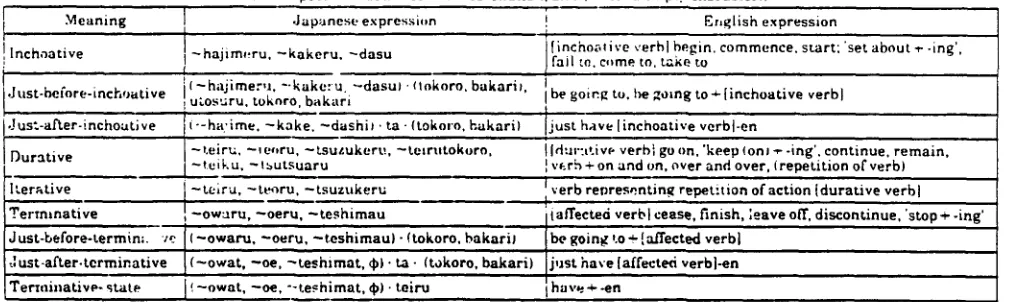
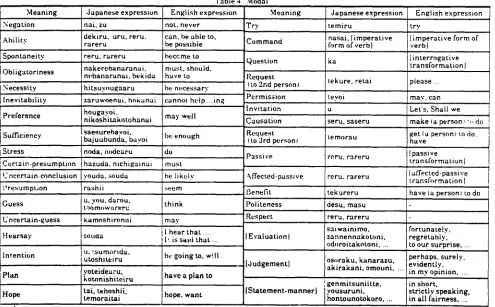
s h o w n in T a b l e 1. E a c h c a t e g o r y can be f u r t h e r c l a s s i f i e d into s u b c a t e g o r i e s , and those a r e shown in T a b l e 2 t h r o u g h T a b l e 5 ( E a c h t a b l e g i v e s both e x a m p l e s of J a p a n e s e e x p r e s s i o n s a n d t h e i r E n g l i s h e q u i v a l e n t s ) . O u r c l a s s i f i c a t i o n of m o d a l i t y f e a t u r e s two c h a r a c t e r i s t i c s c o n c e r n i n g the a s s i g n m e n t of a d v e r b s a n d m o d a l p a r t i c l e s :(1) A m o n g the two k i n d s of a d v e r b s , n a m e l y s e n t e n c e a d v e r b s a n d case a d v e r b s , we a s s i g n s e n t e n c e a d v e r b s to m o d a l i t y while case a d v e r b s to case r e l a t i o n s . S e n t e n c e a d v e r b s a r e classified into t h r e e s u b c a t e g o r i e s in the m o d a l
Table I. Four categories of Modalitv
Categories Meaning
Tense i temporal view of a event relative to the speaking time
state of events viewed from time progress at a Aspect sl:ecifled time point
Modal speaker's or agent's attitude or judgement to the occurrence of events
category : [evaluation], [judgement] a n d
[statement-manner]. (Traditionally, all
adverbs are assigned to modality.)
(2) M o d a l particles are assigned to modality a n d
are classified into a distinct category,
implicature (They h a v e been usually discussed
separately from modality) ~41.
3. M o d a l i t y functions a n d their roles
B y e m p l o y i n g logical expression as the
representation of the m e a n i n g structure, w e can define
modality functions as operations on logical expressions
in strict terms. In the past, studies on modality
analysis in logical f r a m e w o r k treated each type of
modality individually. IsH6] Here, w e deal with it,
however, as a w h o l e a n d c o m b i n e it with the
propositional structure so that w e can provide a
uniform f r a m e w o r k for the representation a n d the
analysis of the m e a n i n g structure. In this purpose w e
e m p l o y the higher order m o d a l logic formalism. It1
In this regard, w e introduce the five types of
modality functions, w h i c h add or modify modality :
{I) addition of the modality operator.
{2) surface modification of the case structure.
(3) semantic modification of the case structure.
(4) determination of the scope of negation,
(5) addition of the implicative m e a n i n g .
W e will n o w discuss the roles of each type of
modality function respectively by indicating their
logical representations.
3.1 A d d i t i o n o f t h e m o d a l i t y o p e r a t o r
This is the m o s t f u n d a m e n t a l function a n d it simply
adds the modality m e a n i n g to the propositional
m e a n i n g . In the following two sentences, (sl) has no
modality while (s2) has modality :
( s l ) Hiroko ga hashiru. (Hiroko runs.) Run(Hiroko),
" ~ In the ~'ollowing. each example sentence is succeeded by an
[image:2.612.56.573.559.710.2]English translation and a logical representation .f the meaning
Table 3. Tense
Japanese
Meaning ,expression
Past t a
Non-past ru
English expression
-ed (past tense)
present tense, or future tense
(S2) Hiroko ga h a s h i t t e i r u .
(Hiroko is runnzng.)
[ d u r a t i v e ] R u n ( H i r o k o ) .(s2) is o b t a i n e d by a d d i n g t h e d u r a t i v e aspect o p e r a t o r " t e i r u
(progressive)" to
(sl) c'~.3.2 S u r f a c e m o d i f i c a t i o n o f t h e c a s e s t r u c t u r e
T h i s does n o t c h a n g e the logical m e a n i n g s t r u c t u r e e v e n w h e n the surface s t r u c t u r e is modified. H o w e v e r h i g h e r level i n f o r m a t i o n such as focus a n d a t t e n t i o n is s o m e t i m e s added.
T h e passive a u x i l i a r y v e r b " r e r u " or " r a r e r u " c a n modify the surface case s t r u c t u r e w i t h o u t c h a n g i n g the logical m e a n i n g s t r u c t u r e . T h e focus is u s u a l l y placed on the ~ubject p a r t of the passive s e n t e n c e , as follows :
(s3) Hiroko ga y a s a i we t a b e r u .
(Hzroko eats vegetables.},
3x(Vegetable(x)AEat(Hiroko,x)),
(s4) Yasai ga Hiroko ni tabe rareru.
(Vegetables are eaten by Hzroko.),
3x((Vegetable(x)AEat(Hiroko,x))A{Focus(x)}),
w h e r e the predicate Focus(x) signifies that the focus is
placed on the a r g u m e n t x.
3.3 S e m a n t i c m o d i f i c a t i o n of the c a s e structure
This results in one of the two alternatives :
(a) one a r g u m e n t is a d d e d to the original predicate, (b:, a higher order predicate is introduced.
Both changes are equivalent in m e a n i n g but the w a y of
representing the c h a n g e is different.
T h e following fragments of modality cause the
semantic modification of the case structure :
I) causative C s e r u " or "saseru"),
2J affected-passive C r e r u " or "rareru"),
3) hope Ctehoshii'" a n d "temoraitai"),
4~ request ,~"temorau"),
5) benefit ("tekureru .... teageru", a n d "teyaru").
Tabie 2. Aspect ( tdou means c o n c a t e n a t i o n , and d~ mtans empty character.)
Meaning Japanese expressi.n ~ Er~glish expression
Inchoative
• ] ust-bei'or e- incJ'd~a tive
haji mf~ru, - kakeru. ~dasu
I . . . .
( - h a j i m e r u , *-kakc:u ~dasuJ (tokoro, bakari;, u~.osuru, tokoro, bakari
[inchoa=ive
verhl
begin, commence, start: 'set about -. -ing'. fai to. c~me to, take toI be go ng to. be go=ng to-*-[inchoative verbl
just have [inchoative verbi-en
J u s t - a f t e r d n c h o a t i v e i - - h a ' l i n e . ~ k a k e . ~ d a s h i # . ta - ( t o k o r o , h a k a r i )
Durative ~teiru, ~ e.ru, ~tsuLukert:, ~tesrutokoro, 11dut-:ttive verb~ go on, "keep (onJ *- -ing'. continue, remain,
teik u. ~ t~utsuaru I ver.h + on and on, over and over, (repetition of verb)
Iterative -teiru, ~teoru, -tsuzukeru t verb reDresnntin~ repetition of action (durative verbl
Terminative
J ust-before-termin:, te
--owaru, --oeru, -teshimau
(-owaru, -oeru, -teshimau) - (tokoro, bakarD
(-owat, -oe, ~teshimat, d#). ta- (tokoro, bakari)
! ~owat, -oe, --te.~himat, ~b) • telru
J ust-after-terminative
Terminative- qtate
g r {, I
I
{affected verbl cease, finish, leave off, discontinue, 'stop d- -ing'
be going t.o -¢- { affected verbl
[
just have {affected verbl-enF o r a n e x a m p l e , the c a u s a t i v e a u x i l i a r y v e r b " s e r u " or % a s e r u " r e s u l t s in (a) the a d d i t i o n of the c a u s a t i v e a g e n t , or (b) t h e i n t r o d u c t i o n of a s e c o n d - o r d e r p r e d i c a t e C A U S E ( x , y ) in w h i c h a r g u m e n t x r e p r e s e n t s the c a u s a t i v e a g e n t a n d a r g u m e n t y r e p r e s e n t s a p r e d i c a t e , as follows :
(s5) T a r o ga H i r o k o ni y a s a i wo tabe s a s e r u .
(Taro makes Hiroko eat vegetables.)
( a ) 3 x ( V e g e t a b l e ( x ) / ' , E a t ' ( H i r o k o , x , T a r o ) ) , or ( b ) 3 x ( V e g e t a b l e ( x ) A C A U S E ( T a r o ,
Eat(Hiroko,x))), w h e r e t h e p r e d i c a t e E a t ' ( x , y, z) is o b t a i n e d by a d d i n g the a r g u m e n t z c o r r e s p o n d i n g to the c a u s a t i v e a g e n t to the p r e d i c a t e Eat{x, y) in (s3).
F o r a n o t h e r e x a m p l e , t h o u g h the a u x i l i a r y v e r b " r e r u " or " r a r e r u " has five m e a n i n g s , n a m e l y , "passive", "affected-passive", " a b i l i t y " , " r e s p e c t i v e " and " s p o n t a n e i t y " , " p a s s i v e " m e a n i n g a m o n g t h e m falls into type (2) above w h i l e " a f f e c t e d - p a s s i v e " m e a n i n g falls into this type and the a f f e c t e d - a g e n t is added :
Is6) T a r o ga H i r o k o ai y a s a i wo tabe r a r e r u .
(Taro was'adversely) affected
by Hiroko's eating vegetables.)
(a) 3x(Vegetable( x }/xEat"(Hiroko.x.Ta ro)), or ( b ) 3 x ( V e g e t a b l e ( x ) A A F F E C T E D - P A S S I V E( T a r o , E a t ( H i r o k o , x ) ) ) .
[image:3.612.74.569.396.703.2]3.4 D e t e r m i n a t i o n o f t h e s c o p e o f n e g a t i o n
Table 5. Implicature
Meaning
LimitationD e g r e e
Extreme-example
Japanese expression
shika, kin, dake, bakari, made, kurai
dake, bakari, hodo, kurai
sac, demo, datte, m a d e
English expression
only
as, about
e v e n
Stress sae, ha, too, koso even
E x a m p l e demo, nado, nari for example
Parallel yara, ya, m o and
Addition I sae, m a d e also
Selection earl, ka or
Uncertainty ~ara, ka s o m e
Distinction ha us for
T h e m o d a l p a r t i c l e " w a " d e t e r m i n e s the role of the a u x i l i a r y v e r b " n a i " as a p a r t i a l n e g a t i o n w h i l e the case p a r t i c l e " g a " d e t e r m i n e s it as total n e g a t i o n . In t h e f o l l o w i n g s e n t e n c e s , (s9) is p a r t i a l l y n e g a t e d w h i l e (s8)
i s t o t a l l y n e g a t e d :
(s7)Zen'in ga k u r u .
[Everybody comes.)
v x ( S ( x ) 3 C o m e ( x ) ) ,
(s8)Zen'in ga ko nai.
(Nobody comes.)
vx(S(x) ~ ~ Come(x)),(sg)Zen'in wa ko nai.
(Not everybody comes.)
-- v x ( S ( x ~ ~ C o m e ( x ) ) ,
w h e r e the p r e d i c a t e S(x) d e n o t e s " z e n ' i n
[all the
persons)".
Table4 Medal
M e a n i n g I .Japanese expression English expression M e a n i n g .Japanese expression
Negation nai, z u not. n e v e r temiru
Ability dekiru, uru, reru. rareru
can. he able to. be possible
Spontaneity ~ re r u , r a r e r u heccme to
nakerebanaranai, must. should, Obligatoriness m~banaranai, bekida have to
Necessity ! hitsuyougaaru he necessary
lnevitabdity zaruwoenai, hokanai canno! help ...ing
hougayoi. I nikoshitakotohana
I saesurebavoi. "
Try
! C o m m a n d
Question
nasal, [imperative form of verbl
ka
English expression
try
[imperative form of verbl
[ interrogative transformationl
Request tekure, retai please ...
(to 2nd personl
Permission teyoi may. can
Invitation U Let's, Shall we
I s e r e . s a s e r u P r e f e r e n c e m a y well
Causation
Sufficiency " bajuubunda, bayoi he enough Request (to 3rd personl temorau
Stress noda, nodearu do
Passive reru. rareru Certain-presumption !hazuda. nichigainai must
1-ncertain-conclusion vouda, souda he likely
:'resumption rashii ~eem
Guess u, you. darou, think
t o o m ( ~ w a r e r u
Uncertain-guess kameshirenai m a y
Hearsay soucta I l hear that
! I'. is said that ...
int.ention , u, :sumortda. utoshiteiru be going to. will.
Plan voteidearu, have a plan to
kotonishiteiru
tai. tehoshii, hope, want
Hope temoraitai I
make (a person, ',, do
get (a person~ to do. have
{passive transformationl
[affected-passive •
~.ffected-pass~ve reru. rareru transformationr
13enefit tekureru ! have la person~ to do
d e s u , m a s u P o l i t e n e s s
Respect
Evaluationl
r e r u . r a r e r u saiwalnimo, z a n n e n n a k o t o n i . o d o r o i t a k o t o n i . . . .
[Judgement] osoraku, kanarazu,
akirakani, o m o u n i ....
genmitsuniitte,
(Statement-mannerJ yousuruni,
hontounotokoro ....
fortunately, regretably, to our surprise ....
perhaps, surely, evidently, in m y opinion ....
i n s h o r t .
3.5 A d d i t i o n o f t h e i m p l i c a t i v e m e a n i n g
An extra logical formula corresponding to the
implicative m e a n i n g is added by modal particles such
as % h i k a
(onlyf
and ~dake
(only)" as
in :
(sl0) Hiroko w a yasai shika tabe nai.
(Hiroko eats nothing but vegetables.)
~x(Vegetable(x)AEat(Hiroko,x))
Avx( -~Vegetable(x)~ -,
Eat(Hiroko,x)).
4, P r o b l e m s in modality analysis
4.1 A m b i g u i t y of the modality m e a n i n g
(I) Ambiguity due to multiple m e a n i n g
The aspect expression "teiru" has three different
kinds of meanings, that is, the "durative", "iterative"
or
"terminative-state" aspects. For example,
(sll)Hiroko ga yasai w o tabe teiru.
(Hiroko {is eating, eats and eats. has eatenl
vegetables.)
3x(Vegetable(x)
/x{[durative],[iterative],[ t e r m i n a tire-state]}
Eat(Hiroko, x)).
(21 Ambiguity concerned with case structure
As stated in Section 3.3 above, the auxiliary verb
"reru" or " r a r e r u " has five meanings, and, among them,
the "passive" and "affected-passive" meanings result in
modification
to the
case
structure.
Therefore,
disambiguation of the m e a n i n g of ~reru" or " r a r e r u "
has a close relationship to analysis of the propositional
meaning.
Moreover the auxiliary verb " r a r e r u " in the
following {s12) means "respect", and that in (s13)
means
"passive",
respectively.
Whereas,
both
expressions are same except the additional m e a n i n g of
respect and focus, as follows :
(sl2)Sensei ga yasai w o tabe rareru.
(The teacher eats vegetables.)
3x(Vegetable(x)/kEat{the-Teacher,x))
ARespect(Speaker,the-Teacher),
(sl3)Yasai ga sensei ni tabe rareru.
(Vegetables are eaten by the Teacher.;
3x((Vegetable(x)/xEat(the-Teacher,x))
/x{Focus(x)}),
where the predicate Respect{x,y) m e a n s that x respects
y.
4.2 S c o p e of modality
Even if',he
main clause has a negative expression, it
does not always m e a n that the main clause is negated.
Sometimes the subordinate clause is negated. W e call
this p h e n o m e n o n
the
transfer
of
negation.
Furthermore even if rnodality involved is not negation,
it sometimes affects the subordinate clause.
Although the main clause in the following (s14) is
not usually negated, the subordinate clause is.
Nevertheless, the tense information in the m a i n clause
has an effect on the subordinate clause. (s14) is
constructed from (s14-1) and (s14-2) by a simple
coordinate conjunction, however the corresponding
logical expression is not a simple concatenation of each
logical
expression :
(sl4)Taro w a hige w o sot be kaisha e ika nakat ta.
(Taro went to the company without shaving.)
[past] -- Shave(Taro,beard)
A{past]Go(Taro,Company),
(sl4-1)Taro wa hige wo soru.
(Taro shaves beard.
Shave(Taro, beard),
(sl4-2)Taro wa k a i s h a e ika n a k a t ta.
(Taro did not go to the company.)
[past]-- Go(Taro, Company).
(sS) and (s9) also exemplify the problem for determining
the scope of negation.
4.3 T r e a t m e n t of implicative m e a n i n g
Modal particles such as "shika
(only)"
and "sae
(even)"
convey individual implicative meaning.
In
order to obtain the logical representation of the
implicative meaning, we are forced to provide different
formulae expressive of the each m e a n i n g of each modal
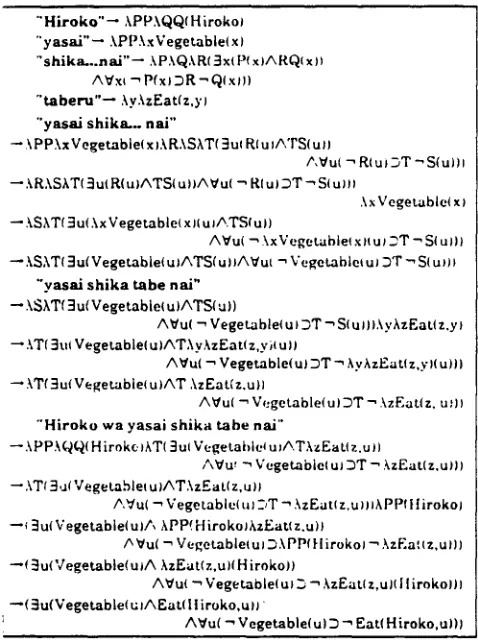
particle. For example, if w e assign the formula (fl) to
the expression %hika...nai" which consists of the modal
particle "shika" and auxiliary verb "nai", w e get the
logical representation of the sentence Is10) by the
procedure of ~,-calculus
s h o w n in Fig. I.
(fl)"shika...nai'--
~LP,kQkR(3x(P(x)ARQ(x))
AVx(-,P(x)~R--Q(x))).
A s can be seen from the example, the logical
formula for
the implicative m e a n i n g is very individual. This
concludes that specification of it for each m e a n i n g is
very complicated and hard, and a more effective
method
is therefore needed.
5. I n f o r m a t i o n
a n d
c o n s t r a i n t s
on
m o d a l i t y
a n a l y s i s
(1) l,exicai m e a n i n g
The lexical m e a n i n g assigned to each modality
expression is the most fundamental information. So w e
need to specify and provide it. For example, the lexical
meaning of the auxiliary verb "ta" is generally the
"past" tense as in :
(slS)Hiroko ga hashit ta.
(Hiroko ran.)
[past]Run(H.;roko).
(2) Predicate features
Predicate features are available for disambiguating
the m e a n i n g of modality.
( s l 6 ) H i r o k o ga h a s h i t t e i r u .
(Hiroko is running.)
[ d u r a t i v e ] R u n ( H i r o k o ) ,( s l 7 ) A k a x i ga kie t e i r u .
(The light is turned off.)
[ t e r m i n a t i v e - s t a t e ] T u r n - o f f ( t h e - L i g h t ) , where the verb mnashiru(run)"
h a s the " c o n t i n u o u s " f e a t u r e while the verb " k i e r u(turn off)"
h a s the " s p o n t a n e o u s " feature. T h e aspect expression " t e i r u " following a " c o n t i n u o u s " verb u s u a l l y m e a n s the " d u r a t i v e " aspect, a n d " t e i r u " following a " s p o n t a n e o u s " verb u s u a l l y m e a n s the " t e r m i n a t i v e - state" aspect.T h e " s p o n t a n e i t y " m e a n i n g of " r e r u " or " r a r e r u " is realized o n l y w h e n it follows the v e r b s h a v i n g s p o n t a n e i t y feature such as "omoidasu
(remember)"
a n d " a n j i r u(care)".
(3) N o u n p h r a s e s a n d a d v e r b s
Some k i n d s of n o u n phrases, adverbs, a n d t h e i r s e m a n t i c categories can be utilized to d i s a m b i g u a t e the m e a n i n g of modality, w h e n they occur s i m u l t a n e o u s l y with it.
( s l 8 ) H i r o k o ga yasai wo i.m.a tabe teiru,
(Hiroko is eating vegetables now.)
3x(Vegetable(x)A [ d u r a t i v e ] E a t " ( H i r o k o , x , n o w ) ) .
"Hiroko"-- ,\PP.\QQ( HirokoJ "yasai"-- .\PP.\xVegetable(x}
"shika...n a]"-- ,~.P,\Q,k R( qx( P( x )Zk R Q ( x )I A V x ~ ~ P f x J D R ~ Q I x J J )
"taberu"-- .~ySzEatfz,yJ "yasai shlka._ nai"
-- ),PP.kx Vegetable( x hkR.\S~T( 3ul R(uJATS(uJ~
A V u ( ~ R(ul D T ~ S(u))t - - SR.\SLT( -3u(R(uJATS( u ) ) A V u ( ", R{ u~ D T ~ S(u)~)
.\ x Vegetable( x; -- .\ShT( B u(.kx Vegetable( x J( u J/x.TS(u))
A V u ( ~ .\x V e g e t a b l e ( x }( u~ ~ T ~ S( u J)) - - , \ S ~ T ( " ] u ( V e g e t a b l e ( u ~ A T S ( u ) JAVut -~ Vegetable(u# D T ~ S( u~)~
"yasai shika tabe nai"
-- S$},Tf 3u(Vegetabie(u)ATS(u))
A V u ( "- Vegetable(u) D T " S( ul)lAyAzEat(z.yl --.~T( 3tu Vegetable( u)AT,\y,kzEat(z,yi( u D
AVu( ~ Vegetable(u} DT -~ ~ykzEat(z,y fl u)}) --.kTf3u(Vegetable(u)AT .\zEat(z.u)l
AVu( ~ Vegetable(u)DT ~ .kzEatiz. u:)) "Hiroko wa yasai shika tabe hal"
--.\PP.~QQ(H iroke JAT( qu( Vegetable4 uJ/\T,kzEat(z.u J)
,~,Vu, "- Vegetable( uJ DT ~ .kzEat(z.uJD --,kT( =l,J(Vegetable(u}/kTSzEat(z,uU
A V u ( -, Vegetable(ul S,T -, .\zEat( z,unJhPP(ilirokoj - - ( 3 u ( V e g e t a b l e ( u l / , kPP(HirokoJkzEat(z.u)}
/ ~ V u ( ~ V e g e t a b l e ( u l D . \ P P f H i r o k o J ~ ,t, zF, a ' ( z , u l ) ) --( 3 u ( V e g e t a b i e ( u ~ A ~.zEat(z.ui(Hiroko))
AVu( -- Vegetable( a J D " kzEat( z,u}( I I irokol)J ~ ( ~ u ( V e g e t a b l e ( u t / k E a t ( I l i r o k o , , , ) J '
[image:5.612.72.311.363.684.2]AVu( ~ Vegetable(u) D "~ Eat( Hiroko,ulD
Fig. 1. Logical analysis of the setltence (sl0)
(s19)Hiroko ga y a s a i wo s u d e n i tabe t e i r u .
(Hiroko has already eaten vegetable.)
3 x ( V e g e t a b l e ( x ) A [ t e r m i n a t i v e - s t a t e ]E a t ' ( H i r o k o , x , a l r e a d y ) ) . I n the above e x a m p l e s , the a d v e r b " i m a
(now)"
is c o n c e r n e d w i t h the " d u r a t i v e " aspect, w h i l e " s u d e n i(already)"
is c o n c e r n e d w i t h t h e " t e r m i n a t i v e - s t a t e " aspect. T h e a r g u m e n t z of the predicate Eat"'(x,y,z) r e p r e s e n t s time i n f o r m a t i o n .(4) M o d a l p a r t i c l e s
As discussed i n Section 3 ( s e n t e n c e s (s8) a n d (s9)), the modal particle "wa" o c c u r r i n g s i m u l t a n e o u s l y w i t h n e g a t i o n s u g g e s t s p a r t i a l n e g a t i o n .
(5) C o n j u n c t i v e r e l a t i o n s
C o n j u n c t i v e r e l a t i o n s are r e l a t e d to the scope of m o d a l i t y . If the s u b o r d i n a t e clause has the following c o n j u n c t i v e r e l a t i o n s r e p r e s e n t e d by
(a) the c o n j u n c t i v e particle "te", or
(b) a r e l a t i v e n o u n such as "toki
(trine)"
or "mae(before)"
modified by embedded sentences,the t r a n s f e r of n e g a t i o n can be predicted as in s e n t e n c e (s14). O t h e r w i s e , the t r a n s f e r will n e v e r occurs as follows :
(s20)Taro wa hige wo sot ta ga
k a i s h a e ika n a k a t ta. ( T h o u g h Taro s h a v e d his beard,
he did not go to the company.) [ p a s t ] S h a v e ( T a r o , b e a r d )
A[ past] ~ G o ( T a r o , C o m p a n y ) .
(6) S e m a n t i c r e l a t i o n s b e t w e e n t h e s u b o r d i n a t e c l a u s e a n d t h e m a i n c l a u s e
T h i s i n f o r m a t i o n is used to d e t e r m i n e the scope of n e g a t i o n in the m a i n clause. In the s u b o r d i n a t e clause with the c o n j u n c t i v e particle "te", if the e v e n t expressed by it is s u b s i d i a r y for the occurrence of the e v e n t in the m a i n clause, the t r a n s f e r of n e g a t i o n can occur. O n the other h a n d , if the s u b o r d i n a t e e v e n t is i n d i s p e n s a b l e to the occurrence of the m a i n e v e n t , the t r a n s f e r n e v e r occurs. For example, in (s14), since the modifier e v e n t S h a v e ( T a r o , b e a r d ) is a s u b s i d i a r y e v e n t for the occurrence of the m a i n e v e n t Go(Taro,Company), the t r a n s f e r of n e g a t i o n is possible. In the following s e n t e n c e (s21), however, since the e v e n t Go(Taro, W a s h i n g t o n ) is a n i n d i s p e n s a b l e e v e n t for the occurrnece of the m a i n e v e n t See(Taro,White-House), the t r a n s f e r ts impossible :
(s21)Taro wa W a s h i n g t o n e it te
W h i t e House wo mi n a k a t ta.
(Taro did not see the White House
when he went to Washington.)
[ p a s t ] G o ( T a r o , W a s h i n g t o n )6. M o d a l i t y
a n a l y s i s
6.1 S t r a t e g y
o f t h e m o d a l i t y a n a l y s i s
Considering the five modality functions defined in
Section 3, it is a p p a r e n t t h a t the logical analysis
method alone is not effective for modality analysis.
There are three reasons for this :
(1) Reference to other expressions is needed to
resolve the a m b i g u i t y of the modality function,
(2) Structural modification occurs when the scope
of negation is transferred,
(3) Analysis of the implicative m e a n i n g sometimes
cause the change of logical expression.
There remains, however, the problem of taking the
individuality of each modality into account. For some
kinds of modality, the result of the case analysis or the
conjunctive analysis is used to analyze it.
These
represent the reasons why we propose an analysis
method consisting of the following three modules
combined with the case analysis and the conjunctive
analysis :
( 1)pre-case-analysis :
activated before the case analysis, (2)post-case-analysis :
activated after the case analysis, (3)post-conjunctive-analysis :
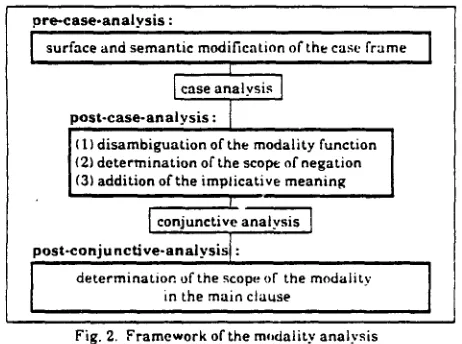
activated after the conjunctive analysis. The relationship of these three modules to the case analysis and the conjunctive analysis is s h o w n in Fig. 2.
ore-case.analysis :
I surface
and
semantic modification of the case framef
[ case analysis ]
post-case-analysis
: [
(I} disambiguation of the modality function [
E
(2) determination of the scop~ of negation
[
(31 addition of the implicative meaningI c°njunctive analysis I
post-conju nctive-an alysis :
[image:6.612.57.288.432.604.2]I determinatioa of the scope of the modality in the main clause
Fig. 2. Framework of the m,dality analysis
6.2 A l g o r i t h m s of e a c h sub-analysis (1) Pre-case-analysis
T h e modality whose analysis requires only lexical m e a n i n g or which causes a change of the case structure is analysed at this stage. T h e case frame to be assigned to the predicate is mcdified by utilizing the result of
this analysis before starting the case analysis. A s for the semantically a m b i g u o u s auxiliary verb "reru" or "rareru", its role is only predicted at this stage, because it is also concerned with the modification of the case structure. After case analysis, the plausibility of the prediction is evaluated. T h e modification of the case frame is as follows :
(a) For the "passive" m e a n i n g of "reru" or "raxeru" (which causes a surface change to the case structure as mentioned in Section 3.2), the object case of the original case frame is changed into the surface subjective case, and the modality category "passive" is assigned to the m e a n i n g structure. If two object cases exist, two possible modifications are performed.
(b) With the modality causing a semantic change to the case structure (for the modality function stated in Section 3.3), a n e w case is added as follows:
(bl)For the "causative", "affected-passive", "hope" or "request" m e a n i n g : A n e w agent (e.g. causative-agent / affected-agent) is added, and the case particle of the original subjective case is changed from "ga" to "hi",
(b2)With the "benefit" m e a n i n g : A beneficiary case is added. T h e case particle in this case is "hi".
Also the modality category corresponding to each m e a n i n g (e.g. "causative", "affected- passive") is assigned to the m e a n i n g structure.
(2)
Post-case-analysisT h e modality whose analysis requires case structure information is analyzed at this stage. This module determines the function of the modality as follows : (a) [f the category of the modality expression is
unique, this category is assigned to the m e a n i n g :;tructure.
(b) if a d a e m o n (a procedure to resolve ambiguities by using heuristics) is attached to the rnodality expression, it performs the three tasks :
(bl) disambignating the function of the modality expression,
(b2) detcrmining the scope,
(b3) adding the implicative meaning.
The d a e m o n utilizes the information mentioned in (I) - (4) in Sect, ion 5. For example, a d a e m o n attached to the aspect expression "teiru" works as s h o w n in Fig. 3. (3) Post-conjunctive-analysis
Is there a case element (noun phrase
or
adverb) suggesting "terminative-state" or "durative" or "iterative" aspect? [no
Does "teiru" follow
" r e r u " o r ~rarerxl'~.
yes ~, I terminative-
state aspect
~
yes [ terminative-state [[ or durative
~no [ or iterative aspect
I Is the feature of the predicate
"spontaneous~
I
no~
,~ y .
I state
I
Fig. 3. Daemon which disambiguates the meaning ofthe aspect expression "teiru"
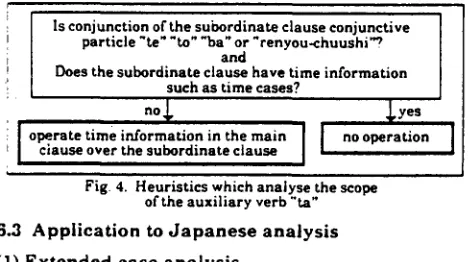
information presented in Section 5. A n example of heuristics which analyze the scope of the a u x i l i a r y verb "ta" is shown in Fig. 4.
For n e g a t i o n in the m a i n clause, the transfer of n e g a t i o n is considered. W h e t h e r or not the modifier event is subsidiary for the occurence of the m a i n e v e n t is tested using the s e m a n t i c relations assigned to the
)redicate of the m a i n clause.
Is conj unction of the subordinate clause conjunctive particle "te" "to" "ba n or "renyou~chuushi"?
and
Does the subordinate clause have time information such as time cases?
no Jr Jfyes
[image:7.612.58.300.67.220.2]operate time ir~'ormation in the main ~ I . no operation I clause over the subordinate clause
Fig 4. Heuristics which analyse the scope of the auxiliary verb "ta"
6.3 Application to J a p a n e s e analysis (I) E x t e n d e d case analysis
W e have already proposed a method n a m e d extended case analysis for Japanese sentences. IvT Input to the extended case analysis is an ordered list of word frames produced by a morphological analysis. The analysis begins to predict a constituent construction of the sentence to be analyzed by utilizing syntactic structure patterns, and then enter into the detail analysis of semantic relations between pairs of the modifier and the modificant by utilizing semantic relation frames. There are four types of the semantic relations, namely, case relation, noun concept relation, embeding relation and conjunctive relation. All of these semantic relations are analyzed in a uniform framework. The both analyses go on iteratively and/or recursively from a small chunk of constituents to large one. Each iteration and recursion executes both the prediction of the syntactic structure and the analysis of semantic structure. The modality analysis is incorporated into those processes.
Let us show the modaiity analysis process for the following example sentence :
(s22)Niku wa n o k o t teite,
y a s a i d a k e ga K i r o k o ni tabe rare teita.
Meat had remained, and
only vegetables had been eaten by Hiroko.
At
first, it is a n a l y s e d t h a t this sentence is a complex sentence by utilizing s y n t a c t i c s t r u c t u r e p a t t e r n s . A f t e r s e m a n t i c s t r u c t u r e s of the modifier and the m a i n clause are analysed, conjunctive relation between these clauses is analyzed. Now, we show a n a l y s i s of the m a i n sentence.T h e following case e l e m e n t s a n d a predicate are analysed by applying structure patterns before starting case analysis :
case1 = "yasai", "ga", "dake", case2 = ~liroko", "ai",
predicate = "taberu", "rareru", %eiru", %a', where "dake", "rarern', "teiru", and "ta" are modality exp~'essions. "Hiroko" and "yasai" have semantic categories, [human] and [food] respectively in each word frame.
(2) Modification of case f r a m e
Case frame is prepared for each m e a n i n g of each predicate. A n intrinsic case frame for the verb "taberu
(eat)" is as follows (Optional cases such as time and
place are omitted here) :
[the intrinsic case frame of the verb "taberu (eat)"] :
Agent -- [human], "ga", Object = [food], ~wo".
Each case slot in the case frame is assigned semantic categories and case particles as constraints to be satisfied by the filler.
The following alternative case frames produced by modifying the intrinsic frame are also prepared before starting case analysis because of the existence of the a u x i l i a r y verb ~rareru" :
["passive" modification of the case frame] : A g e n t = [ h u m a n ] , "hi",
Object = [food], "ga",
["affected-passive" modification of the case frame] : Affected-agent - [ h u m a n ] , "ga",
A g e n t = [ h u m a n ] , "ni", Object - [food], "wo".
These three case frames are examined w h e t h e r each case e l e m e n t in the sentence satisfies constraints. As a result, in this case, "passive" modification case frame is selected as a best m a t c h i n g , and case role of each case e l e m e n t is d e t e r m i n e d as follows :
c a s e l = Object, case2 = Agent.
This result is showing that the m e a n i n g of ~rareru" is "passive".
(3) Determination of meaning of modality
[image:7.612.60.295.322.453.2]performed by the heuristics s h o w n in Fig. 3, where the
m e a n i n g is determined as "terminative-state" judging
from the fact that "teiru" follows "raxeru". T h e
m e a n i n g of the modal particle "dake" is multiple, that
is, "limitation" and "degree". In this case, "limitation"
is
selected by heuristics.
(4) Determination of scope of modality in the m a i n
c l a u s e
After conjunctive analysis between the modifier and
the m a i n clause, scope of the auxiliary verb "ta" in the
m a i n clause is analyzed. Using heuristics shown in
Fig. 4, it is analyzed t h a t "ta" also o p e r a t e s on the
subordinate clause.
In a result, the m e a n i n g structure of (s22) is
obtained as follows :
3x((Meat(x)A[past][terminative-state ]Remain(x))
A3x((Vegetable(x)
A[past][terminative-state]Eat(Hiroko,x))
AVx(( -- Vegetable(x)
~-, [pastl[terminative-state]Eat(Hiroko,x))
A{Focus(x)}).
A n English sentence corresponding to this semantic
structure is s h o w n in (s22).
6.4 Virture of modality analysis
W e show contributions of modality analysis to
understanding and quality of translation for the
following example sentences.
(s23) Densha w a
senro
no ue shika
hashiru
kotogadeki
na_Ai
ga,
watashi
ga
kinou
eiga de m i t a
densha w a
sofa w o tobu
kotomodeki
ta.
T h o u g h a t r a i n can r u n o n l y on a r a i l r o a d , the t r a i n [ s a w in a movie y e s t e r d a y c o u l d also fly.
(s24) Anata
wa
densha
ga
sora
wo
tobu
kotogadekiru
to
omoi
m a s u
ka.
Do y o u t h i n k t h a t a train c a n fly?
(1) [speech act] As shown in (s24), modality contains
much information concerning speech act (question,
command, guess, intention, etc.).
In conversational
systems such as qustion answering systems, these
m e a n i n g can be used for selecting apropriate reactions.
(2) [type of object] Analysis results of aspect or tense are
used for d e t e r m i n i n g the type of objects.
The subordinate clause of (s23) describes a general
character o f ' d e n s h a
( t r m n ) " ,and the first occurrence of
"densha" denotes a
g e n e r i cobject. On the other hand,
the second occurrence of "denaha" is modified by an
embedded sentence, and "densha" denotes a
specific
object which "I s a w in a movie yesterday". Like this,
if
the character of the event is analysed by the analysis of
aspect or tense, the character of the objects can be
specified.
(3) [translation] A s s h o w n in the translated sentences
in (s23) and (s24), results of the modality analysis are
clearly realized in quality of translated sentences. In
these sentences, modality such as "limitation",
"negation", "ability",
"past", "quetion" appears.
7. Conclusion
W e proposed an analysis method for Japanese
modality. In this purpose, we classified
the m e a n i n g of
modality into four categories, and then defined five
modality functions which characterize the role of
modality.
B y employing logical expressions to
represent the m e a n i n g structure, w e could effectively
specify the modality function.
T h o u g h
logical
expression has the s a m e expressive power as frames or
semantic
networks,
a
more
concise
semantic
representation can be realized by this method.
Although w e dealt with the modality analysis
restricted within the scope of one sentence in this paper,
we must investigate the effect
of discourse information
on the analysis of modality in the future.
W e have applied this modality analysis method to
the Japanese sentence analysis in the Japanese-
English experimental machine translation system,
LUTE.IV!
References
[I] Dowty, D. R., R. E. Wall, and S. Peters :
Introduction
to Montague Semantics, 1981.
[2] Fillmore, C. J. : T o w a r d a Modern Theory Qf Case
and Other Articles,
Japanese edition, 1975.
[3]Karttunen, L. and
S. Peters : Conventional
Ixnplicature, "Syntax and Semantics" ii, ed. by C.-
K. O h and D. A. Dinneen, 1979.
[4] Kubo, S. : A Study of Japanese Adverbial Particles
in Montague G r a m m a r , "Linguistic Journal of
Korea", vol.7,
no.2, 1982.
[5] Keenan, E. : Negative Coreference : Generalizing
Quantification for Natural Language, "Formal
Semantics and Pragrnatics for Natural Languages",
ed. by F. Guenthner and S. J. Schmidt, 1979.
[6] Nakau, M. : Tense, Aspect, and Modality, "Syntax