RP-HPLC METHOD DEVELOPMENT AND VALIDATION FOR THE
ESTIMATION OF METRONIDAZOLE IN BULK AND TABLET
DOSAGE FORM
M. Gayathri Devi*, N. Pravallika Sony, A. C. S. Rupika, I. Indu, B. Vamsi Krishna and
G. Rohini
Viswanadha Institute of Pharmaceutical Sciences Visakhapatnam.
ABSTRACT
A new RP-HPLC method for the quantitative determination of
Metronidazole was developed and validated as per ICH guidelines. The
drugs were injected into YL-instrument 9300 Model with Hypersil C18
column (250×4.6, 5 µm) maintained at ambient temperature and
effluent monitored at 314 nm. The mobile phase consisted of
Methanol: Water (50:50 V/V). The flow rate was maintained at 1.0
ml/min. The calibration curve for Metronidazole was linear from
6-40µg/ml (r2 for Metronidazole = 0.99). The proposed method was
adequate, sensitive, reproducible, accurate and precise for the
determination of Metronidazole in bulk and pharmaceutical dosage form.
KEYWORDS: Metronidazole, Linearity, Validation.
INTRODUCTION
Metronidazole, is an antiprotozoal medication. It is used either alone or with other antibiotics
to treat pelvic inflammatory disease, endocarditis and bacterial vaginosis. It is effective for
dracunculiasis, giardiasis, trichomoniasis and amebiasis. It began to be commercially used in
1960 in France. It is on the World Health Organization's List of Essential Medicines, the most
effective and safe medicines needed in a health system. It is available in most areas of the
world. It belongs to the class nitroimidazole. It inhibits nucleic acid synthesis by disrupting
the DNA of microbial cells. This function only occurs when metronidazole is partially
reduced and because this reduction usually happens only in anaerobic cells, it has relatively
Volume 7, Issue 8, 923-931. Research Article ISSN 2277– 7105
Article Received on 22 Feb. 2018,
Revised on 15 March 2018, Accepted on 04 April 2018
DOI: 10.20959/wjpr20188-11860
*Corresponding Author
M. Gayathri Devi
Viswanadha Institute of
Pharmaceutical Sciences
171.156 g/mol. It is soluble in water, ethanol, methanol, chloroform and DMSO.[1,6] Various
analytical methods have been reported for the estimation of Metronidazole, including
spectrophotometric methods and HPLC. HPLC is the most widely used technique for the
estimation of Metronidazole in human plasma, saliva, cerebrospinal fluid, and human blood
cells, as well as for studying the drug metabolites in the urine. Different reagents are used for
assay of Metronidazole which are quite expensive and need complex and sophisticated
instrumentation. The present research work describes a HPLC and UV spectrophotometric
method for estimation of Metronidazole in API.[7,11] The present method aims at developing a
simple, accurate and precise RP-HPLC method for the estimation of Metronidazole in bulk
[image:2.595.185.413.297.430.2]and Pharmaceutical dosage forms.
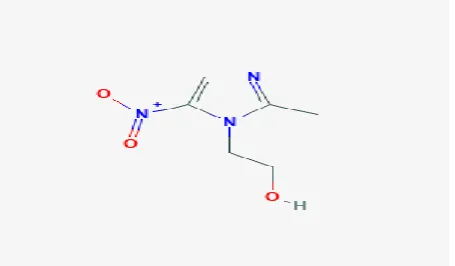
Fig. 1: Chemical structure of Metronidazole.
MATERIALS AND METHODS
Chemicals and solvents: The API of Metronidazole was obtained from Yarrow chemicals,
India. HPLC grade water (prepared by using 0.45 Millipore Milli –Q) was procured from
Standard Reagents, Hyderabad. HPLC grade Methanol was bought from Merck, Mumbai.
Instrumentation: A YL- instrument 9300 module equipped with a UV spectrophotometer
for finding out the λmax values of the drugs was used throughout this study. An Hypersil C18
(250×4.6,5mm) column was employed for the method development. The chromatographic
system was monitored by Autochrome software. Analytes were monitored by UV detection at
314 nm using an isocratic mode with Methanol: water in the ratio 50:50 as mobile phase. The
flow rate was set at 1.0 ml/min and effluent was monitored at 314 nm. The temperature and
run time were maintained at 25°C and 5 min. respectively. Solubility of the compounds was
Selection of mobile phase
The objective of this experiment was to optimize the method for estimation of Metronidazole
based on the literature survey. Various mobile phases were tested to select the best possible
system. The various mobile phases used included water: Acetonitrile (50:50), water:
methanol (70:30), Acetonitrile: water (40:60). Better peak resolution and adequate retention
time were obtained with the ratio of Methanol: water (50:50).
Preparation of Mobile Phase
The mobile phase was prepared by mixing 500 ml of methanol and 500 ml of water in a 1000
ml clean and dry flask. The mobile phase was then degassed using Ultra-Sonicator to remove
dissolved gases and the resultant mobile phase was filtered through a 0.45 μm membrane
filter under vacuum.
Preparation of Standard solution
Standard solution was prepared by accurately weighing 100 mg of Metronidazole and
transferring them into a 100 ml clean dry volumetric flask containing mobile phase. The
solution was sonicated for about 10 mins and then made upto volume with the mobile phase.
The resultant solution was filtered through a 0.45 μm membrane filter under vacuum. From
this 1 ml of solution was taken & made upto 10 ml with mobile phase. The solution was
sonicated for about 10 mins. From this solution 2ml was taken and made upto 10ml with
mobile phase which gives a concentration of 20mcg/ml. This solution was passed through
0.45 μm membrane filter before injecting into HPLC system.
Preparation of Sample solution
Sample solution was prepared by taking 20 tablets and triturating into fine powder and
accurately weighing the amount of drug equivalent to 100 mg of Metronidazole and
transferring them into a 100 ml clean dry volumetric flask containing mobile phase. The
solution was sonicated for about 10 mins and then made upto volume with the mobile phase.
The resultant solution was filtered through a 0.45 μm membrane filter under vacuum. From
this 1 ml of solution was taken & made upto 10 ml with mobile phase. The solution was
sonicated for about 10 mins. From this solution 2ml was taken and made upto 10ml with
mobile phase which gives a concentration of 20mcg/ml. This solution was passed through
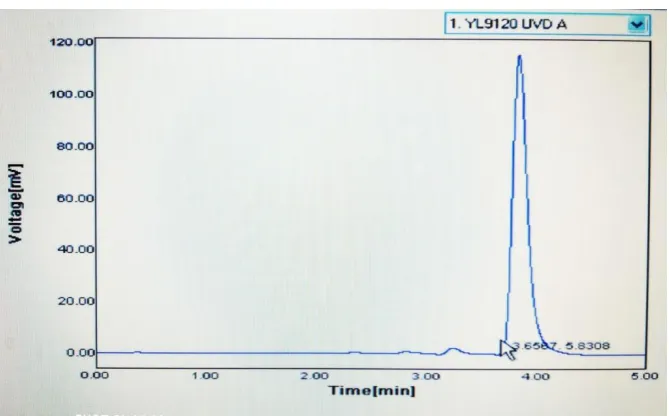
Prior to validation studies blank solution was injected and chromatogram was noted. System
suitability studies were performed using the standard solution of Metronidazole. Optimized
conditions maintained where the drug was eluted with good retention time and peak area
[image:4.595.180.430.168.293.2]which was shown in the fig 3.
Fig. 2: Blank chromatogram.
Fig. 3: Optimized Chromatogram.
System suitability
The standard solution of 20mcg/ml was used as system suitability solution which was
injected for about 6 times. The peak area, tailing factor and number of theoretical plates were
[image:4.595.131.466.333.541.2]Table 1: System suitability data of Metronidazole.
Sample ID Concentration(µg/ml) Retention
Time
Theortical plates
Tailing factor
100% 20 3.65 5709 1.37
100% 20 3.64 5836 1.38
100% 20 3.65 5928 1.35
100% 20 3.65 5953 1.34
100% 20 3.65 5938 1.34
100% 20 3.66 5047 1.35
Mean 20 3.6567
Standard Deviation 0.0028
%CV 0.076
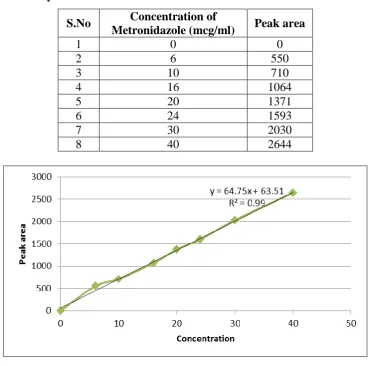
Linearity: The linearity of the method was established by determining the absorbance of
[image:5.595.112.483.331.697.2]different concentrations of Metronidazole over a range of 6-40µg/ml respectively.
Table 2: Linearity data of Metronidazole.
S.No Concentration of
Metronidazole (mcg/ml) Peak area
1 0 0
2 6 550
3 10 710
4 16 1064
5 20 1371
6 24 1593
7 30 2030
8 40 2644
the added concentration of the drug. Each sample was injected thrice. The percent recoveries
[image:6.595.156.440.146.305.2]of the drugs were estimated.
Table 3: Accuracy data of Metronidazole.
S. No Accuracy
level
% Recovery
Avg.% Recovery
1 80% 100.85
100.58
2 80% 100.48
3 80% 100.42
4 100% 97.65
97.61
5 100% 97.29
6 100% 97.90
7 120% 99.12
99.17
8 120% 99.24
9 120% 99.16
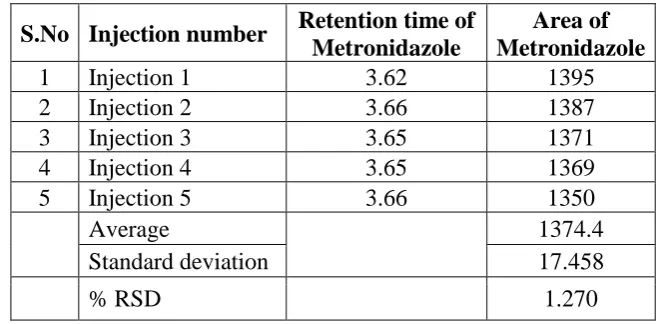
Precision: Precision is one of the important factors which determine the reliability of an
analytical method. The precision of the developed method was tested and was found to be
suitable. Both system and method precision were performed and are given in table 4,5.
Table 4: Method precision data of Metronidazole.
S.No Injection number Retention time of
Metronidazole
Area of Metronidazole
1 Injection 1 3.62 1395
2 Injection 2 3.66 1387
3 Injection 3 3.65 1371
4 Injection 4 3.65 1369
5 Injection 5 3.66 1350
Average 1374.4
Standard deviation 17.458
% RSD 1.270
Table 5: System precision data of Metronidazole.
S .No Injection number Retention Time of
Metronidazole
Area of Metronidazole
1 Injection 1 3.66 1395
2 Injection 2 3.65 1367
3 Injection 3 3.65 1380
4 Injection 4 3.33 1369
5 Injection 5 3.68 1375
Average 1377.2
Standard deviation 11.189
[image:6.595.131.463.414.576.2]Robustness: The robustness of the proposed method was determined by analysis of aliquots
from homogenous lots by differing physical parameters like volume of injection, wavelength
[image:7.595.106.486.165.260.2]which may differ but the responses were still within the limits of the assay.
Table 5: Robustness data of Metronidazole.
Proposed variations Retention
time
Theoritical plates
Assymetric factor Variation in
flow rate
0.9 ml 3.66 5938 1.37
1.1ml 3.65 5836 1.38
Variation in mobile phase
40:60 3.52 5928 1.35
55:45 3.66 5953 1.36
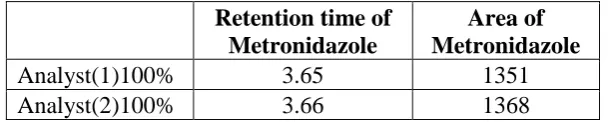
Ruggedness: Ruggedness is the degree of reproducibility of the results obtained under a
variety of conditions. It was checked that the results were reproducible under different
[image:7.595.146.451.368.429.2]analysts.
Table 6: Ruggedness data of Metronidazole.
Retention time of Metronidazole
Area of Metronidazole
Analyst(1)100% 3.65 1351
Analyst(2)100% 3.66 1368
Assay: Assay of different formulations available in the market was carried by injecting
sample corresponding to equivalent weight into HPLC system and recovery studies were
carried out.
Table 7: Assay data of Metronidazole marketed formulation.
DISCUSSION
In the present work, an attempt was made to provide a newer, sensitive, simple, accurate and
economical RP-HPLC method. It was successfully applied for the determination of
Metronidazole in pharmaceutical dosage forms without the interferences of other constituents
in the formulations. Different mobile phase compositions were tried, to get good optimum
results. Mobile phase and flow rate selection was done based on peak parameters (height,
Drug Labelled claim(mg) Drug found % Purity
The optimum wavelength for detection was 314 nm at which better detector response for drug
was obtained. The average retention time for Metronidazole was found to be 3.65 mins. The
% RSD values in the system suitability were found to be less than 2%. The calibration was
linear in concentration range of 6-40 mcg/ml for Metronidazole. The low values of % RSD
indicate the method is precise and accurate.
Sample to sample precision and accuracy were evaluated using, three samples of five and
three different concentrations respectively, which were prepared and analyzed on same day.
These results show the accuracy and reproducibility of the assay. Ruggedness of the proposed
methods was determined by analysis of aliquots from homogeneous slot by different analysts,
using similar operational and environmental conditions; the % RSD. reported was found to be
less than 2%. The proposed method was validated in accordance with ICH parameters and the
results of all methods were very close to each other as well as to the label value of
commercial pharmaceutical formulation. There was no significant difference in the results
achieved by the proposed method.
CONCLUSION
The proposed method for the assay of the Metronidazole in the commercially available tablet
formulation was found to be precise, simple, accurate, economical, and rapid. It can be easily
adopted for routine quality control for monitoring the assay in the bulk drug samples,
in-process samples, and for the finished tablet formulation.
REFERENCES
1. Michael E, Schartz IS, Krull. Analytical method development and Validation, 2004;
25-46.
2. ICH, Validation of Analytical Procedure. Text and Methodology Q2(B), International
conference on Harmonization, IFPMA, Geneva, Switzerland, 2005.
3. Sharma BK. Instrumental methods of chemical analysis, Introduction to Analytical
chemistry: Goel Publishing House Meerut, 2004; 233-238, 23th edition.
4. McDonald, LC; Gerding, DN; Johnson, S; Bakken, JS; Carroll, KC; Coffin, SE;
Dubberke, ER; Garey, KW; Gould, CV; Kelly, C; Loo, V; Shaklee Sammons, J; Sandora,
TJ; Wilcox, "Clinical Practice Guidelines for Clostridium difficile Infection in Adults and
Children: 2017.
5. Corey, E.J, Drug discovery practices, processes, and perspectives, World Health
6. Mandell, Douglas, and Bennett's Principles and Practice of Infectious Diseases , Elsevier
Health Sciences, 2014; 2753.
7. Eisenstein, B. I.; Schaechter, M, "DNA and Chromosome Mechanics", Lippincott
Williams & Wilkins, 2007; 28.
8. Joyani Das, Manabendra Dhua, UV-Spectrophotometric Assay Method Development and
Validation of Metronidazole in Bulk and Tablet Formulation, Journal of Pharma Sci
Tech, 2014; 3(Issue 2): 106-109.
9. K. Siddappa; M. Mallikarjun; P. T. Reddy; M. Tambe, Spectrophotometric determination
of metronidazole through Schiff's base system using vanillin and PDAB reagents in
pharmaceutical preparations, Eclet. Quím., Dec. 2008; 33: 4.
10.Arun K. Mishra, Arvind Kumar, Amrita Mishra, and Hari V. Mishra, Development of
ultraviolet spectroscopic method for the estimation of metronidazole benzoate from
pharmaceutical formulation, J Nat Sci Biol Med., 2014 Jul-Dec; 5(2): 261–264.
11.Pratibha Verma, Varsha Namboodiry, Soni Mishra, Ashok Bhagwat, Suvarna Bhoir, A
stability indicating HPLC method for the determination of Metronidazole using
ecofriendly solvent as mobile phase component, International Journal of Pharmacy and