www.wjpr.net Vol 4, Issue 1, 2015. 1142
TRANSDERMAL DELIVERY OF FENOPROFEN: PREPARATION,
EVALUATION AND IN VITRO RELEASE
Manjula D*1, Shabaraya AR2 and Somashekar Shyale3,
1
Dayananda Sagar College of Pharmacy, Bangalore, Karnataka, India.
2
Srinivas College of Pharmacy, Mangalore, Karnataka, India.
3
H.S.B.P.V.T. college of Pharmacy, Maharashtra, India.
ABSTRACT
The present study aimed at preparation and evaluation of fenoprofen transdermal drug delivery systems using various polymers like ERS100, ERL 100, HPMC and EC, in order to avoid its hepatic first pass metabolism and GI disturbance. The transdermal patches of fenoprofen were prepared by solvent casting method on surface of mercury, dibutyl phthalate (DBT) was used as plasticizer, d-limonene as permeation enhancer. The various formulations were evaluated for their physical appearance, thickness uniformity, weight uniformity, drug content and water vapour transmission (WVT). The in vitro studies revealed that the addition of hydrophilic component (HPMC polymer) to an insoluble film former tends to enhance drug release. Further the transdermal therapeutic systems that showed better permeation were subjected for stability studies at 370 C and 450 C, which were found to be stable. Finally it was concluded that the above transdermal systems could be useful to treat chronic pain and inflammation in arthritis.
KEYWORDS: Fenoprofen, transdermal delivery, arthritis.
INTRODUCTION
Generally NSAID’s are advised to reduce pain and inflammation in the treatment of arthritis which is one of the most affecting syndrome seen in geriatric patients. Usually conventional dosage forms like tablets and capsules are prescribed for the relief of inflammation and pain which are associated with arthritis.[1] But these conventional dosage forms causes gastro intestinal disturbances and fluctuation in the drug level there by making the patient to suffer over dosage.[2] In order to reduce the GI disturbance and to improve the bioavailability of the
Volume 4, Issue 1, 1142-1153. Research Article ISSN 2277– 7105
Article Received on 29 Oct 2014,
Revised on 23 Nov 2014, Accepted on 18 Dec 2014
*Correspondence for
Author
Manjula D
Dayananda Sagar College
of Pharmacy, Bangalore,
www.wjpr.net Vol 4, Issue 1, 2015. 1143
drug, certain novel dosage forms are being investigated. Transdermal drug delivery systems (TDDS) are designed to support the passage of drug substances from the surface of skin, through its various layers, into the systemic circulation. Their advantages over conventional dosage forms include improved patient compliance, avoidance of gastric irritation and first-pass effect and controlled therapeutic responses.[3]
Fenoprofen, is one among the NSAID’s used as anti inflammatory, analgesic and antipyretic. It is used in the treatment of osteoarthritis, rheumatoid arthritis and ankylosing spondilytis.[4] Though it is rapidly being absorbed after oral administration, it undergoes significant first-pass metabolism. It has a very short half life of about 2-3 h and is associated with gastro-intestinal side effects like nausea, gastric irritation etc. To extend drug action, to improve delivery of drug into systemic circulation, the present study was undertaken with the aim to develop and evaluate transdermal films of fenoprofen using various polymers like ERL 100, ERS 100, HPMC and EC, plasticizer like DBP.[5] Further the in vitro drug release was studied using d-limonene and oleic acid as permeation enhancers which belong to diterpene and fatty acids respectively. The formulation that showed promising result was further subjected for in vivo studies.
MATERIALS AND METHODS
Fenoprofen was procured from D. K. Pharma, Mumbai, ERL 100, ERS 100, HPMC E-15 (Supra labs), EC (Himedia labs), d-limonene (Rolex chemical industries), Oleic acid (Qualigens fine chemicals) and all other chemicals obtained were of analytical grade. In vitro
and in vivo experiments were carried out under the strict compliance of institutional animal ethical committee protocol bearing registration number 557/02/C/CPCSEA.
Drug Polymer Interaction by FT-IR[6]
To investigate any possible interaction between the drug and the utilized polymer, IR spectrum of pure drug and its physical mixture with ERS 100, ERL 100, HPMC were carried out by using FT-IR (Perkin elmer 1600 series USA) the range selected was from 400cm-1 to 4000cm-1.
Preparation of Transdermal Patches
www.wjpr.net Vol 4, Issue 1, 2015. 1144
polymers were weighed in requisite ratios by keeping the total polymer weight 2.0 gms and allowed for swelling for about 6 hrs in solvent mixture (1:1 ratio of dichloromethane, methanol). Propylene glycol was incorporated as plasticizer (30 % w/w of polymer) and d-limonene as penetration enhancer. Then specific quantity of drug was dissolved in alcohol and then added to the polymeric solution. The solutions were stirred for 20 minutes using magnetic stirrer and poured within a glass bangle of 5 cm diameter on mercury surface in petridish. The rate of evaporation of the solvent was controlled by inverting cut funnel over petridish. After 24 hrs the dried patches were taken out and stored in a dessicator. All the patches contained 5% d-limonene as penetration enhancer. The ratio of drug to polymer was 1:5 and it was kept constant for all the formulations. The formula is depicted as in table 1.
Table 1: Formulation table of various monolithic transdermal patches containing
fenoprofen.
S.No.
Ingredients (mg/ml)
Formulation Codes
F1 F2 F3 F4 F5 F6 F7 F8 F9 F10
1. Fenoprofen 50 50 50 50 50 50 50 50 50 50
2. ERL 100 250 200 150 100 50 - - - - -
3. ERS 100 - - - - 250 200 150 100 50
4. HPMC - 50 100 150 200 - 50 100 150 200
5. Propylene
glycol 0.058 0.058 0.058 0.058 0.058 0.058 0.058 0.058 0.058 0.058 6. d-limonene 0.003 0.003 0.003 0.003 0.003 0.003 0.003 0.003 0.003 0.003 8. Dichloro
methane 3 3 3 3 3 3 3 3 3 3
9. Methanol 3 3 3 3 3 3 3 3 3 3
Evaluation of Formulated Patches
Physical Appearance
All the transdermal patches were visually inspected for colour, clarity, flexibility and smoothness.
Weight Uniformity
The dried patches were weighed on afcoset digital balance. The average of five observations were taken.
Thickness Uniformity[8]
www.wjpr.net Vol 4, Issue 1, 2015. 1145 Water Vapour Transmission Studies[9] (WVT)
Glass vials of equal diameter were used as transmission cells. These cells were washed and dried in an oven. About 1 gm of fused calcium chloride was taken in the cells and patch of area equivalent to brim of vial (1.36 cm2) was fixed with the help of an adhesive. The cells were weighed accurately and kept in a close dessicator containing saturated solution of potassium bromide (200 ml). the humidity inside the dessicator was measured by a hygrometer and it was found to be 84% RH. The cells were taken out and weighed after 1, 2, 3, 4, 5, 6 and 7 days of storage. The WVT was calculated by taking the difference in the weight of the patches before and at regular intervals of 24 hrs for a total period of seven days.
Drug Content Uniformity[10]
Transdermal films of 1 sq.cm area was cut into small pieces and transferred into 100 ml volumetric flask. 25 ml of methanol was added and shaken for 4 hours to extract the drug. Finally, suitable dilutions were made using phosphate buffer pH 7.4 and absorbance was measured at 272 nm.
In Vitro Permeation Across the Rat Abdominal Skin
Preparation of Rat Abdominal Skin[11]
The swiss albino rats were sacrificed by decapituation. The fresh abdominal skin was excised from swiss albino rats weighing 170-190 gm. The abdominal skin of excised hairless rat skin was separated along the epidermal junction and was kept under a steam of 60 0 C water for exactly 50 seconds. The heat– treated skin was cleared of its subcutaneous fatty substances and immediately kept in normal saline solution to flatten and smooth. This step maintained the integrity and viability of the skin.
Permeation Studies
Vertically assembled Keshary-Chien[12] diffusion cells having down stream volume of 50 ml was used. The above skin was mounted on the diffusion cell and receiver compartment was filled with 50 ml phosphate buffer of pH 7.4 and the temperature was maintained at 37 0 C. The samples were withdrawn every hour (replaced with 1 ml fresh buffer to maintain sink condition) and their concentrations were measured in UV-spectrophotometer at 272 nm.
1. Stability Studies[13]
www.wjpr.net Vol 4, Issue 1, 2015. 1146
were exposed to selected temperatures of 370 C and 450 C in two different hot air ovens. Transdermal patch of area 19.63 cm2 were wrapped individually in butter paper and placed in petridish in the oven for a period of four weeks. The sample of 1 cm2 area of the film was cut from each formulation and it was analyzed for the drug content at the end of every week. Average of triplicate readings were taken.
RESULTS AND DISCUSSION
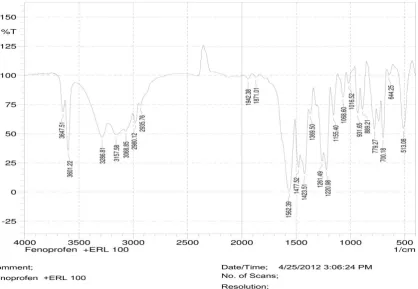
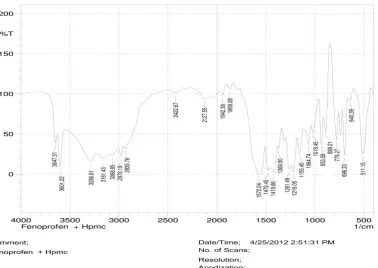
The IR spectra of pure drug and its physical mixtures with polymers (ERS 100, ERL 100 and HPMC) has showed replication of characteristic peaks of N-H stretch, C-H aromatic stretch, NO2 stretch, C-O-C stretch, C-H aliphatic stretch and OH stretch respectively as in IR of pure
[image:5.595.107.512.330.649.2]drug. The results revealed no interaction between drug and polymers hence indicated their compatibility. Fig 1, 2, 3 and 4.
www.wjpr.net Vol 4, Issue 1, 2015. 1147 Figure 2: IR spectroscopy of fenoprofen and ERS 100.
[image:6.595.97.516.445.734.2]www.wjpr.net Vol 4, Issue 1, 2015. 1148 Figure 4: IR spectroscopy of fenoprofen and HPMC.
All the films were evaluated for their physical parameters and they were found to be smooth, flexible and transparent. They were also found to be uniform in their weight and thickness with low SD values. The drug content was found to range from 97.3% to 98.9% as shown in table 2.
Table 2: Physical parameters and drug content of the fenoprofen transdermal
patches.HODS MATERIALS AND M
S.No. Formulation Codes
Physical appearance
*Weight (mg)
*Thickness (mm)
**Drug content (%)
1 F1 ++ 275.3(0.45) 0.165(0.0067) 97.6
2 F2 ++ 274.8(0.35) 0.145(0.0044) 98.1
3 F3 ++ 278.3(0.38) 0.127(0.0022) 98.4
4 F4 ++ 290.8(0.44) 0.145(0.0044) 98.8
5 F5 ++ 293.5(0.35) 0.145(0.0044) 99.1
6 F6 ++ 273.6(0.25) 0.165(0.0067) 97.3
7 F7 ++ 274.8(0.34) 0.165(0.0067) 97.8
8 F8 ++ 277.7(0.45) 0.188(0.0044) 98.3
9 F9 ++ 270.8(0.32) 0.193(0.0067) 98.6
10 F10 ++ 272.5(0.48) 0.165(0.0067) 98.9
The figure inside the parenthesis denotes the standard deviation values * → Average of five observations
www.wjpr.net Vol 4, Issue 1, 2015. 1149
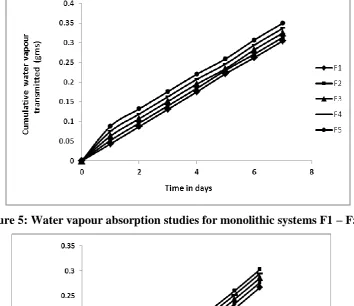
[image:8.595.126.481.280.586.2]The WVT studies for all monolithic formulations were conducted. The results are depicted in t figure 5 and 6 for formulations from F1-F5 and F6-F5 respectively, which indicates that all formulations from F1 to F10 were permeable to water vapour. As shown in figure 5 and 6 it was observed that there was gradual increase in WVT for 7 days at regular intervals of 24 hrs that is the WVT rate constant was ranged between 3.307 x 10⁻² to 3.352 x 10⁻² gm/24hr/cm2 for F1-F5 formulations and 3.05 x 10⁻² gm/24hr/cm2 for formulations F6-F10. The results revealed that the moisture permeability increased with increasing concentration of hydrophilic polymer (HPMC). The small moisture content in the formulations helps them to remain stable and from being completely dried and brittle film.
[image:8.595.132.466.489.743.2]Figure 5: Water vapour absorption studies for monolithic systems F1 – F5.
www.wjpr.net Vol 4, Issue 1, 2015. 1150
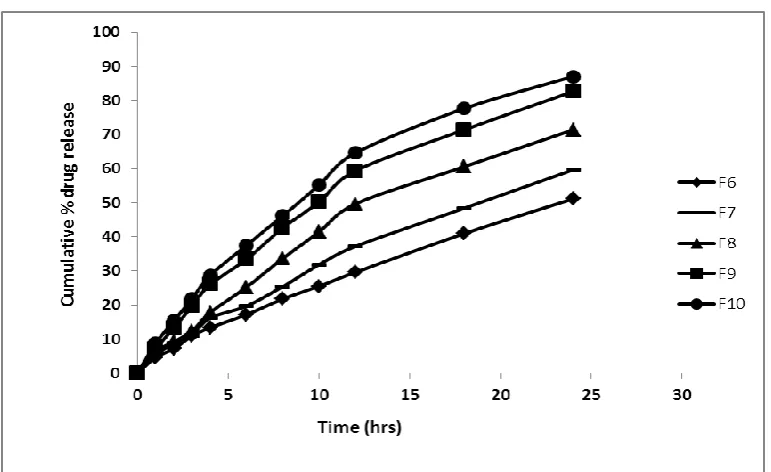
Figures 7 and 8 shows the release profiles of fenoprofen from transdermal patches. Formulations F5 and F10 exhibited greatest percentage of drug release which were found to be 90.15% and 87.01%. The percentage of drug release from various ERL series F1, F2, F3, F4 were found to be 56.13%, 65.52%, 73.65% and 84.39% respectively, from ERS series F6, F7, F8 and F9 were found to be 51.13%, 59.64%, 71.35% and 82.62% respectively.
From the above results of in vitro drug release across rat abdominal skin, the addition of hydrophilic component (HPMC polymer) to an insoluble film former tends to enhance the drug release rates. As the proportion of HPMC increased in all the formulations, an increased drug release and permeation was observed.
[image:9.595.114.502.408.643.2]Further the description of diffusion profiles by model function has been attempted using different kinetic model such as zero order, Higuchi square-root model and Korsmeyer-peppas model. The kinetic values and the slope values are depicted in table 3. The most appropriate model describing release with kinetic values ranging between 0.9676-0.9941 and n values 2.06 - 3.71 indicated that the drug release followed zero order kinetics and was found to be diffusion controlled, non-fickian release.
www.wjpr.net Vol 4, Issue 1, 2015. 1151 Figure 8: In vitro profiles of fenoprofen from monolithic systems of F6 – F10.
The coefficient of determination indicated that the release data was best fitted with zero order kinetics and Higuchi equation (0.9676 – 0.9941) explained the diffusion controlled mechanism. The diffusion exponent n values of korsemeyer-peppas model was found to be in the range of 0.94 – 1.06 indicating non-fickian diffusion, super case II transport.[14]
From the above in vitro drug release studies, formulations F5 and F10 showed good results in all aspects, hence these formulations were further subjected for in vivo studies.
Table 3: Comparative kinetic values of drug release from various transdermal patches.
S.No. Formulatio n Codes
Zero order
equation Higuchi’s equation
Korsemayers-Peppas equation
n r n r n r
1 F1 2.2531 0.9901 11.771 0.9863 0.9449 0.9106
2 F2 2.6691 0.9836 14.0907 0.9901 0.9802 0.9013
3 F3 2.9988 0.9827 15.8256 0.9888 1.0265 0.8943
4 F4 3.4936 0.9736 18.6475 0.9909 1.0265 0.8854
5 F5 3.7172 0.9707 19.9252 0.9921 1.0186 0.8702
6 F6 2.0689 0.9941 10.7042 0.9807 0.9663 0.9361
7 F7 2.4561 0.9912 12.7595 0.9818 1.0002 0.9295
8 F8 3.0635 0.9816 16.0538 0.9808 1.0642 0.9285
9 F9 3.4650 0.9731 18.4815 0.9896 1.0630 0.9034
[image:10.595.71.529.516.706.2]www.wjpr.net Vol 4, Issue 1, 2015. 1152
370 C and 450 C. The above observations were noted for one month at an interval of one week. All the systems were found to be stable at both the temperatures with respect to their physical parameters and drug content. The results are tabulated in table 4.
Table 4: Stability studies of F5 and F10 formlations at 370 C.
S. No. Time in days
Formulation Codes (Temperature 370 C)
Formulation Codes (Temperature 450 C)
F5 F10 F5 F10
%drug remaining %drug remaining %drug remaning %drug remaining
1 0 100 100 100 100
2 7 99.6 99.4 98.8 98.3
3 14 99.2 98.5 98.5 98.1
4 21 98.8 98.2 98.1 97.8
5 28 98.5 98.2 97.4 97.2
ACKNOWLEDGEMENT
The authors are thankful to VGST for providing grants to carry out the research work and also thankful to management and principal, Dayananda Sagar College of Pharmacy for their kind co-operation and support.
REFERENCES
1. Robert L Jackson, Marrow D Jason. Analgesic-antipyretic, anti-inflammatory agents and drugs used in the treatment of gout, 10th Edn., Mcg raw Hill publication., New York, 2003.
2. Chien Yie W. Concepts and system design for rate controlled drug delivery, 2nd Edn, Marcel Dekker Inc, 1992.
3. Chien YW, In; Robinson, J.R and Lee, V.H.Controlled drug Delivery: Fundamentals and Applications, 2nd Edn., Marcel Dekker Inc., Newyork, 1987; 523 - 524.
4. Alfonso RG, Remington: The Science and Practice of Pharmacy, 19th Edn, Mac publishing Company, Pennsylvaia, 1985.
5. Pandey S, Praveen SH and Udupa N: Formulation and evaluation of Nimesulide Transdermal drug delivery systems. Indian J. Pharm. Sci, 62(5): 2000; 376-378.
6. Fregany A, Mohammed, Hussin Dhedr. Preparation and in vitro/in vivo evaluation of buccal adhesive properties of slow-release tablets containing miconazole nitrate. Drug Dev Ind Pharm, 2003; 29(3): 321-37.
www.wjpr.net Vol 4, Issue 1, 2015. 1153
8. Raghavendra K, Doddayya H, Marihar SC, Patil CC, Habbu PV. Comparative evaluation of polymeric films for transdermal application. The Eastern Pharmacist, 2000; XLIII (153): 109-111.
9. Kusum devi V, Saisivam S, Maria GR, Deepti PU. Design and evaluation of matrix diffusion controlled transdermal patches of verapamil hydrochloride. Drug Dev Ind Pharm, 2003; 29(5): 495-503.
10. Gattani SG, Zawar LR, Kakade KN and Surana SJ. Optimization of transdermal films of lovastatin. Indian Drugs, 2008; 45(11): 883-889.
11. Flynn GL,Durrheim h,Higuchi WI.Permeation of hairless mouse skin II:Membrane sectioning techniques and influence on alkanol permeabilities. J pharm Sci, 1981; 70: 52-56.
12. Chien YW. Systemic drug delivery of pharmacologically active molecule across the skin. New York, 1991; 100: 100-102.
13. Narasimha MS, Mini Satish, Hamsa V. Drug release from terbutaline sulphate transdermal films across human cadaver skin. Indian.J.Pharma. Sci, 1997; 59(2): 75-76. 14. Peppas NA. Fitting controlled release and dissolution data. Pharm. ActHelv, 1985; 60: