
www.wjpr.net Vol 3, Issue 9, 2014. 958 DEVELOPMENT AND VALIDATION OF UV
SPECTROPHOTOMETRIC METHOD FOR CHLORTHALIDONE IN
BULK AND PHARMACEUTICAL DOSAGE FORMS
*Sapana U. Ingle, Pallavi A. Patil, Vaishali C. Kulkarni, Sheetal V. Patil, Poonam A. Salunke, Rupali S. Wagh.
Shee Shureshdada Jain Institute of Pharmaceutical Education & Research, Jamner.
ABSTRACT
A new, simple, accurate, rapid and precise spectrophotometric method has been developed for validation of chlorthalidone (CTD) in bulk drug. An attempt was made to preclude the use of corrosive inorganic solvents by the use of 0.2 M NaOH. The developed method was the measurement of absorptivity at 274.5nm (absorption maximum of CTD). The results of analysis have been validated as per ICH guidelines. The Concentrations of this drug were evaluated in laboratory mixture and marketed formulation. Accuracy was
determined by recovery studies from marketed formulation and Ranges
From 97.87-107.39%. Precision of method was find out as repeatability shows the values within acceptable limit.
KEYWORDS: chlorthalidone, UV Spectrophotometric method development, validation.
INTRODUCTION
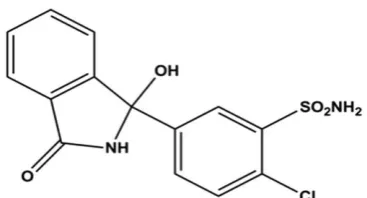
Chlorthalidone (CTD) (first introduced in Switzerland in 1959) is a sulphanyl benzophenone derivative [2-chloro-5-(1-hydroxyl-3-oxo-2,3-dihydro-1H-isoindol-1-yl)benzene-1-sulfonam ide] (fig.-1). It is a diuretic agent used in the treatment of oedema associated with congestive heart failure Compared with other medications like thiazide class, chlorthalidone has a longer duration of action but a similar diuretic effect at maximal therapeutic doses Chlorthalidone analysis as anti-hypertensive drug is of great interest, since hypertension is very common disorder, particularly in the past middle age. Accordingly, the development and validation of new analytical methods for estimation of anti-hypertensive drug are required Literature survey reveals that there are various analytical methods for estimation of chlorthalidone
Volume 3, Issue 9, 958-963. Research Article ISSN 2277– 7105
Article Received on 04 September 2014,
Revised on 29 Sept 2014, Accepted on 23 Oct 2014
*Correspondence for
Author
Dr. Sapana U. Ingle
Shee Shureshdada Jain
Institute of Pharmaceutical
Education &Research,
www.wjpr.net Vol 3, Issue 9, 2014. 959 individually or in combination with other drugs, that involves spectrophotometric, fluorimetric methods.
Figure 1: Structure of Chlorthalidone
2. Experimental Instrumentation
UV experimentation was performed on Shimadzu 1800 UV-visible spectrophotometer equipped with Photo Diode Array (PDA) detector, with 1 cm quartz cell. Citizen Digital Ultrasonic Cleaner was used for solubility purpose.
MATERIALS AND METHODS
All reagents used are AR grade and chlorthalidone was gift sample obtained from Cipla Laboratories, Hyderabad and were used as reference standard. The tablet formulation was purchased from local market.
Preliminary Solubility Study
Solubility of drug was determined at 27 ±1°C. chlorthalidone (10mg) was added in 10 ml volumetric flask and 10ml 0f 0.2M NaOH was added in it. The clear solution of chlorthalidone was obtained.
Preparation of Standard Stock Solutions
Chlorthalidone Standard Stock Solution: (1000µg/ml).
An accurately weighed chlorthalidone (10mg) was added in 10 ml volumetric flask and dissolved in 0.2M NaOH and volume was made up to the mark using 0.2M NaOH to get final concentration(1000µg/ml).
Study of Spectra and Selection of Wavelength
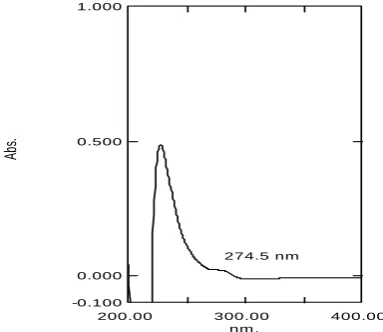
www.wjpr.net Vol 3, Issue 9, 2014. 960 2. From the spectrum wavelength selected for estimation of drug was 274.5nm as λ max of chlorthalidone.
nm .
200.00 300.00 400.00
Ab
s.
1.000
0.500
0.000
-0.100
274.5 nm
[image:3.595.200.392.113.279.2].
Fig.2 Spectrum of Chlorthalidone at the Wavelength 274.5
Study of Linearity Curves
The aliquot Portions of standard stock solutions of chlorthalidone was diluted appropriately with 0.2M NaOH to get a series of concentration from 3-15g/mL for drug. The absorbance
of this drug was measured at 274.5nm respectively and calibration curve was plotted as concentration versus absorbance.
Linearity and Range
The suitable aliquots was taken to obtain 3, 6, 9, 12, 15 µg/ml. from CHLORTHALIDONE (1000µg/ml) stock solution. The results are shown in fig. no. 3,
Fig 3-Linearity Curve of Chlorthalidone
[image:3.595.148.450.499.680.2]www.wjpr.net Vol 3, Issue 9, 2014. 961 Analysis of Marketed Formulation by Proposed Method
20 Tablets was accurately weighed, and reduced to fine powder. An accurately weighed powder sample equivalent to 10 mg of chlorthalidone was transferred to 10 ml volumetric flask and 0.2m NaOH was added in it. Sonicate it for 20 min. The solution was filtered through Whatmann filter paper no. 41. The filtrate was further diluted with 0.2M NaOH to get final concentration (1000µg/ml). From this solution 10µg/ml was prepared. The absorbance of sample solution was measured at 274.5 nm and the result is shown in Table No. 1.
Table No. 1: Results of Application of Proposed Method for Analysis of Marketed Formulation.
Sample Label Claimed % Label Claim* ± SD % RSD CTD 12.5 mg Chlorthalidone 12.5 mg 100.04±0.33 0.33
Validation Method Accuracy
Accuracy of each of the proposed method was ascertained on the basis of recovery studies performed by standard addition method as shown in the table no.2.
Table-2. Accuracy.
*mean of each 3 reading
Precision
Precision of the analytical method is expressed as the series of the measurement. It was ascertained by replicate estimation of the drug by the proposed method as shown in table no.3.
Table 3. Precision. Conc.
(µg/ml)
Inter day Intra Day
Mean*± S.D. Amt. Found % Amt. Found Mean*± S.D. Amt. Found %Amt. Found
6 0.22±0.001 6.20 103.40 0.229±0.042 6.33 105.45
9 0.0.4±0.001 9.48 105.28 0.301±0.001 7.67 85.19
12 0.54±0.001 12.14 101.13 0.495±0.001 11.26 93.83
*mean of each 3 reading S. N Level
(%)
Amt. taken (µg/ml)
Amt. Added (µg/ml)
Absorbance Mean* ± S.D.
Amt. recovered Mean *±S.D.
www.wjpr.net Vol 3, Issue 9, 2014. 962 Repeatability
Repeatability was ascertained by getting the sample analyzed by different analyst and carrying out analysis for no. of times. The results are shown in table no. 04.
Table-4. Repeatability Study.
S. No Conc. (µg/ml) Absorbance Amt. Found % Amt. Found
1 9 0.345 8.67 96.30
2 9 0.355 8.87 97.33
3 9 0.366 8.80 97.74
4 9 0.362 8.89 98.77
5 9 0.367 8.57 95.27
6 9 0.350 8.70 96.71
7 9 0.357 8.76 97.33
8 9 0.360 8.85 98.35
9 9 0.365 8.89 98.77
10 9 0.367 8.89 98.77
Mean 0.3594 8.79 97.65
S.D. 0.0072 1.10 1.16
%RSD 2.00 1.19 0.53
Label Claim
Brand Name: Company: IPCA
Amt taken(mg) Conc.(µg/ml) Absorbance Amt found %Label Claim
80.4 9.0 0.493 8.96 99.56
80.4 9.0 0.495 9.00 100.00
80.4 9.0 0.494 8.98 99.78
80.4 9.0 0.496 9.02 100.22
80.4 9.0 0.497 9.04 100.44
80.4 9.0 0.496 9.02 100.22
Mean 0.495 9.00 100.04
SD 0.001 0.03 0.33
%RSD 0.30 0.33 0.33
RESULT AND DISCUSSION
www.wjpr.net Vol 3, Issue 9, 2014. 963 CONCLUSION
The developed method is suitable for validation of chlorthalidone in pharmaceutical dosage form is accurate, precise, robust and rapid. Therefore this method can be applied for routine analysis of drugs in formulation & bulk drug.
ACKNOWLEDGEMENT
The authors are thankful to Cipla Laboratories, Hyderabad for providing gift samples of chlorthalidone respectively.
REFERENCES
1. Narmeen s. Abdulla, Hassan AM, Hassan RO, spectrophotometric determination of chlorthalidone in pharmaceutical formulation using different order derivative method, Arabian Jr. chem, 2014.
2. Kreny E. parmar, Development and validation of HPTLC method for simultaneous determination of telmisartan and chlorthalidone in a bulk and pharmaceutical dosage form, Int. Jr. pharm. & Sci, 2013; 5(2):420-425.
3. Suhas P. Padmane, Jain ND,Ittadwar AM, Walde S., A Derivative UV-Spectrophotometric Method for the Simultaneous Determination of Metoprolol Succinate andChlorthalidone in Combined Dose Tablet Formulation, Int. Jr. Ana. & Bioana. chem. 2014; 4(1):33-41.
4. Parmar Kreney E., Mehta RS, First Order Derivative spectrophotometric Method for simultaneous estimation of telmesrtan & chlorthalidone in bulk and pharmaceutical dosage form, Int. res. Jr. pharm, 2013; 4(3):224-228.
5. Indian Pharmacopoeia, 2007; 2: 307-308.
6. British Pharmacopoeia, Published by The Stationery office, London, on behalf of Medicines and Healthcare Products Regulatory Agency (MHRA), 2007; 1: 484-485, 2421 7. United States Pharmacopoeia, the National Formulary, Twinbrook Parkway, Rockville,
![The crystal structures and Hirshfeld surface analysis of 6 (naphthalen 1 yl) 6a nitro 6,6a,6b,7,9,11a hexahydrospiro[chromeno[3′,4′:3,4]pyrrolo[1,2 c]thiazole 11,11′ indeno[1,2 b]quinoxaline] and 6′ (naphthalen 1 yl) 6a′ nitro 6′,6a′,6b′,7′,8′,9′,10](data:image/gif;base64,R0lGODlhAQABAIAAAP///wAAACH5BAEAAAAALAAAAAABAAEAAAICRAEAOw==)