Abstract—in this paper, we study the performance of a video-on-demand (VoD) system in wireless mesh network. In our system, it consists of a video block replication scheme, a video block discovery mechanism, and a proposed system enhancement strategy. A simulation model is implemented to evaluate the performance of system in term of blocking probability. The simulation result shows that the enhancement can improve the system performance in certain circumstances.
Index Terms—Wireless Mesh Network (WMN), Video-on-Demand (VoD), Peer-to-Peer (P2P)
I. INTRODUCTION
ireless mesh networks (WMNs) [1] shall be a key technology for next generation wireless network. A typical wireless mesh network composes of mesh routers and mesh clients. The mesh routers form the backbone of the network, provide the network access to the mesh clients, and have minimum mobility. The mesh clients are mobile devices such as laptop and PDA, which connects to the mesh routers for network access. Currently, WMNs are undergoing rapid development progress and inspiring numerous applications. Video-on-demand (VoD), which allows subscribers to playback video from the video library at anytime, is one of the potential applications. VoD over WMN means the subscribers can playback any favorite video at anytime once their mobile devices connect to the WMN. With the increasing popularity of smart phones such as Android devices and IOS devices, it can be expected that providing VoD service over WMN shall have a bright future.
One of the differences between the mobile ad hoc network (MANET) and wireless mesh network (WMN) is the formation of the wireless backbone. The backbone of MANET is formed by the mobiles nodes themselves while the backbone of WMN is maintained by wireless mesh routers. The mobiles nodes in MANET can move or leave the network freely while the wireless mesh routers have minimum mobility and high availability. Therefore, it can be expected that the WMN shall have a better reliability [9], and it is comparatively easy to build a reliable VoD service in
Manuscript received December 08, 2011; revised January 03, 2012. K.T. Sze is with the Department of Electronic and Information Engineering, The Hong Kong Polytechnic University, Hung Hom, Kowloon, Hong Kong (e-mail: [email protected]).
K.M. Ho is with the Department of Electronic and Information Engineering, The Hong Kong Polytechnic University, Hung Hom, Kowloon, Hong Kong (e-mail: [email protected]).
K.T. Lo is with the Department of Electronic and Information Engineering, The Hong Kong Polytechnic University, Hung Hom, Kowloon, Hong Kong (e-mail: [email protected]).
WMN. For example, in order to transmit video to clients who are separated in a wide geographical distance, a VoD system over MANET [10] assumes that there are stationary and dedicated computers which act as forwarder to relay the data. This assumption does not required in WMN.
In order to provide a quality VoD services over WMN, many research works are carried out and published. For example, in [2], several VoD schemes based on caching video data in selected routers and allowing the clients to form the peer-to-peer relationship are proposed. A similar idea in terms of caching video blocks in mesh nodes can also be found in [3]. A work on supporting VoD over WiMax mesh network is done in [4]. In [5], it presents a data replication scheme for home-to-home (H2O) devices. This scheme can minimize the total storage requirement of the system and apply to the WMN also. Another work which bases on H2O and takes the peers’ behaviors into account can be found in [6]. In [7], challenge on selecting the best path is addressed. Several enhancements for Ad Hoc On-Demand Distance Vector (AODV) routing protocol are proposed to improve the video quality over WMN.
In this paper, a VoD system over WMN based on H2O replication scheme is proposed. Unlike H2O that only the mesh routers, or home devices, are involved, the proposed system is composed of mesh routers and mesh clients. The mesh routers store a portion of video in their local storage and handle requests from the mesh clients. A mesh client, such as mobile phone or PDA, acquires the VoD service from nearest mesh router. Once the client connects to the router, a request for video data is sent to the router.
The placement of video data follows the idea of H2O replication scheme in order to minimize the storage requirement. However, this measure also increases the traffic among the mesh routers. To improve the service performance, video broadcasting technique is deployed. A simulation model is built to investigate how the enhancement will improve the performance of the VoD service.
The rest of this paper is organized as follows: Section II describes the architecture of the proposed VoD system. Section III introduces the enhancement. Section IV presents the simulation results. Section V is the conclusion.
II. PROPOSEDSYSTEMARCHITECTURE
A. Grid Topology Used in Simulation
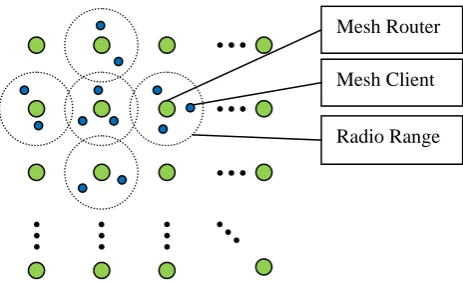
The topology of the proposed framework is shown in Fig. 1. It consists of N mesh routers and some mesh clients. The mesh routers are evenly distributed in a square area and the location of each router is fixed during the simulation. Each mesh router can only communicate with the neighboring routers in cardinal directions. It means a mesh router
Performance Evaluation of a Video Broadcasting
System over Wireless Mesh Network
K.T. Sze, K.M. Ho, and K.T. Lo
Mesh Client Radio Range Mesh Router
Fig. 1. Topology used in simulation
… bx
Time/s L
b4
Sb
b1 b2 b3
Sb : Video Block Length
ts : Startup Delay
[image:2.595.323.540.62.212.2]0 ts Sb + ts 2Sb + ts
Fig. 2. Video Block Placement
Source mesh router
Neighboring Mesh routers in 1 hops
Neighboring Mesh routers in 2 hops
[image:2.595.62.294.116.258.2]Neighboring Mesh routers in 3 hops
Fig. 4. Total Number of Mesh router within N hops
Hop = 1 Hop = 2 Hop = 3
normally has four neighboring routers except those routers on the edge of the grid topology. Moreover, every router holds a portion of video data in its storage. The mesh clients are mobile devices which request for the VoD service.
B. Video Block Placement
In order to reduce the storage requirement, the idea of H2O replication scheme [5] is adopted for distributing video blocks among the mesh routers. In brief, suppose there is a video in L seconds being divided into X blocks equally as shown in Fig. 2. The first video block, b1, is copied to every router in order to reduce the startup delay, ts. The remaining blocks are distributed to the routers which ensure each router can acquire the nth video block before the time ( n – 1 )Sb+ ts
if a mesh client requests a VoD service at time 0.
In our simulation, the nth video block is copied to routers every n-1 hop(s). For example, the first video block will be copied to every mesh router; the second video block will be copied to routers every 1 hop and so on. As a result, fewer copies are needed for a video block in higher order.
The maximum number of mesh routers within n-1 hop(s) in the grid topology is equal to 2(n-1)2 + 2(n-1) + 1 as illustrated in Fig. 3. For example, there are 5 mesh routers, included the source mesh router, in the distance of 1 hops. Therefore, the minimum number of replicas of nth video block is equal to
, where N is the total number of mesh routers in the grid topology. Then, the minimum storage requirements of the VoD service will be equal to ∑ , where X is total number of video blocks.
C. Video Block Discovery Mechanism
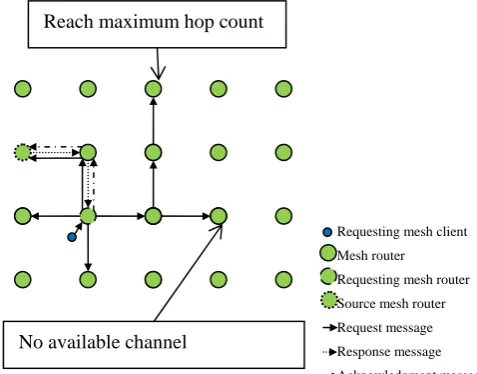
Suppose a video is divided into blocks equally; these blocks are properly scattered over the storage of mesh routers. When a mesh client connects to its nearest mesh router, the client sends a request for the video to the router. Once the router receives the request, the router checks its local storage, generates request messages for those missing video blocks, and sends those request messages to its neighbors. These request messages should at least contain five elements which are Sequence Number (SEQ), Video Block ID, Video Block Arrival Time, Time to Live (TTL), and Timeout. The TTL limits the number of hops that a request message can be forwarded. The SEQ prevents request message from looping in the network.
When a neighboring router receives a new request message, the router first reserves a channel. If there is not channel available, the router simply discards the request message. Otherwise, the router checks the existence of the requesting video block in its local storage. If the requesting video block is not found, the router forwards the request message to all of its neighbors except the sender of the request message. If it is found, however, a response message is returned along the requesting path.
After all, when the requesting mesh router receives the response messages, it sends an acknowledgement message to one of the sources mesh routers which has the fewest hop count. The requesting stage is completed when the source mesh router receives the acknowledgement message. Then, the transmission is started according to the scheduled video block arrival time.
Video block flows in broadcasting channel Video block copy to every mesh router Video block copy to router every 1 hop Original H2O
b4
b1 b2 b3 b5 … bx-2 bx-1 bx
Broadcast the First 3 Blocks
b4
b2 b3 b5 … bx-2 bx-1 bx
b1
Video blocks follow similar change Broadcast the Last 3 Blocks
b4
b3 b5 … bx-2 bx-1 bx
[image:3.595.50.289.163.350.2]b1 b2
Fig. 6. Changes in Video Block Placement
Reach maximum hop count
No available channel
Fig. 5. Video Block Discovery Mechanism
Requesting mesh client
Mesh router
Requesting mesh router
Source mesh router
Request message
Response message
Acknowledgment message
network until there is not available channel of current intermediate router, or the TTL is reached, or the request message reaches the sources mesh router. After that, if the request message is successfully forwarded to the sources mesh router, it sends a response message back to the requesting mesh router along the path. Finally, the requesting mesh router sends the acknowledgement to one of the sources mesh router to confirm the transmission time.
.
III. ASYSTEM ENHANCEMENT
The use of H2O replication scheme can reduce the storage requirement because the necessary replicas of a video block decreases with its order gradually. However, this scheme also increases the traffic among the mesh routers. In order to improve such situation, idea of video broadcasting is proposed; each mesh router reserves channel(s) to forward video block(s) from source mesh router to all other mesh routers actively and continually. For example, suppose first three video blocks are selected to broadcast. At first, each of these three video blocks is placed to a mesh router separately, and three channels are reserved in all mesh routers. After that, the source mesh routers broadcast the video block to their neighbors. Once the neighbors receive the data, they will also broadcast to their neighbors, and so on. It makes these three video blocks available at anytime anywhere by sacrificing three free channels. In the current design, the number of channels reserved in each mesh router is equal to the number of broadcasting video blocks, and it is assumed that the total number of channels in each mesh router is much smaller than total number of video blocks. Therefore, the system can only broadcast a portion of video blocks.
Besides, it is noted that the video block placement is modified accordingly when the broadcasting is implemented. For example, when the first three video blocks are broadcasted, the “position” of remaining video blocks is shifted by 3. It means the fourth video block will be copied to every router and the fifth will be copied to the routers every 1 hop, and so on as illustrated in Fig. 5. As a result, the total number of copies of the rarest video block is increased while the storage requirement is decreased further by sacrificing channels.
IV. SIMULATION RESULT
In order to evaluate the proposed VoD system, a simulation model is built based on C programming language. It assumes that there are 400 mesh routers formed a grid topology. Each mesh router can only communicate with the neighboring routers in cardinal direction, and provides 10 channels for transmission. The transmission rate of each channel is equal to the playback rate of the video. The length of video is 2 hours, which is divided into 15 blocks equally, and they are distributed among the storage of mesh routers according to the method described in Section II and III. Each client sends a request for the video after it connects to its nearest mesh router. The request pattern is modeled as the Poisson Process. The mechanism of video block discovery follows the description in Section IIC. Connected clients can watch the video if it is confirmed in requesting stage that all the video blocks are available in the desired transmission time. Otherwise, clients quit the VoD service. We call these clients are blocked.
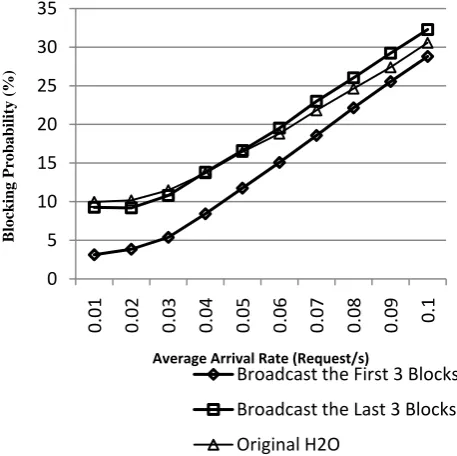
Fig. 6 shows the blocking probability against varies average arrival rates in three different scenarios which are broadcasting the first three video blocks, broadcasting the last three video blocks, and original H2O without broadcasting. When first three video blocks are selected to broadcast, the distribution of the rarest video block, b15, is changes from
every fourteen hops to eleven hops. Moreover, no additional channel is needed when the client is watching the first three video blocks. Channels are only reserved to transmit the video blocks from b4 to b15. When the last three video blocks
are selected to broadcast, the rarest video block is changed from b15 to b12 which is also distributed every eleven hops.
However, additional channel, which transmits the video block b1, is needed immediately once the client requests for
the VoD service.
0 10 20 30 40 50 60 70 80 90
2 4 6 8 10 12
Block
ing Probability
(%
)
Total Number of Video Channels avaliable in Each Mesh Router (half of channels for broadcasting)
Broadcast Beginning Blocks at 0.01 Arrival Rate
Broadcast Beginning Blocks at 0.05 Arrival Rate
Broadcast Ending Blocks at 0.01 Arrival Rate
Broadcast Ending Blocks at 0.05 Arrival Rate
No Boradcast at 0.01 Arrival Rate
No Boradcast at 0.05 Arrival Rate
0 5 10 15 20 25 30 35
0.01 0.02 0.03 0.04 0.05 0.06 0.07 0.08 0.09 0.1
Block
ing Probability
(%
)
Average Arrival Rate (Request/s)
Broadcast the First 3 Blocks
Broadcast the Last 3 Blocks
Original H2O
Fig. 9. Blocking probability against varies video channels equipped in mesh router in two different arrival rates
[image:4.595.313.541.56.331.2]Fig. 8. Blocking probability against varies number of channels used for broadcasting in two different arrival rates
Fig. 7. Blocking probability against varies arrival rates
0 10 20 30 40 50 60
0 1 2 3 4 5 6 7 8 9
Block
ing Probability
(%
)
Number of Channel(s) Used for Broadcasting
Broadcast Beginning Blocks at 0.01 Arrival Rate
Broadcast Beginning Blocks at 0.05 Arrival Rate
Broadcast Ending Blocks at 0.01 Arrival Rate
Broadcast Ending Blocks at 0.05 Arrival Rate Fig. 8 shows the blocking probability against varies number of channels equipped in each mesh router. In this simulation,
half of channels in each mesh router are reserved for broadcasting and the rest are used as usual.
It is expected that the system performance will be improved by adopting the enhancement since it improves the availability of the rare video blocks by scarifying free channels. However, the improvement should be reduced when arrival rate is increasing. It is because the bottleneck shifts from the routers, which hold the rare video blocks, to the total number of free channels available in the VoD system.
[image:4.595.54.283.277.505.2]Besides, it is also expected that the system which broadcasts the beginning video blocks might obtain better performance than the one which broadcasts the ending video blocks since no additional channel is needed immediately. This property will be helpful when all free channel is already exhausted at the time that new client comes.
Fig. 6 shows that the use of enhancement can improve the blocking probability, and the improvement does decrease with the increase of arrival rate. However, the result also indicates that the improvement is not significant when broadcasting the last three video blocks, and it deteriorates the performance of the VoD service when arrival rate increases. This result suggests that scarifying free channels to broadcast the ending blocks generally is not a good idea in such an environment.
Fig. 7 suggests that the minimum blocking probability can be achieved when 3 channels and 1 channel are used for broadcasting in the arrival rate of 0.01 and 0.05 respectively. For example, there is nearly 6% of improvement observed in the case that broadcasts the first video block at 0.01 arrival rate. When the number of broadcasting channels increases further, blocking probability rises exponentially.
Fig. 8 shows that the enhancement can achieve a better improvement, which is compared with the original H2O, when mesh routers equip with substantial number of channels. For example, an improvement in blocking probability is observed when total number of transmission channels reaches 8 at 0.01 arrival rate.
In conclusion, in order to obtain better system performance with video broadcasting, the following conditions are required:
1. It is broadcasting the video blocks in lower order. 2. There are a substantial number of channels equipped in
mesh routers
V. CONCLUSION
[image:4.595.62.284.533.750.2]a system enhancement strategy. The video block replication scheme adopts the idea from H2O in order to reduce the storage requirement. Briefly, this scheme divides a video into blocks equally, and distributes the nth block to every router n-1 hop(s); the necessary copies of each video block decreases gradually with its order, and all the mesh routers only hold a portion of video. The video block discovery mechanism is to acquire all the missing video blocks from the mesh network. The system enhancement, which selected video block(s) for broadcasting, is to improve the availability of the rare video block(s) by scarifying channel(s). The simulation results show that the enhancement can function if mesh router equips substantial channels and it is broadcasting the beginning video blocks.
In coming future, the current simulation model will be moved to ns-3 [8] platform in order to study the effect on video broadcasting in such an environment. For example, why the improvement made by broadcasting beginning video blocks are much obvious than broadcasting the ending video blocks. Or, what is the turning point that the enhancement will improve the blocking probability.
REFERENCES
[1] I.F. Akyildiz, X. Wang and W. Wang, "Wireless mesh networks: a survey," Computer Networks Journal (Elsevier), vol.47, no.4, pp. 445-487, January 2005.
[2] Y. Zhu, W. Zeng, H. Liu, Y. Guo and S. Mathur, “Supporting video streaming services in infrastructure wireless mesh networks: architecture and protocols,” in Proc. IEEE International Conference
on Communications (ICC ’08), pp. 1850–1855, May 2008.
[3] D. Li, Q. Zhang, C. N. Chuah and S. J. B. Yoo, "Multi-source multi-path video streaming over wireless mesh networks," in Proc.
IEEE International Symposium on Circuit and Systems (ISCAS'06), pp.
698-701, May 2006.
[4] F. Xie, K. A. Hua and N. Jiang, "Achieving true video-on-demand service in multi-hop WiMax mesh networks," in Proc. 32nd IEEE
Conference on Local Computer Networks, pp. 287-294, Oct. 2007.
[5] S. Ghandeharizadeh, B. Krishnamachari and S. S. Song, "Placement of continuous media in wireless peer-to-peer networks," IEEE
Transactions on Multimedia, vol.6, no.2, pp. 335- 342, Apr. 2004.
[6] J.W. Ding, W.T. Wang and C.F. Wang, “An Efficient Data Replication Scheme for Peer-to-Peer Video Streaming Over Wireless-Mesh Community Networks,” in International Conference on Intelligent Information Hiding and Multimedia Signal Processing
(IIHMSP-2008), pp.767-770, Aug. 2008.
[7] Y. Zhu, H. Liu, M. Wu, D. Li and S. Mathur, "Implementation Experience of a Prototype for Video Streaming over Wireless Mesh Networks," in Consumer Communications and Networking Conference
(CCNC 2007), pp.23-28, Jan. 2007.
[8] ns3 Website, http://www.nsnam.org/
[9] R. Bruno, M. Conti and E. Gregori, “Mesh Networks: Commodity Multihop Ad Hoc Networks,” IEEE Communications Magazine, vol. 43, no. 3, pp. 123-131, Mar. 2005.
[10] D. A. Tran, M. Le and K. A. Hua, "MobiVoD: a video-on-demand system design for mobile ad hoc networks," in IEEE International
Conference on Mobile Data Management (MDM 2004), pp. 212- 223,