ISSN-L: 2501 - 1235 Available on-line at: www.oapub.org/edu
doi: 10.5281/zenodo.1326434 Volume 4 │ Issue 9 │ 2018
COMPARISONS OF SHOULDER GIRDLE STRENGTH,
EXPLOSIVE LEG POWER AND ABDOMINAL STRENGTH
AMONG JUMPERS, THROWERS AND SPRINTERS
Amandeep Singhi
PhD, Assistant professor Department of Physical Education (T) Guru Nanak Dev University
Amritsar, Punjab, India
Abstract:
The study was designed to compare the three parameters viz. Shoulder girdle strength, explosive leg power and abdominal strength among jumpers, throwers and sprinters. A total of forty five subjects, fifteen of each specialization were included in the study (Age group – 22-25 years). Three tests viz. Medicine Ball Throw Test, Sargent Jump Test (Vertical Jump), Bent-Knee Sit Ups were administered for testing Shoulder Girdle Strength, Explosive Leg Power and Abdominal Strength respectively. One-way ANOVA was applied to compare the three groups. Results revealed that significant differences exist among Jumpers, Throwers and Sprinters on all three parameters (p<.05). To conclude, Throwers exhibit more Shoulder Girdle Strength than jumpers and sprinters; Jumpers had more Explosive Leg Strength than throwers and sprinters; and Sprinters own more Abdominal Strength than jumpers and throwers.
Keywords: Sargent jump, sit ups, medicine ball, athletes
1. Introduction
The track and field athletics can mainly be classified into track field and road events, and, in a further division, it can be meticulously separated into racing, jumping, throwing, combination events and walking race (Sung & Ko, 2017). While viewing at the most significant physical fitness components in the track and field athletics, explosive power, anaerobic endurance and agility are essential in the sprinters (Sung & Ko, 2017). Throwers demand more strength, power, and coordination. Jumpers need more muscular strength, power, flexibility and coordination (Korea Institute of Sport Science, 1998). The significance of physical fitness is accentuated as it is a key element in performance (Hamiltonm, 1994; Korchmny, 1994). A physical fitness factors such as
shoulder strength and leg strength are characterized as an ability of shoulder muscles to overcome the maximum resistance. Lower leg power is much needed in a range of sports and athletic events. Several prevailing procedures emphasis on plyometric or strength training to escalate vertical jump distance measure of leg power. The leg explosive power is predominantly vulnerable to contusions as it is often exposed to direct traumas. Leg explosive power is an ability of our leg muscles to overcome resistance in a short duration of time and is the combination of strength and speed of contraction of muscles. The existing literature define core stability in many ways, but still uncertain on a clear-cut definition. One definition states “The core musculature includes muscles of the trunk and pelvis that are responsible for maintaining the stability of the spine and pelvis and are critical for the transfer of energy from larger torso to smaller extremities during many sports activities” (Tse et al, 2005).Thus, it is tentatively assumed that if the extremities are robust and the core is feeble the drop in muscular outcome through the core may end in less power creation and ineffective movement arrangements. Strength of the abdominal muscles is vital in supporting upright posture and correct alignment of pelvis. The latter is particularly important in the maintenance of low back health. For testing and exercising the abdominal muscles, it is tough to segregate these muscles. The sit-up test is common in evaluating the performance of these muscles which includes the movement of the hip flexor muscles. It is thought that a sturdy core lets an athlete to complete transferal of forces produced in the lower extremities, over the torso, and to the upper extremities (Behm et al., 2005; Cissik, 2002; McGill, 2004). The objective of this study is to compare the Shoulder girdle strength, explosive leg power and abdominal strength among jumpers, throwers and sprinters.
2. Methodology and Procedure
2.1 Subjects
To fulfill the objectives of the study, forty-five (N=45) male athletes including 15 jumpers, 15 throwers and 15 sprinters of age 22-25 years were purposively sampled from the various colleges of Guru Nanak Dev university, Amritsar, Punjab, India.
2.2 Variables and their testing
Table 1: Description of variables, tests and measuring units
Variable Test Measuring unit
Shoulder Girdle Strength Medicine Ball Throw Test Meters Explosive Leg Power Sargent Jump Test (Vertical Jump) Inches
Abdominal Strength Bent-Knee Sit Ups Maximum performed
2.3 Statistical technique
employed where mean differences were found significant. Hypotheses were tested at .05 significance level.
Table 2: Multiple comparisons among jumpers, throwers and sprinters
Variable Group N Mean SD F-value p-value
Shoulder Girdle Strength
Jumpers 15 27.27 1.58
133.20 .001* Throwers 15 32.80 2.08
Sprinters 15 22.07 1.71 Explosive Leg Power Jumpers 15 21.72 1.97
44.47 .001* Throwers 15 17.47 1.81
Sprinters 15 16.20 1.15 Abdominal Strength Jumpers 15 40.72 1.67
179.78 .001* Throwers 15 36.27 1.32
Sprinters 15 47.00 1.65 * Significant at .05 level
Table 2 depicts the results of multiple comparisons among jumpers, throwers and sprinters on the variables shoulder girdle strength, explosive leg power and abdominal strength. The mean and standard deviation for shoulder girdle strength among jumpers, throwers and sprinters was 27.27±1.58, 32.80±2.08 and 22.07±1.71 respectively. The results of ANOVA (F (2, 42) = 133.20, p<.05) revealed significant differences among the three groups. The mean and standard deviation for explosive leg power among jumpers, throwers and sprinters was 21.72±1.97, 17.47±1.81 and 16.20±1.15 respectively. The results of ANOVA (F (2, 42) = 44.47, p<.05) discovered that there exist significant differences among the three groups. The mean and standard deviation for abdominal strength among jumpers, throwers and sprinters was 40.72±1.67, 36.27±1.32 and 47.00±1.65 respectively. The results of ANOVA (F (2, 42) = 179.78, p<.05) depicts that there exist significant differences among the three groups. As the results ANOVA were discovered significant, the LSD post-hoc test was applied to uncover the between-group differences among athletes. The results of Post-hoc analyses are presented in table 3.
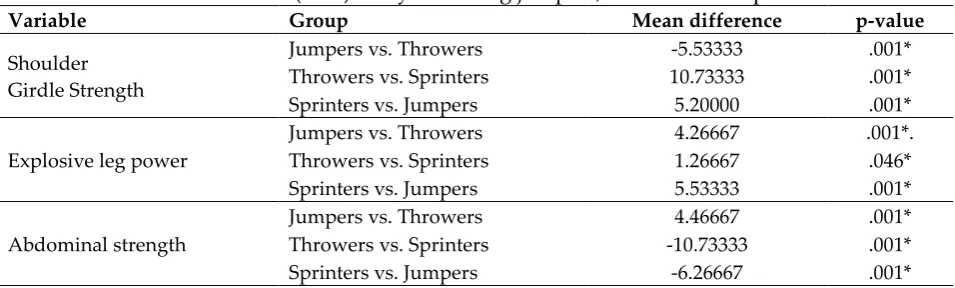
Table 3: Post-hoc (LSD) analyses among jumpers, throwers and sprinters
Variable Group Mean difference p-value
Shoulder Girdle Strength
Jumpers vs. Throwers -5.53333 .001* Throwers vs. Sprinters 10.73333 .001*
Sprinters vs. Jumpers 5.20000 .001*
Explosive leg power
Jumpers vs. Throwers 4.26667 .001*. Throwers vs. Sprinters 1.26667 .046*
Sprinters vs. Jumpers 5.53333 .001*
Abdominal strength
Jumpers vs. Throwers 4.46667 .001*
Throwers vs. Sprinters -10.73333 .001* Sprinters vs. Jumpers -6.26667 .001* * Significant at .05 level
throwers was -5.53333, between throwers and sprinters was 10.73333 and between sprinters and jumpers was 5.2000. All three comparisons were found significant at .05 level. For the variable explosive leg strength, the mean difference between jumpers and throwers was 4.26667, between throwers and sprinters was 1.26667 and between sprinters and jumpers was 5.23333. Similarly, results confirmed that all three comparisons were found significant at .05 level. For the variable abdominal strength, the mean difference between jumpers and throwers was 4.46667, between throwers and sprinters was -10.73333 and between sprinters and jumpers was -6.26667. It can be seen from the table that all three comparisons were found significant at .05 level.
Figure 1: Graphical portrayal of mean values of shoulder girdle strength
among jumpers, throwers and sprinters
Figure 2: Graphical portrayal of mean values of explosive leg power
Figure 3: Graphical portrayal of mean values of abdominal strength among jumpers, throwers and sprinters
3. Discussion
larger trunk, but with relatively short limbs, are most likely to succeed in weight lifting, wrestling, gymnastics and diving (Cureton, 1951).
4. Conclusions
Throwers own more shoulder girdle strength than jumpers and sprinters. Jumpers own more explosive leg strength than throwers and sprinters. Sprinters own more abdominal strength than jumpers and throwers.
References
1. Sung, Bong-ju & Ko, Byoung-goo (2017) Differences of Physique and Physical Fitness among Male South Korean Elite National Track and Field Athletes. International Journal of Human Movement and Sports Sciences 5(2): 17-26.
2. Korea Institute of Sport Science (1998). Development of computerized management system for diagnosis and evaluation of excellent athletes.
3. Hamiltonm, N. (1994). Changes in sprint stride kinematics with age in master’s athletes. Int. J. Sports Biomech, 9, 15-26.
4. Korchmny, R. (1994). Speed development training menu. Track Technique, 129, 4105-4110.
5. Tse M.A., McManus M.A., Masters R.S. Development and validation of a core endurance intervention program: Implications for performance in college age rowers. J Strength and Conditioning Res. 2005;19:547–552.
6. Behm, D.G., Leonard, A.M., Young, W.B., Bonsey, W.A.C. and Mackinnon, S.N. 2005. Trunk muscle electromyographic activity with unstable and unilateral exercises. J. Strength Cond. Res., 19:193 - 201.
7. Cissik, J.M. 2002. Programming abdominal training, part one. Strength Cond. J., 24 (1): 9 - 15.
8. McGill, S.M. 2004. Ultimate Back Fitness and Performance. Ontario, Canada: Wabuno,
9. Sharma A.K. (2015) Comparison of flexibility and explosive strength among throwers and jumpers. International Journal of Applied Research 2015; 1(4): 120-122.
10.Harmandeep, S., Satinder, K., Amita, R., Anupriya, S. (2015). Effects of six-week plyometrics on vertical jumping ability of volleyball players. Research Journal of Physical Education Sciences, 3 (4), 1–4.
11.Tiwari L.M., Singh B. & Singh M. (2011) A Comparative Study of Aggression between University Level Throwers and Jumpers. International Journal of Health, Physical Education and Computer Science in Sports. 3(1); 39-42.
12.Malhotra, M.S., Ramaswamy, SS, Joseph, NT, Sen Gupta, J. Functional capacity and body composition of different classes of Indian athletes. Indian Journal of Physiology and Pharmacology 1972; 16(4): 301–8.
Creative Commons licensing terms