Research Article
a
July
2018
Computer Science and Software Engineering
ISSN: 2277-128X (Volume-8, Issue-7)
Novel Approach for the Node Localization in Under Water
Acoustic Network
Heena*, Simranjit Kaur
Electronics and Communication Engineering,
Sri Sai College of Engineering and Technology, Badhani, Punjab, India
Email- [email protected], [email protected]
Abstract— The wireless sensor network is the decentralized type of network in which sensor nodes can sense information and pass it to base station. The underwater acoustic networks is the network which is deployed under the sea and sense under water conditions. The node localization is the major issue of underwater acoustic networks due to dynamic nature of the network. In this research work, technique of RSSI is proposed for the node localization. The proposed technique is implemented in MATLAB and results are analyzed in terms of number of nodes localized, execution time
Keywords— Underwater acoustic, Node Localization, RSSI, Localization Ratio
I. INTRODUCTION
ISSN(E): 2277-128X, ISSN(P): 2277-6451, pp. 44-49
networks has the issue of node localization due to its dynamic nature. The node localization is the process which performs the task of gather node coordinates of the unknown nodes. The node localization can be done by the distance techniques and also by the coverage area of the sensor nodes. The node localization is important to generate queries from the sensor nodes for various events, transmit data in the groups, routing data from the source to destination. To localize the position of the sensor nodes, the anchor nodes are deployed in the network for the localization distance between the sensor node and anchor is calculated which estimated value not the real value is. To estimate the extract position of the sensor nodes, various optimization techniques need to implement on the anchor nodes. The node localization has various techniques which are proposed by the various authors [5]. The node localization can be broadly divided into centralized and decentralized schemes. The class is assigned to the algorithm correspond to their type weather it is centralized or decentralized. In the centralized type of localization scheme, the control messages are send in the network, the nodes will respond back with the node location. In the decentralized type of localization scheme, the anchor nodes are deployed which send control messages to the nodes and anchor nodes estimate the position of the sensor nodes.Particle swarm optimization (PSO) is a stochastic optimization method which is very flexible and dependent on the movement and logic of swarms.Biogeography-based optimization (BBO) is an evolutionary algorithm (EA) which will optimize the functions or activities by stochastically and repeatedly improving candidate solution related to a given measure of standard or fitness function [6].The trilateration is very widely used method used for localization. The key principle of this method is usage of three or more anchors node.Bee Optimizations Algorithm (BOA) is useful for localizing the nodes of the wireless sensor networks (WSN). Various tests are conducted from different topologies which are based on normal allocation for Time of Arrival (TOA) measurements and received signal strength (RSS) measurements.
II. LITERATURE REVIEW
Ranjit Kaur, et.al, (2017), In this research work, author suggested that the localization is the important issues
of the wireless sensor networks. In the localization scheme the location of the sensor nodes are estimated on the basis distance. The estimated value is not real, it is just the approximation. When the node position is not estimated correctly, then it is difficult to generate useful information from the base station. The node localization has the complex issue due to high size of the sensor networks. The node localization is the optimization problem. The author proposed nature inspired optimization technique for the node localization [7]. The performance of the various optimization algorithms are compared like FPA, FA and GWO. The performances of these algorithms are compared in terms of accuracy and computational time.
S.R.Sujatha, et.al, (2017), author proposed dynamic weight based algorithm for the node localization.The
proposed method will be based on hybrid technique for the node localization in wireless sensor networks. The bit error rate will reduced when the estimated and measured node positions are almost equal. The anchor nodes are used to gather the node locations accurately. The author proposed the DE algorithm for the localization which directly increases accuracy of localization [8]. The simulation results shows that the proposed method performs well in terms of accuracy and execution time
Meng Joo Er, et.al, (2016), author highlights the issue of node localization in wireless sensor networks.The
density of the network should be high for the accurate estimation of the node position. The node density affects the accuracy of node localization. When the density of the nodes in the area is reduced then the number of hops in the network reduced which reduce accuracy. The author proposed node density based estimation technique to node localization [9]. The anchor nodes calculate the node density and according to node density the anchor node divided regions in the sub-regions. The distance between the anchor node and the sensor node is calculated for the estimation of node position. The simulation results show that the proposed HCED algorithm performs well as compared to other density based algorithms in terms of accuracy and execution time.
Eva Tuba, et.al, (2016), the position estimation is the important part of the wireless sensor network. The node
localization is the concept in which the location of the unknown nodes is estimated. The RSSI is the technique in which the distance between the anchor nodes and the sensor nodes are calculated for predicted the location of the sensor nodes. The author proposed node location method which is based on the optimization algorithm called fireworks Swarm intelligence [10]. In this algorithm, the estimated data is collected from the various anchor nodes is given as input to the algorithm. The algorithm work in the three phases, in the first phase, it will compared to location of each node and in the seconds step best location is calculated. In the last phase MSE value is estimated for the node location. The proposed algorithm performs well as compared to other algorithms in terms of accuracy and execution time.
Chin-Shiuh Shieh, et.al, (2016), the author describe about the node location problem and also about the various
ISSN(E): 2277-128X, ISSN(P): 2277-6451, pp. 44-49
optimization problem [11]. In this research paper, author compared various optimization algorithms for node localization. The author compares genetic algorithm, Particle swarm optimization algorithm, grey wolf optimization, firefly algorithm in terms of accuracy and execution time. The author analyzed that fryfly is the algorithm which performs well as compared to other algorithm in terms of accuracy and execution time.
Suman Bhowmik, et.al, (2016), author describe the problem of node location in their research work. When the
position and node identification is unknown then it is difficult to aggregate useful information from the network. The node location is the optimization problem due to dynamic nature of the network. The received signal strength is the efficient technique for the node localization. In the RSSI technique, the node position is estimated based on the received signal strength. In this research paper[12],author proposed the fuzzy logic based node location technique. In the technique of fuzzy logic the fuzzy rules are derived on the basis of distance parameters. The distance is calculated between the anchor node and sensor nodes. The calculated distance follow which define rule will leads to position estimation. The simulation of proposed algorithm is done in Omneet++ and it is analyzed that proposed algorithm has high accuracy for the node localization
III. RESEARCH METHODOLOGY
On the basis of distance threshold mechanism, a technique is proposed within the research work. There are several beacons inserted within the network through this technique. Within the network, the beacons signals are flooded by the beacons along with there is a defined range of beacon signals also provided. A response is provided back to the beacons as per the nodes that exist within the range of each other. The node is declared as a localized node once the beacons receive the response message from the two nodes. There is an increment in the node localization at steady rate with the increase in threshold distance as per the evaluations made within the research work. The angle of trajectory is evaluated with the distance within the technique proposed in the base paper. There are beacons flooded within the network and with the help of defined angle and the range of nodes; the nodes that are available can be localized here. There is minimization of time required for node localization within the underwater acoustic networks on the basis of proposed technique.
IV. PROPOSED ALGORITHM
Input : Number of nodes, Number of beacons
Output : Localized Nodes
1. Deploy wireless network with finite number of sensor nodes 2. N=number of beacons in the networks
3. R=Range of beacon 4. Calculate Distance ()
4.1 For i=1 to n 4.2 For j= i+1 to n 4.3.Distance(i)=
5. For i=1 to n
5.1 If (Distance (i)> R)
5.2 Localization (i)=Node (i) 5.3 else
5.4 Node(i)=Node(i)
6. If (Localized(i)== for two beacons)
6.1 Node localized =Node localized+1; 6.2 else
6.3 Node localized=Node Localized
ISSN(E): 2277-128X, ISSN(P): 2277-6451, pp. 44-49
V. EXPERIMENTRESULT
The proposed work has been implemented in MATLAB and the results are evaluated as shown below
Fig 1: Network deployment
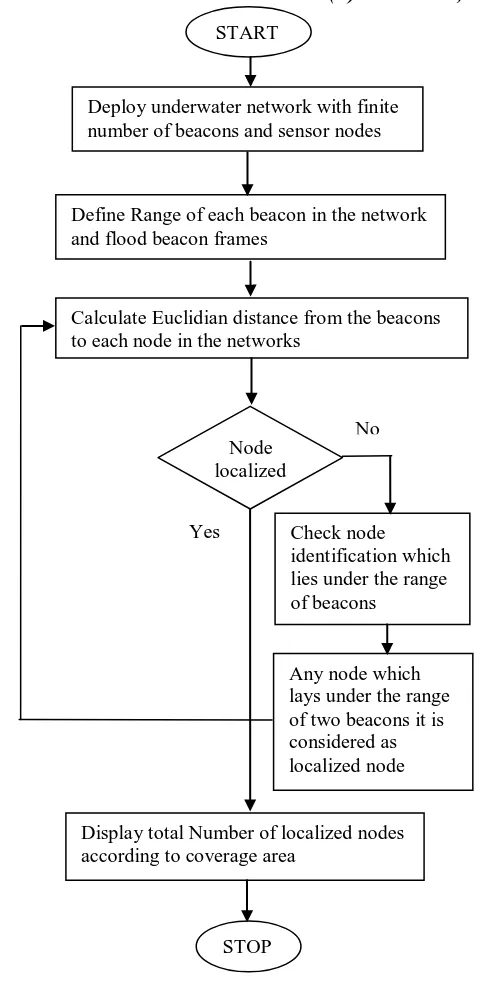
START
Deploy underwater network with finite number of beacons and sensor nodes
Define Range of each beacon in the network and flood beacon frames
Calculate Euclidian distance from the beacons to each node in the networks
Node localized
Check node identification which lies under the range of beacons
Any node which lays under the range of two beacons it is considered as localized node
Display total Number of localized nodes according to coverage area
STOP
No
ISSN(E): 2277-128X, ISSN(P): 2277-6451, pp. 44-49
As shown in figure 1, the network is deployed with the finite number of sensor nodes and in the network beacons are inserted and these beacons can change its location horizontally. The coverage area of the beacons are defined in the last figure which can localize the sensor nodes.
Fig 2: Distance of each node from each beacon
As shown in figure 2, the technique is applied which will check the distance of beacon from the sensor node. The node which is covered with in the range of two beacons get localized
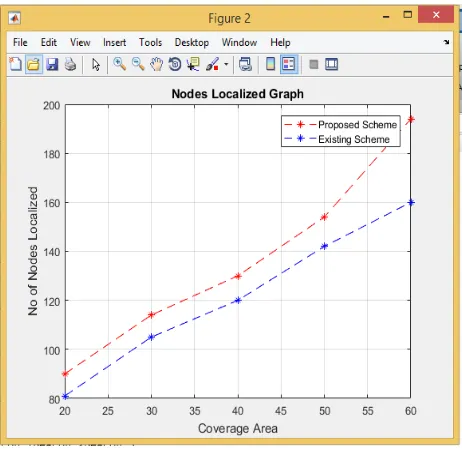
Fig 3: Performance Analysis of proposed technique
As shown in figure 3, the performance of the proposed technique is analyzed and it is been analyzed that when the coverage area of the beacon get increased then the node localization is increased at steady rate.
VI. CONCLUSION
ISSN(E): 2277-128X, ISSN(P): 2277-6451, pp. 44-49
Table 1: Comparision
Coverage Area Existing Algorithm Proposed Algorithm
20 80 90
30 107 110
40 120 130
50 141 150
60 160 190
As shown in table 1, the proposed and existing techniques are compared for the performance analysis. It is analyzed that proposed technique performs well as compared to existing technique
REFERENCES
[1] Saroj kumar Rout, Amiya Kumar Rath, Chidananda Bhagabati, Pradyumna Kumar Mohapatra, “Node Localization by using Fuzzy Optimization Technique in Wireless Sensor Networks,” 2016, IEEE, vol.4 , PP.176-181
[2] Yashwanth N, B R Sujatha, “Wireless Sensor Node Localization in Underwater Environment,” 2016, IEEE International Conference on Electrical, Electronics, Communication, Computer and Optimization Techniques, vol. 4, pp.339-344
[3] Meng Joo Er, Shi Zhang, Ning Wang, “An Improved Node Localization Algorithm for Anisotropic Wireless Sensor Networks with Holes,” 2016, IEEE International Conference on Intelligent Control Power and Instrumentation (ICICPI), vol. 3, pp.263-267
[4] Saroj Kumar Rout, Amiya Kumar Rath, Chidananda Bhagabati, “Energy Efficient and Cost Effective Secure Node Localization with Key Management in Wireless Sensor Networks,” 2016, IEEE, vol. 4, pp.515-520 [5] Santar Pal Singh, S. C. Sharma, “Range Free Localization Techniques in Wireless Sensor Networks: A
Review,” 2015, ELSEVIER 3rd International Conference on Recent Trends in Computing 2015, vol.57, pp.7-116
[6] Ronald Beaubrun, “Methods for Node Localization in Wireless Sensor Networks,” 2014, IEEE 11th International Conference on Mobile Ad Hoc and Sensor Systems, vol.3, pp.521-522
[7] Ranjit Kaur, Sankalap Arora, “Nature Inspired Range Based Wireless Sensor Node Localization Algorithms,” 2017, Springer, vol.4, pp7-17
[8] S.R.Sujatha, Dr.M.Siddappa, “Node Localization Method for Wireless Sensor Networks Based on Hybrid Optimization of Particle Swarm Optimization and Differential Evolution,” 2017, IOSR-JCE, vol.19, pp.7-12 [9] Meng Joo Er, Shi Zhang, Baihai Zhang, Chiang-Ju Chien, and Feifan Wang, “ A novel localization approach
towards anchor to node in wireless sensor networks,” 2016, IEEE, vol.4, pp.143-148
[10] Eva Tuba, Milan Tuba, Marko Beko, “Node Localization in Ad Hoc Wireless SensorNetworks Using Fireworks Algorithm,” 2016, IEEE, vol.3, pp. 130-137
[11] Chin-Shiuh Shieh, Van-Oanh Sai, Yuh-Chung Lin, Tsair-Fwu Lee* , Trong-The Nguyen and Quang-Duy Le, “Improved Node Localization for WSN using Heuristic Optimization Approaches,” 2016, IEEE International Conference on Networking and Network Applications, vol.3, pp.95-98