Research Article
a
April
2018
Special Issue: National Conference on Emerging Trends in Engineering 2018
Conference Held at Sri Venkatesa Perumal College of Engineering & Technology, Puttur, A.P., India
Computer Science and Software Engineering
ISSN: 2277-128X (Volume-8, Issue-4)
Estimation of STATCOM Voltage, Phase and Reactive
Power Using ANN
K. Vijaya Bhaskar, T. Vara Prasad, K. Ravindra Varma
Assistant Professor, Sri Venkatesa Perumal College of Engineering & Technology, A.P, India
Abstract— Different optimization techniques are used for the training of feed forward neural networks, for the estimation of STATCOM voltages and reactive powers. In the first part, the paper presents the voltage regulation in IEEE buses using the Static Compensator (STATCOM) and efficient ways to solve the power systems featuring STATCOM by load flow equations. The load flow equations are solved using iterative algorithms such as Newton-Raphson method. In the second part, the paper focuses on the use of estimation techniques based on Artificial Neural Networks as an alternative to the iterative methods. Two training algorithms have been used for training the weights of Artificial Neural Networks; these methods include Back-Propagation and Genetic Algorithm. A performance analysis of each of these methods is done on the IEEE bus data to examine the efficiency of each algorithm.
Index Terms— Artificial Neural Networks, Back Propagation Algorithm, Genetic Algorithm, STATCOM
I. INTRODUCTION
The power systems are the backbone of any country’s economic and social sectors, without which a country cannot excel in the industrial and social development. Recently, the increase of nonlinear loads has badly affected the power quality, due to inherent voltage fluctuations in these types of loads, and has also raised question on the long-term stability of the power systems and their associated instruments [1, 2]. Hence, more research studies have been dedicated to improving the power quality and efficiency through variety of different techniques. The total power in the system contains both real and reactive power, which implies that if the reactive power of the system is improved, the overall system can benefit from this improvement.
A family of different devices which can control the reactive power at designated buses is given the name Flexible AC Transmission Systems (FACTS). These devices have the capability to dynamically adjust different system parameters to enhance the performance and quality [2]. The FACTS are actually controllers which can improve the system stability in terms of voltages, reactive power, and phase angles in the steady-state operation. One of the important FACTS devices which we have focused on in this research is called the Static Synchronous Compensator (STATCOM). A STATCOM is used to control the bus voltage or reactive power injection/absorption at the bus and is connected in shunt with the designated bus.
The STATCOM when used as a voltage regulator draws controllable reactive currents from the buses. Since it is an expensive device, the selection of the optimal bus for the installation is of prime importance. When installed at an ideal location, the STATCOM can improve the efficiency of the power systems significantly [3-6]. However, the STATCOM must be installed on a load bus only, since the generator buses do not need voltage regulation [7-9]. Several authors have reported the use of STATCOM for the voltage and reactive power regulation with different configurations. For example, in larger power systems involving hundreds of buses, multi pulse inverters based controllers are used because they provide lower harmonic distortion.
Over the past few decades, many different solutions have been proposed for the load flow problems. One of the primary methods used for the solutions of nonlinear equations is Newton-Raphson method [15], which is widely known for its quadratic convergence features. However, the conventional load flow studies do not account for the presence of STATCOM device(s) in the system and hence the method must be redesigned for the STATCOM buses. In this paper, we have briefly explained the method to modify the existing load flow equations to incorporate the STATCOM parameters such as reactive powers and voltage sources using Newton-Raphson method as done in [16].
We propose an alternative approach to this method which is based on machine learning algorithms. More specifically, we propose the use of Artificial Neural Network (ANN) for estimating the STATCOM parameters such as voltages, phase angles, and reactive powers. ANN is a very powerful tool which can be used for the data fitting operations as well as classification problems. ANN has been successfully used in different fields which involve use of datasets, such as medical and biomedical applications business, finance, stock markets, and foreign exchange , and power applications . The ANN can be trained to capture the nuances in the input data and to produce estimated outputs accordingly, which in this case would be the estimated voltages and reactive powers. The ANN can be used efficiently in real time power systems to do the load flow analysis much faster than the NR method, thus saving cost of computation power and making shrewd decisions at the right moment.
ISSN(E): 2277-128X, ISBN: 978-93-87396-07-4, pp. 50-57 angle of the STATCOM bus, while the third and last ANN is used to estimate the reactive power of the STATCOM bus. In order to generate a data set of real and reactive powers of the STATCOM bus, the real and reactive powers of all the load buses in the system were perturbed by gradually increasing their values and the corresponding voltages, angles, and reactive powers at the output were recorded. This data is then fed to both of the ANNs for their respective tasks.
Usually, the Back-Propagation (BP) method is the primary method for training the neural networks; however, this method is prone to get stuck in the local minima and also experiences slower convergence rate towards the optimal solution. Genetic Algorithm is also applied for the parameter tuning of the ANN. Genetic Algorithm is another efficient method of optimization which has been vastly used for different problems pertaining to the optimization of different parameters. Genetic Algorithm is based on the Darwinian concept of survival and involves natural selection and natural genetics. The algorithm consists of binary strings which are evolved during the run, on the basis of their probabilities and minimal cost. The algorithm consists of certain operations such as mutation, crossover, and reproduction. Genetic Algorithm is used in literature to provide training to the neural network parameters.
II. MODELING OF POWER SYSTEMS
A. Without STATCOM
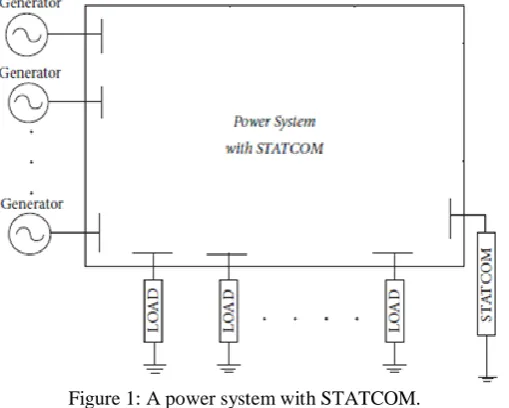
Each power system consists of several buses interconnected with each other through transmission lines. The buses can either be load or generator buses. The interconnection of different buses can be represented by the admittance matrix or the Y-matrix. The Y-matrix is a better representation of the transmission lines because most of the entries in this matrix are zero, as compared to the reactance matrix. However, the Y-matrix does not incorporate the admittances associated with the load connected to the buses and STATCOM controller. This representation is shown in Figure 1.
Figure 1: A power system with STATCOM.
The steady-state model of the system is represented by the static load flow equations for the real and reactive powers of the buses along with the equality constraints of the transmission network. The static load flow equations of a specific bus are written in terms of voltage magnitudes and phase angles of all the buses connected to this bus. That is, the load flow equations for real (Pi ) and reactive power (Qi ) of bus ―i ‖ are written as
ISSN(E): 2277-128X, ISBN: 978-93-87396-07-4, pp. 50-57 B. With STATCOM
As mentioned in the introduction, the purpose of the STAT-COM is to regulate the voltage and reactive powers of the power systems. Hence, the STATCOM has two modes:
(i) Voltage regulation: In this mode, the STATCOM is used to regulate the reactive power by injecting or absorbing the reactive power to and from the bus, respectively, by incorporating voltage source converter circuit and hence it stabilized the voltages to a predefined value. The STATCOM will absorb the reactive power from the bus when the voltage is higher than the limit and will inject reactive power to the bus when the voltage is below the defined limit.
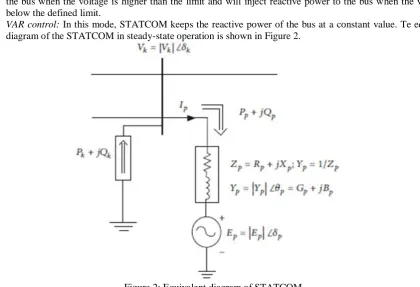
(ii) VAR control: In this mode, STATCOM keeps the reactive power of the bus at a constant value. Te equivalent diagram of the STATCOM in steady-state operation is shown in Figure 2.
Figure 2: Equivalent diagram of STATCOM
The figure shows the model of STATCOM, which is connected to the bus ―k.‖ In this setting, the STATCOM is represented by a controllable voltage source with electric potential Ep and phase angle δp , which is connected in series with an impedance Zp . Yp is the admittance of the link.
III. OVERVIEW OF ANN & GA
A. Artificial Neural Network:
ANN is an excellent machine learning algorithm for the regression and classification problems, which can estimate the data by emulating the functionality of human brain—it works in different layers each with certain number of neurons and weights. The ANN can be used to estimate nonlinear systems even when the input data is sophisticated and contains redundant and corrupt information. Due to its non algorithmic nature, ANN does not try to approximate the solution like the conventional techniques which are used for solving the load flow equations. Each neural network has the following basic layers:
Input layer
Output Layer
Hidden Layer
A schematic of the connections in ANN is shown in Figure 3.
ISSN(E): 2277-128X, ISBN: 978-93-87396-07-4, pp. 50-57 The structure of an artificial neuron is shown in Figure 4.
B. Genetic Algorithm (GA).
Genetic Algorithm proposed by Goldberg and Holland is another very efficient optimization algorithm. This algorithm is based on the natural selection and genetics which are derived from the Darwinian concept of survival. The solutions consist of binary strings with exchange information with each other through different operations. Usually, the solutions are represented in terms of binary strings. The initial solutions are randomly generated and their cost is calculated. The Genetic Algorithm performs three basic operations on these solutions.
Reproduction
Crossover
Mutation
IV. METHODOLOGY
The steps for the design of neural network and GA, can be summarized as follows.
(1) For both case, arrange the dataset into two portions: training and testing. The total number of input features present in the dataset plays important role in determining total number of neuron in hidden layer.
(2) Initialize the total number of hidden layers and hidden neurons ―n.‖ The total number of weighted neurons in the input layer is the product of number of hidden neurons ―n‖ and the features of the input dataset ―m.‖ Similarly, the number of total bias parameters in the hidden layer is equal to total hidden neurons, while the number of bias parameters in output layers equals the number of outputs.
(3) Calculate the total number of parameters to be optimized in the neural network. For a network with ―n‖ hidden neurons and an input with ―m‖ features, the total number of parameters in the input layer is ―𝑛 ∗ 𝑚.‖ In the hidden layer, there are ―n‖ weights of the neurons and ―n‖ bias values. In the output layer, there are total ―o‖ output bias values, corresponding to each output. Hence, the total number of parameters ―𝐷‖ to be optimized is given as
𝐷 = 𝑚∗𝑛 + 𝑛 + 𝑛 + 𝑜.
(4) Initialize the GA populations randomly. Each solution has the dimension given and represents different combination of the weights and biases, which are explained previously. Furthermore, all the relevant constants, iterations, and constraints are initialized. Constraints must be defined according to the given conditions and can play vital role in convergence of the algorithms.
(5) The cost function is defined which is used by all the algorithms to calculate the difference between the actual output (calculated using Newton-Raphson method) and estimated output using the neural networks.
(6) For GA, the steps for this optimization are as follows:
(i) The parents are chosen probabilistically among the set of all solutions based on their cost with a probability. (ii) A crossover is applied between the two selected parents in each iteration to create a child solution. This
involves selection of parents as well as the selection of split (crossover) site.
(iii) Mutation operation takes the child and randomly changes random number of entries. This child is now placed in the population set. In the next iteration, this child would be candidate for the parent
V. RESULTS & DISCUSSION
In order to study the efficiency of the designed STATCOM and the ANN based estimation techniques, we have tested the system on IEEE-30 bus system. The duty of STATCOM is to maintain the bus voltage at 1.0 p.u. while the estimation schemes have been used to estimate the STATCOM voltage, phase angle, and the reactive power at STATCOM. The STATCOM has been connected at the load bus 12. ANN has been trained by a variety of different optimization techniques such as Back-Propagation and GA.
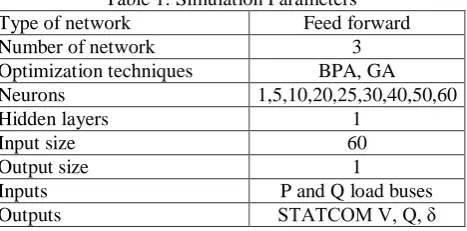
Table 1: Simulation Parameters
Type of network Feed forward
Number of network 3
Optimization techniques BPA, GA
Neurons 1,5,10,20,25,30,40,50,60
Hidden layers 1
Input size 60
Output size 1
Inputs P and Q load buses
ISSN(E): 2277-128X, ISBN: 978-93-87396-07-4, pp. 50-57 1. Voltage Magnitude Estimation.
As the first case, the voltage estimation using BP, and GA is shown in Figures 5, 6, respectively, as the number of neurons is increased from 1 to 60.
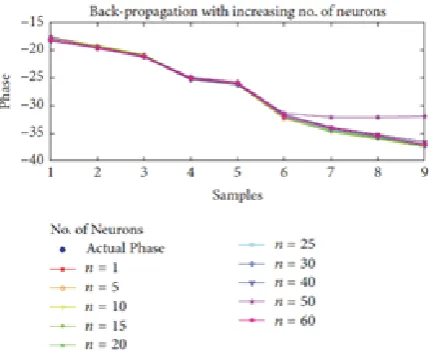
2. Phase Estimation.
For the estimation of STATCOM phase, the results are shown in Figures 7, 8 for BP and GA, respectively.
3. Reactive Power Estimation.
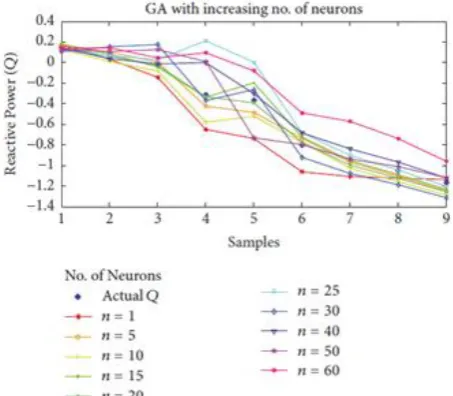
For reactive power estimation, the results are shown in Figures 9, 10 for BP and GA, respectively
Figure 5: Voltage estimation with increasing number of neurons using BP
Figure 6: Voltage estimation with increasing number of neurons using GA
ISSN(E): 2277-128X, ISBN: 978-93-87396-07-4, pp. 50-57
Figure 8: Phase estimation with increasing number of neurons using GA
Figure 9: Reactive Power estimation with increasing number of neurons using BP
Figure 10: Reactive Power estimation with increasing number of neurons using GA
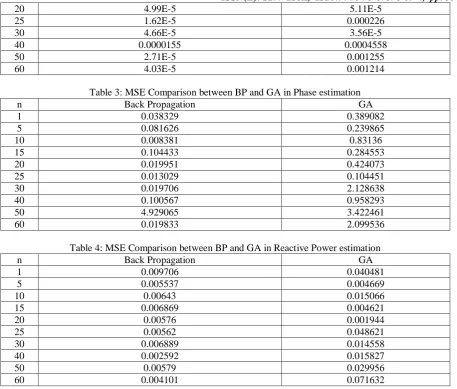
Table 2: MSE Comparison between BP and GA in Voltage estimation
n Back Propagation GA
1 9.79E-5 0.000403
5 8.04E-5 2.36E-5
10 6E-5 3.7E-5
ISSN(E): 2277-128X, ISBN: 978-93-87396-07-4, pp. 50-57
20 4.99E-5 5.11E-5
25 1.62E-5 0.000226
30 4.66E-5 3.56E-5
40 0.0000155 0.0004558
50 2.71E-5 0.001255
60 4.03E-5 0.001214
Table 3: MSE Comparison between BP and GA in Phase estimation
n Back Propagation GA
1 0.038329 0.389082
5 0.081626 0.239865
10 0.008381 0.83136
15 0.104433 0.284553
20 0.019951 0.424073
25 0.013029 0.104451
30 0.019706 2.128638
40 0.100567 0.958293
50 4.929065 3.422461
60 0.019833 2.099536
Table 4: MSE Comparison between BP and GA in Reactive Power estimation
n Back Propagation GA
1 0.009706 0.040481
5 0.005537 0.004669
10 0.00643 0.015066
15 0.006869 0.004621
20 0.00576 0.001944
25 0.00562 0.048621
30 0.006889 0.014558
40 0.002592 0.015827
50 0.00579 0.029956
60 0.004101 0.071632
VI. CONCLUSION
This estimation can be applied to larger power systems such as IEEE-300 bus system to understand the dynamics of larger amount of data and its effect on different optimization techniques.
This paper is focused on fine-tuning the weights of Artificial Neural Network (ANN) using different optimization techniques. Then, the developed ANN is used to estimate voltages, phases, and reactive powers of STATCOM. The role of STATCOM in power buses for the voltage regulation of the buses.
An efficient iterative method to solve the power systems which involve STATCOM was presented. The STATCOM introduces some new variables in the system which must be accounted for.
In the next stage, we have provided an alternative method to calculate the unknown variables in STATCOM using Artificial Neural Network curve fitting, which is faster and requires less memory and processing power. We have trained Artificial Neural Networks with different optimization techniques such as Back-Propagation and Genetic Algorithm. The results show that GA can perform better than the Back-Propagation and other methods when the parameters are fine-tuned according to the given dataset.
REFERENCES
[1] G. Singh and L. Srivastava, ―Genetic Algorithm-Based Artificial Neural Network for Voltage Stability Assessment,‖ Advances in Artificial Neural Systems, vol. 2011, pp. 1–9, 2011.
[2] C. Liu, S. McArthur, and S. Lee, Smart Grid Handbook, John Wiley & Sons, Ltd, Chichester, UK, 2016. [3] S. Varshney, L. Srivastava, and M. Pandit, ―Comparison of PSO models for optimal placement and sizing of
statcom,‖ in Proceedings of the International Conference on Sustainable Energy and Intelligent Systems, SEISCON 2011, pp. 346–351, India, July 2011.
[4] S. Dixit, L. Srivastava, and G. Agnihotri, ―Optimal placement of SVC for minimizing power loss and improving voltage profile using GA,‖ in Proceedings of the 2014 International Conference on Issues and Challenges in Intelligent Computing Techniques, ICICT 2014, pp. 123–129, India, February 2014.
ISSN(E): 2277-128X, ISBN: 978-93-87396-07-4, pp. 50-57 [6] A.Karimi and R. Raisinejad, ―Optimal placement facts device to increase voltage stability margin using direct
search algorithm,‖ Journal of Fundamental and Applied Sciences, vol. 8, no. 3S, pp. 2984–2995, 2016.
[7] M. Eremia, C.-C. Liu, and A.-A. Edris, ―Advanced Solutions in Power Systems: HVDC, FACTS, and AI Techniques,‖ Advanced Solutions in Power Systems: HVDC, FACTS, and AI Techniques, pp. 1–1042, 2016. [8] J. Mu˜noz, P. Mel´ın, and J. Espinoza, ―Control of multilevel STATCOMs,‖ Power Systems, vol. 90, pp. 265–
311, 2015.
[9] B. Stott, ―Review of load-flow calculation methods,‖ Proceedings of the IEEE, vol. 62, no. 7, pp. 916–929, 1974.
[10] J. Zhu,Optimization of power systemoperation, JohnWileySons, 2015.
[11] P. Schavemaker and L. V. D. Sluis, Electrical power system essentials, JohnWiley Sons, 2017.
[12] F. Cajori, ―Historical Note on the NEWton-RaphsonMethod of Approximation,‖ The American Mathematical Monthly, vol. 18, no. 2, pp. 29–32, 1911.
[13] S. Kamel, F. Jurado, and D. Vera, ―A simple implementation of power mismatch STATCOM model into current injection Newton-Raphson power-flow method,‖ Electrical Engineering, vol. 96, no. 2, pp. 135–144, 2014. [14] E. Acha and B. Kazemtabrizi, ―A new STATCOM model for power flows using the newton-raphson method,‖
IEEE Transactions on Power Systems, vol. 28, no. 3, pp. 2455–2465, 2013.
[15] L. Imen, L. Djamel, S. Hassiba, D. Abdellah, and F. Selwa, ―Optimal power flow study using conventional and neural networks methods,‖ in Proceedings of the 4th International Conference on Renewable Energy Research and Applications, ICRERA 2015, pp. 1422–1427, Italy, November 2015.
[16] A. Jain, S. Tripathy, R. Balasubramanian, and Y. Kawazoe, ―Stochastic load flow analysis using artificial neural networks,‖ in Proceedings of the 2006 IEEE Power Engineering Society General Meeting, p. 6 pp., Montreal,Que., Canada, June 2006.
[17] H. A. Hassan and A. E.-A. Lasheen, ―Sizing of STATCOM to Enhance Voltage Stability,‖ Smart Grid and Renewable Energy, vol. 5, pp. 8–18, 2014.
[18] D. J. Sargent, ―Comparison of artificial neural networks with other statistical approaches: Results from medical data sets,‖ Cancer, vol. 91, no. 8, pp. 1636–1642, 2001.
AUTHORS
K.Vijaya Bhaskar completed his UG in 2007 and PG 2010. He is working as Assistant Professor in Department of Electrical and Electronics Engineering in Sri Venkatesa Perumal College of Engineering and Technology. His areas of interests are application of artificial intelligence, FACTS controllers, HVDC.
T.Vara Prasad completed his UG in 2007 and PG 2010. He worked as Assistant Professor in Department of Electrical and Electronics Engineering in Sri Venkatesa Perumal College of Engineering and Technology. His areas of interest are Power Systems, Specialized Machines, Control Systems.