Proceedings of the
Fifth International Workshop on
Foundations and Techniques for
Open source Software Certification
(OpenCert 2011)
The Role of Best Practices to Appraise Open Source Software
Miguel Regedor, Daniela da Cruz and Pedro Henriques
17 pages
Guest Editors: Luis Soares Barbosa, Dimitrios Settas
Managing Editors: Tiziana Margaria, Julia Padberg, Gabriele Taentzer
The Role of Best Practices to Appraise Open Source Software
Miguel Regedor1, Daniela da Cruz2and Pedro Henriques3
1[email protected] 2[email protected]
Dep. de Inform´atica / CCTC Universidade do Minho
Braga, Portugal
Abstract: Thousands of open source software (OOS) projects are available for collaboration in platforms like Github or Sourceforge. However, like traditional software, OOS projects have different quality levels. The developer, or the end-user, need to know the quality of a given project before starting the collaboration or its usage—they might of course to trust in the package before taking a decision. In the context of OSS, trustability is a much more sensible concern; mainly end-users usually prefer to pay for proprietary software, to feel more confident in the package quality. OSS projects can be assessed like traditional software packages using the well known software metrics. In this paper we want to go further and propose a finer grain process to do such quality analysis, precisely tuned for this unique development environment. As it is known, along the last years, open source communities have created their own standards andbest practices. Nevertheless, the classic software metrics do not take into account thebest practicesestablished by the community. We feel that it could be worthwhile to consider this peculiarity as a complementary source of assessment data. Taking Ruby OSS community and projects as framework, this paper discusses the role ofbest practicesin measuring software quality.
Keywords: software metrics, static code analysis, open-source, program compre-hension
1
Introduction
Nowadays, Open Source Software (OSS) is well disseminated. Thousands of OSS packages can be found online, and free to download, in Open Source Project Hosting Websites (OSPHW) likeSourceForge1,Google Code2, orGitHub3. Those websites, usually in conjunction with a Version Control System (VCS), make it easy for developers, all around the globe, to collaborate in Open Source Software Projects (OSSP), and also act as a way to make software available to users.
According toNetCraft4, the market share for top servers across the million busiest sites was 66.82% for the open source web server, Apache, much higher than the 16.87% for Microsoft web servers in May 2010. Even governments started noticing open source, during the last few years, and in some case adopted it[Hah02]. The broad acceptance of OSS means that now OSS is not only used by computer specialists.
John Powell5 has declared that measuring the savings that people are making in license fees, the open-source industry is worth 60 billion dollars. Matt Asay6 shares the view that from the customers perspective open source can be now considered the largest software industry in the world. The full review can be found atCNET News7.
Usually large industries have a strict organization model, that is not the way open source communities operates. Open Source communities work in a kind of bazaar style. E. Ray-mond [Ray00] compares the traditional software development process to built cathedrals, few specialized individuals working in isolation. While open source development seemed to resem-ble a great babblingbazaar. But OSS is not developed, all the time, inbazaar styleand each community can have particular habits. Currently, big open source projects can have companies supporting them. However, most projects are not that big and sometimes it is hard to distinguish the project developers from the project customers/users, because of that bug reports and wanted features can get indistinguishable too. The specification of an open source software project evolves in an organic way [CM07].
Can software that is developed in such chaotic way be trusted as a high quality product? The shock is that in fact thebazaar styleseemed to work [HS02]. Some big projects, for instance Linux distributions such asUbuntu8, are the proof of it. However, how can the quality of this software be measured?
The most basic meaning of software quality is commonly recognized as lack of ”bugs”, and the meeting of the functional requirements. But quality is not simply based on that [GKS+07]. The quality of a software system depends, among other things, on update frequency, quantity of documentation, test coverage, number and type of its dependencies and good programming practices. By analysing those parameters a user can make a better choice when picking software for a specific task [MA07].
When a user/developer finds a new OSSP, for example in GitHub, the things that will most influence the time needed to have a better understanding of the project, to use, or collaborate in it, are the quality of the documentation and the source code readability. Although the OSPHWs provide plenty of useful information about the hosted projects, currently, they do not give a quick answer to the following questions: Does this project have good documentation? Does the code follow standards? How similar is it to other projects?
An OSSP is built up from hundreds, sometimes thousands, of files. It can be coded in many different computer languages. To analyze manually a software project is a very hard and time consuming task, and not all users have the ability to answer the previous questions by looking at the source code [CAH03].
4http://news.netcraft.com/archives/2010/05/14/may 2010 web server survey.html/, accessed on 2010/12/21. 5John Powell is CEO, President, and Co-founder, Alfresco Software Inc.
6Matt Asay is chief operating officer at Canonical, the company behind the Ubuntu Linux operating system. 7http://news.cnet.com/8301-13505 3-9944923-16.html/accessed on 2010/12/21.
However, open source communities are constantly creating and improving their working method-ologies. And even without noticing, communities create rules and best practices. By following thosebest practices, software projects increase their maintainability level.
With that in mind, a system capable of analyzing and measuring a given OSSP, producing detailed quantitative and qualitative reports about it, would enable users to make better choices and, of course, developers to further improve the package.
This paper discusses the concept of Quality when addressing an OSSP, and how to measure it (Section 3) using classic approaches. After that, the notion ofbest practicesis introduced and the impact of taking their use into account when assessing an OSSPs is explored. To make this proposal clearer and stronger,Ruby9community is taken as a starting target (Section 4). At last but not least, to support our proposal a case-study is shown, in Section 5: seven Ruby OSSP are measured and compared.
2
Open Source
Open source describes practices in production and development where everybody as access to the product source materials. Definition fromhttp://opensource.org/:
Open source is a development method for software that harnesses the power of distributed peer review and transparency of process. The promise of open source is better quality, higher reliability, more flexibility, lower cost, and an end to predatory vendor lock-in.
Generically, open source refers to a computer software in which the source code is available, free of charge, to the general public for use, modification and redistribution.
Nevertheless, in the past few years, the concept ofopen sourcehas been widely used, not just in computer software, but in every industry. Actually, new concepts, likeopen design10oropen religions11, emerged from it. A simple metaphoric example:
A restaurant would be open source if the chef reveals to the general public his cooking techniques and recipes. Consequently, by revealing his secrets, other people can start doing the same dishes and even improve his techniques.
That might not be a good bet for a restaurant, but its proved to be a good one in software devel-opment.
2.1 Open Source Software Development
Previously, in the introduction it was said that large industries have a strict organization model and that it is not the way open source communities operates. Open Source communities work in
bazaar style. This term was introduced by Raymond in [Ray00].
9 Ruby is an open source programming language. Ruby community is relatively young but still very focused on
following best practices.
10 Open design is the development of physical products, machines and systems through use of publicly shared design
information.
Of course, OSS is not developed, all the time, in the same way. Each community have par-ticular habits. Different development and management methodologies, more traditional or more agile, can be used. Currently, the truth is that the most successful communities organize them-selves in a similar way as professional and proprietary companies, and some of the big open source projects have big companies supporting them, but that it is not charity. Imagine the con-sequences of a having a handful of highly motivated eyes going through the code, constantly reviewing it, correcting and adding to it. People working not because they were told to, but be-cause it is their own will. Those communities are the strength of OSS and the companies behind it.
OS development makes possible to a project to reach a high quality level, in much less time and with fewer financial investment, comparing to traditional software development. Nevertheless those OSP still follow the OS core rules, and those projects are community driven, the users and developers must feel engaged to it.
It is obvious that companies need to make money, but even if their software is free and open source, new ways of income can be explored, for example charge for support, related services, donations, etc.
The well known open source browser, Firefox, is the descent of the graphical web browser named Mosaic released by Netscap in 1993. When Microsoft bundled Internet Explorer with Windows, it was obvious that Netscape was doomed. But, they turned project into open source, created the Mozilla Foundation, and the community gathered around it, helping the company regain the lost market.
This and other examples shows OS develoment as one of the most effective development models, today. As a fact, many companies are trying to explore these business models.
2.2 Open Source Project Hosting Platforms
The strength of the open source development model comes from the user base and the power given to it. Users should fill out bug reports, submit feature requests, etc. Because the de-velopers can be spread all around the globe there there is the need of effective administered communication channels, for better cooperation and co-ordination.
An open source project hosting platform is the central tool that supports and co-ordinates the development of an open source project, normally it is in a form of a website.
Since 1999 (year that SourceForge was launched), many open source project hosting websites (OSPHWs) were created to host open source projects. OSPHWs offer different features, like codebase12 hosting (a project codebase is typically stored in a source control repository), code review, bug tracking, web hosting, wiki, mailing list, etc [BHK06].
GitHub is one of the youngest OSPHW (launched in 2008). However, in only two years, it drew more than 500,000 users (one quarter of sourceforge users) and is hosting more than 1,500,000 projects. The only version control system provided by GitHub is Git13. Because GitHub projects are in fact git repositories, it is incredibly easy to make branches and merges in GitHub. Although branching was considered a big pain in older version control systems, it
12The term codebase means the whole collection of source code used to build a particular application or component. 13http://git-scm.com/. Git is a free & open source, distributed version control system that Linus Torvalds developed
turned out that using git, it can in fact improve the developers collaboration and organization. This happens because of the distributed philosophy and implementation of git Hosting a Git repository is not hard but co-ordinating efforts of forking and merging amongst people is tough. With a system like Github, it becomes a lot easier [Coo08]. However, the main reason for GitHub popularity are the social aspects. Users and projects have public profiles and activity feeds which display activity on public projects such as commits, comments, forks, etc. Furthermore, with so many high profile projects on board ( jQuery, reddit, Sparkle, curl, Ruby on Rails, node.js, ClickToFlash, Erlang/OTP, CakePHP, Redis), it is easy to imagine that GitHub could be the next SourceForge.
The reasons above allow us to believe that GitHub has a strong and growing open source community, that it is an important platform both for users and developers. Because of that and the high number of ruby on rails projects hosted here, It was decided to focus this study on GitHub projects
3
Assessing Open Source Software
The simplest operation in science and the lowest level of measurement is classification [Kan02]. By assessing OSS we mean to sort OSS projects into anordinal scale14This can be achieved by defining aranking system15 and by placing OSS projects into quality categories with respect to certain quality attributes. First we need to find a way of quantifying those OSS quality attributes. In software, quality is an abstract concept. It is commonly recognized as lack of ”bugs”, and the meeting of the functional requirements. However, quality can be perceived and interpreted differently based on the actual context, objectives and interests of each project. Many software development companies do monitor costumer satisfaction as a quality index, for instance, IBM ranks their software products in levels of CUPRIMDSO [Kan02]:
• Capability/Functionality (refers to the software meeting its functional requirements)
• Usability (refers to the required effort to learn, and operate the software)
• Performance/Efficiency (refers to the software performance and resource consumption)
• Reliability (refers to software fault tolerance and recoverability)
• Instalability/Portability (refers to the required effort to install or transfer the software to another environment)
• Maintainability (refers to the required effort to modify the software)
• Documentation/Information (refers to the coverage and accessibility of the software doc-umentation)
• Service (refers to the company monitoring and service)
14Ordinal scale refers to the measurement operations through which the subjects can be compared in order. 15 Raking system example: to classify a quality attribute, for instance the project documentation, according to its
• Overall (refers to an overall classification based on the other attributes)
Almost every big software company have similar quality attributes. ISO/IEC 9126 provides a framework for the evaluation of software quality (The goal is to achieve quality in use, in other words, quality from the user perspective) [Bev99] IISO/IEC 912 defines six software quality attributes:
• Functionality (refers to the software meeting of the functional requirements)
• Reliability (refers to software fault tolerance and recoverability)
• Usability (refers to the required effort to learn, and operate the software)
• Efficiency (refers to the software performance and resource consumption)
• Maintainability (refers to the required effort to modify the software)
• Portability (refers to the required effort to transfer the software to another environment)
Quality attributes have interrelationships. They can be conflictive16or support17one another. For example, the higher the functional complexity of the software, the harder it becomes to achieve maintainability [Kan02].
Because of the OSP bazaar style and continuous development process, it is intuitive that the maintainability and documentation attributes have a big influence on the overall quality and continuous progress of an OSP (maintainability and documentation have support relationships with usability, reliability and availability attributes, but might be conflictive with functionality and performance attributes).
Failure to meet functionality often leads to late changes and increased costs in the develop-ment process. The software industry and researchers have been mostly interested on testing methodologies that focus on functional requirements and pay little attention to non-functional requirements [CP09].
There are several challenges and difficulties, in assessing non-functional quality attributes for software projects. For example, security is a non-functional requirement that needs to be addressed in every software project. Therefore a badly-written software may be functional, but subject to buffer overflow attacks. Another example is the amount of codebase comments, if the code does not have any comments it will not affect the functional requirements, but it is obvious that it will decrease readability and maintainability [GKS+07].
3.1 Classic Software Metrics
To classify OSS with regards to a certain quality attribute, we need to find which factors influence it. Then we need a way to measure that attribute. If we need to measure we need metrics.
Fortunately, there are around two thousand documented software metrics, but there is few information on how those metrics relate to each other. Most of them simply have different names but give similar information [FN99]. The major challenge is to discover how important
the information given by those metrics is, if the calculation effort pays off, how to interpret their values and findcorrelations18to assess the quality attributes of an OSP.
3.1.1 Lines of Code
A line of code is any line of program text that is not a comment or blank line, regardless of the number of statements or fragments of statements in the line. This specifically includes all lines containing program headers, declarations, and executable and non-executable state-ments [CDS86].
3.1.2 Cyclomatic Complexity
The measurement of cyclomatic complexity [McC76] was designed to indicate a program’s testa-bility and maintainatesta-bility. It is the classical graph theory cyclomatic number, indicating the number of regions in a graph. As applied to software, it directly measures the number of linearly independent paths through a program source code.
3.1.3 Fan-In and Fan-Out
Fan-in and fan-out are perhaps the most common design structure metrics, which are based on the ideas of coupling [YC79]:
• Fan-in is a count of the modules that call a given module
• Fan-outis a count of modules that are called by a given module
In general, modules with a large fan-in are relatively small and simple, and are usually located at the lower layers of the design structure. In contrast, modules that are large and complex are likely to have a small fan-in. There is also the theory that high fan-outs represent a high number of method calls and thus are undesirable, while high fan-ins represent a high level of reuse [WLCR07].
3.1.4 Object-Oriented Metrics
Classes and methods are the basic constructs of OO technology. The amount of function provided by an OO software can be estimated based on the number of identified classes and methods or their variants. Therefore, it is natural that the basic OO metrics are related to classes, methods and their size.
The pertinent question therefore is what should the optimum value be for OO metrics. There may not be one correct answer, but based on his experience in OO software development, Lorenz proposed eleven metrics as OO design metrics called rules of thumb [LK94].
• Average Method Size (LOC): Should be less than 8 LOC for Smalltalk and 24 LOC for C++
18 Correlation is probably the most widely used statistical method to assess relationships among observational
• Average Number of Methods per Class: Should be less than 20. Bigger averages indicate too much responsibility in too few classes.
• Average Number of Instance Variables per Class: Should be less than 6. More instance variables indicate that one class is doing more than it should.
• Class Hierarchy Nesting Level (Depth of Inheritance Tree, DIT): Should be less than 6, starting from the framework classes or the root class.
• Number of Class/Class Relationships in Each Subsystem: Should be relatively high. This item relates to high cohesion of classes in the same subsystem. If one or more classes in a subsystem don’t interact with many of the other classes, they might be better placed in another subsystem.
• Average Number of Comment Lines (per Method): Should be greater than 1.
4
Best Practices in OSSP development
Open source communities have a tendency to createcoding rules, i.e.,principles governing the conduct of programmers and serving as a basis of measure or judgment. It is a natural and evolutive process for people surviving in an open space. We can call these natural rules: best practices. Best practices are methods thought as being the best way for achieving something; they are spread through the community and everybody does it that way. It is obvious that when a developer follows well established principles and best practices, the project maintainability is increased. Consequently, project new comers will find it easier to understand the project code [Dro02]. But there is more than that, following best practices discourage:
• Poor performance (due to bad patterns)
• Poor error checking (defensive programming)
• Inconsistent exception handling / Maintainability (long-term quality)
To attain the same benefits, companies define standards, this is, something considered by an authority as a basis of comparison and a normal requirement for quality; by other words, an approved behavior model for their workers. However, these principles are defined by the few people on top and then spread down on the pyramid. Many times, those rules are not well thought by the project leaders and that can block the progress. In the other way around, the apparent chaos of open source also requires these rules, but contrary to the companies coding standards, which work in a top down way, best practices happen in a bottom up and distributive mode, everybody can try different ways of doing things, but the ones with better results are most likely to be copied.
A simple metaphor exposes the difference:
Both, the strict company standards (traffic lights) and the OSP best practices (roundabouts) are ways to regulate intersections. The result of traffic lights is easier to predict, however that regulation system does not depend much on the drivers skills; because it is so restrictive it will happen often to find a driver stooped alone at the crossroads waiting for a green light, losing precious time. On the other hand, the roundabout system is a less restricted system and relies much more on the quality of the drivers, but it open the possibility to a much more efficient way to avoid a traffic jam.
There is little work done concerned with measuring coding standards by automatic analyz-ing source code. A plausible explanation for that is the fact that best practices are not a set of immutable rules, they are a continuous evolution and improvement of development methodolo-gies. Communities are constantly creating rules and best practices, even without noticing it. It is not possible to write down a list of best practices without some ambiguities. Nevertheless, it is still possible to use source code metrics and, by analyzing their values, to find weather some methodological approaches were taken into account during the project development process.
At first glance, best practices metrics are for classic metrics as natural as medicine is for sci-ence. But, it is not the case. In fact, classic metrics, on their own, do not give much information about a project. In many cases, best practices can be the key to understand what should be the optimum value for a classic metric, for instance, to determinehow many lines of code should a ruby method have. Of course, those questions are subjective. However, by analyzing renowned projects, developers opinions and so on, it is possible to find out a best practice that gives a plau-sible answer to the search for themost favorable value. We believe that, actually, best practices can give a meaning to metrics.
Software projects can benefit a lot from using best practices. But, what is a best practice after all?
4.1 Best Practices in RoR Projects
Ruby is a dynamic, object oriented, open source programming language created by Yukihiro Matsumoto and public released in 1995. It has an elegant syntax that is natural to read and easy to write. Ruby has drawn devoted coders worldwide. In 2006, Ruby achieved mass acceptance. Moreover, the web framework Ruby on Rails is considered the biggest responsible for Ruby popularity ( tens of thousands of Rails applications are online).
Ruby and Ruby on Rails community members are, in general, addicted to best practices. However, in reality, many of those best practices are studied development methodologies. For instance, the majority of Ruby on Rails book authors speak about automated tests, written using specific DSLs, like Cucumber or Rspec. It is also common to associate Ruby on Rails with Behaviour Driven Development (BDD) and Agile methodologies.
Because of all this, the ruby community has great potential to be a starting point to understand the role of best practices, its benefits and how to measure it. In fact, there is already some work done.
The web siteRails Best Practices19, works in similar way to a web forum and its objective is
19http://www.rails-bestpractices.com/is a web site created by Richard Huang, it was inspired by Wen-Tien Chang
to engage developers to discuss which practices should be considered best practices to follow, when building a RoR web application. The community involved with this web site is committed to build a gem20that produces a report about a given project.
4.2 Ruby Best Practices Examples
But what is is a best practice after all? Best practices can be related to code formatting:
• Use two spaces to indent code and no tabs, it is a matter of taste but every worthy ruby developer do it that way.
• Remove trailing whitespace, trailing whitespace makes noises in version control systems.
Can be related to syntax:
• Avoid return where not required.
• Suppress superfluous parentheses, when calling methods, but keep them when calling ¨functions¨(when you use the return value in the same line).
Can be related to naming:
• Use snake case for methods.
• Other method naming conventions: Use map over collect, find over detect, find all over select, size over length.
And can also be specific to a framework, rails best practices:
• Law of Demeter, A model should only talk to its immediate association.
• Move code into controller, according to MVC architecture, there should not be logic codes in view.
• Isolate seed data, do not insert seed data during migrations, a rake task21 can be used
instead.
• Do not use default route, When using a RESTful design. The default RoR routes can cause a security problems.
• Replace Complex Creation with Factory Method, Sometimes you will build a complex model with params, current user and other logics in controller, but it makes your controller too big, you should move them into model with a factory method.
20 Ruby Libraries are called gems. Ruby gems can be easily managed using rubygems (rubygems is for Ruby as
aptitude is for Debian or cpan for perl).
21 Rakefiles work in similar way to Makefiles but are written in ruby. It is a simple way to write code to automate
5
Assessing Ruby on Rails Projects
After deciding that some procedureis abest practice, it would be handy to find a way to au-tomatically verify whether that practice is being followed by the developers of a given project. With that in mind, an open source ruby gem was created (by the authors of Rails best practices web site) with the objective of automatically producing a report that shows where, in the source code, a project is failing to obey to consensual practices. At the moment of writing, this gem can check for 28 kinds of best practices (from the 70 described in that web site).
However, one of the first things that we have noticed when we have applied this gem to OSS projects, is that the biggest and most renown projects have much more errors than the smaller and unknown projects. This nonsense has a simple interpretation. Small projects (like the majority of RoR projects found in github) are simple software packages, often developed by a single user. These applications are so simple that many times the code is almost entirely created by RoR code generators. Usually, when code is not written by humans, it has few mistakes concerning those recommendations.
5.1 First Study
Having taken the above into account, we decided to run the rails best practices gem on similar RoR (Ruby on Rails) projects. Seventime trackingorproject managementopen source systems were chosen. After running the gem and countingnot best practices (NBPs)22 occurrences, the results in table1were obtained:
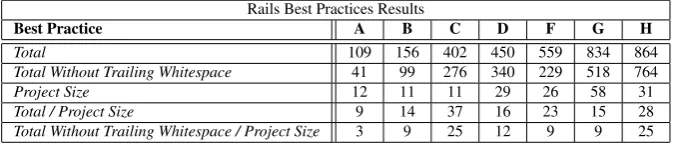
Rubytime seems to have the best results and Clockingit the worst. The fact is that very good user reviews can be found about Rubytime. However, Tracks obtained an unexpected high score, since it has been very sparsely maintained (old code has higher probability of not following the current best practices). As explained before, those values are not really measuring if a project follows best practices but instead measuring when it fails. This should also be taken into consid-eration.
The most evident problem here is that best practices are not being weighted and neither the size of the project considered. For instance, if the developers have the habit of leaving trailing white spaces, the occurrences of this will obviously be related to the size of the project. On the other hand, it is a best practice to remove the default route generated by rails, independently of the project size this is true or false, there is no way to leave the route two times. So, if developers do not take into account those two best practices, when the project grows, the number of trailing spaces will increase and the results will show more NBPs, but the other one will always be only one NBP. Because of that we can get twisted results.
To avoid this, the projects were sized. The size attribute is based on the quantity of models and controllers in the project. After that, we divided the values previously obtained by the project size. By doing that, a new set of results emerge, see table 2.
Those results are much more likely to be helpful in terms of understanding if a project is or is not following best practices. The numbers reflect both the community reviews and our own
22In fact, Rails best practices gem does not find best practices in the source code. It does the opposite, it discovers
Rails Best Practices Results
Best Practice A B C D F G H
a
Add model virtual attribute - 2 7 - - 5 4
Always add db index - - - 43 - - 51
Isolate seed data - - - 79 17
Law of demeter 20 38 45 6 30 164 85
Move code into controller - - - - 2 - 4
Move code into model - 26 - 7 1 3 19
Move model logic into model - - 76 11 11 98 100
Move finder to named scope - 4 9 2 4 25
-Needless deep nesting - - - 1 - -
-Not use default root - 1 1 - 1 1 1
Notes use query attribute - 2 - - - -
-Overuse route customizations - - 2 4 - 2 2
Remove trailing whitespace 68 57 126 110 330 316 100
Use factory method - 15 9 5 1 8 19
Replace instance var with local var 13 - 70 239 142 31 100
Use before filter - 7 9 8 8 19 23
Wrong email content type - 3 - - - -
-Use query attribute - - 11 5 8 29 6
Use say with time in migrations - - 24 - 10 23 56
Use scopes access - - - 04
User model association - - 12 9 - 1 21
Keep finders on their own model 8 4 1 - 11 -
-Total 109 156 402 450 559 834 864
A:Rubytime ,B:Notes ,C:Tracks ,D:Handy Ant ,F:Retrospectiva ,G:Redmine ,H:
Clockingit
Figures shown represent the number of times a project do not follow a best practice; is expected thatsmaller the number, better the project.
Table 1: Results obtained by running the best practices analyzer gem on the 7 Open Source Projects chosen (data produced on April, 2011).
Rails Best Practices Results
Best Practice A B C D F G H
Total 109 156 402 450 559 834 864
Total Without Trailing Whitespace 41 99 276 340 229 518 764
Project Size 12 11 11 29 26 58 31
Total / Project Size 9 14 37 16 23 15 28
Total Without Trailing Whitespace / Project Size 3 9 25 12 9 9 25
A:Rubytime. ,B:Notes ,C:Tracks ,D:Handy Ant ,F:Retrospectiva ,G:Redmine ,H:Clockingit
estimates much more.
5.2 Second Study
After the first study reported above, we felt that it was time to make a bigger one; we should repeat the experiment over a larger sample. In addition, there was the need to define an objective quality metric to compare the metrics results with. As a second target for this new phase, it was decide to find an objective quality rate (a reputation ranking) for each project in the sample, to be possible to compare with the results computed for the best practices metrics.
For the second study, we selected 40 Ruby on Rails projects hosted in github and decided to consider the number of followers23 andforks24, that each project has on github, as aproject reputationmetric.
The objective was to prove that a negative correlation exists, between the NBPs of a project and its followers and forks.
The previous study has shown us the need to apply different weights to each NBP. By diving the NBPs by the project size, in the first study, seemed like we got better results. However, not all NBPs depend on the project size. Therefore, we altered the rails best practices gem to make it possible to know how much project files were analyzed by each rails best practice checker.
Basically, after collecting the GitHub URLs for each project, we followed the next steps:
• Retrieve GitHub information, in this step we get the followers and forks(and more info that might be used in further analyses).
• Download the project repository.
• Run rails best practices gems, at this point, we get the non weighted NBPs and files given by each one of the 29 checkers.
• Calculate the Weighted Global NBPs, the evaluation algorithm consists in dividing the value returned by each NBP checker by the number of files checked and, then sum it.
Next, an excerpt of the obtained table is shown:
23Number of users that want to receive notifications about the project.
24Number of people that forked the project. This means that either they want to contribute to the project or create a
Rails Best Practices Results
Projects Forks Watchers C1 C1 F. W. C1 C2 C2 F. W. C1 ... T. NBPs W. T. NBPs
Rails Admin 30 2478 0 141 0 0 37 0 ... 50 739
Rubytime 12 82 24 161 149 0 134 0 ... 146 1334
Redmine 30 1781 49 996 49 1 362 2 ... 884 1402
BrowserCMS 30 784 11 234 47 0 216 0 ... 268 1510
Tracks 17 87 46 842 54 15 271 55 ... 569 2810
... ... ... ... ... ... ... ... ... ... ... ...
C(x): The rails best practices gem has 29 checkers(when this study was carried), each one tries to find occurrences of a different nbp in the project.
C(x) Files: The number of files in the project, where it tried to find nbps (for instance, some checkers may only be concerned with html files, some other checker nbps my only occur in model files, etc)
W. C(x): Weighted C(x) = C(X) / C(x)Files * 1000 (A really small number is added to each variable to avoid divisions by zero).
Table 3: Results obtained by running the best practices analyzer gemon the 40 Open Source Projects chosen, from GitHub (data produced on April, 2011). The full table can be found at www.bestpracticesstudy.gorgeouscode.com
5.3 Results
After building a table containing the results for the 40 projects, we easily found correlations be-tween columns. We discovered that the average correlation index, for the weighted C(x) columns, is -0.2. Only three of the weighted C(x) columns do not have negative correlation. This is quite good, considering the fact that there is an explanation for it. Those three checkers (without nega-tive correlation) aimed at finding NBPs that almost non of the projects were committing, so there is no correlation.
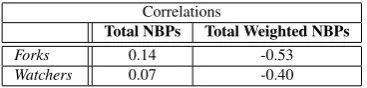
The most important results are in the next table:
Correlations
Total NBPs Total Weighted NBPs
Forks 0.14 -0.53
Watchers 0.07 -0.40
Table 4: The full table can be found at www.bestpracticesstudy.gorgeouscode.com
These correlation indexes show that if we just count the nbps there is no relation between them and the number of forks and watchers. Nevertheless, the Weighted NBPs have a quite perceptible negative correlation both with watchers and forks.
Observing that Table, it is possible to notice that the forks correlation is bigger. We believe that if it happens, it is because forking a project shows intensions of digging into the code and, of course, it easier to understand others code when it follows good practices.
6
Conclusion
Nowadays, thousands of open-source software packages can be found and freely downloaded online. github is a web-based hosting service for projects that use the Git revision control system. It hosts more than 1 million open-source projects.
There is little work done concerning the measurement of coding standards by automatic an-alyzing source code. We strongly believe that some research and development should be done in this direction. Along the paper we gave arguments in order to make evident that it is worth-while to detect on the source code that the author follows the best practices recommended by the respective community.
In this particular context, Ruby Community, there is already some work done. The reports generated by the existent source code analyzers, can spot the occurrences of bad smells but this is not enough. There is the need to interpret those results to end up with a high level quality statement. By comparing some projects, it was possible to start understanding how to interpret those values. For instance, thesize of the projectshould be taken into consideration (it is intuitive that a project with 10 lines of code and 10 errors is worse than a project with 1000 and 20 errors). From the study we carried out and, described in the paper, we also have learned that each best practice has a different importance level — 1 error that affects security or performance is, for sure, worse than 10 errors related to indentation; or 10 errors related to naming conventions are worse than the indentation mistakes).
We do believe that by analyzing a massive amount of open source projects, it is possible to create a new set of metrics capable of quantify the standards followed by a given project, judge the impact of the metrics evaluated and consequently assess its level of maintainability.
The future work is to develop a system capable of automatically produce quality reports about a given OSSP combining traditional SW metrics with best practices analysis.
This system will enable users to make better choices about what software to use and help developers to improve their software.
Acknowledgment
This work is funded by ERDF - European Regional Development Fund through the COMPETE Programme (operational programme for competitiveness) and by National Funds through the FCT - Fundac¸˜ao para a Ciˆencia e a Tecnologia (Portuguese Foundation for Science and Technol-ogy) within project FCOMP-01-0124-FEDER-010049.
Bibliography
[Bev99] N. Bevan. Quality in use: meeting user needs for quality.Journal of Systems and Software49(1):89–96, 1999.
6th International Workshop on Source Code Analysis and Manipulation (SCAM 06). Philadelphia, Pennsylvania, USA. Pp. 43–52. 2006.
[CAH03] K. Crowston, H. Annabi, J. Howison. Defining open source software project suc-cess. 2003.
[CDS86] S. Conte, H. Dunsmore, Y. Shen. Software engineering metrics and models. Benjamin-Cummings Publishing Co., Inc. Redwood City, CA, USA, 1986.
[CM07] A. Capiluppi, M. Michlmayr. From the Cathedral to the Bazaar: An Empirical Study of the Lifecycle of Volunteer Community Projects. INTERNATIONAL FEDERA-TION FOR INFORMAFEDERA-TION PROCESSING -PUBLICAFEDERA-TIONS- IFIP234/2007:31– 44, 2007.
[Coo08] P. Cooper. GitHub Officially Launches: Git Hosting A-Go-Go! 2008.
http://www.rubyinside.com/github-officially-launches-git-hosting-a-go-go-853. html
[CP09] L. Chung, J. Prado Leite. On non-functional requirements in software engineering.
Conceptual Modeling: Foundations and Applications, pp. 363–379, 2009.
[Dro02] R. Dromey. A model for software product quality. Software Engineering, IEEE Transactions on21(2):146–162, 2002.
[FN99] N. Fenton, M. Neil. Software metrics: successes, failures and new directions. Jour-nal of Systems and Software47(2-3):149–157, 1999.
[GKS+07] G. Gousios, V. Karakoidas, K. Stroggylos, P. Louridas, V. Vlachos, D. Spinellis. Software quality assessment of open source software. In Proceedings of the 11th Panhellenic Conference on Informatics. Athens University of Economics and Busi-ness, Patission 76, Athens, Greece, 2007.
[Hah02] R. Hahn.Government policy toward open source software. Brookings Institution Press, Washington, DC, USA, 2002.
[HS02] T. Halloran, W. Scherlis. High quality and open source software practices. 2002.
[Kan02] S. Kan.Metrics and models in software quality engineering. Addison-Wesley Long-man Publishing Co., Inc. Boston, MA, USA, 2002.
[LK94] M. Lorenz, J. Kidd.Object-oriented software metrics: a practical guide. Prentice Hall, 1994.
[MA07] A. Marchenko, P. Abrahamsson. Predicting software defect density: a case study on automated static code analysis. Agile Processes in Software Engineering and Extreme Programming4536/2007:137–140, 2007.
[Ray00] E. Raymond. The Cathedral and the Bazaar.KNOWLEDGE, TECHNOLOGY AND POLICY12:1–35, 2000.
[WLCR07] Y. Wang, Q. Li, P. Chen, C. Ren. Dynamic fan-in and fan-out metrics for program comprehension.Journal of Shanghai University (English Edition)11(5):474–479, 2007.