ISSN-L: 2501 - 1235 Available on-line at: www.oapub.org/edu
Copyright © The Author(s). All Rights Reserved.
doi: 10.5281/zenodo.3675259 Volume 6 │ Issue 2 │ 2020
THE EFFECT OF FUN TENNIS TRAINING ON SOME MOTORIC
FEATURES AND TENNIS SKILL IN 8-10 YEAR OLD CHILDREN
Mine Gül1i,
Rüya Imre2,
Gazanfer Kemal Gül3,
Canan Gülbin Eskiyecek4
¹Assistant Professor, Kocaeli University, Faculty of Sport Science, Kocaeli,
Izmit, Turkey orcid.org/0000-0003-2763-0697
²Undergraduate Student , Kocaeli University, Faculty of Sport Science, Kocaeli,
Izmit, Turkey
3Assistant Professor,
Kocaeli University, Faculty of Sport Science, Kocaeli,
Izmit, Turkey orcid.org/0000-0003-3381-4214
4Assistant Professor
Mardin Artuklu University, School of Physical Training and Sports,
Mardin, Turkey orcid.org/0000-0001-6987-3609
Abstract:
Aim: The aim of this study is to examine the effects of fun tennis training on some motoric features and tennis skills of 8-10 age group girls who have just started tennis. Method: 16 club athletes and 8 students’ volunteers, consisting of female athletes from Izmit Tennis Club, participated in the study. Motoric test measurements were taken from all athletes before the first measurements. Then, by random method club athletes experiment1 (E1), experiment2 (E2) and control (C) group, 24 athletes in total participated in the research. The training sessions were applied 3 days a week and 60 minutes a day for 8 weeks. Entertaining tennis training for E1 group, traditional club technical training program for E2 group and mini tennis training within the scope of sportive activities for Izmit Youth Services and Sports District Directorate were given to C group. Measurement data Parametric tests were accepted in SPSS 22.0 program and ANOVA analyzes and Pared
Sample T Test results were taken to evaluations. Findings: Significant differences were found (p <0.05) in results of E1 group 30s Push-up (p = 0.02), 30s Sit-up (p = 0.03), Ball Throwing (p = 0.001), Standing Long Jump (p = 0.004), Vertical Jump (p = 0.006) and T Test (p = 0.015) results at the end of the trainings. There was a significant difference in Dyer Board (p = 0.017), Dewitt Dugan (p = 0.011) and Wall Catch coordination tests (p = 0.021) in tennis skill tests (p <0.05). While there was no significant difference in E2 and C groups in motor feature tests (p> .05), there was a significant difference in tennis skill tests in E2 group as a result of T test (p = 0.001) (p <.05). As a result of the intergroup analysis, there was a development in favor of the E1 group in terms of mean differences, but no significant difference was found (p> .05). As a result of the T test in tennis skill tests, the E1 group improved compared to the C group (p = 0.037). Result: It has been determined that fun tennis exercises applied to 8-10 age group girls have an impact on selected motor skills like push-up, sit-up, ball throwing, standing long jump and vertical jump skills and tennis skills. In order to provide infrastructure development for athletes, it can be said that performance improvements can be achieved by practicing coordinated skills together with tennis skills in training programs.
Keywords: mini tennis, game, tennis performance
1. Introduction
Some of the important answers to the question why children play games are that the games are effective in personality development, can satisfy creativity, learning hunger, make life fun and improve learning. It has great importance in developing coordination, endurance, strength, speed, agility and flexibility for the child's muscular activities. It is known that it greatly strengthens the ability of healthy communication and problem-solving in every aspect of the individual and ensures individual to be become physically, socially and emotionally strong (Burris & Tsao, 2002; Bayazıt, 2019; Gropper & DiNubile, 2009). Although tennis, which is one of the individual sports, is known as the sport of aristocrats, basic trainings have been diversified recently with new approaches for the development of infrastructure athletes. Tennis is a sport that is exciting to watch and play and is watched all over the world breathtakingly (Ferrauti, Maier & Weber, 2002; Kermen, 2002). Experience and learning gained through regular training to gain skills affects performance positively due to tennis-specific motor learning. Considering that the skills acquired at a young age are transferred to later periods, it is extremely important that tennis skills are also improved and contributed to the performance (Kermen, 2002; Ölçücü, 2011).
healthy and accessible. From early age groups to adults, from the first learning stage to the level that match can be played , the trainings planned in levels and in game format have started to be implemented. In the program that ITF applies by separating by age categories, the first meeting with tennis is at the age of 3-5, it is aimed to develop balance, coordination and movement skills, which are completely played with racket and ball. For children aged 8 and under (Red), long rallies and different hits were aimed on 11mx5m court, with 75% slower balls and small rackets. In 8-9 age group (Orange); different strikes are aimed by using small rackets, slow balls and as the court is being a little bigger, long rallies and using all areas of the court. In the 9-10 age group, it is aimed to play couple game with the points by using the (Green) field fully, to learn the rules of the match fully and to develop the tactical games (LTA.org.uk., 2019).
It was emphasized that the coordinating skills of “Play and Stay” applications (mini tennis) were pedagogically used by most of the coaches and that the game approach played an important role for children. They found that it is the right method (40%) for coaches to start children aged 5-6 to tennis, and that such exercises are supported by many coaches (47%).The majority of the coaches (90%) participating in the study acknowledge the complexity of their coordination skills in 5-6 year old children and argue that they will develop with different test parameters according to the age of the student (Kozak & Ibrahimova, 2014). It has been observed that tennis training sessions lasting more than 12 months develop physical competence in children and enjoy them in tennis, improve memory, and creates a positive effect between cognitive flexibility and skills. Therefore, children should be given opportunities to participate in sports activities such as tennis, and they can also develop emotionally and cognitively (Ishihara & Mizuno, 2018). It was aimed to influence the fun tennis exercises developed in the game format on the tennis skills and some motoric features of 8-10 year old girls in this study in line with the results of the research.
2. Material and Methods
2.1. Research Group
Table 1: Descriptive Statistics (Mean and Standard Deviation) Table of Research Groups
E1 E2 C
Mean Standard
Deviation Mean
Standard
Deviation Mean
Standard Deviation Age
(year) 9,00 0,926 8,88 0,835 9,00 0,926
Heigh
(cm) 134,63 6,760 135,38 5,317 135,13 6,937
Body Weight
(kg) 29,38 4,470 30,50 4,243 30,75 5,339
2.2. Research Method
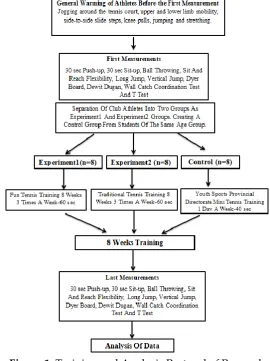
Before training, E1 group of the club students who attend the training 3 days a week in the club were trained with tennis drills in game format with fun tennis activities with small court, low net, child racket and colored balls with internally depressurized suitable for age groups. Tennis training was carried out on the E2 group with the traditional method of coach's ball feeding in the same period. Group K received 40 minutes of tennis training once a week. Measurements including some motoric features and tennis skills selected for all groups were applied twice before and after the training program as pretest and posttest.
2.3. Measurement Methods
The measurement parameters of the research were composed of motoric features and tennis skill tests. 30 sec Push-up, 30sec Sit-up, Ball Throwing, Sit and Reach Flexibility, Standing Long Jump, Vertical Jump and T Test formed the motoric tests, Dyer Board, Dewitt Dugan and Wall Catch Coordination tests formed the tennis skill test. A description of the measurement parameters is written in Table 2.
Table 2: Motoric Skills and Measurement Methods of Tennis Skills
Parameters
30 sec
Push-up
It is the exercise of athletes, in the face down position, hands wide with shoulders, raising the body over the toes and hands for 30 seconds
(Koçyiğit et al., 2018).
30 sec
Sit-up
In 30 seconds, the athlete lies on his back and joins his hands at the nape, the knees bent at a ninety degree angle and the sole of the foot is supported on the ground, with the maximum number of sit-ups recorded (Mackenzie, 2005).
Ball
Throwing
The athlete is asked from the starting point to throw the tennis ball forward in the throw-in position. The first point where the ball touches the ground and the starting point is measured by measuring the meter.
Sit and Reach
In sit and reach test, the athlete is asked to sit on the ground and rest the soles on the flat test bench. The body is leaned forward, it asked its arms to be waited straight for a second or two at the last point and the best flexibility value of the two attempts is recorded (Tamer, 2000).
Standing Long Jump
The student crouches on the ground and jumps forward with maximum effort without waiting. The flight distance between the last point the heel touches and the jump line is recorded where it falls.
Vertical
Jump
The athlete lifts its arm up and the top point its fingers reached is marked. The athlete then kneels on its knees and jumps and touches the highest point it can reach with its finger. The difference between the height marked before the jump and the jump height is recorded (Sevim, 2002)
T Test
Sprint from the cone A to the cone B and tap the cone with the right hand. Run side by side to the C cone to the left, tap the C cone with the left hand, run to cone D sideways and tap the D cone with the right hand. Run to cone B sideways towards left and tap to cone B with left hand. Run to backwards and time is stopped at cone A. The distance of C-B and B-D Cones is 4.65 cm. The distance of the B and A cone is 9.30 cm. Required Materials: 4 cones and meters, stopwatch.
Dyer
Board
The test consisted of hitting the tennis ball as much as possible on the designated board. The participant, who started the test, puts the ball on the ground and shoots it on the designated wall for 30 s after the ball is bounced once on the ground. The reliability of the test was found to be 0.82 for beginners and 0.93 for top players (Kamar, 2008).
Dewitt
Dugan
It is divided into sections like test, serve, serve to board, forehand and backhand shot and hit strike.
Serve 10 hits are requested. The valid balls of the athlete are evaluated with full
points and invalid ones with 0.5 points.
Serve to Board
the fourth circle is 210 cm-3 points; the diameter of the outermost circle is 270 cm.) The subject hits 5 serves from the board at a distance of 12.5 m.
Backhand - Forehand
10 or 15 balls are thrown at side of forehand and the same number of from backhand balls. 1 point is awarded for the received ball (Rally) on the tennis court.
Hit
The subject shoots at a designated area on the wall and tries to throw it to the same area when the ball comes back. The score is the sum of points after 5 shots.
Speed
The athlete throws the ball to the wall for 1 minute by using the desired stroke technique, at least 3 m from the wall. The score is determined by the number of balls hitting the wall during this time. (Kamar, 2008).
Wall Catch
Coordination Test
the ball was thrown steadily from the bottom to the top and was practiced with both hands provided that the athlete catches the ball thrown by hand facing the wall at a distance of 3 meters. The preferred side of the subject was recorded to assist in the evaluation of the results (Özer, 2007).
2.4. Data Collection and Analysis
Pre and posttest values of athletes and descriptive statistics and analysis of data were evaluated in SPSS 22.0 program. Parametric tests were decided by analyzing the compatibility with normal distribution with the Kolmogorov-Smirnov test. Analyzes were made with the Pared Sample T Test to analyze the difference between ANOVA and groups. The level of significance was taken as p = 0.05.
3. Findings
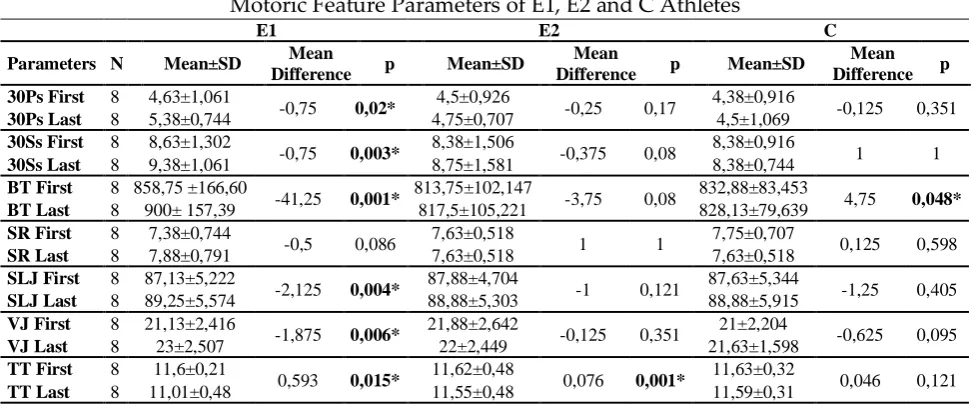
Table 3: ANOVA Analysis Table of First and Last Measurement Motoric Feature Parameters of E1, E2 and C Athletes
E1 E2 C
Parameters N Mean±SD Mean
Difference p Mean±SD
Mean
Difference p Mean±SD
Mean
Difference p
30Ps First 8 4,63±1,061
-0,75 0,02* 4,5±0,926 -0,25 0,17 4,38±0,916 -0,125 0,351
30Ps Last 8 5,38±0,744 4,75±0,707 4,5±1,069
30Ss First 8 8,63±1,302
-0,75 0,003* 8,38±1,506 -0,375 0,08 8,38±0,916 1 1
30Ss Last 8 9,38±1,061 8,75±1,581 8,38±0,744
BT First 8 858,75 ±166,60
-41,25 0,001* 813,75±102,147 -3,75 0,08 832,88±83,453 4,75 0,048*
BT Last 8 900± 157,39 817,5±105,221 828,13±79,639
SR First 8 7,38±0,744
-0,5 0,086 7,63±0,518 1 1 7,75±0,707 0,125 0,598
SR Last 8 7,88±0,791 7,63±0,518 7,63±0,518
SLJ First 8 87,13±5,222
-2,125 0,004* 87,88±4,704 -1 0,121 87,63±5,344 -1,25 0,405
SLJ Last 8 89,25±5,574 88,88±5,303 88,88±5,915
VJ First 8 21,13±2,416
-1,875 0,006* 21,88±2,642 -0,125 0,351 21±2,204 -0,625 0,095
VJ Last 8 23±2,507 22±2,449 21,63±1,598
TT First 8 11,6±0,21
0,593 0,015* 11,62±0,48 0,076 0,001* 11,63±0,32 0,046 0,121
TT Last 8 11,01±0,48 11,55±0,48 11,59±0,31
*p<0.05
(p <0.05), no difference was found in other parameters (p> 0.05). Significant difference was found (p <0.05) in C group BT test (M. Dif. = 4.75; p = 0.048), no significant improvement was found in other parameters (p>0.05).
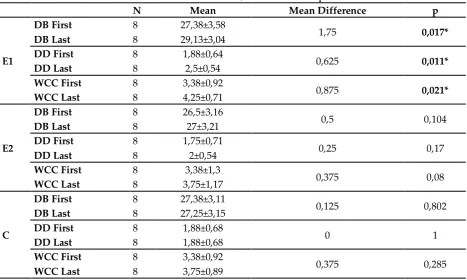
Table 4: Analysis Table of First and Last Measurement Tennis Skill Parameters of E1, E2 and C Groups
N Mean Mean Difference p
E1
DB First 8 27,38±3,58
1,75 0,017*
DB Last 8 29,13±3,04
DD First 8 1,88±0,64
0,625 0,011*
DD Last 8 2,5±0,54
WCC First 8 3,38±0,92
0,875 0,021*
WCC Last 8 4,25±0,71
E2
DB First 8 26,5±3,16
0,5 0,104
DB Last 8 27±3,21
DD First 8 1,75±0,71
0,25 0,17
DD Last 8 2±0,54
WCC First 8 3,38±1,3
0,375 0,08
WCC Last 8 3,75±1,17
C
DB First 8 27,38±3,11
0,125 0,802
DB Last 8 27,25±3,15
DD First 8 1,88±0,68
0 1
DD Last 8 1,88±0,68
WCC First 8 3,38±0,92
0,375 0,285
WCC Last 8 3,75±0,89
*p<0.05
Significant improvement was found in values of E1group DB (M. Dif. = 1.75; p = 0.017), DD (M. Dif. = 0.63; p = 0.011) and WCC (M. Dif. = 0.88; p = 0.021) in table 4 (p<0.05). While there was an improvement in the mean values of the measurement parameters of E2 group athletes, there was no significant difference (p>0.05). There was no significance in all parameters of the C group athletes (p>0.05).
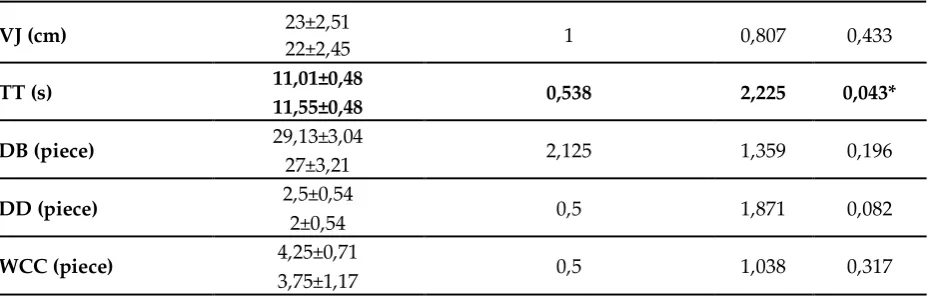
Table 5: Analysis Table of Motoric Features and Tennis Skills Parameters of E1 and E2 Group Athletes
E1 - E2 Mean Mean Difference t p
30P (s) 5,38±0,74 0,625 1,722 0,107
4,75±0,71
30S (s) 9,38±1,06 0,625 0,928 0,369
8,75±1,58
BT (cm) 900±157,39 82,5 1,233 0,238
817,5±105,22
SR (cm) 7,88±0,79 0,25 0,748 0,467
7,63±0,52
SLJ (cm) 89,25±5,57 0,375 0,138 0,892
VJ (cm) 23±2,51 1 0,807 0,433 22±2,45
TT (s) 11,01±0,48 0,538 2,225 0,043*
11,55±0,48
DB (piece) 29,13±3,04 2,125 1,359 0,196
27±3,21
DD (piece) 2,5±0,54 0,5 1,871 0,082
2±0,54
WCC (piece) 4,25±0,71 0,5 1,038 0,317
3,75±1,17 *p<0.05
Only TT (M. Dif. = 0.54; p = 0.043) difference was found in Table 5, as a result of the last measurements between E1 and E2 groups. Considering the other motoric measurements and tennis skill tests, it was determined that the mean values improved in favor of the E1 group compared to the E2 group.
Table 6: Analysis Table of Motoric Features and Tennis Skills Parameters of E1 and C Group Athletes
E1 - C Mean Mean Difference t p
30P (s) 5,38±0,74 0,875 1,9 0,078
4,5±1,07
30S (s) 9,38±1,06 1 2,183 0,047*
8,38±0,74
BT (cm) 900±157,40 71,875 1,153 0,268
828,13±79,64
SR (cm) 7,88±079 0,25 0,748 0,467
7,63±0,52
SLJ (cm) 89,25±5,57 0,375 0,131 0,898
88,88±5,92
VJ (cm) 23±2,51 1,375 1,308 0,212
21,63±1,60
TT (s) 11,01±0,48 0,578 2,834 0,013*
11,59±0,31
DB (piece) 29,13±3,04 1,875 1,21 0,246
27,25±3,15
DD (piece) 2,5±0,54 0,625 2,118 0,053
1,88±0,64
WCC (piece) 4,25±0,71 0,5 1,247 0,233
3,75±0,87 *p<0.05
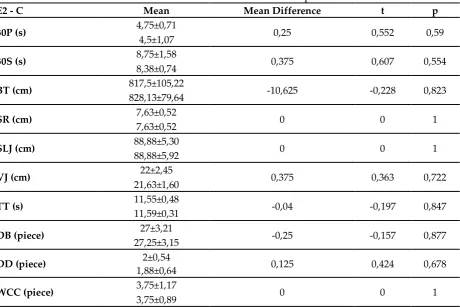
Table 7: Analysis Table of Motoric Features and Tennis Skills Parameters of E2 and C Group Athletes
E2 - C Mean Mean Difference t p
30P (s) 4,75±0,71 0,25 0,552 0,59
4,5±1,07
30S (s) 8,75±1,58 0,375 0,607 0,554
8,38±0,74
BT (cm) 817,5±105,22 -10,625 -0,228 0,823
828,13±79,64
SR (cm) 7,63±0,52 0 0 1
7,63±0,52
SLJ (cm) 88,88±5,30 0 0 1
88,88±5,92
VJ (cm) 22±2,45 0,375 0,363 0,722
21,63±1,60
TT (s) 11,55±0,48 -0,04 -0,197 0,847
11,59±0,31
DB (piece) 27±3,21 -0,25 -0,157 0,877
27,25±3,15
DD (piece) 2±0,54 0,125 0,424 0,678
1,88±0,64
WCC (piece) 3,75±1,17 0 0 1
3,75±0,89
There was no significant difference between E2 group and C group in motoric tests and tennis skill tests in table 7. However, E2 group values (30P, 30S, VJ, DD and TT) means were found to be higher than C group.
4. Discussion and Conclusion
Pişkin (2018), detected 8 weeks of applied court tennis training developed hand grip force (left) and attention measurements in children 10-12 years old experimental group (p<0.05), Özer & Aslan (2018) found that there is a significant difference in mini tennis studies applied to 8-11 year old girls in the Wall Catch coordination test (p = 0.002), Polat (2009) found that there were significant improvements in lateral jump measurements (first-113.80 ± 14.087; last-127.80 ± 13.811 cm average) at the end of 12-week badminton basic training workouts in children 9-12 years old who recently started to badminton sports p <0.05). It was determined that there is an important difference in vertical jump and flexibility measurements of tennis technical training applied to 12-14 year old tennis players (p <0.05) in Şahinler & Koçyiğit (2019), athletics trainings applied to 10-12 years old athlete boys as with and without games for 12 weeks, ensured progression in standing long jump (first-154.50 ± 7.91; last-156.55 ± 8.46 cm average) measurement values in physical fitness in athletes in Savucu et al. (2005) and Ceylan (2016) in his study, 8-week multi-education programs implemented in sports schools for 4-6 year old children develop flexibility and agility features and improves height, waist circumference, sitting height, vertical jump, reaction, agility and flexibility in children 7-9 years old and affects body weight, shoulder width, hip width, waist circumference, hand claw strength, medicine ball launch, speed and flexibility features in 10-12 years old children.
Cirav (2018) examined in its study the presence of effect of 12-week (2 days; 60 minutes) educational games applied to 9-10 year old children's motoric features and effect on all parameters excluding especially flexibility, back force, hand grip force (p<0.05), Coşkun (2019) examined in its study relationship among tennis training applied to 10-12 years old boys for 3 months 2 days in a week, 30m sprint, Wall Catch Coordination, Illinois, sit and reach flexibility tests and AOS (Tennis Skill) test measurements and accordingly; it concluded that motoric features have strong correlation with AOS tennis skill test (Vertical jump/AOS; r= 0.803; 30m/AOS; r=0.809; Wall Catch/AOS; r=0.48; Illinois/AOS; r=0.738; Sit And Reach/AOS; r=0.423) (p <0.05). Ongül et al (2017), reported that swimming, skating and educational games practiced in physical education classes for 28 weeks to 9-10 years old students have effects on motoric features(p <0.05), there were positive developments in the long jump (p = 0.025) and sit and reach flexibility (p = 0.004) test results between girls and boys in the age group students who participated in the study.
the effects of different balls (light, internal pressure reduced and the same size) on tennis skills for 6-9 years old girls and boys while playing tennis, he group playing with different balls has more (F/B) technical hits and the result is also associated with the age group.
Karagöz et al. (2015) detected that Star Test (quickness test in tennis) has a strong relationship with Ball Throwing (r = 0.833), Dynamic Balance (r = 0.718), Speed (r = 0.815) and Vertical Jump data (r = 0.770) in the research conducted on the relationship between the 8 year old little tennis players and their motoric and tennis skills. A moderate to strong correlation was found between the Hewitt Test (Tennis skill test) and the Star test, Ball Throwing, Static and Dynamic balance, Speed, Flexibility and Vertical Jump tests (p <0.05). Gül et al. (2018), found significant difference in coordination test and backhand (p = 0.021), forehand (p = 0.050), hit throw (p = 0.032) and sprint test data (p = 0.030) in the final measurement data inter groups as much as wall trainings Wall Catch Coordination, Dyer board, serve, board serve shoot and speed test and forehand-backhand strikes in the training group (p <0.05) applied to children 9-11 years old (p<0.05), Aslan (2014) found that exercises applied to 8-11 year old boys for 12 weeks, 3 days a week had an effect on reaction times (p = 0.012). Keskin et al. (2016) detected significant differences in Forehand / backhand sensitivity (p <0.03), depth (p <0.05), volley (p <0.00) and serve test results at the end of regular and systematic basic strikes in tennis such as F / B, Volley and Serve for 8 weeks, 3 days in a week.
It is understood that the results in the articles examined in the literature studies support the study. At the end of the planned study, it was determined that the targeted results were reached in terms of both motoric and tennis skills in the training group children, and there was no statistically difference in the group performing the traditional club training despite the average differences of the pre and posttests. As a result, it can be suggested that the targeted fun, game-based tennis skills can be started in early age groups, and that the coaches in the clubs can plan the basic skills in the game format and ensure the development of the children.
Conflict of interest
The authors declare that they have no conflict of interest.
References
Aslan, E. 2014. Effect of Exercise Program on Visual and Auditory Reaction Times of 8-11 Age Group Healthy Children. Journal of YYU Education Faculty, 8-11(1), 169-182. Bayazit, B. 2019. Exercise Training in Children. Sports in All Aspects. Editor; Gulten Herguner, Güven Plus A.S. Publications: 05/2019. S; 32-50, E-ISBN: 978-605-7594-10-5.
Burriss, K. G. & Tsao, L. 2002. Review of Research: How Much Do We Know About the Importance of Play in Child Development? Childhood Education, 78(4), 230-233, DOI: 10.1080/00094056.2002.10522188.
Ceylan, B. 2016. Examination of the Effects of Multiple Branch Studies on Some Anthropometric and Performance Features. Kırıkkale University Health Sciences Institute, Department of Movement and Training Sciences, Unpublished Master's Thesis.
Cirav, O. 2018. The Effect of Educational Game Activities Applied to 9-10 Age Group Children on Physical and Motoric Features. Istanbul Gelişim University Health Sciences Institute Department of Coaching Education. Unpublished Master Thesis.
Coşkun, M. 2019. The Examination of the Effect of Basic Motoric Features on Tennis Skill Training in 10-12 Years Old Boys Undergoing Tennis Training. Bartın University Institute of Educational Sciences Physical Education and Sports Teaching. Unpublished Master Thesis.
Farrow, D. & Reid, M. 2010. The Effect of Equipment Scaling on the Skill Acquisition of Beginning Tennis Players, Journal of Sports Sciences, 28 (7), 723–732. DOI: 10.1080/02640411003770238.
Ferrauti A., Maier P. & Weber K. 2002. Tennistraining. Meyer und Meyer Verlag, 11-25. Fitzpatric, A., Davids, K. & Stone, J.A. (2017). Effects of Lawn Tennis Association Mini
Tennis as Task Constraints on Children’s Match-Play Characteristics. Journal of Sports Sciences, 35:22, 2204-2210, DOI: 10.1080/02640414.2016.1261179.
Groppel, J. & DiNubile, N. 2009. Tennis: For the Health of It! The Physician and Sportsmedicine, 2(3)7, 41-50, DOI: 10.3810/psm.2009.06.1708.
Gül M., Gül K. G. & Akat A. 2018. Effect of Wall Works on Tennis Skill. 16th International Congress of Sports Sciences, Congress booklet, 154-160, 31 October- 03 November. Hammond, J. & Smith, C. 2006. Low Compression Tennis Balls and Skill Development,
Journal of Sports Science and Medicine, 5, 575-581.
Hekim, M. & Hekim, H. 2015. Overview of Strength Development and Strength Training in Children. The Journal of Current Pediatrics, 13, 110-5.
Ishihara, T. & Mizuno, M. 2018. Effects of Tennis Play on Executive Function In 6– 11-Year-Old Children: A 12-Month Longitudinal Study, European Journal of Sport Science, 18:5, 741-752, DOI: 10.1080/17461391.2018.1444792.
Lta.Org.Uk. 2019. Mini Tennis.
https://www3.lta.org.uk/LTA-Mini-Tennis/Green/Mini-Tennis-Green/.(10.12.2019).
Kamar, A. 2008. Ability Skill and Performance Tests in Sports. Nobel Akademic Publishing, Ankara.
Kermen, O. 2002. Tennis, Techniques and Tactics. Ed. B. Yavuz , Nobel Publishing, 30-34, Ankara.
Keskin, B., Ates, O. & Kiper, K. 2016. The Effect of Special Training Program Applied to Tennis Performance Athletes on ITN Ratings. IU Journal of Sports Sciences, 6 (3), 1303-1414.
Koçyiğit, B., Çimen, E. &Karakuş, S. 2018. Comparison of Physical Anthropometric and Motoric Features of 12-14 Age Group Handball and Tennis Performance Athletes. Sports View: Journal of Sports and Educational Sciences, 5 (SI1), 14-25.
Kozak, A.M.& Ibrahimova, M.V. 2014. Construction of Training Process of Tennis Players Aged 5-6 Years, Taking into Account the Specifics of the Development and Control of Their Coordination Skills. Physical Education of Students, 6, 17-23, doi:10.15561/20755279.2014.0604.
Mackenzie, B. 2005. 101 Performance Evaluation Tests. Electric Word Plc, London. Ongül, E., Bayazit, B., Yilmaz, O. & Guler, M. 2017. Effects of Games and Physical
Activities Course on Selected Motoric Features in Children, Journal of Sport Sciences Researches, 2(1), 45-52. DOI: 10.25307/jssr.309716.
Ölçücü, B. 2011. Examination of the Effect of Plyometric Workouts on Arm and Leg Strength, Serve, Forehand, Backhand Hit Speeds and Hit Target Percentages in Tennis Players. Marmara University, Institute of Health Sciences, Department of Physical Education and Sports, Ph.D. Thesis, İstanbul.
Özer, U. & Aslan, C. S. 2018. Effects of Mini Tennis Training on Coordination and Reaction Time in 8-11 Age Girls. Journal of Sports Medicine, 53 (2), 76-82. DOI: 10.5152/tjsm.2018.093.
Pişkin, N. E. 2018. The Effect of 8-Week Court Tennis Training on Some Motoric Features and Attention Developments in Children Between 10-12 Years Old. Niğde Omer Halisdemir University Social Sciences Institute Department of Physical Education and Sports, Master’s. Thesis, Niğde.
Polat, G. 2009. Effects of 12-Week Basic Badminton Training on Motoric Functions and Reaction Times in 9–12 Age Group Children. Çukurova University Institute of Health Sciences, Department of Physical Education and Sports, Unpublished Master's Thesis, Adana.
Savucu, Y., Polat, Y. & Biçer, Y.S. 2005. 12-Weeks Applied with Game and Without Games Athletics Training's Effect on Physical Fitness of Athletic Boys F.U. Journal of Health Sciences, 19(3), 199- 204.
Sevim, Y. 2002. Training Information. S:122, Nobel Press Distribution, Ankara.
Şahinler, Y. & Koçyiğit, B. 2019. Examination of the Effects of Technical Training Programs on Some Bio Motoric and Technical Development of Tennis Players 12-14 Years Old. Atatürk University Journal of Physical Education and Sports Sciences, 21(3), ISSN: 1302-2040.
Yüksek, S. & Arslanoğlu, E. 2013. Effects Of 14 Weeks of Regular Exercise and Mini Tennis Activities on The Respiratory Parameters of 8-12 Years-Old Male Children, Niğde University Journal of Physical Education and Sport Sciences, 7(3). 224-229.
Creative Commons licensing terms