Teacher Reflectivity Revisited: Is Teaching
Reflectivity Gaining a Foothold in Iran?
Ali Kazemi
Dept. of Applied Linguistics, Yasouj University, Iran
Zahra Bazregarzadeh
Dept. of Applied Linguistics, Yasouj University, Iran
Mohammadreza Firoozi
Dept. of Psychology, Yasouj University, Iran
Abstract—Given that reflectivity could help keep the teaching profession vibrant and responsive, reflective teaching practice has become an essential component of teacher education. In recent years, some efforts have been underway to implement it in our educational system, in general and in language teaching, in particular. The present study aimed to investigate the extent to which Iranian English language teachers are reflective, if at all. To this end, a five-point Likert-scale questionnaire including 26 items, originally developed by Akbari et al. (2010) and validated for the purposes of the current study, was used. The participants of the study comprised 217 practicing EFL teachers selected through random sampling. Data analysis, conducted through descriptive statistics, revealed that Iranian English language teachers are reflective in all dimensions of reflection, though degree of reflectivity varies across these dimensions. This finding is promising and suggests that reflectivity is gaining a foothold in our language education.
Index Terms—reflectivity, reflective teaching, dimensions of reflectivity, language education
I. INTRODUCTION
The emergence of the concept of reflective teaching in ELT is considered as one of the outcomes of the post-method pedagogy (Kumaravadevelu, 1994, 2001, 2003, 2006; Prabhu, 1990). Korkmazgil (2009) believes that as there has been a sense of long-felt discontent with the conventional notion of method as the organizing tenet of L2 teaching and learning, Kumaravadivelu (1994) has introduced a beneficial term ‘post method condition’, which can modify the
features and the content of L2 teaching, teacher education, and also classroom research. He asserts that there are inherent inconsistencies between method as conceptualized by theorists and method as actualized by practitioners; therefore, the need has arisen to look carefully beyond the concept of method. In the methods era, teachers dictated language teaching methods without influencing the way methods were established in academic circles; furthermore, the relationship between theoreticians and practitioners was of a top-down natures in which teachers have little critical voice (Akbari et al., 2010). According to Johnson (1996), theoretical knowledge was dominant over procedural or practical knowledge.
Undoubtedly, language teacher education was in acute crisis, and a shift of orientation in teacher competencies was clearly required. Theoreticians’ views were encountered with the eclectic approach of practitioners, and no real dialogue existed between these two groups. Thus, in this context of imposition of political nature (Pennycook, 1989), the notion of reflective teaching could be a favorable solution to the crisis. Halliday (1998) states that “it is understandable that the notion of reflective practice has been eagerly seized by the beleaguered teacher educators seeking to do something emancipatory and authentic in the act of hostility towards theory, moral deliberation and contextuality in teaching practices” (p. 598). As Ferwana (2006) suggests, reflection can be relevant to teaching in any scientific discipline involving teaching language. Therefore, each teacher, irrespective of what he/she teaches, can utilize reflection in his/her teaching process (Ferwana, 2006). Moreover, teacher educators believe that teachers should be encouraged to involve in some kind of reflection to progress into better professionals. Therefore, attempts are made to authorize teachers to become more reflective and qualified practitioners (Korkmozgil, 2009).
Despite the fact that language teacher education seems to be eager to give more voice and respect to teachers and their knowledge, it has moved to other extremes of the continuum (Akbari, 2007). Akbari (2007) argues that the post-method controversy (Kumaravadivelu, 1992, 1994, 2001, 2003, 2006) can be investigated as one of the reasons for the promotion of reflective teaching in ELT. Therefore, teachers in the field of education have their personal beliefs about teaching, personal styles for teaching, personal perceptions of students’ needs and even personal assumptions of what
good teaching includes. Farrell (2003) believes that reflection helps teachers to become free from impulsive and routine behaviors. Moreover, he believes that it helps teachers to construct their daily experiences, permits them to act in a deliberate critical manner, bring about consciousness raising and deeper understanding about teaching, and triggers positive change.
Consistent with the points made above, in the current study, an attempt is made to investigate the extent to which Iranian language teachers are reflective, if at all. This is necessary because reflective practice is believed to improve education programs, which, in turn, will contribute to a more efficient teaching education system. The following section will present the components of reflective teaching.
II. REFLECTIVE TEACHING COMPONENTS
Akbari (2007) and Farrell (2003) indicate that reflection helps teachers to become free from impulsive and routine behaviors. Moreover, they believe that it helps teachers to construct their daily experiences, permits them to act in a deliberately critical manner, causes consciousness raising and deeper understanding about teaching, and starts positive change.
Akbari (2007) suggests that personality, beliefs and affective make-up of teachers encourage them to engage in reflection and will influence their reaction to their own images deriving from reflection. Moreover, Hillier (2005) indicates that it is true that one way for teachers to develop their professional practice is to review what they conduct at particular intervals including evaluating their way of teaching continually, thinking how to enable certain students to make progress and also deciding whether to develop new materials or not; however, he asserts that these are reflection in action (Schön, 1983); that is, an online reflection in the real life in which teachers involve as they encounter a problem in the classroom during teaching. Therefore, teachers should move beyond such reflection to ensure that they are able to reflect on their own beliefs and personalities so that they can stand back from their everyday experiences and apply them in bigger contexts (Hillier, 2005). Hence, Hillier (2005) states that “the role of reflection in teaching and training is to both affirm that what works well in addition to helping us to see what could be changed” (p. 219). These scholars believe in metacognitive component of reflective teaching, as discussed in the following paragraphs.
Due to the fact that various contextual factors shape language teachers’ professional duties, it is believed that there are five components for reflective teaching practices (Akbari, et al., 2010). One of these components is metacognitive component mentioned above. Akbari et al. (2010) report that affective component is one which deals with how teachers reflect on their students, how they are learning, and the way in which their students answer or behave emotionally in their classes. According to Zeichner and Liston (1996), this component focuses on reflection towards students, their cultural and linguistic backgrounds, their contemplation and understandings, their interest, and their developmental readiness for specific tasks. Furthermore, this element concentrates on teachers’ reflecting on their students’ emotional answers in their classrooms (Hillier, 2005; Pacheco, 2005; Pollard et al., 2006; Richards & Farrell, 2005; Richards & Lockhart, 1994). Moreover, Blasco et al., (2006) indicate that as learners’ emotions play a significant role in learning attitudes and behaviors, educators cannot ignore the effect of learners’ affective component in reflective process. However, Hawkey (2006) notes that in the past in western culture little attention was paid to the role of emotion and affective components; nowadays it is believed that emotional aspect of teaching is significant and it is highly emphasized in teacher education (Golombek & Johnson, 2004; Hawkey, 2006). Moreover, Mayer, Caruso, and Salovey (1999) note that emotion and cognition are interwoven. Another component is cognitive component. Bandura (1997) and Akbari (2007) believe that cognitive constructions augment teachers’ performance in relation to reflection. Critical component, that is, socio-political aspects of pedagogy and reflections upon them is the third component related to reflective teaching practices. The importance of critical component was firmly established in the literature (e.g., Bartlett, 1997; Day, 1993; Jay & Johnson, 2002; Yesilbursa, 2013; Zeichner & Liston, 1996). These scholars believe that teachers should reflect on importance of politics in their practice and take into consideration topics refers to race, gender, and social class, paving the ways for student empowerment. In addition, Jay and Johnson (2002) believe that by critical reflection, the individual goes back constantly to one’s own understanding of the problem. Besides, in critical reflection the extensive historical, socio-political, and moral context of teaching are taken into account (Valli, 1990). For instance, a history of inequity in schools may affect the direction, and perspectives of the students and their parents (Jay & Johnson, 2002). Moreover, it is believed that critical reflection should be considered as an important factor in teacher education (Hall, 1997; Hatton & Smith, 1994; Jay & Johnson, 2002; Stanley, 1998; Ward & McCotter, 2004).
In addition, another component is practical component. Many scholars consider practical component to be linked with reflective teaching practices (for e.g. Manen, 1977; Valli, 1990). Therefore, it is believed that these components give meaning to messy events beyond a common sense level in order to improve professional development (Boud, 2001; Brookfield, 1995; Dewey, 1991/ 1933; Osterman & Kottkamp, 2004). Moreover, Akbari (2007) indicates that if reflective teaching is considered as a purely cognitive concept, it cannot contribute to the improvement of society.
In all, one of the key critiques of teacher education system in Iran is the prescriptive perspectives of authorities imposed on EFL teachers either in schools or institutes. So many scholars assert that teacher education has failed producing generations of reflective and critical teachers.
teachers who can make decisions for themselves instead of obeying some prescriptive rules coming from authorities. Hence, the aim of the present investigation is to shed light on the status of reflective teaching in ELT in Iranian language institutes to know the extent to which teachers are reflective, if at all.
III. METHOD
A. Participants
In the current study, data were collected from 217 English teachers who provided responses to the questionnaire. All the participants were selected randomly from language institutes in Shiraz, Mazrvdasht, and Yasouj. This study is comprised of 112 (51.6%) female and 105 (48.4%) male teachers with 1 to 10 years of experience, holding B.A. (49.8%), an M.A. (48.4%), or Ph.D. degrees (1.85%). 51.6% of them had a degree in TEFL, 20.7% in English translation, and 27.6% in English literature. The age of the participants ranged from 20 to 41 years old. Furthermore, the number of participants chosen in each city was proportionate the population size to be studied.
B. Instrumentation
For the current research question, a five-point Liker scale questionnaire involving 5 dimensions from ‘always’ to ‘never’ which consists of 29 items developed by Akbari et al. (2010) was utilized. The first dimension of the questionnaire, ‘practical dimension’, contains elements which are related to the tools and the actual practices of reflection (6 items). The second dimension of the questionnaire, ‘cognitive element’, deals with teachers’ efforts to have professional development (6 items). The third dimension of the questionnaire, ‘learner element’ or ‘affective element’ includes the reflection of teachers on their students and their emotional behaviors in the classes (3 items). Metacognitive element is the fourth in the questionnaire. It takes into account teachers and their reflection on their own opinions and personality and also their influences on teaching practices (7 items). The last dimension is the ‘critical dimension’ which deals with the socio-political aspects of pedagogy and reflections upon them (7 items).
Before administering the questionnaire in the main study, it was piloted with a sample of 42 English language teachers (with characteristics similar to those who participated in the main study). The participants for the pilot study were randomly selected from one of the cities of the main study, that is, Shiraz. By piloting, the researchers aimed to gain insight into possible administration problems, item quality, and psychometric characteristics of the questionnaire especially validity (content and construct) and reliability. Then statistical analysis namely, descriptive statistics was conducted.
1. Reliability
The reliability of the questionnaire (Cronbach’s Alphas if item deleted) was measured and estimated to be 0.84, which is an acceptable high enough reliability. Moreover, the reliability of individual components ranged from 0.60 to 0.88.
2. Face and content validity
Although the questionnaire was standard, four TEFL Ph. D. holders who were completely aware of the aims of the current research were asked to check the appearance and content of the questionnaire. They reviewed the 29 items of the questionnaire, and assured the researchers of the overall appearance and the relevancy of items and components of the instrument.
3. Factor analysis
The 29 items that had the acceptable level of reliability were included in the analysis. Therefore, suitability of the data for factor analysis was calculated by performing Kaiser-Meyer-Olkin (KMO) and Bartlett’s test of sphericity. Furthermore, the KMO measure of sampling adequacy was 0.62, which is higher than the suggested value of 0.60 (Kaiser, 1974). This showed that the data were likely to factor well. In addition, the Bartlett’s test of sphericity (Bartlett, 1954) was statistically significant with the confidence level of more than 99% (p<0.001), confirming that significant correlations existed between variables. To come up with the factorial structure (the exploratory factor analysis (PCA)) of the very questionnaire that was to tap into the subject of investigating English language teachers’ reflective teaching practices, all items were reviewed carefully. This revealed that the questionnaire measured five components including (practical, cognitive, affective, metacognitive, and also critical components) as Akbari et al. (2010) believe they do. The items were ordered in terms of the absolute value of their loadings on the component. Three problematic items (as they were not loaded on the correct component) were removed from the questionnaire. Therefore, the final draft of the questionnaire was comprised of 26 items.
Having established the reliability, content, face, and the construct validity of the instrument and having come up with the final form of the questionnaire, the researchers administered the questionnaire to all the participants (217 teachers).
IV. RESULTS
The highest frequency and percentage (91, 41.9%) belonged to Item 20. It was the most significant issue in applying reflective teaching practices among the participants of the present study. On the other hand, Item 19 was found to have the lowest frequency and percentage (2, 0.9%). Moreover, the categories of 2 (sometimes) and 3 (often) are selected more frequently than other options. The option sometimes was chosen in 13 items as the most frequently selected option. This was followed by often being selected as the most frequent option in 9 items.
TABLE 1
FREQUENCIES & PERCENTAGES OF EACH ALTERNATIVE RATING SCALE1
Items Respondent level of agreement (frequency & percentage for each alternative)
0 1 2 3 4
Q1 35 16.1% 42 19.4% 57 26.3% 48 22.1% 35 16.1%
Q2 21 9.7% 31 14.3% 74 34.1% 49 22.6% 42 19.4% Q3 18 8.3% 54 24.9% 72 33.2% 43 19.8% 30 13.8%
Q4 21 9.7% 32 14.7% 71 32.7% 55 25.3% 38 17.5% Q5 26
12% 39 18% 66 30.4% 66 30.4% 20 9.2% Q6 24 11.1% 47 21.7% 70 32.3% 52 24% 24 11.1%
Q7 14 6.5% 39 18% 51 23.5% 61 28.1% 52 24% Q8 11 5.1% 36 16.6% 67 30.9% 58 26.7% 45 20.7%
Q9 22 10.1% 47 21.7% 50 23% 62 28.6% 36 16.6%
Q11 17 7.8% 55 25.3% 62 28.6% 59 27.2% 24 11.1% Q12 11 5.1% 31 14.3% 71 32.7% 78 35.9% 26 12%
Q13 11 5.1% 25 11.5% 59 27.2% 76 35% 46 21.2%
Q14 6 2.8% 26 12% 74 34.1% 53 24.4% 58 26.7% Q15 10 4.6% 37 17.1% 78 35.9% 61 28.1% 31 14.3%
Q16 6 2.8% 25 11.5% 64 29.5% 58 26.7% 64 29.5%
Q17 5 2.3% 34 15.7% 62 28.6% 81 37.3% 35 16.1% Q19 2
0.9% 14 6.5% 58 26.7% 71 32.7% 72 33.2% Q20 3 1.4% 16 7.4% 47 21.7% 60 27.6% 91
41.9%
Q22 5 2.3% 42 19.4% 60 27.6% 68 31.3% 42 19.4% Q23 22
10.1% 54 24.9% 49 22.6% 52 24% 40 18.4% Q24 21 9.7% 38 17.5% 59 27.2% 52 24% 47 21.7%
Q25 17 7.8% 55 25.3% 56 25.8% 65 30% 24 11.1% Q26 24 11.1% 55 25.3% 59 27.2% 56 25.8% 23 10.6%
Q27 20 9.2% 35 16.1% 55 25.3% 68 31.3% 39 18% Q28 17
7.8% 35 16.1% 59 27.2% 71 32.7% 35 16.1% Q29 18 8.3% 31 14.3% 52 24% 73 33.6% 43 19.8%
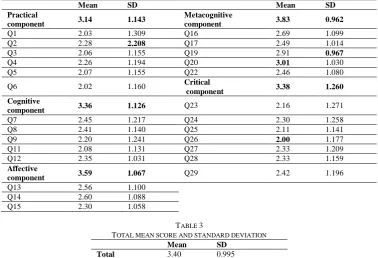
In order to assess Iranian English language teachers’ reflective teaching practices, mean and standard deviation of individual items and the five main factors were calculated (see Table 2). Analyzing the individual items, it was revealed that Item number 20 had the highest mean (3.01) while Item number 26 had the lowest mean (2.00). Moreover, Item 19 was found to have the lowest standard deviation (0.967) while Item 2 had the highest standard deviation (2.208).
Regarding mean and standard deviation of the components in the questionnaire, metacognitive component achieved the highest mean (3.83). This was followed by affective component, critical component, cognitive component, and practical component, respectively. Turning to standard deviation of components, metacognitive component had the lowest standard deviation (0.962) while critical component had the highest standard deviation (1.260).
TABLE 2
MEAN AND STANDARD DEVIATION OF ITEMS AND COMPONENTS IN THE QUESTIONNAIRE2
Mean SD Mean SD
Practical
component 3.14 1.143
Metacognitive
component 3.83 0.962
Q1 2.03 1.309 Q16 2.69 1.099
Q2 2.28 2.208 Q17 2.49 1.014
Q3 2.06 1.155 Q19 2.91 0.967
Q4 2.26 1.194 Q20 3.01 1.030
Q5 2.07 1.155 Q22 2.46 1.080
Q6 2.02 1.160 Critical
component 3.38 1.260
Cognitive
component 3.36 1.126 Q23 2.16 1.271
Q7 2.45 1.217 Q24 2.30 1.258
Q8 2.41 1.140 Q25 2.11 1.141
Q9 2.20 1.241 Q26 2.00 1.177
Q11 2.08 1.131 Q27 2.33 1.209
Q12 2.35 1.031 Q28 2.33 1.159
Affective
component 3.59 1.067 Q29 2.42 1.196
Q13 2.56 1.100
Q14 2.60 1.088
Q15 2.30 1.058
TABLE 3
TOTAL MEAN SCORE AND STANDARD DEVIATION
Mean SD
Total 3.40 0.995
As Table 3 indicates, mean (3.40) and standard deviation (0.995) of all components in the questionnaire were calculated. Judging from the mean value, it could be said that language teachers are reflective in terms of the components identified in the questionnaire. However, in order to obtain a clearer picture of the phenomenon in question based on the data gathered through the questionnaire, it was decided to do further analysis of the data in terms of individual categories in the questionnaire, as in the following figure.
Figure 1 Teachers' reflectivity
As Figure 1 indicates, given that the questionnaire consisted of 26 items, it was necessary to see how the participants answered the individual items. For all the items, assuming that category ‘always’ was chosen, the highest possible score
was 104, and assuming that category ‘never’ was chosen, this would amount to zero. So, the score would range from 0
to 104. Furthermore, in order to investigate their performance in terms of RT, the participants were categorized into different groups. It is common practice to categorize participants into 3 groups (low, average, high) or five groups (extremely low, low, average, high, and extremely high). The current researcher decided to categorize them into three groups. Given that the scores could range from 0 to 104, by dividing 104 by 3, there were 3 groups of scores. Therefore, 0-34 was considered as the first category (i.e., teachers who are low in terms of RT practices), the second category ranged from 35-68 (i.e.,teachers who are average in terms of RT practices), and 69-104 was considered for the third category (i.e., teachers who are highly reflective in their RT practices).
V. DISCUSSION
The research question intended to figure out the extent to which Iranian English teachers are reflective, if at all. According to the results drawn from the questionnaire, the highest mean in the questionnaire belonged to Item 18 (3.01). Interestingly, this item belonged to metacognitive component that had the highest mean among the five components (3.83). Therefore, this showed its significance in ELT contexts.
Regarding descriptive statistics of the five components, the results of this study indicated that the mean values of all components were high (more than two, which is considered as half) and they ranged from 3.14 to 3.83. Therefore, it can be said that English language teachers, in general, considered all components highly important in RT practices.
Furthermore, the participants’ answers, that is, the options they chose from among the five alternatives (never, rarely, sometimes, often, and always) were also examined to investigate the degree of importance that teachers attach both items and components in the questionnaire (see Table 1). As indicated in this table, three options of 2 (sometimes), 3(often), and 4 (always) were selected more frequently than other options. It should be added that Item 18 had the highest frequency and percentage (91, 41.9%) for always, which belonged to metacognitive component. It can be said that the first two options (never and rarely) were chosen less frequently than the last three options (sometimes, often, and always), which were indicators of high levels of significance. These findings indicated that English language teachers considered these items and components highly relevant to reflective teaching practices. These findings appear to be consistent with other studies in the literature as well.
As the result of Ferwana’s (2006) review of the literature of the influence of reflection on teaching, he suggested that reflection can be relevant to teaching in any scientific discipline involving teaching language. Therefore, each teacher, irrespective of what he/she teaches, can utilize reflection in his/her teaching process (Ferwana, 2006). In the same vein, it is believed that teachers should be encouraged to get involved in some kind of reflection to progress into better professionals. Therefore, attempts are made to authorize teachers to become more reflective and qualified practitioners (Korkmozgil, 2009). As this was significant to the current study, in line with what Ferwana (2006) and Korkmozgil (2009) deemed to be important, a close examination of English language teachers’ performances in reflective teaching practices in language institutes in Iran was sought. This was congruent with the results of Akbari (2007) and Farrell (2003) who confirmed that reflection helps teachers to become free from impulsive and routine behaviors. Moreover, they believed that this helps teachers to construct their daily experiences, permits them to act in a deliberate critical manner, causes consciousness raising and deeper understanding about teaching, and starts positive change. As mentioned earlier, one of the main focuses of the current study was taking into account different aspects of reflective teaching practices in fostering reflectivity among language teachers. In the current study, language teachers considered metacognitive component to be the most important factor in becoming a reflective teacher and put high prominence on its sub-components, for instance, thinking of their teaching philosophy, taking into account their strengths and weaknesses, and considering inconsistencies occurring in their classroom practices. Therefore, they should be able to reflect on their own beliefs and personalities and their own feelings. This finding confirms Akbari’s (2007) study. He found that personality, beliefs and affective make-up of teachers encourage them to engage in reflection and influence their reaction toward their own image deriving from reflection. In the same vein, as Hillier (2005) indicated, that it is true that one way for teachers to develop their professional practice is to review what they conduct at particular intervals including evaluating their way of teaching continually, thinking how to enable certain students to make progress and also deciding whether to develop new materials or not; however, he asserted that these are reflection in action. Therefore, teachers should move beyond such reflection to ensure that they are able to reflect on their own beliefs and personalities so that they can stand back from their everyday experiences and apply their experiences in bigger contexts (Hillier, 2005). Hence, Hillier (2005) stated that “the role of reflection in teaching and training is to both affirm that what works well in addition to helping us to see what could be changed” (p. 219). In a like manner, this study confirms that affective component (learner component) is strongly associated with reflective teaching practices. This component has the second highest mean in reflective teaching practices. This finding supports the findings of previous studies linking affective factors and success in reflective teaching. According to Akbari et al., (2010), this element deals with how teachers reflect on their students, how they are learning, and the way in which their students answer or behave emotionally in their classes. According to Zeichner and Liston (1996), this component focuses on reflection towards students, their cultural and linguistic backgrounds, contemplation and understandings, their interests, and their developmental readiness for specific tasks. Furthermore, this element concentrates on teachers’ reflecting on their students’ emotional answers in their classrooms (Hillier, 2005; Pacheco, 2005; Pollard et al., 2006; Richards & Farrell, 2005; Richards & Lockhart, 1994). Moreover, Blasco et al., (2006) indicated that as learners’ emotions play a significant role in learning attitudes and behaviors, educators cannot ignore the effect of learners’ affective component in reflective process. However, Hawkey (2006) noted that in the past in western culture, little attention was paid to the role of emotion and affective component. Nowadays, it is believed that emotional aspect of teaching is significant and it is highly emphasized in teacher education (Golombek & Johnson, 2004; Hawkey, 2006). Moreover, Mayer et al. (1999) proposed that emotion and cognition are interwoven. In the current study, all items relevant to this component were indicated as highly important.
ideas of Bandura (1997) and Akbari et al. (2007), who believed that cognitive constructions augment teachers’ performance in relation to reflection.
Critical component, that is, socio-political aspects of pedagogy and reflections upon them, was the fourth component related to reflective teaching practices. All items relevant to this component were considered as highly significant in reflective teaching practices in the current study. The importance of critical component was firmly established in the literature (e.g., Bartlett, 1997; Day, 1993; Jay & Johnson, 2002; Yesilbursa, 2013; Zeichner & Liston, 1996), who believed that teachers should reflect on the importance of politics in their practices and take into consideration topics refers to race, gender, and social class, paving the ways for student empowerment. In addition, Jay and Johnson (2002) believed that by critical reflection, the individual goes back constantly to one’s own understanding of the problem. Besides, in critical reflection the extensive historical, socio-political, and moral context of teaching are taken into account (Valli, 1990). For instance, a history of inequity in schools may affect the direction, and perspectives of the students and their parents (Jay & Johnson, 2002). Moreover, it is believed that critical reflection should be considered as an important factor in teacher education (Hall, 1997; Hatton & Smith, 1995; Jay & Johnson, 2002; Stanley, 1998; Ward & McCotter, 2004). Therefore, the finding of the current study is in harmony with what has just been mentioned by the scholars in the field.
Finally, the last component was practical component which dealt with actual act of reflection. In the current study, although the mean value of this component (3.14) was not highly different from other components, it is considered as the least significant factor in reflective teaching practices because it has the lowest mean value. This could be due to the fact that various contextual factors shape language teachers’ professional duties (Akbari et al., 2010). This study, therefore, is in line with the findings of many scholars who consider practical component to be linked with reflective teaching practices (for e.g. Manen, 1977; Valli, 1990).
In all, it is worth noting that cognitive, affective, practical, metacognitive, and critical components were found to be highly significant in the current study. In the same vein, it is believed that these components are essential elements of reflection in that they give meaning to messy events beyond a common sense level in order to improve professional development (Boud, 2001; Brookfield, 1995; Dewey, 1991/ 1933; Osterman & Kottkamp, 2004). Moreover, Akbari (2007) indicated that if reflective teaching is considered as a purely cognitive concept, it cannot contribute to the improvement of society. This is in line with the findings of the current study in the sense that different factors of reflective teaching are taken into consideration.
VI. CONCLUSION
It can be concluded that reflectivity is being incorporated into teaching profession either through teacher training programs or through teachers’ own volition and also that reflectivity is gaining a foothold in our language education.
In order to assess Iranian English language teachers in terms of the extent to which they are using reflective teaching practices, mean, standard deviation, percentage, and frequency of individual items and the five main factors were calculated. Analyzing the individual items, it was revealed that Item 18 had the highest mean (3.01) while Item 23 had the lowest mean (2.00). Moreover, Item 17 was found to have the lowest standard deviation (0.967) while Item 2 had the highest standard deviation (2.208).
Regarding mean and standard deviation of the components in the questionnaire, metacognitive component was found to have the highest mean (3.83). This was followed by affective component, critical component, cognitive component, and practical component, respectively. Turning to standard deviation of components, metacognitive component had the lowest standard deviation (0.962) while critical component had the highest standard deviation (1.260). In addition, the mean (3.40) and the standard deviation (0.995) of all components in the questionnaire were calculated. The highest frequency and percentage (91, 41.9%) belonged to Item 18; that is, it was the most significant issue in reflective teaching practices from the perspectives of the participants of the present study. On the other hand, Item 17 with (never)
was found to have the lowest frequency and percentage (2, 0.9%). This study was conducted to take a hold of the extent to which English language teachers are reflective, if at all. The conclusions drawn from this study could help English language teachers to improve professional development and teacher empowerment.
REFERENCES
[1] Akbari, R. (2007). Reflection on reflection: a critical appraisal of reflective practices in L2 teacher education. System, 35, 192-207.
[2] Akbari, R., Behzadpoor, F., & Dadvand, B. (2010). Development of English language teaching reflection inventory. System, 38, 211-227.
[3] Bartlett, L. (1997). Teacher development through reflective teaching. In J.C. Richards & D. Nunan (Eds.), Second Language Teacher Education. New York, NY: Cambridge University Press. pp. 202-214.
[4] Bandura, A. (1997). Self-efficacy: The exercise of control. New York: W. H. Freeman.
[5] Boud, D. (2001). Using journal writing to enhance reflective practice. In English, L. M. and Gillen, M. A. (Eds.) Promoting Journal Writing in Adult Education. New Directions in Adult and Continuing Education, 90. San Francisco: Jossey-Bass, 9-18. [6] Brookfield, S. D. (1995). Becoming a critically reflective teacher. San Francisco, CA: Jossey-Bass.
[7] Day, C. (1993). Reflection: A necessary but not sufficient condition for teacher development. British Educational Research Journal, 19 (1), 83-93.
[8] Dewey, J. (1933). How we think: a re-statement of the relation of reflective thinking to the education process. (2nd rev.ed.). Lexington, MA: D.C. Heath.
[9] Ferwana, M. (2006). Levels of reflective teaching among the student teachers of English in Gaza Universities(unpublished doctoral dissertation). Palestine: Gaza.
[10] Farrell, T. (2003), Reflective teaching: principles and practice. English Teaching Forum, 41(4), 14-21.
[11] Golombek, P. R., & Johnson, K. E. (2004). Narrative inquiry as a mediational space: examining emotional and cognitive dissonance in second-language teachers’ development. Teachers and Teaching Education, 10(3), 307-327.
[12] Hall, S. (1997). Forms of reflective teaching practice in higher education. In Pospisil, R., & Willcoxson, L. (Eds.), Learning through teaching. Proceedings of the 6th Annual Teaching Learning Forum, Murdoch University.
[13] Halliday, J. (1998). Technicism, reflective practice and authenticity in teacher education. Teaching and Teacher Education, 14, 597-605.
[14] Hatton, N., & Smith, D. (1994). Facilitating reflection: issues and research. Paper presented at the conference of Australian Teacher Education Association. 24th Brisbane, Queensland, Australia, p. 23.
[15] Hawkey, R. (2006).Impact theory and practice: studies of the IELTS test and Progetto Lingue 2000. Cambridge: Cambridge University Press.
[16] Hillier,Y. (2005). Reflective teaching in further and adult education. London: Continuum.
[17] Hoban, G. F. (2006). Supporting reflection on learning with a web environment in Australian pre-service teacher education classes. Research and Practice in Technology Enhanced Learning, 1(1), 65-82.
[18] Jay, J. K. & Johnson, K. L. (2002). Capturing complexity: a typology of reflective practice for teacher education. Teaching and Teacher Education, 18, 73-85.
[19] Kaiser, H. (1974). An index of factorial simplicity. Psychometrika, 39, 31-36.
[20] Korkmazgil, S. (2009). How does blogging enhance pre-service English language teachers’ reflectivity in practicum?. Unpublished M.A. Thesis. Istanbul: Turkey.
[21] Kumaravadivelu, B. (1992). Macrostrategies for the second/foreign language teacher. Modern Language Journal, 76, 41-49. [22] Kumaravadivelu, B. (1994). The post method condition: merging strategies for second/foreign language teaching. TESOL
Quarterly, 28, 27-48.
[23] Kumaravadivelu, B. (2001). Toward a post method pedagogy. TESOL Quarterly, 35, 537-560.
[24] Kumaravadivelu, B. (2003). Beyond methods: macrostrategies for language teaching. New Haven, CT: Yale University Press. [25] Kumaravadivelu, B. (2006). TESOL methods: changing tracks, challenging trends. TESOL Quarterly, 40, 59-81.
[26] Mayer, J. D., Caruso, D. R., & Salovey, P. (1999). Emotional intelligence meets traditional standards for an intelligence.
Intelligence, 27(4), 267-298.
[27] Osterman, K. F., & Kottkamp, R. B. (2004). Reflective practice for educators. Thousand Oaks, CA: Corwin Press. [28] Pacheco, A.Q. (2005). Reflective teaching and its impact on foreign language teaching. Numero Ectraordinarion, 5, 1-19. [29] Pennycook, A. (1989). The concept of method, interested knowledge, and the politics of language teaching. TESOL Quarterly,
23(4), 589-612.
[30] Pollard, et al. (2006). Reflective teaching. Continuum, London. Pugach, M. (Eds.), encouraging reflective practice: an examination of issues and exemplars. New York: Teachers Vollege press, 39-56.
[31] Prabhu, N.S. (1990). There is no best method-Why? TESOL Quarterly, 24, 161-176.
[32] Johnson, K.E. (1996). The role of theory in L2 teacher education. TESOL Quarterly, 30, 711-765.
[33] Richards, J.C., & Farrell, T. (2005). Professional development for language teachers. New York: Cambridge University Press. [34] Richards, J.C., & Lockhart, C. (1994). Reflective teaching in second language classrooms. Cambridge University Press: New
York.
[35] Stanley, C. (1998). A framework for teacher reflectivity. TESOL Quarterly, 32, 584-591.
[36] Schön, D. A. (1983). The reflective practitioner: how professionals think in action. New York: Basic Books, Inc.
[37] Thrupp, M., & Willmott, R. (2003). Education management in managerialist times: beyond the textual apologists.Maidenhead: Open University Press.
[38] Ward, J. R., & McCotter, S. S. (2004). Reflection as a visible outcome for pre-service teachers. Teaching and Teacher Education, 20, 243-257.
[39] Valli, L. (1990). Moral imperatives in reflective teacher education programs. In Clift, R.T., Houston, W. R., Pugach, M. (Eds.),
Encouraging reflective practice: An examination of issues and exemplars., New York: Teachers College Press, pp. 39-56. [40] Van Manen, M. (1977). Linking ways of knowing with ways of being practical. Curriculum Inquiry, 6 (3), 205–228.
[42] Zeichner, K. M., & Liston, D. P. (1996). Reflective teaching: an introduction. Mahwah, New Jersey: Lawrence Erlbaum Associates.
Ali Kazemi is an Associate Professor of Applied Linguistics, in the Department of Applied Linguistic at Yasouj University. He received his doctoral degree in Applied Linguistics from the University of New South Wales and Master’s Degree in Applied Linguistics from Tarbiat Modarres University. His research interests include language assessment, conversation analysis and L2 pedagogy.
Zahra Bazregarzadeh holds an M. A. in TEFL. She received both here Master’s and B. A. in TEFL from Yasouj University. She is currently teaching English as a Foreign Language.