1
The Future of e-Learning:
A Challenge to Explore the New World
Shuichi Fukuda
System Design and Management Research Institute, Keio University, Japan Corresponding e-mail: [email protected]
Abstract
How learning will change and what role e-Learning will play tomorrow are discussed. The current learning framework is more education than learning and our major efforts have been paid to how we can transfer our experience to the next generation. Changes were small and smooth yesterday so that we could predict the future. But changes today are frequent and extensive. Thus the world tomorrow is unpredictable. Therefore, learning tomorrow will be exploration of a new world we have never experienced. It is more than aiming at a richer harvest as we did in the past. Our traditional learning are focused on problem solving and we were taught how we should act, but learning tomorrow must focus more on sensing. They must help us how we sense the changes and adapt to the new situations. More attention must be paid to problem discovery and we should make an adequate decision to make a correct step forward. In order to realize such fast adaptability, our learning contents should be flexible and versatile enough so that we can combine them easily as we need. If we modularize our learning materials, we could possibly realize such fast adaptability and reduce our time to develop such fast adaptable contents. Therefore, e-Learning tomorrow will be no more just distance learning, but will provide such a versatile framework for learning. This will also change our needs for learning. We learn to survive yesterday, but tomorrow we will learn to satisfy our basic human needs of self-actualization, because tomorrow learning will provide us with a life full of big challenges. Challenge is the core and mainspring of all human activities. Learning tomorrow will satisfy our needs for challenge and e-Learning tomorrow will provide us with such a framework for learning for a challenge to explore the new world.
Keywords: Challenge, Fast Adaptable, Sensing,
1. Introduction
How learning will change and what role e-Learning will play tomorrow is discussed in this paper.
First the current status of e-Learning is described and then it is pointed out that the changing world calls for a new learning framework. Such a new framework must be flexible and adaptive enough to cope with the frequently and extensively changing situations.
In order to realize such fast adaptability, it is pointed out that modularization of learning materials would be a most promising solution and we have to think more divergently. Our traditional approach has been convergent.
We are moving more and more to the connected world so we need a new learning framework which facilitates easy and flexible connections of
materials and provides an adequate network for problem discovery and solving. Therefore, the learning materials tomorrow must provide more support for sensing and decision making.
e-Learning materials tomorrow will, therefore, have to provide the learner with situational awareness and problem consciousness and must help them see things in their proper perspective.
2. e-Learning Today
As is well known, OCW, MOOC, etc. have succeeded in providing better tools for learning. The greatest advantages they offered is everyone can learn, if he or she would like to, no matter where he or she may be or what background he or she may have.
They also helped teachers to organize their courses and helped administrators to archive and store class
2
contents. They realized easy access to courses and facilitated knowledge dissemination.
And they helped to motivate people. They helped students to share their experience and connect them to one another, but also helped them to solve the problem as a team, no matter how far away they may be.
3. Changing World
Our world was closed yesterday so that we could accumulate and structure our experience into knowledge. The current e-Learning contents are developed on such a basis. In these days, the changes were small and not frequent. But today the changes take place very frequently and extensively.
We have to note that the changes of yesterday and those of today are very much different. The changes were smooth or curved yesterday so that they were differentiable, thus, predicable. But those of today are angular so that they are not differentiable. We cannot predict the future (Figure 1).
Figure 1. Changes of yesterday and today
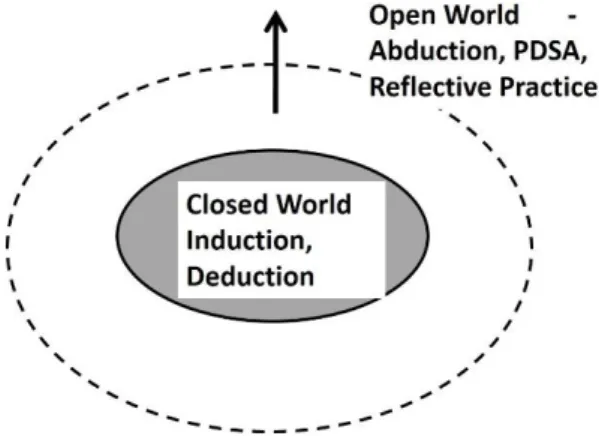
Our world today is expanding and it is now an open world. There are no boundaries and our traditional approaches do not work in a straightforward manner as they did yesterday (Figure 2).
Figure 2. Closed and Open World
As the world changes from closed to open, requirements for learning diversified very quickly.
4. Course Materials
Course materials developed until today are like a hardware. They are developed with particular applications in mind. They are not flexible.
But to cope with the quickly progressing diversification, course materials must adapt to such changes in our world. Most of the current contents fall short for this purpose.
As I am a mechanical engineer, let me take automotive industry to illustrate the point of discussion.
Cars were mass produced because they satisfied the needs of people and this production system worked very well to reduce cost so people could afford to buy them.
But even in such days, trucks were developed based on modularization. Their chassis are common to all applications, but their bodies vary from application to application. So truck industry introduced modularization since long time ago. (Figure 3).
Figure 3. Truck design
(A=Cargo body, C=Chassis)
Now passenger cars are introducing
modularization to cope with diversification. And we also have to note that there is another motivation coming up for modularization.
It is modularization to cope with personalization.
Maslow proposed the hierarchy of human needs [1]. At the lower level, people look for material satisfaction, but as they go up, they look for mental satisfaction and at the top level people pursue self-actualization. They would like to actualize themselves. Challenge is one of such self-actualizations (Figure 4).
3
Figure 4. Maslow’s hierarchy of human needs
Diversification brought about personalization, but we should remember that humans look for self-actualization from the beginning, no matter whether the world is diversified or not.
Now, let us come back to the discussion about course materials. Most of current course materials have been developed with particular applications on mind and most of their efforts were paid to how we can transfer our knowledge and
experience to the next generation. In other words, most of our traditional materials have been more or less focused on education.
If we consider the increasing diversification and personalization, we should move from education to learning. And indeed learning is taking the place of education quickly. But the course
materials still remain the same basically. They are developed for a particular application and they are not modularized enough in the sense discussed above.
In automotive industry, recently a car is
developed whose parts can be changed as you like to suit to the situations (Figure 5 and Figure 6). Just like a dress code, you can dress your car up as you like.
Figure 5. Reconfigurable car
Figure 6 Changeable parts
In fact, fashion industry has been practicing such a reconfigurable approach since long time ago. The same dress looks different, if you wear different accessories.
Therefore, in order to cope with diversification and personalization, we need a new framework for learning materials. The current framework is something like hardware. They do not change with situations. We need another “soft” framework. Such “soft” materials can be developed by modularizing materials into two kinds. The one is common platform materials which can be applied across different applications and the other kind is application-specific.
5. Convergent and Divergent
Our traditional course materials are convergent. We have a clearly defined problem and we mobile all pieces of our knowledge to solve it.
But today the situations are so complex and complicated. First of all, we have to discover what the problem is in order to decide which materials we can use to solve it. Thus, we have to know what problems can be solved with the current materials. Or we have to know what other areas the current material can be applicable. This is a divergent approach (Figure 6 and Figure 7)
4
Figure 7. Divergent approach
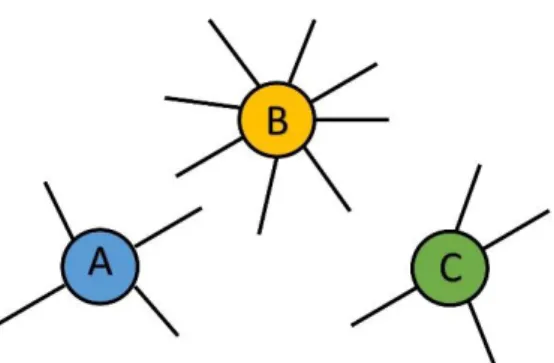
To describe it using graph theory terms, our traditional course materials are developed on the idea how we can find links to reach to our destination node (solution).
But materials tomorrow call for an approach the other way around. We start from the node to find out what nodes we can reach from there.
If one node and another node share the same link, then they can be linked together. Thus, if we repeat this process, it will constitute a network (Figure 8).
Figure 8. Divergent Approach and Network
6. Learning Materials for Tomorrow
In short, our traditional course materials are focused on independent nodes, not linked together very well. We have been making efforts to how we can enrich each node.
But what is needed today and tomorrow is more than just richness of an individual node, but how they can be linked together to form an appropriate network to solve a problem. The organization of such a network varies from problem to problem and from situation to situation.
Thus, learning has to be carried out as a team. This team not only implies human team, but the combination or connection of learning materials. How we can let our materials work as a team is our next challenge. We have to prepare materials so that they can be easily combined in a different manner in order to adapt to the situation and to solve the problems in a frequently and extensively changing world.
This holds true in classroom, too. e-Learning today is more or less emphasizing distance learning. But what e-Learning offers is more than that.
e-Learning not only diminishes physical distance, but it will also reduce distance among different areas. The development of such an e-Learning materials serves to provide very versatile tools for learning. They help us to adapt to the changing situations and to explore the new area. They will provide us with situational awareness and problem consciousness. They help us to see things in their proper perspective.
Traditional learning was focused on how we can transfer our experience to the next generation. But tomorrow is another day and we have to explore the new area beyond our past experience.
Of course, experience counts, but we need a decision which pieces are applicable and work best to solve the problem in a changing world. Whether our decisions are correct or not is crucial tomorrow.
Past education was problem solving. But now it is the age of problem discovery. Learning will be our challenge to the new unknown and unexperienced world. Tomorrow learning will be nothing other than satisfying our human needs for self-actualization.
7. Connecting World
Today Internet of Things [2] are getting wide attention and as Cyber-Physical Systems [3] indicates products are getting more connected. Learning is not an exception. We have to connect our learning materials more and more so that they can work as a network.
Industrie 4.0 [4] points out that an initiative on the part of people is called for in order for it to succeed. Until today, we have been doing what we are supposed to do, but since the world is changing every minute, we are facing a new world every minute so each of us must take an initiative and make a decision to make an appropriate next step forward.
5
8. Sensing and Decision-making
We have to look for other persons who can work together with us to solve the new emerging problems.
So decision-making plays an important role in learning tomorrow. To make a correct decision, we have to know what is happening now. Thus, sensing becomes crucially important.
Up to now, actions have been focused on and how wisely we can act was important. But tomorrow, in order to make an appropriate decision to move forward, we have to sense what is happening now around us.
We have to develop such learning materials for sensing and decision-making. This is a big challenge for learning tomorrow.
9. Why Do We Learn?
To prepare learning materials for tomorrow, we have to ask ourselves again, “Why do we learn?” Yesterday, it was to survive. But we have to remember that we learn to grow. As we learn more, we feel more confident. This is another kind of self-actualization. Self-actualization or challenge serves for us to build up our confidence.
Education may have started as the need for us to survive. But now we are moving from education to learning. Learning provides us with the joy of self-actualization and it is a challenge. Challenge is the core and mainspring of all human activities.
10. Concluding Remarks
The world is changing frequently and extensively these days. So we have to learn to adapt to such changes. But this is not a straightforward application of course materials. What is needed now is sensing and decision making. Our
traditional course materials put emphasis on how we should act. But today we need materials to help us sense what is happening now and help us make an appropriate decisions on which action to take.
In order to cope with these requirements, it is pointed out that if we modularize our course materials and re-organize them, it would provide a solution,
And at the same time, we have to add new learning materials which help us to discover what the problem is and help us to define the problem adequately. Most of the current course materials are focused on problem solving.
e-Learning started as a tool for learning at a distance, but now it changed pedagogy from education to learning. Our traditional education was focused on how we can transfer our
knowledge and experience to the next generation. But the frequent and extensive changes call for another new framework.
e-Learning will provide flexible and versatile tools to cope with such situations. Our traditional education was focused on problem solving and it taught us how to act. But e-Learning tomorrow will help us to recognize the situations and to find out what the problem is. It will help us to sense the changes and to make an adequate decision for the next step forward.
e-Learning tomorrow will be a tool to explore the new world we have never experienced. It is a tool for a challenge.
Learning is quickly moving toward the direction of being autonomous and decentralized. e-Learning will accelerate this transition.
e-Learning materials tomorrow must provide the learner with situational awareness and problem consciousness and must help them see things in their true perspective.
References
[1] Abraham H. Maslow, “A Theory of Human Motivation”, Psychological Review, Vol.50, No.4, pp.370-396, (1943).
[2] Kevin Ashton, “That ‘Internet of Things’ Thing”, RFID Journal, 22, June, (2009).
[3] http://www.nsf.gov/publications/ pub_summ.jsp?ods_key=nsf08611 [4] http://www.acatech.de/fileadmin/ user_upload/Baumstruktur_nach_Website/ Acatech/root/de/Material_fuer_Sonderseiten/ Industrie_4.0/ Final_report__Industrie_4.0_accessible.pdf
[5] Shuichi Fukuda (ed.), “Emotional Engineering”. Springer, (2011).
[6] Shuichi Fukuda (ed.), “Emotional Engineering, Vol.2”, Springer, (2013).
[7] Shuichi Fukuda (ed.), “Emotional Engineering, Vol.3”, Springer, (2014).