ISSN: 2147-611X
www.ijemst.com
Comparison of Simulation-Based and
Textbook-Based Instructions on Middle
School Students’ Achievement, Inquiry
Skills and Attitudes
Aysegul Cayvaz1, Hakan Akcay2 , Hasan Ozgur Kapici2
1
Fidan Demircioglu Middle School
2Yildiz Technical University
To cite this article:
Cayvaz, A., Akcay, H., & Kapici, H.O. (2020). Comparison of simulation-based and
textbook-based instructions on middle school students’ achievement, inquiry skills and
attitude.
International Journal of Education in Mathematics, Science and Technology
(IJEMST), 8
(1), 34-43.
This article may be used for research, teaching, and private study purposes.
Any substantial or systematic reproduction, redistribution, reselling, loan, sub-licensing,
systematic supply, or distribution in any form to anyone is expressly forbidden.
Authors alone are responsible for the contents of their articles. The journal owns the
copyright of the articles.
International Journal of Education in Mathematics, Science and Technology
Volume 8, Number 1, 2020
Comparison of Simulation-Based and Textbook-Based Instructions on
Middle School Students’ Achievement, Inquiry Skills, and Attitudes
Aysegul Cayvaz, Hakan Akcay, Hasan Ozgur Kapici
Article Info
Abstract
Article History
Received: 19 June 2019
Simulations, which is a type of educational technology has started to be used widely in classes. Contradictive results show that there is no certain conclusion about the effects of them on students’ domain knowledge, inquiry skills and attitudes towards science. The goal of the study is to compare the impacts of simulation-based and textbook-based instructions on the middle school students’ science achievement, inquiry skills and attitudes towards science. The study was done with 188 middle school students and three science teachers. Whereas 98 of them enrolled in the classes where simulation-based instruction was used, 90 of the participants were from the classes in which textbook-based instruction followed. A quasi-experimental research design was used in the study. The data was gathered by the achievement test, the inquiry skills, and the attitude scale. The findings revealed that simulation-based instruction is significantly efficient in enhancing middle school students’ science achievement and inquiry skills. Yet, it was also reached that both of the instructions have no significant impact on students’ attitudes towards science. Possible reasons behind the results were also discussed.
Accepted: 06 August 2019
Keywords
Simulation Textbook Inquiry Achievement Science education
Introduction
Although most of the countries have transformed their science curriculums from teacher-centered to student-centered approach, the science achievement of elementary and middle school students is still uneven. This is a disquieting result because some of today’s students will become scientists, engineers or technical workers to create the innovations in order to enhance a nation’s economic growth and international competitiveness (National Academy of Sciences, National Academy of Engineering, and Institute of Medicine, 2007; National Research Council, 2011). Another danger of this result is today’s students will become citizens of the future and they have to make informed decisions based on their understanding of science and technology about socio-scientific issues such as global warming or nuclear power plants (NRC, 2011). The uneven science achievement score of today’s students presents a threat to this issue.
Furthermore, NRC (2005, 2007) advocates that one of the main reasons for students’ to have limited science achievement scores is due to a lack of interest in science and motivation. In order to deal with these problems, simulations can be one of the solutions since they have the potentials to increase students’ interest, motivation and as a result of which augmenting students’ science scores. Also, these educational technologies make it possible to use student-centered learning experiences (Autio et al., 2019; Bixler, 2019; Karisan, Macalalag, & Johnson, 2019; Shin, 2002; Wallace-Spurgin, 2018; Yerdelen, Osmanoglu, & Tas, 2019) in which students encounter with inquiry and problem solving (Basuhail, 2019; Land & Hannafin, 1996).
Theoretical Framework
Simulations in Science Education
Simulation is one of the popular tools for teaching and learning (Bayraktar, 2001) due to the increasing availability of computers, smart boards and mobile devices in classes (Pambayun et al., 2019; Rutten, van Joolingen, and van der Veen, 2012; Yahya & Adebola, 2019). Simulations are programs that contain a model of a system (natural or artificial, e.g., equipment), or a process (de Jong and van Joolingen 1998, p.4) and have many advantages for students such as providing dynamic visualization, rapid feedback, and proper to follow inquiry learning (Moore, Herzog, and Perkins, 2013). Teachers are also eager to use simulations in their classes because of saving the time, allowing them to spend more time with their students instead of the setting up and supervising the experiments, easy to design and implement investigations, and providing multiple representation such as dynamically changing diagrams and graphs (Blake & Scanlon, 2007; Lowe, 2003).
Simulations encourage learners to use their spatial learning and perceptual systems which cannot be achieved through text and verbal interactions (Lindgren & Schwartz, 2009). It is possible to model scientific phenomena that cannot be observed in a real classroom context electrical current and cell structure (Clark, Nelson, Sengupta, & D’Angelo, 2009). Clark et al. (2009) define four dimensions of simulations. These are (i) the degree of user control, (ii) the extent and nature of the surrounding guiding framework in which the simulations are embedded, (iii) how information is represented, and (iv) the nature of what is being modeled (p. 6).
Degree of User Control
The degree of user control varies from mostly structured to mostly open-ended versions. Allowing a leaner to control a few variables or vice versa is an important concern because it’s one of the important determinants for the learner’s success. If the required cognitive process cannot be provided by the learner to handle the controlling amount of the variables, then it is possible to reach unsuccessful results. An important point here can be that learner’s prior knowledge and experience (Chen, Fan, & Macredie, 2006; Lim, 2004) because expert learners may have more advantages to handle with mostly open-ended simulations.
Surrounding Guiding Framework
In this dimension, there are mainly two types of simulations. One of them is the simple ones that allow learners/teachers direct access to the simulation and the teacher can integrate it into any other curriculum materials (i.e., hands-on experimentation) (Clark et al., 2009). The other type is larger platforms or frameworks in which there are other tools such as discussion board, several scratchpads, drawing activities or probe ware data collection with the simulation in the platform (Clark et al., 2009).
Representation of Information
Studies show that different representations of knowledge may have an impact on students’ learning. There are several theoretical frameworks (i.e. multimedia learning, dual coding approach) that emphasize the importance of presenting knowledge in different forms. Simulations also enable learners to reach knowledge into different formats such as alphanumerical, graphical, symbolic or abstract iconic representations of information (Clark et al., 2009).
Nature of What is Modeled
36 Cayvaz, Akcay, & Kapici
Inquiry-based Learning
Inquiry learning refers engaging students with scientific processes like orientation, developing hypothesis, designing and implementing experiment(s) to test the hypothesis, gathering and analyzing data and reaching conclusion to help them build their own knowledge and to use it in order to predict and explain the events in the natural world (de Jong, 2006; van Joolingen, de Jong & Dimitrakopoulou, 2007). One of the efficient ways to create inquiry-based learning environments is simulations because it is possible to use several tools to support inquiry processes such as hypothesis scratchpad and experiment design tool (Hovardas, Xenofontos, & Zacharia, 2017). Research has shown that guidance in inquiry-based learning environments has a vital role in students’ learning (Lazonder & Harmsen, 2016). A meta-analysis study done by D’Angelo et al. (2014) showed that simulations with some form of learner guidance had a consistent result on learning outcomes and inquiry skills. In another meta-analysis study, Alfieri et al. (2011) reached that whereas inquiry-based learning environments with no or minimal guidance were less effective than expository instruction, providing sufficient guidance into inquiry-based learning environments made it more effective than expository instruction. These results show that the effectiveness of inquiry-based learning in simulated environments depends on the availability of proper guidance (Lazonder & Harmsen, 2016).
De Jong and Lazonder (2014) defined various types of inquiry learning guidance. These are process constraints, prompts, heuristics, scaffolds, and direct explanations. Studies propose that younger and less-experienced students need more explicit guidance than older ones (Lazonder & Harmsen, 2016). For example, process constraints can be used for learners with highly developed inquiry skills because it is the least specific type of guidance, on the other side, explanations can be preferred for learners who lack basic inquiry skills since it is the most explicit type of guidance (Lazonder & Harmsen, 2016). In the current study, we preferred to use the laboratory worksheet and teachers’ explanations as guidance tools because the participants were lack of basic inquiry skills and were not able to perform the action themselves.
Research Questions
In this study, we compared the effectiveness of simulation-based and textbook-based instructions on middle school students’ science achievement, inquiry skills and attitudes towards science. There are contradictive results about the effects of simulations on students’ conceptual understanding and inquiry skills. Although some of them (Chang, Chen, Lin, & Sung, 2008; Huppert, Lomask, & Lazarowitz, 2002; Trey & Khan, 2008) found that simulations provided significant impact on knowledge and inquiry acquisition, some others reached that traditional approach gave better outcomes than simulation-based instruction (Winn et al., 2006). Most of these studies claim that the effectiveness of simulations in science education depends on the simulation, the topic taught by the simulation, the learners and the science teachers (Rutten et al., 2012). In the current study, we used the same simulation to teach the same topic for middle school students with similar backgrounds in the experimental classes. In this way, we tried to investigate the effect of the simulation used by different science teachers on middle school students’ science achievements, inquiry skills and attitudes towards science. The following research questions were investigated in the study:
Do seventh-grade middle school students who learn about the domain of work and energy in simulation-based and textbook-based learning environments differ in their science achievement?
Do seventh-grade middle school students who learn about the domain of work and energy in simulation-based and textbook-based learning environments differ in their acquisition of inquiry skills?
Do seventh-grade middle school students who learn about the domain of work and energy in simulation-based and textbook-based learning environments differ in their attitudes towards science?
Method
Participants
distributions over conditions are as follows: 98 students in S and 90 students in T. All of the students had no prior experience with the simulation.
Instruments
Multiple-Choice Achievement Test
The multiple-choice achievement test was developed by Erşahan (2016). This test involves 23 multiple-choice questions (each question has four choices). The questions on the test are about work and energy, kinetic energy, potential energy, energy conversion and simple machines (for some examples of questions, see Appendix 1) and asked for students’ conceptual knowledge of the domain. Each correct answer was given one point. Possible scores, therefore, varied between 0 and 23. Cronbach’s alpha coefficient was 0.71 for the achievement posttest.
Inquiry Skills Test
The inquiry skills test was developed by Eager and Yager (1998) and translated into Turkish by Koray (2007). The test includes 31 questions (for examples of questions, see Appendix 2) and is intended to measure students’ basic inquiry skills (e.g. observation or classification) and higher-order inquiry skills (e.g. forming hypothesis or implementing investigation) through multiple-choice questions. Cronbach’s alpha coefficient was 0.72 for the inquiry skills posttest.
Science Attitude Scale
To measure students’ attitudes, the scale developed by Enger and Yager (2001) was used in the current study. The scale contains 18 items and aims to measure middle school students’ attitudes towards science in the following four subscales: Science Teachers (ST), Science Classes (SC), Usefulness of Science Study (USS), and Perceptions of Being a Scientist (PBS). The questionnaire uses a 5-point Likert type scale. The response choices are “strongly disagree”=1, “disagree”=2, “Neither agree nor disagree”=3, “Agree”=4 and “Strongly agree”=5 for the items. In the data analysis process, the responses were reversely coded for negatively phrased items. Cronbach’s alpha coefficient was 0.70 for the science attitude scale posttest.
Research Design and Implementation
Three science teachers were involved in the study. The lesson plans for the students that included the topic of work and energy, how to use the simulations in a classroom environment and some basic technical issues about the simulations were all discussed with the science teachers. For these activities, three meetings were arranged with them. In the first meeting, the simulation programs were introduced to the science teachers. The functionalities and properties of the program were presented. In the second meeting, the teachers created their own simulations about the unit of work and energy and discussed how to develop the simulation. In the last meeting, microteaching with the simulations was done by the teachers, so they were able to see in which part of the lesson they were good or weak.
Each science teacher had two classes and the classes were randomly assigned as control and experimental groups. Totally six classes involved in the study. Three of them (T1, T2, and T3) were control conditions and another three ones (S1, S2, and S3) were experimental conditions. Teacher A instructed for T1 and S1, teacher B instructed for T2 and S2, and teacher C instructed for T3 and S3. Whereas the teachers followed textbook-based instruction in the control groups, the simulation-textbook-based instruction was used through the learning process in the experimental conditions.
38 Cayvaz, Akcay, & Kapici
The study was performed in the unit on work and energy in the students’ curriculum. It lasted for three weeks. Science classes were 4 h per week. At the end of the study, the same tests were taken as the posttest. The pretests and posttests were taken on an individual basis and did not count for the students’ official results. Whereas students’ scores from T1, T2, and T3 classes were evaluated together as a score of the control group, the scores of the students from S1, S2, and S3 classes were evaluated together as a score of the experimental group. The tests were administered at the beginning and end of the study; we assumed that the duration of the study (3 weeks) and the total number of questions on the tests prevented students from memorizing the questions. All classes were taught with the same teaching approach, which was guided inquiry-based learning. The science teachers acted as the main source of guidance supporting the students. For the S1, S2, and S3 classes, the worksheets were primary instructional materials. On the other side, textbooks and the teachers’ explanations were the main instructional materials for the classes T1, T2, and T3.
Data Analysis
The same approach was used for the analysis of the scores from the multiple-choice achievement test, the inquiry skills test and the science attitude scale. Firstly, an independent samples t-test was used for comparing the pretest scores of the classes. After that, the paired-samples t-test was used for comparing the pretest and posttest scores of the classes. This procedure was followed to determine whether a class improved their achievement, inquiry skills and/or attitudes towards science significantly. And lastly, an independent samples t-test was used again in order to compare the postt-test scores of the classes.
Results
In the current study, we investigated the effects of simulated environment on middle school students’ achievement, the inquiry skills and attitudes towards science. The results for the multiple-choice achievement test are presented first. Then, the results for the inquiry skills test are given. Finally, the results for the science attitude scale are presented.
Results of the Multiple-Choice Achievement Test
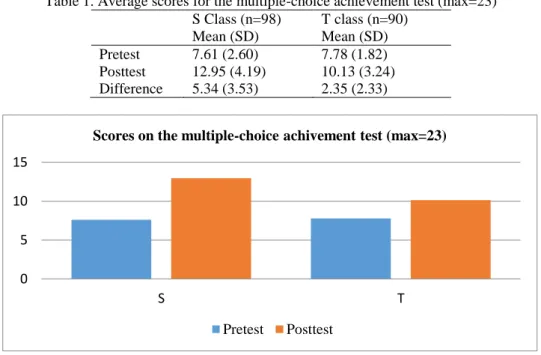
The multiple-choice achievement test was administered as both pretest and posttest. Table 1 and Figure 1 show descriptive results for this test.
Table 1. Average scores for the multiple-choice achievement test (max=23) S Class (n=98)
Mean (SD)
T class (n=90) Mean (SD) Pretest 7.61 (2.60) 7.78 (1.82) Posttest 12.95 (4.19) 10.13 (3.24) Difference 5.34 (3.53) 2.35 (2.33)
Figure 1. Multiple-choice achievement test scores at pretest and posttest 0
5 10 15
S T
Scores on the multiple-choice achivement test (max=23)
The classes’ pretest scores were compared in an independent samples t-test. The results showed that there were no significant differences between the classes on the pretest (t (186)=.363, p=.676). Separate paired-samples t-tests showed that each group increased its score on the multiple-choice achievement test significantly (for S,
t(97)=13.62, p<.001; for T, t(89)=9.60, p<.001). Then, an independent samples t-test showed that the classes differed on their posttest scores (t (186)=2.148, p<.001). Posttest scores of the classes in which the simulation was used were higher than for the classes that followed the textbook-based instruction. As a consequence, the classes increased their achievement about the topic of work and energy significantly. Furthermore, the overall picture suggested by this comparison is that using the simulation provides a better learning opportunity than using the textbook-based instruction alone for teaching about work and energy.
Results of the Inquiry Skills Test
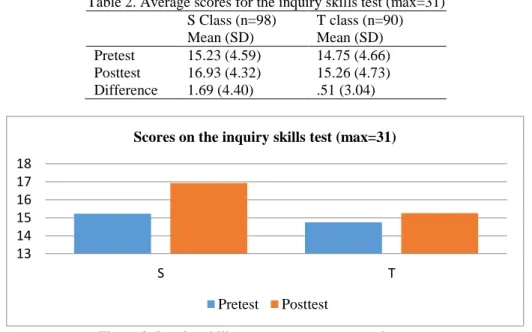
For the inquiry skills test, a similar procedure was followed as for the multiple-choice achievement test. The test was implemented as a pretest and posttest. Table 2 and Figure 2 indicate the descriptive results of this test.
Table 2. Average scores for the inquiry skills test (max=31) S Class (n=98)
Mean (SD)
T class (n=90) Mean (SD) Pretest 15.23 (4.59) 14.75 (4.66) Posttest 16.93 (4.32) 15.26 (4.73) Difference 1.69 (4.40) .51 (3.04)
Figure 2. Inquiry skills test scores at pretest and posttest
The classes’ pretest scores were compared with each other through an independent samples t-test. The result showed that there was no difference between the classes at the pretest (t (186)=0.120, p=.479). Separate paired-samples t-test showed that students in the experimental group (S class) increased their scores on the inquiry skills test significantly (for S, t(97)=3.812, p<.001) but those in the control group (T class) did not (for T,
t(89)=1.558, p=.123). After that, an independent samples t-test showed that the classes differed on their posttest scores (t (186)=2.536, p=.012). Posttest scores of the classes in which the simulation was used were higher than for the classes that followed the textbook-based instruction.
Results of the Science Attitude Scale
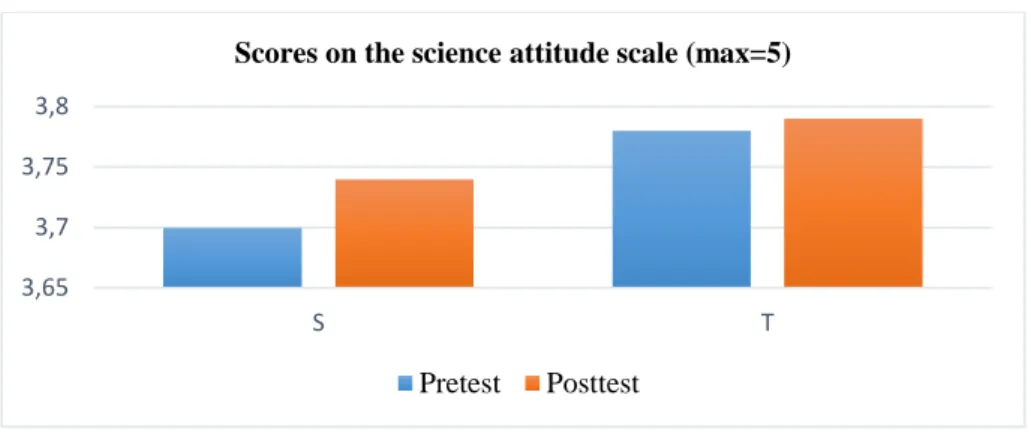
The scale was administered as both pretest and posttest. Table 3 and Figure 3 show the results of the scale.
Table 3. Average scores for the science attitude scale (max=5) S Class (n=98)
Mean (SD)
T class (n=90) Mean (SD) Pretest 3.70 (0.40) 3.78 (0.52) Posttest 3.74 (0.36) 3.79 (0.43) Difference 0.04 (0.35) 0.01 (0.39) 13
14 15 16 17 18
S T
Scores on the inquiry skills test (max=31)
40 Cayvaz, Akcay, & Kapici
Figure 3. Science attitude scale scores at pretest and posttest
The classes’ pretest scores were compared with each other through an independent samples t-test. The result showed that there was no difference between the classes at the pretest (t (186)=-1.12, p=.265). Separate paired-samples t-test showed that students both in the control and experimental groups did not increase their scores on the science attitude scale significantly (for S, t(97)=1.092, p=.278; for T, t(89)=0.364, p=.717). Lastly, an independent samples t-test was used again to compare the classes’ posttest scores. The result showed that the classes did not differ on their posttest scores (t (186)=0.915, p=.361). Posttest scores of the classes showed that neither the simulation nor the textbook-based instructions have not significant impact on middle school students’ attitudes towards science.
Discussion
In this study, we investigated the effects of simulation-based instruction on middle school students’ science achievement, inquiry skills and attitudes towards science. The findings based on the achievement test revealed that simulation-based instruction was significantly more effective in middle school students’ achievement for the topic of work and energy. This result implies that the simulation-based instruction used in the current study is repeatable because of the tool used in the three different classes with three different science teachers. The result is also in line with other studies (Guy & Lownes-Jackson, 2015; Odadžić et al., 2017). It is obvious that simulation-based instructions are precious tools for enhancing students’ conceptual knowledge in science topics (Faour, & Ayoubi, 2018; Renken & Nunez, 2013) because the environment provides simplification for eliminating distractors, so students can easily focus on the subject (ChanLin, 2001; Hebebci et al., 2014; Trundle & Bell, 2010). Although this is one of the vital properties of simulations, the crucial point is that they are not mostly an adequate substitute for hands-on investigations for conceptual knowledge (Renken & Nunez, 2013). Many studies in the literature (Chang et al., 2008; Corbett et al., 2010) emphasize the importance of guidance through students’ learning process within simulation-based instructions. We also used the worksheets as scaffolding tools for students in the simulation-based environment. This might be a reason for the students’ significant increase in science achievement for the topic of work and energy.
Furthermore, scaffolding tools are not only crucial for conceptual understanding in inquiry-based learning environments but also have vital roles for developing learners’ inquiry skills in such environments. For the current study, we reached that the middle school students who were taught by simulation-based instruction enhance their inquiry skills significantly more than their counterparts. On the other side, it was also reached that the students’ inquiry skills were and remained quite low for this study. This shows that scaffolding tools (worksheets and teachers’ explanations) were not powerful to make a great change in students’ inquiry skills. Besides, Turkish middle school students’ inquiry skills are generally at a low level (Kapici et al., 2019). For example, students’ ranks in international exams such as PISA and TIMMS are relatively low when compared to students from other countries. That’s why, it is difficult to make a big chance by a single implementation, such as the one we did in this study.
Students’ attitudes towards science were also investigated in this study and found that participants’ attitudes towards science were not significantly developed positively. Although several studies (Lawrenz, 1976; Haladyna & Shaughnessy, 1982) mention that learning environments have impacts on students’ attitudes towards science; we reached no significant difference in our study. In addition to learning environments, students’ attitudes towards science can be affected by several factors such as science teachers, school science laboratories, peers’ and parents’ attitudes, motivation towards science, student’ science achievement and self-esteem (Kind et al., 2007; Osborne et al., 2003). In this study, we just had to control science teachers and
3,65 3,7 3,75 3,8
S T
Scores on the science attitude scale (max=5)
learning environments. In other words, different science teachers taught the topic by using different instructional materials, which did not have significant impacts on students’ attitudes towards science. We were not able to control the participants’ friends’ or parents’ attitudes towards science, or their motivation towards science, or self-esteem in science. These variables may be causes for not changing students’ attitudes towards science.
Conclusion
As a conclusion, it is obvious that simulations provide many advantages for enhancing students’ learning and inquiry skills if they are used properly. We also reached that the students who were taught by simulation-based instruction reached significantly higher scores on the achievement test and the inquiry skills test. Three different teachers taught in the study. This shows that it is possible to reach similar results with different teachers although they taught students from different backgrounds. It means that if teachers use the simulations appropriately, it is possible to gain the same outcomes. Yet, there were no significant positive developments in students’ attitudes towards science. This was an unexpected outcome for the current study because learning environments have effects on students’ attitudes towards science. In this study, out-of-school factors might have an impact on this result since school variables (teachers and learning environment) were provided for students.
Consequently, the results of this study offer several implications for science teachers. Simulations can be used for the topics which involve unobservable entities such as particulate nature of matter and astronomy. It is also suitable to use for the subjects that can cause dangerous situations in classes like acid and base. Furthermore, simulations also enable students to follow inquiry learning. For example, some of them provide hypothesis scratchpad, experiment design tool, observation or conclusion tools, which are important scaffolding tools in inquiry-based learning. All in all, one of the crucial points is that teachers should know how to use technology through the teaching process. In our study, we organized workshops for the teachers to make them aware of technology-enhanced learning environments.
This study also had several limitations. For example, the duration of the study was too limited. If students were exposed to simulation-based instruction for a long time, it would be possible to reach higher scores on their science achievement, inquiry skills and attitudes towards science. The study was done with the topic of work and energy. Yet, chemistry topics would attract middle school students’ attention more, so further studies can be replaced with topics form chemistry education.
Notes
The parts of this study were presented in the International Conference on Education in Mathematics, Science and Technology (ICEMST), Mugla, Turkey. This study was based on the first author’s master thesis.
References
Alfieri, L., Brooks, P. J., Aldrich, N. J., & Tenenbaum, H. R. (2011). Does discovery-based instruction enhance learning? Journal of Educational Psychology 103(1), 1-18.
Autio, O., Jamsek, J., Soobik, M., & Olafsson, B. (2019). Technology education in Finland, Slovenia, Estonia and Iceland: The structure of students’ attitudes towards technology. International Journal of Technology
in Education and Science (IJTES), 3(2), 95-106.
Basuhail, A. (2019). e-Learning objects designing approach for programming-based problem solving.
International Journal of Technology in Education (IJTE), 2(1), 32-41.
Bayraktar, S. (2001). A meta-analysis of the effectiveness of computer-assisted instruction in science education.
Journal of Research on Technology in Education 34(2), 173-188.
Bixler, S. (2019). One-to-one iPad technology in the middle school mathematics and science classrooms.
International Journal of Technology in Education and Science (IJTES), 3(1), 1-18.
Blake, C. & Scanlon, E. (2007). Reconsidering simulations in science education at a distance: Features of effective use. Journal of Computer Assisted Learning23(6), 491-502.
Chang, K.-E., Chen, Y.-L., Lin, H.-Y., & Sung, Y.-T. (2008). Effects of learning support in simulation-based physics learning. Computers & Education51(4), 1486-1498.
ChanLin, L. (2001). Formats and prior knowledge on learning in a computer-based lesson. Journal of Computer
42 Cayvaz, Akcay, & Kapici
Chen, S. Y., Fan, J.-P., & Macredie, R. D. (2006). Navigation in hypermedia learning systems: Experts vs. novices. Computers in Human Behavior 22(2), 251-266.
Clark, D., Nelson, B., Sengupta, P., & D’Angelo, C. (2009) Rethinking science learning through digital games
and simulations: Genres, examples, and evidence. National Academies Press: Washington, DC.
Corbett, A., Kauffmann, L., Maclaren, B., Wagner, A., & Jones, E. (2010) . A cognitive tutor for genetics problem solving: Learning gains and student modeling. Journal of Educational Computing Research 42(2), 219-239.
D’Angelo, C., Rutstein, D., Harris, C., Haertel, G. Bernard, R., & Borokhovski, E. (2014) Simulations for STEM
learning: Systematic review and meta-analysis. SRI Education: Menlo Park, CA.
de Jong, T. & Lazonder, A. W. (2014). The guided discovery principle in multimedia learning. In R. E. Mayer, J. J. G. van Merriënboer, W. Schnotz, & J. Elen (Eds.), The Cambridge handbook of multimedia learning
(2nd ed.) (pp. 371-390). Cambridge, NY: Cambridge University Press.
de Jong, T. (2006). Technological advances in inquiry learning. Science 312(5773), 532-533.
de Jong, T., & van Joolingen, W. R. (1998). Scientific discovery learning with computer simulations of conceptual domains. Review of Educational Research 68(2),179-202.
Faour, M.A. & Ayoubi, Z. (2018). The effect of using virtual laboratory on grade 10 students’ conceptual understanding and their attitudes towards physics. Journal of Education in Science, Environment and
Health (JESEH), 4(1), 54-68. DOI:10.21891/jeseh.387482
Guy, R. S., & Lownes-Jackson, M. (2015). The use of computer simulation to compare student performance in traditional versus distance learning environments. Issues in Informing Science and Information
Technology12(1), 95-109.
Haladyna, T., & Shaughnessy, J. (1982). Attitudes toward science: A quantitative synthesis. Science Education 66(4), 547-563.
Hebebci, M. T., Kucuk, S., Celik, I., Akturk, A. O., Sahin, I., & Eren, F. (2014). Designing an Online Case-Based Library for Technology Integration in Teacher Education. Online Submission, 8(8), 1253-1258. Hovardas, T., Xenofontos, N. A., & Zacharia, Z. C. (2017). Using virtual labs in an inquiry context: The effect
of a hypothesis formulation tool and an experiment design tool on students’ learning. In I. Levin & D. Tsybulsky (Eds.), Optimizing STEM education with advanced ICTs and simulations (pp. 58-83). Pennsylvania: IGI Global.
Huppert, J., Lomask, S. M., & Lazarowitz, R. (2002). Computer simulations in the high school: Students’ cognitive stages, science process skills and academic achievement in microbiology. International
Journal of Science Education24(8), 803-821.
Kapici, H. O., Akcay, H., & de Jong, T. (2019). Using hands-on and virtual laboratories alone or together – which works better for acquiring knowledge and skills? Journal of Science Education and Technology 28(3), 231-250.
Karisan, D., Macalalag, A., & Johnson, J. (2019). The effect of methods course on pre-service teachers’ awareness and intentions of teaching science, technology, engineering, and mathematics (STEM) subjects. International Journal of Research in Education and Science (IJRES), 5(1), 22-35.
Kind, P., Jones, K., & Barmby, P. (2007). Developing attitudes towards science measures. International Journal
of Science Education 29(7), 871-893.
Land, S. M. & Hannafin, M. J. (1996). A conceptual framework for the development of theories-in-action with open-ended learning environments. Educational Technology Research and Development 44(3) 37-53. Lawrenz, F. (1976). The prediction of student attitude toward science from student perception of the classroom
learning environment. Journal of Research in Science Teaching 13(6), 509-515.
Lazonder, A. W., & Harmsen, R. (2016). Meta-analysis of inquiry-based learning. Review of Educational
Research 86(3), 681-718.
Lim, C. P. (2004). Engaging learners in online learning environments. TechTrends 48(4), 16-23.
Lindgren, R. & Schwartz, D. L. (2009). Spatial learning and computer simulations in science. International
Journal of Science Education 31(3), 419-438.
Lowe, R. K. (2003). Animation and learning: Selective processing of information in dynamic graphics.
Learning and Instruction 13(2), 157-176.
Moore, E. B., Herzog, T. A., & Perkins, K. K. (2013). Interactive simulations as implicit support for guided-inquiry. Chemistry Education Research and Practice14(3), 257-268.
National Academy of Sciences, National Academy of Engineering, and Institute of Medicin e (2007).
Rising above the gathering storm: energizing and employing america for a brighter economic
future. National Academies Press: Washington, DC.
National Research Council (2005). America’s lab report: Investigations in high school science. National Academies Press: Washington, DC.
National Research Council (2011). Learning science through computer games and simulations. National Academies Press: Washington, DC.
Odadžić, V., Miljanović, T., Mandić, D., Pribićević, T., & Županec, V. (2017). Effectiveness of the use of educational software in teaching biology. Croatian Journal of Education 19(1), 11-43.
Osborner, J., Simon, S., & Collins, S. (2003). Attitudes towards science: A review of the literature and its implications. International Journal of Science Education 25(9), 1049-1079.
Pambayun, B., Wirjawan, J. V., Herwinarso, H., Wijaya, A., Untung, B., & Pratidhina, E. (2019). Designing mobile learning app to help high school students to learn simple harmonic motion.
International Journal on Social and Education Sciences, 1(1), 24-29.
Renken, M. D., & Nunez, N. (2013). Computer simulations and clear observations do not guarantee conceptual understanding. Learning and Instruction23(1), 10-23.
Rutten, N., van Joolingen, W. R., & van der Veen, J. T. (2012) . The learning effects of computer simulations in science education. Computers & Education58(1), 136-153.
Shin, Y.-K. (2002). Virtual reality simulations in web-based science education. Computer Application in
Engineering Education 10(1), 18-25.
Trey, L. & Khan, S. (2008). How science students can learn about unobservable phenomena using computer-based analogies. Computers & Education51(2), 519-529.
Trundle, K. C., & Bell, R. L. (2010). The use of a computer simulation to promote conceptual change: A quasi-experimental study. Computers & Education54(4), 1078-1088.
van Joolingen, W. R., de Jong, T., & Dimitrakopoulou, A. (2007). Issues in computer supported inquiry learning in science. Journal of Computer Assisted Learning23(2), 111-119.
Wallace-Spurgin, M.R. (2018). Implementation of the instructional practices inventory-technology process with fidelity: The impact on technology use and student cognitive engagement. International Journal of
Technology in Education (IJTE), 1(1), 35-45.
Winn, W., Stahr, F., Sarason, C., Fruland, R., Oppenheimer, P., & Lee, Y.-L. (2006). Learning oceanography from a computer simulation compared with direct experience at sea. Journal of Research in Science
Teaching43(1), 25-42.
Yahya, D. O., & Adebola, S. T. (2019). Availability of activities and appropriateness of graphical illustrations in recommended economics textbooks for senior secondary school students. International Journal on Social
and Education Sciences, 1(2), 73-77.
Yerdelen, S., Osmanoglu, A., & Tas, Y. (2019). The influence of a teaching practice course with video-case enriched microteaching on prospective teachers' self-efficacy for teaching. International Journal of
Research in Education and Science (IJRES), 5(2), 560-573.
Author Information
Aysegul CayvazFidan Demircioğlu Middle School Istanbul, Turkey
Hakan Akcay
Yildiz Technical University Istanbul, Turkey
Hasan Ozgur Kapici
Yildiz Technical University Istanbul, Turkey