R E V I E W
Open Access
Engineered nanoparticles interacting with cells:
size matters
Li Shang
1, Karin Nienhaus
1and Gerd Ulrich Nienhaus
1,2,3*Abstract
With the rapid advancement of nanoscience and nanotechnology, detailed knowledge of interactions between engineered nanomaterials and cells, tissues and organisms has become increasingly important, especially in regard to possible hazards to human health. This review intends to give an overview of current research on nano-bio interactions, with a focus on the effects of NP size on their interactions with live cells. We summarize common techniques to characterize NP size, highlight recent work on the impact of NP size on active and passive cellular internalization and intracellular localization. Cytotoxic effects are also discussed.
Keywords:Nanoparticle, Cellular uptake, Protein corona, Endocytosis, Red blood cell, Cytotoxicity
Introduction
In recent years, nanoparticles (NPs) and other nanoma-terials have entered essentially all areas of our everyday lives. In industrial applications, they have become indis-pensable components of catalysts [1], sensors [2] or photovoltaic devices [3]. In the biomedical field, they have found wide-spread use as nanovaccines [4], nano-drugs [5] and diagnostic imaging tools [6]. However, our knowledge about biological effects and, importantly, po-tential risks of the omnipresent (intended and unin-tended) exposure to nanomaterials has not kept up with the pace of these developments and is still very limited [7,8].
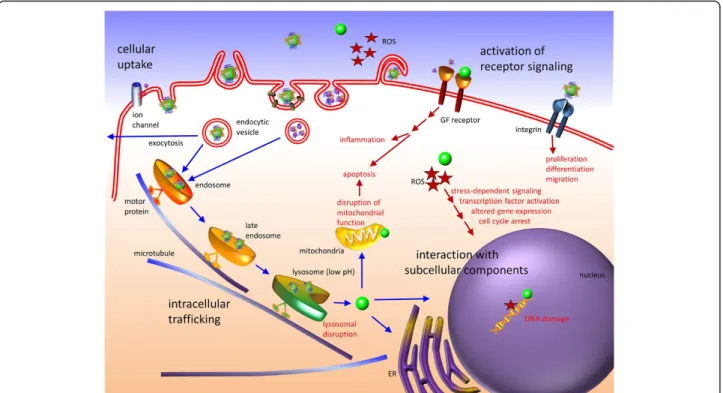
NPs may invade the human body via inhalation, ingestion or through the skin (Figure 1). Once they have entered a biological milieu, NPs will inevitably come into contact with a huge variety of biomolecules including proteins, sugars and lipids that are dissolved in body fluids, such as the interstitial fluid between cells, lymph or blood. These bio-molecules immediately coat the NP surfaces and form the so-called‘protein corona’[9-11], which determines the bio-logical identity of the NP [12]. Its composition is dynamic
and depends on the relative concentrations of the individ-ual components and on their affinities toward the NP sur-face. In fact, NPs have to be viewed as evolving systems that adapt to varying concentrations of the biomolecules present in the fluid. It has been suggested that the‘final cor-ona’reflects its own prior history [13].
NPs have to surmount the cell membrane to intrude cells. One of the hallmarks of any cell membrane is its abil-ity to selectively control the flow of ions and molecules into and out of the cell, and to maintain a separation between the cytosol and the extracellular environment. Large macromolecular agglomerates,e.g., protein assemblies, lipo-protein particles, viruses and also NPs are typically encap-sulated in vesicles and selectively transported into and out of the cells via endocytosis and exocytosis, respectively (Figure 1). Different types of endocytosis mechanisms are known, varying with the size of the transport vesicle, cargo properties and the internalization machinery involved. In most cells, internalization occurs via pinocytosis. In this process, an invagination forms in the cell membrane that is finally pinched off so as to generate a vesicle in the cyto-plasm that contains the internalized materials. Typically, the inward budding vesicles contain receptor proteins that recognize specific chemical groups on the molecules to be internalized. Thus, if proteins adsorbed to an NP trigger cell surface receptors, they will readily activate the cell’s uptake machinery, whereas adsorbed proteins that only weakly interact with membrane-associated biomolecules will re-duce the uptake of the‘disguised’NPs. Specialized cells,
so-* Correspondence:[email protected] 1
Institute of Applied Physics and Center for Functional Nanostructures (CFN), Karlsruhe Institute of Technology (KIT), Wolfgang-Gaede-Strasse 1, 76131 Karlsruhe, Germany
2Institute of Toxicology and Genetics (ITG), Karlsruhe Institute of Technology (KIT), Hermann-von-Helmholtz-Platz 1, 76344 Eggenstein-Leopoldshafen, Germany
Full list of author information is available at the end of the article
called‘professional phagocytes’, such as macrophages, neu-trophils, and monocytes are capable of phagocytosis, a form of endocytosis in which the cell engulfs larger particles. In addition to intruding cells by active transport, NPs may also enter cells by passive penetration of the cell membrane. In fact, for cells lacking the endocytosis machinery such as red blood cells (RBCs), passive transport is the only option.
Regardless of the specific internalization mechanism, the cell-NP interactions are, on the one hand, modulated by physicochemical properties of the NPs including size, shape, surface charge and surface chemistry [14] and, on the other hand, by cell-specific parameters such as cell type or cell cycle phase [15]. The uptake efficiency might even be affected by specific properties of the experimen-tal setup [16]. A quantitative understanding of the NP-biomolecule/membrane interaction is, therefore, an im-portant prerequisite for designing and engineering NPs with intentionally enhanced or suppressed cellular up-take [17,18]. In the present review, we shall focus mainly on the effect of NP size on the interaction with live cells. We present a survey of methods to determine the size of NPs, investigate the impact of the NP size on active and passive uptake and discuss their cytotoxic effects.
Characterization of the NP size in biological media To correlate a particular physicochemical property of a NP with biological responses and to ensure that these results are reproducible and meaningful, an accurate characterization of the NP is essential. NP size is a key
parameter (in the following, particle size always refers to the diameter). Many NPs are composed of a‘heavy’core
(e.g.,a metal or semiconductor nanocrystal) surrounded
of the duration of brief bursts of photons from individ-ual NPs passing through a tiny focal volume of typically 1 fL (10–15l), from which the NP size can be calculated
via autocorrelation analysis [21,22]. As with DLS, the
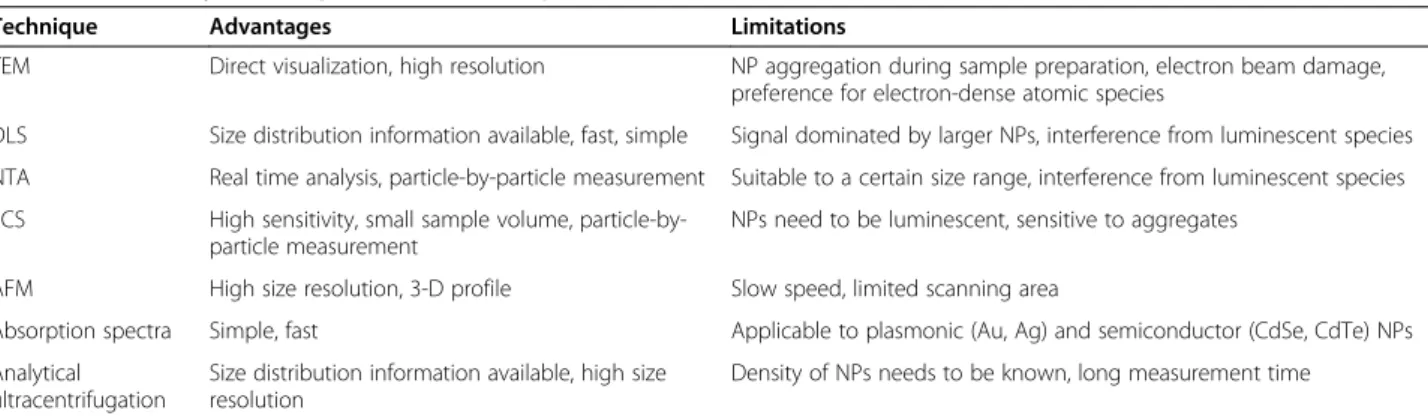
size information comprises both the core and the ligand layer. Other techniques to determine NP size include nanoparticle tracking analysis (NTA) [23], atomic force microscopy (AFM) [24], absorption spectroscopy [25] and analytical ultracentrifugation [26]. Advantages as well as limitations of the different techniques are sum-marized in Table 1.
One should be aware that NP preparations are often polydisperse. The DLS technique directly provides the size distribution information. Still, one has to be careful when interpreting the data because DLS is based on density-density correlations and, therefore, the intensity scales with the sixth power of the NP diameter. Caution is advised when dealing with samples containing parti-cles of markedly different sizes. Size distributions may also be quantified by using AFM. Such data have been proposed to be more accurate than those obtained via DLS [27]. TEM image analysis suffers from limited sam-pling, so that the selected NPs may not be representative of the whole sample. Overall, it is advisable to apply dif-ferent methods to ensure a robust size determination.
Independent of the technique chosen for size
characterization, the NPs should–if at all possible –be suspended in the medium/solvent that will be used to expose the NPs to the biological samples during such measurements. The colloidal stability of NP suspensions is influenced by many factors including the solution ionic strength, pH and solvent composition. Because NPs are often charge-stabilized, the colloidal stability of NPs in pure water is significantly different from that in biologically relevant media [28,29]. Particularly, one has to be aware that biomolecules present in biological media, such as proteins, will inevitably adsorb on the NP surface [30-32], which leads to an increase in the hydro-dynamic radius of the NP. In fact, the NP size may even
influence the characteristics of the protein corona [33-36], such as thickness, composition and protein ac-tivity, which may modulate their cellular interactions.
NP size effects on active cellular internalization
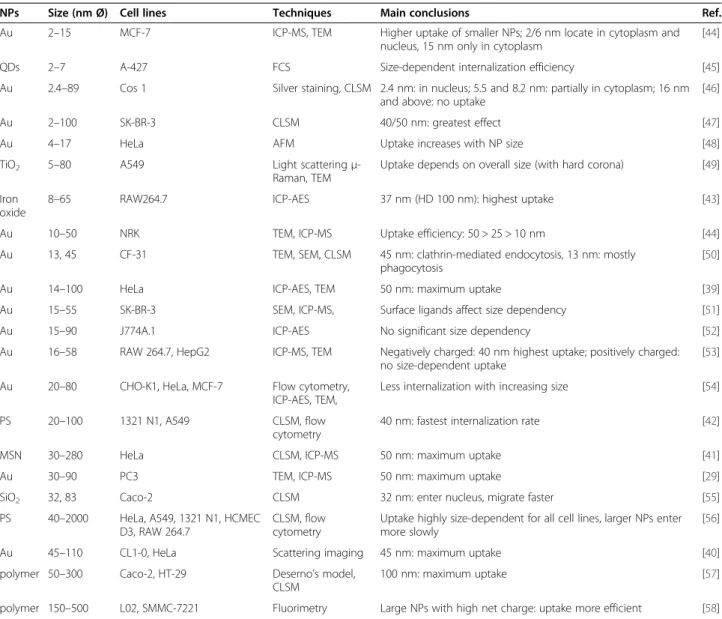
Endocytosis is a fundamental biological process used by cells to internalize (bio)molecules and, because of their similar size, also NPs [37,38]. It may involve the engage-ment of either clathrin or caveolin pits, but may also be independent of these proteins. As is apparent from the studies listed in Table 2, NP size may affect the uptake efficiency and kinetics, the internalization mechanism and also the subcellular distribution. A size-dependent uptake in different cell lines has been observed for Au [29,39,40], mesoporous silica [41], polystyrene [42] and iron oxide NPs [43], with the maximum cellular uptake at a NP core size in the range of 30–50 nm, which sug-gests that there is an optimal size for active uptake.
Hökstra et al. [59] used a range of fluorescent latex
beads of defined sizes (50–1,000 nm) to investigate the effect of NP size on the entry pathway in non-phagocytic B16 cells. Internalization of NPs <200 nm was observed to involve clathrcoated pits. With in-creasing size, a shift towards caveolae-mediated internal-ization became apparent, which turned out to be the predominant entry route for 500-nm particles. Rafailo-vich et al. [50] reported that 45-nm Au NPs penetrated cells via clathrin-mediated endocytosis, while the smaller 13-nm NPs entered mostly via phagocytosis.
By using spinning disk confocal microscopy and quan-titative image analysis, Nienhaus and coworkers have systematically investigated the uptake of various NPs in
the range of 3.3 ‒ 100 nm by live HeLa cells.
Interest-ingly, QDs [60] and Au nanoclusters (AuNCs) [61,62] with less than 10 nm diameter were found to accumulate on the plasma membrane before gradually entering the intracellular region (Figure 2). In stark contrast, large polystyrene NPs (100 nm) were directly internalized without detectable prior accumulation at the plasma
Table 1 Commonly used experimental techniques to characterize NP size
Technique Advantages Limitations
TEM Direct visualization, high resolution NP aggregation during sample preparation, electron beam damage, preference for electron-dense atomic species
DLS Size distribution information available, fast, simple Signal dominated by larger NPs, interference from luminescent species
NTA Real time analysis, particle-by-particle measurement Suitable to a certain size range, interference from luminescent species
FCS High sensitivity, small sample volume, particle-by-particle measurement
NPs need to be luminescent, sensitive to aggregates
AFM High size resolution, 3-D profile Slow speed, limited scanning area
Absorption spectra Simple, fast Applicable to plasmonic (Au, Ag) and semiconductor (CdSe, CdTe) NPs
Analytical ultracentrifugation
Size distribution information available, high size resolution
Density of NPs needs to be known, long measurement time
membrane (Figure 2) [63,64]. Lunov et al. [65] demon-strated that, despite having the same size, ~100-nm car-boxy (PS-COOH) and amino functionalized polystyrene
(PS-NH2) NPs were internalized by human macrophages
and by undifferentiated and PMA-differentiated mono-cytic THP-1 cells via different mechanisms. Notably, the mechanism did not only depend on the NP type and the cell type, but also on the experimental conditions (buffer or medium supplemented with human serum). They also
noticed that only the PS-NH2 NPs triggered NLRP3
inflammasome activation and subsequent release of
pro-inflammatory interleukin 1β (IL-1β) by human
macro-phages [66]. Hühn et al. [67] modified colloidal AuNPs
with amphiphilic polymers to obtain NPs with identical physical properties except for the sign of the charge
(negative/positive) and showed that the uptake rate by cells was higher for positively than for negatively charged NPs.
The size-dependent interaction of NPs with the cell membrane is likely related to the membrane-wrapping process that initiates receptor-mediated endocytosis. It requires the concerted formation of multiple NP-receptor interactions [68,69]. Small NPs have less ligand-to-receptor interactions than larger ones; thus, several small NPs need to interact simultaneously with receptors in close proximity to trigger membrane wrap-ping. In contrast, an individual, large NP can act as a cross-linking agent to cluster receptors and induce up-take. Mathematical modeling has demonstrated that receptor-mediated endocytosis is optimal when there is Table 2 Size dependence of active cellular NP uptake
NPs Size (nm Ø) Cell lines Techniques Main conclusions Ref.
Au 2–15 MCF-7 ICP-MS, TEM Higher uptake of smaller NPs; 2/6 nm locate in cytoplasm and nucleus, 15 nm only in cytoplasm
[44]
QDs 2–7 A-427 FCS Size-dependent internalization efficiency [45]
Au 2.4–89 Cos 1 Silver staining, CLSM 2.4 nm: in nucleus; 5.5 and 8.2 nm: partially in cytoplasm; 16 nm and above: no uptake
[46]
Au 2–100 SK-BR-3 CLSM 40/50 nm: greatest effect [47]
Au 4–17 HeLa AFM Uptake increases with NP size [48]
TiO2 5–80 A549 Light scatteringμ -Raman, TEM
Uptake depends on overall size (with hard corona) [49]
Iron oxide
8–65 RAW264.7 ICP-AES 37 nm (HD 100 nm): highest uptake [43]
Au 10–50 NRK TEM, ICP-MS Uptake efficiency: 50 > 25 > 10 nm [44]
Au 13, 45 CF-31 TEM, SEM, CLSM 45 nm: clathrin-mediated endocytosis, 13 nm: mostly phagocytosis
[50]
Au 14–100 HeLa ICP-AES, TEM 50 nm: maximum uptake [39]
Au 15–55 SK-BR-3 SEM, ICP-MS, Surface ligands affect size dependency [51]
Au 15–90 J774A.1 ICP-AES No significant size dependency [52]
Au 16–58 RAW 264.7, HepG2 ICP-MS, TEM Negatively charged: 40 nm highest uptake; positively charged: no size-dependent uptake
[53]
Au 20–80 CHO-K1, HeLa, MCF-7 Flow cytometry, ICP-AES, TEM,
Less internalization with increasing size [54]
PS 20–100 1321 N1, A549 CLSM, flow cytometry
40 nm: fastest internalization rate [42]
MSN 30–280 HeLa CLSM, ICP-MS 50 nm: maximum uptake [41]
Au 30–90 PC3 TEM, ICP-MS 50 nm: maximum uptake [29]
SiO2 32, 83 Caco-2 CLSM 32 nm: enter nucleus, migrate faster [55]
PS 40–2000 HeLa, A549, 1321 N1, HCMEC D3, RAW 264.7
CLSM, flow cytometry
Uptake highly size-dependent for all cell lines, larger NPs enter more slowly
[56]
Au 45–110 CL1-0, HeLa Scattering imaging 45 nm: maximum uptake [40]
polymer 50–300 Caco-2, HT-29 Deserno’s model, CLSM
100 nm: maximum uptake [57]
polymer 150–500 L02, SMMC-7221 Fluorimetry Large NPs with high net charge: uptake more efficient [58]
no ligand shortage on the NP and no localized receptor shortage on the cell surface [70]. Thermodynamically, a
50–60 nm NP is capable of recruiting enough receptors
to successfully trigger internalization. The nature of the protein corona, which is controlled by the NP surface li-gands, may also affect the membrane response and, thereby, modify the cellular responses toward the NPs [52,71]. Considering that most uptake studies involving live cells have been performed in cell culture media sup-plemented with protein mixtures in varying composi-tions, it is not surprising that apparently ‘identical’ studies in some cases yielded conflicting results.
The size‒as well the coating ‒can also influence the subcellular distribution of the internalized NPs. Lovrićet al. [72] demonstrated that positively charged 5.2-nm CdTe QDs were distributed throughout the cytoplasm of N9 cells but did not enter the nucleus, whereas posi-tively charged 2.2-nm QDs were localized predominantly
in the nuclear compartment. In contrast, Parak et al.
[73] found that the size of the silica-coated QDs (8 and 16 nm, functionalized with thiols, amines or mercapto-propionic acid) did not influence the intracellular distri-bution. Ohet al. [46] investigated the cellular uptake of AuNPs coated with a cell-penetrating peptide. They re-ported that the ultimate intracellular destination was governed by the AuNP diameter. While the smallest, 2.4-nm AuNPs were found to localize to the nucleus, intermediate, 5.5- and 8.2-nm particles remained seques-tered within the endolysosomal system. The 16-nm and larger AuNPs did not enter the cells on the experimental time scale, which is at variance with other reports (see Table 2).
These few examples already show the wide range of conclusions that can be drawn from NP uptake data. A dependence on one particular physicochemical param-eter, e.g., the core material of a core-shell NP, can be measured only if all other parameters are kept constant. There are only a few studies so far where this rule was strictly obeyed.
NP size effects on passive uptake
Red blood cells (RBCs) lack a cell nucleus, most organelles and, most importantly, the endocytic machinery [74]. Therefore, they have become valuable as a model system to investigate passive NP uptake. In 2005, Geiseret al. [75] an-alyzed the uptake of PS-NPs by RBCs and found that <200-nm but not 1-μm NPs enter RBCs. Rothen-Rutishauser and coworkers [76] refined the study and exposed RBCs to NPs of different material, size and surface charge (Table 3), and visualized them inside RBCs using confocal laser scanning microscopy (CLSM) in combination with digital data res-toration, conventional TEM, and energy filtering TEM. A quantitative analysis revealed that only the size determined the uptake efficiency. They confirmed that particles <200 nm enter RBCs. The overall numbers were extremely small, however, with less than 1 particle per cell on average. Zhaoet al. [79] investigated the interactions of meso-porous silica nanoparticles (MSNs) having different sizes and surface properties with RBC membranes using membrane filtration, flow cytometry, and various micro-scopic techniques to evaluate their potential for intra-venous drug delivery. The study focused on the first step
of NP uptake, i.e., the interaction of the NPs with the
adsorbed to the surface of RBCs without disturbing the membrane or the cell morphology (Figure 3). In
con-trast, adsorption of large SBA-15-type MSNs (∼600 nm)
induced strong local membrane deformations, followed by internalization of the particles and, eventually, hemolysis. The interactions of MSNs with the RBC membranes apparently depended on the presence of sila-nol groups on the particle surface because blocking these silanols with organic groups reduced their interac-tions with the RBC membranes.
Recently, Wanget al. [77] studied the interactions be-tween 8-nm QDs coated with the small, zwitterionic amino acid ligand D-penicillamine (DPA) and RBCs. At neutral pH, the charges on the amino and carboxylic acid groups of the surface ligands are balanced. After in-cubation with 10 nM DPA-QDs in PBS solution for dif-ferent time periods and separation of free DPA-QDs by centrifugation, the RBC cells were transferred to a microscope sample cell and imaged using confocal fluor-escence microscopy. The data clearly showed that the Table 3 Size dependence of passive cellular NP uptake
NPs Size (nm Ø) Bio-system Techniques Main conclusions Ref
DPA-QDs
8 RBCs CLSM, SEIRAS QDs penetrate cell membranes without pore formation [77]
MSNs 100–300 RBCs TEM Hemolytic properties of MSNs related to silanol groups accessible to the cell membranes
[78]
MSNs 100–600 RBCs CLSM, TEM Strongly dependent on surface chemistry and NP size [79]
PS 78–2,000 RBCs CLSM NPs < 0.2μm enter RBCs [75]
PS 2–1,000 RBCs CLSM, TEM Surface charge and NP composition do not influence entry, NPs < 0.2μm enter RBCs, size is key factor for internalization by RBCs
[76]
Au 25–1,000
TiO2 20–30
HAP 14–175 RBCs Optical
microscopy, TEM
Surface charge more crucial than the size for NP-RBC interaction, NP adhesion led to invaginations on RBC membrane
[80]
Au 4–5 DC2.4 STM, CLSM ‘Striped’NPs, decorated with alternating hydrophobic and hydrophilic ligands, penetrate cell membranes without generating transient holes
[81]
Abbreviations used: SEIRAS surface-enhanced infrared absorption spectroscopy, HAP hydroxyapatite.
DPA-QDs adhered to the RBC membranes, and the number of fluorescence spots, either close to the cell membranes or inside the cells, increased with exposure time (Figure 3). Moreover, the adsorbed DPA-QDs did not induce strong local membrane deformations. In fact, the RBC membranes remained largely intact during NP penetration of the bilayer, as evidenced by confocal mi-croscopy images taken in the presence of calcein violet AM. This cell membrane-permeant dye becomes imper-meant after entering the cell because of hydrolysis by intracellular esterases [81]. Surface-enhanced infrared absorption spectroscopy (SEIRAS) measurements car-ried out on model membrane preparations resembling RBC membranes revealed that the bilayer structure was softened in the presence of DPA-QDs, which may facili-tate penetration of DPA-QDs into the lipid bilayer with-out causing poration.
The interaction of the NP with the membrane is argu-ably the most critical step in passive membrane
penetra-tion. Van Lehn et al. [82] proposed that, to avoid pore
formation, the interaction should lead to fusion of the NP with the membrane. They suggested that fusion is highly favored when the ligand layer on the NP is able to easily fluctuate to adjust to the membrane, allowing
surface charges to rearrange so that the NP appears lo-cally hydrophobic. As the ligand layer around smaller particles contains a large amount of free volume because of the high curvature, ligand fluctuations are maximized so that small NPs should more easily penetrate a mem-brane. Certain small peptides [83,84] and synthetic nanomaterials such as carbon nanotubes [85] were found to be capable of crossing membranes without poration. The DPA monolayer of the QDs used by Wang et al. [77] resembles the pattern of hydrophobic and charged residues found in cell-penetrating peptides. Charged particles such as cationic QDs, however, typic-ally induce transient poration of the cell membranes, which may result in cytotoxic effects [81].
NP size affects cytotoxicity upon internalization
A complete analysis of the pharmacokinetics of NPs has to include absorption of biomolecules, distribution, metabol-ism, and excretion [86]. A protein adsorption layer on the surface confers a new biological identity to the NP, which may completely modify the subsequent cellular and tissue responses, e.g., the distribution to various organs, tissues, and cells. Once inside a cell or tissue, the surface layer, in-cluding the adsorbed biomolecules, and also the NP core
material will likely be metabolized. Subsequently, the (rem-nants of the) NPs may be excreted by the organism. All these interactions with the biological environment are again dependent on the physicochemical properties of NPs in-cluding their size [87] (Figure 4). To evaluate the toxicity profile of NPs, two main approaches have been established: (i) functional assays assess the effects of NPs on cellular processes, (ii) viability assays probe whether the NPs cause death in a cell or a system of cells [88]. Although some as-pects of size dependent NP toxicity may be reasonably well predicted byin vitrotechniques, it remains difficult to judge whether the observed cytotoxicity is clinically relevant.
As can be inferred from the studies listed in Table 4, smaller NPs appear to be more toxic than larger ones. Small NPs possess a high surface area relative to their total mass, which increases the chance to interact with surrounding biomolecules and, as a consequence, to trigger adverse responses. Pan et al. [89] observed that small AuNPs (1.4 nm) were highly toxic and caused pre-dominately rapid cell death by necrosis within 12 h, while larger, 15-nm AuNPs displayed low toxicity, irre-spective of cell type and surface ligands. Likewise, 4-nm AgNPs were found to induce much higher levels ROS production and interleukin-8 secretion than 20- and 70-nm AgNPs at otherwise identical conditions [90]. A size
dependent toxicity was also reported for SiO2 [91] and
polymer NPs [92]. In contrast, the immunological
re-sponses of macrophages to AgNPs in the size range 3–
25 nm were not significantly different, as inferred from the expression of the pro-inflammatory gene products interleukin-1, interleukin-6, and tumor necrosis factor [93]. Chen et al. [94] reported that Au NPs of 3, 5, 50, and 100 nm were nontoxic when injected intraperitone-ally into mice, whereas Au NPs between 8 and 37 nm caused severe toxicity and death within 3 weeks. In HeLa cells, however, the same set of AuNPs was essen-tially non-toxic, regardless of size. The toxic effects in mice were less pronounced after coating the NP surface with peptides that induced an enhanced immune re-sponse. These apparently contradicting observations stress that caution is advised when it comes to drawing general conclusions on thein-vivotoxicity of a particular
NP preparation from in-vitro data. In fact, the
condi-tions under which nano-bio interaccondi-tions take place in living organisms such as experimental mammals or humans are much more complex.
In summary, small NPs have a large, often catalytically active surface that may favor adverse chemical reactions such as ROS generation. Endocytosis mechanism, cellu-lar uptake yield and efficiency of particle processing in the endocytic pathway also depend on the NP size [87]. In whole organisms, e.g., mice, the in-vivoNP toxicity is
Table 4 Size-dependent cytotoxicity of NPs
NPs Size (nm, Ø)
Cell lines Evaluation techniques Main conclusions Ref
Au 0.8–15 SK-MEL-28, HeLa, L929, J774A1
TEM, MTT assays, FACS Cytotoxicity depends on size, not ligand chemistry; small NPs more toxic
[89]
QDs 2.2, 5.2 PC12, N9 MTT assays Smaller NPs more toxic [72]
Au 5, 15 Balb/3 T3 Colony forming efficiency, Trypan Blue assays 5 nm, toxic; 15 nm, non-toxic [95]
Au 3–38 J774 A1 Sizing and counting of cells AuNPs, increased toxicity for larger NPs; AgNPs, no size-dependence in toxicity
[93]
Ag 3–25
Au 10–25 HDMEC, A549, NCIH441
MTS assays, Ki-67 expression, LDH release Size not a significant factor for cytotoxicity compared with surface ligands
[96]
Ag 15–55 F-12 K MTT assays, LDH leakage, ROS production, MMP, inflammatory response
Increased toxicity for smaller NPs [97]
Ag 4–70 U937 Cell viability, ROS production, cytokine release assays Size-dependent toxicity (4 nm highest) [90]
SiO2 32, 83 Caco-2 WST-1 assays, comet assays No cytotoxicity detected for either size [55]
polymer 45, 90 NR8383, Caco-2 Mitochondrial membrane potential, ROS production, ATP depletion, TNF-αrelease
Positively charged 45-nm NPs more toxic than equally charged 90-nm NPs
[92]
Ag 10–100 MC3T3, PC12 Cell viability, ROS production, LDH release assays, gene expression, apoptosis detection
10 nm: greatest amount of apoptosis [98]
TiO2 14–196 osteoblasts, L-02, HEK 293
Alkaline phosphatase and zymography evaluation Size-dependent cytotoxicity, 100 nm critical size [99]
Au 20, 200 DU-145 MTS assays Both sizes cytotoxic [100]
SiO2 50, 200 GT1-7 Counting cells, intracellular calcium homeostasis 200 nm: no toxic effects, 50 nm: toxicity with Ca level increase
[91]
directly related to the biodistribution and the retention times, which are both size-dependent. Overall, the harmfulness of NPs may closely correlate with their size-related ability to readily enter biological systems. However, size is not the only factor that governs tox-icity; other factors such as surface functionalization also play important roles. For example, cationic NPs are con-sidered more toxic than neutral or anionic ones, pos-sibly due to their high affinity towards the negatively charged plasma membrane. Therefore, NP toxicity must be evaluated by changing NP properties systematically, one at a time.
Conclusions
In summary, the size of NPs has a strong effect on their interactions with living cells, influencing uptake effi-ciency, internalization pathway selection, intracellular localization and cytotoxicity. Despite huge efforts in this area, it still remains challenging to reliably correlate a particular cellular response with NP size. Considering the vast variety of nanomaterials and the complexity of the biological probes, it is difficult to draw general con-clusions from the huge pool of available data. Still, we believe that there are a few general trends that can be trusted. (i) There is an optimal size for efficient endo-cytosis of NPs independent of the particle composition. (ii) This critical size can vary with cell type and surface properties of the NPs. (iii) Small NPs have a higher probability to be internalized by passive uptake than large ones. (iv) Under otherwise identical conditions, small NPs are more likely to cause toxic cellular responses.
Further research on NP-cell interactions will benefit from advances in the synthesis of well-defined, monodis-perse NPs and the development of sophisticated analysis tools. We are confident that these efforts will result in a better understanding of the influence of physicochemical properties of nanomaterials on their interaction with biological systems and will provide guidelines to the de-sign of more advanced biocompatible and efficient nanodevices.
Competing interests
The authors declare that they have no competing interests.
Authors’contributions
All authors have written and approved the final manuscript. They agree to be accountable for all aspects of the work in ensuring that questions related to the accuracy or integrity of any part of the work are appropriately investigated and resolved.
Acknowledgements
Financial support from the Deutsche Forschungsgemeinschaft (DFG) through the Center for Functional Nanostructures (CFN) and the Priority Program SPP1313 is gratefully acknowledged.
Author details 1
Institute of Applied Physics and Center for Functional Nanostructures (CFN), Karlsruhe Institute of Technology (KIT), Wolfgang-Gaede-Strasse 1, 76131 Karlsruhe, Germany.2Institute of Toxicology and Genetics (ITG), Karlsruhe Institute of Technology (KIT), Hermann-von-Helmholtz-Platz 1, 76344 Eggenstein-Leopoldshafen, Germany.3Department of Physics, University of Illinois at Urbana-Champaign, Urbana, IL 61801, USA.
Received: 3 January 2014 Accepted: 31 January 2014 Published: 3 February 2014
References
1. Astruc D:Transition - metal nanoparticles in catalysis: from historical background to the state - of - the art.InNanoparticles and Catalysis. Edited by Astruc D. KGaA, Weinheim: WILEY-VCH Verlag GmbH & Co; 2008. 2. Saha K, Agasti SS, Kim C, Li XN, Rotello VM:Gold nanoparticles in chemical
and biological sensing.Chem Rev2012,112:2739–2779.
3. Stratakis E, Kymakis E:Nanoparticle-based plasmonic organic photovoltaic devices.Mater Today2013,16:133–146.
4. Saroja C, Lakshmi P, Bhaskaran S:Recent trends in vaccine delivery systems: a review.Int J Pharm Invest2011,1:64–74.
5. Meng FH, Cheng R, Deng C, Zhong ZY:Intracellular drug release nanosystems.Mater Today2012,15:436–442.
6. Yoo JW, Irvine DJ, Discher DE, Mitragotri S:Bio-inspired, bioengineered and biomimetic drug delivery carriers.Nat Rev Drug Discov2011, 10:521–535.
7. Stark WJ:Nanoparticles in biological systems.Angew Chem Int Ed2011, 50:1242–1258.
8. Cheng LC, Jiang XM, Wang J, Chen CY, Liu RS:Nano-bio effects: interaction of nanomaterials with cells.Nanoscale2013,5:3547–3569. 9. Röcker C, Pötzl M, Zhang F, Parak WJ, Nienhaus GU:A quantitative
fluorescence study of protein monolayer formation on colloidal nanoparticles.Nat Nanotechnol2009,4:577–580.
10. Jiang X, Weise S, Hafner M, Röcker C, Zhang F, Parak WJ, Nienhaus GU: Quantitative analysis of the protein corona on FePt nanoparticles formed by transferrin binding.J R Soc Interface2010,7(Suppl 1):S5–S13. 11. Maffre P, Nienhaus K, Amin F, Parak WJ, Nienhaus GU:Characterization of
protein adsorption onto FePt nanoparticles using dual-focus fluores-cence correlation spectroscopy.Beilstein J Nanotechnol2011,2:374–383. 12. Lynch I, Salvati A, Dawson KA:Protein-nanoparticle interactions: what
does the cell see?Nat Nanotechnol2009,4:546–547.
13. Lundqvist M, Stigler J, Cedervall T, Berggard T, Flanagan MB, Lynch I, Elia G, Dawson K:The evolution of the protein corona around nanoparticles: a test study.ACS Nano2011,5:7503–7509.
14. Verma A, Stellacci F:Effect of surface properties on nanoparticle-cell inter-actions.Small2010,6:12–21.
15. Mahmoudi M, Saeedi-Eslami SN, Shokrgozar MA, Azadmanesh K, Hassanlou M, Kalhor HR, Burtea C, Rothen-Rutishauser B, Laurent S, Sheibani S, Vali H: Cell "vision": complementary factor of protein corona in nanotoxicology.
Nanoscale2012,4:5461–5468.
16. Cho EC, Zhang Q, Xia Y:The effect of sedimentation and diffusion on cellular uptake of gold nanoparticles.Nat Nanotechnol2011,6:385–391. 17. Li LW, Mu QX, Zhang B, Yan B:Analytical strategies for detecting
nanoparticle-protein interactions.Analyst2010,135:1519–1530. 18. Saptarshi S, Duschl A, Lopata A:Interaction of nanoparticles with proteins:
relation to bio-reactivity of the nanoparticle.J Nanobiotechnol2013,11:26. 19. Mahl D, Diendorf J, Meyer-Zaika W, Epple M:Possibilities and limitations of different analytical methods for the size determination of a bimodal dis-persion of metallic nanoparticles.Colloids Surf A2011,377:386–392. 20. Cho EJ, Holback H, Liu KC, Abouelmagd SA, Park J, Yeo Y:Nanoparticle
characterization: state of the art, challenges, and emerging technologies.
Mol Pharm2013,10:2093–2110.
21. Zemanova L, Schenk A, Nienhaus GU, Valler MJ, Heilker R:Confocal optics microscopy for biochemical and cellular high-throughput screening.
Drug Discov Today2004,9:26–26.
22. Nienhaus GU, Maffre P, Nienhaus K:Studying the protein corona on nanoparticles by FCS.Methods Enzymol2013,519:115–137.
24. Glatzel T, Hölscher H, Schimmel T, Baykara MZ, Schwarz UD, Garcia R: Advanced atomic force microscopy techniques.Beilstein J Nanotechnol 2012,3:893–894.
25. Haiss W, Thanh NTK, Aveyard J, Fernig DG:Determination of size and concentration of gold nanoparticles from UV–vis spectra.Anal Chem 2007,79:4215–4221.
26. Planken KL, Colfen H:Analytical ultracentrifugation of colloids.
Nanoscale2010,2:1849–1869.
27. Hoo C, Starostin N, West P, Mecartney M:A comparison of atomic force microscopy (AFM) and dynamic light scattering (DLS) methods to characterize nanoparticle size distributions.J Nanopart Res2008, 10:89–96.
28. MacCuspie R:Colloidal stability of silver nanoparticles in biologically relevant conditions.J Nanopart Res2011,13:2893–2908.
29. Malugin A, Ghandehari H:Cellular uptake and toxicity of gold nanoparticles in prostate cancer cells: a comparative study of rods and spheres.J Appl Toxicol2010,30:212–217.
30. Treuel L, Nienhaus G:Toward a molecular understanding of nanoparticle– protein interactions.Biophys Rev2012,4:137–147.
31. Monopoli MP, Walczyk D, Campbell A, Elia G, Lynch I, Baldelli Bombelli F, Dawson KA:Physical−chemical aspects of protein corona: relevance to in vitro and in vivo biological impacts of nanoparticles.J Am Chem Soc 2011,133:2525–2534.
32. Shang L, Dörlich RM, Trouillet V, Bruns M, Nienhaus GU:Ultrasmall fluorescent silver nanoclusters: protein adsorption and its effects on cellular responses.Nano Res2012,5:531–542.
33. Wang J, Jensen UB, Jensen GV, Shipovskov S, Balakrishnan VS, Otzen D, Pedersen JS, Besenbacher F, Sutherland DS:Soft interactions at nanoparticles alter protein function and conformation in a size dependent manner.Nano Lett2011,11:4985–4991.
34. Tenzer S, Docter D, Rosfa S, Wlodarski A, Kuharev J, Rekik A, Knauer SK, Bantz C, Nawroth T, Bier C,et al:Nanoparticle size is a critical physicochemical determinant of the human blood plasma corona: a comprehensive quantitative proteomic analysis.ACS Nano2011, 5:7155–7167.
35. Shang W, Nuffer JH, Muniz-Papandrea VA, Colon W, Siegel RW, Dordick JS: Cytochrome c on silica nanoparticles: influence of nanoparticle size on protein structure, stability, and activity.Small2009,5:470–476. 36. Tenzer S, Docter D, Kuharev J, Musyanovych A, Fetz V, Hecht R, Schlenk F,
Fischer D, Kiouptsi K, Reinhardt C,et al:Rapid formation of plasma protein corona critically affects nanoparticle pathophysiology.Nat Nanotechnol 2013,8:772–781.
37. Iversen TG, Skotland T, Sandvig K:Endocytosis and intracellular transport of nanoparticles: present knowledge and need for future studies.
Nano Today2011,6:176–185.
38. Canton I, Battaglia G:Endocytosis at the nanoscale.Chem Soc Rev2012, 41:2718–2739.
39. Chithrani BD, Ghazani AA, Chan WCW:Determining the size and shape dependence of gold nanoparticle uptake into mammalian cells.
Nano Lett2006,6:662–668.
40. Wang SH, Lee CW, Chiou A, Wei PK:Size-dependent endocytosis of gold nanoparticles studied by three-dimensional mapping of plasmonic scat-tering images.J Nanobiotechnol2010,8:33.
41. Lu F, Wu SH, Hung Y, Mou CY:Size effect on cell uptake in well-suspended, uniform mesoporous silica nanoparticles.Small2009, 5:1408–1413.
42. Varela JA, Bexiga MG, Aberg C, Simpson JC, Dawson KA:Quantifying size-dependent interactions between fluorescently labeled polystyrene nano-particles and mammalian cells.J Nanobiotechnol2012,10:39.
43. Huang J, Bu L, Xie J, Chen K, Cheng Z, Li X, Chen X:Effects of nanoparticle size on cellular uptake and liver MRI with polyvinylpyrrolidone-coated iron oxide nanoparticles.ACS Nano2010,4:7151–7160.
44. Huang K, Ma H, Liu J, Huo S, Kumar A, Wei T, Zhang X, Jin S, Gan Y, Wang PC,et al:Size-dependent localization and penetration of ultrasmall gold nanoparticles in cancer cells, multicellular spheroids, and tumors in vivo.
ACS Nano2012,6:4483–4493.
45. Dong C, Irudayaraj J:Hydrodynamic size-dependent cellular uptake of aqueous QDs probed by fluorescence correlation spectroscopy.J Phys Chem B2012,116:12125–12132.
46. Oh E, Delehanty JB, Sapsford KE, Susumu K, Goswami R, Blanco-Canosa JB, Dawson PE, Granek J, Shoff M, Zhang Q,et al:Cellular uptake and fate of
PEGylated gold nanoparticles is dependent on both cell-penetration peptides and particle size.ACS Nano2011,5:6434–6448.
47. Jiang W, Kim BYS, Rutka JT, Chan WCW:Nanoparticle-mediated cellular response is size-dependent.Nat Nanotechnol2008,3:145–150. 48. Shan Y, Ma S, Nie L, Shang X, Hao X, Tang Z, Wang H:Size-dependent
endocytosis of single gold nanoparticles.Chem Commun2011, 47:8091–8093.
49. Andersson PO, Lejon C, Ekstrand-Hammarstrom B, Akfur C, Ahlinder L, Bucht A, Osterlund L:Polymorph- and size-dependent uptake and toxicity of TiO(2) nanoparticles in living lung epithelial cells.Small2011,7:514–523. 50. Mironava T, Hadjiargyrou M, Simon M, Jurukovski V, Rafailovich MH:Gold
nanoparticles cellular toxicity and recovery: effect of size, concentration and exposure time.Nanotoxicology2010,4:120–137.
51. Cho EC, Au L, Zhang Q, Xia Y:The effects of size, shape, and surface functional group of gold nanostructures on their adsorption and internalization by cells.
Small2010,6:517–522.
52. Walkey CD, Olsen JB, Guo H, Emili A, Chan WC:Nanoparticle size and surface chemistry determine serum protein adsorption and macrophage uptake.J Am Chem Soc2012,134:2139–2147.
53. Liu X, Huang N, Li H, Jin Q, Ji J:Surface and size effects on cell interaction of gold nanoparticles with both phagocytic and nonphagocytic cells.
Langmuir2013,29:9138–9148.
54. Elbakry A, Wurster EC, Zaky A, Liebl R, Schindler E, Bauer-Kreisel P, Blunk T, Rachel R, Goepferich A, Breunig M:Layer-by-layer coated gold nanoparti-cles: size-dependent delivery of DNA into cells.Small2012,8:3847–3856. 55. Schübbe S, Schumann C, Cavelius C, Koch M, Müller T, Kraegeloh A:
Size-dependent localization and quantitative evaluation of the intracellular migration of silica nanoparticles in caco-2 cells.Chem Mater2012,24:914–923. 56. dos Santos T, Varela J, Lynch I, Salvati A, Dawson KA:Quantitative
assessment of the comparative nanoparticle-uptake efficiency of a range of cell lines.Small2011,7:3341–3349.
57. Xu A, Yao M, Xu G, Ying J, Ma W, Li B, Jin Y:A physical model for the size-dependent cellular uptake of nanoparticles modified with cationic sur-factants.Int J Nanomedicine2012,7:3547–3554.
58. He C, Hu Y, Yin L, Tang C, Yin C:Effects of particle size and surface charge on cellular uptake and biodistribution of polymeric nanoparticles.
Biomaterials2010,31:3657–3666.
59. Rejman J, Oberle V, Zuhorn IS, Hoekstra D:Size-dependent internalization of particles via the pathways of clathrin- and caveolae-mediated endo-cytosis.Biochem J2004,377:159–169.
60. Jiang X, Röcker C, Hafner M, Brandholt S, Dörlich RM, Nienhaus GU: Endo-and exocytosis of zwitterionic quantum dot nanoparticles by live HeLa cells.ACS Nano2010,4:6787–6797.
61. Yang L, Shang L, Nienhaus GU:Mechanistic aspects of fluorescent gold nanocluster internalization by live HeLa cells.Nanoscale2013,5:1537–1543. 62. Shang L, Stockmar F, Azadfar N, Nienhaus GU:Intracellular thermometry
by using fluorescent gold nanoclusters.Angew Chem Int Ed Engl2013, 52:11154–11157.
63. Jiang X, Dausend J, Hafner M, Musyanovych A, Röcker C, Landfester K, Mailänder V, Nienhaus GU:Specific effects of surface amines on polystyrene nanoparticles in their interactions with mesenchymal stem cells.Biomacromolecules2010,11:748–753.
64. Jiang X, Musyanovych A, Röcker C, Landfester K, Mailänder V, Nienhaus GU: Specific effects of surface carboxyl groups on anionic polystyrene particles in their interactions with mesenchymal stem cells.
Nanoscale2011,3:2028–2035.
65. Lunov O, Syrovets T, Loos C, Beil J, Delacher M, Tron K, Nienhaus GU, Musyanovych A, Mailänder V, Landfester K, Simmet T:Differential uptake of functionalized polystyrene nanoparticles by human macrophages and a monocytic cell line.ACS Nano2011,5:1657–1669.
66. Lunov O, Syrovets T, Loos C, Nienhaus GU, Mailänder V, Landfester K, Rouis M, Simmet T:Amino-functionalized polystyrene nanoparticles activate the NLRP3 inflammasome in human macrophages.ACS Nano2011, 5:9648–9657.
67. Hühn D, Kantner K, Geidel C, Brandholt S, De Cock I, Soenen SJ, Rivera Gil P, Montenegro JM, Braeckmans K, Mullen K,et al:Polymer-coated
nanoparticles interacting with proteins and cells: focusing on the sign of the net charge.ACS Nano2013,7:3253–3263.
69. Lunov O, Zablotskii V, Syrovets T, Röcker C, Tron K, Nienhaus GU, Simmet T: Modeling receptor-mediated endocytosis of polymer-functionalized iron oxide nanoparticles by human macrophages.Biomaterials2011, 32:547–555.
70. Yuan H, Li J, Bao G, Zhang S:Variable nanoparticle-cell adhesion strength regulates cellular uptake.Phys Rev Lett2010,105:138101.
71. Shang L, Yang L, Seiter J, Heinle M, Brenner-Weiss G, Gerthsen D, Nienhaus GU:Nanoparticles interacting with proteins and cells: a systematic study of protein surface charge effects.Adv Mater Interfaces2014. 10.1002/ admi.201300079.
72. LovrićJ, Bazzi H, Cuie Y, Fortin GA, Winnik F, Maysinger D:Differences in subcellular distribution and toxicity of green and red emitting CdTe quantum dots.J Mol Med2005,83:377–385.
73. Parak WJ, Boudreau R, Le Gros MA, Gerion D, Zanchet D, Micheel CM, Williams SC, Alivisatos AP, Larabell C:Cell motility and metastatic potential studies based on quantum dot imaging of phagokinetic tracks.
Adv Mater2002,14:882–885.
74. Underhill DM, Ozinsky A:Phagocytosis of microbes: complexity in action.
Annu Rev Immunol2002,20:825–852.
75. Geiser M, Rothen-Rutishauser B, Kapp N, Schurch S, Kreyling W, Schulz H, Semmler M, Im Hof V, Heyder J, Gehr P:Ultrafine particles cross cellular membranes by nonphagocytic mechanisms in lungs and in cultured cells.Environ Health Perspect2005,113:1555–1560.
76. Rothen-Rutishauser BM, Schurch S, Haenni B, Kapp N, Gehr P:Interaction of fine particles and nanoparticles with red blood cells visualized with advanced microscopic techniques.Environ Sci Technol2006,40:4353–4359. 77. Wang T, Bai J, Jiang X, Nienhaus GU:Cellular uptake of nanoparticles by
membrane penetration: a study combining confocal microscopy with FTIR spectroelectrochemistry.ACS Nano2012,6:1251–1259.
78. Slowing II, Wu CW, Vivero-Escoto JL, Lin VS:Mesoporous silica nanoparti-cles for reducing hemolytic activity towards mammalian red blood cells.
Small2009,5:57–62.
79. Zhao Y, Sun X, Zhang G, Trewyn BG, Slowing II, Lin VS:Interaction of mesoporous silica nanoparticles with human red blood cell membranes: size and surface effects.ACS Nano2011,5:1366–1375.
80. Han Y, Wang X, Dai H, Li S:Nanosize and surface charge effects of hydroxyapatite nanoparticles on Red blood cell suspensions.ACS Appl Mater Interfaces2012,4:4616–4622.
81. Verma A, Uzun O, Hu Y, Han HS, Watson N, Chen S, Irvine DJ, Stellacci F: Surface-structure-regulated cell-membrane penetration by monolayer-protected nanoparticles.Nat Mater2008,7:588–595.
82. Van Lehn RC, Atukorale PU, Carney RP, Yang YS, Stellacci F, Irvine DJ, Alexander-Katz A:Effect of particle diameter and surface composition on the spontaneous fusion of monolayer-protected gold nanoparticles with lipid bilayers.Nano Lett2013,13:4060–4067.
83. Koren E, Torchilin VP:Cell-penetrating peptides: breaking through to the other side.Trends Mol Med2012,18:385–393.
84. Heitz F, Morris MC, Divita G:Twenty years of cell-penetrating peptides: from molecular mechanisms to therapeutics.Br J Pharmacol2009, 157:195–206.
85. Kostarelos K, Lacerda L, Pastorin G, Wu W, Wieckowski S, Luangsivilay J, Godefroy S, Pantarotto D, Briand JP, Muller S,et al:Cellular uptake of functionalized carbon nanotubes is independent of functional group and cell type.Nat Nanotechnol2007,2:108–113.
86. Sharifi S, Behzadi S, Laurent S, Forrest ML, Stroeve P, Mahmoudi M:Toxicity of nanomaterials.Chem Soc Rev2012,41:2323–2343.
87. Nel A, Xia T, Madler L, Li N:Toxic potential of materials at the nanolevel.
Science2006,311:622–627.
88. Love SA, Maurer-Jones MA, Thompson JW, Lin Y-S, Haynes CL:Assessing nanoparticle toxicity.Annu Rev Anal Chem2012,5:181–205.
89. Pan Y, Neuss S, Leifert A, Fischler M, Wen F, Simon U, Schmid G, Brandau W, Jahnen-Dechent W:Size-dependent cytotoxicity of gold nanoparticles.
Small2007,3:1941–1949.
90. Park J, Lim DH, Lim HJ, Kwon T, Choi JS, Jeong S, Choi IH, Cheon J:Size dependent macrophage responses and toxicological effects of Ag nanoparticles.Chem Commun2011,47:4382–4384.
91. Ariano P, Zamburlin P, Gilardino A, Mortera R, Onida B, Tomatis M, Ghiazza M, Fubini B, Lovisolo D:Interaction of spherical silica nanoparticles with neuronal cells: size-dependent toxicity and perturbation of calcium homeostasis.Small2011,7:766–774.
92. Bhattacharjee S, Ershov D, Fytianos K, van der Gucht J, Alink GM, Rietjens IMCM, Marcelis ATM, Zuilhof H:Cytotoxicity and cellular uptake of tri-block copolymer nanoparticles with different size and surface character-istics.Part Fibre Toxicol2012,9:11.
93. Yen HJ, Hsu SH, Tsai CL:Cytotoxicity and immunological response of gold and silver nanoparticles of different sizes.Small2009,5:1553–1561. 94. Chen YS, Hung YC, Liau I, Huang GS:Assessment of the in vivo toxicity of
gold nanoparticles.Nanoscale Res Lett2009,4:858–864.
95. Coradeghini R, Gioria S, Garcia CP, Nativo P, Franchini F, Gilliland D, Ponti J, Rossi F:Size-dependent toxicity and cell interaction mechanisms of gold nanoparticles on mouse fibroblasts.Toxicol Lett2013,217:205–216. 96. Freese C, Uboldi C, Gibson MI, Unger RE, Weksler BB, Romero IA, Couraud
PO, Kirkpatrick CJ:Uptake and cytotoxicity of citrate-coated gold nano-spheres: Comparative studies on human endothelial and epithelial cells.
Part Fibre Toxicol2012,9:23.
97. Carlson C, Hussain SM, Schrand AM K, Braydich-Stolle L, Hess KL, Jones RL, Schlager JJ:Unique cellular interaction of silver nanoparticles: size-dependent generation of reactive oxygen species.J Phys Chem B2008, 112:13608–13619.
98. Kim T-H, Kim M, Park H-S, Shin US, Gong M-S, Kim H-W:Size-dependent cellular toxicity of silver nanoparticles.J Biomed Mater Res A2012, 100A:1033–1043.
99. Cai K, Hou Y, Hu Y, Zhao L, Luo Z, Shi Y, Lai M, Yang W, Liu P:Correlation of the cytotoxicity of TiO2nanoparticles with different particle sizes on a sub-200-nm scale.Small2011,7:3026–3031.
100. Vedantam P, Huang G, Tzeng TRJ:Size-dependent cellular toxicity and uptake of commercial colloidal gold nanoparticles in DU-145 cells.
Cancer Nanotechnol2013,4:13–20.
doi:10.1186/1477-3155-12-5
Cite this article as:Shanget al.:Engineered nanoparticles interacting with cells: size matters.Journal of Nanobiotechnology201412:5.
Submit your next manuscript to BioMed Central and take full advantage of:
• Convenient online submission
• Thorough peer review
• No space constraints or color figure charges
• Immediate publication on acceptance
• Inclusion in PubMed, CAS, Scopus and Google Scholar
• Research which is freely available for redistribution
![Figure 3 Passive NP uptake by red blood cells. (a – d) Internalization of DPA-QDs (8 nm) [77]](https://thumb-us.123doks.com/thumbv2/123dok_us/7883297.2101024/6.892.82.807.683.1041/figure-passive-uptake-blood-cells-internalization-dpa-qds.webp)