Rectifying Face and It’s Expressions Using LDN in Image
Processing
G. Raviteja
1& S.Ranga Swamy
2 1PG Scholar,Dept of CSE, Rao & Naidu Engineering College, Ongole,Prakasam Dist,Andhra Pradesh 2
Associate Professor,Dept of CSE, Rao & Naidu Engineering College, Ongole,Prakasam Dist,Andhra Pradesh
ABSTRACT
LDN encodes the directional information of the face’s textures producing a more compact discriminative code than current present methods. With the help of a compass mask that extracts directional information, and compute the structure of each micro-pattern and encode such information using the prominent direction indices (directional numbers) and sign—this allows us to distinguish among similar structural patterns that have different intensity transitions. Here we divide the face into several regions to extract the distribution of the LDN features from them. We use it as a face descriptor by concatenate these features into a feature vector. We have performed several experiments in which our descriptor performs consistently under noise, illumination, expression, and time lapse variations. Furthermore, we test our descriptor with different masks to analyze its performance in different face analysis tasks.
Keywords: Local directional number pattern; image descriptor; face descriptor; feature; face recognition; expression recognition.
I.INTRODUCTION
Face analysis is a task that we humans perform routinely and effortlessly in our daily lives. With the wide availability of powerful and low-cost desktop and embedded computing systems, an enormous interest has been created in automatic processing of digital images and videos. Face
analysis has a varied range of applications, namely biometric authentication, surveillance, human-computer interaction, and multimedia management. Due to the endless possibility of its application and the interest generated, research and development in automatic face analysis which consist of face recognition and expression recognition follows naturally.
In face analysis, a key issue is the descriptor of the face appearance [1][2]. The efficiency of the descriptor depends on its representation and the ease of extracting it from the face. Ideally, a good descriptor should have a high variance among classes i.e. between different persons or expressions, but little or no variation within classes i.e. same person or expression in different conditions. These descriptors are used in several areas, such as, facial expression and face recognition
examples of holistic methods. Although, the global features are popular and studied widely, their performances deteriorate in changing environment. Hence local features are gaining more attention because of their robustness in uncontrolled environment like illumination and pose variations.
The local-feature methods compute the descriptor from parts of the face, and then gather the information into one descriptor. Local Features Analysis (LFA)[8], Gabor features [9], Elastic Bunch Graph Match[10], Local Binary Pattern (LBP) [11], [12] are popular among the local methods for locating the local face features. The LBP feature, which was originally designed for texture description [13], is applied to face recognition. LBP provides an illumination invariant description of face image so it gained popularity and is widely used. Newer methods tried to overcome the shortcomings of LBP, like Local Ternary Pattern (LTP) [14], and Local Directional Pattern (LDiP) [15]–[17]. These methods use other information, instead of intensity, to overcome noise and illumination variation problems. However these methods still suffer in non-monotonic illumination variation, random noise, and changes in pose, age, and expression conditions.
This paper describes a face descriptor, Local Directional Number Pattern (LDN) for robust face analysis that encodes the intensity variations thus distinguishing the face’s textures. LDN considers the edge response values in all different directions with a compass mask instead of surrounding neighboring pixel intensities like LBP. This provides more consistency in the presence of noise; since edge response magnitude is more stable than pixel intensity. LDN is more compact with a six bit long code and conveys more information.
II. RELATED WORK
In [1] the local directional pattern (LDN) method is used for recognizing face .LDN uses directional information that is more stable against noise than intensity, to code the different patterns from the face’s textures.LDN uses the sign information of the directional numbers which allows it to distinguish similar texture’s structures with different intensity transitions e.g., from dark to bright and vice versa. In [2] it described FACE, a new framework for face analysis including
classification. FACE improves accuracy
performance compared to state-of-the-art
methods, for uncontrolled settings when the image acquisition conditions are not optimal. Confidence in the system response is further assessed using SRR I and SRR II, two reliability indices based on the analysis of system responses in relation to the composition of the gallery. In [3]This work reports a study of how the usage of soft labels can help to improve a biometric system for challenging person recognition scenarios at a distance. These soft labels can be visually identified at a distance by humans (or an automatic system) and fused with hard biometrics (as e.g., face recognition).
III. PROPOSED WORK
The expressions of a person plays a vital role in nonverbal communication .There are various types of expressions like angry, happy, joy, sad,
surprise, disgust. These expressions are
normal. From this shapes of mouth the features are extracted. The scope of this project is to extract the facial features using phase congruency (i.e.) training phase. The extracted facial features are tested using the classifier. The classifier used to test the image is SVM (Support vector machine).
Fig.1. general block diagram of face
recognition system
The input image is taken from the JAFFE database. In this database the images are based on the Japanese female expression of face like sad, happy etc. The preprocessing is the basic step in an image processing. It is used to remove the unwanted noise that is present in the image. It is used to reduce the complexity for further process. The images should be resized (i.e.) normalized in order to obtain the feature vectors easily. The feature vectors are based on the position and geometry of images. Feature extraction plays a vital role in pattern classification. The main aim of feature extraction is to minimize the dimensionality of data points for the purpose of data visualisation or discrimination. There are various methods for extracting features. In this the Phase congruency technique is used for extracting the features. It is used to detect the lines, corners, edges in an image. It is used to extract the image in phase as well as in magnitude levels. Classifier is used to find the regularities in patterns of empirical data (training data). There are various types of classifier. In this the SVM (Support Vector Machine) is used for testing images.
In the JAFFE database the various expressions are present like anger, fear, happy, sad, surprise, disgust are taken into account. The features like
eyebrow, eyes, mouth are considered .This classifier is used because it can be trained in many ways and it provides confidence in classification. In this the supervised learning and unsupervised learning are taken into account. It constructs the hyper plane that is used for classification. The city block distance is used for measuring the feature distance. This is also known as Manhattan distance. The shortest distance between two points and its hypotenuse is called Euclidean distance. These are used for calculating the feature vectors.
IV. ALGORITHM DESCRIPTION
A. Coding Scheme
In our coding scheme, we generate the code, LDN, by analyzing the edge response of each
mask, {M0,...,M7}, that represents the edge
significance in its respective direction, and by combining the dominant directional numbers. Given that the edge responses are not equally important; the presence of a high negative or positive value signals a prominent dark or bright area. Hence, to encode these prominent regions, we implicitly use the sign information, as we assign a fixed position for the top positive directional number, as the three most significant bits in the code, and the three least significant bits are the top negative directional number, as shown in Fig. 1. Therefore, the code is defined as:
where (x, y) is the central pixel of the neighborhood being coded, ix,y is the directional number of the maximum positive response, and
where Ii is the convolution of the original image,
I, and the i th mask, Mi , defined by:
Fig.2: LDN Code Computation
B. Compass masks
We use the gradient space, instead of the intensity feature space, to compute our code. The former has more information than the later, as it holds the relations among pixels implicitly (while the intensity space ignores these relations). Moreover, due to these relations the gradient space reveals the underlying structure of the image. Consequently, the gradient space has more discriminating power to discover key facial features. Additionally, we explore the use of a Gaussian to smooth the image, which makes the
gradient computation more stable. These
operations make our method more robust; similarly previous research used the gradient space to compute their code. Hence, our method is robust against illumination due to the gradient space, and to noise due to the produce the LDN code, we need a compass mask to compute the edge responses. In this paper, we a code using two
different asymmetric masks: Kirsch and
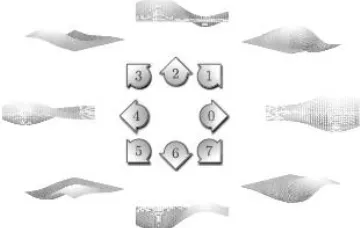
derivative-Gaussian (shown in figs. 2 and 3). Both masks operate in the gradient space, which reveals the structure of the face. Furthermore, we explore the use of Gaussian smoothing to stabilize the code in presence of noise by using the derivative-Gassian mask. apart to obtain the edge response in
eight different directions, as shown in fig. 2. We denote the use of this mask to produce the LDN code by LDNK.
C. Derivative-Gaussian Mask
The use of the derivative-Gaussian mask allows to freely varying the size of the mask. The change in the size allows the coding scheme LDNG to capture different characteristics of the face. Hence, a fine to coarse representation is achieved by computing the LDNG and by concatenating the histogram of each region and can also merge the characteristics at different resolutions.
Fig.3 Kirsch compass masks
This mixture of resolutions is called as a multi-LDN histogram (MLH).
Fig 4. Derivative of Gaussian compass masks
V. Face Description
regions {R1… RN} and extract a histogram Hi from each region Ri. The histogram Hi is created using each code as a bin and then accumulating all the codes in the region in their respective bin. The spatially combined LHplays the role of a global face feature for the given face.
5.1. Face Recognition
The LH and MLH are used during the face recognition process. The objective is to compare the encoded feature vector from one person with all other candidate’s feature
vector with the Chi-Square dissimilarity measure between two feature vectors F1 and F2, of length N. The feature vector with the lowest measured value indicates the match found.
Fig:5 Proposed System model
5.2. Expression Recognition
The facial expression recognition is performed by using a Support Vector Machine (SVM) to evaluate the performance of the proposed method. SVM is a supervised machine learning technique that implicitly maps the data into a higher dimensional feature space. Consequently, it finds a linear hyper plane with a maximal margin to separate the data in different classes in this higher dimensional feature space. Consequently, it finds a linear hyper plane, with a maximal margin, to
separate the data in different classes in this higherdimensional space.
VI. CONCLUSION
A novel encoding scheme has been introduced using Local Directional Number (LDN) that takes advantage of the structure of the face’s textures and encodes it efficiently into a compact code. LDN uses directional information that is more stable against noise than intensity to code the different patterns from the face’s textures. Additionally it analyzed the use of two different compass masks (a derivative and Kirsch) to extract this directional information and their performance on different applications. In general LDN implicitly uses the sign information of the directional numbers, which allows it to distinguish similar texture’s structures with different intensity transitions e.g., from dark to bright and vice versa. To evaluate LDN under expression lapse and illumination variations and found that it is reliable and robust throughout all these conditions unlike other methods. For example, Gradient faces had excellent results under illumination variation but failed with expression and time lapse variation. Also LBP and LDiP recognition rate deteriorates faster than LDN in presence of noise and illumination changes.
VII REFERENCES
[1] R. Chellappa, C. Wilson, and S. Sirohey, “Human and machine recognition of faces: A
survey,” Proc. IEEE, vol. 83, no. 5, pp. 705–741,
May 1995.
[2] W. Zhao, R. Chellappa, P. J. Phillips, and A. Rosenfeld, “Face recognition: A literature
survey,” ACM Comput. Surv., vol. 35, no. 4, pp.
399–458, Dec. 2003
[3] S. Z. Li, A. K. Jain, Y. L. Tian, T. Kanade, and J. F. Cohn, “Facial expression analysis,” in
[4] M. Turk and A. Pentland, “Eigenfaces for
recognition,” J. Cognit. Neurosci., vol. 3, no. 1,
pp. 71–86, 1991.
[5] P. N. Belhumeur, J. P. Hespanha, and D. J.
Kriegman, “Eigenfaces vs. Fisherfaces:
Recognition using class specific linear
projection,” IEEE Trans. Pattern Anal. Mach.
Intell., vol. 19, no. 7, pp. 711– 720, Jul. 1997.
[6] J. Yang, D. Zhang, A. F. Frangi, and J. Y. Yang, “Two-dimensional PCA: A new approach to appearance-based face representation and
recognition,” IEEE Trans. Pattern Anal. Mach.
Intell., vol. 26, no. 1, pp. 131–137, Jan. 2004.
[7] K. Etemad and R. Chellappa, “Discriminant
analysis for recognition of human face images,” J.
Opt. Soc. Amer. A, vol. 14, no. 8, pp. 1724–1733, 1997.
[8] P. Penev and J. Atick, “Local feature analysis:
A general statistical theory for object
representation,” Netw., Comput. Neural Syst., vol.
7, no. 3, pp. 477–500, 1996.
[9] D. Gabor, “Theory of communication,” J. Inst.
Electr. Eng. III, Radio Commun. Eng., vol. 93, no. 26, pp. 429–457, Nov. 1946.
[10] L. Wiskott, J.-M. Fellous, N. Kuiger, and C. von der Malsburg, “Face recognition by elastic
bunch graph matching,” IEEE Trans. Pattern
Anal. Mach. Intell., vol. 19, no. 7, pp. 775–779, Jul. 1997.
[11] C. Shan, S. Gong, and P. W. McOwan, “Facial expression recognition based on local
binary patterns: A comprehensive study,” Image
Vis. Comput., vol. 27, no. 6, pp. 803–816, 2009.
[12] T. Ahonen, A. Hadid, and M. Pietikäinen, “Face description with local binary patterns:
Application to face recognition,” IEEE Trans.
Pattern Anal. Mach. Intell., vol. 28, no. 12, pp. 2037–2041, Dec. 2006.
[13] T. Ojala, M. Pietikäinen, and D. Harwood, “A comparative study of texture measures with classification based on feature distributions,”
Pattern Recognit., vol. 29, no. 1, pp. 51–59, Jan. 1996.
[14] X. Tan and B. Triggs, “Enhanced local texture feature sets for face recognition under
difficult lighting conditions,” IEEE Trans. Image
Process., vol. 19, no. 6, pp. 1635–1650, Jun. 2010.
[15] T. Jabid, M. H. Kabir, and O. Chae, “Local directional pattern (LDP) for face recognition,” in