Address for correspondence Brig. Asher Ahmed Mashhood Classified Skin Specialist CMH, Peshawar
E mail: [email protected]
Original Article
Association of epidermal melasma with skin phenotypes
and other contributing factors
Introduction
Melasma, the most common acquired
hypermelanosis in females, is characterized by brownish and grey black, bilaterally symmetrical macules and patches on face. It predominantly affects areas above the upper lips, nose, cheeks, forehead and chin.1 There are three distinct types of melasma; epidermal, dermal and mixed type, epidermal being the most common type.2 It affects women more than men. There are many studies that have been conducted to investigate the factors that contribute to the development of
melasma and the contributing factors in this regard are; pregnancy, use of oral contraceptives, sun exposure and iron deficiency.3 Melasma is seen in women mostly in their reproductive years. It is rare in pre-pubertal and postmenopausal women4; strongly suggesting a hormonal etiology. There has not been any study regarding the prevalence of melasma in Pakistan. The disease worsens during summer season and fades relatively during winters5. It being the cosmetic concern, puts the patients under psychological stress and social disruptions.
Methods
This was a single-center, cross-sectional study, carried out in the Department of Dermatology, Numera Amin, Asher Ahmed Mashhood, Afsheen Bilal
Dermatology Department, Combined Military Hospital, Multan
Abstract Objective The objective of this study was to determine the extent to which various factors contribute in the development of epidermal types of melasma.
Methods This single-center, cross-sectional study was carried out in the Department of Dermatology, Combined Military Hospital Multan, from July 2014 to December 2014. The study population was married females of reproductive ages, who reported in skin outpatient for treatment. A proforma was designed to get information regarding various factors that are assumed to predispose to the development of epidermal melasma. Type of our data was categorical. SPSS version 19 was used to analyze the data.
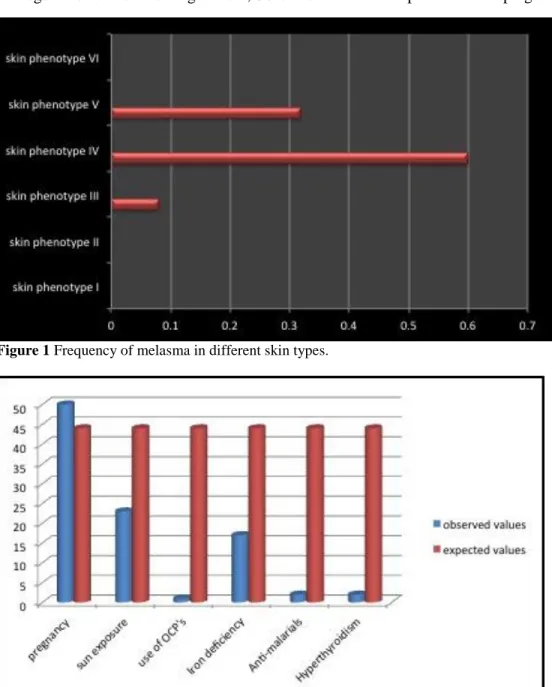
Results 88 patients were included in the study. Their ages ranged between 20-45 years (mean age 30±5.5 years). Eighty-two patients were housewives and 6 teachers. The main skin phenotype seen in our patients was type IV (60.2%). 56.8% of patients developed melasma while they were pregnant and 27.3% developed it after excessive sun exposure.
Conclusion Among various suspected causes; skin type IV, pregnancy and excessive sun exposure were the major contributory factors in causation of epidermal-type melasma.
Key words
Combined Military Hospital Multan, a tertiary care hospital from July 2014 to December 2014 over a period of six months.
The study population was married females of reproductive ages, who reported in skin OPD for treatment. The patients in the study group were not the permanent residents of Multan city, but were there due to their husband’s posting; hence presenting as a mixed ethnic group.
We selected one hundred female patients of reproductive age group. Out of 100, 88 patients were having epidermal type and 12 having dermal type melasma. As the main focus of our study was epidermal type so we selected only 88 patients with epidermal-type melasma for the study.
Inclusion criteria of the study were: voluntary consent for participation in the study, only female patients of melasma, females in the reproductive age group and patients having epidermal type melasma only. Females below 15 and above 55 years of age were excluded.
A proforma was designed to get information regarding various factors that predisposed to the development of epidermal melasma and to find out the relationship of epidermal melasma with skin phenotypes. Each patient was informed about the purpose of study in detail and informed consent was sought from the patients to fill up the proforma. The proforma included patient’s biodata i.e. name, age, occupation, social status, residence; types of skin (I to VI); and types of melasma (epidermal, dermal and mixed). It also included 14 questions relating to contributing factors (viz. pregnancy, level of sun exposure, use of oral contraceptives, endocrine and other disease associations, drug intake other than contraceptives and iron deficiency). Drugs taken into consideration for study were chlorpromazine, ACTH, and antimalarial as they
are all known to contribute to melasma. Diseases excluded in the study were Addison’s disease,
Cushing’s syndrome, hypo- and
hyperthyroidism. The contributing factors were assessed by detailed history, examination and interview of the patient. Hemoglobin status was checked through rapid method. Skin phenotype was assessed according to Fitzpatrick’s skin type scale which classifies skin into six phenotypes, I to VI. Type of melasma was assessed using Wood’s lamp.
Type of our data was categorical. SPSS version 19 was used to analyze the data and the relationship among various variables was established by using cross tabulation. Each factor was discussed in detail as an individual variable. Statistical significance was assessed by using chi-square (X2) goodness of fit test. At 95% confidence interval the level of significance (α) was 0.05.
Results
Total 88 female patients with epidermal-type melasma were selected for the study. The ages of these patients ranged between 20-45 years (mean age 30±5.5 years). Regarding occupation, 82 patients were housewives and 6 were doing some teaching jobs.
As regards other contributing factors, 50 out of 88 patients had pregnancy (56.8%), 24 had
Figure 1 Frequency of melasma in different skin types.
Figure 2 Frequency of various factors in melasma.
excessive and significant sun exposure (27.3%), 1 (1.1%) gave history of using oral contraceptive pills (OCPs), 2 (2.3%) gave history of taking antimalarial and 2 (2.3%) had positive history of hyperthyroidism. As regards iron deficiency, 63 (71.6%) patients had hemoglobin (Hb) around the standard value while 17 (19.32%) had Hb below the standard value, remaining 8 patients did not turn up for follow-up with their laboratory reports. Out of 17 patients who had
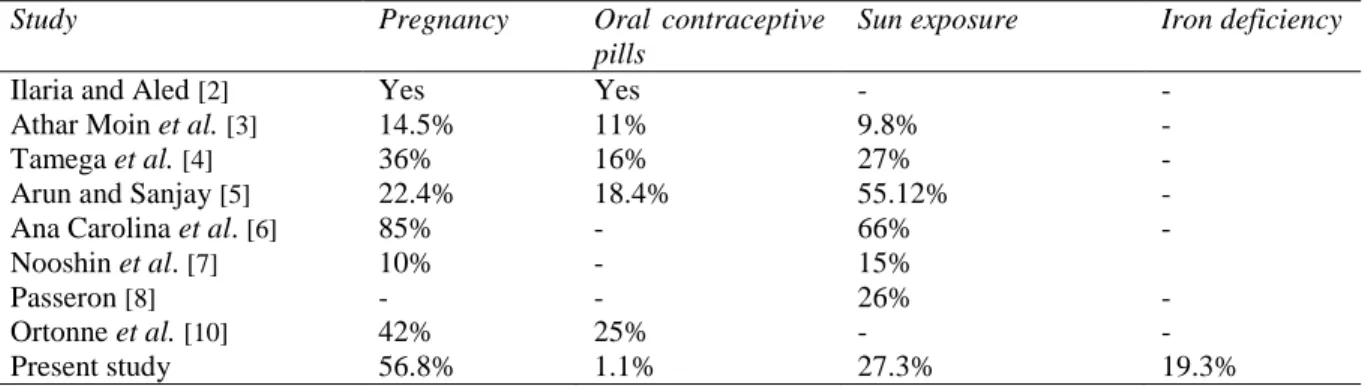
Table 1 Comparison of the results of various studies on the role of contributing factors in causation of melasma
Study Pregnancy Oral contraceptive
pills
Sun exposure Iron deficiency
Ilaria and Aled [2] Yes Yes - -
Athar Moin et al.[3] 14.5% 11% 9.8% -
Tamega et al.[4] 36% 16% 27% -
Arun and Sanjay [5] 22.4% 18.4% 55.12% -
Ana Carolina et al. [6] 85% - 66% -
Nooshin et al. [7] 10% - 15%
Passeron [8] - - 26% -
Ortonne et al. [10] 42% 25% - -
Present study 56.8% 1.1% 27.3% 19.3%
Figure 2 shows the observed and expected frequencies of various contributing factors under study.
Discussion
Various studies on melasma focused on contributing factors of melasma. In our study skin type IV (60.2%), pregnancy (56.8%) and sun exposure (27.3%) were major contributing factors for epidermal melasma.
In a study by Muller and Reeds,2 there was high prevalence of melasma in pregnancy. Other contributing factors were use of OCPs and association with thyroid disorder in one case.
In another study by Athar et al.3 11% of patients declared that they developed melasma after using OCP’s, 14.5% developed after pregnancy and 9.8% after excessive sun exposure.
In the study by Tamega et al.4the most common triggering factors were pregnancy 36%, OCPs 16% and intense sun exposure 27%.
A study by Arun and Sanjay5 showed that about 55.12% patients reported their disease to be exacerbated during sun exposure. Among 250 female patients, 56 (22.4%) reported pregnancy and 46 (18.4%) reported oral contraceptive as the precipitating factors. The same study showed
the dermal melasma being the most common type seen in 54.48% patients; epidermal and mixed types were seen in 21.47% and 24.03% of the cases respectively while in our study group epidermal melasma was the most common type.5
Another study by Ana Carolina et al.6showed that 52 out of 61 (85%) patients reported having melasma during pregnancy and 66% contributed it to sun exposure.
A study by Bagherani et al.7 revealed the familial predisposition and genetic component is the most important risk factor for the development of melasma, with 10% and 15% of
patients having pregnancy and UVR,
respectively as other important predisposing factor in the melasma development.
A study by Passeron8 revealed the following contributing factors in his study population; genetic background, exposure to ultraviolet radiation and female sex hormones.
In a study by Aluka et al.9 the frequency of epidermal melasma was highest (46.5%) like our study.
skin (90% types III-VI) compared to those without (77% types III-VI). The most common time of onset was after pregnancy (42%), 25% who had used hormonal contraception claimed that melasma appeared for the first time after its use.
A comparison of results of these studies with our study is presented in Table 1.
Conclusion
Among the various factors which were studied as the cause of epidermal-type melasma, we could only find pregnancy and sun exposure as statistically significant contributory factors. Among skin phenotypes, type IV showed more vulnerability to develop epidermal melasma followed by type V.
References
1. Anstey AV. Disorders of Skin Colour. In: Burns T, Breathnach S, Cox N, Griffiths C, eds. Rook’s Textbook of Dermatology, 8th edition, Vol.3. Oxford: Wiley-Blackwell; 2010. P. 58.1-58.60.
2. Muller I, Rees DA. Melasma and endocrine disorders. J Pigment Disord. 2014;S1:001. doi: 10.4172/JPD.S1-001
3. Athar M, Zahra J, Nader F. Prevalence and awareness of melasma during pregnancy. Int J Dermatol. 2006;45:285-8.
4. Tamega Ade A, Miot LDB, Bonfietti C, Gige TC, Marques MEA, Miot HA. Clinical patterns and epidemiological characteristics of facial melasma in Brazilian women. J Eur Acad Dermatol Venereol. 2013;27:151-6. 5. Arun A, Sanjay KR. Melasma: a
clinico-epidemiological study of 312 cases. Indian J Dermatol. 2011;56:380-2.
6. Ana CH, Luciane DBM, Hélio AM. Melasma: a clinical and epidemiological review.An Bras Dermatol. 2014;89:5. 7. Bagherani N, Gianfoldoni S, Smoller B. An
overview on melasma. J Pigment Disord. 2015;2:216. doi: 10.4172/2376-0427. 1000216
8. Passeron T. Melasma pathogenesis and influencing factors - an overview of the latest research. J Eur Acad Dermatol Venereol. 2013;27 (Suppl 1):5-6.
9. Aluka JR, Priyank K, Sanker RS, Jain SK. Endocrinological evaluation of melasma in females of western Uttar Pradesh region. Int J Sci Study. 2014;2(6):59-61.