AUSTRALIAN JOURNAL OF BASIC AND
APPLIED SCIENCES
ISSN:1991-8178 EISSN: 2309-8414 Journal home page: www.ajbasweb.com
Open Access Journal
Published BY AENSI Publication
© 2016 AENSI Publisher All rights reserved
This work is licensed under the Creative Commons Attribution International License (CC BY). http://creativecommons.org/licenses/by/4.0/
To Cite This Article: Indira R., Ramya N.D. and Tamilselvi R., Energy Efficient In-Network Estimation for Asynchronous Duty Cycled Wireless Sensor Network. Aust. J. Basic & Appl. Sci., 10(1): 255-259, 2016
Energy Efficient In-Network Estimation for Asynchronous Duty Cycled
Wireless Sensor Network
1Indira R., 2Ramya N.D. and 3Tamilselvi R.
1Asst. Professor, Department of ECE, Panimalar Institute of Technology ,Chennai 2Asst. Professor, Department of ECE, Panimalar Institute of Technology ,Chennai 3Department of ECE , Anna University, Regional Centre, Coimbatore
Address For Correspondence:
Indira R., Asst. Professor, Department of ECE, Panimalar Institute of Technology ,Chennai E-mail: [email protected]
A R T I C L E I N F O A B S T R A C T Article history:
Received 10 December 2015 Accepted 28 January 2016 Available online 10 February 2016
Keywords:
Wireless sensor network, estimation, aggregation scheduling, asynchronous duty cycle.
For some real-time control applications, the controllers need to accurately estimate the process state within the delay constraints. There has been lots of work on delay-efficient aggregation scheduling in WSNs and the objective is to minimize the total time of aggregating the whole sensor data from the network to the sink, but there is no work on estimating the aggregation scheduling for large-scale network systems. Thus for accurately estimating a process state as well as satisfying rigid delay constraints, the in-network estimation operations and an aggregation scheduling algorithm is designed. And to reduce energy consumption in multihop broadcast using asynchronous sleep scheduling approaches, the efficient multihop broadcasting for asynchronous duty cycled (EMBA) wireless sensor network is designed.
INTRODUCTION
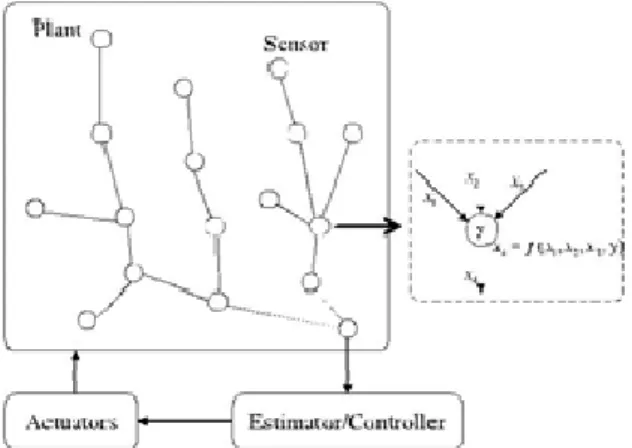
The cyber physical systems(CPS) are a new class systems which is the integration of cyber capabilities and physical process. Since the wireless sensor network(WSN) has the advantage of easy deployment and low cost, it is regarded as observing physical world for CPS. eg: disaster monitoring systems, waste water processing systems and smart building applications. The WSN based CPS architecture has a set of sensor nodes deployed in the observed area to perform the dynamical process is shown in the figure 1. By using multihop WSN, the sampling data are collected from the sensor nodes to one or more sink. Based on the information, the controllers make decisions to change the physical process. Before making the decisions, controllers need to accurately know the process state, which cannot be obtained directly due to the presence of the measurement noise and process noise. Thus the process state is estimated based on the sensor measurement and this estimates are used by the controllers as the input.
transmitted neighbor nodes are synchronized to reduce the energy consumption. Due to independent wake up time for sensor nodes, the asynchronous sleep scheduling approaches are weak for supporting multihop broadcasting. Since every nodes wake up in its own duty cycle, it is hard to reach multiple neighbor nodes for one broadcast transmission. Thus to support multihop broadcast in asynchronous sleep scheduling approaches, the node must use independent unicast transmissions to its neighbor nodes. This causes redundant transmission and collisions of the same broadcast messages. Thus energy efficient multihop broadcasting for asynchronous duty cycled(EMBA) WSN is designed. It is very challenging to jointly design the in-network estimation operation and aggregation scheduling algorithm and also to design an efficient multihop broadcast for WSNs.
Fig. 1: Architecture of WSN-based CPS.
IN-Network Estimation:
The in-network estimation is the technique in which each intermediate node calculates the information based on the data received by the child nodes in aggregation tree and from its own measurements. The overall process of in-network estimation approach in each scheduling period is described. Every nodes takes the following actions in an aggregation tree.
1. The leaf node samples the process state at a given time and performs the estimation based on its own measurement which is obtained before the time. Then the collected estimation waits for scheduling process. Finally it transmits the estimate to its parent node directly after the leaf node is scheduled.
2. The relay node also first samples the process state at a given time and performs the estimation based on its own measurements obtained before time. The relay node collects information, based on the information received from the child nodes and its own local measurement. If the information is not received from the child nodes in the scheduling period, this relay node will expect the information based on the information which is received previously from the child nodes and this information is used to calculate the process. Then finally it transmits the processed information to next hop node only when the relay node is scheduled.
3. Before every scheduling period, the sink node expect the information based on the received estimates previously from its child nodes and then best estimates is calculated by the expected information and previously received information. Thus the sink node collects all the information from its child nodes.
Aggregation Scheduling:
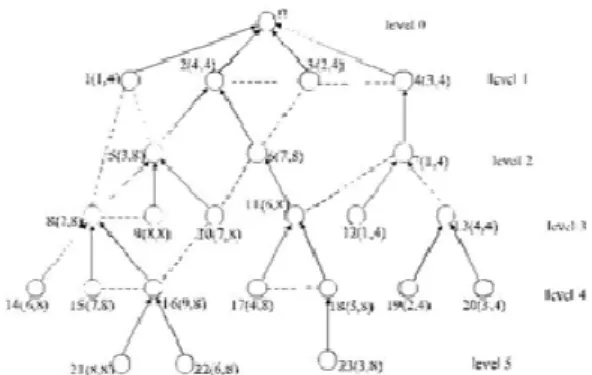
The aggregation scheduling algorithm is used to gather maximum information at the sink within the delay constraints, to reduce the error occurred through collecting information from the network. For satisfying the delay constraints and accurately estimating, an EASDC (Effective interference free Aggregation Scheduling algorithm with Delay Constraints) was designed. The aggregation scheduling algorithm is estimated based on few techniques eg. Breadth first search tree or depth first search tree. In EASDC algorithm, a top-down time slot assignment mode is adopted. The scheduling algorithm is performed in each node in the aggregation tree where each node determines its schedules based on the previously received information. An example of our scheduling algorithm is shown in figure 2. In the scheduling algorithm, every node maintains the following variables.
1. Number of Children: NoCi, number of child node in aggregation tree Q.
2. Children number of i‘s parent: CNoPi, number of child nodes of i ’s parent in the aggregation tree. 3. Time slot to first transmit: TSFT, the time slot at which node send its data to its parent for first time.
4. Node scheduling period: NSPi, the scheduling period of the node which is scheduled once every NSPi time
slot after time TSFTi.
6. Indicator array of available time slot(IAATS) is the array in which the child nodes can send the data without interferencing the time slot.
7. RANKi = (level,i), where level is the hop distance of node i to the root.
Fig. 2: An example of the result of our scheduling algorithm.
IV. EMBA:
EMBA operates on asynchronous MAC protocol and uses two techniques: Forwarder’s guidance and the overhearing of broadcast messages. EMBA allows the nodes to support multihop broadcast by avoiding redundant transmission and collisions. It achieves higher energy efficiency and small message cost in both sparse and dense network.
Forwarder’s guidance:
The source node and a node which forwards the broadcast message generated by source node, both of them were represented as forwarders. The forwarder generates the guidance list which includes three list.
(i) COVERED if nodes v and forwarder node s are the same node is already covered.
(ii) DELEGATED if node v is uncovered then node v will be covered by another node which has a better link than node r.
(iii) OBLIGATED if node r is obligated to cover node v. The node r has responsibility for forwarding broadcast message to node v, because node r has the best link quality to node v among the neighbors of node s.
Overhearing of broadcast message:
During an active state, the forwarder node projected to certain node, then the forwarder node can eliminate the ID of the node specified in the message from its obligation set. Thus, the number of transmissions required for covering of neighbor nodes will be reduced. Thus energy efficiency is increased by reducing the active time of each forwarder and the number of transmissions.
V. Performance Evaluation:
The performance is simulated by using ns2 simulator. The sensor nodes are randomly deployed in the observed region and an aggregation tree is constructed. The aggregation tree is constructed by the effective interference free aggregation scheduling algorithm with delay constraints using breadth first search tree method.
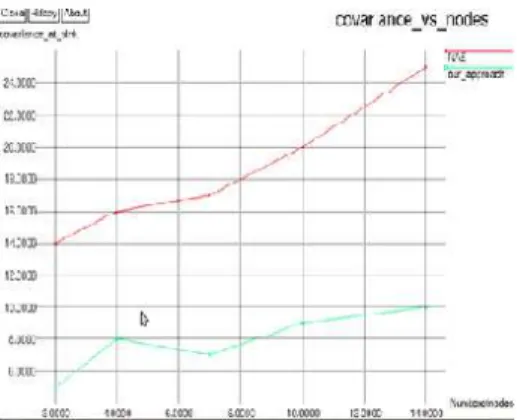
The Average trace of Covariance Matrix at the sink is shown in the figure 3. In this graph we compare the estimation accuracy of our in-network estimation approach with that of NAE under the different network parameters. When the number of nodes increases, the covariance value at the sink is decreased than the non-aggregation method. The performance estimation is larger with the increase of number of nodes and the transmission radius. The Covariance Matrix Trace at the sink for the three methods is shown in the figure 4.
This graph compares the traces of the estimate error covariance matrix of the sink with every estimation time step using the three methods. The in-network estimation approach has the ability to compensate for the estimate loss of the remote sensors by exploiting the temporal correlation of the state. On the other hand, the in-network estimation approach can gather more estimate information than NAE within the delay constraint so that the estimation performance of our method is better than that of NAE in the most of the time.
Fig. 3: Average trace of Covariance matrix trace at the sink.
Fig. 4: Covariance matrix trace at the sink for three methods.
Fig. 5: Average energy consumption.
Conclusion:
Thus, to accurately estimate the process in-network estimation and aggregation scheduling is jointly designed within the delay constraints. The aggregation scheduling is constructed using the EASDC algorithm. EMBA can support multihop broadcast efficiently by using two techniques of the forwarder’s guidance and the overhearing of broadcast messages. The forwarder’s guidance significantly reduces redundant transmissions and collisions. This technique greatly improves the energy efficiency in sparse networks by reducing duty cycle. The overhearing of broadcast messages help to reduce the number of transmissions. This simple technique minimizes the active time of forwarders, which is more efficient in dense networks. EMBA shows much higher energy efficiency in both sparse and dense networks compared to the conventional protocols.
REFERENCES
Haitao Zhang, Huadong Ma, IEEE, Xiang-Yang Li, Senior member, IEEE, and Shaojie Tang, 2013. Student member, IEEE “In-network Estimation with Delay Constraints in Wireless Sensor Networks,” IEEE transaction on parallel and distributedsystem, 24-2.
Ingook Jang, Suho Yang, Hyunsoo Yoon and Dongwook Kim, 2013. “EMBA: an Efficient Multihop Broadcast Protocol for Asynchronous Duty-Cycled Wireless Sensor Network,” IEEE transaction on wireless communication, 12-4.
Gupta, V., A. Dana, J. Hespanha, R. Murray, B. Hassibi, 2009. “Data Transmission over Networks for Estimation and Control,” IEEE Trans. Automatic Control, 54(8): 1807-1819.
Ahmadi, H. and T. Abdelzaher, 2009. “An Adaptive-Reliability Cyber-Physical Transport Protocol for Spatio-temporal Data,” Proc.30th IEEE Real-Time Systems Symp. (RTSS ’09), 238-247.
Chen, X., X. Hu, J. Zhu, 2005. “Minimum Data Aggregation Time Problem in Wireless Sensor Networks,” Proc. First Int’l Conf. Mobile Ad-Hoc and Sensor Network, 133-142.
Xu, X., X.Y. Li, X. Mao, S. Tang, S. Wang, 2011. “A Delay-Efficient Algorithm for Data Aggregation in Multihop Wireless Sensor Networks,” IEEE Trans. Parallel and Distributed Systems, 22(1): 163-175.
Sun, Y., O. Gurewitz, S. Du, L. Tang, D. Johnson, 2009. “ADB: an efficient multihop broadcast protocol based on asynchronous duty-cycling in wireless sensor networks,” in Proc. ACM SenSys, 43–56.
Du, S., A.K. Saha, D.B. Johnson, 2007. “RMAC: a routing-enhanced duty-cycle MAC protocol for wireless sensor networks,” in Proc. IEEE INFOCOM, 1478–1486.