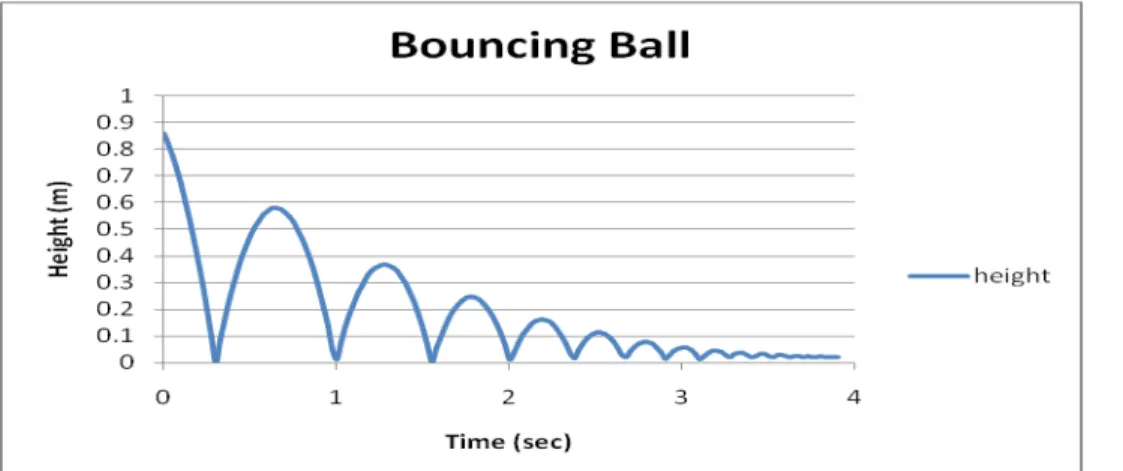
In this demonstration we are going to look at the motion of a bouncing ball. What we want to determine is the total distance (both up and down) a ball travels before it stops bouncing. If a ball is dropped, and its height above a table (or floor) is measured as a function of time, we get a graph similar to the one in Figure 1.
Figure 1 Bouncing Ball Height versus Time
When a ball is dropped from any height, the ratio of the maximum height the ball reaches between any two successive bounces is a constant,
Let h0= the initial ball height,
h1= the maximum ball height after the first bounce,
h2 = the maximum ball height after the second bounce, etc.
1. Write an equation using the hi’s for the total distance travelled by the ball, D.
2. If we want to write h1 as a function of h0 [i.e., h1 = f(h0)], we can write h1 = h0r.
Similarly find h2, h3, and h4 in terms of h0 and r.
3. Rewrite the equation for the distance travelled using just the variables h0 and r.
If we add and subtract h0 from the right side of the equation, we can rewrite the distance
travelled as
If we factor out the common factor 2h0, we can rewrite this as:
The ratio between successive terms in this series is r, so this is a geometric series. Let’s just look at to determine the sum of this series. Let
(1)
4. Multiply both sides of equation (1) by r and call the new equation (2).
What you should have found is
6. Now that you know what the infinite sum is equal to, rewrite your equation for the total distance travelled.
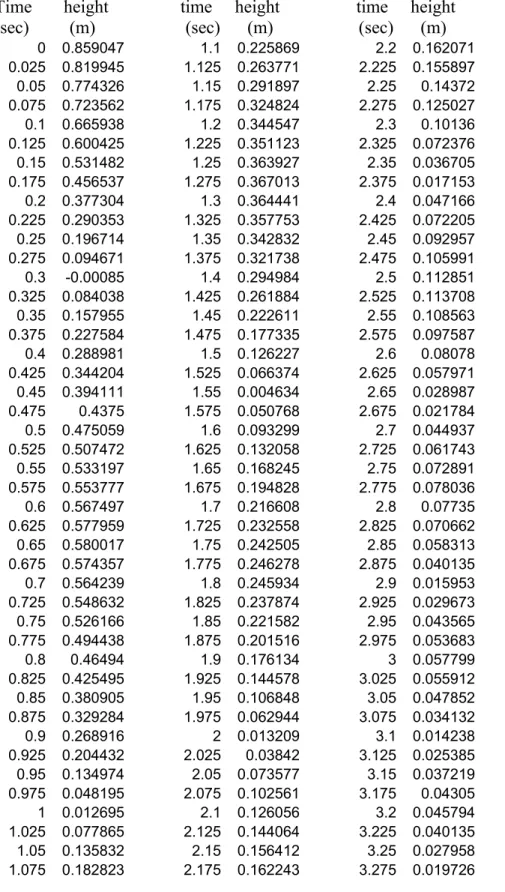
7. Either use the data in Table I, or conduct an experiment to find an average value for the ratio between successive peak heights.
Bounce number, n h
h0 =
1 h1 =
2 h2 =
3 h3 =
4 h4 =
5 h5 =
6 h6 =
7 h7=
Average value of r =
8. Now use the equation you just derived along with, to find the total distance travelled by the bouncing ball
.
Table I. Bouncing Ball Data
Time height time height time height time height (sec) (m) (sec) (m) (sec) (m) (sec) (m)
Instructor Notes:
Learning Outcomes:
Upon completion of this module the students should be able to:
Determine if a sequence is geometric, and
Find the sum of a geometric sequence.
Equipment: ball and tape measure
An alternative to using the provided bounce data, is to have students drop a ball and measure the rebound height, and use this as the bounce ratio.
1.
2.
3.
4. 5.
6.
7. Using data from the table for a soccer ball,
Bounce number, n h
h0 = 0.859
1 h1 = 0.580 0.675
2 h2 = 0.367 0.632
3 h3 = 0.246 0.670
4 h4 = 0.162 0.659
5 h5 = 0.114 0.704
6 h6 = 0.078 0.684
7 h7= 0.058 0.744
Average value, ravg= 0.681