English constructions from a Dutch perspective
Where are the differences?
Arie Verhagen
Leiden University
In construction grammar, specific constructions are daughters of more gen-eral patterns, the former inheriting properties of the latter, besides providing specifications of their own. Therefore, differences and similarities between lan-guages may differentially involve lower and higher levels of generality. This paper demonstrates this by comparing three construction types in Dutch and English: thewayconstruction, thetime-awayconstruction, and causative constructions. The first instantiates a productive pattern in English, but not in Dutch. The sec-ond is syntactic in English, and morphological in Dutch. The third inherits more properties from general clause syntax in Dutch than in English. The grammatical properties of each case nevertheless show important similarities. Low-level con-structions may strongly determine cross-linguistic similarity, due to similarity of form-meaning pairing.
. Introduction
In typology, terms like ‘analytic’ and ‘synthetic’ are quite commonly used to charac-terize a whole language, i.e. they are applied at the level of a complete grammar. One language may be said to ‘use syntax’ for the selfsame purposes that another ‘uses mor-phology’ for. In such statements, differences between languages are located at highly general dimensions of linguistic organization. Similarly, with respect to word order, a question like “SVO or SOV?” is often also asked at the level of the language as a whole, rather than at the level of a particular subset of expressions in the language. These tendencies reflect a view of languages as complete and coherent systems in which eve-rything is connected to eveeve-rything else; as is well known, this view goes back to (at least) Saussure’s view of a system of values that mutually determine each other, and thereby define the system as a whole.
Arie Verhagen
the conclusion that all kinds of ‘in-between’ patterns of regularities exist; they have to be assumed in order to account for all of language structure and processes of use and change. A number of approaches have developed which incorporate this insight; they differ in detail and sometimes also on more general points (cf. Croft & Cruse 2004: Ch. 10 and the references cited there; Langacker 2005), but they share the in-sight that a substantial part of linguistic knowledge consists in knowing grammatical pairings of form and meaning – not only words and idioms, but also prototypical ‘constructions’: partly specified templates that have a conventional meaning, and one or more open slots for variable constituents (The X-er,the Y-er;X[negative clause], let alone Y[phrase];What’s X doing Y?;let X Y[verb];be Y[verb]-ing; etc.). The cover term for these approaches is ‘construction grammar’.
In such a view, general grammatical rules (of the type [NP VP]) on the one hand and specific lexical items on the other are considered to be limiting cases of ‘construc-tions’ in an extended sense, with the prototypical constructions in the middle part of a single lexicon-syntax continuum, the ‘constructicon’ (cf. Croft & Cruse 2004: 255). These constructions are related to each other in taxonomic networks, in the same way as the mental lexicon is regarded as being organized in terms of conceptual taxonomic relationships (hyponymy, besides possibly other kinds of connections), with the more specific templates inheriting characteristics from the more general ones, without be-ing completely reducible to such general patterns. In this way, we are witnessbe-ing the emergence of a view of grammar as a much more loosely organized network of words and constructions, at all kinds of different levels of abstractness, or schematicity. The scientific virtue of generalization is no longer sought in general properties of the struc-tural components of the systems as such, but in principles of organization (such as the analogical and metonymic extension of prototypes), and especially in the way such networks emerge from language use over time – both developmental time in indi-viduals, and historical time in communities (Barlow & Kemmer 2000; Bybee 1985, 1995, 2001; Bybee & Hopper 2001; Croft & Cruse 2004: Ch. 11; Goldberg 2003, 2006; Langacker 1987: Ch. 10; Tomasello 2003).
This view of grammar makes the kind of general statement that I mentioned at the beginning rather suspect. Only if pieces of linguistic knowledge belong to neatly distinguishable components of a grammar such as syntax òr morphology is there any reason to expect differences between grammars to observe boundaries between such alleged components. In a constructional view, differences may be expected to occur at any level of specificity, but not completely randomly: the hypothesis that the most general rules of grammar are limiting cases of constructional templates predicts acline of differences at different levels of generality, with a larger number of differences at lower levels yielding greater differences in general rules. Moreover, differences may also occur in theorganizationof the networks of constructions, and do not have to be manifested (only) in the constructions themselves.
English constructions from a Dutch perspective
not straightforwardly predictable from more general properties of the language. In this respect, this approach differs fundamentally from structuralist (including genera-tive) approaches, which seek to ‘explain’ as many specific phenomena in a language as possible in terms of properties of the system itself.
Comparative research is especially useful here. Often, some sort of correlation be-tween a more specific and a more general phenomenon can be established, and then there is a scientifically understandable temptation to explain one in terms of the other. But such a correlation within a single language is in itself only a very weak indication of its proper explanation. If one other language exhibits the same general property but lacks the more specific phenomenon, or the other way around, this suffices to show that a strict system-based explanation cannot be the whole story, and that at least some element of convention is also involved. What I will do in this paper is com-pare some aspects of English and Dutch that illustrate precisely this point. The fact that this can already be done relatively easily with such closely related languages pro-vides additional support for the general idea that grammatical systems are not very tightly integrated, but organized rather loosely, with considerable space for variation in conventional solutions to similar communicative and conceptual problems.
First, I will discuss the similarities and differences between thewayconstructions in Dutch and in English. At a relatively low level of analysis, they appear rather sim-ilar, but the English case seems much more integrated into the rest of the grammar of English – in the sense of sharing properties with other words and constructions, especially general and productive ones – than the Dutch one. Nevertheless, it is not at all clear that this seemingly better integration makes any difference for the status of the English construction in speakers’ knowledge of their language. Next, I compare the syntactictime-awayconstruction of English with a particular morphological con-struction of Dutch, involving the prefixver-, that has the same function as the syntactic construction has in English. The general difference between morphology and syntax turns out not to be very illuminating for understanding specific grammatical prop-erties of the two constructions in the two languages. The English case even turns out to be more like the Dutch one than existing analyses of the English construction have suggested. Finally, I compare the possibilities for marking participant roles in causative constructions across the two languages. Here, it is Dutch that appears to exhibit a more tightly integrated system (in the sense indicated above), but here too, not much seems to follow from this difference for understanding properties of the specific patterns.
All data discussed stem from the studies cited. The empirical basis of this research involves corpora and informants, and in some cases grammars; for details, both of facts and of analysis, the reader is referred to the original publications.
. Thewayconstruction
Arie Verhagen
a (relatively detailed) analysis of its parallel in Dutch. English examples are given in (1)–(2) and Dutch ones in (3)–(4).
(1) Pat pushed her way out of the room.
(2) Volcanic material blasted its way to the surface.
(3) Zo Thus blufte bluffed zij she zich refl een a weg way uit out Auschwitz. Auschwitz ‘That’s how she bluffed her way out of Auschwitz.’
(4) Twee Two bussen buses boren bore zich refl een a weg way naar to het the hart heart van of Istanbul Istanbul ‘Two buses are boring their way to the heart of Istanbul.’
Such sentences exemplify a particular construction because they exhibit a number of systematic, correlated properties – both in form and in interpretation – which cannot be explained on the basis of their general grammatical structure (in combination with the ordinary meanings of the words): the subject referent creates a (possibly metaphor-ical) path and/or removes obstacles on it, and the subject referent moves along this path, also when the verb, e.g.push in (1), does not normally indicate either move-ment of the subject or the creation of something. Moreover, the nouns (way,weg) are necessary elements of the respective constructions. Thus, English has a template (informally) “toverbone’s way + oblique (locational) phrase”, and Dutch a template “zich een wegverb+ oblique (locational) phrase”, each conventionally associated with a specific meaning.
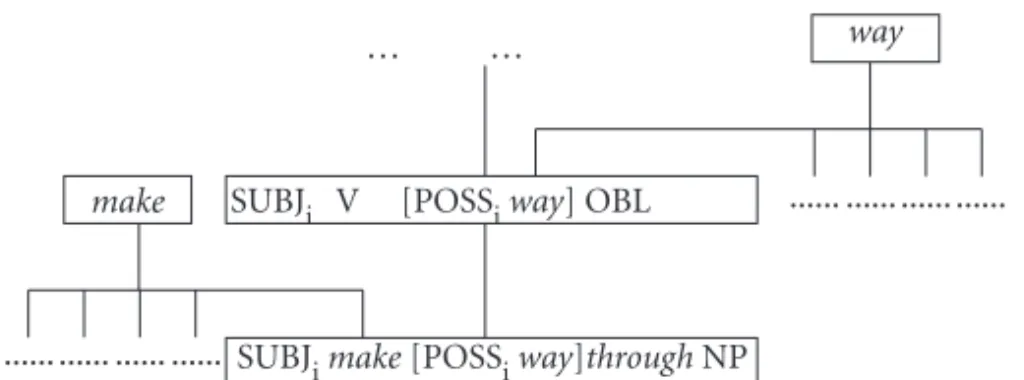
The Dutch and English constructions explicitly differ in a number of respects (in particular, the use of a possessive vs. a reflexive pronoun), but two important differ-ences are not visible in the templates themselves. The first concerns the fact that both English and Dutch have a default verb for this construction, but that this is not the same verb: English usesto make, Dutchbanen. Thus, English has the specific pattern “to make one’s way through X” and Dutch “zich een weg banen door X” as specific templates, separately stored in speakers’ long term memories, but inheriting the prop-erties of the more general ones. The functional similarity is that these verbs do not add meaning beyond the meaning of the construction. The difference is thatmakeis a quite general verb, whilebanenis highly specific: in fact, the latter only occurs in this construction.1Thus, while the specific pattern in English also inherits the properties of
the well entrenched and productive verbmake, its parallel in Dutch only inherits char-acteristics from the more general template; the difference is represented in the partial networks in Figures 1 and 2, respectively.
English constructions from a Dutch perspective
SUBJ V [POSSi iway] OBL
SUBJimake[POSSiway through] NP
make
way
...
... ... ... ...
... ... ...
… …
Figure 1. Englishwayconstruction network
SUBJ V REFL [i i een weg]OBL
SUBJibanenREFL [ieen weg door] NP
weg
... ... ... ...
… …
Figure 2. Dutchwegconstruction network
Thus, although the English and the Dutchwayconstructions appear to have much in common in terms of structure and function, the way they are integrated into the overall networks of linguistic units is not the same in the two languages. The same in fact holds for their connections to more general constructional patterns (the parts indicated by “. . . ”.. at the top of Figures 1 and 2). The specific pattern “zich een weg banen door X” (with both the verb and the path-marker lexically specified) as well as the somewhat more general superordinate schema “zich een weg +V + OBL” have to be conceived of as stored in the long-term memory of speakers of Dutch, with the specific schema as the prototype of the general one. Analogously, the prototypical pattern “to make one’s way through X” and its superordinate “to +V one’s way + OBL” are stored in long-term memory of speakers of English.
Arie Verhagen
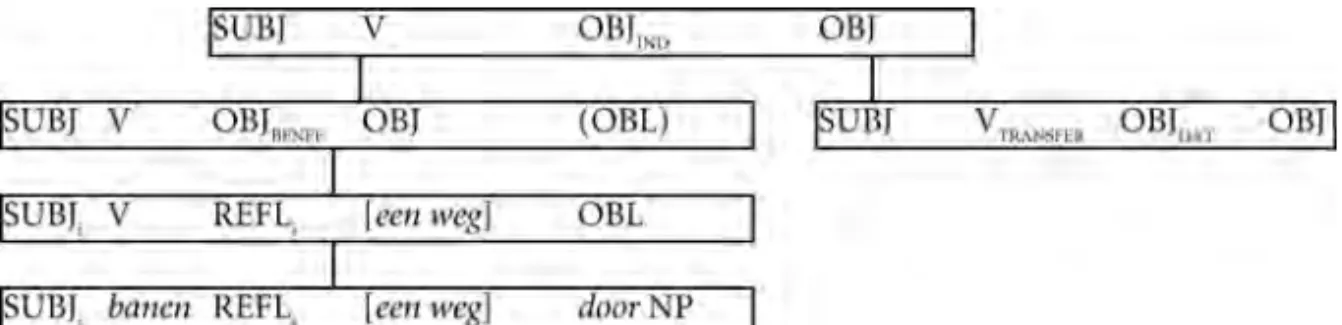
Figure 3. Extended Dutchwegconstruction network
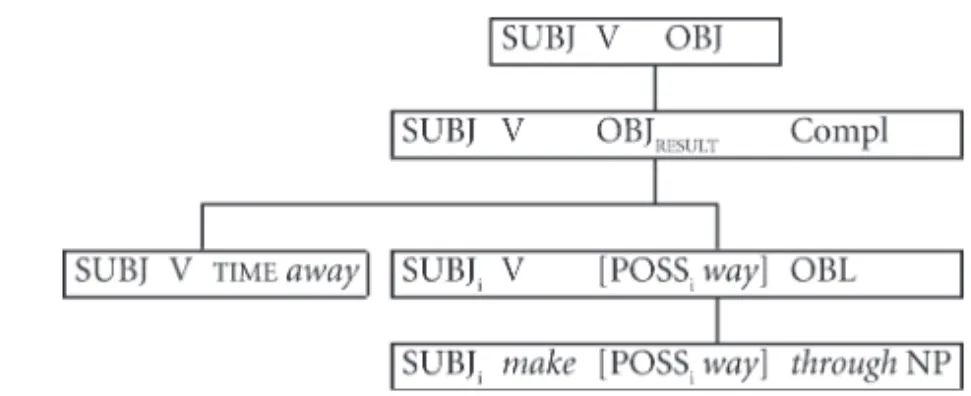
Figure 4. Extended Englishwayconstruction network
In English, however, the more general pattern to which the minor network ofway constructions should be subordinated is the transitive one, as it is a kind of resultative; i.e. it should look as in Figure 4.
What this suggests is that the position of these constructions in the ‘grammatical space’ of Dutch and English is quite different for each language. However, it should be noticed that the benefactive pattern near the top in Figure 3 is not at all a produc-tive pattern in Dutch.2There is a conventional, productive pattern “zich een weg +V”,
which can be glossed as “to V oneself a way” and which (roughly) means “create a path/opportunity for oneself (and use it), by means of V-ing”, but it isnotan instan-tiation of a more general pattern “iemand +Y +V” (“to V someone Y”), meaning “to make Y for someone by V-ing”. Curiously enough, English does have a productive pat-tern of the latter sort; while (5) is unacceptable in Dutch (this can only be expressed as in (7)), the English parallel (6) is perfectly acceptable.
(5) ??Jan maakte haar een boterham.
(6) John made her a sandwich.
(7) Jan John
maakte made
een a
boterham sandwich
voor for
haar. her ‘John made her a sandwich.’
There is something of a paradox here. English has a fairly productive general benefac-tive construction, but thewayconstruction is not an instance of it – Dutch doesnot
English constructions from a Dutch perspective
Figure 5. The Dutchwegconstruction as an island
have a productive benefactive construction, although itswayconstruction does seem to instantiate it. In any case, the consequence is that we have to exclude theway con-struction from the network of Dutch ditransitive concon-structions, and replace Figure 3 by Figure 5: in Dutch, the network of more and less specificwayconstructions actually constitutes a kind of island in the whole of the grammar.
In English, on the other hand, thewayconstruction does not constitute such an island. Although it has a number of properties that are not derivable from more gen-eral patterns, it can still be considered as a particular instantiation of the resultative construction, because the latter does in fact constitute a rule of the language, and the wayconstruction inherits its general characteristics.
It is true that there are other grammatical patterns in Dutch with which theweg -construction shares properties, so that it may be said to be not completely isolated. For example, there are reflexive expressions similar to thewayconstruction but lacking the way-constituent itself:
(8) Zij She worstelde struggled zich refl een a weg way door through de the menigte. crowd ‘She struggled her way through the crowd.’
(9) Zij She worstelde struggled zich refl door through de the menigte. crowd ‘She struggled through the crowd.’
Still, thewayconstruction present in (8) is notjusta special case of the ‘reflexive move-ment’ construction exemplified in (9), since the former implies exertion of energy and removal of obstacles, while the latter does not:
(10) Zij She bewoog moved zich refl rustig quietly naar to de the uitgang. exit ‘She quietly moved to the exit.’
Another related set of expressions are those in which a so-called ‘possessive dative’ oc-curs, and which may therefore suggest that the difference between Dutch and English is one of a more general pattern:
Arie Verhagen
(12) Ze They
hebben have
me me
op on
de the
vingers fingers
getikt. tapped ‘They rapped my knuckles.’
After all, the role of the reflexive in the Dutchwayconstruction may just as well be called possessive (indicating the one whose way is made; the fact that English uses a possessive construction proves the possibility of such a construal). However, while this is a productive construction in German, it is not so in Dutch, just as it is not produc-tive in English; there are only fixed, idiomatic expressions, and no template (Hüning 2003: 151–153). So although the Dutch construction certainly belongs to a number of larger families, it is still not a straightforward instantiation of a more general rule of the language.3
Thewayconstructions in Dutch and English thus provide a nice illustration of the fact that the grammars of two languages may differ even though they share the rules as such (in a particular domain): the way the constructions are connected to the rest of the network differs. Clearly, a difference at a relatively general level, such as “English has a dative benefactive construction, Dutch has not” doesnotpredict the existence or non-existence of productive patterns at a more specific level, as the comparison with Dutch shows. The theoretical consequence of this is that the distinction between being or not being an instantiation of general rules in a language – the place of a construc-tion in ‘the system’ – is only a minor factor determining the status of a grammatical construction.
. Thetime-away-construction
According to Jackendoff (1997), thewayconstruction belongs to a set of constructions sharing several features of form and meaning. Another member of this set, he claims, is what he calls thetime-awayconstruction; examples are in (13) and (14).
(13) Bill slept the afternoon away.
(14) We’re twistin’ the night away.
English constructions from a Dutch perspective
Figure 6. Thetime-awayconstruction in the English constructional network
On the one hand Jackendoff claims a separate status for this construction, while on the other he maintains the position that it shares important properties with other patterns in the language:
This construction shares many general properties with the resultative construc-tion [. . .] and theway-construction, [. . .] however, [. . .] it is a distinct member of a family of constructions to which all three belong. (Jackendoff 1997: 53)
We may depict the network suggested by Jackendoff as in Figure 6.
An independent status for thetime-awayconstruction is justified, us usual, by the fact that a specific set of characteristics of form is conventionally associated with a specific function. In this case, the template contributes the meaning that the object in question is restricted to indications of time periods, and that the subject referent wastes this period by engaging in the activity indicated by the verb. Thus, English has a syntactic template that (using the notation from Goldberg 1995) can be represented as in (15):
(15)
Apparently, Dutch does not have an analogue to thetime-awayconstruction – at least not a syntactic one. But there does seem to be amorphologicalprocess playing the same role as the English syntactic template. One of the morphological categories analysed in De Vries’ (1975) book on Dutch verbal morphology, is exemplified in (16)–(17);4as is
clear from these examples, this could at least count as the translation equivalent of the
time-awayconstruction.
(16) Hij He
had had
de the
hele whole
middag afternoon
verslapen. ver-slept ‘He had slept the entire afternoon away.’
Arie Verhagen
(17) Ze They
hebben have
hun their
tijd time
verpraat. ver-chattered ‘They chattered their time away.’
By prefixing a verb withver-, the idea is evoked that what the object refers to is spent completely (in fact wasted) through the process the subject referent chose to engage in (denoted by the verb-stem). This raises the following question: How much does the fact that the English construction seems to belong to a family of syntactic patterns and the Dutch one to morphology, actually contribute to their identity? Does it help to explain anything about the differences between the two, beyond what is implied by what makes one a case of syntax and the other one of morphology? In discussing the syntactic difference between the Dutch and Englishwayconstructions, I noticed that they seemed to occupy rather different positions in the grammatical space of each lan-guage (one instantiating a ditransitive, the other a transitive pattern), but concluded that this actually only shows the limited relevance of abstract patterns in determining the properties of a grammatical construction. In the same vein, we may also doubt the importance of the general distinction between ‘syntax’ and ‘morphology’ for the na-ture of the Dutch and English constructions considered here. We could simply analyse the constructions in the two languages as in (15) and (18), and claim that this basically captures what the difference amounts to.
(18)
The Dutch constructional template mentions parts of words, and specifies thatver -and the verb stem combine into a single word. This implies, among other things, that no other material may intervene between these two elements; more generally, in the absence of specifications to the contrary,5the combination behaves in the way single words normally do in the language. But beyond that, no further consequences need to follow; the way this construction interacts and combines with other elements (words or templates) is not particularly different from the way the ‘syntactic’ English construc-tion does. Construcconstruc-tions do not divide into two classes with different combinatorial or functional properties corresponding to the distinction between morphology and syn-tax. In a constructionist view, similar grammatical behaviour results from similarity of the symbolic relations involved rather than from the position of the construction in the grammar as a whole, so we should expect that the ways in which the English con-struction (15) and the Dutch one in (18) are used and combine with other elements are similar. In fact, they are. First, consider the verbs listed in (19).
English constructions from a Dutch perspective
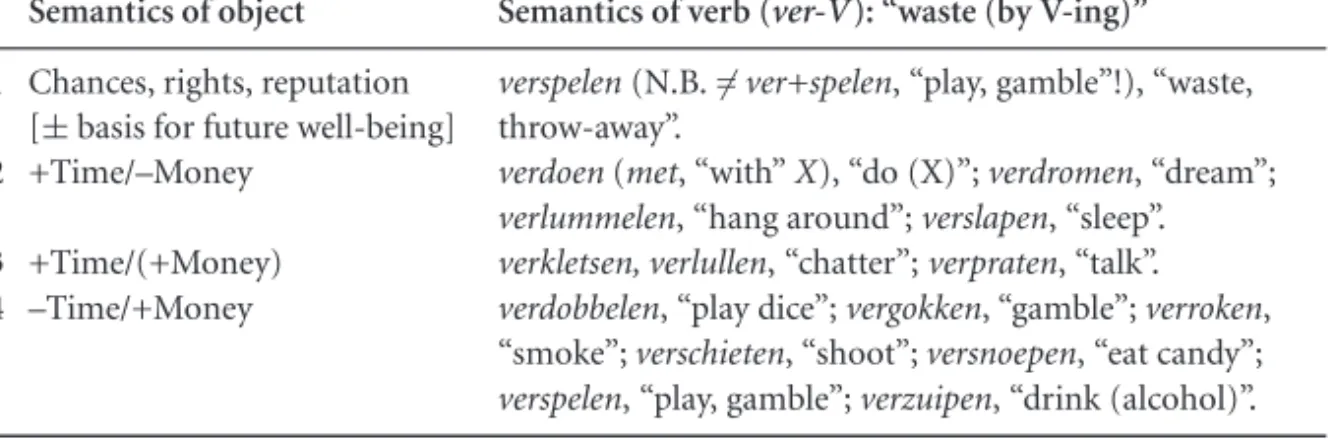
Table 1. Verbs with prefixver-in Dutch and their objects
Semantics of object Semantics of verb (ver-V): “waste (by V-ing)”
1 Chances, rights, reputation [±basis for future well-being]
verspelen(N.B.=ver+spelen, “play, gamble”!), “waste, throw-away”.
2 +Time/–Money verdoen(met, “with”X), “do (X)”;verdromen, “dream”;
verlummelen, “hang around”;verslapen, “sleep”. 3 +Time/(+Money) verkletsen, verlullen, “chatter”;verpraten, “talk”. 4 –Time/+Money verdobbelen, “play dice”;vergokken, “gamble”;verroken,
“smoke”;verschieten, “shoot”;versnoepen, “eat candy”;
verspelen, “play, gamble”;verzuipen, “drink (alcohol)”.
(19) verkwanselen, “bargain/fritter away, waste”; verkwisten, “waste, squander”; verspillen, “waste, fritter away”
These are members of the relevant category, but they cannot be considered as blends of the construction and other elements, simply because the latter do not exist. The verbs share an aspect of form corresponding to an aspect of meaning – the prefixver-and the concept of wasting – but there are no verbskwanselen, kwistenenspillen. Thus, the role of the prefix here is one of formal similarity indicating semantic similarity, not one of a compositional element of the verbs. As Jackendoff points out, there are verbs in English, such aswhileandfritter, that occur only in thetime-awayconstruction, and this is of course precisely the same kind of situation. People have specific instances of the constructions, including their structure, stored in memory, as well as (slightly) more general patterns, some of which may be used productively.
Next, consider the data in Table 1, which lists the kinds of objects that some typ-ical instances of the Dutch construction (taken from a large dictionary, Van Dale) apply to.6
There are some specific instances of conventionalization here, such as the specific association of the verbverspelenwith objects that, apparently, evoke some notion of ‘opportunities’ being wasted, without a specification of the nature of the activity that produces this result. However, the same form verspelenmay also be combined with an object that does not refer to time, but rather represents some monetary value (e.g. “a week’s pay”), in which case the activityspelen, “play”, is understood in its specific sense of “gamble”. There are several verbs taking this type of object (category 4 in Table 1). Also, verbs indicating some form of talking (category 3) normally take objects indicating a period of time, but they may also mention monetary values in the ‘right’ contexts, especially when time literally costs money: one can “chatter away” a fortune making long distance telephone calls.
Arie Verhagen
Beyond these specifics, however, there is clearly also a general pattern: the objects in instances of this construction indicate things that are consideredvaluable; (18) can be generalized to (20).
(20)
The fact that these often, and especially with certain kinds of activities, involve time, does not have to come as a surprise, given the metaphorical mapping between time and money. Now according to Jackendoff, the English construction, as indicated by the name he gives it, requires objects indicatingtime. Although it cannot be excluded that such a specific kind of meaning is conventionally tied to an expression while a conceptually related one is not, it is not the kind of thing to be expected, in the view presented here. Productive patterns express repeated conceptually salient aspects of situations, so it would be surprising if this shared cultural model – the time-as-money metaphor – would completely fail to show up in this pattern in English. And in fact, such examples do occur. A typical instance of the Dutch construction with its English translation is (21), and example (22) stems from the Brown corpus.
(21) Hij He
vergokte ver-gambled
zijn his
erfenis. inheritance ‘He gambled his inheritance away’
(22) But it is our health – more precious than all the money in the world – that these modern witch doctors with their fake therapeutic gadgets are gambling away.
Example (22) is especially interesting in that it not only shows that the ‘Xaway con-struction’ is available for expressing the idea that something valuable has been wasted because of someone’s activity, but explicitly invokes money, the prototypical instanti-ation of valuable commodities, as the standard of comparison. It seems clear that in both languages, other valuable things than time occur in instances of this pattern, so that the semantic specification of the construction represented in (15) must be revised as in (23):
(23)
English constructions from a Dutch perspective
of the Dutch and English constructions,7but such differences would then concern the
levelin the taxonomy of constructions at which ‘time’ is a conventionalized aspect of meaning or its degree of entrenchment, not its presence as such.
At a relatively specific level of the constructional patterns themselves, we have once again seen a remarkable parallel between Dutch and English. In this case, the Dutch perspective even offered a possibility to improve the analysis of English. So let us re-turn to the question about the role of higher level generalizations as possible factors determining the properties of the constructions. As we have seen at the beginning of this section, Jackendoff claims that there are many such generalizations, suggesting that this captures an important insight. But it is quite unclear what kind of conse-quences, i.e. predictions about differences in grammatical, combinatorial behaviour, follow from such a statement. In fact, Jackendoff is much more successful in point-ing out the peculiarities of the construction than its similarity to others; claims of the type “Important properties such as X are explained by the fact that this construction is related to that one” are conspicuously absent from his treatment. Assigning an impor-tant role to the general patterns would seem to entail the prediction that when such general patterns are different in another language, the constructions should also differ in other forms of grammatical behaviour, and that simply seems hard to substantiate.
. Causative constructions
In the case of English, the two sets of specific constructions discussed in the previ-ous sections appear to be well integrated into the system of the language. Even though the general rules may not determine the grammatical properties of the specific pat-terns to a large extent, the latter do instantiate the former: thewayand thetime-away constructions are both cases of the transitive (resultative) pattern. Their Dutch coun-terparts appear to be less well integrated. Although it cannot be excluded in principle, it is unlikely that this asymmetry is a consequence of general properties of the lan-guages (English allegedly being ‘more systematic’ than Dutch). Let me briefly mention one example in which the situation seems to be reversed, viz. the case of causative con-structions: clauses in which a basic verb form – stem or infinitive – is combined with a marker (a special kind of verb, or a specific affix) to yield an expression indicating the causation, in one way or another, of the process or state indicated by the verb stem or infinitive (which thus functions as a ‘result predicate’). Some examples in English are He made me do it,She let me sleep for an hour,He had Da Vinci paint his portrait.
Arie Verhagen
Kemmer and Verhagen (1994) explore the way in which the roles of participants in causative constructions are marked. In this respect, causative expressions quite gener-ally turn out to share many properties with simplex clauses, not with complex clauses, contrary to what is predicted by many analyses assuming an underlying dual clause structure for causatives. Causees are frequently marked by means of case endings or prepositions that are available in a language for other purposes, in ways that are moti-vated by the meanings such markings have in simplex clauses. In particular, markings for participants with a somewhat ‘intermediary’ role in the causal structure of events – roughly, ‘datives’ and ‘instrumentals’ – are often also employed to mark causees; (24) and (25) give examples of ‘dative-like’ marking in French and Hindi respectively:
(24) J’ai I-have fait made manger eat-inf les the pommes apples à to Jean. John ‘I made John eat the apples.’
(25) Mai-nee I-ag raam-koo Ram-dat masaalaa spice cakh-vaa-yaa. taste-caus-past
‘I had Ram taste the seasoning.’
Examples (26)–(28) illustrate the use of ‘instrument-like’ markings in German, French, and Hindi, respectively:
(26) Er He liess let den the-acc Brief letter von from seinem his-dat Sohn son abtippen. type-inf
‘He had the letter typed by his son.’
(27) J’ai I-have fait made manger eat-inf les the pommes apples par by Jean. John (28) Mai-nee I-ag raam-see Ram-inst masaalaa spice cakh-vaa-yaa. taste-caus-past
‘I had the seasoning tasted by Ram.’
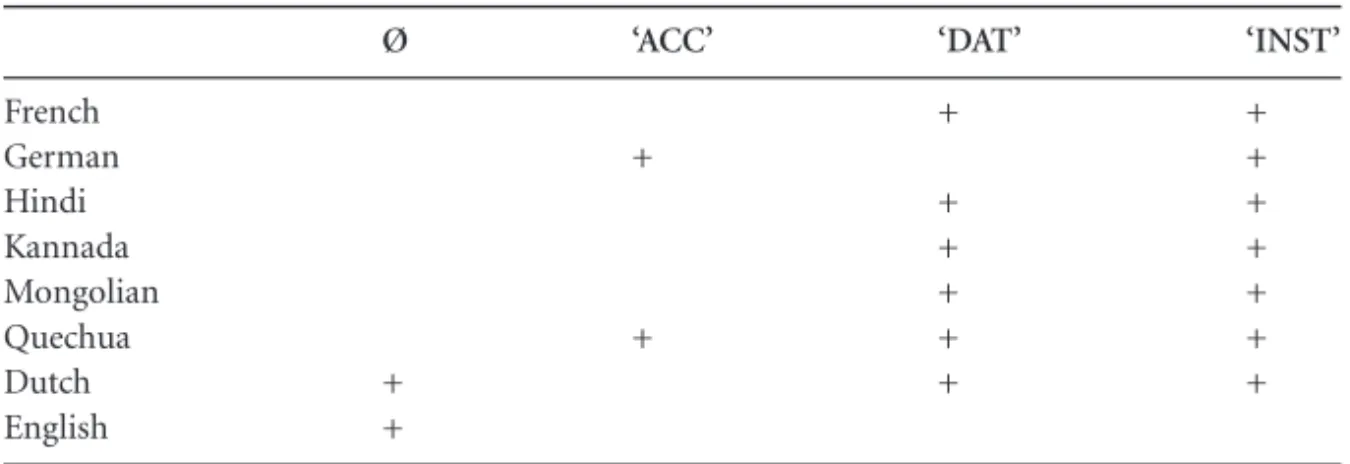
Table 2 (from Kemmer & Verhagen 1994: 137) gives an overview of causee markings (for nominals – pronouns often exhibit different marking possibilities) in a number of different languages.
English constructions from a Dutch perspective
Table 2. Marking of causees in causative constructions in a number of languages
Ø ‘ACC’ ‘DAT’ ‘INST’
French + +
German + +
Hindi + +
Kannada + +
Mongolian + +
Quechua + + +
Dutch + + +
English +
other evidence discussed in Kemmer & Verhagen 1994), is how causative construc-tions are normally integrated (in the sense mentioned before) into the grammar of a language: they tend to share properties with two types of general simplex clause pat-terns, viz. indirect object constructions and instrument-like constructions available in the language involved.
Now, the situation in Dutch looks rather similar to that in most other languages listed in Table 2.8The specific indirect object marking with the prepositionaan(‘at’,
‘to’), for example, can occur in causative sentences if the causee’s role in the overall process is sufficiently similar to that of a recipient, also when none of the verbs involved by itself specifies such a role, as in example (29).
(29) Je You
mag may
die that
brief letter
aan to
niemand nobody
laten let
lezen. read ‘You may not let anyone read that letter.’
But as Table 2 indicates, English causative constructions do not inherit this kind of property from general (simplex clause) recipient constructions. This indicates that English causative constructions are more like an island of constructions in the entire constructicon than the Dutch ones. The English construction does not share as many properties with productive basic clause patterns of the language as the Dutch one does. Another phenomenon strengthening this conclusion concerns so-called causeeless causatives. Many languages allow the causee to remain implicit in the case of transitive result predicates, and Dutch is no exception, witness example (30):9
(30) We We
laten let
een a
nieuw new
huis house
bouwen. build ‘We are having a new house built.’
Arie Verhagen
The optionality of the causee reflects the optionality of recipient participants, or indi-rect objects in general, in transitive clauses, i.e. clauses containing a diindi-rect object. It is thus a further indication that the Dutch causative construction is relatively well inte-grated in the general network of simplex clause constructions in Dutch. English, on the other hand, is again an exception in this regard, in that it does not allow causees to re-main implicit in standard causative constructions. This does not imply that a causative eventcould not be described in English without mentioning the causee; but one has to use another constructionto do this: as the translation in (30) indicates, the En-glish counterpart to the Dutch causeeless causative contains a past participle rather than an infinitive/stem. Thus, this constitutes a separate member of the English net-work of causative constructions, setting this family as a whole somewhat more apart from other simplex clause constructions than in a language like Dutch. The use of the past participle, combined with the fact that the causee remains implicit, constitutes a resemblance between this subtype of English causatives and passive constructions, linking this particular family of causative constructions to another part of the con-structicon than the causatives based on infinitives/stems. The fact that the causee may be inserted in this construction in aby-phrase (e.g.He had his portrait painted by Da Vinci, and the translations of (26) and (28)), strengthens this link.
Naturally, this is not an exhaustive discussion of causative constructions in En-glish, but it suffices to see that in this area, Dutch may be considered more ‘systematic’ than English. More important, though, is the fact that lack of full-scale regularity is, apparently, not really a problem in either system.
. Conclusion
English constructions from a Dutch perspective
may differ considerably from another one even though they may both contain largely the same set of patterns.
From the authors cited in this paper, Jackendoff most frequently invokes sim-ilarities of constructions to other patterns in English, at least suggesting that these are important factors in understanding the construction involved. However, we have seen that at relatively specific levels, constructions share important combinatorial and functional properties across languages, whether they are syntactically similar or not. Different positions of constructions in the overall taxonomic network, and different degrees of integration into this network, turn out not to provide clear and consistent clues about the grammatical or semantic behaviour of the constructions – the role of convention is bigger than apparent formal systematicity within a single language may suggest. From a cognitive point of view, emphasizing the symbolic character of con-structions, this need not come as a surprise. Even if speakers of different languages have to use different conventional resources, if the kind of concepts they regularly express – e.g. actions of obstacle-removal, wasting valuable resources, making things happen or having people do things – show systematic (cross-cultural) similarities, then the behaviour of these different resources can be expected to exhibit similarities.
In principle, constructional grammars are well designed to handle the kind of phe-nomena dealt with here. Similarities are captured by inheritance relations between more general and more specific patterns. Such relations will occur frequently in the grammar of any fully developed language, because of the way the language has devel-oped over time (conventionalization of routines that started as fully ‘compositional’ expressions; cf. Verhagen 2003: 53–56), and because of the usefulness of motivation: a system is more efficient if formal distinctions correspond to semantic ones, i.e. if the formal distinctions are motivated (Haiman 1985; Lakoff 1987: 537–540). There are also other mechanisms that provide ‘pressure’ for regularity, especially the way chil-dren construct knowledge of grammatical structure (Tomasello 2003).10 So there is bound to be a lot of regularity in any grammar, rather than complete arbitrariness of the form-meaning-relationships in each separately stored construction. However, the constructional approach does not impose a priori constraints onwhichaspects of these relationships will be shared by many constructions at different levels of schematicity and productivity, which is why it is well suited to deal with cross-linguistic differences of the kind I have illustrated here.
References
Barlow, M. & Kemmer, S. (Eds.). (2000).Usage-based Models of Language. Stanford, CA: CSLI. Booij, G. (2002). Constructional idioms, morphology, and the Dutch lexicon. Journal of
Germanic Linguistics, 14, 301–329.
Arie Verhagen
Bree, C. van (1981). Hebben-constructies en datiefconstructies binnen het Nederlandse taalgebied: Een taalgeografisch onderzoek. H.I. Ambacht: Intercontinental Graphics.
Bybee, J. L. (1985).Morphology: A Study of the Relation Between Meaning and Form. Amsterdam: John Benjamins.
Bybee, J. L. (1995). Regular morphology and the lexicon.Language and Cognitive Processes, 10, 425–455.
Bybee, J. L. & Hopper, P. (Eds.). (2001).Frequency and the Emergence of Linguistic Structure. Amsterdam: John Benjamins.
Croft, W. & Cruse, D. A. (2004).Cognitive Linguistics. Cambridge: CUP.
Goldberg, A. E. (1995).Constructions: A Construction Grammar Approach to Argument Structure. Chicago, IL: The University of Chicago Press.
Goldberg, A. E. (1996). Making one’s way through the data. In M. Shibatani & S. A. Thompson (Eds.),Grammatical Constructions: Their Form and Meaning(pp. 29–53). Oxford: OUP. Goldberg, A. E. (2003). Constructions: A new theoretical approach to language. Trends in
Cognitive Sciences, 7, 219–224.
Goldberg, A. E. (2006).Constructions at Work: The Nature of Generalization in Language. Oxford: OUP.
Hüning, M. (2003). Zwischen Deutsch und English: Aspekte der sprachlichen Identität der Niederländischen. In H. van Uffelen, M. E. Weissenböck, & C. van Baalen (Eds.),Sprache und Identität: Akten des Symposiums zum 10-jahrigen Bestehen der Nederlandistik am 18. und 19. Oktober 2002 in Wien(pp. 143–158). Vienna: Edition Praesens.
Jackendoff, R. (1990).Semantic Structures. Cambridge, MA: The MIT Press.
Jackendoff, R. (1995). The boundaries of the lexicon. In M. Everaert et al. (Eds.), Idioms: Structural and Psychological Perspectives(pp. 133–167). Hillsdale, NJ: Lawrence Erlbaum. Jackendoff, R. (1997). Twistin’ the night away.Language, 73, 534–559.
Kemmer, S. E. & Verhagen, A. (2002). The grammar of causatives and the conceptual structure of events.Cognitive Linguistics, 5, 115–156.
Langacker, R. W. (1987).Foundations of Cognitive Grammar: Vol. I:Theoretical Prerequisites.
Stanford, CA: Stanford University Press
Langacker, R. W. (1988). A usage-based model. In B. Rudzka-Ostyn (Ed.),Topics in Cognitive Linguistics(pp. 127–161). Amsterdam: John Benjamins.
Langacker, R. W. (2005). Construction Grammars: Cognitive, radical, and less so. In Francisco J. Ruiz de Mendoza Ibáñez & M. Sandra Peña Cervel (Eds.),Cognitive Linguistics: Internal Dynamics and Interdisciplinary Interaction(pp. 101–159). Berlin and New York: Mouton de Gruyter.
Tomasello, M. (2003).Constructing a Language: A Usage-based Theory of Language Acquisition. Cambridge: Harvard University Press.
Verhagen, A. (2002). From parts to wholes and back again.Cognitive Linguistics, 13, 403–439. Verhagen, A. (2003). The Dutch way. In A. Verhagen & J. van de Weijer (Eds.),Usage-based
Approaches to Dutch(pp. 27–57). Utrecht: LOT.
Verhagen, A. & Kemmer, S. (1997). Interaction and causation: Causative constructions in modern standard Dutch.Journal of Pragmatics, 27, 61–82.