Fairplay — A Secure Two-Party Computation System
Dahlia Malkhi
1, Noam Nisan
1, Benny Pinkas
2, and Yaron Sella
11
The School of Computer Science and Engineering
The Hebrew University of Jerusalem
E-mail:
{
noam,dalia,ysella
}
@cs.huji.ac.il
2
HP Labs
E-mail: [email protected]
Abstract
Advances in modern cryptography coupled with rapid growth in processing and communication speeds make secure two-party computation a realistic paradigm. Yet, thus far, interest in this paradigm has remained mostly theoretical.
This paper introduces Fairplay [28], a full-fledged system that implements generic secure function eval-uation (SFE). Fairplay comprises a high level proce-dural definition language called SFDL tailored to the SFE paradigm; a compiler of SFDL into a one-pass Boolean circuit presented in a language called SHDL; and Bob/Alice programs that evaluate the SHDL cir-cuit in the manner suggested by Yao in [39].
This system enables us to present the first evaluation of an overall SFE in real settings, as well as examining its components and identifying potential bottlenecks. It provides a test-bed of ideas and enhancements con-cerning SFE, whether by replacing parts of it, or by integrating with it. We exemplify its utility by exam-ining several alternative implementations of oblivious transfer within the system, and reporting on their ef-fect on overall performance.
1
Introduction
Motivation. Modern cryptography is usually con-sidered to have its beginning in the landmark papers of Diffie and Hellman [16], who introduced the concept of public key encryption, and of Rivest, Shamir and Adelman [35] who suggested a concrete public key sys-tem. The fundamental theoretical studies along these lines originate in the late 1970’s, and the results - the well-known cryptographic primitives of public key en-cryption, authentication and digital signature - have been widely applied in practice during the 1990’s.
However, theoretical cryptography provided addi-tional, powerful (and perhaps less intuitive) tools. One of the most attractive paradigms in this category is a secure function evaluation (SFE). It allows two
par-ticipants to implement a joint computation that, in real life, may be implemented using a trusted party, but does this digitally without any trusted party. A classic simple example of such a computation is the Millionaires’ problem [39]: Two millionaires want to know who is richer, without any of them revealing to the other his net worth. More generally, informally, the two-party SFE problem is the following. Alice has an input ~x = x1, . . . , xs and Bob has an input
~y = y1, . . . , yr. They both wish to learn f(~x, ~y) for
some publicly known functionf, without revealing any information on their inputs that cannot be inferred from f(~x, ~y). (We refer the reader to, e.g. [20], for a formal introduction to SFE.) SFE is a universal build-ing block, and many interestbuild-ing cryptographic proto-cols can be formulated as instances thereof, e.g., zero knowledge proofs, private database mining, electronic auction and negotiation, and voting protocols.
Thus far, SFE techniques are rarely applied in prac-tice, and are typically considered to have mostly the-oretic significance. In this paper, we suggest that it is prime time to start translating these theoretical re-sults into practical applications. We see three main forces converging to make this transition possible:
1. New applications: new applications are driven by advances in the communication infrastructure (such as the ubiquity of the Internet or the emergence of web services), coupled with increased demand for informa-tion based relainforma-tionships (e.g. for business or homeland security purposes). These applications often involve sensitive information related to issues such as pricing, business processes, or personal information, and their security often relies on trusting a designated trusted party (such as eBay in the case of auctions). Not all users feel completely confident giving this trust, es-pecially when high stakes are involved. SFE offers a solution for unmediated e-commerce applications such as auctions and web services [32, 17].
seen a growing theoretical effort to overcome the main efficiency bottlenecks of previous theoretical solutions. Such efforts include more efficient cryptographic so-lutions for specific tasks such as auctions and certain database access tasks (e.g. [31, 13]), as well as gen-eral theoretical results improving on various efficiency parameters (e.g. [29, 30, 24]).
3. Improved CPU and communication speeds:
while sending megabytes of communication, or spend-ing GigaFlops of processspend-ing power would have seemed unreasonably expensive only a few years ago, such ef-fort is certainly acceptable now. It is not unreasonable to spend such an effort even for tasks whose monetary value is a few dollars. Even Gigabytes of communica-tion, and TeraFlops of processing power are reasonable for important tasks.
The goal of this work is to provide the first full fledged secure two-party computation tool that is read-ily deployed by the community. Fairplay provides the first solid answers to questions regarding the efficiency of the overall computation, and its breakdown into parts. Thus, using this tool, we are able to tell for the first time the overall price of solving a problem like the above mentioned Millionaires’ problem in real network settings (the answer is ≈ 4 seconds over a wide area network, see Section 6). We further discern the cost of different components of the SFE, and assess their relative effect on overall elapsed time. Thus, for example, in Section 6 we analyze the relative contribu-tion of the public key operacontribu-tions performed as part of the SFE protocol, and conclude that while 27%-77% of the time is due to public key operations over a fast LAN, only 9%-42% is accountable to public key oper-ations over a wide area link.
Fairplay also serves as a test-bed of new ideas and algorithmic variations. For demonstration, we already considered several flavors of oblivious transfer (OT) al-gorithms within our tool. Specifically, we have imple-mented the original scheme by Bellare and Micali from [6, 7], the enhancements suggested by Naor and Pinkas in [30], and straight-forward communication batching. Our experiments show a remarkable matching of the predicted 30% speedup of the enhancement in [30] over [6]. The effect of communication batching is observed to be up to nearly nine-fold speedup (see Section 6). Thus, our platform provides valuable guidance in trad-ing different parameters.
Technical approach. The first issue we tackle is the compilation paradigm. The correct paradigm for ad-dressing the computation is to adopt the trusted party model for the definition of tasks, and to compile these definitions into protocols that do not use any trusted party. In this way, the user specification is completely
oblivious to the actual protocol that implements it. This is the common definition of secure computation used in cryptography1 (we refer the reader to cryp-tographic literature, e.g. to [10, 12, 20], for an exact definition). Specifically, a definition of a task using a trusted party involves the following elements:
1. Exact specification of the interaction of the trusted party with the participants. This in-cludes specification of what the participants tell and what they learn from the trusted party. 2. Exact specification of the internal computations
of the trusted party.
In support of the user’s high level view of the com-putation, we provide our own high-level definition language called Secure Function Definition Language (SFDL). SFDL is a procedural language that resembles a subset of Pascal or C, and is tailored to our purpose. For convenience, a syntax-driven GUI is provided that guides the program developer.
Once such a specification is given, a compiler gen-erates an intermediate level specification of the com-putation in the form of a one-pass Boolean circuit. Whereas classical theory on SFE was satisfied with the fact that it is provably possible to reduce any function to a canonical Boolean representation, we tackle for the first time actually automating the transformation, while keeping efficiency in mind.
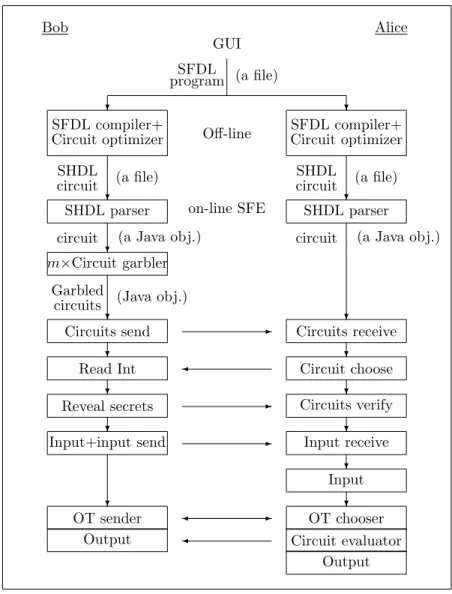
The language used for describing the Boolean cir-cuit is named Secure Hardware Definition Language (SHDL). Developing an SFDL-to-SHDL compiler is a novel endeavor in itself, because unlike common hard-ware compilers, our compiler may use no registers, no loops or goto’s, and moreover, may use every gate only once. Its complete obliviousness makes compiling even the most primitive operations like array indexing (e.g., “a[i]”) a daunting task: it must create essentially a multiplexer, such that all possible values of “i” are hardwired into it. Thus, the SFDL-to-SHDL compiler includes many novel tricks for reducing the number of resulting gates in the circuit, and for optimizing the use of wires. The final component of Fairplay is a Bob/Alice pair of programs, whose input is an SHDL circuit, which together carry a secure compu-tation protocol of the circuit in the manner suggested by Yao. The entire computation structure of Fairplay is depicted in Figure 1.
Security. The main security property guaranteed by the system is the equivalence to the specified trusted party. I.e., each user is guaranteed that whatever the other participant does, including using completely dif-ferent software for communicating with him, his se-curity is assured to the same level that the trusted
party would have assured it. In particular, the func-tion is correctly computed on the reported values and no information about the input of one party is leaked to the other (beyond what is implied by the specified output). Note, however, that, in principle, there is no way to “force” any party what to tell the trusted party (e.g. force it to report its “true” input), and that in two-party secure computation it is also impossible to prevent one party from terminating the protocol pre-maturely, before the other party learns its output – this is detected, but cannot be recovered from.
The Fairplay system provides the guarantee above based on common and widely accepted cryptographic assumptions. We describe the security properties of Fairplay in more detail in Section 5. The level of se-curity provided is asymmetric: Alice can only cheat with negligible probability, but Bob can potentially cheat with probability 1/m, wherem is a parameter that can be chosen at will and there is an overhead that is proportional tom.2
Summary of Contributions. We contribute a generic two-party computation engine that we make available for use by the security community. The tool is available at Fairplay’s web-site [28]. It includes a specially tailored high level description language (SFDL) that describes a secure computation in the trusted third-party model. It tackles the challenge of efficient compilation of SFDL into a one-pass Boolean circuit. And it provides a Bob/Alice implementation that securely evaluates the circuit.
Fairplay enables experimenting with mechanisms re-lated to secure function evaluation, whether by replac-ing a component of it, buildreplac-ing on top of it, or interact-ing with it. Our preliminary investigation introduces results concerning the overall cost of the SFE paradigm in today’s Internet settings; it presents a breakdown of costs into components and bottlenecks; and it ex-amines various enhancements that were introduced in the literature.
2
System Overview
We start by a general overview of the computation being performed, which also allows us to present the main entities and components of our system. Fair-play comprises two applications that are activated by the two players, who want to engage in two-party se-cure function evaluation (SFE). By convention we call these players/applicationsBobandAlice. Prior to ex-ecuting the SFE protocol, the two players must define and coordinate the function-to-be-evaluated. In order to do that, they use the Secure Function Definition Language (SFDL), a language which was designed es-pecially for this purpose. The SFDL is a high-level
programming language, which allows humans to spec-ify the function-to-be-evaluated in the form of a com-puter program. Another language that the system uses is the Secure Hardware Definition Language (SHDL). The SHDL is a low-level language designed for speci-fying Boolean circuits. The SFE computation is done in several stages as shown in Figure 1.
• An SFDL program file is written by the users us-ing an SFDL editor.
• The SFDL program is translated by an SFDL compiler to an SHDL circuit file. The circuit is optimized before it is passed on to the next stage.
• The SHDL circuit is parsed. The resulting circuit is in the form of a Java object.
• Bob constructsmgarbled/encrypted circuits and sends them to Alice. Alice randomly chooses one of the circuits that will be evaluated.
• Bob exposes the secrets of the other m−1 gar-bled/encrypted circuits, and Alice verifies them against her reference circuit.
• Bob specifies his inputs, and sends them to Alice in garbled form. Alice inserts Bob’s inputs in the garbled/encrypted circuit that she chose to eval-uate.
• Alice specifies her inputs, and then Bob and Al-ice engage in Oblivious Transfers (OTs) in order for Alice to receive her inputs (in garbled form) from Bob, while Bob learns nothing about Alice’s inputs.
• Alice evaluates the chosen circuit, finds the gar-bled outputs of both her and Bob, and sends the relevant garbled outputs to Bob.
• Each party interprets his/her garbled outputs and prints the results.
3
The SFDL, SHDL and their
Com-piler
3.1
Motivation
The secure function evaluation protocol requires that the function to be evaluated be given as a Boolean cir-cuit. Designers, however, will desire the function to be given in a more convenient high-level form. In the context of secure protocols, this is even more impor-tant than the strong usual reasons for writing in high-level programming languages. The starting point of any attempt of security is a clear, formal, and easily-understandable definition of the requirements. Such
Bob Alice GUI
SFDL
program (a file)
? ?
Off-line SFDL compiler+
Circuit optimizer Circuit optimizerSFDL compiler+
?
SHDL
circuit (a file)
?
SHDL
circuit (a file) on-line SFE
SHDL parser
?
circuit (a Java obj.)
SHDL parser
?
circuit (a Java obj.)
m×Circuit garbler
?
Garbled
circuits (Java obj.) Circuits send
?
Circuits receive
?
-Read Int
?
Circuit choose
? ¾
Reveal secrets
?
Circuits verify
?
-Input+input send
?
Input receive
?
-Input
?
OT sender ¾ - OT chooser Output ¾ Circuit evaluator
Output
Figure 1: Computation overview
clarity of definition is almost impossible, for humans, using low-level formalisms such as Boolean circuits. Clear high-level languages are needed.
The compiler will thus accept a function written in a high-level programming language and compile it into a Boolean circuit that evaluates the same function. In our case the compiler compiles an SFDL program into an SHDL circuit. In addition to bridging the se-mantic gap between high and low level languages, as done by every compiler, a compiler into hardware has to bridge another semantic gap: that of obliviousness. Boolean circuits are oblivious – they perform the same sequence of operations independently of the input (i.e. compute the values of the gates one after the other). Normal high-level languages change their flow of con-trol according to the input: they execute statements conditionally, loop for a variable number of steps, etc. This semantic gap is not a technicality, but rather the central issue in hardware compilers. On one hand
this is one of the key reasons why it is humanly diffi-cult to design efficient Boolean circuits. On the other hand, the key reason why Boolean circuits were used as the computation model for secure function evalua-tion protocols (rather than, e.g., a Turing machine) is their obliviousness. Non-oblivious computations would seem to leak information from the very identity of the operation being simulated (existing solutions for running RAM based computations obliviously are quite complex [22]).
There do exist “hardware compilers” that compile a high-level language into low level Boolean circuits. These hardware compilers are used for actual hard-ware construction, and serve to ease the development effort. Most commonly used are the high level hard-ware description languages VHDL [14] and Verilog [37] that do not “look” like “normal” programming lan-guages. There are also many compilers that do aim to use languages that “look” like usual programming
languages, e.g. the C programming language (see e.g. [9, 18, 33, 38, 19]). There are some similarities and some differences between the goals of such languages and our goals. The similarities are concerned with is-sues like making conditional execution oblivious and the “single assignment” issue – each hardware bit can only be assigned a value once, but software allows re-assigning values, e.g. in statement like x=x+1.
The main difference comes from the required out-put. In our case the output should be a “theoreti-cian’s Boolean circuit”: purely combinatorial, with no sequential logic. Compilers into real hardware are ac-tually mostly concerned with the use (and re-use) of registers. Thus, for example, consider a command like
for i = 1 to 16 do sum = sum + a[i]. Our com-piler should produce a circuit that has 16 copies of the addition circuit. Real hardware compilers would pro-duce a circuit with a single register (sum) and a single addition circuit, where in each of the 16 clock cycles, one value a[i] is added to the register’s contents. Ad-ditionally, our optimization metric is very simple: the number of gates (weighed by the the gate size). We are not bound at all by technological restrictions such as FPGA structure, delay considerations, or wiring is-sues.
3.2
The Secure Function Definition
Language (SFDL)
Let us begin with the simple example of the Million-aires’ problem:
program Millionaires {
type int = Int<4>; // 4-bit integer type AliceInput = int;
type BobInput = int;
type AliceOutput = Boolean; type BobOutput = Boolean; type Output = struct {
AliceOutput alice, BobOutput bob}; type Input = struct {
AliceInput alice, BobInput bob}; function Output out(Input inp) {
out.alice = inp.alice > inp.bob; out.bob = inp.bob > inp.alice; }
}
First, note that the syntax is quite conventional, borrowing heavily from the C and Pascal program-ming languages. Now, let us look at some of the main ingredients of this program as well as the language in general. A full description of the language may be found in Appendix A.
Type system. The SFDL supports a full type sys-tem. The primitive types are Boolean, integer, and enumerated. For maximum efficiency and since there is no pre-wired hardware word size, integers may be declared to be of any bit-length and are always signed 2’s-complement. Similarly, enumerated types are al-located the minimal number of required bits. Struc-tures and arrays create more complex types from sim-pler ones. Structure entries are accessed using dot-notation, s.f, and array entries using the standard ar-ray notationa[i]. Access to arrays has a potential for non-obliviousness if the index is not a constant expres-sion. This is handled by the compiler, but users should be aware of the high price of such access. Pointers do not exist – this is in order to maintain obliviousness. Beyond their usual role as defining variable types, the type system is used to formalize the input and out-put of the function to be evaluated. The special types AliceInput, AliceOutput, BobInput, BobOutput, must be defined in every program, specifying the respective input and output types of the two players. The types Input andOutput are always defined to be structures encapsulating the inputs (resp. outputs) of both play-ers.
Program Structure and Functions. An SFDL program consists of a sequence of functions (as in C, no nesting is allowed) preceded by declarations of global constants and types. Functions receive parameters and return values using the Pascal-like syntax of as-signment to a variable whose name is identical to the function name. As in Pascal, a function must precede any function that calls it. Unlike Pascal, no “forward” clause exists, and no recursion is allowed. The lack of recursion is critical in order to maintain oblivious-ness. Functions may define and use local variables; in the current implementation we forbid global variables. The last function in the program is the one computing the desired output from the inputs. By convention it is namedoutput. It accepts a single parameter of type Inputand produces the result of typeOutput.
Assignments and expressions. Expressions use the standard notations: they combine constants, vari-ables (including, recursively, array entries and struc-ture items), and function calls using operators and, optionally, parenthesis. The allowed operators include arithmetic addition and subtraction, Boolean logical operators (bitwise, for integers), and the standard comparison operators. Due to their cost, multiplica-tion and division are not provided as primitive opera-tors, but rather should be implemented as functions. Data types of different widths may be combined, and sign-extension is used.
Loops and Conditional Execution. The SFDL has the standard if-then and if-then-else statements.
It should be noted that conditional execution is not oblivious, and thus the compiler generates hardware that always computes both sides of the branch. Gen-eral loops are not oblivious and are not possible in the language. The language does provide a for-loop where the number of iterations is known in advance (a compile-time constant).
3.3
The compiler
The compiler reads the input program written in SFDL, and performs a sequence of transformations on it. In the end of the sequence of transformations, a data structure that corresponds to the hardware is ob-tained, and is then output in SHDL format. The fol-lowing example shows part of the SHDL output pro-duced for the Millionaires’ problem above. Each line in the SHDL output file specifies a “wire” in the gener-ated circuit that is either an input bit or a Boolean gate with given truth-table and input wires. This format is in a verbose form, in particular containing comments (automatically generated, but ignored by the secure evaluation protocols).
0 input //output$input.bob$0 1 input //output$input.bob$1 2 input //output$input.bob$2 3 input //output$input.bob$3 4 input //output$input.alice$0 5 input //output$input.alice$1 6 input //output$input.alice$2 7 input //output$input.alice$3 8 gate arity 2 table [1 0 0 0]
inputs [4 5]
9 gate arity 2 table [0 1 1 0] inputs [4 5]
10 gate arity 2 table [0 1 0 0] inputs [8 6]
11 gate arity 2 table [1 0 0 1] inputs [8 6]
12 gate arity 2 table [1 0 0 1] inputs [10 7]
13 gate arity 2 table [0 0 0 1] inputs [4 0]
14 gate arity 3 table [0 0 0 1 0 1 1 1] inputs [13 9 1]
15 gate arity 3 table [0 0 0 1 0 1 1 1] inputs [14 11 2]
16 gate arity 2 table [0 1 1 0] inputs [12 3]
17 gate arity 2 table [0 1 1 0] inputs [15 16]
18 output gate arity 1 table [0 1] inputs [17] //output$output.alice$0 ...
Additionally, the compiler outputs another file that gives formatting instructions enabling the secure func-tion evaluafunc-tion protocol to input and output values in a convenient user-friendly format. E.g. in the SHDL circuit produced above the first 4 wires (numbered 0– 3) while treated as just 4 arbitrary bits inside the circuit, should be read from the user as an integer. The following example is produced for the Millionaires’ problem above:
Bob input integer "input.bob" [0 1 2 3]
Alice input integer "input.alice" [4 5 6 7]
Alice output integer "output.alice" [18] Bob output integer "output.bob" [29]
Here is a short description of the sequence of steps performed by the compiler:
1. Parsing. Simple syntactic analysis and parsing, resulting in a memory-resident data structure. Due to the simplicity of the language we have not used any compiler-compiler tools.
2. Function inlining and loop unfolding. all func-tion calls are treated as macros and simply inlined where they are called. All for-loops are simply un-folded (note that the number of iterations is a compile-time constant). These two transformations may seem quite inefficient at first sight but that is not the case: they are absolutely required in order to maintain obliv-iousness.
3. Transformation into single-bit operations.
Every command that deals with multi-bit values is transformed into a sequence of single-bit operations. In the simplest case, an assignment of the form a=b where a andb are 4-bit integers is converted into the four single-bit assignments a0 = b0, a1 = b1, a2 =
b2, a3 = b3. In the case of expressions, first a com-plex expression is transformed into a sequence of op-erations, e.g. a=b+c+dis converted into temp=
b+c, a = temp+d. Then, each multi-bit operator is converted into its hardware implementation. E.g. an operation a = b+c, where b and c are 4-bit in-tegers is converted into a sequence of 4 ”full-adders”, implemented using 8 ternary gates.
4. Array access handling. Handling array indices that are compile-time constants is simple: each array entry is treated as a separate variable, and the array access logic is thus completely compile-time and incurs no hardware cost. Handling array indices that are ex-pressions must incur a significant hardware cost due to the semantic gap that must be bridged. In particular, every access to a single array entry results inO(n) pro-duced hardware gates, where nis the total array size.
An access to the value of an array entry, as ina=b[i] is obtained by constructing a multiplexor whosen in-puts are the entries of b, and whose selection input bits are the bits of i. Assigning a value to an array entry, as in a[i] =b, is obtained essentially by using a demultiplexer. More precisely by using, in effect, the sequence ofnif-commands that contain only constant array access indices: if (i= 0) thena[0] =b; if (i= 1) then a[1] =b; ...
5. Single variable assignment. Normal code com-monly assigns values to variables multiple times, as in
a = b+c;...;a = a+ 1. Hardware, does not allow this: each ”variable”, actually, wire, is assigned a sin-gle value computed as an obliviously known operation on other wires. One of the main challenges of every hardware compiler is to eliminate multiple assignments of values to variables, and to transform them into sin-gle assignments. This issue has received much atten-tion in the literature (see e.g. work on SSA form [15]). It seems that our algorithm for this problem is new and superior to previous approaches. In particular, it runs in linear time as long as the nesting depth of if statements in the program is bound by a constant.
Let us first look at the simple case shown above
a=b+c;...;a=a+1. The single assignment transfor-mation defines a new copy of the variable for each as-signment: a1 =b+c;...;a2 =a1 + 1. Things get more complicated, when the different assignments are inter-leaved with conditional execution, e.g. a=b+c; if (x) thena=a+1 elsea=a+2; In this case, we must cre-ate new copies of afor each branch, and an additional copy combining them together after the loop ends:
a1 = b+c;a2 =a1 + 1;a3 =a1 + 2;a4 =x?a2 :a3, where the last assignment uses the C-language ”?:” operator notation, which in hardware is a simple mul-tiplexor. Note also that this transformation has elimi-nated the ”if” statement, yielding an oblivious circuit. The algorithm for the general case is of independent interest and is described in the next subsection.
6. Optimization. At this point we have obtained an in-memory image of a Boolean circuit. This circuit is now optimized, i.e., its size is reduced. The opti-mization step is crucial, often reducing the size of the circuit by an order of magnitude. The optimization is done in linear time, and has three components:
• Peekhole optimization: local simplifications of code, e.g. (x and true→x), (x or not x→true), etc.
• Duplicate code removal: a hash table of all values computed in the circuit is kept. If some value is computed twice, then one of the duplicates is removed and replaced with direct access to the other wire.
• Dead code elimination.
Peekhole optimization and duplicate removal are done in a single pass in topological order over the cir-cuit. Dead code elimination is then done in an addi-tional single pass in reverse topological order.
3.4
The single assignment algorithm
The input to this algorithm is code that contains signment statements, where each variable may be as-signed a value multiple times and (possibly nested) if statements. The output is straight line code where each variables is assigned a value only once.
Data structure. Our basic data structure is a stack of hash tables. It maintains a running version number for each identifier. It supports the following opera-tions:
• new(id): increases the version number of this identifier (and returns the new version number). The first time an id is declared, its version number is assigned to 1.
• get(id): returns the current version number of the identifier.
• push-scope(): starts a new version scope for all identifiers. The version numbers of all identifiers are initialized to the current version numbers, but all furthernew(id) commands will only affect the new scope.
• pop-scope(): ends the current version scope. All version numbers of all identifiers are reset to their value in the previous scope.
• enum-scope(): enumerate all the variables in the current scope.
The implementation uses a new hash table for each version scope. A new() command updates the ver-sion number in the current scope. A get() command traverses the stack of hash tables (from the most re-cent backwards) until it finds an instance of the desired identifier. Its running time is proportional to the stack depth.
Algorithm. Assume that the input is a sequence of statements s1...sn. For ease of exposition, let us
assume that all assignment commands involve two variables on the RHS, and that all if-statements contain no else clauses. (An ”if (x) then y else z” command is equivalent to ”if (x) then y; if (not(x)) then z”.) The algorithm is now given by:
Fori= 1..ndo{
"a=f(b, c)" then{ i=get(b)
j =get(c)
k=new(a)
output: " ak=f(bi, cj)"
}
ifsi is a statement of the form
"if(x)then {r1...rm} " then{
push-scope()
recursively process {r1...rm}
LetV =enum-scope() For eachv∈V do
jv=get(v)
pop-scope()
For eachv∈V do{ i=get(v)
j=jv
k=new(v)
output: "vk =x?vj :vi "
} } }
4
Bob-Alice Two-Party SFE
This section describes the specific two-party SFE pro-tocol that was implemented in Fairplay, based on the protocol suggested by Yao in his seminal work that in-troduced the notion of secure function evaluation [39]. We start with a general overview and then describe in detail how Bob constructs garbled circuits and how Alice evaluates one. Finally we discuss the oblivious transfer (OT) variants that were implemented thus far. We do not prove here the security of the protocol, since it was mostly borrowed from existing theoretical con-structions (however, Section 5 states the security guar-antees of the protocol, describes the reasoning for the choice of the specific cryptographic operations that we use, and suggests some variants of the current proto-col).
4.1
General overview
Our SFE computation is given as input a Boolean cir-cuitCmade of gates and wires, described using SHDL. Then Alice and Bob interact in order to evaluate C
securely. The version of Yao’s protocol that we im-plemented requires a single OT per eachinput wireof
C. In this version Bob constructs the circuit C, and converts it into a garbled circuit. The garbled circuit is transferred to Alice. Then Bob and Alice execute an OT once per each input wire. After this step Al-ice evaluates the circuit independently without further interaction with Bob.
Thwarting malicious behavior by Alice is
guaran-teed by Yao’s protocol and is based on the security of the symmetric function used for encoding the se-cret (SHA-1, which is modeled, for this purpose, as a pseudo-random function) and on the security of the OT protocol against malicious behavior. The same properties also prevent malicious behavior of Bob, if we can guarantee the correctness of the circuit encod-ing that he constructs. This last property was imple-mented using a cut-and-choose technique. Specifically, Bob sendsm garbled circuits to Alice, and Alice ran-domly chooses one circuit that will be evaluated. Bob must then reveal the secrets associated with the cir-cuits that were not chosen by Alice for evaluation. Al-ice verifies that these m−1 circuits indeed represent the function f, by comparing them to a reference cir-cuit that she constructed herself. The two parties then evaluate the circuit Alice has chosen. This method al-lows to catch a cheating Bob with probability 1−1/m. In real-world scenarios, where cheating leads to bad reputation, this may be enough. We leave implemen-tation of more complex cut-and-choose techniques for future enhancements.3
4.2
Circuit preparation and evaluation
This section describes how Bob converts the Boolean circuit C into a garbled circuit, and how Alice evalu-ates that garbled circuit.
Circuit preparation. We use the notationWk, k=
0, .., `−1 to denote all the wires that compose the circuitC. All the gates in SHDL circuits have a single Boolean output. The number of inputs into a gate can be either 1, 2 or 3 (SHDL itself allows more inputs, but the compiler produces only unary, binary or ternary gates). For simplicity of exposition, in the description below, we focus only on binary gates. The conversion of Cinto a garbled circuit works as follows.
1. Bob assigns to each wire Wk ∈C two randomt
-bit strings v0
k, vk1 (t is a security parameter that
was set to 80). The string v0
k represents the bit
0 for Wk. The string v1k represents the bit 1 for
Wk. Bob also assigns to each wire Wk ∈ C a
random binary permutation (i.e., a bit) pk, and
appends it to the pair v0
k, v1k as follows: wk0 =
v0
k||(0⊕pk), w1k = vk1||(1⊕pk). We let wk0, wk1
denote the final result.
2. For each gateg∈Cwhose output wire isWkand
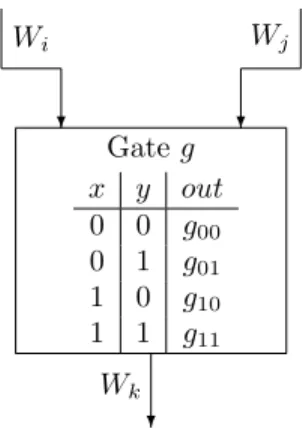
whose input wires are Wi, Wj (see Figure 2)
(a) The original truth table ofgconsists of four 0/1 entries. Bob constructs the Garbled-Truth-Table (GT T) of g by replacing every 0 or 1 in the truth-table with w0
k or w1k,
x y out
0 0 g00 0 1 g01 1 0 g10 1 1 g11
Gateg
?
Wk
?
Wi
?
Wj
Figure 2: A gate in a circuit
(b) Bob constructs the Encrypted-Garbled-Truth-Table (EGT T) of g in the follow-ing way. For entry (x, y) in g’s GT T, de-fine x0 = x⊕p
i, y0 = y ⊕pj. The
en-try is encrypted using vx
i, vjy as
encryption-keys and k, x0, y0 as an IV: EGT T[x, y] = Encryptvx
i,vyj,k,x0,y0(GT T[x, y]). The
encryp-tion is done by hashing vx
i||k||x0||y0 and
vyj||k||x0||y0 using SHA-1, and XORing the
two results to the plaintext (see Section 5 for explanations).
(c) Bob constructs the Permuted-Encrypted-Garbled-Truth-Table (P EGT T) of g by swapping the entries ing’sEGT T based on the permutation bits assigned to g’s input wires, namely pi, pj (the role of these
per-mutations is to make the position of a cer-tain string in a P EGT T meaningless). I.e., ifpi= 1 then the first two entries of the
ta-ble are swapped with the last two entries. If
pj = 1 then the first and third entries are
swapped with the second and fourth entries. (d) For each wire which carries a bit of Al-ice’s output, Bob sends an appropriate translation-table that allows Alice to inter-pret the circuit’s output from the garbled value of the wire. Namely, for every out-put wire k Bob sends a table of the form
h(H(w0),0),(H(w1),1)i, whereH is a colli-sion resistant hash function, which we imple-mented as SHA-1.
Interaction. Initially, Bob sends to Alicemgarbled circuits as well as commitments to his garbled inputs to each circuit. Out of these, Alice chooses at random
m−1 circuits which are opened by Bob to prove that the circuits were prepared properly.4 Bob then opens the commitments to the garbled strings that represent his input bits of the remaining unopened circuit. Note
that Alice cannot interpret these strings back to Bob’s input bits, because the circuit is garbled. Alice then uses oblivious transfer (OT) in order to obtain from Bob the garbled strings that match her input wires. The OT protocol that was implemented is discussed in the next subsection. For now assume that for each in-put bit Alice obtains the corresponding garbled string.
Circuit evaluation. Alice proceeds to evaluate the garbled circuit gate by gate. Letgbe a specific garbled gate whose output wire isWk and whose input strings
are wi, wj. Let the least significant bits of wi, wj be
x, y and the rest of the bits bevi, vj respectively. For
each such gate:
1. Alice uses x, y as indices into an entry to be de-crypted ing’sP EGT T.
2. Alice uses vi, vj as decryption-keys, and
k||x||y as an IV. Namely, Alice sets
wk = Decryptvi,vj,k,x,y(P EGT T[x, y]). The
decryption is done by hashing vi||k||x||y and
vj||k||x||y using SHA-1, and XORing the two
results to the ciphertext.
Throughout the evaluation all that Alice obtains are garbled strings. These do not leak information on the values of the bits flowing through the circuit. When Alice finds the garbled values of the output gates she uses the translation tables to interpret the circuit’s true output. As for Bob’s output, Alice sends him the garbled values of his output wires. Bob associates them with the corresponding 0 or 1 values. (Note that in the case of a wire that carries an output bit which should be revealed to Bob alone, Alice cannot decipher the value, or change it without being detected by Bob. In the case of a wire that carries an output bit which is revealed to both Bob and Alice, Alice can, of course, decrypt the value but she cannot change it without finding a collision in the hash function.)
Malicious vs. Semi-honest parties. If the parties are assumed to be semi-honest (i.e. follow the proto-col) then there is no need for using cut-and-choose methods for verifying the circuits constructed by Bob, and we can setm= 1. The OT protocol, too, can be simplified, since the current implementation is secure against malicious parties.5
4.3
Oblivious Transfer
Two OT variants were implemented thus far (the sys-tem can be easily extended to employ more variants). Both variants are based on the Diffie-Hellman prob-lem (and are impprob-lemented over a groupZq, which is a
sub-group of prime orderqofZ∗
q|p−1). The first one is the 1-out-of-2 oblivious trans-fer (OT2
1) protocol due to Bellare and Micali [6], which was adapted to using random oracles [7]. The sec-ond protocol, which was proposed by Naor and Pinkas in [30], is an optimization of the first one, that uses the same grmodpvalue for multiple OT executions (gis
a generator of the groupZq,ris a random exponent).
A detailed description of both protocols can be found in [30]. Both these OT protocols are secure in the random oracle model and were implemented using the SHA-1 hash function. (There are constant-round OT protocols secure in the standard model [2, 30]. The SFE application requires multiple concurrent invoca-tions of these protocols, but on the other hand it is only required that the SFE implementation, and not necessarily each OT invocation, provide both privacy and correctness.)
5
Cryptographic Background
This section describes the rationale behind the choice of specific cryptographic operations for Fairplay and suggests several additional variants. We do not pro-vide here proofs of the correctness and security of the implementation, as it is mostly based on existing con-structions.
The protocol we implemented provides security guarantees which depend on the following three as-sumptions:
1. SHA-1 is modeled as a random oracle.
2. The oblivious transfer protocol is secure (the se-curity of the OT protocol can be based on the computational Diffie-Hellman assumption [2, 30], but we use random-oracle based protocols which are more efficient).
3. Alice does not terminate the protocol before send-ing Bob’s output to him.
We get the following guarantees:
• Bob is guaranteed that an interaction with a ma-licious Alice is not different than an interaction with the trusted third party, except for a negligible error probability.
• Alice has the same guarantee with relation to Bob, with error probability of1/m.
Note that these guarantees means that (1) a mali-cious party cannot learn more information about the other party’s input than it can learn in the trusted party model, and (2) a malicious party cannot change the computed function. Also, if we are assured that Bob does not change the circuit he provides to Alice then his cheating probability is also negligible.
Garbling the circuit. The basic symmetric crypto-graphic function that we use is SHA-1. We preferred it to using a block cipher (such as AES) since it sup-ports a variable input length. The encoding of the circuit (garbling) can be implemented using a pseudo-random function (as is described in detail, for exam-ple, in [31]), where the output of the function is used as a pad that masks the values in the table represent-ing a gate in the circuit. We use the maskrepresent-ing values SHA-1(wi||k||x||y), SHA-1(wj||k||x||y) for entry (x, y)
of the table of gate number k, whose input wires are
i andj. (Note that wires iand j could be input into multiple gates.) The underlying security assumption is that SHA-1 is pseudo-random function keyed by wi
or wj and applied to other parameters.
OT. The OT protocols are based on the random or-acle model and the computational Diffie-Hellman as-sumption. Alternative two-round OT protocols that are secure in the standard model and use onlyO(1) ex-ponentiations were described in [30, 2]. We preferred not to use them in order to reduce the number of ex-ponentiations.
Cut-and-choose. Bob commits to his garbled in-puts before the cut-and-choose step. This is done in order to prevent him from choosing his input based on Alice’s choices in this step. We leave it for future work to let Alice choose more than one circuit for evalua-tion. This will reduce the cheating probability of Bob to be exponentially small in the number of circuits that are evaluated, but implementing this variant re-quires Bob to prove that he provides the same input to all circuits, and this step incurs additional overhead. (An alternative method for verifying the garbled cir-cuit constructed by Bob is to require him to prove, in zero-knowledge, that the tables are correct. To the best of our knowledge, this approach requires an even higher overhead.)
Bob’s output. The protocol provides Alice with the garbled values of Bob’s output wires. If the value of an output wire should become known only to Bob (and not to Alice) then she receives no information about the relationship between actual and garbled values of this wire. If the output is used by both Bob and Alice, she receives hash values of the garbled values corre-sponding to 0 and to 1. However, she is not able to provide Bob with a garbled value that corresponds to a different output than the one she computed, since this would mean that she can invert the hash function.
6
Experimental results
The first, immediate contribution of a system such as Fairplay is that it can provide answers to very basic, concrete questions like:
• How much time does it take to execute the two-party SFE protocol for the quintessential Million-aires’ problem?
• What would be the time-penalty if the two ty-coons in question were actually Billionaires and not just Millionaires?
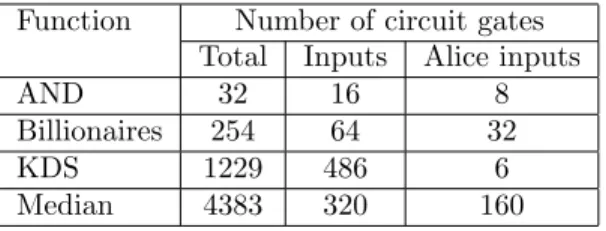
The experiments that we conducted using our sys-tem gave a very definite answer, that even the tougher Billionaires’ problem (i.e., using 32 bit inputs) can be solved in very reasonable time. It took our system only 1.25 seconds to solve the Billionaires’ problem using fast communication, and 4.01 seconds when commu-nication was slow. More generally, in this paper we report results for four functions, which produced cir-cuits ranging in size from tens of gates to thousands of gates. A summary of the various size parameters of these four functions is shown in Table 1 (their SFDL source code can be found in Fairplay’s web-site [28]).
Function Number of circuit gates Total Inputs Alice inputs
AND 32 16 8
Billionaires 254 64 32
KDS 1229 486 6
Median 4383 320 160 Table 1: The four functions
The details of the four functions are as follows:
• AND - performs bit-wise AND on two registers. The input size for both Alice and Bob is 8 bits. Total circuit size is 32 gates, out of which 16 are inputs and 16 are outputs.
• Billionaires - compares two integers. The input size for both Alice and Bob is 32 bits. Total circuit size is 254 gates, out of which 64 are inputs and 2 are outputs.
• Keyed Database Search (KDS) - Bob has a database of 16 items, each item is keyed by a 6-bit key and comprises of 24 data bits. Alice privately retrieves the data of one item by specifying its key. The input size for Bob is 480 bits and for Alice 6 bits. Total circuit size is 1229 gates, out of which 486 are inputs and 24 are outputs.
• Median - finds the median of two sorted arrays. The input for both Alice and Bob are ten 16-bit
numbers. Total circuit size is 4383 gates, out of which 320 are inputs and 32 are outputs.
The AND function was chosen as an example of the simplest possible circuit, whose size is of the same or-der as the number of its inputs. The KDS function demonstrates a circuit in which the size of Alice’s in-put (which defines the number of OTs) is much smaller than either the number of Bob’s inputs or the number of gates. The median function demonstrates a circuit whose size is much greater than the number of inputs.
Communication vs. computation. Another im-portant contribution of a working system is that it enables a systematic, realistic investigation of the rel-ative cost of its various ingredients. This can be done by utilizing profiling tools, and by performing super-vised experiments, in which the cost of the different sub-components is measured in isolation. One spe-cific question that we found interesting in this area is the following: what is the relative cost of the public key operations required by the two-party SFE proto-col? Since this relative cost is affected by the cost of communication, and since communication delays vary dramatically in different environments, we conducted our experiments in two extreme settings - LAN and WAN. The LAN’s latency is 0.4 ms, and its effective throughput is 617.8 MBPS (Mega bit per second). The WAN’s latency is 237.0 ms, and its effective through-put is 1.06 MBPS. By activating our system on the four functions described above, and profiling it under the LAN/WAN environments, we discovered that the public key operations were responsible for 27%-77% of the total delay in the LAN setting, while in the WAN setting the relative cost of the public key opera-tions was only 9%-42%. These results suggest that, at least for some interesting functions, the relative cost of the communication is rather significant, especially in a WAN environment where communication is slow. In light of this, we also calculated the slowdown fac-tor caused by moving from LAN to WAN, which was found to be at least 2.34 and at most 6.89.
Communication optimization using batching.
Communication batching means that instead of send-ing k big integers (associated with different OTs) in
k separate messages, we aggregate them together and send them in one big message. It is useful because of the relatively large constant overhead associated with any message being sent regardless of its size, and also due to internal implementation details of TCP/IP. By implementing and measuring the performance of two variants of the SFE protocol, with and without com-munication batching, we were able to assess its con-tribution. The observed speedup factors due to com-munication batching in a LAN setting were between
Function LAN WAN
IPCG CC OTs EV EET (sec) IPCG CC OTs EV EET (sec) AND 1.5% 18.8% 79.5% 0.2% 0.41 0.2% 58.4% 41.4% 0.0% 2.57 Billionaires 3.2% 5.4% 91.1% 0.3% 1.25 0.8% 45.2% 53.9% 0.1% 4.01 KDS 40.4% 2.8% 54.1% 2.7% 0.49 5.9% 64.3% 29.4% 0.4% 3.38 Median 13.2% 7.2% 78.7% 0.9% 7.09 4.7% 45.8% 49.2% 0.3% 16.63
Table 2: Elapsed execution times and their breakdown into sub-tasks
1.89-2.72, while in a WAN setting they were between 2.11-8.75.
OT optimization. We have also implemented an optimization technique for OT that was proposed by Naor and Pinkas in [30], in which the sender uses the same value of grmodp for multiple OTs, improving
both computation and communication. The maximum speedup factor of this optimization method that was observed in our system was 1.32.
There are many additional optimization techniques that may be considered, implemented and tested (e.g., turning multiple 2 OTs to a single 1-out-of-n OT [30], or usi1-out-of-ng computatio1-out-of-n batchi1-out-of-ng of multiple modular inverses). This is an area for future research (see Section 8).
We conclude this section by presenting Table 2. This table shows the elapsed execution times required for the aforementioned functions in both LAN and WAN settings, and their breakdown into four main sub-tasks. These sub-tasks are: IPCG - initializations, parsing and circuit garbling, CC - circuits communi-cation, OTs - Oblivious Transfers, EV - circuit evalu-ation. (Note that the cost of the OTs includes contri-butions from both calculating public key operations, and communicating their results back and forth.) The results shown in Table 2 were obtained using the most optimized method currently available in our system (namely, communication batching and Naor-Pinkas
gr optimization with no communication/computation
tradeoff). The EET columns present the elapsed exe-cution time (in seconds), which was required for Alice to execute the entire two-party SFE protocol excluding SFDL-to-SHDL compilation.6 The number of garbled circuits for the cut-and-choose algorithm was set to
m = 2, and the size of the DL parameters p, q was 1024 and 160 bits, respectively. Both Alice and Bob used Intel 2.4 GHz Linux machines. The system was implemented in Java, and it used the TCP/IP pro-tocol for communication via Java sockets. The mea-surements were taken as the average of 100 repetitions (10 for the Median function) of the protocol. All it-erations used a single TCP/IP connection, which was established in the beginning.
Part of the future work includes a more fine grained analysis of the performance. Namely, expressing the
expected execution time as a function of the number of OTs (Alice’s input bits), the number of gates, and the security parameterm.
7
Related work
There are very few previous actual implementations of secure computation, and even fewer automated com-pilers that generate an implementation of a secure pro-tocol from a program description in a higher level lan-guage.
K¨uhne implemented a translator that takes a trusted-party specification of a multi-party protocol and generates a specification for running the proto-col using the BGW paradigm [25]. (This implementa-tion is based on the specific construcimplementa-tion of Hirt and Maurer [23].) However, that project does not have an “evaluator” part, which performs a distributed imple-mentation of the resulting BGW protocol.
MacKenzie et al. [27] implemented a compiler that automatically generates protocols for secure two-party computation that use arithmetic functions over groups and fields of special form. The compiler receives a specification of a protocol that uses a secret key, e.g., for signature generation or for decryption, and imple-ments a threshold crypto protocol where the key is shared between two parties and only the two of them together can perform the protocol. The key is gen-erated by a TTP and is given to the parties. Com-pared to Fairplay, this is a compiler for a restricted but important class of functions, which is particularly suitable for applications where the secret key has to be closely guarded using threshold cryptography. In principle this type of functions can be implemented by a Boolean circuit, but the result would be an over-whelmingly large circuit.
An example of an automated security toolkit in a different domain is AGVI, a toolkit for Automatic Generation, Verification, and Implementation of Se-curity Protocols [36]. AGVI receives as input a sys-tem specification and security requirements, and au-tomatically finds protocols for the specific application, proves their correctness (using efficient search of a space representing the protocol execution), and im-plements them in Java.
that employs a trusted third party. The trusted plat-form co-joins participants in a joint computation, pass-ing authenticated information among participants over guarded communication channels. TEP users need to annotate their program with information flow labels in order to automatically verify that no information on any private data is leaked through the TEP channels to other participants. In comparison, our system does not employ a TTP, and does not require information flow labels by the user.
The secure program partitioning technique of [40] takes a user program written in a security-typed lan-guage, and automatically provides a distributed par-titioning of the program. The user annotated pro-gram contains static information flow labels that spec-ify which program components may use what data and how. An automated compiler splits the program to run on heterogeneously trusted hosts. Compared with their approach, the secure program partitioning is ben-eficial only for programs that naturally break into com-municating components, in a manner dictated by the user’s annotation.
8
Future Work
The current implementation of the secure two-party computation system can be extended in many ways.
Improving the performance. The elapsed execu-tion time is a funcexecu-tion of the communicaexecu-tion delay and bandwidth, and of the processing time. Ideally the network and the processor should run in parallel, and none of them should be idle waiting for the other one to finish its job. The current implementation does not perform this optimization.
The main computational overhead is incurred by running invocations of the oblivious transfer protocol. It would be interesting to explore deployment of fur-ther recent enhancements of OT, such as extending a small number of OTs into a large number of OTs us-ing symmetric cryptographic operations alone [24], or using OT variants which are based on the hardness of breaking RSA, rather than the DDH assumption.
Security against malicious parties. The basic SFE protocol of Section 4 provides a weak security against malicious parties. Namely, the cut-and-choose method guarantees with probability 1/mthat the cir-cuit that Bob prepares is correct. Some additional care must be taken if we want to reduce Bob’s cheat-ing probability to be exponentially small in m (see, e.g., [34]).
Fair termination. No implementation can prevent a malicious party from aborting the protocol prema-turely (e.g after learning its output and before the other party learns its output).7 Although there is no
perfect solution for this issue and existing solutions are quite complex, some solutions can be implemented (e.g. [34]). We are currently extending our system with fair termination mechanisms borrowing from [34].
Reactive secure computation. Reactive secure computation is an SFE which consists of several steps, where each step operates based on inputs from the par-ties and a state information that it receives from the previous step. For example, in each step the parties could compare two numbers and receive the result of the comparison, which they use to decide which in-puts to provide to the following step. In addition, se-cret state information is communicated from round to round, and the inputs to all rounds are used by the protocol for computing the output of the final round (but should otherwise remain hidden from the parties). This scenario, as well as appropriate security defini-tions and construcdefini-tions, was described in [10, 12]. (A protocol that uses reactive computation for securely computing the median, in the presence of malicious parties, was presented in [1].) In order to implement secure reactive computation each step should transfer a secret and authenticated state-information string to the following step. In the two-party case this property can be enforced using a modified implementation of Yao’s protocol, see [1].
Integrating other SFE primitives. While the generic construction of Yao can be used to implement any functionality, more efficient constructions can be designed for specific tasks (e.g. for bignum opera-tions, computing comparisons or intersecopera-tions, evalu-ating polynomials, or querying a database). A secure protocol for a more complex task can use a circuit whose inputs are the results of specialized construc-tions (for example, the protocol in [11] runs a circuit that computes statistics based on the results of secure database queries, and the protocol in [26] runs a cir-cuit that uses uses the results of oblivious polynomial evaluation).
Multi-party computation. The system we built implements secure computation between twoparties. There is also a large body of research on secure multi-party computation, for either combinatorial or alge-braic circuits, and using different trust assumptions (see e.g. [21, 8, 5]). A natural next step is to im-plement the compilation paradigm in the multi-party scenario. An additional open challenge is to devise fair termination techniques for multiple participants.
Acknowledgements
We are grateful for the proactive and valuable par-ticipation of several research students in the project. Specifically, Ziv Balshai and Amir Levy implemented
the SFDL-to-SHDL compiler [4]; Dudi Einey wrote the program development GUI; and Ori Peleg imple-mented fair termination.
1An alternative definition uses simulation. The two defini-tions are identical if the parties are assumed to be semi-honest, but the trusted party definition is preferable for the case of ma-licious parties and for defining secure composition of protocols. 2While in principle logarithmic overhead should suffice, it seems that this is still not practical using current techniques.
3Bob’s cheating probability can be reduced to be exponen-tially small inmif the protocol lets Alice check a constant frac-tion (e.g. m/2) of the circuits that Bob constructed, evaluate the remaining (m/2) circuits and output the majority result. In that case, however, the protocol must have additional, measures for ensuring that Bob provides the same input to all the circuits evaluated by Alice (see e.g. [34]).
4Care must be taken to ensure that a circuit can only be opened in a single way. In our implementation this depends on the assumption that it is infeasible to findα, α0, β, β0 such that
H(α)⊕H(α0) =H(β)⊕H(β0), whereHis SHA-1.
5An OT protocol for semi-honest parties is very simple: Alice sends to Bob two strings, one of them random and the other being the public key corresponding to a private key of her choice. Bob encrypts each of the input items using the corresponding string, and Alice is able to decrypt only one of them.
6Compilation can and should be done by the two parties off-line.
7On the other hand, a premature termination of the protocol by one party is detected by the other party, which in many scenarios can then take measures against the corrupt party. This is different than other types of malicious activity which are not easily detected.
References
[1] G. Aggarwal, N. Mishra, and B. Pinkas. Secure computation of the kth-ranked element. In
Av-dances in Cryptology - Proc. of Eurocyrpt ’04, 2004.
[2] B. Aiello, Y. Ishai, and O. Reingold. Priced obliv-ious transfer: How to sell digital goods. In Pro-ceedings of Eurocrypt ’01, LNCS, volume 2045, 2001.
[3] S. Ajmani, R. Morris, and B. Liskov. A trusted third-party computation service. Technical Re-port MIT-LCS-TR-847, MIT, May 2001.
[4] Z. Balshai, A. Levy, and N. Nisan. A secure fun-cation definition language (SFDL) compiler. in preparation.
[5] D. Beaver, S. Micali, and P. Rogaway. The round complexity of secure protocols. InProceedings of the 22nd ACM Symposium on Theory of Comput-ing (STOC), pages 503–513, 1990.
[6] M. Bellare and S. Micali. Non-interactive obliv-ious transfer and applications. In Proceedings of Crypto 89, pages 547–557, 1990.
[7] M. Bellare and P. Rogaway. Random oracles are practical: A paradigm for designing efficient pro-tocols. In Proceedings of the 1st Annual Confer-ence on Computer and Communications Security, pages 62–73, 1993.
[8] M. Ben-Or, S. Goldwasser, and A. Wigderson. Completeness theorems for non cryptographic fault tolerant distributed computation. In Pro-ceedings of the 20th Annual Symposium on the Theory of Computing (STOC), pages 1–9, 1988. [9] R. Bergamaschi, R. Damiano, A. Drumm, and
L. Trevillyan. Synthesis for the ’90s: Highlevel and logic synthesis techniques. InICCAD93 Tu-torial Notes, 1993.
[10] R. Canetti. Universally composable security: A new paradigm for cryptographic protocols. In Proceedings of FOCS, 2001.
[11] R. Canetti, Y. Ishai, R. Kumar, M. Reiter, R. Ru-binfeld, and R. Wright. Selective private func-tion evaluafunc-tion with applicafunc-tions to private statis-tics. In Proceedings of Twentieth ACM Sym-posium on Principles of Distributed Computing (PODC), 2001.
[12] R. Canetti, Y. Lindell, R. Ostrovsky, and A. Sa-hai. Universally composable two party computa-tion. InProceedings of the 34th ACM Symposium on the Theory of Computing (STOC), 2002.
[13] B. Chor, O. Goldreich, E. Kushilevitz, and M. Su-dan. Private information retrieval. InProceedings of the 36th FOCS, pages 41–50, 1995.
[14] D. R. Coelho.The VHDL Handbook. Kluwer Aca-demic Publisher, Norwell, MA, 1989.
[15] R. Cytron, J. Ferrante, B. K. Rosen, M.N. Weg-man, and F. K. Zadeck. Efficiently comput-ing static scomput-ingle assignment form and the con-trol dependence graph. ACM Transactions on Programming Languages and Systems, 13(4):451– 490, 1991.
[16] W. Diffie and M. Hellman. New directions in cryptography.IEEE Transactions on Information Theory, 22(6):644–654, 1976.
[17] J. Feigenbaum and S. Shenker. Distributed al-gorithmic mechanism design: Recent results and future directions. In Proc. of the 6th Inter-national Workshop on Discrete Algorithms and Methods for Mobile Computing and Communica-tions, pages 1–13, 2002.
[18] D. Galloway. The transmogrifier c hardware de-scription language and compiler for fpgas. In D. A. Buell and K. L. Pocek, editors, Proceed-ings of IEEE Workshop on FPGAs for Custom Computing Machines, pages 136–144, April 1995. [19] M. Gokhale and E. Gomersall. High level compila-tion for fine grained fpgas. In J. Arnold and K. L. Pocek, editors,Proceedings of IEEE Workshop on FPGAs for Custom Computing Machines, pages 165–173, April 1997.
[20] O. Goldreich. The Foundations of Cryptography -Volume 2, Ch. 7. 2004.
[21] O. Goldreich, S. Micali, and A. Wigderson. How to play any mental game. In Proceedings of the 19th ACM Symposium on Theory of Computing (STOC), pages 218–229, 1987.
[22] O. Goldreich and R. Ostrovsky. Software protec-tion and simulaprotec-tion on oblivious RAMs. Journal of the ACM, 43(3):431–473, 1996.
[23] M. Hirt and U. Maurer. Player simulation and general adversary structures in perfect multiparty computation. Journal of Cryptology: the journal of the International Association for Cryptologic Research, 13(1):31–60, 2000.
[24] Y. Ishai, J. Kilian, K. Nissim, and E. Petrank. Ex-tending oblivious transfers efficiently. In Proceed-ings of Crypto ’03, LNCS 2729, pages 145–161. Springer-Verlag, 2003.
[25] T. K¨uhne. Evaluation, design and implemen-tierung von multi-party-berechnungen. Master’s thesis, ETH Z¨urich, September 1997.
[26] Y. Lindell and B. Pinkas. Privacy preserving data mining. Journal of Cryptology, 15(3):177–206, 2003.
[27] P. MacKenzie, A. Oprea, and M. K. Reiter. Au-tomatic generation of two-party computations. In Proceedings of the 10th ACM Conference on Computer and Communications Security, Octo-ber 2003.
[28] D. Malkhi, N. Nisan, B. Pinkas, and Y. Sella. The Fairplay project. http://www.cs.huji.ac.il/labs/danss/FairPlay. [29] M. Naor and B. Pinkas. Oblivious transfer and
polynomial evaluation. In Proceedings of the 31st Symposium on Theory of Computer Science (STOC), pages 245–254, 1999.
[30] M. Naor and B. Pinkas. Efficient oblivious trans-fer protocols. InProceedings of SODA 01, 2001. [31] M. Naor, B. Pinkas, and R. Sumner. Privacy
pre-serving auctions and mechanism design. InProc. of the 1st ACM conf. on Electronic Commerce, 1999.
[32] N. Nisan. Algorithms for selfish agents – mech-anism design for distributed computation. In STACS, 1999.
[33] J. B. Peterson, R. B. O’Connor, and P. M. Athanas. Scheduling and partitioning ansi-c pro-grams onto multi-fpga ccm architectures. In J. Arnold and K. L. Pocek, editors, Proceedings of IEEE Workshop on FPGAs for Custom Com-puting Machines, pages 178–187, April 1996. [34] B. Pinkas. Fair secure two-party computation. In
Proceedings of Eurocrypt ’03, LNCS 2656, pages 87–105. Springer-Verlag, 2003.
[35] R. L. Rivest, A. Shamir, and L. Adleman. A method for obtaining digital signatures and public key cryptosystems. Communication of the ACM, (21):120–126, 1978.
[36] D. Song, A. Perrig, and D. Phan. AGVI — au-tomatic generation, verification, and implementa-tion of security protocols. In 13th Conference on Computer Aided Verification (CAV), 2001. [37] D. E. Thomas and P. R. Moorby. The Verilog
hardware description language. Kluwer Academic Publishing, Boston, MA, 1991.
[38] T. Yamauchi, S. Nakaya, and N. Kajihara. Sop: A reconfigurable massively parallel system and its controldata- flow based compiling method. In J. Arnold and K. L. Pocek, editors, Proceedings of IEEE Workshop on FPGAs for Custom Com-puting Machines, pages 148–156, April 1996. [39] A. C. Yao. How to generate and exchange secrets.
In Proceedings of the 27th IEEE Symposium on Foundations of Computer Science, pages 162–167, 1986.
[40] S. Zdancewic, L. Zheng, N. Nystrom, and A. C. Myers. Untrusted hosts and confidentiality: Se-cure program partitioning.ACM Transactions on Computer Systems, 20(3):283–328, 2002.
A
SFDL Overview
Programs in SFDL instruct a virtual ”trusted party” what to do. The SFDL compiler compiles it into a ”Boolean circuit” low level format that instructs a true client/server pair what to do. When the client/server pair run the compiled form of the program, they imple-ment correctly and securely the fictional trusted party.
A.1
Program Structure
program <program-name> { <type declarations> <function declarations> }
In the first part of a program, the type declarations, the programmer defines the data types that he will use. The data types supported are Booleans, inte-gers, structs (records), and arrays. Of particular im-portance are the following data types that must be defined in every program:
1. AliceInput - the data type of Alice’s input
2. BobInput - ditto for Bob
3. AliceOutput - the data type of Alice’s output
4. BobOutput - ditto for Bob
The data typesInputandOutputare automatically defined for each program to be the structures of both inputs and both outputs, respectively:
1. type Input = struct {
AliceInput alice, BobInput bob}; 2. type Output = struct {
AliceOutput alice, BobOutput bob};
In the second part of the program, the function def-initions, the programmer defines a sequence of func-tions. Each function may call the previous ones (but not later ones nor itself). The main functionality of the program is the evaluation of the last function de-fined. This function must be called output and must receive a single parameter of type Input and return a value of type Output.
A.2
Type declarations
Constant definitions may appear in the <type declarations>segment. The syntax is standard, e.g.:
const numberOfBits = 16;
Data types can be defined using the type command. Here are the supported data types:
1. Boolean: false/true
2. Integer types: e.g. Int<30> - a 30-bit integer (signed). Any number of bits is allowed.
3. Enumerated types: e.g. enum {red, blue, green}. Enumerated types are assigned the smallest possible number of bits (in this case 2). 4. Structures: e.g. struct { Boolean ranked,
Int<7> level }
5. Arrays: e.g. Boolean[7] - has entries indexed 0 .. 6
New data types can be defined using the type state-ment:
1. type Short = Int<16>;
2. type Byte = Boolean[8];
3. type Void = struct {};
4. type Color = enum {red, blue, green};
5. type Pixel = struct {Color color, Int<10>[2] coordinates};
A.3
Function Declarations
Function Structure. The function header defines the number of parameters to the function, their types, and the return data type. Function must always re-turn a value. After the header come local variable declarations, and finally the statements themselves.
function <return data type> <function name>
( <arg1 type> <arg1 name>, ... ) {