Two-locus population genetics
Introduction
So far in this course we’ve dealt only with variation at a single locus. There are obviously many traits that are governed by more than a single locus in whose evolution we might be interested. And for those who are concerned with the use of genetic data for forensic purposes, you’ll know that forensic use of genetic data involves genotype information from multiple loci. I won’t be discussing quantitative genetic variation for a few weeks, and I’m not going to say anything about how population genetics gets applied to forensic analyses, but I do want to introduce some basic principles of multilocus population genetics that are relevant to our discussions of the genetic structure of populations before moving on to the next topic. To keep things relatively simplemultilocus population genetics will, for purposes of this lecture, meantwo-locus population genetics.
Gametic disequilibrium
One of the most important properties of a two-locus system is that it is no longer sufficient to talk about allele frequencies alone, even in a population that satisfies all of the assumptions necessary for genotypes to be in Hardy-Weinberg proportions at each locus. To see why consider this. With two loci and two alleles there are four possible gametes:1
Gamete A1B1 A1B2 A2B1 A2B2
Frequency x11 x12 x21 x22
If alleles are arranged randomly into gametes then,
x11 = p1p2
x12 = p1q2
x21 = q1p2
x22 = q1q2 ,
where p1 = freq(A1) and p2 = freq(A2). But alleles need not be arranged randomly into
gametes. They may covary so that when a gamete contains A1 it is more likely to contain
B1 than a randomly chosen gamete, or they may covary so that a gamete containing A1 is
less likely to containB1 than a randomly chosen gamete. This covariance could be the result
of the two loci being in close physical association, but it doesn’t have to be. Whenever the alleles covary within gametes
x11 = p1p2+D
x12 = p1q2−D
x21 = q1p2−D
x22 = q1q2+D ,
whereD=x11x22−x12x22 is known as thegametic disequilibrium.2 When D6= 0 the alleles
within gametes covary, and D measures statistical association between them. It does not (directly) measure the physical association. Similarly, D = 0 does not imply that the loci are unlinked, only that the alleles at the two loci are arranged into gametes independently of one another.
A little diversion
It probably isn’t obvious why we can get away with only one D for all of the gamete fre-quencies. The short answer is:
There are four gametes. That means we need three parameters to describe the four frequencies. p1 and p2 are two. D is the third.
Another way is to do a little algebra to verify that the definition is self-consistent.
D = x11x22−x12x21
= (p1p2+D)(q1q2 +D)−(p1q2 −D)(q1p2−D)
= p1q1p2q2+D(p1p2+q1q2) +D2
−p1q1p2q2−D(p1q2+q1p2) +D2
= D(p1p2+q1q2+p1q2+q1p2)
= D(p1(p2+q2) +q1(q2+p2))
= D(p1 +q1)
= D .
2You will sometimes see D referred to as the linkage disequilibrium, but that’s misleading. Alleles at
Transmission genetics with two loci
I’m going to construct a reduced version of a mating table to see how gamete frequencies change from one generation to the next. There are ten different two-locus genotypes (if we distinguish coupling, A1B1/A2B2, from repulsion,A1B2/A2B1, heterozygotes as we must
for these purposes). So a full mating table would have 100 rows. If we assume all the conditions necessary for genotypes to be in Hardy-Weinberg proportions apply, however, we can get away with just calculating the frequency with which any one genotype will produce a particular gamete.3
Gametes
Genotype Frequency A1B1 A1B2 A2B1 A2B2
A1B1/A1B1 x211 1 0 0 0
A1B1/A1B2 2x11x12 12 12 0 0
A1B1/A2B1 2x11x21 12 0 12 0
A1B1/A2B2 2x11x22 1−2r r2 r2 1−2r
A1B2/A1B2 x212 0 1 0 0
A1B2/A2B1 2x12x21 r2 1−2r 1−2r 2r
A1B2/A2B2 2x12x22 0 12 0 12
A2B1/A2B1 x221 0 0 1 0
A2B1/A2B2 2x21x22 0 0 12 12
A2B2/A2B2 x222 0 0 0 1
Where do
1−r2and
r2come from?
Consider the coupling double heterozygote, A1B1/A2B2. When recombination doesn’t
hap-pen,A1B1 and A2B2 occur in equal frequency (1/2), and A1B2 andA2B1 don’t occur at all.
When recombination happens, the four possible gametes occur in equal frequency (1/4). So the recombination frequency,4 r, is half the crossover frequency,5 c, i.e., r = c/2. Now the
results of crossing over can be expressed in this table:
Frequency A1B1 A1B2 A2B1 A2B2
1−c 12 0 0 12
c 1 4 1 4 1 4 1 4
Total 2−4c c4 4c 2−4c
1−r
2
r
2
r
2
1−r
2
3We’re assuming random union ofgametesrather than random mating of genotypes. 4The frequency of recombinant gametes in double heterozygotes.
Changes in gamete frequency
We can use this table as we did earlier to calculate the frequency of each gamete in the next generation. Specifically,
x011 = x211+x11x12+x11x21+ (1−r)x11x22+rx12x21
= x11(x11+x12+x21+x22)−r(x11x22−x12x21)
= x11−rD
x012 = x12+rD
x021 = x21+rD
x022 = x22−rD .
No changes in allele frequency
We can also calculate the frequencies of A1 and B1 after this whole process:
p01 = x011+x012
= x11−rD+x12+rD
= x11+x12
= p1
p02 = p2 .
Since each locus is subject to all of the conditions necessary for Hardy-Weinberg to apply at a single locus, allele frequencies don’t change at either locus. Furthermore, genotype frequencies at each locus will be in Hardy-Weinberg proportions. But the two-locus gamete frequencies change from one generation to the next.
Changes in
D
You can probably figure out that Dwill eventually become zero, and you can probably even guess that how quickly it becomes zero depends on how frequent recombination is. But I’d be astonished if you could guess exactly how rapidly D decays as a function ofr. It takes a little more algebra, but we can say precisely how rapid the decay will be.
D0 = x011x022−x012x021
= (x11−rD)(x22−rD)−(x12+rD)(x21+rD)
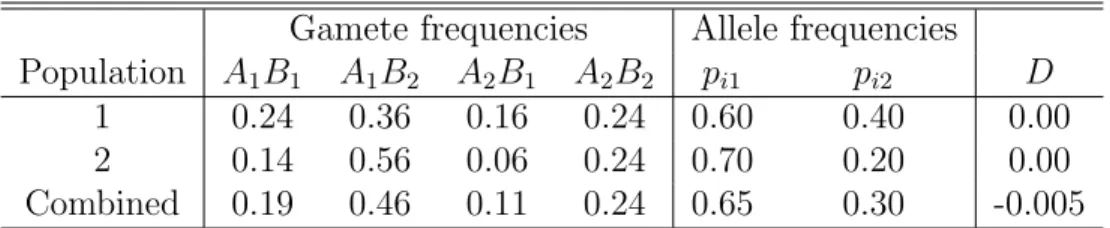
Gamete frequencies Allele frequencies Population A1B1 A1B2 A2B1 A2B2 pi1 pi2 D
1 0.24 0.36 0.16 0.24 0.60 0.40 0.00
2 0.14 0.56 0.06 0.24 0.70 0.20 0.00
Combined 0.19 0.46 0.11 0.24 0.65 0.30 -0.005
Table 1: Gametic disequilibrium in a combined population sample. = x11x22−x12x21−rD(x11+x12+x21+x22)
= D−rD
= D(1−r)
Notice that even if loci are unlinked, meaning thatr= 1/2,Ddoes not reach 0 immediately. That state is reached only asymptotically. The two-locus analogue of Hardy-Weinberg is that gamete frequencies will eventually be equal to the product of their constituent allele frequencies.
Population structure with two loci
You can probably guess where this is going. With one locus I showed you that there’s a deficiency of heterozygotes in a combined sample even if there’s random mating within all populations of which the sample is composed. The two-locus analog is that you can have gametic disequilibrium in your combined sample even if the gametic disequilibrium is zero in all of your constituent populations. Table 1 provides a simple numerical example involving just two populations in which the combined sample has equal proportions from each population.
The gory details
You knew that I wouldn’t be satisfied with a numerical example, didn’t you? You knew there had to be some algebra coming, right? Well, here it is. Let
Di = x11,i−p1ip2i
where ¯x11 = K1 PKk=1x11,k, ¯p1 = K1 PKk=1p1k, and ¯p2 = K1 PKk=1p2k. Given these definitions, we can now caclculate Dt.
Dt = x¯11−p¯1p¯2
= 1
K
K X
k=1
x11,k−p¯1p¯2
= 1
K
K X
k=1
(p1kp2k+Dk)−p¯1p¯2
= 1
K
K X
k=1
(p1kp2k−p¯1p¯2) + ¯D
= Cov(p1, p2) + ¯D ,
where Cov(p1, p2) is the covariance in allele frequencies across populations and ¯D is the
mean within-population gametic disequilibrium. Suppose Di = 0 for all subpopulations. Then ¯D= 0, too (obviously). But that means that
Dt = Cov(p1, p2) .
So if allele frequencies covary across populations, i.e., Cov(p1, p2) 6= 0, then there will be
non-random association of alleles into gametes in the sample, i.e., Dt 6= 0, even if there is random association alleles into gametes within each population.6
Returning to the example in Table 1
Cov(p1, p2) = 0.5(0.6−0.65)(0.4−0.3) + 0.5(0.7−0.65)(0.2−0.3)
= −0.005 ¯
x11 = (0.65)(0.30)−0.005
= 0.19 ¯
x12 = (0.65)(0.7) + 0.005
= 0.46 ¯
x21 = (0.35)(0.30) + 0.005
= 0.11 ¯
x22 = (0.35)(0.70)−0.005
= 0.24 .
6Well, duh! Covariation of allele frequencies across populations means that alleles are non-randomly
Creative Commons License
These notes are licensed under the Creative Commons
Attribution-NonCommercial-ShareAlike License. To view a copy of this license, visit http://creativecommons.org/licenses/by-nc-sa/3.0/ or send a letter to Creative Commons, 559 Nathan Abbott Way, Stanford, California 94305, USA.