More Precious than Gold…
Mineral Development and the Protection
of Biological Diversity in Canada
Prepared by
Environmental
Mining Council of BC
On behalf of
More Precious Than Gold: Mineral Development and the Protection of Biological Diversity in Canada © 1998 by Environmental Mining Council of BC
ISBN 0-9683841-0-2
For more copies of this publication, or to find out more about the subject matter, contact: Environmental Mining Council of British Columbia
1216 Broad St., Victoria, B.C. Canada V8W 2A5
Phone: (250) 384-2686 Fax: (250) 384-2620
E-Mail: [email protected] Internet: http://emcbc.miningwatch.org
For information on the Endangered Spaces Campaign, contact: World Wildlife Fund Canada
90 Eglinton Avenue East, Suite 504 Toronto, Ontario
Canada M4P 2Z7
Phone: 1-800-26-PANDA
Phone in the Toronto area: (416) 489-8800 Fax: (416) 489-3611
E-Mail: [email protected] Internet: http://www.wwfcanada.org
More Precious than Gold…
Mineral Development and the Protection
of Biological Diversity in Canada
THE BIG PICTURE ON MINING AND THE
ENVIRONMENT ...2
Introduction ...2
The Impact of Mining ...3
The Agenda for Change...4
BIODIVERSITY PROTECTION AND THE ENVIRONMENTAL IMPACTS OF MINING ...6
MYTH #1: “MINING-RELATED IMPACTS ARE LIMITED TO A VERY SMALL FOOTPRINT” ...7
Tenure Troubles ...7
Getting it Right from the Start...9
Compensation Questions ...10
Leave Nothing but Footprints…...10
MYTH #2: “MINING IS A TEMPORARY LAND USE...12
Infrastructure Impacts ...13
Acid Mine Drainage ...13
Accidents Happen… ...15
MYTH #3: “THE MINING INDUSTRY IS BEING CHASED OUT OF CANADA”...15
Global & Canadian Trends in Mining...15
Implications of Global Competition for Canada..17
Canadian Exploration Trends...17
Taking Stock… Linking Access to Money and Access to Land ...19
PATHS OF CONFLICT AND COOPERATION ....20
The Whitehorse Mining Initiative (WMI)...21
A Science-based Approach to Cooperation ...21
The Manitoba Cooperative Experience ...22
When the Carrot Fails… Linking Stakeholders to Shareholders ...22
ENDANGERED SPACES CONCLUSIONS AND RECOMMENDATIONS ...23
Principle 1 - Mineral Development Should Be Prohibited in Protected Areas...23
Principle 2 - Interim Protection Measures Are Required to Protect Candidate Sites...23
Principle 3 - Assessments of Candidate Protected Areas Must Consider Natural Values ...24
Principle 4 - Mineral Resource Assessments Should Proceed Under More Stringent Conditions ...24
Principle 5 - Ensure that Areas of High Mineral Potential Are Not Immediately Excluded...25
Principle 6 - Mineral Exploration Standards Must Be Broadened and Enforced ...26
Principle 7 - Governments Should Be Encouraged to Reform the Mineral Tenure System ...26
Principle 8 - The Protected Area Establishment Process Must Be Open and Transparent ...26
Principle 9 - Conservation Organizations Must Understand Their Government’s Mineral Policy and The Rationale for Protected Area Boundaries ...26
Principle 10 - Ensure That Regional Prospecting and Mining Associations Support the WMI...27
APPENDIX 1 ...28
GUIDELINES FOR A RESPONSIBLE MINE (OUTSIDE PROTECTED AREAS) ...28
The Big Picture on Mining and the
Environment
Introduction
cross Canada, those seeking to protect biodiversity and those seeking mineral wealth have often ended up looking up the same valleys…. For World Wildlife Fund Canada’s Endangered Spaces Campaign, mineral development - from exploration to mine closure - poses some unique challenges and concerns.
In the effort to complete and safeguard Canada’s protected areas system,
environmental organizations have engaged with the mining industry many times— sometimes in cooperation, sometimes in conflict.
Why conflict? Some mining projects
threaten the integrity of Canadian wild places, which are being lost at the rate of 100
hectares (240 acres) every hour. At risk from this loss of habitat are many of the 300,000
species of plants and animals that live in Canada and the ecosystems that sustain both them and us.
Over the last few decades, society has become more aware of the environmental legacy of mining. The price we pay for our everyday use of minerals is sometimes very high. Changes in laws, technologies and attitudes have begun to address some of the most immediate threats posed by mineral development. However, there are many mining policies and practices that continue to require attention and action.
This discussion paper lays out some of the primary issues and concerns, particularly from a biodiversity-protection perspective. It
provides an overview for those concerned about mining and environment conflicts, and raises questions about future directions. The Endangered Spaces Campaign helps to
conserve Canada’s biodiversity in a network of protected areas that represents natural
habitats across the
country–on the land, in our lakes and streams, and in our oceans.
The campaign seeks to protect a representative sample of each of the country’s terrestrial regions and one- third of the marine regions by the year 2000, and to complete the marine protected areas system by the year 2010.
Setting up this network of protected areas, and ensuring that the lands and waters around them are also
A
A
Caribou and other wildlife species are vulnerable to roads, habitat
loss and other mineral development impacts
Photo by Ric Carelesswell managed, provides a framework for conservation.
By saving sufficiently large and whole
examples of habitats, we save the wild species in all their diversity.
The Impact of Mining
So where does mining fit into the larger, global picture of
environmental impacts? One of the most stunning comparisons that looks at the level of global mineral activity is offered by the Worldwatch Institute. About 24 billion tons of non-fuel minerals are taken from the Earth each year. Taking into account the overburden (the soil and rock on top of the ore), the total is around 28 billion tons of material disturbed each year. This amounts to about 1.7 times the
estimated amount of sediment carried each year by all the world’s rivers combined.
Regardless of the
potential for site reclamation, this figure points to the real short- and long-term habitat
disruption concerns posed by mineral development.
The primary environmental damage from the mineral industry happens during the extraction of the raw materials. Unfortunately, our consumption of virgin mineral materials has increased at a staggering rate over the past 100 years, despite the fact that minerals are durable and can very effectively be recycled. The Worldwatch Institute reports that, while the world population doubled, the global use of minerals increased tenfold between 1750 and 1900. Since 1900, the
increase has been thirteenfold again1.
While the rate of extraction has increased over the years, the average grade of ore (percentage of useable minerals) has steadily decreased. With technology making the exploitation of lower grade deposits feasible, the result is a trend to more open pit mines, more waste and greater amounts of
disturbance per unit of mineral extracted. While technology and science may be
improving our technical ability to reclaim disturbed land, some of the
fundamental, long-term environmental questions are still poorly understood. These questions were reiterated by a recent symposium of experts on mine waste from across Canada. The experts acknowledged the high degree of uncertainty regarding the prediction and treatment of serious long-term mine pollution problems such as Acid Mine Drainage.2
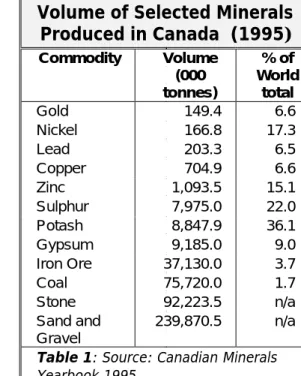
The figures in Table 1 illustrate selected primary products produced by the Canadian mining industry. The figures do not, however, represent the total amount of material removed or disturbed in the process of mining. The tonnage includes only the commodity that is the final
commercial product of the mining process. With a mineral like copper, average grades mined in Canada are under 1%. This means that 99% of the material mined is waste. This waste may be in the form of waste rock or the finely ground “tailings” left after the ore has been extracted. Typically, the amount of gold per tonne of material disturbed is even less.
Volume of Selected Minerals
Produced in Canada (1995
)
Commodity Volume
(000 tonnes)
% of World
total
Gold 149.4 6.6
Nickel 166.8 17.3
Lead 203.3 6.5
Copper 704.9 6.6
Zinc 1,093.5 15.1
Sulphur 7,975.0 22.0
Potash 8,847.9 36.1
Gypsum 9,185.0 9.0
Iron Ore 37,130.0 3.7
Coal 75,720.0 1.7
Stone 92,223.5 n/a
Sand and Gravel
239,870.5 n/a
Table 1: Source: Canadian Minerals Yearbook 1995
As a result, the Canadian mineral industry generates one million tonnes of waste rock and 950,000 tonnes of tailings per day, totalling 650 million tonnes of waste per year.3 If you
figure that an average dump truck carries a load of around 20 tonnes….
In Canada today, there are roughly 90 metal mines, 33 coal mines, and over 300 “industrial mineral” operations that include sand and gravel, stone, gypsum, potash, etc. Government forecasts suggest that over the next several years an average of 20 new mines (including metal, coal and industrial metals) are likely to be opened
annually across the country. As will be discussed later, the potential impacts of the different stages and types of mineral development range well beyond the final hole in the ground. In trying to understand the effect of a mine, it has to be considered from the initial exploration phase through to its closure. And it must be understood as being at the centre of a complex energy, water, processing and transportation infrastructure.
The impacts must be understood in both economic and ecological terms.
According to the Mining Association of Canada, the current cost of cleaning up the legacy of thousands of past and current mines across Canada is $6 billion.
Each stage of the mining process has the potential for different impacts of various degrees (see Environmental Considerations in Mining, below). The impacts depend on a variety of factors including the sensitivity of local terrain, the composition of minerals being mined, the type of technology employed, the
skill, knowledge and environmental
commitment of the company, and finally, our ability to monitor and enforce compliance with environmental regulations.
The potential conflict between the
Endangered Spaces commitment to protecting biodiversity and mineral development starts with the land use competition between protected area candidates and sites with valuable mineral potential.
Other concerns arise if ecologically important “buffer” areas adjacent to established protected areas suffer impacts
from mineral development. Impacts can range from the degradation of water or air quality to the loss of important wildlife corridors and
destruction of critical habitat areas.
The Agenda for
Change
The growing popular and scientific awareness of the principles of conservation biology demands a broader joint commitment from industry, government and the public to protect the
connections and components throughout each ecosystem.
Important first steps in this direction were undertaken by representatives from different stakeholder groups who came together at the
Whitehorse Mining Initiative, a national forum on the future of mining held in 1992-1994. All sectors agreed that the future health of our economy relies on following conservation principles, including the establishment of a secure, representative protected areas network (see Whitehorse Mining Initiative, below).
Acid mine drainage is a serious
threat to surface and groundwater
With some notable exceptions, however, much more work needs to be done by all sides before harmony can be achieved between interests of mineral development and biodiversity conservation.
To work toward the goal of protecting ecological integrity while fulfilling our social demand for mineral resources we must, a) protect representative
examples of biological diversity throughout each of Canada’s ecoregions,
b) understand the specific ecological risks and uncertainties posed by different mining projects,
c) address the risks with reliable regulatory safeguards that provide industry with clear and strong incentives for sound
environmental management and, d) consider means to (re)use our minerals
more efficiently so that we maximize the use of this non-renewable resource. There is a need for a clearer public agenda on when, where, and under what conditions mineral development may be acceptable. Such an agenda reminds decision-makers that minerals are a public resource belonging to all Canadians, to be exploited in a manner that complements our larger public needs and not simply the demands of investors.
Integrating mineral development into a sustainable economy and environment requires protection of the public from the ecological liabilities caused by irresponsible and inappropriate mineral development.
The long-term legacy of toxic mine waste, and the disruption of ecosystem-based planning by the antiquated mineral tenure
systems that persist across Canada, will continue to pose threats and challenges to environmental sustainability. The precautionary principle, which is at the root of Endangered Spaces Campaign and is endorsed by all stakeholders in the Whitehorse Mining Initiative, has yet to be implemented.
This said, it is critical to acknowledge the importance mining plays in many regional
economies and the fact that we use metals constantly throughout each day of our lives. The value of non-fuel mineral production in 1995 was $19.3 billion, with mining, concentrating, refining and fabricating activities
producing about 4% of the GDP. It is a fact that this central part of the non-renewable resource sector can and will
continue to be an economic force in many regions of Canada for the foreseeable future.
Furthermore, simply exporting our industry and its impacts overseas is neither ethically nor economically desirable. Sending mining
companies off to largely unregulated southern nations would be applying the NIMBY (Not In My Back Yard) syndrome at a global level.
A larger challenge is how we use our
mineral resources more safely and sustainably, reduce our consumption of non-renewable resources, increase our “mineral efficiency”, and minimize the short and long-term impacts of mining. While this is an interesting and vital area of policy, it goes beyond the scope of this discussion paper. For those interested in pursuing this area of resource policy and strategy, the Worldwatch Institute and others have begun this discussion in a series of essays on resource efficiency.
“There is a need for a clearer public agenda on
when, where, and under what conditions mineral
development may be acceptable.”
Biodiversity Protection and the
Environmental Impacts of Mining
hile there have been many
improvements in mining practices from “the bad old days,” significant
environmental risks remain. Negative impacts vary from small-scale habitat disruption of trenching in exploration through to large-scale and long-term threats posed by mine waste and tailings after closure (see Environmental
Considerations for Mineral Development, below). In the right place - and with the right
company, new technologies and some good planning - many of the potential impacts are avoidable. History has shown that good
environmental performance is most likely when you have:
• the cooperation of sound regulations,
• freedom of information,
• a responsible company and labour force, and
• an informed, effective public.
When these factors are in place, there is accountability and transparency built in to the operation (see Appendix 1: “Guidelines For a Responsible Mine”).
Unfortunately, this ideal world is still far from being implemented, and there are a number of trends that currently threaten progress to the goal of environmentally appropriate mineral development.
Some of the primary areas of concern include
• limited public capacity for independent and equitable participation in development assessment processes,
• ongoing uncertainty in assessing cumulative effects and long term toxins problems of mining through the Environmental Assessment process,
• significantly reduced government resources/capacity for monitoring and
enforcement of existing environmental regulations resulting in significant compliance problems,
• the current trend toward environmental deregulation, which is seen by many analysts as an erosion of public safeguards and corporate accountability,
• increased competition for mineral investment, which has resulted in reduced leverage and weighting of environmental and social issues.4
These conditions, which undermine the integrity of environmental regulations and assessments, magnify the need for full protection of critical ecological areas.
Even if our regulatory system were working well to protect the environment, there are some places where mining, or any industrial activity, is simply inappropriate.
As noted above, all stakeholder groups in the Whitehorse Mining Initiative (WMI)
acknowledged this fact. Industry, conservation, labour and First Nations delegates agreed that,
“Protected areas networks are a
fundamental part of the sustainable balance of society, economy and environment…. [O]ur goal is to create and set aside from industrial development by the year 2000 those protected areas required to achieve representation of Canada’s land-based natural regions.” (WMI Accord)
On the remaining unprotected landscape that surrounds these vital areas, a challenge we face as conservationists and consumers of mineral products is to know where, when, and how it is possible to have environmentally sound mining operations.
In dealing with the land use and ecological
W
W
protection issues around mining, there are a number of claims and assumptions that are common and often repeated by mining
advocates. Clearly anyone engaged in this issue must be prepared to test the validity of these
assumptions on a site by site basis. The following is a discussion of just three of these claims and what they mean for biodiversity protection efforts.
Myth #1: “Mining-related impacts are limited to a
very small footprint”
ining promoters often point to the relatively small size of a mine as a measure of its ecological impact. And on the surface the argument sounds convincing. After all, what’s a hole in the ground compared with a 1,000 hectare clear-cut?
However, the mine site itself is just one point in a long line of activity before and after the digging starts. It is also at the centre of a geographical web of transportation routes (roads/barges/air access routes), energy infrastructure (dams/power lines), tailings ponds, waste rock piles, and processing plants (see Table 3, Environmental Considerations for Mineral Development).
The impacts of mining begin, as many protected areas activists are only too familiar, with the claim staking process. In itself, staking a claim does not necessarily disturb the land. It may be done by helicopter or even by mapping. However, the act of staking a claim is a kind of tenure that may jeopardize and take precedence over other land uses.
Tenure Troubles
Eight out of ten Canadian provinces, as well as both Territories, have a “free entry” tenure system. (Only PEI and Alberta use a
discretionary mineral tenure system.) The free entry approach was developed in Europe in the 1500s, largely to serve the military needs of warring noble clans.5
The general principle is that the Crown’s
mineral resources are available on a first come, first served basis; those who seek minerals are permitted to explore and claim tenure of the sub- surface rights for that purpose. Individuals engaged in mineral exploration register as “Free Miners” and are charged little or nothing for the rights of access and tenure to the public
resource.
The concept was brought into law in England in the 18th century and was carried with
Europeans to manage gold rushes in California and eventually British Columbia, where the colony’s first mining law, establishing a free entry system, was enacted in 1859.
In North America, the free entry tenure played a role as an incentive for opening up new land for settlement and development. This is still the case in remote areas. In northern British Columbia, for example, the Tulsequah Chief copper mine in Northwest BC could be the catalyst for major, and likely irreversible, changes to a region that is currently without roads, development or land use plans.
Areas like this are used extensively by less visible renewable resource users, including First Nations, guide outfitters, recreational and commercial fishers and backcountry tourism operators. None of these legitimate land users enjoys the privilege of tenure in the way a mineral exploration company or prospector does.
• While it varies to a certain degree across Canada, this system universally accords free miners
• the right of entry and access to lands which have mineral potential, and
• the right to locate and stake a claim without consultation with other resource users.
•
These rights are unique to mining and are seriously out of place in today’s complex land management challenges. They allow one interest group to frustrate others that are subject to a more modern discretionary tenure system.
A discretionary system, such as that often used for oil and gas or other natural resources, affords the opportunity to consult and have some measure of community control over the pace and location of
development. This is
particularly true in sensitive areas, and those areas on which other users rely for economic reasons, such as guide outfitting and
fisheries.
Given the increasingly complex demands and concerns for the public land and water, a free entry system is an anachronism.
Based on the notion that minerals are rare, unpredictable and unmovable, free entry gives precedence to minerals over other kinds of resource development and/or protection. A modern addition to the free entry rationale is that exploration is benign, or non-consumptive, and thereby worthy of special status.
This line of argument runs into a variety of problems in the real world. First, it is abundantly clear that the habitats of many threatened and endangered species are at least as rare, certainly no more movable, and much more subject to irreparable damage than mineral deposits.
Second, while the ecological footprint from
individual exploration projects may be small, the cumulative impacts of exploration can be
extensive. If, as the industry suggests, the ratio of exploration programs to successful mines is 1,000:1, this means considerable human activity, machinery and fuel being transported into a broad area of backcountry by road or by air.
In 1995, the total amount of land staked for new mineral claims was almost 16 million
hectares (see Table 2). This was then the fourth highest total on record. Thirty-nine percent of the exploration activity was in Newfoundland, 24% in Northwest Territories, and 11% in Alberta.6 This
staking activity is part of a cyclic process of investment that will continue to fluctuate regionally, subject to a variety of influences, ranging from geological research and commodity prices to government tax incentive programs.
In the recent staking rush in Voisey’s Bay, Labrador, over 250,000 claims were staked, involving over 100 companies. The NWT experienced a similar frenzy of activity with its diamond rush. Both events were fueled as much by stock market speculation as
geological assessment. Both rushes had disruptive effects on native land claims, protected areas and other interests not
associated with speculation and exploitation of minerals.
Controls on exploration activities and of these kinds of impacts could and should be better-integrated into tenure systems.
Unfortunately, the current free entry tenure system continues to create complications and uncertainty. The lack of balance and integration with other interests restricts the opportunity to make wise land use decisions that meet all
New Mineral Claims
Staked in Canada
Year Area Staked
(ha.)
1989 5,063,569 1990 4,998,490 1991 5,398,340 1992 32,886,339 1993 27,003,430 1994 15,855,435 1995 15,772,035 Table 2: Source: Canadian
needs (see Endangered Spaces Conclusions and Recommendations, below).
Getting it Right from the Start
Governments, industry and environmentalists should be looking seriously at how to reduce mining and environment conflicts early in the process. With adequate education, regulation and technology, modern practices could prevent much of this conflict in the future.
Opportunities to reduce impacts and encourage more extensive use of “green” exploration practices include:
• restructuring tenure to consider other land use priorities,
• minimizing the construction of ground access routes wherever possible,
• identifying and mitigating for ecologically sensitive areas during exploration permitting,
• prohibiting outdated, destructive exploration practices
• creating incentives for the use of advanced sensing and testing technologies, and
• linking tenure rights with environmental performance.
In addition, there is the need to use mineral staking restrictions or “interim withdrawals” in selective cases where protected areas are being considered. By using staking withdrawals to limit
exploration activity until the planning process is completed, governments can avoid cost and confusion for all stakeholders.
Creating a level playing field for the assessment of different potential land uses is critical to sound decision-making for public resources.
The Whitehorse Mining Initiative Accord
notes that “the granting of permits and environmental assessment are made more difficult [where] issues of compatibility and suitability of land uses have not been addressed. Dealing with the land use questions early
through effective land use decision-making process will enhance the quality and efficiency of other related processes.”7
A disturbing development away from this kind of level playing field is found in the current move to deregulation and industry
self-regulation in many regions of the country. From one perspective, this move is a positive sign that some in industry are adopting environmental codes of conduct, and are being encouraged to take more responsibility for environmental standards. However, these policies are of limited comfort as they bring no mechanism for public accountability, are open to broad interpretation and are not applied consistently across the landscape.
An example of the trend reduce regulation is the loss of public involvement and permitting control over exploration access construction, trenching and drilling in Ontario. This kind of deregulation increases the potential for damage to the environment and to wilderness-based economies from mineral exploration and development.
In the long run, such an approach to
managing our public resources poses risks to the industry as well. It allows less responsible
operators to create the kind of damage that will invoke a broader backlash, which will be felt by the industry as a whole.
What is needed is a clear, fair and
environmentally sound system for permitting
Exploration camp and access roads
exploration activities that will address the need for ecological as well as mineral wealth.
Compensation Questions
It is important to note that there are limits to the rights granted free miners under the
Canadian legal system. Industry references to mineral rights as “property rights” obscure important factors that affect the public right to cancel or expropriate mineral exploration claims where doing so is in the public interest.
According to the Sierra Legal Defence Fund (SLDF) Report on Compensation Issues
Concerning Protected Areas,
Rights to public resources such as mineral claims are contractual in nature; and are received subject to limitations which are inconsistent with traditional views of the
“right of property.” … It is neither useful nor accurate terminology to refer to policy changes in allocation of public resources as “takings.” … In Canadian law, changes in public policy which affect land values or business interest do not, as a matter of law, require compensation… most corporate claims to compensation are not based on existing legal rights; …Public rights have as much status as private rights at this level.8
The limited nature of mineral rights establishes an important base from which to discuss and settle disputes over mineral exploration claims. Public right and corporate right need to be put into appropriate balance. To ensure balance and fairness in public policy, SLDF recommended, as did the Whitehorse Mining InitiativeAccord, that some level of compensation should be considered in land use decisions involving cancellation of mineral exploration tenure in good standing. This compensation could be considered as a matter of policy, even if it is not legally required.
SLDF suggests that, where it is warranted, fair compensation should be received for investment dollars less depreciation. Any damage done to public resources should be deducted and mitigation of these effects should be required. Compensation should not be paid for future profits, nor should “the public be forced to buy back its own assets.”
Leave Nothing but Footprints…
Mineral development includes a broad range of activities, from exploration to closure, which may occur over several decades. The potential impacts range from the most benign
technologies for airborne surveys, to some of the most persistent and highly toxic industrial waste sites in the world.
Improvements in mitigation technologies and techniques have been significant in recent years. Nevertheless, significant uncertainty remains about controlling impacts from many aspects of mineral development—from our ability to
manage unauthorized access on exploration and mining roads, to the well-documented scientific uncertainty of Acid Mine Drainage (AMD) prediction and prevention.
Even before a mine gets established, there are “footprint” concerns. A notable example is found at the Windy Craggy site, in the heart of the Tatshenshini-Alsek World Heritage Site. There, independent research has confirmed that the pH levels in streams draining from the
Windy Craggy, once site of a proposed copper
mine and now in the Tatshenshini-Alsek
World Heritage Site
Photo by Ric Carelessentrance of the “bulk sampling” tunnels or adits and the exploration waste rock piles are already dropping, proof that the AMD process has been accelerated by exploration activity.
From a protected areas perspective, the experience at the Myra Falls copper mine in Strathcona park in BC graphically illustrates the problems of mineral development. Bob Ahrens, former parks director for Strathcona says:
“What harm is a ten acre mine in a park of 500,000 acres? Let me tell you about a 10-acre mine in one provincial park. This requires a hydroelectric power development (or power poles into the park), a tailings disposal site, a mining mill site, mill effluent disposal sites, many roads, a camp, barge shipping and tugs on a major lake, loading out works, then a highway through the park (along water grades) all for just a starter.
Environmental Considerations for Mineral Development
Development
Phase Potential Activities Environmental Issues (subject tomitigation/prevention measures)
Preliminary
Exploration airborne and ground-based geochemicaland geophysical surveys, prospecting, map staking
land alienation from protection options
Advanced
Exploration claim staking, line cutting, stripping,drilling and trenching, road/trail building and/or helicopter transport, bulk
sampling
trail/road and trenching erosion, access-related over harvesting and fishing, habitat disruption, noise pollution, acid mine drainage
Mining and
Milling environmental impact assessment, minedesign and construction, stripping/storing of “overburden” of soil and vegetation, ore extraction,
crushing/grinding of ore, flotation or chemical concentration of ore, mine and surface water treatment, storage of waste rock and tailings
wildlife and fisheries habitat loss, changes in local water balance, sedimentation,
containment of toxins in tailings ponds and/or leaching solutions, tailings ponds or leaching pads stability failure, potential acid generation from waste rock and pit walls, heavy metal leaching from acid mine drainage, cyanide solution containment at heap leach operations, wind borne dust
Smelting and
Refining processing of mineral concentrate byheat or electro-chemical processes sulphur dioxide emissions contribute to acidrain, toxic chemical (e.g., ammonia, sulphuric acid) use for processing, high energy
requirement Mine Closure recontouring of pit walls, and waste
dumps, covering of reactive tailings dumps, decommissioning of roads, dismantling of buildings,
re-seeding/planting of disturbed areas, ongoing monitoring and possible water quality treatment
seepage of toxic solutions into ground and surface water, water contamination from acid mine drainage, wildlife and fisheries habitat loss, revegetation failure, wind borne dust, slope and tailings impoundment failure
That 10 acre hole influences 100,000 acres of the choicest part of the park.”
The Myra Falls mine, a relatively modern underground operation, underscores the inappropriateness of industrial activity and the resulting impacts associated with
infrastructure.
Conflicts have arisen over noise, water quality, and visual impacts over the course of 30 years. Various areas of the park have been opened up for exploration and development.
The presence of the mine has necessitated decades of local protest and advocacy to try to control the impacts on the ecological integrity of the park.9
There have been ongoing concerns about mine expansion plans and hazardous waste management. Even when it is finally closed, the mine’s acid-generating tailings, located in a seismic fault zone, will require long-term treatment and maintenance.
Beyond the direct impacts of mining inside parks, there is the question of impacts from “upstream” development. Contemporary examples include:
• concerns over the potential for pollution from the New World mine that was proposed beside Yellowstone National Park
• habitat destruction from the Cheviot Mine adjacent to Jasper National Park, Alberta.
These are classic examples of the need to look beyond the
boundaries of protected areas to see how they relate to the broader landscape.
In cases where water, wildlife or fish travel across protected area borders, a transition corridor or “buffer zone” may be required. Conservation biologists have recognized that limiting harm to these transboundary resources is essential to ensure the long-term health of core protected areas.
What can happen to protected lands if a poorly designed and/or under-regulated mineral development occurs in adjacent areas? Table 3 (below) summarizes potential environmental issues and concerns arising at the different stages of mineral development.
Appendix 1 lists some approaches to mine design that can assist in mitigating the identified concerns, in the short and long-term.
Myth #2: “Mining is a temporary land use
any proposed mines have projected lives of a few decades or less. To industry spokespeople, this fact alone ensures that impacts will be short-lived. Why make a big fuss over a mine that’ll be closed and reclaimed practically before you know it’s there?
While in many cases mining can be a
temporary use of the land, this clearly has not always been the case. The lasting ecological footprint of irresponsible mining can be measured in many ways.
Perhaps the two greatest and most long lasting impacts from mining are:
(a)habitat destruction and increased access from construction of infrastructure (mine waste impoundments, transportation and energy corridors), and
(b)the effects of Acid Mine Drainage on fish, wildlife and water quality.
It is also the case that accidents happen, often leaving impacts that last long after the mine owners move their investments somewhere else.
M
“The Myra Falls mine… underscores the inappropriateness of industrial activity and
the resulting impacts associated with infrastructure.”
Infrastructure Impacts
The potential for lasting impacts from
mineral development must be assessed in light of substantial requirements for power, water and transportation routes.
Mining (excluding the iron and steel industry) consumes 14% of all industrial energy used across Canada. In northern regions, where human population is sparse, mining operations often account for
considerably more of the regional power demand. Over the past decade, the industry has increased its energy intensity (use of energy per unit of material produced) by 13%, rather than reducing it.10 Its energy demands
are second only to the pulp and paper
industry. These massive energy requirements are met with hydroelectric, coal and natural gas power through the use of dams, thermal generating stations and pipelines.
In terms of landscape-level and site-specific biodiversity protection efforts, these power systems pose serious, long-term concerns.
Roads cause a variety of impacts, not the least of which is opening up intact wildlands to a range of development. While historically this may have been a useful function, the
pressures on biodiversity and the changing
nature of environmental values challenge the usefulness of this strategy. The historical and current effects of increased road access include habitat fragmentation, erosion and
stream sedimentation, wildlife disruption, overharvesting, and toxic waste spills.
The effectiveness of policy and regulation for road site planning, access management and decommissioning remains weak and inconsistent across Canada.
The role of energy and transportation corridors as a catalyst or stimulant for incremental development is well
understood but poorly incorporated into our assessment of cumulative impacts on the landscape. More work must be done to incorporate these issues into land use planning.
Acid Mine Drainage
Industry, labour, government, and
environmentalists agree on the seriousness of Acid Mine Drainage (AMD). It is the number one environmental problem facing the mining industry. There is no dispute that AMD
• devastates fish and aquatic habitat,
• is virtually impossible to reverse with existing technology,
• costs millions of dollars annually to treat, and
• can continue for centuries.
AMD occurs when sulphide-bearing minerals in rock are exposed to air and water, changing the sulphide sulphur to sulphuric acid.
This acid dissolves heavy metals such as lead, zinc, copper, arsenic, selenium, mercury, and cadmium into ground and surface water. Certain naturally present bacteria can
significantly increase the rate of this reaction. AMD and heavy metals pollution can poison ground and drinking water and can destroy aquatic life and habitat. Ore bodies commonly
A mine is more than the hole in the ground… It is the
center of a web of developments.
Photo by Laura Duncanmined that pose AMD risk are gold, silver, copper, iron, zinc, lead (or multi-metal combinations) and coal. Acid mine drainage can develop at several points throughout the mining process, in underground workings, open pit mine faces, waste rock dumps, tailings deposits, and ore stockpiles.
Acid generation can last for decades, centuries, or longer, and its impacts can travel many miles downstream. There are Roman mine sites in Great Britain that continue to generate acid drainage 2,000 years after mining ceased.
There are many Canadian examples. The Equity Silver Mine in BC is a classic example validating public concerns. Despite the best
efforts and experts
working on it, Equity Silver will need pollution control measures applied for the next five
centuries. If
these measures fail, the heavy metals and acidic drainage will affect the Bulkley and Skeena River system, one of the
richest salmon systems in BC.
In BC alone there are 26 known
generating mine sites and 20 potentially acid-generating sites (see map this page).
According to the BC State of Environment Report, there are currently 72 million tonnes of acid generating tailings and 250 million tonnes of acid generating waste rock. This figure is increasing by some 25 million tonnes per year.
In speaking to the historical legacy of mining in the US, Albert Gilbert reported to the American Mining Congress in 1988 that,
“Mining waste cases typically span very, very large areas... what you’re talking about is the
entire environment. The problems are typically larger than in an average Superfund [national environmental clean-up program] hazardous waste site.”
Larger, and more expensive…. The Financial Post reported that, in Canada, the "Acid
drainage at existing mining operations in Canada is considered to be the most serious environmental threat, with federal estimates of clean-up costs between $2B and $5B."11
Even a small mine can have an enormous ecological and economic cost. On the Tsolum River, for instance, a small three year, 13 acre mine has ruined a $2 million annual fishery and will cost
millions more to fix.
Fisheries officials identified AMD as the leading cause of a 90% reduction in the salmon fishery. Despite major
clean-up efforts, there is just as much copper in the water, a
substance deadly to salmon, as there was when clean-up efforts started
a decade ago. According to a recent BC Water Quality
Branch report, fisheries rehabilitation efforts have yielded near
complete failures. The broadly recognized scientific uncertainty surrounding AMD prediction and treatment, combined with its potentially
devastating long term effects suggest the need for a strongly pre-cautionary approach to the development of such mines. The WMI Accord
endorses the precautionary principle, noting that,
“In the past, arguments over the need for
scientific certainty delayed action in situations where it was required. For sound
environmental decisions to be made during the life cycle of a mine complete certainty is not a prerequisite to appropriate action to protect the environment where risk of serious adverse impacts to the ecosystem are evident.”
To protect biodiversity, the application of the precautionary principle to effective assessments, policies and regulations
concerning AMD is of fundamental importance.
Accidents Happen…
Precaution is essential when dealing with mineral developments because of the high costs of mistakes. The deceptive “temporary footprint” argument does not capture
environmental realities, past or present. Unfortunately, there are many recent high profile examples of mine failures by Canadian companies that have underscored public and environmental risk:
• Placer Dome’s Marcopper disaster in the Philippines involved a major tailings failure that resulted in the massive sediment
loading to the Boac River, mine closure and the arrest of senior officials.
• Cambior’s Omai mine released a major cyanide spill into the Essequibo River, an accident in which Canadian engineering firms have been accused of negligence.
• Curragh’s Westray coal mine resulted in the death of over 20 Nova Scotians, and
• Galaxy’s Summitville mine left the U.S. Environmental Protection Agency holding a $100M clean up bill.
• Boliden’s Los Frailes mine, adjacent to Donana National Park in Southern Spain, spilled acidic and heavy metal tailings in 1998, contaminating 5,000 hectares of farmland and devastating Europe’s largest wetland.
The reality of mineral development is that it is a very high stakes game. When mistakes happen, there is the risk of serious and long-term damage due to the scale and nature of the mining process.
Safeguards must be in place to ensure that the short- and long-term risks are thoroughly assessed and that, where mining occurs, the costs are not offloaded to the public and the environment.
Myth #3: “The mining industry is being chased out of
Canada”
n the wake of the 1993 Tatshenshini decision, the push for completion of the protected areas system, integrated land use planning efforts and land claims settlements, it has been claimed that the mining industry is being driven out of Canada.
The public relations campaigns sponsored by industry associations claim that the industry is “on the rocks” and that we need to grant regulatory, land use and other concessions to companies seeking to “keep mining in Canada.”
Despite this lobby effort, the reported
economic performance in the Canadian mining industry during this period has largely been significant increases in employment, profits, capital investment, returns to shareholders, and exploration investment.
Global & Canadian Trends in
Mining
The reality of the mining industry has always been “boom and bust.” It is a highly cyclic
industry, with economic peaks and troughs that are traceable more to financial factors such as the price of copper or gold (and to the whims of stock promotion—see “Taking Stock”, below) than to any “unfavourable” land use decisions.
Modern mines require very large capital flow and investment to continue operations. As a result, small fluctuations in the value of the ore being produced, or in the cost of borrowing money, can make or break a project. The 1997 downturn in the price of gold, for example, is said to have threatened the economic feasibility of some 40% of the world’s
gold mines.
An illustration of this reality is found in looking at the recent industry performance in British Columbia. The worst economic year in the last decade for the mining industry in BC was in 1990, when the industry lost $1 billion. (Notably, this was three years before Windy Craggy.) This loss was due to a combination of fallen
commodity prices, unfavourable interest and exchange rates, and increased investment interest in newly stabilized southern countries such as Chile, Mexico and Venezuela.12
The mineral exploration and
development expansion in southern nations is part of a global phenomenon. Factors pushing this expansion include:
• the availability of rich, relatively untapped mineral deposits,
• lower production costs and
• fewer regulatory hurdles.
Canada is by no means alone in witnessing this phenomenon of offshore interest. The globalization of investment is a critical factor that has affected all the major mining nations, including Australia, the U.S., and South Africa. An example of the bigger picture of some of
the shifts in investment can be seen in changes in gold production, where Canada has fared very well compared to the rest of the leading mining nations. The Northern Miner, an industry journal, reported that restructuring of the gold production capacity throughout the world as of 1995 had resulted in Canada losing 2% of its gold production to newly developed mining regions in the south. This figure compares to South Africa, which was down 15%, Australia, down 8% and the US, down 5%. 13
As explained below, this trend is part of a
global restructuring. However, it does not mark an abandonment of countries like Canada by the mining industry, despite claims to the contrary by some industry spokespeople. In the last several years, Canadian mining companies have expanded exploration and development activities both domestically and internationally. The
industry, including large and small companies, has interests in over 8,300 properties worldwide. Of these properties, 3,400 are in 100 foreign countries.14
In March 1997, TheNorthern Miner’s editorial noted that many companies are “coming around to the view that Canada might not be so bad after all. Companies have learned that it is no
Highland Valley copper mine near Kamloops, BC
picnic exploring in regions where there are no roads and no infrastructure; nor is it easy negotiating deals in countries where there is no legal framework to protect business
agreements.”15
Nothing illustrates this tangle of foreign speculation and the hazards of offshore
investment better than the recent Bre-X fiasco, which ensnared so many Canadian mining experts and investors.
Beyond the economic issues that drive much of the global competition agenda, an important factor that must be considered is that, although some developing countries have broad
environmental laws, effective, regulation of the minerals industry is rare.
Where apparently progressive laws do exist, as in Chile, these rules are often not enforced. In a recent World Bank report on the state of Chile’s regulatory environment, it is noted that although standards for water quality are “in line with World Health Organization standards,” there is “no systematic enforcement of these standards.”16
These realities put into a more balanced context the fuller costs and benefits of industry’s demands for concessions around environmental regulation and land access in Canada.
In terms of biodiversity protection and human health, not to mention sustainable economies, the demand for public concessions for private “global competition” will continue to have costs both inside and outside of Canada.
Implications of Global
Competition for Canada
Despite major shifts in the industry, the news is hardly bleak even in areas such as BC where resource conflicts are often highly publicized.
According to the Natural Resources Canada Mineral Yearbook, in 1995 three times as many mines opened as were closed across Canada.
Contrary to all the gloomy predictions made by some mining spokespeople, even after all the land use processes and after 2.5M hectares of new protected areas, the BC mining industry registered record-high mineral production, and significant increases in both mine development and exploration.
In fact, the Price Waterhouse report
commissioned by industry reported three years of increased revenues, earnings and investment between 1993 and 1996.17 Only in 1996 did the
industry see moderately reduced returns largely due to slumps in the prices of some key
commodities, especially copper and gold. Some relevant figures:
• Net revenues were up from $1,741M in 1993 and to $2,694M in 1996.
• Earnings soared from a loss of $14M in 1993 to a gain of $208M in 1996.
• In 1995, solid mineral production reached a record-high gross of $3.48B.
• According to a survey of the whole industry (not just some of the majors as reported by PW), exploration investment, including majors and juniors, was at $66M in 1993 and is estimated at over $126.3M for 1996.
• There are 7 mine expansions are currently in the assessment and permitting process. 18
Canadian Exploration Trends
According to the Prospectors and Developers Association of Canada, investment in worldwide exploration boomed in the 1990s.19 Relative to
all other nations in the world, Canada has consistently ranked among the top four destinations of mineral exploration, and has swapped either first or second spot with Australia since 1980.20
During the last five years, exploration
increases have been fueled by a combination of generally favourable metal prices and the diamond exploration boom in Canada’s North that has accounted for nearly 20% of all
investment. Aside from the direct environmental impacts of potential mines, it is a telling
comment on our society at large that the frenzied search for the luxury status symbol of diamonds has been able to take such
precedence over completion of protected areas and land claims in the North.
The fluctuations in mineral exploration investment (see chart below) are notable for their characteristic peaks and
troughs. Some industry lobbyists have pointed to the trough of the early 1990s as an indication that mining is on the rocks, and that protected areas efforts and other regulatory and land use burdens are driving investment out of Canada.
By contrast, there are two notable peaks (in the early and late 1980s), that are often referenced by the industry as
indications of legitimate and desirable exploration levels.
The earlier peak from 1980-82 can be largely attributed to high prices in gold, silver and copper.
The peak in 1987-1988 coincides with a
particularly ill-conceived tax incentive program (the Mineral Exploration Depletion Allowance) using flow-through shares to stimulate the use of mineral exploration programs as a tax shelter. This program has undergone thorough
government review and has been found to have virtually no effect on discovery of mineral reserves. It resulted instead in a high degree of
wasteful and ineffective exploration efforts. It can be better characterized as a failed policy experiment than a desirable resource management target.
When accounting for these anomalies, it is clear that
exploration has and will continue to fluctuate over time. The claims of mining investment being driven out of Canada ignore or downplay these fluctuations to bolster the drive for regulatory and taxation concessions. The data show that economic factors and regional exploration and development “rushes” will continue to dominate investment patterns much more than environmental regulatory factors. Scapegoating environmental and protected areas decisions for these peaks and
“…it is a telling comment on our society at large that the frenzied search
for the luxury status symbol of diamonds has
been able to take such precedence over completion of protected areas and land claims in
the North.”
0 200 400 600 800 1000 1200 1400 1600 1800
1969 1970 1971 1972 1973 1974 1975 1976 1977 1978 1979 1980 1981 1982 1983 1984 1985 1986 1987 1988 1989 1990 1991 1992 1993 1994 1995 1996 Year
$ Millions
troughs, as has been done too often in the past, is a sign of disrespect for the facts and an unwillingness to seek meaningful solutions.
Taking Stock… Linking Access
to Money and Access to Land
In trying to understand the mining industry— what drives and potentially stops undesirable developments—it is important to look at the role of venture capital and stock markets in financing exploration.
There is a complex and often troublesome relationship between geologists in the field, stock promoters (who, as was shown in the case of Bre-X, often know very little about the
realities of mining), shareholders, and the communities that live with exploration and development impacts.
This relationship is generally lost in the business focus on share prices, but connecting the source of cash to human and ecological costs can be a very powerful tool for gaining the attention of companies.
Why and how are stock markets so closely linked to mining? Due to the financial risks associated with mineral exploration, smaller ‘junior’ mining companies typically are unable to raise exploration funds from banks. They
therefore rely heavily on equity investment, through either public financing or joint ventures with larger mine companies.
Hence the common industry refrain, "we are not in the business of mining ore, we mine money."
For a variety of reasons, Canada is
considered a world leader in both mine financing and geological expertise.21 Due to financial and geological successes over the years, Canadian junior mining companies have attracted a very large pool of capital. Over the past five years, in excess of $4 billion has been raised on the
Vancouver Stock Exchange (VSE), primarily for small and medium-sized mining companies. In 1994, some 20% of the world's exploration capital driving junior companies came from the VSE alone.22 The largest percentage of this expanding area of investment money went (and continues to flow) to Latin America.
In 1996, it was estimated that half of the global exploration dollars were raised in
Canadian venture capital markets (including the VSE and the Toronto Stock Exchange).
According to Toronto stock expert John Embry, "We're going into a worldwide mining boom with the development of Third World economies... so this isn't the last inning of the game."23 This buoyant optimism has been somewhat tempered in the post Bre-X caution and skepticism around speculative financing of mineral exploration, and the downturn in key commodity prices like copper and gold.
For many years, the VSE has been synonymous with the financing of junior mining companies around the world. More recently, thanks to financial successes like Voisey’s Bay as well as frauds such as Bre-X, the more conservative Toronto Stock Exchange is also gaining notoriety for exploration financing.
Since the late seventies, the VSE has also been infamous as a high risk, scandal-ridden institution that Equity Magazine has called "the Sodom and Gomorrah of modern-day financial markets."24 Recent corruption problems underscore the chronic speculation, greed and deception that drive the market.25
Over 100 companies attempting to cash in on the Voisey's Bay nickel rush in eastern Canada raised their capital on the VSE. According to The Globe and Mail, dozens of companies racked up big share price gains (500-900%) without drilling a single hole...26 The big winner in Voisey's Bay was Robert Friedland, who sold his interests for $4.3 billion to Inco.
Friedland's DiamondFields company was on
A common refrain in
the industry states that
“we are not in the
business of mining ore,
the leading edge of the huge Voisey's Bay discovery. It made him a billionaire when he sold it to Inco Ltd., but the ensuing staking rush left over 250,000 mineral claims on Innu and Innuit land and a host of social and
environmental disruptions. The costs and
benefits of the speculation frenzy are clearly out of balance.
Not surprisingly, stock markets like the VSE tend not to ask where the money comes from or goes to. Recently, however, there are a number
of organizations who are researching and
reporting on this path of investment and impact. Progressive analysts such as Toronto’s Social Investment Organization (SIO) and Ethicscan: the Clearinghouse on Corporate and Consumer Ethics have begun studies of the Canadian mining industry. Their intention is to develop ethical investment guidelines to inform individual and fund investors of the consequences of their actions. 27
Paths of Conflict and Cooperation
rowing demands on our limited land and water resources are forcing increased overlap between mining claims and biodiversity protection interests.
At this time, mining interests, with some notable exceptions, are seen as a primary hurdle to completion of a protected areas system in Canada—more so than
forestry and other
industries. There are many obstacles and opportu nities ahead.
The contact between industry, environmentalists and governments is taking place in the context of globalization of both
mineral investment and the conservation community. It is happening while the fields of conservation biology and the geo-sciences are rapidly advancing. Furthermore, the internet and other new information and research technologies are allowing much faster and broader distribution of problems and solutions to an
international audience.
While the available land base continues to shrink, the social space for conflict and cooperation is expanding. How do we best operate in this changing landscape? The mining industry seeks:
• continued access to land,
• the ability to gain permit and approvals without engaging excessive public resistance, and
• sympathetic policy treatment.
These industry desires can and will be affected by public awareness and action. The industry can expect protected areas groups to be among the most active agents of public awareness on land use across Canada.
Environmental groups seeking to implement the principles of conservation biology and complete the protected areas system will be up against profound government pressure for
G
Environmental challenges will demand
more attention from industry and the
public
investment revenue and increasingly
sophisticated mining companies at the planning and assessment processes.
The following section will look at some options for the future.
The Whitehorse Mining
Initiative (WMI)
From 1992 to 1994, national multi-stakeholder discussions were held with the purpose of looking at the future of mining in Canada. Senior representatives from industry, regulators, and environmental, labour and aboriginal groups met to discuss concerns, conflicts and possible common approaches to solutions. The result of this initiative was a series of principles and goals laid out in the WMI Leadership Accord and Issue Group Reports on environment, land access, workplace and workforce, and finance and taxation.
Many people around the world watched this process, one of the first attempts at achieving consensus on the social, environmental and economic issues and approaches to mining practices and policy. While far from perfect, the Accord and reports addressed a number of important environmental issues. Among the environmental commitments made by all WMI parties are:
• Completion of a representative protected areas system free from industrial activity,
• The need to employ the precautionary
principle in assessing potential environmental impacts of mining,
• The need for integration of land use planning, environmental assessment and environmental monitoring systems,
• Comprehensive mine reclamation planning and posting of financial securities to cover all environmental costs,
• Open, fair and accountable decision-making, including adequate resources for public participation.
The challenge in the coming years is to hold
all parties to these commitments and to design and test the reforms necessary to achieve these goals. Environmentalists, in conjunction with aboriginal and community groups, will play a key role in defining the terms of this engagement for the future.
A Science-based Approach to
Cooperation
One of the more contentious issues during the two-year WMI process concerned the creation of new protected areas free from industrial activity.
As a consequence of the balance struck by stakeholders in WMI, the public policy debate between the mining industry and
environmentalists over protected areas has shifted from "why should Canada create new protected areas" to "how can Canada
accomplish this task while better managing the conflicts inherent in these sometimes conflicting goals."
The agreement in principle does not resolve disputes over specific sites and what constitutes "good" process.However, it does create an opening for discussing rational solutions.
With an agreement in place on the fundamental importance of representative protected areas, much of the subsequent discussion between stakeholders has centered on the role of science and public policy in defining candidate areas for both biodiversity protection and mineral development.
The rationale for using science as a starting point for cooperative efforts on areas of mutual concern is based on three main observations:
• Science is a relatively safe, “objective” ground to begin discussions and serves as a means to bring additional people to the table to listen to issues.
• The theme of accurate, credible information as the requisite for good decision-making
runs throughout many areas of the WMI agreement.
• Science-based discussions can invoke a discipline that can lead to a more interest-based approach that is likely to yield productive results.
The Manitoba Cooperative
Experience
A cooperative approach between industry and environmental representatives poses many challenges due to the focused and disparate demands of the constituents on both sides. The very different power relations and resources can confound the best intentions of individuals on both sides.
Nevertheless, under certain circumstances, working models exist that show mutual concerns sometimes have common solutions. Recently in Manitoba, a series of land use issues and potential conflicts was dealt with successfully from this perspective.
Representatives of the Manitoba Mining Association and the WWF Endangered Spaces Campaign worked together initially to deal with mutual problems arising in the establishment of four northern parks (totaling 2 million hectares). The two groups subsequently worked
constructively on reviewing new candidate protected areas and wildlife management areas, as well as ongoing education on mining and protected areas issues.
What factors contributed to this ability to work together? According to staff members involved, some of the key elements include,28 • both of the organizations and the key
individuals are explicitly committed to the WMI principles regarding protected areas
• all exchanges and joint work are based on principles set forth in the WMI Accord
• information exchanges regarding protected areas decisions are technical and science-based
• both routinely deal with the same
government officials and are directly involved with the details of current land use processes
• both interact regularly with common constituencies
• representatives are accountable to their organizations for maintaining goals and codes of conduct.
The two organizations noted that serious crises have arisen due to the complex circumstances of multi-stakeholder land use decision-making processes. These crises can serve to magnify the perception of disagreement and increase the distance between organizations and individuals. Alternatively, they can become an opportunity for communication and
partnership and the identification of common solutions.
In the case of the four new Northern parks in Manitoba, the crises resulting from process confusion resulted in a consultative process between the two organizations. As a result, over the next two years a number of significant decisions regarding the establishment of
protected areas in Manitoba were made with mining industry support.
When the Carrot Fails… Linking
Stakeholders to Shareholders
When cooperation fails, a variety of strategies and tactics has been successfully employed in gaining the attention of companies and government agencies.
One such tactic is shareholder and stock market advocacy. Increasingly, targeting investors is an effective tool that is used by church, environment and labour activists against irresponsible corporate practices.
Junior mining stocks are notably volatile. Conflicts and complications that decrease the assurance of quick profits and development opportunity can, if handled strategically, convince investors and their financial advisors that their money would be safer and more
wisely spent elsewhere.
The increase in corporate concern for the public image around environmental performance shown by companies such as Placer Dome and BHP makes shareholder advocacy a potentially useful tool in larger operations as well.
This tactic was used successfully in the Tatshenshini campaign and was instrumental in drawing attention to fights against other high-risk mines such as Noranda’s New World Mine, the AJ mine in Juneau, Alaska, and others.
Shareholder advocacy forces the business community (and, of equal importance, the business media) to examine issues of risk in
different ways than those they are typically used to. It aims to ensure that there is full disclosure of factors that may affect the “success” of the project (such as long-term environmental liability and the degree of public concerns and resistance to potential environmental damage).
Linking development impacts with head offices and stockholders is a substantial but strategically powerful challenge. The growing international awareness of mining impacts (thanks in part to some recent spectacular disasters by Canadian companies) combined with the powerful communication tools of the internet open up new strategic opportunities.
Endangered Spaces Conclusions and
Recommendations
he range of issues identified in this paper speaks to a complex set of problems for all stakeholders. Steps toward solutions and suggestions to avoid future conflicts have been put forward—some legal, some technical, some political.
Below are a set of principles and priorities based on the experience of regional and national Endangered Spaces campaigners across Canada who have worked with and against mining interests to protect biodiversity.
They are set out to provide a framework to enable a more informed approach to
advocating new protected areas where progress could be delayed or stopped by mineral development. Principle 1 - no mining in protected areas - is the ultimate goal. The other principles are to help us achieve our first principle.
Principle 1 - Mineral Development
Should Be Prohibited in Protected
Areas
Mineral exploration and development should be prohibited in existing and future protected areas. In particular, it should be excluded from representative protected areas, wilderness and ecological reserves, and other types of
protected areas where environmental values and conservation objectives are not compatible with industrial activity. Mineral development should also be excluded from critical wildlife habitat areas, especially as required for rare and endangered species, calving and birthing areas, etc.
Principle 2 - Interim Protection
Measures Are Required to Protect
Candidate Sites
Governments should apply interim protection measures to candidate protected areas in order to protect their natural values from damage due to exploration activities, and to ensure that third-party interests do not take precedent over the public interest, possibly resulting in the need for compensation.