Journal of Algebra Combinatorics Discrete Structures and Applications
On the metric dimension of rotationally-symmetric
convex polytopes
∗
Research Article
Muhammad Imran, Syed Ahtsham Ul Haq Bokhary, A. Q. Baig
Abstract: Metric dimension is a generalization of affine dimension to arbitrary metric spaces (provided a re-solving set exists). Let F be a family of connected graphsGn: F = (Gn)n≥1depending onnas
follows: the order |V(G)| =ϕ(n) and lim
n→∞ϕ(n) = ∞. If there exists a constant C >0such that dim(Gn) ≤C for everyn ≥1then we shall say that F has bounded metric dimension, otherwise F has unbounded metric dimension. If all graphs inF have the same metric dimension, thenF is called a family of graphs with constant metric dimension.
In this paper, we study the metric dimension of some classes of convex polytopes which are rotationally-symmetric. It is shown that these classes of convex polytoes have the constant met-ric dimension and only three vertices chosen appropriately suffice to resolve all the vertices of these classes of convex polytopes. It is natural to ask for the characterization of classes of convex polytopes with constant metric dimension.
2010 MSC:05C12
Keywords: Metric dimension, Basis, Resolving set, Prism, Antiprism, Convex polytopes
1.
Notation and preliminary results
Slater refereed to the metric dimension of a graph as itslocation number and motivated the study of this invariant by its application to the placement of a minimum number of sonar/loran detecting devices
∗
This research is supported by the grant of Higher Education Commission of Pakistan Ref. No.
20-367/NRPU/R&D/HEC/12/831.
Muhammad Imran (Corresponding Author); Department of Mathematics, School of Natural Sciences (SNS), National University of Sciences and Technology (NUST), Sector H-12, Islamabad, Pakistan (email: [email protected]).
Syed Ahtsham Ul Haq Bokhary; Centre for Advanced Studies in Pure and Applied Mathematics, Bahauddin Zakariya University, Multan, Pakistan (email: [email protected]).
in a network so that the position of every vertex in the network can be uniquely described in terms of its distances to the devices in the set ([18],[19]). These concepts have also some applications in chemistry for representing chemical compounds ([5],[12]) or to problems of pattern recognition and image processing, some of which involve the use of hierarchical data structures [16].
If G is a connected graph, the distance d(u, v) between two vertices u, v ∈ V(G) is the length of a shortest path between them. Let W ={w1, w2, . . . , wk} be an ordered set of vertices of G and let v be a vertex of G. The representation r(v|W)of v with respect to W is thek-tuple (d(v, w1), d(v, w2), d(v, w3), . . . , d(v, wk)). W is called aresolving set [5] orlocating set [18] if every vertex ofGis uniquely identified by its distances from the vertices of W, or equivalently, if distinct vertices of G have distinct representations with respect to W. A resolving set of minimum cardinality is called a basis for Gand this cardinality is the metric dimension or location number of G, denoted by dim(G)[3]. The concepts of resolving set and metric basis have previously appeared in the literature (see [3-6, 8-12, 15-21]).
For a given ordered set of verticesW ={w1, w2, . . . , wk}of a graphG, theith component ofr(v|W) is 0 if and only ifv=wi. Thus, to show thatW is a resolving set it suffices to verify thatr(x|W)6=r(y|W) for each pair of distinct vertices x, y∈V(G)\W.
A useful property in finding dim(G)is the following lemma:
Lemma 1.1. [20] LetW be a resolving set for a connected graphGandu, v∈V(G). Ifd(u, w) =d(v, w)
for all vertices w∈V(G)\ {u, v}, then {u, v} ∩W 6=∅.
By denotingG+H the join ofGandH a wheel Wn is defined asWn=K1+Cn, forn≥3, af an is fn =K1+Pn for n ≥1 and Jahangir graph J2n,(n ≥2) (also known as gear graph) is obtained from the wheel W2n by alternately deletingn spokes. Buczkowski et al. [3] determined the dimension of wheel Wn, Caceres et al. [8] the dimension of f an fn and Tomescu and Javaid [21] the dimension of Jahangir graph J2n.
Theorem 1.2. ([3], [8], [21]) Let Wn be a wheel of order n≥3,fn be fan of ordern≥1and J2n be a Jahangir graph. Then
(i) Forn≥7,dim(Wn) =b2n5+2c; (ii) For n≥7,dim(fn) =b2n5+2c; (iii) For n≥4,dim(J2n) =b23nc.
The metric dimension of all these plane graphs depends upon the number of vertices in the graph. On the other hand, we say that a familyGof connected graphs is a family with constant metric dimension ifdim(G)is finite and does not depend upon the choice ofGinG. In [5] it was shown that a graph has metric dimension 1 if and only if it is a path, hence paths on n vertices constitute a family of graphs with constant metric dimension. Similarly, cycleswith n(≥3) vertices also constitute such a family of graphs as their metric dimension is 2 and does not depend upon on the number of verticesn. Javaid et al. proved in [11] that the plane graphantiprism Anconstitute a family of regular graphs with constant metric dimension asdim(An) = 3for everyn≥5. The prism and the antiprism areArchimedeanconvex polytopes defined e.g. in [13]. The metric dimension of cartesian product of graphs has been discussed in [4, 17].
The metric dimension of some classes ofconvex polytopes has been determined in [9] and [10] where it was shown that these classes of convex polytopes have constant metric dimension3and following open problems were raised in [9] and [10].
Open problem [9]: Is it the case that the graph of every convex polytope has constant metric dimension?
Open problem [10]: Let G0 be the graph of a convex polytope obtained from the graph of convex polytopeGby adding extra edges inGsuch thatV(G0) =V(G). Is it the case thatG0andGwill always have the same metric dimension?
Bacˇa defined in [2] the graph of convex polytopeRn which is obtained as a combination of the graph of a prism and the graph of an antiprism. The prism and antiprism have constant metric dimension [4,11] and it was proved in [9] that the graph of convex polytopeRnalso has constant metric dimension. In this paper, we extend this study to some classes of convex polytopes which are obtained by combination of two different graph of convex polytopes. We prove that these classes of convex polytopes have constant metric dimension and only three vertices appropriately chosen suffice to resolve all the vertices of these classes of convex polytopes. In what follows all indicesi which do not satisfy the given inequalities will be taken modolun.
2.
The graph of convex polytope
B
n
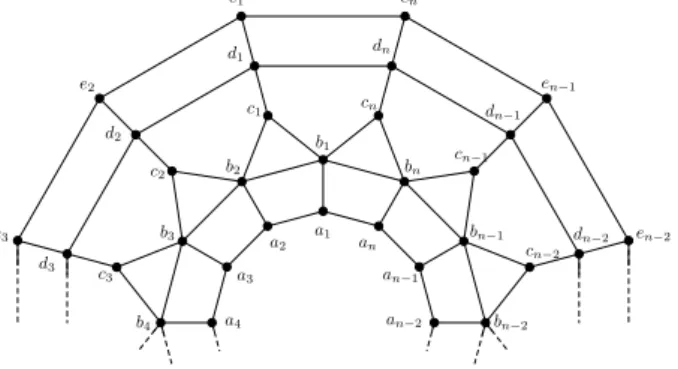
The graph of convex polytope Bn (Fig. 1) consisting of2n4-sided faces, n3-sided faces, n5-sided faces and a pair of n-sided faces is obtained by the combination of the graph of convex polytope Qn [2] and graph of a prismDn. We have
V(Bn) ={ai;bi;ci;di, ei: 1≤i≤n}
and
E(Bn) ={aiai+1;bibi+1;didi+1;eiei+1: 1≤i≤n} ∪{aibi;bici;bi+1ci;cidi;diei: 1≤i≤n}.
For our purpose, we call the cycle induced by {ai : 1 ≤ i ≤ n}, the inner cycle, cycle induced by
an−2
an−1
an
a1
a2
a3
a4 bn−2
bn−1
bn
b1
b2
b3
b4
cn−2
cn−1
cn
c1
c2
c3
dn−2
dn−1
dn
d1
d2
d3
en−2
en−1
en
e1
e2
e3
Figure 1. The graph of convex polytopeBn
{bi: 1≤i≤n}, the interior cycle, cycle induced by{di: 1≤i≤n}, the exterior cycle, cycle induced by
{ei: 1≤i≤n}, the outer cycle and set of vertices{ci : 1≤i≤n}, the set of interior vertices.
The metric dimension of graph of convex polytopeQn and graph of a prismDn have been studied in [9] and [4]. In the next theorem, we show that the metric dimension of the graph of convex polytopeBn is
3. Note that the choice of appropriate basis vertices (also referred to as landmarks in [14]) is core of the problem.
Theorem 2.1. Forn≥6, let the graph of convex polytopes be Bn; thendim(Bn) = 3.
Proof. We will prove the above equality by double inequalities. We consider the two cases.
Case(i)Whennis even.
respect to W.
Representations of the vertices on inner cycle are
r(ai|W) =
(i−1, i−2, k−i+ 1), 3≤i≤k;
(2k−i+ 1,2k−i+ 2, i−k−1), k+ 2≤i≤2k.
Representations of the vertices on interior cycle are
r(bi|W) =
(1,2, k+ 1), i= 1;
(i, i−1, k−i+ 2), 2≤i≤k+ 1;
(2k−i+ 2,2k−i+ 3, i−k), k+ 2≤i≤2k.
Representations of the set of interior vertices are
r(ci|W) =
(2,2, k+ 1), i= 1;
(i+ 1, i, k−i+ 2), 2≤i≤k;
(k+ 1, k+ 1,2), i=k+ 1;
(2k−i+ 2,2k−i+ 3, i−k+ 1), k+ 2≤i≤2k.
Representations of the vertices on interior cycle are
r(di|W) =
(3,3, k+ 2), i= 1;
(i+ 2, i+ 1, k−i+ 3), 2≤i≤k;
(k+ 2, k+ 2,3), i=k+ 1;
(2k−i+ 3,2k−i+ 4, i−k+ 2), k+ 2≤i≤2k.
Representations of the vertices on outer cycle are
r(ei|W) =
(4,4, k+ 3), i= 1;
(i+ 3, i+ 2, k−i+ 4), 2≤i≤k;
(k+ 3, k+ 3,4), i=k+ 1;
(2k−i+ 4,2k−i+ 5, i−k+ 3), k+ 2≤i≤2k.
We note that there are no two vertices having the same representations implying that dim(Bn) ≤ 3. On the other hand, we show that dim(Bn)≥3 by proving that there is no resolving set W such that
|W|= 2. Suppose on contrary thatdim(Bn) = 2, then there are following possibilities to be discussed.
(1)Both vertices are in the inner cycle. Without loss of generality we suppose that one resolving vertex is a1. Suppose that the second resolving vertex is at (2 ≤ t ≤k+ 1). Then for 2 ≤ t ≤ k, we have r(an|{a1, at}) =r(b1|{a1, at}) = (1, t)and fort=k+ 1,r(a2|{a1, ak+1}) =r(an|{a1, ak+1}) = (1, k−1),
a contradiction.
(2) Both vertices are in the interior cycle. Without loss of generality we suppose that one resolving vertex isb1. Suppose that the second resolving vertex isbt (2≤t≤k+ 1). Then for2≤t≤k, we have r(bn|{b1, bt}) =r(cn|{b1, bt}) = (1, t)and fort=k+ 1,r(b2|{b1, bk+1}) =r(bn|{b1, bk+1}) = (1, k−1), a
contradiction.
(3) Both vertices are in the set of interior vertices. Without loss of generality we suppose that one resolving vertex isc1. Suppose that the second resolving vertex isct (2≤t≤k+ 1). Then for2≤t≤k, we have r(b1|{c1, ct}) = r(d1|{c1, ct}) = (1, t)and for t = k+ 1, r(d2|{c1, ck+1}) = r(dn|{c1, ck+1}) =
(1, k−1), a contradiction.
(4) Both vertices are in the exterior cycle. Without loss of generality we suppose that one resolving vertex isd1. Suppose that the second resolving vertex isdt (2≤t≤k+ 1). Then for2≤t≤k, we have r(c1|{d1, dt}) =r(dn|{d1, dt}) = (1, t)and fort=k+ 1,r(d2|{d1, dk+1}) =r(dn|{d1, dk+1}) = (1, k−1),
a contradiction.
(5)Both vertices are in the outer cycle. Without loss of generality we suppose that one resolving vertex is e1. Suppose that the second resolving vertex is et (2 ≤ t ≤k+ 1). Then for 2 ≤ t ≤ k, we have r(d1|{e1, et}) =r(en|{e1, et}) = (1, t)and fort=k+ 1, r(e2|{e1, ek+1}) =r(en|{e1, ek+1}) = (1, k−1),
a contradiction.
that one resolving vertex is a1. Suppose that the second resolving vertex is bt (1≤t ≤k+ 1). Then for t = 1, we have r(a2|{a1, b1}) =r(an|{a1, b1}) = (1,2) and when 2 ≤t ≤k+ 1, r(a2|{a1, bk+1}) = r(b1|{a1, bk+1}) = (1, t−1), a contradiction.
(7) One vertex is in the inner cycle and other in the set of interior vertices. Without loss of generality we suppose that one resolving vertex is a1. Suppose that the second resolving vertex is ct (1 ≤ t ≤ k+ 1). Then for 1 ≤t ≤ k, we have r(bn|{a1, ct}) =r(cn|{a1, ct}) = (2, t+ 1) and when t = k+ 1, r(a3|{a1, bk+1}) =r(cn|{a1, bk+1}) = (2, k), a contradiction.
(8)One vertex is in the inner cycle and other in the exterior cycle. Without loss of generality we suppose that one resolving vertex is a1. Suppose that the second resolving vertex isdt (1 ≤t ≤k+ 1). Then fort= 1, we haver(d2|{a1, d1}) =r(e1|{a1, d1}) = (4,1). If 2≤t≤k, r(a2|{a1, dt}) =r(b1|{a1, dt}) =
(1, t+ 1)and whent=k+ 1,r(an|{a1, dk+1}) =r(b1|{a1, dk+1}) = (1, k+ 1), a contradiction.
(9)One vertex is in the inner cycle and other in the outer cycle. Without loss of generality we suppose that one resolving vertex is a1. Suppose that the second resolving vertex iset (1 ≤t≤ k+ 1). Then for t = 1, we have r(b2|{a1, e1}) = r(cn|{a1, e1}) = (2,3) and when 2 ≤ t ≤ k+ 1, r(b2|{a1, et}) = r(c1|{a1, et}) = (2, t+ 1), a contradiction.
(10)One vertex is in the interior cycle and other in the set of interior vertices. Without loss of generality we suppose that one resolving vertex isb1. Suppose that the second resolving vertex isct (1≤t≤k+ 1). Then for 1 ≤ t ≤ k−1, we have r(bn|{b1, ct}) = r(cn|{b1, ct}) = (1, t+ 1). For t = k, we have r(c1|{b1, ck}) =r(bn|{b1, ck}) = (1, k)and whent=k+ 1,r(b2|{b1, ck+1}) =r(cn|{b1, ck+1}) = (1, k), a
contradiction.
(11) One vertex is in the interior cycle and other in the exterior cycle. Without loss of generality we suppose that one resolving vertex is b1. Suppose that the second resolving vertex isdt (1≤t≤k+ 1). Then for 1 ≤ t ≤ k−1, we have r(a1|{b1, dt}) = r(bn|{b1, dt}) = (1, t+ 2). For t = k, we have r(bn|{b1, dk}) = r(c1|{b1, dk}) = (1, k+ 1) and when t = k+ 1, r(b2|{b1, dk+1}) = r(cn|{b1, dk+1}) =
(1, k+ 1), a contradiction.
(12) One vertex is in the interior cycle and other in the outer cycle. Without loss of generality we suppose that one resolving vertex is b1. Suppose that the second resolving vertex is et (1≤t≤k+ 1). Then for 1 ≤ t ≤ k−1, we have r(a1|{b1, et}) = r(bn|{b1, et}) = (1, t+ 3). For t = k, we have r(bn|{b1, ek}) = r(c1|{b1, ek}) = (1, k+ 2) and when t = k+ 1, r(b2|{b1, ek+1}) = r(cn|{b1, ek+1}) =
(1, k+ 2), a contradiction.
(13)One vertex is in the set of interior vertices and other in the exterior cycle. Without loss of generality we suppose that one resolving vertex is c1. Suppose that the second resolving vertex is dt (1 ≤ t ≤ k+ 1). Then for 1 ≤t ≤ k, r(a1|{c1, dt}) = r(bn|{c1, dt}) = (2, t+ 2) and when t = k+ 1, we have r(d2|{c1, dk+1}) =r(dn|{c1, dk+1}) = (2, k), a contradiction.
(14)One vertex is in the set of interior vertices and other in the outer cycle. Without loss of generality we suppose that one resolving vertex is c1. Suppose that the second resolving vertex is et (1 ≤ t ≤ k+ 1). Then for 1 ≤ t ≤k, we have r(a1|{c1, et}) = r(bn|{c1, et}) = (2, t+ 3) and when t = k+ 1, r(e2|{c1, ek+1}) =r(en|{c1, ek+1}) = (3, k−1), a contradiction.
(15)One vertex is in the set of exterior cycle and other in the outer cycle. Without loss of generality we suppose that one resolving vertex is d1. Suppose that the second resolving vertex iset (1≤t≤k+ 1). Then for 1 ≤t ≤ k, we have r(c1|{d1, et}) = r(dn|{d1, et}) = (1, t+ 1)and when t =k+ 1, we have r(e2|{d1, ek+1}) =r(en|{d1, ek+1}) = (2, k), a contradiction.
Hence, from above it follows that there is no resolving set with two vertices for V(Bn) implying that dim(Bn) = 3in this case.
Case(ii) Whennis odd.
In this case, we can write n= 2k+ 1,k≥3,k∈Z+. Again we show thatW ={a
1, a2, ak+1} ⊂V(Bn) is a resolving set for Bn in this case. For this we give representations of any vertex of V(Bn)\W with respect to W.
Representations of the vertices on inner cycle are
r(ai|W) =
(i−1, i−2, k−i+ 1), 3≤i≤k;
(k, k,1), i=k+ 2
Representations of the vertices on interior cycle are
r(bi|W) =
(1,2, k), i= 1;
(i, i−1, k−i+ 2), 2≤i≤k+ 1;
(k+ 1, k+ 1,2), i=k+ 2;
(2k−i+ 3,2k−i+ 4, i−k), k+ 3≤i≤2k+ 1.
Representations of set of interior vertices are
r(ci|W) =
(2,2, k+ 1), i= 1;
(i+ 1, i, k−i+ 2), 2≤i≤k;
(k+ 2, k+ 1,2), i=k+ 1;
(2k−i+ 3,2k−i+ 4, i−k+ 1), k+ 2≤i≤2k+ 1.
Representations of the vertices on exterior cycle are
r(di|W) =
(3,3, k+ 2), i= 1;
(i+ 2, i+ 1, k−i+ 3), 2≤i≤k;
(k+ 3, k+ 2,3), i=k+ 1;
(2k−i+ 4,2k−i+ 5, i−k+ 2), k+ 2≤i≤2k+ 1.
Representations of the vertices on outer cycle are
r(ei|W) =
(4,4, k+ 3), i= 1;
(i+ 3, i+ 2, k−i+ 4), 2≤i≤k;
(k+ 4, k+ 3,4), i=k+ 1;
(2k−i+ 5,2k−i+ 6, i−k+ 3), k+ 2≤i≤2k+ 1.
Again we see that there are no two vertices having the same representations which implies thatdim(Bn)≤
3.
On the other hand, suppose that dim(Bn) = 2, then there are the same possibilities as in case (i) and contradiction can be deduced analogously. This implies thatdim(Bn) = 3in this case, which completes the proof.
3.
The graph of convex polytope
C
n
The graph of convex polytope Cn (Fig. 2) consisting of 3n3-sided faces, n4-sided faces, n5-sided faces and a pair of n-sided faces is obtained by the combination of the graph of convex polytope Qn [2] and graph of an antiprism An [1]. We have
V(Cn) ={ai;bi;ci;di;ei: 1≤i≤n}
and
E(Cn) ={aiai+1;bibi+1;didi+1;eiei+1: 1≤i≤n} ∪{aibi;bici;cidi;diei;bi+1ci;di+1ei: 1≤i≤n}.
The graph of convex polytopeCn can also be obtained from the graph of convex polytopeBnby adding new edges di+1ei and having the same vertex set. i.e. V(Cn) =V(Bn)andE(Cn) =E(Bn)∪ {di+1ei:
1≤i≤n}.
For our purpose, we call the cycle induced by {ai : 1 ≤ i ≤ n}, the inner cycle, cycle induced by
{bi: 1≤i≤n}, the interior cycle, cycle induced by{di: 1≤i≤n}, the exterior cycle, cycle induced by
{ei: 1≤i≤n}, the outer cycle and set of vertices{ci : 1≤i≤n}, the set of interior vertices.
The metric dimension of graph of convex polytope Qn and graph of an antiprismAn have been studied in [9] and [11]. In the next theorem, we show that the metric dimension of the graph of convex polytope
an−2
an−1
an
a1
a2
a3
a4 bn−2
bn−1
bn
b1
b2
b3
b4
cn−2
cn−1
cn
c1
c2
c3
dn−2
dn−1
dn
d1
d2
d3
en−1
en
e1
e2
e3
Figure 2. The graph of convex polytopeCn
Theorem 3.1. LetCn denotes the graph of convex polytope; thendim(Cn) = 3for everyn≥6.
Proof. We will prove the above equality by double inequalities. We consider the two cases.
Case(i)Whennis even.
In this case, we can writen= 2k,k≥3,k∈Z+. LetW ={a1, a2, ak+1} ⊂V(Cn), we show thatW is a resolving set forCnin this case. For this we give representations of any vertex ofV(Cn)\W with respect to W.
Representations of the vertices on inner cycle are
r(ai|W) =
(i−1, i−2, k−i+ 1), 3≤i≤k;
(2k−i+ 1,2k−i+ 2, i−k−1), k+ 2≤i≤2k.
Representations of the vertices on interior cycle are
r(bi|W) =
(1,2, k+ 1), i= 1;
(i, i−1, k−i+ 2), 2≤i≤k+ 1;
(2k−i+ 2,2k−i+ 3, i−k), k+ 2≤i≤2k.
Representations of the set of interior vertices are
r(ci|W) =
(2,2, k+ 1), i= 1;
(i+ 1, i, k−i+ 2), 2≤i≤k;
(k+ 1, k+ 1,2), i=k+ 1;
(2k−i+ 2,2k−i+ 3, i−k+ 1), k+ 2≤i≤2k.
Representations of the vertices on exterior cycle are
r(di|W) =
(3,3, k+ 2), i= 1;
(i+ 2, i+ 1, k−i+ 3), 2≤i≤k;
(k+ 2, k+ 2,3), i=k+ 1;
(2k−i+ 3,2k−i+ 4, i−k+ 2), k+ 2≤i≤2k.
Representations of the vertices on outer cycle are
r(ei|W) =
(4,4, k+ 2), i= 1;
(i+ 3, i+ 2, k−i+ 3), 2≤i≤k−1;
(k+ 3, k+ 2,4), i=k;
(2k−i+ 3,2k−i+ 4, i−k+ 3), k+ 1≤i≤2k−1;
We note that there are no two vertices having the same representations implying thatdim(Cn)≤3. On the other hand, we show that dim(Cn) ≥3 by proving that there is no resolving set W such that
|W|= 2. Suppose on contrary that dim(Cn) = 2, then there are following possibilities to be discussed.
(1)Both vertices are in the inner cycle. Without loss of generality we suppose that one resolving vertex is a1. Suppose that the second resolving vertex is at (2 ≤ t ≤k+ 1). Then for 2 ≤ t ≤ k, we have r(an|{a1, at}) =r(b1|{a1, at}) = (1, t)and fort=k+ 1,r(a2|{a1, ak+1}) =r(an|{a1, ak+1}) = (1, k−1),
a contradiction.
(2) Both vertices are in the interior cycle. Without loss of generality we suppose that one resolving vertex isb1. Suppose that the second resolving vertex isbt (2≤t≤k+ 1). Then for2≤t≤k, we have r(bn|{b1, bt}) =r(cn|{b1, bt}) = (1, t)and fort=k+ 1,r(b2|{b1, bk+1}) =r(bn|{b1, bk+1}) = (1, k−1), a
contradiction.
(3) Both vertices are in the set of interior vertices. Without loss of generality we suppose that one resolving vertex isc1. Suppose that the second resolving vertex isct (2≤t≤k+ 1). Then for2≤t≤k, we have r(b1|{c1, ct}) = r(d1|{c1, ct}) = (1, t)and for t = k+ 1, r(d2|{c1, ck+1}) = r(dn|{c1, ck+1}) =
(1, k−1), a contradiction.
(4) Both vertices are in the exterior cycle. Without loss of generality we suppose that one resolving vertex isd1. Suppose that the second resolving vertex isdt (2≤t≤k+ 1). Then for2≤t≤k, we have r(c1|{d1, dt}) =r(dn|{d1, dt}) = (1, t)and fort=k+ 1,r(d2|{d1, dk+1}) =r(dn|{d1, dk+1}) = (1, k−1),
a contradiction.
(5)Both vertices are in the outer cycle. Without loss of generality we suppose that one resolving vertex is e1. Suppose that the second resolving vertex is et (2 ≤ t ≤k+ 1). Then for 2 ≤ t ≤ k, we have r(d1|{e1, et}) =r(en|{e1, et}) = (1, t)and fort=k+ 1, r(e2|{e1, ek+1}) =r(en|{e1, ek+1}) = (1, k−1),
a contradiction.
(6)One vertex is in the inner cycle and other in the interior cycle. Without loss of generality we suppose that one resolving vertex is a1. Suppose that the second resolving vertex is bt (1≤t ≤k+ 1). Then for t = 1, we have r(a2|{a1, b1}) = r(an|{a1, b1}) = (1,2) and when 2 ≤ t ≤ k+ 1, r(a2|{a1, bt}) = r(b1|{a1, bt}) = (1, t−1), a contradiction.
(7) One vertex is in the inner cycle and other in the set of interior vertices. Without loss of generality we suppose that one resolving vertex is a1. Suppose that the second resolving vertex is ct (1 ≤ t ≤ k+ 1). Then for 1 ≤t ≤ k, we have r(bn|{a1, ct}) =r(cn|{a1, ct}) = (2, t+ 1) and when t = k+ 1, r(a3|{a1, bk+1}) =r(cn|{a1, bk+1}) = (2, k), a contradiction.
(8)One vertex is in the inner cycle and other in the exterior cycle. Without loss of generality we suppose that one resolving vertex is a1. Suppose that the second resolving vertex isdt (1 ≤t ≤k+ 1). Then fort= 1, we haver(d2|{a1, d1}) =r(e1|{a1, d1}) = (4,1). If 2≤t≤k, r(a2|{a1, dt}) =r(b1|{a1, dt}) =
(1, t+ 1)and whent=k+ 1,r(an|{a1, dk+1}) =r(b1|{a1, dk+1}) = (1, k+ 1), a contradiction.
(9)One vertex is in the inner cycle and other in the outer cycle. Without loss of generality we suppose that one resolving vertex is a1. Suppose that the second resolving vertex iset (1 ≤t≤ k+ 1). Then for t = 1, we have r(b2|{a1, et}) = r(cn|{a1, et}) = (2,3) and when 2 ≤ t ≤ k+ 1, r(b2|{a1, et}) = r(c1|{a1, et}) = (2, t+ 1), a contradiction.
(10)One vertex is in the interior cycle and other in the set of interior vertices. Without loss of generality we suppose that one resolving vertex isb1. Suppose that the second resolving vertex isct (1≤t≤k+ 1). Then for 1 ≤ t ≤ k−1, we have r(bn|{b1, ct}) = r(cn|{b1, ct}) = (1, t+ 1). For t = k, we have r(c1|{b1, ck}) =r(bn|{b1, ck}) = (1, k)and whent=k+ 1,r(b2|{b1, ck+1}) =r(cn|{b1, ck+1}) = (1, k), a
contradiction.
(11) One vertex is in the interior cycle and other in the exterior cycle. Without loss of generality we suppose that one resolving vertex is b1. Suppose that the second resolving vertex isdt (1≤t≤k+ 1). Then for 1 ≤ t ≤ k−1, we have r(a1|{b1, dt}) = r(bn|{b1, dt}) = (1, t+ 2). For t = k, we have r(bn|{b1, dk}) = r(c1|{b1, dk}) = (1, k+ 1) and when t = k+ 1, r(b2|{b1, dk+1}) = r(cn|{b1, dk+1}) =
(1, k+ 1), a contradiction.
(12) One vertex is in the interior cycle and other in the outer cycle. Without loss of generality we suppose that one resolving vertex is b1. Suppose that the second resolving vertex is et (1≤t≤k+ 1). Then for 1 ≤ t ≤ k−1, we have r(a1|{b1, et}) = r(bn|{b1, et}) = (1, t+ 3). For t = k, we have r(bn|{b1, ek}) = r(c1|{b1, ek}) = (1, k+ 2) and when t = k+ 1, r(b2|{b1, ek+1}) = r(cn|{b1, ek+1}) =
(13)One vertex is in the set of interior vertices and other in the exterior cycle. Without loss of generality we suppose that one resolving vertex is c1. Suppose that the second resolving vertex is dt (1 ≤ t ≤ k+ 1). Then for1 ≤t ≤ k, we have r(a1|{c1, dt}) = r(bn|{c1, dt}) = (2, t+ 2), and whent =k+ 1, r(d2|{c1, dk+1}) =r(dn|{c1, dk+1}) = (2, k), a contradiction.
(14)One vertex is in the set of interior vertices and other in the outer cycle. Without loss of generality we suppose that one resolving vertex is c1. Suppose that the second resolving vertex is et (1 ≤ t ≤ k+ 1). Then for 1 ≤ t ≤k, we have r(a1|{c1, et}) = r(bn|{c1, et}) = (2, t+ 3) and when t = k+ 1, r(cn|{c1, ek+1}) =r(e1|{c1, ek+1}) = (2, k), a contradiction.
(15) One vertex is in the set of exterior cycle and other in the outer cycle. Without loss of generality we suppose that one resolving vertex is d1. Suppose that the second resolving vertex is et (1 ≤ t ≤ k+ 1). Then for 1 ≤t ≤k, we have r(c1|{d1, et}) = r(dn|{d1, et}) = (1, t+ 1) and when t = k+ 1, r(dn|{d1, ek+1}) =r(en|{d1, ek+1}) = (1, k−1), a contradiction.
Hence, from above it follows that there is no resolving set with two vertices for V(Cn) implying that dim(Cn) = 3in this case.
Case(ii) Whennis odd.
In this case, we can write n= 2k+ 1, k≥3, k∈Z+. LetW ={a1, a2, ak+1} ⊂ V(Cn), we show that W is a resolving set forCn in this case. For this we give representations of any vertex ofV(Cn)\W with respect to W.
Representations of the vertices on inner cycle are
r(ai|W) =
(i−1, i−2, k−i+ 1), 3≤i≤k;
(k, k,1), i=k+ 2;
(2k−i+ 2,2k−i+ 3, i−k−1), k+ 3≤i≤2k+ 1.
Representations of the vertices on interior cycle are
r(bi|W) =
(1,2, k+ 1), i= 1;
(i, i−1, k−i+ 2), 2≤i≤k+ 1;
(k+ 1, k+ 1,2), i=k+ 2;
(2k−i+ 3,2k−i+ 4, i−k), k+ 3≤i≤2k+ 1.
Representations of the set of interior vertices are
r(ci|W) =
(2,2, k+ 1), i= 1;
(i+ 1, i, k−i+ 2), 2≤i≤k;
(k+ 2, k+ 1,2), i=k+ 1;
(2k−i+ 3,2k−i+ 4, i−k+ 1), k+ 2≤i≤2k+ 1.
Representations of the vertices on exterior cycle are
r(di|W) =
(3,3, k+ 2), i= 1;
(i+ 2, i+ 1, k−i+ 3), 2≤i≤k;
(k+ 3, k+ 2,3), i=k+ 1;
(2k−i+ 4,2k−i+ 5, i−k+ 2), k+ 2≤i≤2k+ 1.
Representations of the vertices on outer cycle are
r(ei|W) =
(4,4, k+ 2), i= 1;
(i+ 3, i+ 2, k−i+ 3), 2≤i≤k−1;
(k+ 3, k+ 2,4), i=k;
(k+ 3, k+ 3,4), i=k+ 1;
(2k−i+ 4,2k−i+ 5, i−k+ 3), k+ 2≤i≤2k;
(4,4, k+ 3), i= 2k+ 1.
Again we see that there are no two vertices having the same representations which implies thatdim(Cn)≤
3 in this case.
Note that the result in above theorem gives the positive answer to the open problem raised in [10] in this case.
4.
The graph of convex polytope
E
n
The graph of convex polytopeEn is obtained as a combination of graph of convex polytopeTn [10] and graph of an antiprismAn [1]. The graph of convex polytopeEn can also be obtained from the graph
an−1
an
a1
a2
a3
a4
bn−2
bn−1
bn
b1
b2
b3
b4
cn−2
cn−1
cn
c1
c2
c3
dn−2
dn−1
dn
d1
d2
d3
en−2
en−1
en
e1
e2
Figure 3. The graph of convex polytopeEn
of convex polytopeCn by adding new edgesai+1bi and having the same vertex set. i.e. V(En) =V(Cn) andE(En) =E(Cn)∪ {ai+1bi: 1≤i≤n}.
For our purpose, we call the cycle induced by {ai : 1 ≤ i ≤ n}, the inner cycle, cycle induced by
{bi: 1≤i≤n}, the interior cycle, cycle induced by{di: 1≤i≤n}, the exterior cycle, cycle induced by
{ei: 1≤i≤n}, the outer cycle and set of vertices{ci : 1≤i≤n}, the set of interior vertices.
The metric dimension of graph of convex polytope Tn and graph of a prismDn have been studied in [10] and [4]. In the next theorem, we show that the metric dimension of the graph of convex polytope En is3. Once again, the choice of appropriate landmarks is crucial.
Theorem 4.1. LetEn denotes the graph of convex polytope; thendim(En) = 3 for everyn≥6.
Proof. We will prove the above equality by double inequalities. We consider the two cases.
Case(i)Whennis even.
In this case, we can write n= 2k, k≥3, k ∈Z+. LetW ={a1, a3, ak+1} ⊂V(En), we show thatW is a resolving set for En in this case. For this we give representations of any vertex of V(En)\W with respect to W.
Representations of the vertices on inner cycle are
r(ai|W) =
(1,1, k−1), i= 2;
(i−1, i−3, k−i+ 1), 4≤i≤k;
(k−1, k−1,1), i=k+ 2;
Representations of the vertices on interior cycle are
r(bi|W) =
(1,2, k), i= 1;
(2,1, k−1), i= 2;
(i, i−2, k−i+ 1), 3≤i≤k;
(k, k−1,1), i=k+ 1;
(k−1, k,2), i=k+ 2;
(2k−i+ 1,2k−i+ 3, i−k), k+ 3≤i≤2k.
Representations of the vertices on exterior cycle are
r(ci|W) =
(2,2, k), i= 1;
(3,2, k−1), i= 2;
(i+ 1, i−1, k−i+ 1), 3≤i≤k−1;
(k+ 1, k−1,2), i=k;
(k, k,2), i=k+ 1;
(2k−i+ 1,2k−i+ 3, i−k+ 1), k+ 2≤i≤2k−1;
(2,3, k+ 1), i= 2k.
and
r(di|W) =
(3,3, k+ 1), i= 1;
(4,3, k), i= 2;
(i+ 2, i, k−i+ 1), 3≤i≤k−1;
(k+ 2, k,3), i=k;
(k+ 1, k+ 1,3), i=k+ 1;
(2k−i+ 2,2k−i+ 4, i−k+ 2), k+ 2≤i≤2k−1;
(3,3, k+ 2), i= 2k.
Representations of the vertices on outer cycle are
r(ei|W) =
(4,4, k+ 1), i= 1;
(5,4, k), i= 2;
(i+ 3, i+ 1, k−i+ 2), 3≤i≤k−2;
(k+ 2, k,4), i=k−1;
(k+ 2, k+ 1,4), i=k;
(k+ 1, k+ 2,4), i=k+ 1;
(2k−i+ 2,2k−i+ 4, i−k+ 3), k+ 2≤i≤2k−2;
(4,5, k+ 2), i= 2k−1;
(4,4, k+ 2), i= 2k.
We note that there are no two vertices having the same representations implying thatdim(En)≤3. On the other hand, we show that dim(En)≥3. Suppose on contrary thatdim(En) = 2, then there are following possibilities to be discussed.
(1)Both vertices are in the inner cycle. Without loss of generality we suppose that one resolving vertex is a1. Suppose that the second resolving vertex is at (2 ≤ t ≤k+ 1). Then for 2 ≤ t ≤ k, we have r(an|{a1, at}) =r(bn|{a1, at}) = (1, t)and fort=k+ 1,r(a2|{a1, ak+1}) =r(an|{a1, ak+1}) = (1, k−1),
a contradiction.
(2) Both vertices are in the interior cycle. Without loss of generality we suppose that one resolving vertex isb1. Suppose that the second resolving vertex isbt (2≤t≤k+ 1). Then for2≤t≤k, we have r(a1|{b1, bt}) =r(bn|{b1, bt}) = (1, t)and fort=k+ 1,r(b2|{b1, bk+1}) =r(bn|{b1, bk+1}) = (1, k−1), a
contradiction.
(3) Both vertices are in the set of interior vertices. Without loss of generality we suppose that one resolving vertex isc1. Suppose that the second resolving vertex isct (2≤t≤k+ 1). Then for2≤t≤k, we haver(an|{c1, ct}) =r(bn|{c1, ct}) = (2, t+ 1)and fort=k+ 1,r(a1|{c1, ck+1}) =r(b1|{c1, ck+1}) =
(1, k), a contradiction.
vertex isd1. Suppose that the second resolving vertex isdt (2≤t≤k+ 1). Then for2≤t≤k, we have r(c1|{d1, dt}) =r(dn|{d1, dt}) = (1, t)and fort=k+ 1,r(d2|{d1, dk+1}) =r(dn|{d1, dk+1}) = (1, k−1),
a contradiction.
(5)Both vertices are in the outer cycle. Without loss of generality we suppose that one resolving vertex is e1. Suppose that the second resolving vertex is et (2 ≤ t ≤k+ 1). Then for 2 ≤ t ≤ k, we have r(d1|{e1, et}) =r(en|{e1, et}) = (1, t)and fort=k+ 1, r(e2|{e1, ek+1}) =r(en|{e1, ek+1}) = (1, k−1),
a contradiction.
(6)One vertex is in the inner cycle and other in the interior cycle. Without loss of generality we suppose that one resolving vertex is a1. Suppose that the second resolving vertex is bt (1≤t ≤k+ 1). Then for t = 1, we haver(a2|{a1, b1}) = r(bn|{a1, b1}) = (1,1) and when 2 ≤t ≤k+ 1, r(a2|{a1, bk+1}) = r(b1|{a1, bk+1}) = (1, t−1), a contradiction.
(7)One vertex is in the inner cycle and other in the set of interior vertices. Without loss of generality we suppose that one resolving vertex is a1. Suppose that the second resolving vertex is ct (1≤t≤k+ 1). Then fort= 1, we haver(a2|{a1, c1}) =r(bn|{a1, c1}) = (1,2)and when2≤t≤k+1,r(a2|{a1, bk+1}) = r(b1|{a1, bk+1}) = (1, t), a contradiction.
(8)One vertex is in the inner cycle and other in the exterior cycle. Without loss of generality we suppose that one resolving vertex is a1. Suppose that the second resolving vertex isdt (1 ≤t ≤k+ 1). Then fort= 1, we haver(d2|{a1, d1}) =r(e1|{a1, d1}) = (4,1). If 2≤t≤k, r(a2|{a1, dt}) =r(b1|{a1, dt}) =
(1, t+ 1)and whent=k+ 1,r(an|{a1, dk+1}) =r(bn|{a1, dk+1}) = (1, k), a contradiction.
(9)One vertex is in the inner cycle and other in the outer cycle. Without loss of generality we suppose that one resolving vertex isa1. Suppose that the second resolving vertex iset (1≤t≤k+ 1). Then fort= 1, we haver(a2|{a1, e1}) =r(bn|{a1, e1}) = (1,4). For2≤t≤k,r(a2|{a1, et}) =r(b1|{a1, et}) = (1, t+ 2) and whent=k+ 1,r(d2|{a1, ek+1}) =r(e1|{a1, ek+1}) = (1, k), a contradiction.
(10)One vertex is in the interior cycle and other in the set of interior vertices. Without loss of generality we suppose that one resolving vertex isb1. Suppose that the second resolving vertex isct (1≤t≤k+ 1). Then for 1 ≤ t ≤ k−1, we have r(a1|{b1, ct}) = r(bn|{b1, ct}) = (1, t+ 1). For t = k, we have r(a2|{b1, ck}) =r(bn|{b1, ck}) = (1, k)and whent=k+ 1,r(a1|{b1, ck+1}) =r(cn|{b1, ck+1}) = (1, k), a
contradiction.
(11) One vertex is in the interior cycle and other in the exterior cycle. Without loss of generality we suppose that one resolving vertex is b1. Suppose that the second resolving vertex isdt (1≤t≤k+ 1). Then for 1 ≤ t ≤ k−1, we have r(a1|{b1, dt}) = r(bn|{b1, dt}) = (1, t+ 2). For t = k, we have r(a2|{b1, dk}) = r(bn|{b1, dk}) = (1, k+ 1) and when t = k+ 1, r(a1|{b1, dk+1}) = r(cn|{b1, dk+1}) =
(1, k+ 1), a contradiction.
(12) One vertex is in the interior cycle and other in the outer cycle. Without loss of generality we suppose that one resolving vertex is b1. Suppose that the second resolving vertex is et (1≤t≤k+ 1). Then for 1 ≤ t ≤ k−1, we have r(a1|{b1, et}) = r(bn|{b1, et}) = (1, t+ 3). For t = k, we have r(an|{b1, ek}) =r(cn|{b1, ek}) = (1, k+ 2) and when t =k+ 1, r(a2|{b1, ek+1}) =r(c1|{b1, ek+1}) =
(1, k+ 2), a contradiction.
(13)One vertex is in the set of interior vertices and other in the exterior cycle. Without loss of generality we suppose that one resolving vertex isc1. Suppose that the second resolving vertex isdt (1≤t≤k+ 1). Then for 1 ≤ t ≤ k−1, we have r(a1|{c1, dt}) = r(bn|{c1, dt}) = (2, t+ 2). For t = k, we have r(dn|{c1, dk}) = r(en|{c1, dk}) = (2, k) and when t = k+ 1, r(d2|{c1, dk+1}) = r(dn|{c1, dk+1}) =
(1, k−1), a contradiction.
(14)One vertex is in the set of interior vertices and other in the outer cycle. Without loss of generality we suppose that one resolving vertex isc1. Suppose that the second resolving vertex iset (1≤t≤k−1). Then for 1 ≤ t ≤ k−1, we have r(a1|{c1, et}) = r(bn|{c1, et}) = (2, t+ 3). For t = k, we have r(dn|{c1, ek}) =r(en|{c1, ek}) = (2, k)and whent=k+1,r(dn|{c1, ek+1}) =r(en|{c1, ek+1}) = (2, k−1),
a contradiction.
(15)One vertex is in the set of exterior cycle and other in the outer cycle. Without loss of generality we suppose that one resolving vertex is d1. Suppose that the second resolving vertex iset (1≤t≤k+ 1). Then for 1 ≤ t ≤ k−1, we have r(c1|{d1, et}) = r(dn|{d1, et}) = (1, t+ 1). For t = k, we have r(dn|{d1, ek}) = r(en|{d1, ek}) = (1, k) and when t = k+ 1, r(dn|{d1, ek+1}) = r(en|{d1, ek+1}) =
(1, k−1), a contradiction.
dim(En) = 3 in this case.
Case(ii) Whennis odd.
In this case, we can write n= 2k+ 1, k≥3, k∈Z+. Let W ={a1, a3, ak+1} ⊂V(En), again we show that W is a resolving set forEn in this case. For this we give representations of any vertex ofV(En)\W with respect to W.
Representations of the vertices on inner cycle are
r(ai|W) =
(1,1, k−1), i= 2;
(i−1, i−3, k−i+ 1), 4≤i≤k;
(k, k−1,1), i=k+ 2;
(k−1, k,2), i=k+ 3;
(2k−i+ 2,2k−i+ 4, i−k−1), k+ 4≤i≤2k+ 1.
Representations of the vertices on interior cycle are
r(bi|W) =
(1,2, k), i= 1;
(2,1, k−1), i= 2;
(i, i−2, k−i+ 1), 3≤i≤k;
(k+ 1, k−1,1), i=k+ 1;
(2k−i+ 2,2k−i+ 4, i−k), k+ 2≤i≤2k+ 1.
Representations of the set of interior vertices are
r(ci|W) =
(2,2, k), i= 1;
(3,2, k−1), i= 2;
(i+ 1, i−1, k−i+ 1), 3≤i≤k−1;
(k+ 1, k−1,2), i=k;
(k+ 1, k,2), i=k+ 1;
(k, k+ 1,3), i=k+ 2;
(2k−i+ 2,2k−i+ 4, i−k+ 1), k+ 3≤i≤2k;
(2,3, k+ 1), i= 2k+ 1.
Representations of the vertices on exterior cycle are
r(di|W) =
(3,3, k+ 1), i= 1;
(4,3, k), i= 2;
(i+ 2, i, k−i+ 2), 3≤i≤k−1;
(k+ 2, k,3), i=k;
(k+ 2, k+ 1,3), i=k+ 1;
(k+ 1, k+ 2,4), i=k+ 2;
(2k−i+ 3,2k−i+ 5, i−k+ 2), k+ 3≤i≤2k;
(3,4, k+ 2), i= 2k+ 1.
Representations of the vertices on outer cycle are
r(ei|W) =
(4,4, k+ 1), i= 1;
(5,4, k), i= 2;
(i+ 3, i+ 1, k−i+ 2), 3≤i≤k−1;
(k+ 3, k+ 1,4), i=k;
(k+ 2, k+ 2,4), i=k+ 1;
(2k−i+ 3,2k−i+ 5, i−k+ 3), k+ 2≤i≤2k−1;
(4,5, k+ 3), i= 2k;
(4,4, k+ 2), i= 2k+ 1.
Again we see that there are no two vertices having the same representations which implies thatdim(En)≤
3 in this case.
On the other hand, suppose that dim(En) = 2, then there are the same subcases as in case (i) and contradiction can be obtained analogously. This implies that dim(En) = 3in this case, which completes the proof.
5.
Concluding remarks
In this paper, we have studied the metric dimension of some classes of convex polytopes which are obtained by the combination of two different graph of convex polytopes. We see that the metric dimension of these classes of convex polytopes is finite and does not depend upon the number of vertices in these graphs and only three vertices appropriately chosen suffice to resolve all the vertices of these classes of convex polytopes. It is natural to ask for the characterization of classes of convex polytopes with constant metric dimension. We also note that the results proved in Theorem3 and4 give the answer to the open problem raised in [10] positively.
Note that in [16] Melter and Tomescu gave an example of infinite regular plane graph (namely the digital plane endowed with city-block distance) having no finite metric basis. We close this section by raising a question as an open problem that naturally arises from the text.
Open problem: Let Gbe the graph of a convex polytope which is obtained by the combination of graph of two different convex polytopes G1 andG2 both having constant metric dimension. Is it the case
that Gwill always have the constant metric dimension?
References
[1] M. Baˇca, Labelings of two classes of convex polytopes, Utilitas Math. 34 (1988) 24–31.
[2] M. Baˇca, On magic labellings of convex polytopes, Ann. Disc. Math. 51 (1992) 13–16.
[3] P. S. Buczkowski, G. Chartrand, C. Poisson, P. Zhang, On k-dimensional graphs and their bases, Period. Math. Hungar. 46(1) (2003) 9–15.
[4] J. Caceres, C. Hernando, M. Mora, I. M. Pelayo, M. L. Puertas, C. Seara, D. R. Wood, On the metric dimension of cartesian products of graphs, SIAM J. Discrete Math. 21(2) (2007) 423–441.
[5] G. Chartrand, L. Eroh, M. A. Johnson, O. R. Oellermann, Resolvability in graphs and metric dimension of a graph, Discrete Appl. Math. 105(1-3) (2000) 99–113.
[6] M. R. Garey, D. S. Johnson, Computers and Intractability: A Guide to the Theory of NP-Completeness, New York: wh freeman, 1979.
[7] F. Harary, R. A. Melter, On the metric dimension of a graph, Ars Combinatoria. 2 (1976) 191–195.
[8] C. Hernando, M. Mora, I. M. Pelayo, C. Seara, J. Caceres, M. L. Puertas, On the metric dimension of some families of graphs, Electron. Notes Discrete Math. 22 (2005) 129–133.
[9] M. Imran, A. Q. Baig, A. Ahmad, Families of plane graphs with constant metric dimension, Util. Math. 88 (2012) 43–57.
[10] M. Imran, A. Q. Baig, M. K. Shafiq, A. Semaničová–Feňovčíková, Classes of convex polytopes with constant metric dimension, Util. Math. 90 (2013) 85–99.
[11] I. Javaid, M. T. Rahim, K. Ali, Families of regular graphs with constant metric dimension, Util. Math. 75 (2008) 21–33.
[12] M. A. Johnson, Structure-activity maps for visualizing the graph variables arising in drug design, J. Biopharm. Stat. 3(2) (1993) 203–236.
[13] E. Jucoviˇc, Convex polyhedra, Bratislava:Veda, 1981.
[14] S. Khuller, B. Raghavachari, A. Rosenfeld, Landmarks in graphs, Discrete Appl. Math. 70(3) (1996) 217–229.
[15] S. Khuller, B. Raghavachari, A. Rosenfeld, Localization in graphs, 1998.
[16] R. A. Melter, I. Tomescu, Metric bases in digital geometry, Comput. Vision Graphics Image Process. 25(1) (1984) 113–121.
[17] J. Peters-Fransen, R. O. Oellermann, The metric dimension of Cartesian products of graphs, Util. Math. 69 (2006) 33–41.
[18] P. J. Slater, Leaves of trees, Congr. Numer. 14 (1975) 549–559.
[20] I. Tomescu, M. Imran, On metric and partition dimensions of some infinite regular graphs, Bull. Math. Soc. Sci. Math. Roumanie. 52(100)(4) (2009) 461–472.