TECHNICAL UNIVERSITY OF CLUJ-NAPOCA
ACTA TECHNICA NAPOCENSIS
Series: Applied Mathematics, Mechanics, and Engineering Vol. 63, Issue I, March, 2020
ALL SHADES OF LIFE WITH CANCER THROUGH A MODEL
BASED ON PRINCIPLE OF MECHANICS
M. SALEEM, M. NOMAN, M. Younus BABA, Abdur RAHEEM
Abstract: In this paper, we propose a mathematical model representing immune-cancer cell interactions based on the principle of a mechanical system. The main assumption that leads to model formulation is that each cell population has a constant threshold value and the acceleration or deceleration of one cell population is directly proportional to the deviation of the other cell population from its threshold value. The closed form solution of the model is given, and it depicts almost all possible patterns of life of a cancer patient. This includes eradication of cancer, survival with cancer or sure-death by cancer. For a situation when immune system fails, a treatment schedule by immunotherapy is suggested. The model although devised for immune-cancer cell interactions can be applied to any disease (bacterial, viral etc.) in which immune cells play important role. Finally, it is proposed that clinically observed data can be directly related to model parameters.
Key words: Mechanical system; Immune cells; Cancer cells; immunotherapy; Oscillations.
1. INTRODUCTION
When the equilibrium of a mechanical system (see [1] and [2]) is disturbed, a restoring force is induced automatically to bring the system back to equilibrium state. A human body is supposed to be in equilibrium state under pure healthy conditions. This equilibrium is often disturbed when the body is infected through bacteria, virus etc. or meets pathogens. Nature has provided in the body a built-in restoring force called immune network that acts against any primary level of diseases confronted by the body. Many times a person gets cured from disease without seeing a doctor for medical advice. It all happens due to proper functioning of the immune network in the body. A weak or malfunctioning immune system makes a person prone to diseases. The human immune response has two main components: the innate and the adaptive.
The innate response can get quickly mounted unlike the adaptive response that takes longer (up to 7 days) to mount a
and Th cells help regulate immune response and control adaptive immunity against pathogens and cancer.
Mathematical modeling has played a very important complementary role in elucidating tumor-immune interactions along with the advance of knowledge of these interactions through experimental investigations. An overview of modeling approaches, particularly focusing on spatial models, incorporating one or more immune cell types and evaluating immune effects on tumor progression can be found in the most recent review by Mahlbacher et al. [3].
Further recent comprehensive reviews are de Pillis et al. [4], Eftimie at al. [5], and Norton et al. [6]. In [4], authors evaluate modeling of cancer-immune responses to therapy. Eftimie at al. [5] review tumor-immune non-spatial (i.e. ODE) models. Norton et al. in [6] present an overview of multiscale agent-based and hybrid modeling of the tumor-immune microenvironment and cancer-immune response. It is clear from the above discussion on immune system that in innate immune response, NK cells and neutrophils are the main c e l l s that target stressed or cancerous cells and in adaptive response, T lymphocytes particularly CTLs are the main killers of cancer. In [3], Mahlbacher et al. write in the abstract, “although important insight has been gained from a mathematical modeling perspective, the development of models incorporating patient-specific data remains an important goal yet to be realized for potential clinical benefit”. The present paper attempts to take a first step forward to address this concern and fill this gap. Ours is the first step in this direction in the sense that we assume a greatly simplified immune network in which all killer cells are bracketed into one category called effector cells, denoted . We denote cancer cells by . We formulate our model under the assumption that one cell type counteracts the restoring response of the other cell type. Based on this idea, we present our model in the next section. It is interesting to note that our simple model system covers all shades of life of a cancer patient and its parameters can be directly related to clinical data.
2.FORMULATION OF THE MODEL
Let = ( ) and = ( ) respectively denote the number of effector and cancer cells in the body at time . Let and respectively represent the threshold values of effector and cancer cells in the body. We assume that the acceleration or deceleration of one cell type in the body is directly proportional to the deviation of the other cell type from its threshold value. More specifically, we assume
∝ ( − )
∝ ( − )
Considering and as proportionality constants, our main model of this paper with initial conditions becomes
= ( − )
= ( − )
= , =
⁄ = , ⁄ = at = 0. (2.1)
We assume that the dynamics of the model (2.1) remains operative till the time when either the effector cells become zero (representing the death of the biological system) or the cancer cells go to zero and the healthy conditions of the body are restored. In certain circumstances, the model (2.1) may remain operative for longer
time representing coexistence of effector and cancer cells in an oscillatory manner.
3. DIFFERENT SITUATIONS
REPRESENTED BY THE MODEL
It can be easily checked that the general solution of the model (2.2) is
( ) = + + + !" +
$!%&"
( ) = − (" ⁄ )( + ) +
" = ( ) ⁄$
= (1 4⁄ )[ − − ( "⁄ )( − ) + ⁄" − ⁄" ]
= (1 4⁄ )[ − − ( "⁄ )( − ) − ⁄" + ⁄" ]
= (1 2⁄ )[ − + ( "⁄ )( − )]
$= (1 2⁄ )[ ⁄ +" ⁄" ] (3.2)
3.1 Survival with cancer in pure oscillatory manner
If the initial vital parameters , , , , , and of the body are such that
− = ( "⁄ )( − )
= ( "⁄ ) , (3.3) then the solution (3.1) represents a pure
oscillatory (limit cycle) solution as follows
( ) = + !" + $!%&"
( ) = + (" ⁄ )( !" + $!%&" ) (3.4) with,
= −
$= ⁄"
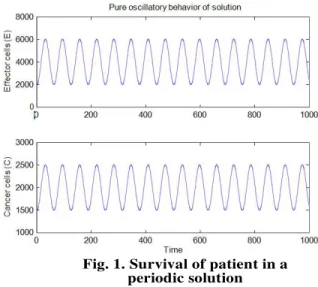
Solution (3.4) ensures survival of the patient with cancer.
Remark 1. If the vital parameters , , ,
and of the body are such that
− − ( "⁄ )( − ) =
⁄" − ⁄", then there can be ups and downs in the life of the patient but in the long run (as time passes) he/she will survive with cancer in an oscillatory manner represented by
( ) ≈ + !" + $!%&"
( ) ≈ + (" ⁄ )( !" + $!%&" ), with
= − + (1 2⁄ )( ⁄ −" ⁄ )" $= (1 2⁄ )( ⁄ +" ⁄ )"
3.2 Cancer is eliminated in a finite time and the patient becomes healthy
If the vital parameters , , , , , and of the body are such that
− − ( "⁄ )( − ) >
−[ ⁄ − ( "" ⁄ ) ], (3.5)
then the solution (3.1) remains valid with >
0. It thus follows that as → ∞, ( ) →
−∞. Since > 0, it implies from intermediate value theorem that there
exists a time 0 > 0 such that (0 ) = 0. It can be seen that T1 has an upper bound as
0 ≤" 2 3 4"1 +| |+| |+| $|6
Condition (3.5) thus guarantees removal of cancer in a finite time.
3.3 Sure death of the patient is inevitable
If the vital parameters , , , , , and of the body are such that
− − ( "⁄ )( − ) <
−[ − ( "⁄ ) ], (3.6) then the solution (3.1) is valid with < 0 whereas can be positive or negative. It follows from solution (3.1) that as → ∞,
( ) → −∞. Since > 0, it implies that there exists a time (say 0 ) such that (0 ) = 0 and this suggests death of the patient in a finite time.
4.GRAPHICAL ILLUSTRATION OF DIFFERENT SITUATIONS FACED BY A CANCER PATIENT
We consider some plausible values for constants , , , , , , , and display different situations faced by the cancer patient numerically. These situations have been discussed analytically in section 3. The range of WBC in human beings is of the order of
4000 − 11000 /9:. We take =
4000, the lower limit of WBC and set
= ⁄ = 20002 . We choose =
0.04 ( <=)⁄ , = 0.0025 ( <=)⁄ such that " = 0.1/ <=to ensure that cancer may be eliminated in approximately 60 days. Other parameters are chosen accordingly.
Situation 4.1: Survival of patient with cancer in a pure oscillatory manner
Considering = 2000, = 1500, =
Fig. 1. Survival of patient in a periodic solution
Situation 4.2: Eradication of cancer in a finite time
We find that condition (3.5) is satisfied if we
choose = 6100, = 2400, =
10 <=⁄ , = 11/ <=. The solution (3.1) provides a decreasing trend in cancer ensuring that cancer cells become zero in a finite time. This shows that eradication of cancer is possible in a finite time and we depict it in Fig. 2.
Fig. 2. Eradication of cancer in a finite time
Situation 4.3: Sure, death of the patient is inevitable
It can be seen that when = 6260, = 2500,
= 10 <=⁄ , = 11/ <=, condition (3.6) gives
< 0, ≠ 0. The solution (3.1) provides a
decreasing trend in effector cells bringing it to zero. This indicates sure death in a finite time as shown in Fig. 3.
Fig. 3. Sure death of the patient in a finite time
Referring to situation 3.3, we see that there always remains a possibility that immuno-surveillance fails and cancer dominates. We devote next section to such situations and propose a treatment strategy by immunotherapy.
5. TREATMENT BY IMMUNOTHERAPY
We introduce immunotherapy treatment strategy in the model (2.1) by modifying it as
= ( − ) + % A B
= ( − )
= , =
⁄ = , ⁄ = at = 0. (5.1)
The term % A B in the model (5.1) represents an input of effector cells from outside in the body and it gets consumed in the process in an exponential manner with
% and A as postive constants. The solution of the model (5.1) is
( ) = + C + C + C !" + C$!%&" + % A
$
A$− "$ B
( ) = − D (C + C −
C !" − C$!%&" ) −EFB G
BG G B
conditions given in (5.1). The expressions for CEare
C = + EFB
$ (BH )
C = − EFB
$ (B )
C = − EFB
(B H )
C$ = $+ EFB I (B H )
where E, % = 1,2,3,4 are given in (3.2). The initial dose of effector cells to be injected is % A$⁄(A$− "$) with A > ". Because of the term% A (4"(A + "))⁄ present in the expression for C , it can be made positive in those situations when
< 0 to eliminate cancer in finite time.
5.1 Sure Death avoided by immunotherapy: a graphical illustration
We refer to situation 3.3 in section 4. We notice that when = 6260, = 2500,
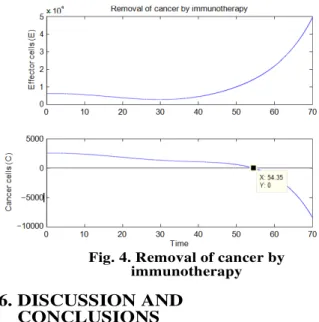
= 10/ <=, = 11/ <=, the solution (3.1) suggests sure death of the patient in a finite time as shown in Fig. 3. Here we show in Fig. 4 that by injecting immune cells with % = 180 andA = 2",
C > 0 even though < 0 and this ensures decreasing trend in cancer with its number tending to zero in a finite time.
Fig. 4. Removal of cancer by immunotherapy
6. DISCUSSION AND CONCLUSIONS
The model of this paper has been developed as a mechanical system. This
helps include double roles of each cell type. In this formulation, effector immune cells can have both negative effect on cancer cells when they rightly kill them and positive effect when they fail. Similarly cancer cells can play both a dominant and a subservient role against immune surveillance. The model represents all shades of life of a cancer patient. It is generally observed that some patients complete normal age with cancer, a few are cured in finite time without any medical intervention and many die if not treated. All these features are present in our study (section 3) for different sets of values of model parameters , , , , ,
, and .
The importance of this study lies in the fact that one can predict by careful clinical evaluation of parameters specific to a patient whether he/she is going to survive without medical intervention or not. In case, one comes to the conclusion that medical intervention is inevitable one can opt for treatment by immunotherapy (section 5.) with treatment schedule based on injecting suitable initial dose of effector cells and the rate of their consumption. The time for complete elimination of cancer can be predicted in advance.
It is interesting to note that although numerical values considered for , , , , , , and , % and Ain this paper have not been taken from any clinical studies, still they explain all possible features of immune-cancer interactions. Thus it is left to clinicians and medical researchers to have intelligent guess and observations about the relevant parameters and start treatment trials for patients who volunteer themselves for this purpose.
The model has two significant parameters " and A. The time of cancer elimination relates to 1 "⁄ and half-life of injected immune cell consumption to
1 A⁄ . Naturally 1 A⁄ should be less than
1 "⁄ . We have taken A = 2". The ratio
A "⁄ should be decided by clinical observations.
REFERENCES
[1] Sinha, A., Vibrations of mechanical
systems, Cambridge Univ. Press,
(2010).
[2] Gans, R.F., Mechanical systems: a unified approach to vibrations and
controls, Springer International
Publishing, (2015).
[3] Mahlbacher, G.E., Reihmer, K.C., Frieboes, H.B., Mathematical modeling of tumor-immune cell
interactions, J. Theor. Biol., Vol. 469,
(2019), 47-60.
doi.org/10.1016/j.jtbi.2019.03.002 [4] de Pillis, L.G., Eladdadi, A.,
Radunskaya, A.E., Modeling
cancer-immune responses to
therapy, J. Pharmacokinet.
Pharmacodyn., Vol. 41, (2014), 461-478.
[5] Eftimie, R., Bramson, J.I., Earn D.J.,
Interactions between the immune system and cancer: a brief review of
non-spatial mathematical models,
Bull. Math. Biol., Vol. 73, (2011), 2-32.
[6] Norton, K.A., Gong, C., Jamalian, S., Popel A.S., Multiscale agent-based and hy- brid modeling of the
tumor-immune microenvironment,
Processes (Basel), Vol. 7, (2019). doi:10.3390/pr7010037.
TOATE NUANȚELE VIEȚII CU CANCER PRINTR-UN MODEL BAZAT PE PRINCIPIUL MECANICII
Rezumat:În această lucrare, propunem un model matematic care reprezintă interacțiunile celulelor
cancerului imun pe baza principiului unui sistem mecanic. Principala ipoteză care duce la formularea modelului este că fiecare populație celulară are o valoare constantă a pragului, iar accelerarea sau decelerația unei populații celulare este direct proporțională cu abaterea celeilalte populații celulare de la pragul său Valoarea. Soluția formă închisă a modelului este data și descrie aproape toate modelele posibile de viață a unui pacient cu cancer. Aceasta include eradicarea cancerului, supraviețuirea cu cancer sau sigur-moarte de cancer. Pentru o situație în care sistemul imunitar eșuează, se sugerează o schemă de tratament prin imunoterapie. Modelul, deși conceput pentru interacțiunile celulelor de cancer imun poate fi aplicat la orice boală (bacteriene, virale, etc), în care celulele imune joacă un rol important. În cele din urmă, se propune ca datele observate clinic să fie direct legate de parametrii modelului.
SALEEM, M., Professor (Rtd.), Department of Applied Mathematics, Faculty of Engineering and
Technology, Aligarh Muslim University, Aligarh 202002, UP, India, [email protected]
NOMAN, M., Professor (Rtd.), Department of Physics, B. N. College, Patna 800004, Bihar, India
BABA, M.Y., Research Scholar, Department of Applied Mathematics, Faculty of Engineering and Technology, Aligarh Muslim University, Aligarh 202002, UP, India, [email protected]
RAHEEM, A., Assistant Professor, Department of Mathematics, Faculty of Science, Aligarh