TECHNICALUNIVERSITY OF CLUJ-NAPOCA
ACTA TECHNICA NAPOCENSIS
Series: Applied Mathematics, Mechanics, and Engineering Vol. 63, Issue I, March, 2020
STOCHASTIC MODELING OF TIME EVOLUTION OF A MOTORCYCLE
PUMP REPAIR
Naima TAMALOUSSI, Azzedine BOUZAOUIT
Abstract: The strategy of predictive maintenance seems adequate to anticipate the failure and degradation
of equipment status. A study of reliability is needful to quantify the indicators to describe the performance of any system over time. The present work is devoted to the monitoring and analysis of the stoppage generated by the pump-motor system, based on the evaluation of the total time of repair of TTR equipment. In a first stage, we carried out a static analysis with the aim of describing the distribution law of the time sample to be analyzed, that is the various times of TTR repair of t he system. In the first step, we carried out a static analysis with the objective of describing law of the sample of the time times to be analyzed, namely the various system repair times TTR. The static analysis of the values of this latter has confirmed that the distribution of the TTR follows a normal law, whose parameters are (m and σ). The adjustment of the adequacy of the Normal distribution of the sample has been verified according to the KOLMOGOROV-Smirnov test for a risk degree of 5٪ . Subsequently, we proposed and approach based on stochastic processes, for the modeling of the evolution of times repair of the studied system, chiefly by the Wiener degradation process.
Key words: Predictive maintenance, stochastic process, Normal law, Wiener process, modelisation
1. INTRODUCTION
The maintenance of production facilities plays an important role in the industrial sector, increasing the reliability and availability of the production process. Predictive maintenance is adequate to anticipate equipment failure and degradation. A reliability study is required to quantify the indicators in order to describe the functioning of any system over time.
This work is based on the use of a stochastic process, which is a mathematical approach; it allows following the evolution of a phenomenon over time. For a repairable system, it is necessary to introduce another probabilistic concept: that of availability: which is defined by the probability D (t) that the device will operate at time t. In this article, we present the results of a stochastic modeling followed by a statistical analysis of a motor pump system installed in an industrial complex. These calculations are based on the total TTR repair time and the repair rate. These two parameters are continuously
calculated in order to study the impact of the shutdown on the operation of the system. The analysis of these results makes it possible to study the phenomenon of system degradation by using stochastic processes, which represent a set of random variables (XT) T = 0 with values in all
observations. The latter have been widely used recently. The most frequently used models are the Markov process, Wiener process.
Stochastic modelling often refers to reversible systems and is considered the basis for monitoring, diagnostic and maintenance methods. As a result, the different operating states of such a system have been described, from the good state, through the degradation states to failure. The transition from one state to another is done by transition probabilities. These transitions are considered instantaneous in Markovian modeling [2].
numerous (networks, population genetics, mathematics, stock management, stochastic optimization algorithms, simulation). In this context, the Law “transition probability"; from a state i to a state j [6] is defined by :
= = | = (1)
With which the associated model is given by:
= = (2)
Models describing the degradation of the systems have a major interest because they make it possible to apprehend the dynamics of degradation of a repairable system, this theory is founded on the calculation of probabilities and statistics for instance, a Brownian movement (or the process of wiener) evolves in continuous time according to continuous trajectories, as he possesses independent increments, it is also a Markovian case [7].
The evolution of a degradation is seen as a combined effort of several effects, this increase approximately follows a normal distribution, which justified the use of such a non-monotonic process, especially the wiener process [8].
2. WORK METHODOLOGY
Based on the history of the continuous process of supplying a boiler to a motor pump, based on the operating time (TBF) and the total time repair (TTR).
We suggest to describe a method of statistical treatment of TTR’s and to carry out a search for a probability rule that is adjustable to the studied sample. This method will provide the following characteristics: R (t), F(t), f(t), (t) [9]. To do this, a statistical analysis is performed for the description of the TTR distribution rule, followed by a Kolmogorov-Smirnov adequacy test commonly used in a given situation. The values of TBF and TTR are shown in table 1.
Table 1 Duration of good functioning TBF and TTR repair of
power pump
TTR TBF TTR TBF
1 11087 5 1996
16 9200 7 1158
1 7172 8 6808
9 6398 4 1042
6 4407 4 5550
5 4072 4 3798
3 2968 4 2986
7 3237 10 2488
8 1407 18 3665
9 2566 3 4521
5 6523 5 2366
6 5332 8 3358
8 1258 8 2253
18 3888 / /
2.1.Analysis of the degradation process by the evolution of TTR
Among the degradation processes we find : Markov, Levy, Gamma, Wiener…, Stochastic processes, knowing that each process requires a well-defined distribution, for instance for the wiener process which has a linear or non-linear W(t) trend characterized by the parameters m and σ respectively the linear trend (the average) and the variance.
The initial conditions of such a process W(0)=0, W(t) is a stochastic process with independent increases with continuous trajectories .
For all t> 0 and Δt> 0, The law of evolution of the Wiener process is given by ;
W ( + ∆ ) − ( ) = ( ∆ ,σ2∆ ) (3)
With : ( ∆ , 2∆ the parameters of the normal rule or theory
for a time t>0,
- The function of density probability is given by :
=
√
∆" #
#$#∆" (4)
- The repair function :
% t =
'√ ()*+ e
-#
. /01
2#01 #34 *
The repair rate μ in terms of TTR is given in figure (1). For an analysis of the degradation of the pump by analyzing the evolution of the accumulated (TTRcu), repair time represented by
figure (2)
Fig. 1. The rate of repair
Fig. 2. Cumulative repair time
2.1.1. Statistical analysis of TTR values
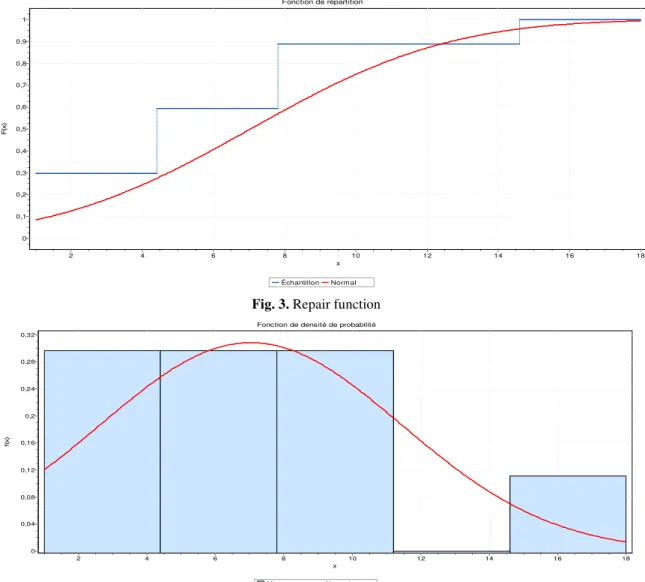
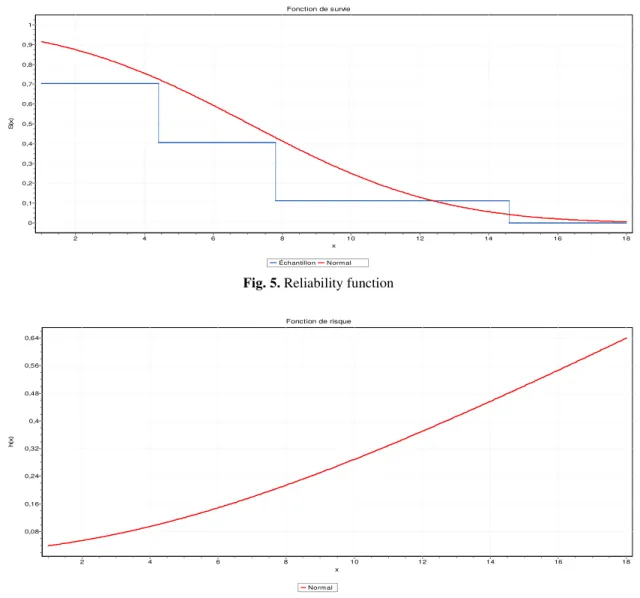
A statistical analysis was carried out on the evolution of the time of repair, and this with the use of the statistical software Easy 5.4 according to the figures (4,5,6,7).the analysis allowed us to check the distribution of the TTR which follows a normal rule this condition is required for such a process deterioration Wiener.
Fig. 3. Repair function
Fig. 4. Probability density function 0
1 2
1 1 18 8 8 15 10 8 8
μ
;
(1
/h
)
TTR; (h)
0 100 200
1 4 7 101316192225
T
T
R
cu
;(
H
)
Fonction de répartition
Échantillon Normal
x 10 12 14 16 18
8 6
4 2
F
(x
)
1
0,9
0,8
0,7
0,6
0,5
0,4
0,3
0,2
0,1
0
Fonction de densité de probabilité
His togramm e Norm al x
18 16
14 12
10 8
6 4
2
f(
x)
0,32
0,28
0,24
0,2
0,16
0,12
0,08
0,04
Fig. 5. Reliability function
Fig. 6. Risk function
2.1.2. Test of adequacy of normal distribution adequacy of TTR values
on the other hand, to confirm whether the distribution of the data can be correctly modeled by a normal rule or not, we will carry out a test of Kolmogorov-smirnov, the latter compares the uniform distribution function with the distribution function of the analyzed sample. The idea is to calculate the maximum distance between the theoretical and empirical functions, if this distance exceeds a certain value, that we read in a table, we say that the sample is bad or to be rejected.
the test results are given in table 2.
Table 2 . Results of the statistical test for the normal
law Test of Kolmogorov-Smirnov, law Normal (δ=
4.3,m=7)
values
sample size 27
statistics 0,19113 value of P 0,24438
α (risk) 0.05
critical value 0,25438
2.1.3. Modeling cumulative repair time by Wiener degradation process
After the statistical analysis of the TTR, whose distribution follows a normal distribution Fonction de survie
Échantillon Normal x
18 16
14 12
10 8
6 4
2
S
(x
)
1 0,9 0,8 0,7 0,6 0,5 0,4 0,3 0,2 0,1 0
Fonction de risque
Normal x
18 16
14 12
10 8
6 4
2
h(
x)
0,64
0,56
0,48
0,4
0,32
0,24
0,16
N(4.3,7), the model of Wiener according to equation(3), describing the evolution of the repair times becomes :
W ( + ∆) − ( ) = 4,3хN (0, ∆) +7х∆ (6)
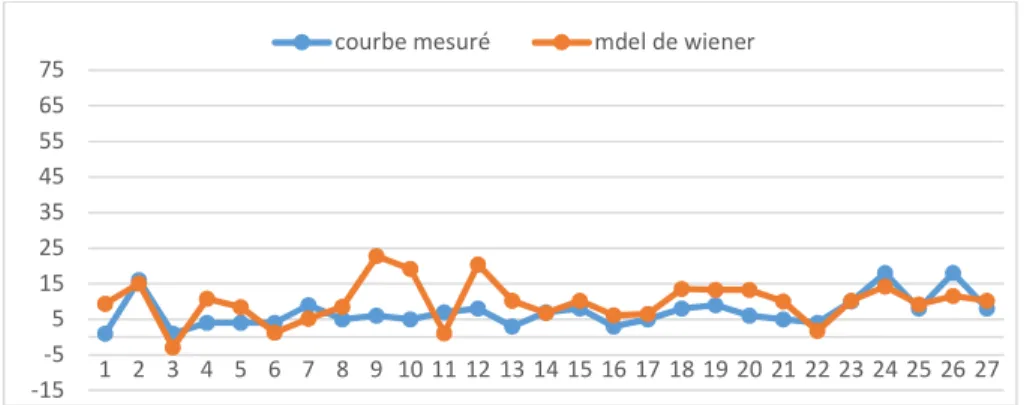
The modeled values are presented by the following figure:
Fig. 7. TTR repair time calculated and modeled for normal distribution N(4.3,7)
According to the Wiener model, it becomes a comparaison with the calculated analytic
values,and who are represented by Figure 8
Fig.8. Representation of cumulative repair time computed and with the Wiener model for a normalized law N(55,50)
3. RESULTS INTERPRETATION
Figures 3 and 4 show respectively the distribution function and the density of the TTR repair times. They confirm that the TTR sample follows a normal distribution N(m,σ),whose parameters are :the average m=7, and the standard deviation σ=4,3. The different repair times of the motor-pump system are given in figure 7, which are random values, the cumulative distribution time has been calculated and subsequently modeled.
Figure 8 clearly shows that the suggested Wiener model provides a good estimate of the probability of system shutdowns of production understudy and that the evolution of the cumulative TTR recovery time follows the same pace as that calculated by the analytical method, based on the value of the correlation coefficient (R=0.987).
The values of the computed and modeled TTR’s are well correlated, which confirms the robustness of the Wiener model to describe such a degradation situation of a repairable equipment.
-15 -5 5 15 25 35 45 55 65 75
1 2 3 4 5 6 7 8 9 10 11 12 13 14 15 16 17 18 19 20 21 22 23 24 25 26 27
courbe mesuré mdel de wiener
0 50 100 150 200
0 500 1000 1500 2000 2500
1 2 3 4 5 6 7 8 9 10 11 12 13 14 15 16 17 18 19 20 21 22 23 24 25 26 27
4. CONCLUSION
Predictive maintenance plays a very important role in the monitoring and evolution of the deterioration of the operating condition of a production equipment in order to predict the Shutdowns, the analysis of the TTR repair stop times. A motor pump during a given period t systematically makes it possible to make an evaluation of its real state, and to calculate its probability of stopping during its running time. The behavior of repairable equipment in the event of a fault, helps to identify and evaluate the gravity of an anomaly, our study shows that the stochastic modeling is considered as an important mathematical tool, able to provide a good prediction of the possible failures, and this has through the analysis of a history or a reliable return of experience.
We considered a sample of the TTR stop times calculated by a analytical method, which allowed us to propose a stochastic model of adequate estimation, namely the wiener model, with the aim of predicting possible stops, thus, we sees that the suggested models can also be used in the planning of predictive maintenance in order to avoid unforeseen events, with the aim of improving the reliability of such equipment and its availability accordingly.
5. REFERENCES
[1] Pascal. “Modelling malfunctions of a system under maintenance activities”, research master’s report, 2007.
[2]. L. Agnes, C. Claudie. “Stochastic processes and modeling”, ISMAG MASTER 2 - MI00451X, 2012. [4]. P. Claire, ENSEEIHT. “Dependability”, 3rd TR - SE
option, December. 2012.
[3]. L. Banege. Stochastic process. “Markov chains and Poisson Process”, 2004.
[5]. A. Bouzaouit, O. Bennis, M. Gahgah.” Modelling of the dynamic evolution of the state change of the bearings”, RECENT Journal, ISSN 1582-0246, Vol.13, N° 3(36), 2012, pp 254-258.
[6].A. Bouzaouit, E. HadjadjAouel, O. BENNIS. “Stochastic modeling for the follow-up the bearing degradation”.U.P.B ,Sci, Bull., ISSN 1454-2358, Series D, Vol 79,Iss 1, 2017, pp 209-218.
[7]. H.Louahem m’sabah..”Modélisation du phénomène de degradation des roulements par le processus Wiener et Gamma”.These de doctorat en electromecanique,2016
[8]. Xing He, Xiaojiao Xu , Wei Tian, Yuebing Li , WeiyaJin and Mingjue Zhou. “Markov stochastic process modeling for evolution of wear depth in steam generator tubes”. Advances in Mechanical Engineering 2019, Vol 11(5),2019, pp1–9
[9]. https://www.clicours.com/cours-maintenance- connaissance-des-equipements-et-de-leurs-comportements/
Modelarea stocastica a evoluției unei motociclete-pompa in timpul reparațiilor
Resumat: Strategia de întreținere predictivă pare adecvată pentru a anticipa defectarea și degradarea stării echipamentului. Este necesar un studiu de fiabilitate pentru a cuantifica indicatorii, pentru a descrie funcționarea oricărui sistem în timp. Lucrarea prezentă este dedicată unui studiu de analiză pentru monitorizarea opririlor generate de sistemul unei pompe de motor, pe baza evaluării timpului total de reparare TTR a unui astfel de echipament. Ca o primă etapă, Am efectuat o analiză statistică cu scopul de a descrie legislația de distribuție a eșantionului de timp care trebuie analizat, și anume diferitele timpi de reparație TTR ale sistemului. Analiza statistică a valorilor acestora din urmă a confirmat că distribuția Ttrs respectă o lege normală, ai cărei parametri sunt (m și σ). Ajustarea nivelului de adecvare a distribuției normale a eșantioanelor a fost verificată în funcție de testul Kolmogorov-Smirnov pentru un nivel de risc de 5%. Ulterior, am propus o abordare bazată pe utilizarea proceselor stocastice, pentru modelarea evoluției timpilor de reparare a sistemului studiat, în principal prin procesul de degradare a Wiener.
Cuvinte cheie: Intretinere predictiva, proces stocastic, lege normala, proces de Wiener, modelizare
Naima TAMALOUSSI, Department of Mechanical Engineering, Faculty of Technology, the 20 August 1955 University of Skikda, Algeria. Email: naimatamaloussi@yahoocom, office phone : 0667838635.