ORIGINAL RESEARCH ARTICLE
Maternal Near-Miss Due to Unsafe Abortion and Associated
Short-Term Health and Socio-Economic Consequences in Nigeria
Elena Prada*
1, Akinrinola Bankole
2, Olufemi T. Oladapo
3, Olutosin A. Awolude
4, Isaac F.
Adewole
5and Tsuyoshi Onda
6Consultant to Guttmacher Institute1; Director of International Research, Guttmacher Institute2; Associate Professor, Department of Obstetrics and Gynaecology, Olabisi Onabanjo University Teaching Hospital, Sagamu, Ogun State, Nigeria3;
Lecturer/Consultant/Obstetrician and Gynaecologist, College of Medicine, University of Ibadan4; Professor/Consultant Obstetrician and Gynaecologist, College of Medicine, University of Ibadan, Nigeria5; Research Assistant II, Guttmacher
Institute6.
*For Correspondence: E-mail: [email protected], phone: +5716917993
Abstract
Little is known about maternal miss (MNM) due to unsafe abortion in Nigeria. We used the WHO criteria to identify near-miss events and the proportion due to unsafe abortion among women of childbearing age in eight large secondary and tertiary hospitals across the six geo-political zones. We also explored the characteristics of women with these events, delays in seeking care and the short-term socioeconomic and health impacts on women and their families. Between July 2011 and January 2012, 137 MNM cases were identified of which 13 or 9.5% were due to unsafe abortions. Severe bleeding, pain and fever were the most common immediate abortion complications. On average, treatment of MNM due to abortion costs six times more than induced abortion procedures. Unsafe abortion and delays in care seeking are important contributors to MNM. Programs to prevent unsafe abortion and delays in seeking postabortion care are urgently needed to reduce abortion related MNM in Nigeria.
(Afr J Reprod Health 2015; 19[2]: 52-62).
Keywords: Unsafe abortion, Maternal morbidity, Maternal mortality, Severe obstetric morbidity, Delays seeking PAC
Résumé
On est peu renseigné sur la mort manquée maternel (MMM) en raison de l'avortement à risque au Nigeria. Nous nous sommes servis des critères de l'OMS pour identifier les événements de presque manqué maternels et la proportion dus aux avortements chez les femmes en âge de procréer dans huit grands hôpitaux secondaires et tertiaires à travers les six zones géopolitiques. Nous avons également exploré les caractéristiques des femmes avec ces événements, des retards dans la recherche de soins et les impacts socio-économiques et la santé à court terme sur les femmes et leurs familles. Entre juillet 2011 et janvier 2012, 137 cas PMM ont été identifiés, dont 13 ou 9,5% étaient dus aux avortements dangereux. L'hémorragie sévère, la douleur et la fièvre étaient les complications d'avortement immédiats les plus communs. En moyenne, le traitement de PMM en raison de l'avortement coûte six fois plus que les procédures d'avortement provoqué. L'avortement dangereux et des retards dans la recherche de soins sont des contributeurs importants à PMM. Il faut d’urgence des programmes de prévention dangereux et en cherchant des soins après l’avortement pour réduire l'avortement PMM liés à l’avortement au Nigeria. (Afr J Reprod Health 2015; 19[2]: 52-62).
Mots-clés: avortement à risque, morbidité maternelle, mortalité maternelle, morbidité obstétricale sévère, retards en recherchant
Introduction
Despite abortion being permitted by law only to save a woman’s life1
, many Nigerian women resort to induced abortions, of which many are unsafe. About 1, 243,660 induced abortions (33 per 1,000 women aged 15-49) occurred in the country in
Nigeria in 2012 resulted in complications serious enough to require treatment in health facilities2. An unknown proportion of these morbidities are maternal near-miss events (MNM) in that they are severe enough to claim the lives of the women but for the intervention of the health system. Several studies worldwide have demonstrated that paying attention to such cases is as critical to evaluating maternal health care as maternal mortality.
A retrospective study in one tertiary hospital in the South West zone of Nigeria reported a total of 242 near-miss events over three years with a decreasing trend from 2002 to 2004. The vast majority of the near-miss cases (61%) were associated with hypertensive disorder in pregnancy and haemorrhage4.Various previous MNM studies have also provided useful information on contributing factors, other than medical, to severe morbidities associated with pregnancy, childbirth and puerperium5-12. One study at Mulago hospital in Uganda involving 30 women who had severe maternal morbidity found that socio-cultural factors in addition to quality of care contributed to severity of obstetric morbidity13. The most striking socio-cultural factor highlighted was the extremely low social status of women in the society. Nonetheless, very little is known about the incidence of MNM due to unsafe abortion. Little is also known about the social, economic and short-term health consequences of abortion related MNM. The present study assesses the incidence of MNM in selected Nigerian hospitals and the proportion due to unsafe abortion. This study also explores the factors that are associated with women’s health seeking behavior after having an abortion that may have contributed to the severity of morbidity experienced.
Methods
Hospital Setting
This was a hospital-based cross sectional study of women who experienced MNM according to the WHO organ dysfunction near-miss criteria14. All cases of MNM were identified through a prospective surveillance of all women admitted for delivery or pregnancy related complications over a period of six months in eight hospitals spread
across the six geo-political zones (South South, South West, South East, North Central, North East, and North West zones) in Nigeria. The hospitals consist of the largest government hospital in each zone and the largest mission hospital in two of the zones. The study was approved by the Guttmacher Institutional Review Board and by the ethics committees of the University of Ibadan/University College Hospital (UI/UCH) and hospitals that required that the study obtain their own ethical approval.
Selection of cases
Since most women requiring obstetric care at health facilities would not experience near-miss events, it was not necessary to examine all of them to assess cases of MNM. Instead, a surveillance system was put in place in each hospital to help determine which of these women needed further monitoring. A project staff member, who was a medical professional, made daily visits to obstetrical wards, delivery rooms, emergency rooms and intensive care units to check whether there have been admissions of MNM or cases with potentially life-threatening conditions. Cases of MNM were also identified through routine departmental clinical audit meeting at the various hospitals.
experiencing MNM due to unsafe abortion were interviewed before they were discharged from the health facility.
Data collection instruments
Two questionnaires were used: a care provider’s questionnaire and woman’s questionnaire. The provider’s questionnaire is an adapted version of the WHO maternal near-miss tool. It collected information on dates and times of admission and discharge, place of events, woman’s obstetric history, gestational age at the time of abortion procedure, nature of the near-miss and woman’s conditions upon discharge. The woman’s questionnaire collected information on woman’s socio-demographic characteristics, their health conditions that led them to seek care at a health facility, and the issues related to delays in seeking and obtaining care. The questionnaire also included questions about whether the woman was using a contraceptive method at the time of the pregnancy, the decision to terminate the pregnancy, and all the costs she and her family incurred.
Limitations
One of the limitations of the study was the inability to carry out a planned follow-up interview of women two months after they were discharged from the hospital. The reason for this was that only two of the women with abortion-related MNM agreed to be re-contacted after leaving the hospital. Therefore our study could not obtain information on a broader and longer term spectrum of consequences of abortion related near-miss experience regarding their marital and sexual lives, their fertility and contraceptive behavior and other related issues.
Another potential limitation of our study was that it may not have captured all near-miss cases, including abortion related ones, for reasons such as providers’ omission to report such cases to the study or transfer of women to other hospitals. Also, induced abortion related MNM may be
somewhat under estimated because of the difficulty of distinguishing induced abortion from spontaneous abortion. Finally, because the study was limited to the largest tertiary and mission hospital(s) in each zone, the study findings may not be representative of all abortion-related near-miss cases in the country; they are likely to reflect the more severe cases.
Results
Between July 2011 and January 2012, a total of 137 women with MNM were admitted in the eight hospitals included in this study, and 71 maternal deaths were registered during the same time period. Out of the 137 MNM, unsafe abortion was responsible for 13 of them, representing 9.5% of all MNM cases. Since one of the women refused the interview, findings presented in Table 2 are based on 13 cases that had provider’s information. Findings from Table 3 on are based on 12 cases of MNM cases due to unsafe abortion and who gave consent to be interviewed.
Underlying causes of life-threatening maternal complications
A total of 204 near-miss morbidities were identified among the 137 near-miss cases which implies an average of 1.5 morbidities per case (Table 1). The most common underlying causes of near-miss events were hypertensive disorders in pregnancy (37%), haemorrhage (33%) and anaemia (33%). About seventeen percent of the near-miss events were related to infection (17%) and 10% were due to unsafe abortion.
Table I: Underlying Causes of Maternal Near-Miss and Maternal Death
* N of cases is more than 137 because of a near-miss *event may be associated with more than one morbidity
Characteristics of women with maternal near-miss
Women with abortion-related MNM differed from women with MNM due to other causes. Not surprisingly, the life threatening episode resulting from an induced abortion occurred mainly among women who were in the first trimester of gestation whereas for the other women the severe complication occurred mainly in their third trimester of gestation (Table 2). Furthermore, women with MNM due to unsafe abortion have had fewer pregnancies and births and were more likely to have had repeat abortions (39% vs. 7%) than women with MNM due to other causes. Women with MNM due to causes other than unsafe abortion were older (median age 30 years) than women with abortion-related MNM (median age 20 years).
Among women with abortion-related near- miss conditions, most were in school, the majority were of low socio-economic status and almost all were not in union (ten out of 12). In nine cases induced abortion was performed in sites other than a health facility and in all cases, the life-threatening complications occurred before women were admitted in a health facility.
Timing of abortion complication and measures taken to seek care
The time women began to experience
complications varied: few occurred the same day the procedure was performed, the majority (seven cases) experienced complications the following week, and in one case, complications began three weeks after inducing the abortion. Only four women went to see a doctor or to a hospital and four others went to a pharmacy as soon as health problems arose. Although all women told someone other than a health care provider they were having problems not all of them did so immediately; seven waited until the next day, one waited one week, while three did it the same day the health problems began.
Friends and mothers/mothers-in-law were the persons most commonly mentioned as the people respondents talked to about their health problems. Those who did not seek care reported not having done so because they did not have money, did not know where to go, were afraid everybody in the family and the community would know or they did not think the health problem was serious (data not shown).
Causes of delays in seeking care
Using the “three delays model”15
, a useful tool to analyze avoidable factors in acute obstetric morbidity, we examined which factors of each of the three types of delays contributed more to the abortion-related near-miss condition. These three types of delays are: (1) delays associated with deciding to seek appropriate medical help; (2) delays between time decision to seek care was reached and when the woman gets to an appropriate health facility; and (3) delays in receiving adequate care after reaching a facility.
Delay associated with decision to seek care
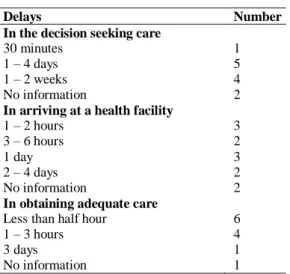
Women were asked how much time passed from the time they started experiencing health problems to the time a decision was taken to seek health care. Although in all but one instance the decision to seek care was taken by the woman herself, the
Delays Number
In the decision seeking care
30 minutes 1 1 – 4 days 5 1 – 2 weeks 4 No information 2
In arriving at a health facility
1 – 2 hours 3 3 – 6 hours 2
1 day 3
2 – 4 days 2 No information 2
In obtaining adequate care
Less than half hour 6 1 – 3 hours 4
3 days 1
Table 2: Characteristics of Women with Maternal Near-Miss Experiences, Nigeria, 2011
decision was not taken immediately. Only one woman did so within 30 minutes while nine others waited from one day up to one to two weeks (Table 3). Since few women seek a doctor or go to a health facility as soon as complications occur,
while some wait even days before telling someone they are experiencing health problems, a delay in making the decision to seek medical care
contributes to the severity of complications at the time of treatment.
Characteristics
Maternal near-miss due to: Total
N (%)
Obstetric causes other than unsafe
abortion N (%)
unsafe abortion
N (%) Timing of near-miss event
1rst or 2nd trimester 32 (23.4) 19 (15.3) 13 (100.0)
3rd trimester 80 (58.4) 80 (64.5) 0 Postpartum 23 (16.8) 23(18.5) 0 No information 2 (1.4) 2 (1.6) 0 Total 137 (100.0) 124 (100.0) 13 (100.0)
No. of pregnancies
One-two 65 (47.4) 55 (44.4) 10 (77.0) Three-four 30 (21.9) 27 (21.8) 3 (23.0) Five + (5 to 14) 42 (30.6) 42 (33.8) 0 Total 137 (100.0) 124 (100.0) 13 (100.0)
Mean 3.8 1.9
No. of live births
One-two 70 (51.1) 57 (46.0) 13 (100.0) Three-four 17 (12.4) 17 (13.7) 0 Five + (5 to 8) 16 (11.7) 16 (12.9) 0 No information 34 (24.8) 34 (27.4) 0 Total 137 (100.0) 124 (100.0) 13 (100.0)
Mean 2.3 0.5
No. of living children
One-two 87 (63.5) 74 (59.6) 13 (100.0) Three-four 30 (21.9) 30 (24.2) 0 Five + (5 to 9) 14 (10.2) 14 (11.3) 0 No information 6 (4.4) 6 (4.8) 0 Total 137 (100.0) 124 (100.0) 13 (100.0)
Mean 2.2 0.5
No. of induced abortions
None 84 (61.3) 84 (67.6) 0 One 23 (16.8) 15 (12.1) 8 (61.5) Two + (2 to 6) 13 (9.5) 8 (6.5) 5 (38.5) No information 17 (12.4) 17 (13.7) 0 Total 137 (100.0) 124 (100.0) 13 (100.0)
Mean 0.4 1.4
Age
14-19 10 (7.3) 6 (4.8) 4 (30.8) 20-29 59 (43.1) 52 (41.9) 7 (53.8) 30-46 67 (48.9) 65 (52.4) 2 (15.4) No information 1 (0.7) 1 (0.8) 0 Total 137 (100.0) 124 (100.0) 13 (100.0)
Mean 30 23
Table 3: Duration of delays by type of delay, Nigeria 2011
Box 1 illustrates the decision-making process one woman goes through from the time she realizes she is pregnant and the time the decision to seek health care is taken.
BOX 1
Decision process and first delay
Yemi, a 16 year old student, never married and resident of a rural area reported she did not want to become pregnant, because she would have had to drop out of school. At the time she got pregnant she was using periodic abstinence. Two weeks after missing her period she thought about talking to somebody about her decision to interrupt the pregnancy but waited one month to do so. She talked to a friend and later to a Traditional Birth Attendant. She reported she was six weeks
pregnant when she went to see a
pharmacist/chemist to have the abortion, meaning she was at least eight weeks pregnant then in reality (By the time a woman suspects she is pregnant, she is already at least 2 weeks pregnant).
The abortion provider, ─a patent medicine seller─ used a solid object to induce the abortion. Two days after the procedure, the young woman started experiencing severe abdominal pain, severe fever and severe abnormal vaginal discharge. She reported having done something to treat her health problems but what she did was not recorded. This respondent reported not seeking medical care immediately due to lack of money and waited two hours before telling her mother of her condition. Three days passed before deciding she needed medical care. Nonetheless, one more day passed before she got to a private health hospital nearby her house. Lack of money was the reason for delaying seeking medical treatment and the decision was taken by a member of her family. Although she received inpatient medical care for two days in this facility, she left because she felt the treatment was unsatisfactory.
Delay in reaching a health facility after a decision to seek care
Not all women sought care immediately after the decision to do so was made. Five of the women were taken to a health facility in less than six hours while the remaining five waited between one to four days before reaching the health facility (Table 3). The reasons given for the delay in going immediately to a facility were lack of money, lack of transport, fear of other people discovering the abortion, and indecision about which facility to go to (data not shown).
In terms of how they arrived at the hospital where they were finally treated, seven out of twelve women were referred from other hospitals in a critical state for ICU. Women went to other facilities first because they were close to the woman’s house, they charged low fees, they were small/private facilities, or owned by a friend or neighbor. Although all women received treatment in those facilities, they left because they did not get better, the treatment was unsatisfactory, or they were referred to either the current facility or to another facility most likely because their health condition required higher level of specialization at an ICU. Of the women who did not come directly to the current facility, four stayed between two to five days at the previous hospital and one stayed
Economic impact Number
Money spent in all attempts to induce abortion (in Naira)
19,000 and less 6
20,000 + 4
No information 2
Mean 12,586
Median 12,000
Who paid for all attempts
Respondent 1 Other family member/person 3
Boyfriend 6
No information 2
Money spent in treating health problems (in Naira)
Less than 100,000 5
100,000 + 4
No information 3
Mean 74,407
Who paid for treatment
Respondent 2 Other family member/person 5
Boyfriend 1
two weeks before arriving to the current facility. The majority of the women were in critical condition upon arrival to the hospital, experiencing one or more of the following complications: shock, severe sepsis, breathing difficulty, required pulmonary resuscitation and/or transfusion of > 5 units of red blood cells, acute cyanosis, gasping, unconsciousness for more than 12 hours, or paralysis. In seven cases the underlying complication was anaemia (data not shown).
Delay in receiving adequate care once a facility is reached
Not all women received immediate treatment upon getting to the current hospital, despite the life threatening condition in which they arrived. From the time respondents arrived at the current facility to the time when they were seen by a medical doctor (including the time spent during check up/interview for admission), only six women received treatment in less than half hour. Four other women had to wait between one to three hours before being attended by a medical doctor and one woman reported that she waited three days before a medical doctor came to see her (Table 2). The three-day waiting time for this one patient seems unrealistic given the nature of her complication and the size of the level of the health facility. However, it may not be inaccurate and there may be reasons, justifiable or not, for such a long delay.
Box 2 illustrates the case of a young woman who received prompt attention and the delays she had in deciding to seek care and actually going to a health facility.
BOX 2
Delays
Kudi is a 24 year old single woman, residing in a rural area. She reported waiting one month before telling her mother she was pregnant. Another three weeks passed before she attempted the abortion. Although she reported being six weeks pregnant when she had the procedure, her pregnancy was at least eight weeks. According to her, a doctor at a private facility performed the abortion using D&C.
Two hours after the procedure, the woman began experiencing severe vaginal bleeding and abdominal pain. Another three hours passed before telling her mother she was having health problems. Despite feeling sick for five hours, she waited two more days before seeking care. Once she realized needing medical care, it took her an additional hour before she visited a health facility because she was afraid other people, including her family, would discover the abortion.
Finally, respondents were asked their opinion about the time they had to wait between the process of admission and the provision of care by a medical doctor. Only one expressed that it was reasonably long because there were many patients in line before her. For all others, waiting time was perceived as very short.
Women’s health conditions at the time of discharge from hospital
All women with a near-miss event due to unsafe abortion were followed up during their hospital stay until their discharge. At the time of discharge from hospitals eight women had completely recovered. Six of them were hospitalized from three to eight days while the other two stayed longer: 19 days and 64 days respectively.
Short term consequences of abortion related near-miss experience
Health and social consequences: The most common health problems women with abortion-related near-miss experience after the abortion procedure were severe abdominal pain (six out of 11) and severe vaginal bleeding (nine out of 11). Others suffered mild to moderate fever and moderate abnormal vaginal discharge. Only one woman reported having experienced severe injuries (Table 4). The majority of the women experienced these health complications the week after the abortion procedure was performed but some experienced complications the day of the procedure and in one case complications started more than a week later.
household chores such as cooking but reported that these tasks were performed with difficulty. The narrative in Box 3 provides an example of severe health problems a woman may suffer when she seeks an abortion from an untrained provider.
Table 4: Immediate Health Problems among Women with Abortion-Related Near-Miss event, Nigeria, 2011
BOX 3
Health Problems
Onome, a 20 years old student living in an urban area became pregnant despite using a male condom, though inconsistently. One month passed between the time she realized she was pregnant and the time she decided to talk to a friend. Three days after talking to her friend, she went to a patent medicine seller who performed the abortion using dilation and curettage (D&C). Complications began two hours after the abortion procedure. According to the woman’s report, she had severe vaginal bleeding and abdominal pain, high fever, abnormal vaginal discharge and moderate injuries. Despite the immediate severe health problems, ten days had passed before the woman arrived at the first facility. She was referred to the study site two days after when she
was not getting well with treatment provided. The woman was in shock and was hospitalized for eight days.
Economic Impact: The cost of treating
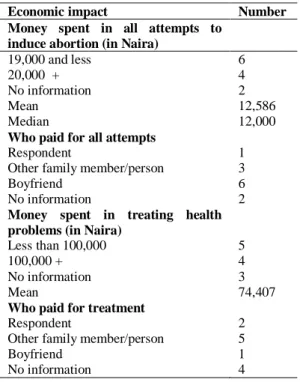
life-threatening complications due to unsafe abortion was six times higher than the cost of all attempts to end the pregnancy. Women spent on average 12,586 Naira (US$8316) in all attempts to end the pregnancy while the average cost of treating the severe unsafe abortion complications was 74,407 Naira (US$488). Boyfriends (six out of 11), and to a lesser extent family members, were most commonly responsible for paying the cost of the abortion procedure. About half of the women did not know who bore the cost of treatment (Table 5).
Women were also asked whether they or anyone in their household lost any income during the time they were hospitalized. Four women responded that they lost between 4,000 and 65,000 Naira (US$26-$426), whereas nine reported that someone else from their household had lost between 6,000 and 100,000 Naira (US$39-$656). Since the minimum monthly salary in Nigeria was 18,000 Naira at the time the study was conducted (US$118)17, these costs represent a huge amount of money for these women and their households.
Discussion and Conclusions
This study documents the extent to which induced abortion is a cause of MNM and the immediate health and economic consequences on women and families in Nigeria. A total of 137 obstetric near-miss cases were identified over a period of six months in the study hospitals and one-tenth of these were due to unsafe abortion. Hypertensive disorders in pregnancy and haemorrhage were responsible for the majority of all near-miss events treated in the eight hospitals of the study, similar to findings from other studies carried out in developing countries9-13. Hypertensive disorders and haemorrhage are the two most common morbidities in MNM and in maternal deaths. Whereas anaemia is more prevalent among MNM cases than in maternal deaths abortion complications are similarly associated with the two maternal events. Women experiencing abortion-related near-miss events differ from women with obstetric near-miss experience due to other causes.
Immediate health problems Number Bleeding
Severe 6
Mild - Moderate 2 Did not experienced 3 No information 1
Pain
Severe 9
Mild 1
Did not experienced 1 No information 1
Fever
Severe 2
Mild-Moderate 6 Did not experienced 2 No information 2
Vaginal discharge
Severe 2
Mild-Moderate 5 Did not experienced 4 No information 1
Injuries
Severe 1
Table 5: Immediate Economic Impact to Women and Families due to Abortion-Related Near-Miss Event, Nigeria, 2011
Women with abortion-related MNM were younger and had on average lower numbers of pregnancies and live births than women with MNM associated with other causes. This finding tends to confirm the typical finding that while women of all ages and parity have unsafe abortions in developing regions, the experience tends to be disproportionately higher among younger women in Sub-Saharan Africa18,19. Studies on induced abortion in Nigeria found that abortions tend to be more common among younger, unmarried and childless women3,20-22.
The lower status associated with these women’s characteristics along with the fear that family and community members would find out about the abortion, the lack of knowledge of the serious warning signs of abortion-related complications, and the delays in talking to somebody and taking the decision to seek care predispose women to acutemorbidity.
Apart from the health consequences, the short-term economic impact of MNM due to unsafe abortion can be very high for women and their families. In a study conducted in 2002-03 in
Nigeria, the average cost to women treated for abortion-related complications in hospitals of secondary level was at that time 10,933 Naira23. Since treatment of a near-miss case requires expensive medical interventions such as the use of blood products and use of special and costly equipment, the cost to patient of the abortion-related near-miss treatment is higher than the cost of treating less severe abortion complications. It is therefore the case that the average cost of treating MNM would have been higher than this in 2002-03. According to another study24, women and their households bear about three-quarters of the total cost of treating abortion-related complications in Nigeria. Such an economic burden is capable of shifting the tide and can plunge a household into debt and worsen its poverty status.
The health conditions of women with acute severe morbidity require that appropriate medical intervention be immediate if they are to survive. This implies that policy makers and health care program managers must ensure that hospitals have adequate and up-to-date medical equipments and supplies as well as trained personnel to deal with MNM cases. It is also crucial that MNM patients should not have to wait for unreasonable length of time to be attended by a doctor as observed for some of the women in this study. It is not surprising that none of the respondents reported their waiting time to receive treatment as very long. It is likely that many Nigerian women have become used to bad quality of care that they perceive it as normal. This may be the case in developing countries where patients tend to be less educated and economically dependable and where patients’ rights are not entrenched or enforced in the health care system. Nonetheless, several studies have pointed to the poor and judgmental attitudes of health providers as a barrier to obtaining health care, especially for complications resulting from stigmatized behaviors such as induced abortion. More research is needed to assess the quality of the care given to this special group of women with abortion-related MNM.
Acknowledgements
The authors would like to thank the regional coordinators who were in charge of the supervision and quality control of the data, the
Economic impact Number
Money spent in all attempts to induce abortion (in Naira)
19,000 and less 6
20,000 + 4
No information 2
Mean 12,586
Median 12,000
Who paid for all attempts
Respondent 1 Other family member/person 3
Boyfriend 6
No information 2
Money spent in treating health problems (in Naira)
Less than 100,000 5
100,000 + 4
No information 3
Mean 74,407
Who paid for treatment
Respondent 2 Other family member/person 5
Boyfriend 1
interviewers who did the hard job of data collection and the people who did the data entry for their contributions to making this article possible. The research was supported by funding from the Dutch Ministry of Foreign Affairs, the UK Department for International Development and the John D. and Catherine T. MacArthur Foundation.
Conflict of Interest
The authors have no conflict of interest.
Contribution of Authors
Elena Prada and Akinrinola Bankole were involved in the conceptualization of the project. Ms. Prada and Dr. Bankole along with Olufemi Oladapo, Olutosin Awolude and Isaac Adewole developed the study design and instruments. Drs. Bankole, Oladapo, Awolude and Adewole conducted the field work training, coordinated and oversaw the various aspects of the data collection. Ms. Prada and Tsuyoshi Onda undertook data analysis and produced the first draft of the paper. Drs. Bankole, Oladapo, Awolude and Adewole reviewed multiple drafts of the manuscript and provided extensive comments. Ms. Prada supported by Mr. Onda, led the finalization of the article including responding to reviewers’ and editor’s comments.
References
1. Center for Reproductive Rights (CRR) The World’s Abortion Laws. Available at http:// worldabortionlaws.com/.Accessed 5 February 2014.
2. Bankole A, Adewole I, Hussain R, Awolude O, Singh S and Akinyemi J. The incidence of abortion in Nigeria. Int Perspect Sex Reprod Health (Forthcoming).
3. Henshaw S. Severity and cost of unsafe abortion complications treated in Nigerian hospitals.
Int Fam Plan Perspect 2008; 34(1): 40–50. 4. Oladapo OT, Sule-Odu AO, Olatunji AO and
Daniel OJ. ‘Near-miss’ obstetric events and maternal deaths in Sagamu, Nigeria: a retrospective study. Reprod Health 2005; 2(9): 1-9.
5. Jabir M, Abdul-Salam I, Suheil DM, Al-Hilli W, Abul-Hassan S, Al-Zuheiri A, et al. Maternal near-miss and quality of maternal health care
in Baghdad, Iraq. BMC Pregnancy and Childbirth 2013; 13(11): 1-9.
6. Lotufo F, Parpinelli MA, Haddad SM, Surita FG and Cecatti JG. Applying the new concept of maternal near-miss in an intensive care unit.
Clinics 2012; 67(3): 225-230.
7. Oladapo O, Adetoro OO, Fakeye O, Ekele BA, Fawole AO, Abasiattai A, et al. National data system on near-miss and maternal death: shifting from maternal risk to public health impact in Nigeria. Reprod Health 2009; 6(8): 1-11.
8. Pattison RC and Hall M. Near-misses: a useful adjunct to maternal death enquiries. Br Med Bull 2003; 67: 231–243.
9. Prual A, Bouvier-Colle MH, de Bernis L and Bréart G. Severe maternal morbidity from direct obstetric causes in West Africa: incidence and case fatality rates. Bull World Health Organ
2000; 78(5): 593-602.
10. Filippi V, Ganaba R, Baggaley RF, Marshall T, Storeng KT, Sombié I, et al. Health of women after severe obstetric complications in Burkina Faso: a longitudinal study. Lancet
2007;370(9595):1329-37.
11. Filippi V, Alihonou E, Mukantaganda S, Graham WJ and Ronsmans C. Near-misses: maternal morbidity and mortality. Lancet 1998; 351(9096): 145-146.
12. Filippi V, Ronsmans C, Graham WJ, Gandaho T and Alihonou E. Near-misses: Are Life Threatening Complications Practical Indicators for Safe Motherhood Programmes? Proceedings of the IUSSP Seminar on Innovative Approaches to the Assessment of Reproductive Health; 1996 Sept 24-27; Manila, Philippines: IUSSP.
13. Weeks A, Lavender T, Nazziwa E and Mirembe F. Personal accounts of ‘near-miss’ maternal mortalities in Kampala, Uganda. BJOG 2005; 112(9): 1302–1307.
14. Say L, Souza JP, Pattinson RC for the WHO working group on maternal mortality and morbidity classification: Maternal near miss – towards a standard tool for monitoring quality of maternal health care. Best Pract Res Clin Obstet Gynaecol 2009, 23:287-296.
15. McCarthy J and Maine D. A framework for analyzing the determinants of maternal mortality. Stud Fam Plann 1992; 23(1): 23– 33.
16. Exchange rate at the time was US$ 1 = 152.498 NGN, http://www.xe.com/currencytables/? from= USD&date=2011-07-15.
17. CSR West Africa. Nigeria: Minimum Wage In Nigeria 2011. Available at http://csrwestafrica. com/2011/07/08/nigeria-minimum-wage-in-nigeria. Accessed 9 July 2013.
estimates of the incidence of unsafe abortion and associated mortality in 2008, 6th ed. Geneva: Department of Reproductive Health and Research, World Health Organization, 2011.
19. Shah IH and Ahman E. Unsafe abortion in 2008: global and regional levels and trends. Reprod Health Matters 2010; 18(36): 90–101. 20. Bankole A, Oye-Adeniran B, Singh S, Adewole I,
Wulf D, Sedgh G, et al. Unwanted Pregnancy and Induced Abortion in Nigeria: Causes and Consequences. New York: Guttmacher Institute, 2006.
21. Sedgh G, Bankole A, Oye-Adeniran B, Adewole IF, Singh S and Hussain R. Unwanted Pregnancy and Associated Factors Among Nigerian Women. Int Fam Plan Perspect 2006; 32(4): 175-184.
22. Okonofua FE, Onwudiegwu U and Odunsi OA. Illegal induced abortion: a study of 74 cases in Ile Ife, Nigeria. Trop Doct 1992; 22(2): 75-78.
23. Bankole A, Singh S, Vlassoff M and Woog V. Estimating the cost of post-abortion care in Nigeria: a case study. In Lule E, Singh S, Chowdhury SA (Ed.). Fertility Regulation Behaviors and Their Costs. Washington, DC: World Bank, 2007.