VOLUME 15 ISSUE 3 (2017), Page 135 – 146
TRANSFORMING HERITAGE BUILDING FOR COMMERCIALISATION
Prihatmanti Rani1, Cantika Putri2, & Adeline Devina3
1,2,3Interior Architecture Department
CIPUTRA UNIVERSITY, SURABAYA, INDONESIA
Abstract
Adaptive reuse is known as one of the conservation methods to prevent the building from being abandoned, dilapidated, as well as to halt further deterioration of the fabrics, both in interior and exterior. Surabaya has a number of Dutch colonial buildings as evidence of the Dutch settlements for 350 years. The aesthetic value, location and the historical significance of the buildings have made the proprietors conserving those buildings and reusing them as commercial spaces. In this research, two prominent Dutch-colonial mansions have been chosen as the research objects. Those buildings have been transformed into an upscale dining place in Surabaya, Indonesia. Based on the local regulation for heritage building conservation, the designated buildings have adhered to the conservation regulations. However, in some parts, alterations were still discovered and not according to the original of the building. These changes were purposely done in order to accommodate the business owners’ need. Therefore, this paper aims to review the transformation of heritage building and the compliance to the regulation.
Keyword: Adaptive reuse, heritage building, commercialisation, transformation
INTRODUCTION
Heritage building is a witness of the past that deserved to be kept to retain the memories. It is also a legacy from the past and should be preserved for our next generation. Besides, the unique building form has distinct characters from the past architectural styles. The aesthetic value embedded in the building has made heritage building interest many people. According to a study by Armitage and Irons (2013), there is a certain pleasure such as a sense of place, belonging or connection that someone could find from the aesthetic quality of heritage buildings. It is widely known from the previous research that physical quality of the building, including the layout, lighting, interior fixture and furnishings, ambience, as well as the air quality are significantly known to affect the customers' emotional response. Therefore, it could create a memorable experience to the customers, provide dining satisfactions as well as their behavioural intentions (Song, 2010; Heung & Gu, 2012); Chen, Peng & Hung, 2015). These positive impacts are significantly affecting the patrons’ intention to return, spreading positive word-of-mouth, and they are also willingly to pay more (Song, 2010; Chen, Peng & Hung, 2015).
Thus, there are more and more business owners locate their restaurant in a heritage building in order to capture the patrons’ experience in dining. There are five key experience design principles for designing a memorable experience, those are theme the experience, harmonise impressions with positive cues, eliminate negative cues, mix in memorabilia, and engage all the five senses (Pine & Gilmore, 1999)
This phenomenon also occurred in Surabaya where several heritage buildings are being adaptively reused into restaurants and commercial spaces. However, there are limited discussion among scholars on the transformation of the heritage building, particularly in Surabaya. Previous research studied the ventilation system in tropical-humid architecture (Prianto et al., 2000), the morphological framework of the Chinese and the European districts in Surabaya (Kwanda, 2011), the spatial planning of the Chinese architecture in Surabaya, and the environmental and heritage building conservation on the north of Surabaya (Danardi, Antariksa & Hariyani, 2010). Therefore, this research focuses on the transformation of the physical aspects of the heritage buildings that have been adaptively reused into commercial spaces.
commonly found in Surabaya is the Empire Style or known as The Dutch Colonial style.
The Dutch Colonial style is influenced by the neo-classical style that occurred in the Europe. however due to the high temperature and heavy rainfall, the buildings that were built in the East Indies, were made to be adaptable to the local climate and using the local materials (Handinoto, 1996). The main building are characterised by symmetrical layout and building mass, 1-2 story building with hip roof, terrace in the front part of the house, Greek-style columns that support the canopy/cantilever as a shade. In terms of the building appearance in accordance with the ventilation system, Colonial Dutch buildings are generally high in ceiling (more than 3.5 meters) and equipped with ventilation mesh, wall full of openings, tall doors and windows, hollowed attic, high roof, path around the buildings as a form of circulation, and a tower that functions as a wind catcher (Prianto et al., 2000)
ADAPTIVE REUSING HERITAGE BUILDING
UNESCO (1972) has stated that heritage is a legacy and witness from the past of the man-made environment that represents the cultural history and cannot be duplicated or replaced once lost. Moreover, it is also a source of life and inspiration for the next generation. One method for conserving heritage building is by adaptive reusing it. As stated in the Burra Charter, adaptive reuse is rehabilitating or renovating heritage buildings or structures for any uses other than the present uses (Australian ICOMOS, 1999). It involves no change to the culturally significant fabric, changes that are significantly reversible, or changes with minimal impact.
According to Rypkema (2008), there are several positive impacts in adaptive reusing heritage buildings. By adaptive reusing, it could help to reuse the existing public infrastructure. Therefore, it would be cost effective, energy conserving, as well as time saving, compare to constructing new building. Moreover, properly managed and maintained historical buildings could reduce the number of vacant buildings; create viable business districts and employment, as well as could attract visitors.
New uses of adaptive reused heritage buildings are classified into two categories, the active and the passive use. Active use can be defined as a new activity that generates sufficient income to cover restoration and maintenance costs in the adaptive reuse programme, such as hospitality (restaurants, hotels) and commercial (shops and other retails) business. While the passive use does not generate significant income to cover restoration as well as the maintenance cost. However, passive use will bring social benefits to the community such as libraries, museums, welfare housing, etc. (Pimonsathean, 2002)
in Surabaya.
A. Building that must be maintained its original characters and fabrics where minimum intervention of the conservation methods are required; B. Building that can be conserved in order to maintain the original
characters and fabrics by restoring/rehabilitating or reconstructing; C. Buildings that are conserved by adaptively reusing it but the building
façade must be retained as it was. Alteration is only allowed on the internal parts and must suit the original design of the building;
D. Buildings that are under-utilised and in a risk of demolition. These buildings are legally allowed to be demolished and must be rebuilt as it was.
However, there is a lack of information on the category of the listed heritage buildings in Surabaya. It is compulsory to identify the category of the listed buildings before doing any conservation works.
METHODOLOGY
To obtain the objective, this research employed a qualitative descriptive method, mainly observation, and interview. This study begins with the literature review on government documents, academic journals, media publication on adaptive reuse of the designated research objects in Surabaya. An observation was conducted to obtain data on the physical aspects of the buildings studied that includes the building fabric, furniture, and furnishings, interior layout, ambience as well as the exterior condition. Interview with the proprietor of each building was also conducted in order to gain deeper data regarding the transformation of functions and form of the buildings. A descriptive analysis was used to describe the differences of the buildings before and after the alteration.
Selection of the Case Study
The buildings studied were two restaurants of more than 50 years of age, heritage listed buildings, and categorised as B class. According to the heritage regulation and UNESCO (1972), a building can be considered as heritage if it is believed to be more than 50 years of age. The studied buildings are located in the center of Surabaya where the Dutch settlement was located during their occupancy in Surabaya. Those buildings are:
The 1914 Restaurant
(Centre Culturel et de Cooperation Linguistique) as well as the representative office of French Consulate General Surabaya (CCCL Surabaya) until 2012. On the same year, this building was officially gazetted by the Surabaya City government as a heritage listed building. After gazetted, it was then renovated and converted into a high-end restaurant in 2013, named The 1914 Restaurant. This restaurant is a multi-concept destination for food and beverage, entertainment, socialising, as well as for private dining. It offers a variety of Western, Mexican and Asian food, live music lounge, cigar bar, wine cellar and lounge, private function rooms and outdoor garden piazza.
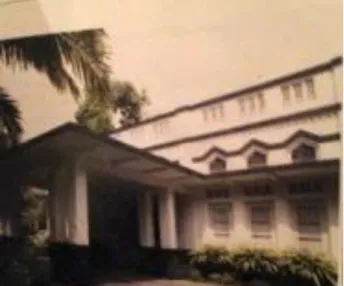
In order to accommodate the concept of this restaurant, this building has undergone several major renovations in some parts of the buildings, both exterior and interior. Since this building is categorised as the B class, any restoration, rehabilitation or reconstruction works are acceptable in order to maintain the original characters of the buildings. The façade of this building is still similar although there are some effects of the alterations can be seen (refer to Fig. 1 and 2).
Figure 1 The Façade of CCCL Surabaya
Figure 2 The Current Façade of the 1914 Restaurant Source: https://www.instagram.com/ theconsulatesurabaya/
de Soematra Function House 1910 Surabaya
Figure 3 The Building Façade in the Past
Figure 4 The Current Building Façade Source: http://www.de-soematra.com
RESULTS AND DISCUSSION
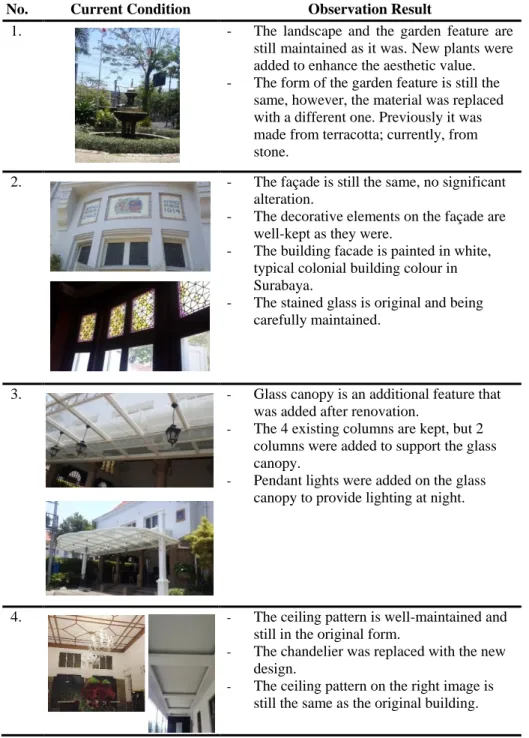
Table 1 The Transformation of The 1914 Restaurant
No. Current Condition Observation Result
1. - The landscape and the garden feature are
still maintained as it was. New plants were added to enhance the aesthetic value.
- The form of the garden feature is still the
same, however, the material was replaced with a different one. Previously it was made from terracotta; currently, from stone.
2. - The façade is still the same, no significant
alteration.
- The decorative elements on the façade are
well-kept as they were.
- The building facade is painted in white,
typical colonial building colour in Surabaya.
- The stained glass is original and being
carefully maintained.
3. - Glass canopy is an additional feature that
was added after renovation.
- The 4 existing columns are kept, but 2
columns were added to support the glass canopy.
- Pendant lights were added on the glass
canopy to provide lighting at night.
4. - The ceiling pattern is well-maintained and
still in the original form.
- The chandelier was replaced with the new
design.
- The ceiling pattern on the right image is
5. - Additional railings made from wrought iron was added (left image).
- The material on the column and the
ornamentation (lotus motif) are maintained
as they were. Lotus or padma (in Sanskrit)
means strength, durability, passion and purity.
6. - The position of the plants is still in the
same location to filter the dust, reduce the noise and to maintain visual privacy
- The wooden door panels are still
maintained as they were. Restaining the wood is regularly conducted.
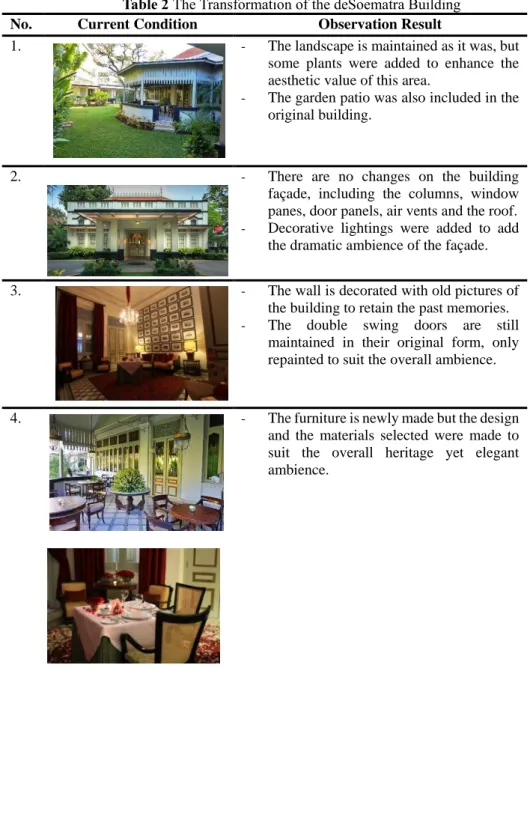
Table 2 The Transformation of the deSoematra Building
No. Current Condition Observation Result
1. - The landscape is maintained as it was, but
some plants were added to enhance the aesthetic value of this area.
- The garden patio was also included in the
original building.
2. - There are no changes on the building
façade, including the columns, window panes, door panels, air vents and the roof.
- Decorative lightings were added to add
the dramatic ambience of the façade.
3. - The wall is decorated with old pictures of
the building to retain the past memories.
- The double swing doors are still
maintained in their original form, only repainted to suit the overall ambience.
4. - The furniture is newly made but the design
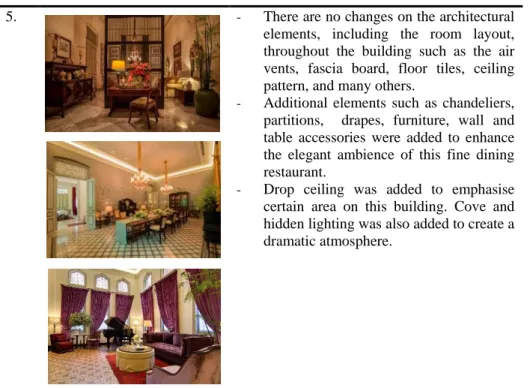
5. - There are no changes on the architectural elements, including the room layout, throughout the building such as the air vents, fascia board, floor tiles, ceiling pattern, and many others.
- Additional elements such as chandeliers,
partitions, drapes, furniture, wall and table accessories were added to enhance the elegant ambience of this fine dining restaurant.
- Drop ceiling was added to emphasise
certain area on this building. Cove and hidden lighting was also added to create a dramatic atmosphere.
Table 2 shows the studied building already adheres to the principles of conservation as well as the conservation regulation. Despite the changes on the interior, the architectural elements including the layout as well as the façade are still maintained as they were. The conservation work was done according to the original design of the building and maintained regularly until today. The interior design, including the furniture and the embellishments, were well-furnished to perform the elegance of this building. This building is one of the good examples of heritage building conservation in Surabaya.
CONCLUSION
safeguard heritage buildings and to prevent any conservation work that might jeopardise the heritage value of the buildings.
REFERENCES
Armitage, L., & Irons, J. (2013). The values of built heritage. Property Management,
31(3), 246-259. DOI: http://dx.doi.org/10.1108/02637471311321487
Australian ICOMOS (1999). The Burra Charter: The Australia ICOMOS Charter for
places of cultural significance (pp. 2-5). Victoria: Australia ICOMOS Incorporated.
Chen, A., Peng, N., & Hung, K. P. (2015). The effects of luxury restaurant environments
on diners’ emotions and loyalty. International Journal of Contemporary
Hospitality Management, 27(2), 236-260. DOI:
http://dx.doi.org/10.1108/IJCHM-07-2013-0280
Danardi, R. W., Antariksa, & Hariyani, S. (2010). Pelestarian lingkungan dan bangunan
kuno di koridor Jalan Rajawali Kota Surabaya. Arsitektur e-Journal, 3(2).
Handinoto (1996). Perkembangan kota dan arsitektur kolonial Belanda di Surabaya
1870-1940. Surabaya: Penerbit Andi.
Heung, V. C. S., & Gu, T. (2012). Influence of restaurant atmospherics on patron
satisfaction and behavioral intentions. International Journal of Hospitality
Management, 31(4), 1167–1177. DOI:
http://dx.doi.org/10.1016/j.ijhm.2012.02.004
Kwanda, T. (2011). The morphological framework of the Chinese and the European
districts in Surabaya, 1787-2005. DIMENSI, 38(1), 1-14.
Pimonsathean, Y. (2002). Current issues concerning adaptive re-use in the conservation
of urban cultural heritage. RC: Revista de Cultura = Review of Culture. 4.
Pine, J., & Gilmore, J. H. (1999). The experience economy. Boston, Harvard Business
School Press
Prianto, E., Bonneaud, F., Depecker, P., & Peneau, J-P. (2000). Tropical-humid architecture in natural ventilation efficient point of view: A reference of
traditional architecture in Indonesia. International Journal on Architectural
Science, 1(2), 80-95.
Song, J. (2010). Retail design and sensory experience: Design inquiry of complex reality.
Proceeding of the International Conference Design and Complexity (pp. 120-126). Montreal, Canada: Design Research Society.
UNESCO (1972, November). 7th session at general conference concerning the