Navigating Multilingual News
Collections Using Automatically
Extracted Information
Ralf Steinberger, Bruno Pouliquen and Camelia Ignat
European Commission – Joint Research Centre, Ispra (VA), Italy
We are presenting a text analysis tool set that allows analysts in various fields to sieve through large collec-tions of multilingual news items quickly and to find information that is of relevance to them. For a given document collection, the tool set automatically clusters the texts into groups of similar articles, extracts names of places, people and organisations, lists the user-defined specialist terms found, links clusters and entities, and generates hyperlinks. Through its daily news analysis operating on thousands of articles per day, the tool also learns relationships between people and other entities. The fully functional prototype system allows users to explore and navigate multilingual document collections across languages and time.
Keywords: news analysis, clustering, named entity recognition, topic detection, topic tracking, automatic hyperlinking, visualisation, multilingual, cross-lingual.
1. Introduction
Most large organisations employ full-time per-sonnel to search the media for relevant informa-tion: Politicians and political parties are inter-ested in the media’s opinions expressed about them or about certain subjects; Organisations with an interest in medical or financial issues monitor reports about the outbreak of diseases, about stock exchange- relevant transactions, etc. The various users have in common that they need to sieve through vast amounts of news ar-ticles or other reports every day, in order to find the most relevant documents, to digest and store them. When analysts search this manually com-piled text repository, they are again confronted with the time-consuming and monotonous task of having to look through large document col-lections.
The text analysis tool set presented here aims at improving the efficiency of this process signif-icantly, by ordering any collection into related documents, by extracting information from each cluster of related documents, by visualising the results in an intuitive manner, and by allowing the information seekers to explore the document collection via automatically generated hyper-links.
In this paper, we start from the assumption that the organisation already is in possession of the document collection, because they purchase news wires from press agencies or because they receive lists of potentially relevant articles from a news monitoring system like theEurope Me-dia Monitor EMM (1]). News is often
dis-tributed in the standardised XML format RSS
(6]). We therefore take it for granted that the
documents are clean and well structured, or that separate format conversion tools convert other formats like HTML or PDF into RSS.
The following sections describe the extraction of named entities and terms from news texts
(Sect. 2), as well as the clustering of similar
doc-uments and the monolingual and cross-lingual linking of related clusters(Sect. 3). Sect. 4
2. Extraction of Information from Texts
The contents of factual news can roughly be summarised asWho does What to Whom, Where and When. Our aim is to cluster news articles that talk about the same event or story into one group(Sect. 3), and to then provide the users
with answers to as many of these questions as possible: persons and organisations involved
(Who, to Whom), keywords and specialist
ter-minology found in the texts (What), the
geo-graphical coverage of a news story(Where), and
the period of time concerned(When). Named
Entity Recognition is a rather well-known field of text analysis. For an overview of the state-of-the-art, see, for instance,2].
2.1. Named Entities
We store all the information that has been ex-tracted from articles in a relational database. For the recognition of named entities, we do not use part-of-speech taggers or parsers because we aim at analysing all 20 official European Union (EU) languages and it is difficult and
expensive to procure such linguistic tools for all these languages. Instead, we use name lists and gazetteers to recognise references to known persons and places, and we use lexical patterns to identify references to new persons and or-ganisations. The lexical patterns found (e.g.
‘former Yugoslav president’) are stored in the
database as ‘Titles’ because they provide useful information about each person. Disambigua-tion heuristics are used to distinguish between places and persons with the same name (e.g.
‘Victoria’) and to disambiguate between
vari-ous places with the same name(such as the 45
places called ’Paris’ world-wide). For details,
see 10] and 13]. For each place name, the
co-ordinates are identified and used to generate maps. We have developed tools to identify date expressions in text 7], but this information is
not yet integrated with the rest of the system.
2.2. Keywords and Country Score
For each document, we also extract a ranked list of keywords and their keyness(the degree with
which the keyword is outstandingly frequent in the text), using the statistical log- likelihood test
(3]). The reference word frequency list used
was built using the same text type, i.e. large numbers of news texts.
Internally, each text is represented by a vec-tor consisting of a long list of keywords and their keyness. This vector is enhanced by the normalised country scores of the text. Coun-try scores are calculated by adding one counter each time the country or one of its cities is re-ferred to, and by then normalising this text oc-currence frequency with the average ococ-currence frequency of the country in the reference cor-pus (see 11] for details). Country scores are
expressed as country ISO codes and their key-ness (the log- likelihood value). Adding the
country score to the list of keywords helps to distinguish clusters with contents that are sim-ilar, but distinct, such as election campaigns in different countries. Its representation by the ISO code furthermore helps to find related clus-ters in different languages(see Sect. 3.3).
2.3. Specialist Terms
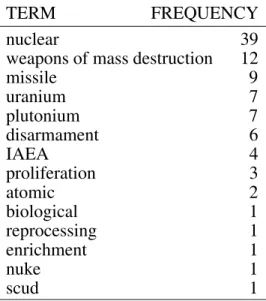
The lists of people, organisations, places and keywords give users a good idea of what the doc-ument is about. However, analysts are normally specifically looking for information regarding their own subject domain. It is therefore useful to additionally display a list of those subject-specific terms that were found in the document or in a group of documents (See Table 1). If
users provide term lists, the system automati-cally checks for each of the terms whether it is
TERM FREQUENCY
nuclear 39
weapons of mass destruction 12
missile 9
uranium 7
plutonium 7
disarmament 6
IAEA 4
proliferation 3
atomic 2
biological 1
reprocessing 1
enrichment 1
nuke 1
scud 1
Table 1. List of specialist terms from the field of nuclear non-proliferation found in a cluster of six news articles
found in the text and, in the positive case, lists the terms. This term list tells the users about the specific relevance of this document for their field of interest.
2.4. Morphological Variants
The lookup of terms and names of people or places in plain text will only be successful if the looked up term is morphologically identical with the string found in the text. For inflected languages, we therefore provide exhaustive suf-fix lists that will be appended to the search term in all combinations so that any of the morpho-logical variations will be found. By doing this, we can ensure, for example, that the inflected Estonian place namesLondonitandNew Yorgile
are successfully recognised and mapped to Lon-donandNew York. See14]for details.
To make the lookup process of the hundreds of thousands of names, terms and their variants computationally viable, the regular expressions are compiled into a Finite State Automaton us-ing FLEX(9]).
2.5. Eurovoc Thesaurus Classification
We also map the contents of the whole news cluster(see Sect. 3.1)onto the multilingual
the-saurus Eurovoc(5]). Eurovoc is a list of over
6000 hierarchically organised concepts that is used by many European parliaments for the manual indexing and classification of docu-ments in their libraries. The wide-coverage the-saurus descriptors(class names)exist in
one-to-one translations in over twenty languages. The automatic categorisation tool was trained on manually classified documents. The approach was to build a profile-based category-ranking tool, which considers a number of parameters that have been empirically optimised to achieve maximum results. Details of the system are de-scribed in 12]. State-of-the-art categorisation
methods were not used due to the extraordinary complexity of the unbalanced, multi-label clas-sification data and the size of the training set. Depending on the language, up to 80000 doc-uments had been manually classified according to over 5000 descriptors with an average of 5.6 descriptors per text.
The result of the thesaurus mapping is a vector of the 100 most relevant Eurovoc descriptors and their numerical identifiers(selected out of
the pool of 6000 Eurovoc descriptors), and their
relevance. This vector is used to link similar news clusters across languages(see Sect. 3.3).
3. Clustering Texts and Linking Clusters
3.1. Clustering and Topic Detection
In order to group related news articles into a cluster, we build a hierarchical clustering tree
(dendrogram), using an agglomerative
algo-rithm (8]). This tree is built by first
calcu-lating a pair-wise similarity between all docu-ment pairs, using the cosine on the docudocu-ment vectors described in Sect. 2.2. The most simi-lar pair of vectors is then combined into a new vector and a new representation is built for this sub-cluster, by merging the keywords and by averaging their keyness. This new node will henceforth be treated like a single document, with the exception that it will have twice the weight of a single document. The hierarchical, binary clustering continues in this way until all documents are part of the cluster. The result-ing dendrogram will have clusters of articles that are similar, and a list of keywords and their weight for each cluster. The degree of similar-ity for each cluster is shown by its intra-cluster similarity value, or cluster cohesiveness. In a next step, we search the dendrogram for the major news clusters of the day(topic detection)
by identifying all sub-clusters with an empiri-cally derived minimum intra-cluster similarity of 50%. For further details, see11].
3.2. Cluster Representation
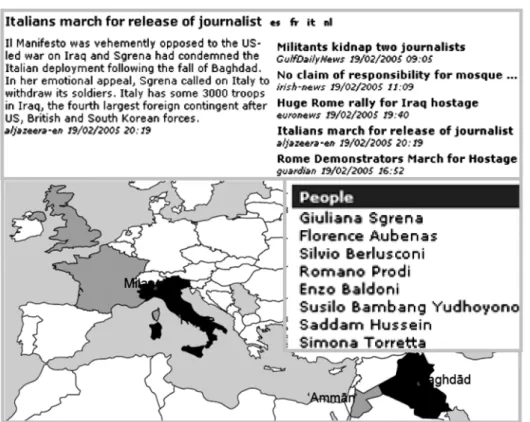
For each cluster, we choose the article that is most similar to the cluster’s centroid and we use its title as the title for the whole cluster. For each cluster, we furthermore display the major keywords and the sum of all names and terms found in the individual articles of the cluster(see
Fig. 1). We also generate a zoomable and
Fig. 1.English news cluster consisting of 5 documents, widh automatically identified links to related news clusters in Spanish, French, Italian and Dutch. Hyperlinks on the titles allow users to read the individual articles; links on names
allow them to find out more about the persons, about all news articles in which they are mentioned, etc.
coverage of the articles in this cluster. By mov-ing the mouse over a country or place name, the occurrences of the name are shown in their context(see Fig. 2).
Fig. 2.Geographical map using SVG, allowing to zoom and to display the context of places.
3.3. Linking Clusters Over Time and Across Languages
As the whole cluster has a representation similar to that of each individual article, we can display the keywords for the cluster and we can also calculate the similarity between this cluster and clusters of other collections. For instance, in our daily news analysis, we compare each clus-ter with the clusclus-ters of the previous days so as
to show the relationships between clusters over time(topic tracking).
We also link similar clusters across languages. When calculating the similarity between clus-ters in different languages, we use three vectors as ingredients, with a relative weighted impact of 70%, 20% and 10%, respectively, on the over-all cross-lingual cluster similarity(see11]for
details): (1)We map the cluster onto the
mul-tilingual classification thesaurus Eurovoc (see
Sect. 2.5);(2)We produce a vector representing
the geographical coverage, using the weighting described in Sect. 2.2; (3) We calculate the
similarity between the monolingual vector rep-resentations of the clusters(not considering the
enhancement with the country score).
by two more specific vectors: one consisting of person and organisation names and the other cluster consisting of dates and numbers.
3.4. Access to the NewsExplorer
The results of the daily clustering, cluster link-ing and information extraction have been integrated into the JRC’s NewsExplorer sys-tem, which can be accessed at the address
http://press.jrc.it/NewsExplorer(Fig. 3).
The zoomable maps and some other details are not yet available on this public web site.
Fig. 3.Public NewsExplorer web site.
4. Learning Relations Over Time
4.1. Name Variants
Due to differing transcription standards, foreign names are frequently spelled differently across languages, and even within the same language. An example is former Iraqi Interim Prime Min-isterIyad Allawi, for whom we found variants likeIyad Alaui,Ajad Allawi,Ijad Alawi,Illyad Allaoui, and many more. We often find name variants for the same person within one clus-ter. We therefore apply an approximate name matching algorithm on all names found in the same cluster to identify those name strings that are likely to refer to the same person. The algo-rithm calculates the cosine of the letter bigram and trigram frequency lists of each name pair, automatically groups those whose similarity is above the empirically determined threshold of 0.7, and stores them under the same numeri-cal name identifier. Name variants not auto-matically identified(e.g.Joseph Ratzingerand
Benedict XVI)or wrong matches(like those
be-tween the similar names George Bush jr. and
George Bush sr.) can be corrected
interac-tively. For some Arabic and Russian names, our database has collected over sixty variants
(see13]).
4.2. Entity Relations
The NewsExplorer system currently analyses news in English, German, French, Spanish, Ital-ian, Dutch, Slovene and Estonian. It produces an average of between 20 and 130 clusters per language and per day. For each of the clusters, a number of people, organisations, country scores and keywords are identified and stored in a rela-tional database. Over time, this database builds up statistics on the frequency of co-occurrence of any of these entities in the same cluster. As the system has been running for over a year, a simple database query can tell how often peo-ple have been mentioned in individual articles or in clusters. It can also give information on which names are frequently mentioned together with which others. As the names of some fa-mous politicians are mentioned disproportion-ately often, a weighting algorithm suppresses personalities that are associated with many dif-ferent other names, and it picks up name pairs that are mainly mentioned together and that are not associated with too many other names. For details on learning relations between people and on the weighting mechanism, see13]. Table 2
shows the top of the list of weighted associated names for the Formula-1 driverMichael Schu-macher.
NAME COMM-CLUST WGHT
Kimi Raikkonen 142 1.10
Takuma Sato 126 1.0
Giancarlo Fisichella 147 1.0
Rubens Barrichello 246 0.99
Fernando Alonso 234 0.95
Felipe Massa 76 0.94
Jarno Trulli 179 0.91
Jenson Button 189 0.90
Nick Heidfeld 143 0.89
Juan Pablo Montoya 86 0.88
David Coulthard 137 0.88
Jean Todt 58 0.83
...
The comparison of Column 2(number of
clus-ters in which both names occur)versus Column
3 (weighted association measure) shows that
the number of clusters in which both names co-occur is not the most significant feature, because a number of further features are considered in the weighting.
5. Exploring the Document Collection
The information collected in the processes de-scribed in the previous sections is stored in a relational database. Information that needs to be accessed quickly (e.g. daily information in
the NewsExplorer application) is additionally
exported into XML files. The user interfaces can be viewed with common web browsers. For a document collection that can consist of all the news of the day or of any other selection, users can explore the available information via several entry points. The first and major entry
point is the list of clusters, which gives the users an overview of what can be found in the collec-tion. For each cluster, an individual HTML page can be created on the fly, containing a list of all individual articles belonging to the cluster, a geographical map, information about the clus-ter’s keywords, person and organisation names, and lists of clusters that are related to the chosen one(see Fig. 1). These linked clusters are either
those that were published in the previous days about the same story, or they are the ones that talk about the same story in other languages.
Each of the individual articles has a hyperlink to the URL where it was originally found so that the user can read the full article(if it is still
available). When clicking on any of the
key-words or on any of the place names, the system displays a list of all clusters for which this key-word or place was identified. As the keykey-words are language-dependent, the list of related arti-cles will be in the same language as the original document, but cluster lists for place names can
be in any of the languages, because the geo-graphical information (place ID, latitude and
longitude)is language-independent.
When clicking on any of the person or organi-sation names, additional information about this name will be displayed, where available, as shown in Fig. 4.
The item ‘titles’ contains the list of lexical pat-terns in the various languages that helped us identify the name. If users do not know a per-son and no Wikipedia encyclopaedia entry is available, the list of titles, associated keywords and countries gives them a rather good idea of the context of the person.
Instead of starting navigating the document col-lection via the list of clusters, users can also use a search form to enter a name, keyword or country. If the entered name is not found in the database of names and their variants, the approximate name matching process will be started to find names spelled similarly to the one sought. For any keyword or place name en-tered, the user will be presented with the same links as shown in Table 3, except obviously the Wikipedia entries and the name-related links
(‘titles’, ‘name variants’ and ‘weighted
associ-ated names’). The navigation and exploration
tool exploits the full power of the relational database whose knowledge about relations has been built up over time.
6. Conclusion and Future Work
We have developed a multi-component system for multilingual news analysis that can be used by analysts who frequently have to look through large news collections to find information about their specific field of interest. The proposed system first organises the whole collection into groups of similar articles by applying state-of-the-art clustering methods. It then analyses the collection, cluster by cluster, by extracting and displaying information such as named entities and occurrences of controlled vocabulary spe-cialist terms. The system stores all the extracted information in a relational database. As the system analyses vast amounts of news articles every day, the database contains a lot of rela-tional information that the user can access. The acquired database knowledge includes informa-tion on which persons or organisainforma-tions are fre-quently or mainly mentioned in the same news
stories, which keywords and countries are asso-ciated with each person, what spelling variants the press uses for the same person, etc. Users can browse the document collection and the in-formation stored in the database.
The system is in an advanced prototype phase, but some of the current functionality is already available on the public web site of the JRC’s
NewsExplorer.
It is planned to extend the functionality and the language coverage of the NewsExplorer. Even-tually, news from all 20 official EU languages should be included. The system will be im-proved by extracting further entities such as dates and currency expressions, and by using these plus extracted person names to improve the linking of related news clusters in different languages.
We also plan to apply the tool to the analysis of document collections of different types, such as in-house collections of documents, the re-sults of search engine queries or the rere-sults of subject-specific or site-specific web-crawling. This application to new text types brings new challenges, such as the need for document for-mat conversion and the need to tune the named entity recognition software to other text types. Finally, we would also be interested in detect-ing the more specific relationships between the entities found in the news — which leads us to event scenario template filling — and we would like to gather information about the sentiment expressed in the news report (‘How’ the event
is reported).
7. Acknowledgments
We thank the JRC’s Web Technology sector, and especially Clive Best, Erik van der Goot, Ken-neth Blackler and Teofilo Garcia, for the access to theEurope Media Monitornews data and for their support. We furthermore thank the many persons who have contributed over time to de-velop the existing text analysis tool set and to adapt it to so many languages.
References
1] C. BEST, E.VAN DERGOOT, M.DEPAOLA, T. GAR
-CIA, D. HORBY, Europe Media Monitor — EMM.
JRC Technical Note No. I.02.88, Sept. 2002.
2] B. DAILLE, E. MORIN, Reconnaissance automatique
des noms propres de la langue `ecrite: les r`ecentes r`ealisations. Traitement Automatique des Langues (TAL), Vol. 41(3), pp. 601–622, 2000.
3] T. DUNNING, Accurate Methods for the Statistics of
Surprise and Coincidence.Computational Linguis-tics, Volume 19, number 1, pp. 61–74. 1993. 4] D. EISENBERG, SVG essentials. O’Reilly &
Asso-ciates, 2002.
5] Thesaurus EUROVOC — Volume 2:
Subject-Oriented Version. Ed. 3/English Language. An-nex to the index of the Official Journal
of the EC. Luxembourg, Office for Offi-cial Publications of the European Communities.
http://europa.eu.int/celex/eurovoc, 1995. 6] B. HAMMERSLEY, Content syndication with RSS.
O’Reilly & Associates, 2003.
7] C. IGNAT, B. POULIQUEN, A. RIBEIRO, R. STEIN
-BERGER, Extending an Information Extraction
Tool Set to Central and Eastern European Lan-guages. In: Proceedings of the International Workshop ‘Information Extraction for Slavonic and other Central and Eastern European Lan-guages’ (IESL’2003), held at RANLP’2003,
pp. 33–39. Borovets, Bulgaria, 8–9 September 2003.
8] A. JAIN, M. MURTY, P. FLYNN, Data clustering: a
review. ACM Computing Surveys, Vol. 31(3), pp.
264–323, 1999.
9] V. PAXSON, Flex — Fast Lexical Analyzer
Gen-erator. Lawrence Berkeley Laboratory, Berke-ley, CA. 1995. ftp://ftp.ee.lbl.gov/flex-2.5.4.tar.gz.
10] B. POULIQUEN, R. STEINBERGER, C. IGNAT, T. DE
GROEVE, Geographical Information Recognition
and Visualisation in Texts Written in Various Lan-guages. In: Proceedings of the 19th Annual ACM Symposium on Applied Computing (SAC’2004),
Special Track on Information Access and Re-trieval(SAC-IAR), vol. 2, pp. 1051–1058. Nicosia,
Cyprus, 14–17 March 2004.
11] B. POULIQUEN, R. STEINBERGER, C. IGNAT, E.
K ¨ASPER AND I. TEMNIKOVA I, Multilingual and
Cross-lingual News Topic Tracking. In: CoL-ing’2004proceedings, Vol. II, pp. 959–965. Geneva, August 2004.
12] B. POULIQUEN, R. STEINBERGER, C. IGNAT,
Auto-matic Annotation of Multilingual Text Collections with a Conceptual Thesaurus. In: Proceedings of the Workshop ’Ontologies and Information Extrac-tion’ at the Summer School’The Semantic Web and Language Technology — Its Potential and Practi-calities’ (EUROLAN’2003), Bucharest, Romania,
28 July – 8 August 2003.
13] B. POULIQUEN, R. STEINBERGER, C. IGNAT, W. ZA
-GHOUANI, J.ZˇIZKAˇ , Detection of Person Names and their Translations in Multilingual News. Colloque ‘Traitement lexicographique des noms propres’. Tours, France, 24 March 2005.
14] R. STEINBERGER, B. POULIQUEN, C. IGNAT,
Exploit-ing MultilExploit-ingual Nomenclatures and Language-Independent Text Features as an Interlingua for Cross-lingual Text Analysis Applications. In: Infor-mation Society 2004 (IS’2004) — Proceedings B of the 7th International Multiconference — Language Technologies, Ljubljana, Slovenia.
Recived:June, 2005.
Accepted:October, 2005.
Contact address:
Ralf Steinberger European Commission — Joint Research Centre Via E. Fermi 1, T.P. 267 21020 Ispra(VA), Italy
Bruno Pouliquen European Commission — Joint Research Centre Via E. Fermi 1, T.P. 267 21020 Ispra(VA), Italy
Camelia Ignat European Commission — Joint Research Centre Via E. Fermi 1, T.P. 267 21020 Ispra(VA), Italy
[email protected] http://www.jrc.it/langtech, http://press.jrc.it/NewsExplorer
RALFSTEINBERGERleads the Language Technology group at the Euro-pean Commission’sJoint Research Centrein Ispra, Italy. He received his M.A. degree(1991)in theoretical linguistics fromLMU University
in Munich, Germany, and his Ph.D.(1994)in computational linguistics
from theUniversity of Manchester Institute of Science and Technology
(UMIST), United Kingdom. Before joining the European Commission,
he worked at theInstitute for Applied Information SciencesIAI in Ger-many, at UMIST, at theKyushu Institute of Technologyin Japan, and atSharp Laboratories of Europein Oxford, UK. His research interests include multilingual and cross-lingual text analysis applications, with a focus on methods to provide cross-lingual information access and to help users digest large multilingual document collections.
BRUNOPOULIQUENreceived an M.Sc. degree in computer science and a Ph.D. in natural language processing from theUniversity of Rennes Iin France in 1989 and 2002, respectively. He is currently a senior researcher at theJoint Research Centreof the European Commission. Before joining the European Commission he worked in the Medical Informatics field in theUniversity Hospital of Rennes(France). His
re-search interests include statistical, knowledge-poor techniques to cross the language barrier, which includes thesaurus indexing and automatic classification based on Machine Learning techniques, clustering and Named Entity Recognition.
CAMELIAIGNATreceived an M.Sc. degree in computer science from theUniversity of Bucharestin 1995 and an M.Sc. degree in cognitive sciences from the University of Paris XI in 1998. She is currently researcher in the Language Technology group at theJoint Research Centreof the European Commission. She has worked on computa-tional linguistics since 1995, in the Research Institute for Informatics in Bucharest and at France Telecom R&D(France). Her research interests