Preliminary Numerical Experiments in Multiobjective Optimization of a
Metallurgical Production Process
Bogdan Filipiˇc and Tea Tušar Department of Intelligent Systems Jožef Stefan Institute
Jamova 39, SI-1000 Ljubljana, Slovenia E-mail: [email protected], [email protected]
Erkki Laitinen
Department of Mathematical Sciences University of Oulu
P.O. Box 3000, FIN-90014 Oulu, Finland E-mail: [email protected]
Keywords: continuous casting of steel, product quality, process parameters, multiobjective optimization, differential evolution
Received:November 3, 2006
This paper reports on preliminary numerical experiments in optimizing coolant flows in continuous casting of steel with respect to multiple objectives. For this purpose, Differential Evolution for Multiobjective Optimization (DEMO) coupled with a reliable numerical simulator of the casting process was applied. The algorithm parameters were initially tuned to balance between the quality of the expected results and the computational cost of the optimization process. Afterwards, suitable sets of coolant flow settings were calculated under conflicting requirements for minimum temperature deviations and predefined core length in the caster. In contrast to solutions produced in single-objective optimization, approximation sets of Pareto optimal fronts obtained in multiobjective optimization provide more information to metallurgists and allow for better insight into the casting process.
Povzetek: ˇClanek obravnava nastavljanje pretokov hladila v industrijskem kontinuiranem ulivanju jekla
kot veˇckriterijski optimizacijski problem in ga rešuje z evolucijskim algoritmom DEMO.
1 Introduction
Production and processing of materials are nowadays un-der strong market-driven pressure for shortening the pro-cess development time, reducing experimental costs, im-proving material properties, and increasing productivity. In achieving these goals, numerical analysis is playing an in-creasingly important role. Material scientists and engineers actually consider empirical knowledge and computational approximation as the basis for material process design and control. Numerical simulators give insight into process evolution, allow for execution of virtual experiments and support manual optimization by trial and error. However, the optimization procedure can be automated by coupling a simulator with an optimization algorithm and introducing a quality function which allows for automatic assessment of the simulation results.
Continuous casting of steel is an example of a process to which novel computational approaches have been applied intensively over the last years to enhance product character-istics and minimize production costs. In this complex met-allurgical process molten steel is cooled and shaped into
semi-manufactures. To cast high quality steel, it is impor-tant to properly control the metal flow and heat transfer during the process. They depend on numerous parame-ters, including the casting temperature, casting speed and coolant flows. Finding optimal values of process parame-ters is difficult as the number of possible parameter settings is high, the involved criteria are often conflicting, and pa-rameter tuning through real-world experimentation is not feasible because of safety risk and high costs. Techniques applied to overcome these difficulties include knowledge-based techniques, neural networks, fuzzy logic and evolu-tionary computation. Nevertheless, the predominant opti-mization approach taken in the applied studies so far was to aggregate multiple criteria into a single cost value and solve the optimization problem empirically using the simulator-optimizer coupling.
sim-ulations continuous casting of a selected steel grade un-der steady-state conditions was assumed. Through the ob-tained approximation sets of optimal solutions the plant en-gineers can get better insight into process behavior and pa-rameter effects.
The paper outlines the related work, describes the op-timization task and the multiobjective opop-timization ap-proach, and reports on the performed numerical experi-ments and obtained results.
2 Related Work
Over the last years, several advanced computer techniques have been used in attempts to enhance the process perfor-mance and material properties in metallurgical production. Cheung and Garcia [3], for example, combine a numerical model of the process with an artificial intelligence heuris-tic search technique linked to a knowledge base to find parameters values that result in defect-free billet produc-tion. Chakraborti and coworkers [1] report that genetic algorithms have proved to be the most suitable for opti-mizing the settings of the continuous casting mold. They use a Pareto-converging genetic algorithm to solve a multi-objective problem of setting the casting velocity in the mold region. In a further study [2] relying on heat trans-fer modeling, genetic algorithms are used to determine the maximum casting speed and solidified shell thickness at the mold exit. Oduguwa and Roy [13] use a novel fuzzy fitness evaluation in evolutionary optimization and apply it in rod rolling optimization. They solve a multi-objective problem of optimal rod shape design.
Our approach to process parameter optimization in con-tinuous casting of steel involves a numerical simulator of the casting process and various stochastic optimization techniques among which evolutionary algorithms play the key role. The initial version of the optimization system [11] was designed to search for process parameter values that would result in as high as possible quality of contin-uously cast steel. Based on empirical metallurgical crite-ria, it was able to deliver improved parameter settings that proved beneficial in practice. However, using a simple evo-lutionary algorithm, it spent thousands of process simula-tions to find high-quality solusimula-tions. As the time aspect is critical, the purpose of further exploration [9, 7] was to re-duce the number of needed process simulations. These ap-plied studies were all using the weighted-sum technique of aggregating multiple criteria into a scalar cost function. As opposed to that, in a recent work [10] an attempt was made to handle multiple criteria by means of evolutionary mul-tiobjective optimization. Based on the initial findings, this paper refines the problem definition by introducing an addi-tional technological constraint, justifies the algorithm set-tings by checking the algorithm performance metrics and analyzes the new numerical results.
3 Problem Description
In industrial continuous casting, liquid steel is poured into a bottomless mold which is cooled with internal water flow. The cooling in the mold extracts heat from the molten steel and initiates the formation of a solid shell. The shell forma-tion is crucial for the support of the slab behind the mold exit. The slab then enters the secondary cooling area in which it is cooled by water sprays. The secondary cooling region is divided into cooling zones where the amount of the cooling water can be controlled separately.
We consider a casting machine with the secondary cool-ing area divided into nine zones. In each zone, coolcool-ing water is dispersed to the slab at the center and corner po-sitions. Target temperatures are specified for the slab cen-ter and corner in every zone. Wacen-ter flows should be tuned in such a way that the resulting slab surface temperatures match the target temperatures as closely as possible. From metallurgical practice this is known to reduce cracks and inhomogeneities in the structure of the cast steel. Formally, cost functionc1is introduced to measure deviations of
ac-tual temperatures from the target ones:
c1=
NZ
X
i=1
|Tcenter
i −Ticenter∗|+ NZ
X
i=1
|Tcorner
i −Ticorner∗|,
(1) where NZ denotes the number of zones, Ticenter and
Tcorner
i the slab center and corner temperatures in zone
i, andTcenter∗
i andTicorner∗ the respective target
temper-atures in zonei.
There is also a requirement for core length,lcore, which
is the distance between the mold exit and the point of com-plete solidification of the slab. The target value for the core length, lcore∗, is prespecified, and the actual core length should be as close to it as possible. Shorter core length may result in unwanted deformations of the slab as it so-lidifies too early, while longer core length may threaten the process safety. We formally treat this requirement as cost functionc2:
c2=|lcore−lcore∗|. (2)
The optimization task is to minimize bothc1andc1over
possible cooling patterns (water flow settings). It is known that the two objectives are conflicting, hence it is reason-able to handle this optimization problem as a multiobjec-tive one.
In search for solutions, water flows cannot be set arbitrar-ily, but according to the technological constraints. For each zone, minimum and maximum values are prescribed for the center and corner water flows. Moreover, to avoid unac-ceptable deviations of the core length from the target value, a hard constraint is imposed: c2 ≤∆lmaxcore. Candidate
so-lutions not satisfying the water flow constraint and/or the core length constraint are considered infeasible.
For this purpose we used the mathematical model of the process with Finite Element Method (FEM) discretization of the temperature field and the corresponding nonlinear equations solved with relaxation iterative methods, already applied in previous single-objective optimization study of the casting process [8].
4 Multiobjective Optimization
4.1 Preliminaries
The multiobjective optimization problem (MOP) is defined as finding the minimum of the cost functionc:
c:X →Z
c: (x1, . . . , xn)7→(c1(x1, . . . , xn), . . . , cm(x1, . . . , xn)),
whereXis ann-dimensional decision space, andZ⊆Rm
is an m-dimensional objective space (m ≥ 2). The ob-jective vectors fromZ can be partially ordered using the concept ofPareto dominance: z1dominatesz2(z1 ≺z2)
iffz1 is not worse than z2 in all objectives and better in
at least one objective. When the objectives are conflicting, there exists a set of optimal objective vectors calledPareto optimal front. Each vector from the Pareto optimal front represents a different trade-off between the objectives and without additional information no vector can be preferred to another.
With a multiobjective optimizer we search for an ap-proximation setthat approximates the Pareto optimal front as well as possible. When solving MOPs in practice it is often important to provide the user with a diverse choice of trade-offs. Therefore, beside including vectors close to the Pareto optimal front, the approximation set should also contain near-optimal vectors that are as distinct as possible.
4.2 The DEMO Algorithm
Finding a good approximation set in a single run requires a population-based method. Consequently, evolutionary al-gorithms have been frequently used as multiobjective op-timizers [4]. Among them, the recently proposed Differ-ential Evolution for Multiobjective Optimization (DEMO) [15] is applied in optimizing the described metallurgical process.
DEMO is based on Differential Evolution (DE) [14], an evolutionary algorithm for single-objective optimization that has proved to be very successful in solving numerical optimization problems. In DE, each solution is encoded as ann-dimensional vector. New solutions, also called candi-dates, are constructed using operations such as vector addi-tion and scalar multiplicaaddi-tion. After the creaaddi-tion of a can-didate, the candidate is compared with its parent and the best of them remains in the population, while the other one is discarded.
Because the objective space in MOPs is multidimen-sional, DE needs to be modified to deal with multiple ob-jectives. DEMO is a modification of DE with a particular
mechanism for deciding which solution should remain in the population. For each parent in the population, DEMO constructs the candidate solution using DE. If the candi-date dominates the parent, it replaces the parent in the cur-rent population. If the pacur-rent dominates the candidate, the candidate is discarded. Otherwise, if the candidate and its parent are incomparable, the candidate is added to the pop-ulation. After constructing candidates for each parent dividual in the population, the population has possibly in-creased. In this case, it is truncated to the original size us-ing nondominated sortus-ing and crowdus-ing distance metric (as in NSGA-II [5]). This steps are repeated until a stopping criterion is met.
DEMO is a simple but powerful algorithm, presented in detail in [15]. From the three proposed algorithm variants, the elementary one, called DEMO/parent, is used in this work.
5 Optimization Experiments
5.1 Experimental Setup
Numerical experiments in multiobjective optimization of the casting process were performed for a selected steel grade with the slab cross-section of 1.70 m × 0.21 m. Candidate solutions were encoded as 18-dimensional real-valued vectors, representing water flow values at the center and corner positions in 9 zones of the secondary cooling area. Search intervals for cooling water flows at both cen-ter and corner positions in zones 1, 2 and 3 were between 0 and 50 m3/h, while in the zones 4–9 between 0 and 10
m3/h. Table 1 shows the prescribed target slab surface
tem-peratures. The target value for the core lengthlcore∗ was 27 m, while its maximum deviation allowed ∆lcore
max was
7 m.
Table 1: Target surface temperatures in◦C.
Zone number Center position Corner position
1 1050 880
2 1040 870
3 980 810
4 970 800
5 960 790
6 950 780
7 940 770
8 930 760
9 920 750
DEMO was integrated with the numerical simulator of the casting process into an automated optimization environ-ment. DEMO evolved sets of candidate solutions in search for a good approximation set, and the simulator served as a solution evaluator. Steady-state operation of the casting machine was assumed and optimization performed in the off-line manner.
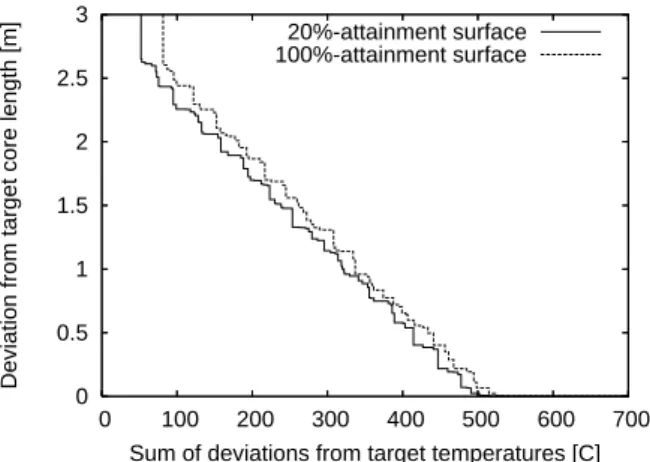
The most limiting factor for experimental analysis is the computational complexity of the casting process simula-tion. A single simulator run takes about 40 seconds on a 1.8 GHz Pentium IV computer. In initial experimenta-tion we found DEMO runs with 5000 soluexperimenta-tion evaluaexperimenta-tions (and therefore taking about 55 hours) well compromising between the execution time and solution quality. Further algorithm settings were also adopted according to the ini-tial parameter tuning experiments [6] and were as follows: population size 50, number of generations 100, scaling fac-tor 0.5 and crossover probability 0.05. These settings en-sure highly acceptable algorithm performance and repeata-bility of the results as indicated by the hypervolume mea-sure [16] and attainment surface plots [12] obtained over five test runs of the algorithm and shown in Figs. 1–2.
3.4 3.5 3.6 3.7 3.8 3.9 4
1000 2000 3000 4000 5000
Hypervolume
Evaluations
Figure 1: Hypervolume values in five test runs of the DEMO algorithm.
5.2 Results and Findings
The key result of this study were approximation sets of Pareto optimal fronts. Figure 3 shows the approximation sets found by DEMO for five casting speeds, ranging from 1.2 m/min to 1.8 m/min. Each set of nondominated solu-tions is the final result of a single DEMO run at a constant casting speed.
It can be observed that the two objectives are really con-flicting in the sense that finding a minimum for one of them the optimization procedure fails to do so for the other and vice versa. It is also obvious that the casting speed has a de-cisive impact on the result. Moreover, the higher the cast-ing speed, the more the two objectives can be met simulta-neously. This corresponds with practical experience on the considered casting machine, where the process is easier to
0 0.5 1 1.5 2 2.5 3
0 100 200 300 400 500 600 700
Deviation from target core length [m]
Sum of deviations from target temperatures [C] 20%-attainment surface 100%-attainment surface
Figure 2: 20% and 100% attainment surfaces for the solu-tions found in five test runs of the DEMO algorithm.
0 1 2 3 4 5 6 7
0 200 400 600 800 1000 1200 1400 1600 1800
Deviation from target core length [m]
Sum of deviations from target temperatures [C] 1.2 m/min 1.4 m/min 1.6 m/min 1.8 m/min
Figure 3: Nondominated solutions found with DEMO for different casting speeds.
control at the usual casting speed (1.6–1.8 m/min). Lower casting speed is clearly shown as disadvantageous and in practice it is only set exceptionally, for example, when a new batch of steel is awaited.
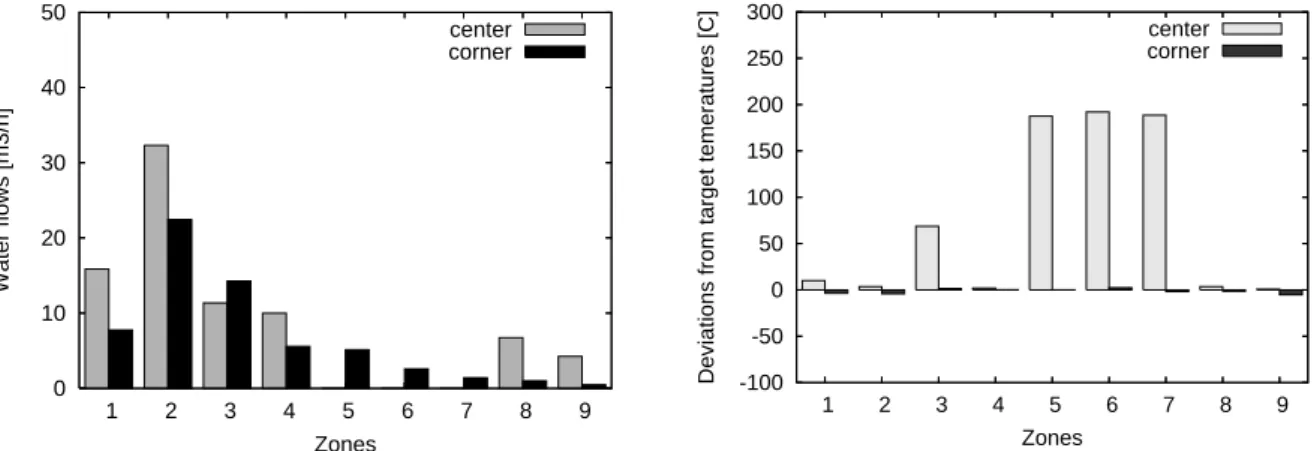
A detailed analysis of the solution properties also reveals that, in view of the objectivec1, the majority of actual
sur-face temperatures are higher than the target temperatures, while regardingc2, the actual core length is almost always
shorter than the target value.
0 10 20 30 40 50
1 2 3 4 5 6 7 8 9
Water flows [m3/h]
Zones
center corner
-100 -50 0 50 100 150 200 250 300
1 2 3 4 5 6 7 8 9
Deviations from target temeratures [C]
Zones
center corner
Figure 4: A trade-off solution from the middle of the approximation set for the casting speed speed of 1.2 m/min: c1=
1051◦C,c
2= 3.8 m.
0 10 20 30 40 50
1 2 3 4 5 6 7 8 9
Water flows [m3/h]
Zones
center corner
-100 -50 0 50 100 150 200 250 300
1 2 3 4 5 6 7 8 9
Deviations from target temeratures [C]
Zones
center corner
Figure 5: A trade-off solution from the middle of the approximation set for the casting speed speed of 1.4 m/min: c1=
677◦C,c
2= 2.2 m.
ing speeds. Such a situation is not preferred in practice and calls for the reformulation of objectivec1in further
calcu-lations.
On the other hand, it is worth checking the extreme so-lutions from an approximation set at a given casting speed. Figures 8 and 9 clearly show how one objective is met at the expense of the other. None of these would normally be used in practice. Instead, a plant engineer would rather select a trade-off setting balancing between the two objec-tives.
6 Conclusion
Advanced manufacturing and processing of materials strongly rely on numerical analysis of the related processes made possible by powerful modeling and simulation soft-ware packages. To use them efficiently, an upgrade is needed towards process automatic optimization. The op-timization environment studied in this paper consists of a numerical process simulator and an evolutionary
multiob-jective optimization algorithm. We illustrated the capabil-ities of this approach in process parameter optimization in continuous casting of steel. Solving this task successfully is a key to higher product quality.
0 10 20 30 40 50
1 2 3 4 5 6 7 8 9
Water flows [m3/h]
Zones
center corner
-100 -50 0 50 100 150 200 250 300
1 2 3 4 5 6 7 8 9
Deviations from target temeratures [C]
Zones
center corner
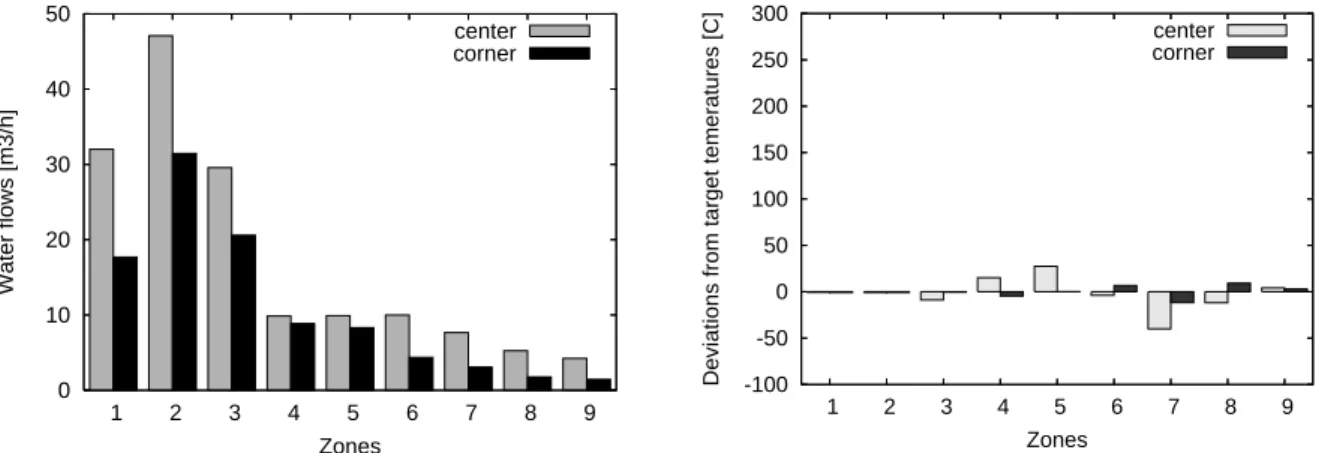
Figure 6: A trade-off solution from the middle of the approximation set for the casting speed speed of 1.6 m/min: c1=
281◦C,c
2= 1.3 m.
0 10 20 30 40 50
1 2 3 4 5 6 7 8 9
Water flows [m3/h]
Zones
center corner
-100 -50 0 50 100 150 200 250 300
1 2 3 4 5 6 7 8 9
Deviations from target temeratures [C]
Zones
center corner
Figure 7: A trade-off solution from the middle of the approximation set for the casting speed speed of 1.8 m/min: c1=
151◦C,c
2= 0.0 m.
how much the optimization results are affected by the fac-tors that were kept constant so far, such as steel grade, slab geometry and casting machine characteristics.
Acknowledgment
This work was supported by the Slovenian Research Agency and the Academy of Finland under the Slovenian-Finnish project BI-FI/04-05-009Numerical Optimization of Continuous Casting of Steel, and by the Slovenian Re-search Agency under the ReRe-search Programme P2-0209 Artificial Intelligence and Intelligent Systems.
References
[1] N. Chakraborti, R. Kumara and D. Jain. A study of the continuous casting mold using a Pareto-converging genetic algorithm.Applied Mathematical Modelling, 25 (4): 287–297, 2001.
[2] N. Chakraborti, R. S. P. Guptaa and T. K. Tiwari. Op-timisation of continuous casting process using genetic algorithms: studies of spray and radiation cooling re-gions.Ironmaking and Steelmaking, 30 (4): 273–278, 2003.
[3] N. Cheung and A. Garcia. The use of a heuristic search technique for the optimization of quality of steel billets produced by continuous casting. Engi-neering Applications of Artificial Intelligence, 14 (2): 229–238, 2001.
[4] K. Deb. Multi-Objective Optimization Using Evolu-tionary Algorithms. John Wiley & Sons, Chichester, UK, 2001.
0 10 20 30 40 50
1 2 3 4 5 6 7 8 9
Water flows [m3/h]
Zones
center corner
-100 -50 0 50 100 150 200 250 300
1 2 3 4 5 6 7 8 9
Deviations from target temeratures [C]
Zones
center corner
Figure 8: The leftmost solution from the approximation set for the casting speed speed of 1.6 m/min: c1= 58◦C,c2=
2.6 m.
0 10 20 30 40 50
1 2 3 4 5 6 7 8 9
Water flows [m3/h]
Zones
center corner
-100 -50 0 50 100 150 200 250 300
1 2 3 4 5 6 7 8 9
Deviations from target temeratures [C]
Zones
center corner
Figure 9: The rightmost solution from the approximation set for the casting speed speed of 1.6 m/min:c1= 620◦C,c2=
0.0 m.
[6] M. Depolli, T. Tušara and B. Filipiˇc. Tuning param-eters of a multiobjective optimization evolutionary algorithm on an industrial problem. In B. Zajc and A. Trost (Eds.),Proceedings of the Fifteenth Interna-tional Electrotechnical and Computer Science Con-ference ERK 2006, Vol. B, pages 95–98, Portorož, Slovenia, 2006. Slovenian Section IEEE, Ljubljana (in Slovenian).
[7] B. Filipiˇc. Efficient simulation-based optimization of process parameters in continuous casting of steel. In D. Büche, N. Hofmann (Eds.), COST 526: Auto-matic Process Optimization in Materials Technology: First Invited Conference, pages 193–198, Morschach, Switzerland, 2005.
[8] B. Filipiˇc and E. Laitinen. Model-based tuning of pro-cess parameters for steady-state steel casting. Infor-matica, 29 (4): 491 ˝U496, 2005.
[9] B. Filipiˇc and T. Robiˇc. A comparative study of coolant flow optimization on a steel casting machine.
InProceedings of the 2004 Congress on Evolution-ary Computation CEC 2004, Vol. 1, pages 569–573, Portland, OR, USA, 2004. IEEE, Piscataway.
[10] B. Filipiˇc, T. Tusar and E. Laitinen. Computer-assisted analysis of a metallurgical production pro-cess in view of multiple objectives. In B. Filipiˇc, J. Šilc (Eds.), InProceedings of the Second Interna-tional Conference on Bioinspired Optimization Meth-ods and their Applications BIOMA 2006, pages 167– 176. Jožef Stefan Institute, Ljubljana, Slovenia, 2006.
[11] B. Filipiˇc and B. Šarler. Evolving parameter settings for continuous casting of steel. InProceedings of the 6th European Conference on Intelligent Techniques and Soft Computing EUFIT’98, Vol. 1, pages 444– 449, Aachen, Germany, 1998. Verlag Mainz, Aachen.
Prob-lem Solving from Nature PPSN IV, 4th International Conference, Lecture Notes in Computer Science, Vol. 1141, pages 584–593, Berlin, 1996. Springer.
[13] V. Oduguwa and R. Roy. Multiobjective optimization of rolling rod product design using meta-modeling approach. InProceedings of the Genetic and Evolu-tionary Computation Conference GECCO 2002, pp. 1164–1171. Morgan Kaufmann, San Francisco, CA, 2002.
[14] K. V. Price and R. Storn. Differential evolution – a simple evolution strategy for fast optimization. Dr. Dobb’s Journal, 22 (4): 18–24, 1997.
[15] T. Robiˇc and B. Filipiˇc. DEMO: Differential evolu-tion for multiobjective optimizaevolu-tion. In C. A. Coello Coello, A. Hernandez Aguirre, E. Zitzler (Eds.): Proceedings of the Third International Conference on Evolutionary Multi-Criterion Optimization EMO 2005, pages 520–533, Guanajuato, Mexico, 2005. Lecture Notes in Computer Science, Vol. 3410, Springer, Berlin.