GET REAL AND HEEL: EFFECT OF A 16-WEEK, COMMUNITY-BASED GROUP EXERCISE INTERVENTION ON FITNESS, PHYSICAL FUNCTION, AND QUALITY OF
LIFE IN BREAST CANCER SURVIVORS
Dean James Amatuli
A thesis submitted to the faculty of the University of North Carolina at Chapel Hill in partial fulfillment of the requirements for the degree of Master of Arts in the Department of Exercise
and Sport Science (Exercise Physiology).
Chapel Hill 2020
Approved by:
Claudio L. Battaglini
Anthony C. Hackney
ii
iii
ABSTRACT
Dean James Amatuli: Get Real and Heel: Effect of a 16-week, Community-Based Exercise Intervention on Fitness, Physical Function, and Quality of Life in Breast Cancer Survivors
(Under the direction of [Claudio Battaglini])
Exercise has been shown to be beneficial in alleviating several treatment related
side-effects in breast cancer survivors (BCS). However, few community-based exercise programs do
exist to help BCS rehabilitate from cancer treatment related side-effects. The purpose of this
study was to evaluate the effects of a community-based exercise program on fitness, physical
function, and quality of life (QoL) outcomes.
Thirty-two BCS exercised for 16 weeks at the UNC Get Real and Heel (GRH) cancer
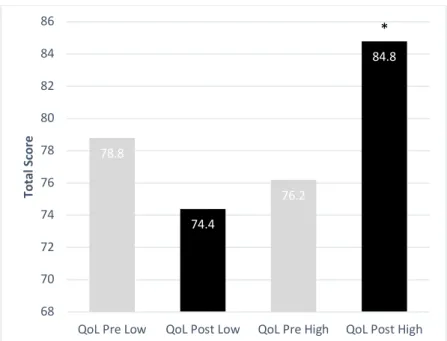
program. VO2peak and 6MWT (20.9+5.2, 22.2+5.4, p = 0.04 and 536+72, 570+76, p<.001 respectively), improved significantly from pre to post intervention. When the cohort was split
into the highest and lowest adherence quartiles, significant improvement in QoL was observed
for the high adherence group from pre to post intervention (76.2+12.8, 84.8+12.8, p = 0.005).
The GRH program promotes improvement in various fitness, physical function, and QoL
iv
To all of the participants of Get Real and Heel past and present, thank you for being an inspiration and teaching me the true meaning of being grateful. You all have helped shape my
v
ACKNOWLEDGEMENTS
To Dr. Battaglini, the person who got me started at Get Real and Heel. Thank you for
teaching me everything I know in this field. Your guidance for the past eleven years is
impossible to put into words.
To Jordan Lee and Chad Wagoner, thank you for being my mentors for all things Get
Real and Heel and otherwise. You are both reliable sources of information, and more
importantly, friendship.
To my parents and sister, thank you for your love and support always.
To my wife, thank you for being my inspiration and keeping me on track. Your support
over the past two years cannot be matched. You are the person who kept me going. I love you,
vi
TABLE OF CONTENTS
LIST OF TABLES ... ix
LIST OF FIGURES ... x
LIST OF ABBREVIATIONS ... xi
CHAPTER I: INTRODUCTION ... 1
Purpose ... 4
Research Questions ... 5
Research Hypotheses ... 6
Definition of Terms ... 7
Delimitations ... 8
Limitations ... 9
Assumptions ... 10
Significance of Study ... 10
CHAPTER II: LITERATURE REVIEW ... 12
Introduction ... 12
Breast Cancer Pathology ... 12
Disease Manifestation... 12
vii
Side Effects ... 14
Exercise as an Alternative Therapy ... 14
Exercise and Physical Function ... 17
Quality of Life ... 18
Community Based Exercise ... 20
Conclusion... 21
CHAPTER III: METHODOLOGY ... 22
Participants ... 23
Experimental Design ... 23
Intervention ... 25
VO2max (Cardiorespiratory Function) ... 26
Muscular Strength ... 27
Body Composition ... 28
Physical Function ... 28
PROs and QoL ... 30
Statistical Analyses ... 30
CHAPTER IV: RESULTS ... 33
Subjects ... 33
Training Effects ... 34
viii
Relationship Between Changes in Fitness, Physical Function, PROs, and QoL ... 39
Analysis of Magnitude of Change in All Variables in Response to Low and High Adherence ... 40
CHAPTER V: DISCUSSION ... 49
Overview ... 49
Fitness and Physical Function ... 50
Patient Reported Outcomes and Quality of Life ... 55
Practical Application ... 56
Future Research and Limitations ... 57
Conclusion... 57
APPENDIX 1: DATA COLLECTION SHEET ... 59
APPENDIX 2: FACT-G ... 66
APPENDIX 3: PROMIS QUESTIONNAIRE ... 70
APPENDIX 4: EXERCISE LOG ... 96
ix
LIST OF TABLES
Table 1 – Variables and Forms of Measure……….5
Table 2 – Hypotheses and Corresponding Variables………...7
Table 3 – Day of Testing with Testing Measures………..24
Table 4 – Subject Characteristics………...34
Table 5 – Primary Outcomes……….35
Table 6 – Secondary Outcomes……….39
Table 7 – Relationship of Changes Scores on QoL Change………..40
Table 8 – Adherence Comparison…..………41
x
LIST OF FIGURES
Figure 1 – Aerobic and Strength Intervention Baseline and Progression………..26
Figure 2 – Pre and Post Intervention Values: VO2………36
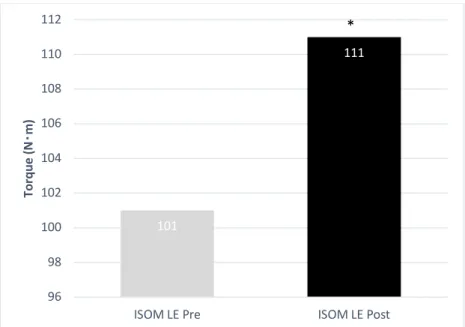
Figure 3 – Pre and Post Intervention Values: Isometric Leg Extension………37
Figure 4 – Pre and Post Intervention Values: 6MWT………37
Figure 5 – Pre and Post Intervention Values: TUG………...38
Figure 6 – Pre and Post Intervention Values: Balance………..38
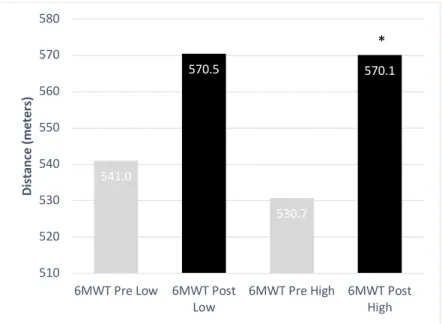
Figure 7 – Adherence Comparison for Pre and Post Testing: 6MWT………...44
Figure 8 – Adherence Comparison for Pre and Post Testing: TUG………..44
xi
LIST OF ABBREVIATIONS
%BF Percent body fat
6WMT Six-minute walk test
BCS Breast cancer survivor(s)
CPET Cardio-pulmonary exercise testing
GRH Get Real and Heel
LBM Lean body mass
PRO Patient reported outcomes
QoL Quality of life
SOT Sensory organization test
1
CHAPTER I: INTRODUCTION
Over the past few decades, the prevalence of breast cancer has continued to rise, with
incidence predictions approaching 330,000 in the United States alone1. Presently, 1 in 8 women will be diagnosed with BC during their lifetime, and in 2019, 42,000 women died from the
disease in the U.S.1.
However, the 5-year survival rate for all breast cancer survivors (BCS) is as high as
89.9% as of 2015, meaning that more people than ever are living with a history of the disease1. The issue arises from BCS living with various deleterious side effects from the disease and
treatments leading them to experience a lower level of quality of life (QoL) when compared to
pre-cancer levels2. With this information, it seems more prescient than ever that survivorship issues should be a priority. Researchers need to think not only of how they can help patients
reach the “No Evidence of Disease” stage, but what can be done for them during and
post-treatment to help them ease back into a “normal”, functional, healthy life.
The side effects from chemotherapy, radiation, surgery, or any combination of the three
are known to leave BCS feeling fatigued, in pain, depressed, anxious, and unable to function at a
high enough level to complete their daily tasks3. In addition, adjuvant therapy such as hormonal therapy levied daily for years following treatment exacerbate treatment-related side-effects,
compromising even further the QoL of survivors4. Following diagnosis, up to 90% of women experience at least one treatment-related side effect, while 60% experience multiple side effects
2
side effects, depressed aerobic capacity is a hallmark complication following cancer therapy and
is of great concern because it has significant implications on QoL and long-term prognosis. In
general, aerobic capacity is often 30% low in cancer survivors who undergo anti-cancer
treatments6.
Keeping in mind that the survival rate for all types of BC is nearly 90%, the focus must
be shifted to interventions that can alleviate treatment-related side-effects, while promoting
better health, and consequently decrease all-cause mortality4. Exercise has been shown to
alleviate many cancer treatment-related side-effects, promote improvement in overall health, and
be safe for most survivors who are cleared by their oncologists to engage in regular exercise7. Furthermore, engaging in physical activity on a regular basis has been shown to be protective for
breast cancer, as the combined effects of being sedentary, having a poor diet, and being
overweight appear to directly impact the development of 25-33% of all breast cancer; these same
facts mentioned above are also postulated as factors increasing the risk of recurrence in BCS4. Randomized controlled trials have supported the use of aerobic and strength training
exercises for BCS as a safe and effective means of alleviating treatment related side effects8. Exercise guidelines for cancer survivors have recently been updated as a complementary therapy
to the traditional treatment plans, which has led to increasing interest by the medical community
for survivors to participate in exercise programs7.
A community-based program called Get Real and Heel (GRH) on the campus of
UNC-Chapel Hill aims to ease the transition back into life post-cancer by offering
moderate-to-vigorous supervised exercise in a group setting for the improvement of fitness, health, and
overall QoL of BCS. The GRH program offers exercise prescriptions tailored to each person on
3
group setting of the exercise also fosters an environment where survivors can feel comfortable
and at ease enough to take off their wig or prosthetics, and feel accepted by a group of people
who understand their journey to get there. The aim of GRH is not only to increase physical
function through structured endurance, strength, and flexibility exercises, but most importantly,
create social capital between survivors and improve QoL.
In 2006, the year of its inauguration, the GRH program started as a 20-week exercise
intervention where BCS exercised 1-on-1 with a personal trainer. Although survivors were
finding a physical benefit from the training, they were still lacking the interpersonal connections
of being surrounded by people who have undergone similar circumstances; the development of
social capital. In 2013, GRH shifted its model to be a group-based exercise program to not only
address the interpersonal issue, but to make the program more cost-effective and scalable for
implementation in other universities and cancer centers. Now, at GRH, BCS workout together in
groups of 5-10, not only allowing them to form a community of their own, but also allowing
GRH to exponentially increase the amount of people it is able to serve, while maintaining the
program free of cost to survivors.
The GRH program’s major goal isto improve the aerobic capacity of BCS, as well as
their physical functioning, strength, and balance, as part of a comprehensive and individually
tailored exercise program under the supervision of a personal trainer. These components of
fitness cited above all play a role in a survivor’s QoL. While the GRH program has been
operating in this manner for years with great satisfaction to its participants, it has yet to be
empirically evaluated for its effectiveness on improving various components of fitness and
4
As the world of cancer treatment begins to shift its focus to survivorship, GRH’s program
format could shed light on a method of training that is both effective, scalable, and cost-effective,
thereby setting a precedent to help thousands of cancer survivors in the U.S. and abroad.
However, as previously mentioned, the GRH program’s effectiveness has yet to be
systematically evaluated.
Purpose
The primary purpose of this study was to evaluate the effectiveness of the GRH 16-week
community-based exercise program on factors influencing fitness (VO2peak, muscular strength, and body composition (Body Fat% [%BF]/Lean Body Mass [LBM])) and physical function (6
Minute Walk Test (6MWT), Timed Up and Go (TUG), and balance) in BCS. The secondary
purpose of this study was to evaluate patient reported outcomes (PROs) including overall QoL.
PROs included fatigue, sleep quality, pain interference, applied cognition, and self-efficacy for
physical activity measures using the PROMIS (Patient Reported Outcomes Management
Information System) questionnaire, and an overall score of QoL assessed via the Functional
Assessment of Cancer Therapy: General (FACT-G) questionnaire. The third purpose was to
explore the relationship between changes in factors influencing fitness (VO2peak, muscular strength, and body composition), physical function (6MWT, TUG, and balance), PROs (fatigue,
sleep quality, pain interference, and applied cognition and self-efficacy), and QoL. These
exploratory analyses will help better inform how changes in physical function and PROs after a
16-week exercise program at GRH are related to QoL in BCS, so specific interventions at GRH
can be developed to target outcomes that have the greatest impact on QoL. The last aim, which
5
the 16-week exercise program elicited different fitness, physical function, PROs, and QoL
responses after patients were stratified into a low or high participation adherence to the exercise
intervention.
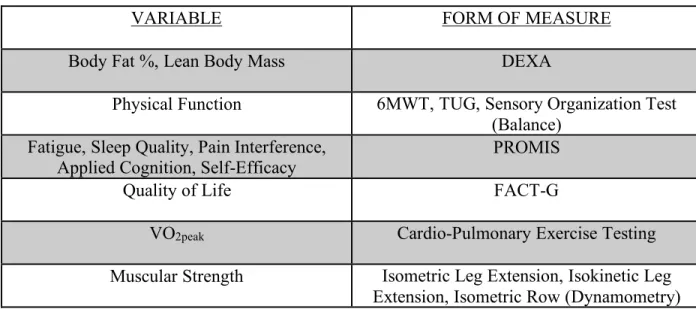
All variables along with form of measure can be seen in the table below:
Table 1: Variables and Forms of Measure
VARIABLE FORM OF MEASURE
Body Fat %, Lean Body Mass DEXA
Physical Function 6MWT, TUG, Sensory Organization Test
(Balance) Fatigue, Sleep Quality, Pain Interference,
Applied Cognition, Self-Efficacy PROMIS
Quality of Life FACT-G
VO2peak Cardio-Pulmonary Exercise Testing
Muscular Strength Isometric Leg Extension, Isokinetic Leg
Extension, Isometric Row (Dynamometry)
Research Questions
1) Is the GRH protocol effective in eliciting positive changes in fitness and physical
function in BCS?
2) Does GRH improve PROs in BCS?
3) Does GRH improve QoL in BCS?
4) Are changes in fitness, physical function, and PROs associated with changes in QoL?
5) Did those subjects with higher adherence values see greater magnitudes of improvement
6
Research Hypotheses
H1a: Fitness parameters will improve in BCS following participation in a 16-week exercise
intervention at the GRH facility.
H1b: Physical function will improve in BCS following the participation in a 16-week exercise
intervention at the GRH facility.
H2: PROs will improve in BCS following participation in a 16-week exercise intervention at
the GRH facility.
H3: QOL will improve in BCS following participation in a 16-week exercise intervention at
the GRH facility.
H4: There will be a significant association between changes in fitness, physical function,
PROs and QoL following participation in a 16-week exercise intervention at the GRH
facility.
H5: BCS with higher adherence to the 16-week exercise program will present with greater
7
Table 2: Hypotheses and Corresponding Variables
HYPOTHESIS VARIABLES
H1a: Fitness parameters will improve in BCS following participation in a 16-week exercise intervention at the GRH facility.
VO2peak, Muscular Strength, %BF/LBM
H1b: Physical function will improve in BCS following the participation in a 16-week exercise intervention at the GRH facility.
6MWT, TUG, Balance
H2: PROs will improve in BCS following participation in a 16-week exercise
intervention at the GRH facility.
Fatigue, Sleep Quality, Pain Interference, Applied Cognition, Self-Efficacy
H3: QOL will improve in BCS following participation in a 16-week exercise intervention at the GRH facility.
Overall Quality of Life
H4: There will be a significant association between changes in fitness, physical
function and QoL following participation in a 16-week exercise intervention at the GRH facility.
VO2peak, Muscular Strength, %BF/LBM, 6MWT, TUG, Balance, Fatigue, Sleep
Quality, Pain Interference, Applied Cognition, Self-Efficacy
H5: BCS with higher adherence to the 16-week exercise program will present with greater changes in magnitude of fitness, physical, PROs, and QoL.
Low & High Adherence Quartiles, VO2peak, Muscular Strength, %BF/LBM, 6MWT, TUG, Balance, Fatigue, Sleep Quality, Pain
Interference, Applied Cognition, Self-Efficacy
Definition of Terms
• Adherence to the 16-week GRH exercise program was defined by stratifying BCS into
both low and high adherence splits, as well as quartiles based on total planned exercise
training days. BCS who attended 75% or more of planned sessions were considered high
adhering, and those below were low adhering. A second analysis was conducted using the
8
adherence) and BCS falling into the highest quartile (high adherence) were used for
analyses.
• Get Real and Heel (GRH): An exercise facility on the campus of UNC-Chapel Hill that
offers supervised group exercise sessions to BCS.
• Breast Cancer (BC): A type of cancer beginning in the breast due to unmitigated cell
growth.
• Cardiopulmonary Exercise Testing (CPET): A test used to assess the integrative system
(pulmonary, cardiovascular, skeletal systems) response to an increasing intensity of
exercise on a cycle ergometer or treadmill.
• Sensory Organization Test: A form of balance test which uses visual, proprioceptive, and
vestibular cues to maintain stability while standing.
• 6-Minute Walk Test (6MWT): A walking test used to assess aerobic endurance and
functionality by measuring how far a subject can walk in meters in a 6-minute time
frame.
• Timed Up & GO (TUG): A functionality test which measures agility and dynamic
balance by timing how long it takes for a subject to rise from a chair, walk around a cone
placed 8 feet away, and return to the chair.
• Rating of Perceived Exertion (RPE): A scale numbered 6-20 used to assess a difficult an
exercise task is for a subject, with 6 being “No exertion” and 20 being “Maximal
exertion.”
Delimitations
• Subjects had non-metastatic BC, and completed all primary cancer treatments within the
9
• Subjects were recruited from UNC Hospitals and surrounding medical institutions.
• Subjects engaged in exercise (aerobic, strength) 3 days per week for 16 weeks at the
GRH exercise facility on the campus of UNC-Chapel Hill. Exercise sessions lasted
approximately 1 hour
• Exercise days were Monday, Wednesday, and Thursday
• Subjects began the intervention at different ability levels, with the goal of completing 30
minutes of aerobic exercise, and 30 minutes of muscular strength training, but exercises
were tailored to engage at intensities relative to their fitness level
• Subjects were excluded if they did not have a history of cancer, or had not completed all
primary treatments within 1 year since starting the study
• After completing all physical function testing, subjects could be deemed not medically
suited to participate in the GRH protocol, at the discretion of the investigators
• This was a 1-arm study, so all subjects participated in the exercise intervention
• Rating of Perceived Exertion (RPE): A scale numbered 6-20 used to assess a difficult an
exercise task is for a subject, with 6 being “No exertion” and 20 being “Maximal
exertion.”
Limitations
• Subjects were recruited from UNC Hospitals and surrounding areas, so subject
participation cannot be deemed truly random, limiting generalization of the study results
• Subjects underwent various types and combinations of treatment protocols
• Subjects entered the study at different levels of exercise ability, so their response to the
10
• Subjects were expected to exercise at the facility 3 days per week, however the facility is
only open on 3 days. Therefore, exercise could not be rescheduled if there is a conflict. • Advancement in exercise progression relied heavily on self-motivation.
Assumptions
• BCS will adhere to all pre-testing guidelines.
• BCS will engage in increasing levels of intensity and duration as the study prescription
progresses.
• BCS will maintain normal exercise/lifestyle habits outside of GRH for the duration of the
study period.
Significance of Study
This study was unique/novel in that it evaluated the effectiveness of an exercise
intervention program that is quite uncommon (community-based exercise program for cancer
survivors), yet well-functioning. Currently, there are highly-controlled, laboratory-based exercise
trials, and there are time-limited community-based exercise programs for cancer survivors. The
GRH program is one of very few community-based exercise programs in the world that offers
supervised exercise training in a group format for BCS. As the survivorship pool grows, more
real-world settings such as GRH will be necessary to accommodate long-term needs of a large
number of survivors. Evaluating the effectiveness of a real-world exercise intervention designed
to assist BCS with the alleviation of disease and treatment-related side-effects, while also
providing survivors with the best chance to improve their health and have the best QoL in the
11
how to best develop their exercise interventions so they are aimed to maximize fitness, physical
12
CHAPTER II: LITERATURE REVIEW
Introduction
More than 17 million new cancer cases were diagnosed in 2018 worldwide, with more
than 2 million of those cases being attributed to breast cancer9. It is expected that the United States will see greater than 1.7 million new cases of cancer, with breast cancer contributing more
than 268,000 to that total1. More than 600,000 people will die from cancer, and of that total, approximately 41,000 will be due to BC1. In some countries, the leading cause of death for women between the ages of 40-60 is breast cancer, but thanks to improvements in detection and
treatment strategies, mortality rates are on the decline, with some projections indicating that 3
out of 4 BC survivors will be 65 years old or older by the year 204010,11. This number is
significant because it means that as more people survive the disease, some of the focus should be
shifted toward survivorship.
Breast Cancer Pathology
Disease Manifestation
Cancer is a disease characterized by the unmitigated growth of abnormal cells1. According to one review, one of the most fundamental traits of a cancer cell is its ability to
control its own proliferation by deregulating signals that would cause the normal production of
growth-promoting signals, and the absence of negative feedback loops that would under normal
13
Cancer,” which include a cell’s ability to sustain proliferative signaling, evade growth
suppressors, activate invasion and metastasis, enable replicative immortality, induce
angiogenesis, and resist cell death12. In breast cancer, these cells can begin multiplying in the ducts that carry milk to the nipple, the glands that make breast milk, or the breast tissue itself13.
Treatment for Breast Cancer
Treatment for breast cancer can involve several possible combinations of treatment
options, including surgery, radiation, chemotherapy, or a combination of the three. Locally,
surgery can be used in order to remove as much of the cancer as possible, via lumpectomy or
mastectomy13. Some surgeries, such as lymph node biopsies or dissections, are performed in the underarm area in order to evaluate if the cancer has spread to the lymph nodes, thereby
indicating just how far the cancer has spread outside of the breast13.
Another form of local treatment for breast cancer is radiation, which employs high energy
particles to eliminate cancer cells13. Radiation acts to lessen the possibility of cancer returning in the originating breast, or in lymph nodes that may have been affected, and may also be used if
the cancerous tumor was greater than 5 centimeters or spread to several lymph nodes13. Systemically, chemotherapy can be used after surgery (adjuvant) or before surgery
(neoadjuvant). Adjuvant chemotherapy is sometimes used to make certain all cancer cells have
been destroyed, even those which are undetectable, while neoadjuvant chemotherapy is used in
order to shrink the tumor prior to surgery to make its excavation less extensive13. Some of the more common chemotherapy drugs are anthracyclines, taxanes, cyclophosphamide, carboplatin,
14 Side Effects
Life as a cancer survivor can mean dealing with the myriad side effects that come along
with a standard treatment for cancer. In breast cancer, it can mean scarring, pain, and immobility
from surgery, anxiety and depression, nausea and vomiting, skin changes, weight change, higher
risk of infection, and elevated levels of fatigue which is seen in 99% of women who undergo
chemotherapy10,13. In many cases, fatigue levels become so debilitating that the patient becomes inactive, leading to stress, poor sleep, and poor physical conditioning, thereby causing more
fatigue in a positive feedback system10.
Cardiorespiratory function is severely declined in cancer patients, with VO2peak values falling 30% lower than age-matched, sedentary people without a history of cancer, which could
be attributed to the toxic effects of cancer treatment that damage the cardiovascular system and
impact the systems that affect an individual’s capacity to exercise14. Certain chemotherapies, such as trastuzumab, can cause left ventricular remodeling, and decrease oxygen delivery to
exercising muscles via decreased ejection fraction15. In addition to Cardio-Pulmonary Exercise Testing (CPET), aerobic endurance can be measured via the 6MWT. Schmidt et al found that
6MWT distances of cancer patients correlated significantly with exercise capacity measured via
VO2peak, maximum workload in Watts, and perceived physical function, and among trials in cancer patients most studies reported an increase of more than 5.2% from pre to post testing16. This trial also displayed acceptable test-retest reliability in cancer patients16.
Exercise as an Alternative Therapy
Unfortunately, completing primary treatment for cancer does not mean that the journey
15
much of their life. In addition to the immediate treatment related side effects comes the increased
risk for other comorbidities to develop, such as cardiovascular disease, diabetes, osteoporosis,
and sarcopenia3. In fact, cardiovascular disease in cancer survivors is now a leading cause of death along with recurrence of cancer. In a 2011 comorbidity review that included more than
63,000 subjects, only 15.1% of the study population died due to BC, while 36.2% died due to
other causes; cardiovascular disease accounted for a 59.2% increase in chance of death, and
diabetes came in at 47.8%, both of which were higher than having a previous cancer (43.8%)17. For a long time, exercise was not considered as part of the post-treatment process. It
wasn’t until the 1990’s that research in exercise began to challenge some of the long-held beliefs
that rest was key to recovery, and to this day health care providers do not prescribe exercise as a
standard of care for patients and survivors; 1 in 10 professionals still believe that rest is more
important than physical activity7,10. In 2012, the American College of Sports Medicine developed the first guidelines for exercise for people with cancer18. Exercise intervention studies were more difficult to come by at that time, but they were able to conclude that exercise was “generally safe
and well tolerated” for survivors, and physical activity could improve variables such as fitness,
physical function, QoL, and cancer-related fatigue7. Due to the small amount of evidence, those exercise guidelines were not far different from the exercise guidelines set forth for adults.
However, the past decade of work allowed for more specific exercise prescriptions to be formed
which could target specific outcomes, showing the growing appreciation for the need to
individualize treatment. With the more than 2,500 publications that have arisen in the interim, a
second roundtable of the ACSM was able to advance those guidelines based on cancer type, and
16
CPET, which is a gold standard used to measure a person’s aerobic capacity described in volume of oxygen consumed (VO2), also happens to be a reliable predictor of both QoL and morbidity in women who have undergone standard treatment for breast cancer, specifically
adjuvant and neo-adjuvant therapies19. Physical activity in BCS overall is much lower than the general population, with only 8% of survivors meeting aerobic activity guidelines, and peak
oxygen consumption levels approximately 30% lower than healthy, even sedentary women14,19. Exercise is a known promoter of improved cardiorespiratory fitness in healthy individuals, and
research has shown that its benefits extend to cancer survivors as well7. Unfortunately, physical activity is not always recommended as part of the recovery process by health care providers, and
even when patients are motivated to make more positive lifestyle choices, exercise
encouragement from a provider might still be necessary in order for those choices to be
realized20. One study looking at Moderate-Vigorous Physical Activity showed that a high
number of BCs are inactive, and without the use of an exercise intervention, survivors are highly
unlikely to change their current levels of physical activity21. As it has been seen in numerous studies, the safety and efficacy of exercise post-treatment is safe and well-tolerated, with
survivors who are physically active showing significantly higher QoL measures compared to
those who are more inactive7,20. Increased physical capacity allows individuals to engage in daily activities that promote independence and leave them feeling more satisfied with their lives. In
fact, survival and total mortality risk has been tied to the amount of exercise performed; each 10
MET task-hours per week increase in activity following diagnosis was associated with a 24%
decrease in mortality, and for those who were sedentary pre-diagnosis, any increase in physical
17
Exercise and Physical Function
One meta-analysis by Jones et al. showed that a supervised exercise training intervention
elicited statistically significant increases in VO2peak, while a non-exercise control group correlated to a decrease in VO2peak14. A meta-analysis by Fong et al. revealed that exercise interventions elicited a statistically significant increase (2.2 ml/kg/min) in peak oxygen
consumption, and peak power output (21.0 Watts)22. McNeely et al. had pooled results showing a 3.39 ml/kg/min improvement in oxygen consumption values23. These findings cannot be
understated, as oxygen consumption values are reliable predictors of all-cause mortality. An
increase of just 1 MET in exercise capacity corresponds to a reduced risk of death by 17%, as
shown by the Framingham Risk Score; a measure of cardiovascular related illness24. In fact, studies in older adults, and women in particular, yielded a VO2 of ~15ml/kg/min necessary to maintain independent living, and many cancer patients do not meet that criteria14,25. Being that by 2040, 3 out of 4 cancer survivors will be 65 years or older, this is of critical importance.
In terms of more basic forms of physical function testing, Fong et al. showed an increase
of 29 meters post-intervention in the 6MWT22. A second review showed similar improvements, with an increase of 28 meters11. Rajotte et al. reported an increase of 37 meters in the 6MWT following a 12-week group exercise intervention for survivors26. A 2017 meta-analysis on physical function in BCS showed that all results favored the exercise group over the control
group in improvements in physical function, regardless of the time of the intervention, or the
type of adjuvant therapy10. A 2006 review had pooled results which showed statistically significant improvements in favor of the exercise group for the 6MWT, 12-Minute Walk Test,
18
Physical activity has been shown to increase physical function in cancer survivors, across
all modes of exercise. A 2016 Cochrane Review showed that muscular strength was significantly
improved following an exercise intervention that included resistance training27. A 12-week group exercise intervention by Rajotte et al showed a statistically significant increase in upper and
lower body strength scores using a 1 repetition maximum test26. A second systematic review evaluated strength gains and changes in lymphedema incidence following resistance training.
This review showed that there is strong evidence that moderate-high intensity resistance training
provides significantly greater gains in strength than a non-exercise group, all without the
exacerbation of breast cancer related lymphedema symptoms28. Besides strength gains, low-intensity resistance training for the shoulder coupled with flexibility exercises provoked
significant strength gains in flexion and abduction movements compared with non-exercise
groups, two traditionally difficult or painful movements for many BCS28. This same review showed that those subjects who performed resistance exercises on 2-3 non-consecutive days had
significantly greater strength gains compared to controls, with no exacerbation of symptoms
regardless of the resistance training protocol that was used28. These strength gains are important to improving a survivor’s ability to complete their activities of daily living and maintain
independence.
Quality of Life
With increasing numbers of breast cancer survival, the quality of life post-treatment is
now more of an issue than ever before. BCS deal with anxiety, fear of recurrence, problems with
19
Rajotte et al. saw improvements in all Patient Reported Outcomes (PRO) measures
except for muscle cramps following a 12-week exercise intervention that included aerobic and
resistance exercises26. Improvements were elicited in physical function, general health, mental health, social function, social support, body pain, fatigue, and insomnia26.
A 2017 meta-analysis including 17 randomized controlled trials showed that exercise was
shown to reduce fatigue when compared to conventional care, and although a combination of
aerobic and resistance training has the most benefit, a moderate intensity resistance protocol of
3-6 METs or 60-80% of 1 Rep Maximum was able to reduce cancer related fatigue more than
lower intensity resistance or aerobic exercise10.
Fong et al. showed that results favored the exercise intervention when measuring fatigue
via the Piper Fatigue scale, depression measured with the Beck depression inventory, and
improvements in mental health and social function22. Another review from McNeely et al. showed that pooled estimates resulted in statistically significant improvements in QoL by a
magnitude of 4.0 on the FACT scale, which deems it clinically meaningful due to exercise23. Pinto et al. studied the link between physical activity and psychosocial benefits in breast cancer
patients. They found that those women who adopted physical activity into their lifestyle saw
significant improvements in QoL versus those who never adopted physical activity at a 3-month
follow up, and those who maintained 150 min/week reported less fatigue, higher physical
functioning, and improved QoL 6 months later compared to non-adopters29.
The 2019 Exercise Guidelines for Cancer Survivors showed that a combination of aerobic
and strength training done 2-3 sessions/week for at least 12 weeks can improve QoL whether
done during or after treatment, and the combination of an aerobic regimen with a strength
20
Community Based Exercise
Being a BCS brings with it a host of problems, and while exercise can help alleviate
those burdens, patients have identified certain barriers to exercise such as cost, lack of
accessibility, transportation, safety concerns, and negative attitudes toward exercise among other
things3,4. However, healthcare providers can help promote exercise a part of a rehabilitation plan that includes an exercise professional who can provide appropriate supervision, and an exercise
program that is part of the same institution that administered the treatment4. Another important facilitator to exercise and physical activity is a group-based program that remains individually
prescribed, with slow, gradually progressing exercise3. With this, improvements in physical function were seen when aerobic and resistance training were done 3 times/week for 8-12 weeks,
with more effective training coming under the supervision of a professional as opposed to an
at-home intervention.
Community-based exercise interventions can also help in overcoming barriers to exercise
by providing exercise in a more “real-world” setting, and not relying on the cost,
high-resource design of a randomized controlled trial11. This can enhance a patient’s sense of
behavioral control, and a positive setting combined with a like-minded group can aid in creating
a positive attitude and subjective norms3. A systematic review and meta-analysis in 2017 identified that all of the studies identified for the review that had “supervised exercise” held
sessions twice per week in conjunction with home-based exercise, and had both aerobic and
strength training as part of the protocol11. This same review found that for 6MWT values,
community-based exercise interventions that met in groups had the largest effect size, along with
21
cancer survivors is a protocol that includes group-based intervention and cognitive behavioral
therapy11.
A 2011 study conducted group exercise sessions for cancer survivors at local YMCAs. It
found that a group-based format with personal trainer supervision meeting 2 days/week elicited
positive changes in fatigue, insomnia, physical function, mental health, social support, and
general physical activity26. These patients participated in a 12-week intervention, but still had access to the facility and trainers at the end of their study period. It should be noted that personal
trainers in the program had to possess at minimum 1 year of personal training experience, and a
16-hour course led by a cancer rehabilitation specialist26.
Conclusion
The results of these studies and reviews have shown that exercise in any form is a safe
and effective way for cancer survivors to manage their symptoms, and improve their physical
function and QoL. However, much of this work has been done in highly controlled laboratory
trials, and with the growing demand that is coupled with increased survival, it is important to
investigate if community-based group programs can offer as effective an intervention. A
community-based program will trade off internal validity for external validity, but an evaluation
of a program such as GRH could help discover if this form of exercise intervention is effective,
scalable, and cost-effective. It has also been seen in the literature that supervised group exercise
has more benefits than laboratory trials or at-home interventions. Supervision by a trained
professional allows for detailed manipulation of the exercise protocol in order to fit each
22
and effective interventions30. Besides this, the group atmosphere can offer more comfort and motivation in the exercise space.
GRH offers small group (5-10 persons) exercise sessions, lasting 60 minutes in duration,
under the supervision of a trained professional, for 3 sessions per week. Survivors are free to
exercise in facility which is available only to cancer survivors, for as long as they choose at no
cost to them.
By offering a free, easily accessible, individually tailored program via the UNC-Cancer
Hospital, GRH can evaluate if the protocol in use offers safe and effective exercise classes to the
masses, thereby helping survivors take control of their own healthcare, and possibly drive down
future healthcare costs. Cost projections for 2020 show that breast cancer is among the cancers
with the highest increase in cost for the continuing care phase of life in the past decade,
increasing 32% from 2010 projections31. A low-cost, scalable, and effective exercise program such as GRH can potentially help to alleviate that cost burden, and make exercise accessible to
the masses.
23
CHAPTER III: METHODOLOGY
Participants
This study included females who had been diagnosed with early stage (non-metastatic)
breast cancer, and had completed primary treatment within the past 1 year. Participants were
permitted to be on continuing hormone therapy. Participants were not be permitted to take part in
the study if they possessed any physical ailments which could have precluded them from
participating in a moderate-intensity exercise program, as decided by the study investigators or
the subject’s medical team. Subjects were not included if they had not completed surgery,
radiation, or chemotherapy, or if their doctor had not cleared them for activity. Subjects could
not participate if they had previously completed the GRH exercise program. All participants
were required to sign an IRB approved written informed consent, and agreed to take part in the
full 16-week exercise program, as well as all blood draws, physiological assessments, and
questionnaires.
Experimental Design
This study was a 1-arm intervention designed to evaluate the effectiveness of the GRH
exercise program in improving fitness, physical function and QoL in BCS. Participants were
required to attend 2 days of pre-testing, followed by a 16-week exercise intervention at the GRH
facility. At the completion of the 16-week intervention, the participant underwent 2 days of
post-testing following the exact format of pre-post-testing. All post-testing was performed in the UNC Exercise
24
Sport-Related TBI Research Center. Pre-testing was completed within 2 weeks of beginning the
GRH program, and post-testing was completed within 2 weeks of completion. Subjects
underwent testing for the following variables in this order: body composition for the evaluation
of %BF and LBM, physical function testing including 6MWT and TUG, PROs (fatigue, sleep
quality, pain interference, applied cognition, and self-efficacy), QoL, Sensory Organization
Testing (SOT) for balance, VO2peak, and muscular strength.
Body composition was evaluated first on Day 1 of testing, before the subject had
participated in exercise. Because the 6MWT is a functional test of endurance, it was performed
prior to the TUG test, which measures a subject’s agility and dynamic balance. PROs and QoL
questionnaires were taken home at the end of Day 1 to be completed by the subject at their
leisure, in order to ascertain more reliable answers. Because muscular strength for lower body
exercises were unilateral, Day 2 began with VO2peak testing on a cycle ergometer to ensure that the leg tested for strength is not more fatigued than the non-tested leg prior to cycling.
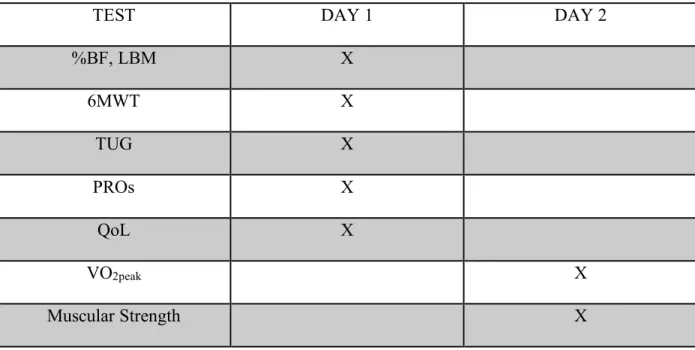
Table 3: Day of Testing with Testing Measures
TEST DAY 1 DAY 2
%BF, LBM X
6MWT X
TUG X
PROs X
QoL X
VO2peak X
25
Intervention
The exercise intervention progressed from low to moderate intensity over the course of
16-weeks. Aerobic exercise was performed on either a treadmill, bicycle, elliptical, rower, or
seated stepper, and began at a duration of 10-15 minutes with a rating on the Borg Rating of
Perceived Exertion Scale (RPE) of 8-11. The eventual goal was for subjects to reach 30 minutes
of continuous aerobic exercise, with a corresponding 12-14 on the RPE scale.
Resistance training exercises were done in correspondence with the previously described
aerobic exercise, and consisted of 6 exercises done 3 times per week, focusing on all major
muscle groups. Training began with 10-15 repetitions done for only 1 set, with a corresponding
7-13 on the RPE scale for the first 2 weeks. Weeks 3-5 required a progression in intensity,
bringing the RPE number to 14-15, as well as an increase to 2 sets for each exercise. Balance
was incorporated into resistance training exercises. Training sessions were monitored by all staff
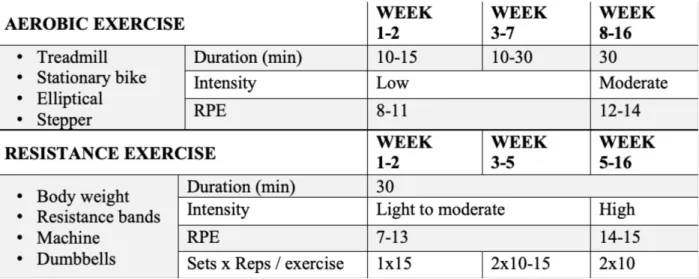
members, with safety and correct form of the utmost priority. Figure 1 shows a breakdown of
26
Figure 1: Aerobic and Strength Intervention Baseline and Progression
For this study, the independent variables were pre and post exercise intervention, while
the dependent variables were the change scores of all measures of fitness, physical function,
PROs, and QoL.
VO2peak (Cardiorespiratory Function)
VO2peak, considered the “Gold Standard” for assessing aerobic fitness, was assessed on an electronically braked cycle ergometer (Lode, Gronigen, The Netherlands) during day 2 of
pre/post testing. Subjects were familiarized prior to testing to control for the learning effect.
Testing utilized a continuous incremental ramp protocol which followed ACSM testing
guidelines; breath by breath metabolic analysis was used to determine oxygen consumption via
Parvo Medics TrueMax 2400 Metabolic System (Parvo Medics, Salt Lake City, UT USA.)
The test began with the subject sitting quietly on the cycle ergometer, allowing
researchers to collect resting metabolic data. The first stage of testing was an unloaded 2-minute
warm-up, with 0 Watts on the ergometer, followed by a 3-minute loaded warm up at 20 Watts.
27
until the test was completed. Heart rate readings and RPE values were collected continuously
throughout the test. Test termination was reached in one of the following ways: the subject
reached volitional exhaustion and signaled their intent to stop, there was a VO2 plateau or decrease with an increase in intensity, or the researchers determined an abnormal response from
the subject.
Muscular Strength
Muscle strength was evaluated using the HUMAC Norm Dynamometer (Computer
Sports Medicine, Inc., Stoughton, MA, USA) in the UNC Sports Medicine Laboratory. Peak
torque of the vastus lateralis was assessed using isokinetic and isometric leg extension. Upper
body strength was assessed via peak torque of an isometric row.
The isokinetic leg extension was evaluated at 60°/second. Subjects began by being
harnessed into a chair, with straps placed over the shoulders, waist, and right leg. When the
subject was properly placed, they performed 3 warm-up leg extensions at 50% of their perceived
max. Following the warm-up, subjects performed 3 isokinetic leg extensions as fast as possible,
with 3 minutes of rest between each trial. The highest torque recorded during the 3 trials was
used in the data analysis, which was measured using a BIOPAC MP150 (BIOPAC Systems Inc.,
CA, USA).
Isometric leg extensions were performed with the arm of the dynamometer locked in
place, with the subject’s anterior tibialis perpendicular to the floor. Subjects were asked to extend
their leg as hard as possible against the immovable arm for 3-4 seconds. The subject performed
isometric leg extensions for 3 trials, with 3 minutes of rest between each trial. The highest peak
28
The isometric row was performed with the subject in an upright seated position, secured
to the chair. The subject was placed with their elbows bent 90° with their arms at their side, and
hands pronated, gripping a horizontal bar. Two to three warm-ups were performed before testing.
Upon testing, the subject pulled straight back as hard as possible, for 3-4 seconds. After three
trials, the highest peak torque was recorded.
Body Composition
Body Composition analysis was conducted using Dual X-ray Absorptiometry (DEXA),
which is considered a reliable and valid means of assessing %BF and LBM32. A Hologic (Discovery W) DEXA scanner was used to evaluate %BF and LBM.
Physical Function
Functionality was assessed using the 6MWT, the TUG, and the SOT for balance.
6MWT was used to measure aerobic endurance, and is considered a valid and reliable
measure to use in cancer patients33. This test utilized a 50-yard course which was marked in 5-yard increments. Subjects had six minutes to walk as far as possible, with no jogging or running
allowed. Researchers estimated the total distance to the nearest 5-yard increment, which was
then converted to meters.
TUG testing assessed dynamic balance and agility, and is a valid and reliable test in
cancer survivors34. The subject began by sitting in a chair placed securely against a wall, with their hands on their thighs. When signaled to begin, the subject rose from the chair, walked
around a cone placed eight feet away, and returned to a seated position in the chair as fast as
29
Balance and postural stability were evaluated using a SOT via the Neurocom Balance
Master (Neurocom International Inc., OR, USA). Dual force plates assessed the visual,
somatosensory, and vestibular systems over 18 trials in 6 different conditions.
The balance tasks were assessed in random order and included the following conditions:
1. Eyes open, stable surface
2. Eyes closed, stable surface
3. Eyes open, stable surface, visual surround disturbance
4. Eyes open, unstable surface
5. Eyes closed, unstable surface
6. Eyes open, unstable surface, visual surround disturbance
Each trial lasted 20 seconds, with 5 seconds of rest between each trial. Trials conditions were
30
PROs and QoL
PROs included fatigue, sleep quality, pain interference, applied cognition, and
self-efficacy for physical activity measures using the PROMIS questionnaire, and an overall score of
QoL was assessed via the Functional Assessment of Cancer Therapy – General (FACT-G).
PROMIS measures have been validated in clinical populations35. The FACT-G is a questionnaire that relies on self-report with the subsections divided into physical well-being, social/family
well-being, emotional well-being, and functional well-being. The FACT-G has been shown to be
both a valid and reliable measure in older and younger cancer patients alike36.
Statistical Analyses
This one-arm study consisted of one group assigned to a 16-week exercise intervention.
All recorded data was entered into an electronic database and analyzed using SPSS Version 20.0
(Chicago, IL) for Windows; an alpha level of 0.05 was used for all analyses.Descriptive
statistics were computed and were presented in the form of means ± standard deviation (SD) for
quantitative variables and frequencies for categorical variables.Confidence intervals of the
means were also reported, as well as effect size calculations. The effect size of each t test
analysis was computed via the Cohen’s d method (small effect size, d = .2 - .5: medium effect
size, d = .5 - .8: large effect size, d > .8)32
Hypothesis 1a: Fitness parameters will improve in BCS following participation in a 16-week
exercise intervention at the GRH facility. Pre and post intervention evaluation of fitness parameters
31
composition (%BF and LBM) were analyzed using change scores, utilizing dependent samples
t-tests.
Hypothesis 1b: Physical function parameters (6MWT, TUG, and balance) will improve in BCS
following participation in a 16-week exercise intervention at the GRH facility. Pre and post
intervention physical function parameters were analyzed using change scores, utilizing dependent
samples t-tests.
Hypothesis 2: PROs will improve in BCS following participation in a 16-week exercise
intervention at the GRH facility. PRO parameters including fatigue, sleep quality, pain
interference, applied cognition, and self-efficacy were analyzed using change scores, utilizing
dependent samples t-tests.
Hypothesis 3: QoL will improve in BCS following participation in a 16-week exercise
intervention at the GRH facility. QoL evaluated via the FACT-G was analyzed using change
scores, utilizing dependent samples t-tests.
Hypothesis 4: There will be a significant association between changes in fitness, physical
function, PROs and QoL following participation in a 16-week exercise intervention at the GRH
facility. The relationship between fitness parameters including VO2peak (mlO2/kg/min), strength (peak torque), and body composition (%BF and %LBM) and physical function parameters
self-32
efficacy), and QoL was analyzed using change scores, utilizing simple regressions with QoL
being the dependent variable.
Hypothesis 5: BCS with higher adherence to the 16-week exercise program will present with
greater changes in magnitude of fitness, physical function, PROs, and QoL. Adherence to the
16-week GRH exercise program was defined by stratifying BCS into low and high adherence, as
well as a second analysis using the lowest and highest quartiles of adherence based on total
planned exercise training days. A value of 75% or lower was considered low adherence, and
anything above 75% was considered high adherence. There were 15 subjects in the Low
Adherence group, and 17 subjects in the High Adherence group. Dependent samples t-tests were
used for each variable within each group. For the quartile analysis, there were 8 subjects in the
low adherence group (62% or below), and 9 subjects in the high adherence group (87.5% or
33
CHAPTER IV: RESULTS
The purpose of this study was to examine the effects of a 16-week exercise intervention
on factors influencing fitness and physical function in a BCS population. A secondary purpose
was to determine if the exercise intervention had an effect on PROs and overall QoL. The third
purpose of the study was to determine the relationship between changes in fitness, physical,
function, PROs, as a predictor of overall QoL. Finally, an exploratory aim of the study was to
determine if adherence rates of low and high attendees showed a difference in magnitude of
change for each of the variables measured.
Subjects
A total of 35 BCS participated in the study. Thirty-two of those subjects completed the
entire 16-week intervention and were included in analyses, while three were not. Charcteristics
of the subjects are presented in Table 1 below, in the form of means + standard deviations.
Overall adherence to the intervention for those who completed all 16 weeks was 72.14%.
34
Table 4: Subject Characteristics; n = 32 (mean + SD)
Age (years) 53.8 + 11.7
Height (cm) 167 + 7.1
Pre Weight (kg) 76.3 + 12.3
Post Weight (kg) 76.4 + 12.4
Race (# of subjects Black,White) 4, 28
Chemotherapy 5
Radiation 13
Combination 10
Surgery Only 3
* Note: Treatment type missing for 1 subject
Training Effects
Pre and post intervention means + SD, change scores, p-values, lower and upper
35
Table 5: Primary Outcomes (mean + SD)
Variables Pre Post Change p-value
95% C.I. Lower 95% C.I. Upper Effect Size (Cohen’s d)
%BF 40.6 + 5.7 40.3 + 5.9 -.3 0.53 -0.7 1.4 0.1
LBM 42.2 + 5.9 42.5 + 5.6 0.3 0.51 -1.1 0.6 0.1
VO2peak 20.9 + 5.2 22.2 + 5.4* 1.3 0.04 -2.5 -0.0 0.4
ISOK LE 80.2 + 20.5 76.9 + 25.3 -3.3 0.48 -4.1 8.7 0.1
ISOM LE 101.0 + 26.3 111 + 31.9* 10.0 0.001 -17.3 -4.7 0.6
ISOM Row 61.5 + 22.4 62.9 + 19.2 1.4 0.59 -7.8 4.5321 0.1
6MWT 536.0 + 72.0 570 + 76.0* 34.0 <.001 -52.4 -17.0488 0.7
TUG 4.8 + 1.2 4.26 + 1.3* -0.57 0.004 0.2 0.9333 0.5
BalComp 71.7 + 11.6 76.5 + 10.5* 4.8 0.003 -8.144 -1.7919 0.6
* p < 0.05 from pre to post intervention
VO2peak (ml*kg-1*min-1); ISOK LE (Peak Torque); ISOM LE (Peak Torque); ISOM Row (Peak
Torque); 6MWT (meters); TUG (seconds)
(small effect size, d = .2 - .5: medium effect size, d = .5 - .8: large effect size, d > .8)
Hypotheses 1a & 1b, which stated that fitness and physical function parameters would
improve in response to 16-weeks of training at the GRH facility, were evaluated using dependent
samples t-tests. Significant improvements were seen in VO2peak [ml*kg-1*min-1] (p = 0.044) with a small effect size of 0.4, isometric leg extension (p = 0.001) with a medium effect size of 0.6,
36
medium effect size of 0.5, and balance composite scores (p = 0.003), with a medium effect size
of 0.6.
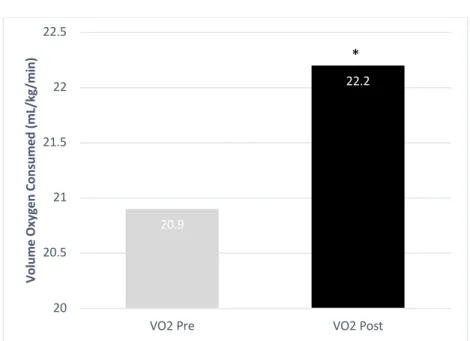
The figures below illustrate the differences in means for pre and post testing.
Figure 2: Pre and Post Intervention Values: VO2 (ml*kg-1*min-1)
* p < 0.05 from pre to post intervention
20.9 22.2 20 20.5 21 21.5 22 22.5
VO2 Pre VO2 Post
37
Figure 3: Pre and Post Intervention Values: Isometric Leg Extension (Torque)
* p < 0.05 from pre to post intervention
Figure 4: Pre and Post Intervention Values: 6MWT (meters)
* p < 0.05 from pre to post intervention
101 111 96 98 100 102 104 106 108 110 112
ISOM LE Pre ISOM LE Post
To rq ue (N ・ m) * 536 570 510 520 530 540 550 560 570 580
6MWT Pre 6MWT Post
38
Figure 5: Pre and Post Intervention Values: TUG (seconds)
* p < 0.05 from pre to post intervention
Figure 6: Pre and Post Intervention Values: Balance (composite score)
* p < 0.05 from pre to post intervention
Factors Affecting Quality of Life
Pre and post intervention means + SD, change scores, p-values, lower and upper
confidence intervals, and effect sizes of all secondary outcomes are presented in Table 6, below:
4.8 4.3 3.9 4 4.1 4.2 4.3 4.4 4.5 4.6 4.7 4.8 4.9
TUG Pre TUG Post
Ti m e (s ec on ds ) * 71.7 76.5 69 70 71 72 73 74 75 76 77
Balance Pre Balance Post
39
Table 6: Secondary Outcomes (mean + SD)
Variables Pre Post Change p-value 95% C.I. Lower 95% C.I. Upper Effect Size (Cohen’s d) Fatigue 16.6 + 4.89 15.9 + 4.1 -0.7 0.092 -0.2 2.1 0.3
Pain 11.5 + 6.7 10.8 + 4.5 -0.7 0.408 -1.5 3.5 0.2
AppCog 64.6 + 29.4 59.5 + 24.1 -5.1 0.100 -1.2 13.2 0.3
SEPA 16.0 + 4.5 17.0 + 3.1 1.0 0.298 -2.6 0.8 0.2
ISSI 8.7 + 5.4 7.1 + 4.5* -1.6 0.012 0.4 2.9 0.5
QoL 82.6 + 13.0 84.8 + 16.4 2.2 0.314 -8.5 2.8 0.2 * p < 0.05 from pre to post intervention
(small effect size, d = .2 - .5: medium effect size, d = .5 - .8: large effect size, d > .8)
Hypotheses 2 & 3, which stated that PROs and QoL would improve in response to
16-weeks of training at the GRH facility, respectively, were evaluated using dependent samples
t-tests. Significant improvements were seen in ISSI (p = 0.012), with a medium effect size of 0.5.
It is important to note that scores for all variables, with the exception of applied cognition,
trended in the direction of improvement.
Relationship Between Changes in Fitness, Physical Function, PROs, and QoL
Hypothesis 4 stated that there would be a significant association between changes in
40
Table 7: Relationship of Change Scores on QoL Change
Variable p-value 95% C.I. Lower 95% C.I. Upper
%BF Change .770 -2.3 1.7
LBM Change .153 -3.7 0.6
VO2 Change .492 -1.2 2.4
ISOK LE Change .407 -.5 .2
ISOM LE Change .622 -.2 .1
ISOM Row Change .548 -.4 .2
6MWT Change .684 -.1 .1
TUG Change .323 -8.5 2.9
Balance Change .638 -1.0 .6
Fatigue Change .285 -3.3 1.0
Pain Change .149 -2.2 .4
AppCog Change .998 -.4 .4
SEPA Change .044* .1 3.7
ISSI Change .277 -3.0 .9
* p < 0.05 from pre to post intervention
Of all variables measured, only a change in ISSI was associated with a change in overall
QoL when baseline scores were controlled for. All other variables were not good predictors of
change in QoL from pre to post intervention.
Analysis of Magnitude of Change in All Variables in Response to Low and High Adherence
Hypothesis 5 stated that survivors with higher adherence to the 16-week intervention
41
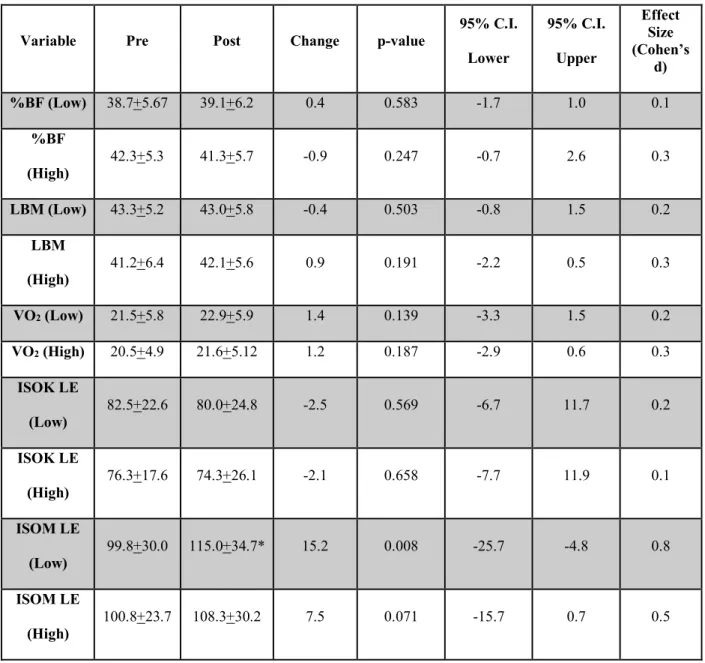
For this analysis, low adherence was considered 75% (n = 15) attendance or lower, with high
adherence being anything above 75% (n = 17). Dependent samples t-tests were used for each
adherence group.
Pre and post intervention means + SD, change scores, p-values, lower and upper
confidence intervals, and effect sizes of all secondary outcomes are presented in Table 8, below:
Table 8: Adherence Comparison (mean + SD)
Variable Pre Post Change p-value
95% C.I. Lower 95% C.I. Upper Effect Size (Cohen’s d)
%BF (Low) 38.7+5.67 39.1+6.2 0.4 0.583 -1.7 1.0 0.1
%BF
(High) 42.3+5.3 41.3+5.7 -0.9 0.247 -0.7 2.6 0.3 LBM (Low) 43.3+5.2 43.0+5.8 -0.4 0.503 -0.8 1.5 0.2
LBM
(High) 41.2+6.4 42.1+5.6 0.9 0.191 -2.2 0.5 0.3 VO2 (Low) 21.5+5.8 22.9+5.9 1.4 0.139 -3.3 1.5 0.2 VO2 (High) 20.5+4.9 21.6+5.12 1.2 0.187 -2.9 0.6 0.3
ISOK LE
(Low) 82.5+22.6 80.0+24.8 -2.5 0.569 -6.7 11.7 0.2 ISOK LE
(High) 76.3+17.6 74.3+26.1 -2.1 0.658 -7.7 11.9 0.1 ISOM LE
(Low) 99.8+30.0 115.0+34.7* 15.2 0.008 -25.7 -4.8 0.8 ISOM LE
(High)
42 ISOM Row
(Low) 61.5+27.6 64.3+21.4 2.8 0.565 -13.2 7.5 0.2 ISOM Row
(High) 61.1+18.7 61.8+17.7 0.7 0.863 -9.2 7.8 0.0 6MWT
(Low)
541.0+50.8 570.5+71.5 29.4 0.059 -60.1 1.3 0.5
6MWT
(High) 530.7+87.9 570.1+82.0* 39.4 0.002 -61.8 -16.9 0.9 TUG (Low) 4.6+1.2 4.1+1.0 -0.5 0.135 -0.2 1.1 0.4
TUG
(High) 5.0+1.3 4.4+1.6* -0.6 0.013 0.2 1.1 0.7 Balance
(Low) 69.9+13.3 77.8+12.1* 7.9 0.009 -13.5 -2.3 0.8 Balance
(High) 73.0+10.6 75.5+9.2 2.5 0.158 -6.2 1.1 0.4 Fatigue
(Low) 16.6+3.7 16.4+3.0 -0.3 0.624 -0.9 1.5 0.1 Fatigue
(High)
16.9+5.8 15.4+5.0 -1.6 0.104 -0.4 3.5 0.4
Pain (Low) 11.4+6.7 10.5+3.8 -0.9 0.500 -1.8 3.5 0.2
Pain (High) 11.8+7.0 10.6+5.0 -1.2 0.577 -3.2 5.6 0.1
AppCog
(Low) 61.6+25.1 50.9+13.6* -10.7 0.028 1.3 20.1 0.7 AppCog
(High) 68.3+33.9 66.4+29.5 -1.9 0.730 -9.5 13.2 0.1 SEPA
43 SEPA
(High) 16.9+3.8 17.9+2.2 1.0 0.261 -2.6 0.6 0.3 ISSI (Low) 9.5+5.2 7.1+4.6* -2.4 0.018 0.5 4.2 0.7
ISSI (High) 8.3+5.6 7.3+4.7 -1.0 0.261 -0.8 2.8 0.3
QoL (Low) 85.3+14.3 84.6+18.4 -0.7 0.887 -10.0 11.4 0.0
QoL (High) 79.9+11.9 85.8+15.2** 5.9 0.050 -11.9 0.0 0.5
* p < 0.05 from pre to post intervention ** p = 0.05 from pre to post intervention
(small effect size, d = .2 - .5: medium effect size, d = .5 - .8: large effect size, d > .8)
Hypothesis 5, which stated that those subjects who reached the threshold of high
adherence would present with greater magnitudes of change for all variables compared to those
with low adherence was true for the following variables: %BF, LBM, 6MWT, TUG, fatigue,
pain, SEPA, and QoL. Of these variables, statistical significance was observed for 6MWT with a
large effect size of 0.9, and TUG with a medium effect size of 0.7. QoL for the high adherence
group returned a p-value of 0.05, which had a corresponding medium effect size of 0.5. Figure 7
and Figure 8 below show the differences between 6MWT and TUG group means for low and
44
Figure 7: Adherence Comparison for Pre and Post Testing: 6MWT (meters)
* p < 0.05 from pre to post intervention
Figure 8: Adherence Comparison for Pre and Post Testing: TUG (seconds)
* p < 0.05 from pre to post intervention
Of note, for the isokinetic leg extension, post intervention values decreased for both
groups. For the isometric row, the low adherence group saw a greater increase in magnitude in
541.0 570.5 530.7 570.1 510 520 530 540 550 560 570 580
6MWT Pre Low 6MWT Post
Low 6MWT Pre High 6MWT PostHigh
Di st anc e (m et er s) * 4.6 4.1 5.0 4.4 0 1 2 3 4 5 6
TUG Pre Low TUG Post Low TUG Pre High TUG Post High
45
terms of strength, and the same was true for isometric row, despite starting at similar baseline
scores for each variable. For balance, though the low adherence group began with a lower mean
baseline score, the group also saw a magnitude of change 3x that of the high adherence group,
and the post intervention scores for low adherence were greater than the high adherence group.
Applied cognition scores declined for both groups, but the change was greater in the low
adherence group; this group also began with much lower baseline scores. ISSI scores, which
measures sleep insomnia, was better in the low adherence group, though baseline scores for for
this group were much greater. Finally, QoL scores declined from pre to post intervention for the
low adherence group, while the high adherence group nearly presented statistically significant
changes with a p-value equal to 0.05.
On an extra exploratory basis, a second adherence analysis was run using only the lowest
and highest quartiles for attendance. For this analysis, the low adherence quartile (n = 8)
represented attendance values of 62% or below, and the high adherence quartile (n = 9)
represented attendance of 87.5% or above. From here, dependent t-tests were used for each
adherence group. The results can be seen in Table 9 below.
Table 9: Adherence Comparison of Lower and Upper Quartiles (mean + SD)
Variable Pre Post Change p-value 95% C.I. Lower 95% C.I. Upper Effect Size (Cohen’s d) %BF
(Low) 37.9+7.3 37.9+7.6 0.0 0.935 -1.8 1.7 0.0 %BF