FACING CHALLENGES ON TWO FRONTS: EXPLORING THE PROCESS OF RESILIENCE FOR MILITARY FAMILIES RAISING A CHILD WITH AUTISM
Ashley Caroline Freuler
A dissertation submitted to the faculty of the University of North Carolina at Chapel Hill in partial fulfillment of the requirements for the degree of Doctor of Philosophy in the
Department of Allied Health Sciences (Occupational Science).
Chapel Hill 2013
ABSTRACT
ASHLEY C. FREULER: Facing Challenges on Two Fronts: Exploring the Process of Resilience for Military Families Raising a Child with Autism
(Under the direction of Dr. Grace T. Baranek)
Managing daily life in the presence of their child’s pervasive symptoms and coping with stressors unique to military culture characterize the battle on two fronts that face military families raising children with autism spectrum disorder (autism). Resilience models describe the process of adaptation to stressful circumstances and have been used to describe family stress and coping. However, little is known about the mechanisms that facilitate resilience for military families raising a child with autism or the impact that this process has on wellbeing for this particular population. Further, the concept of
occupation is overlooked in the literature as a potential mechanism in the resilience process despite the identified link between participation in everyday routines and
wellbeing. Family occupations consist of shared daily activities that provide structure and meaning within families.
iv
were stationed at instillations across the country, representing bases in nine different states and in the District of Columbia.
vi
ACKNOWLEDGEMENTS
This project represents the efforts of so many. I would like to thank first and foremost the families who participated in my study and agreed to share their stories with me. I feel humbled to have been offered a glimpse into your lives. You have each
inspired me both personally and professionally. I am indebted to my mentor and advisor, Dr. Grace Baranek, who has continued to convince me that I can reach the high standards that she sets. I feel honored to have learned from you and am so thankful for all of the opportunities that you have offered me. I am thankful to the members of my committee for supporting this project, and for providing me with ongoing guidance. I have been inspired by each one of you. I am so very thankful to Claire Murray for listening to and transcribing hours of interviews. I am also thankful for my fellow doctoral students with whom I have gratefully shed occupational tears and laughter over the past 5 years.
Finally, I would like to thank my village of support. I am grateful for my mom and Dennis who ensure that Miles is well entertained and have offered unwavering support. To Luz, for taking such good care of Miles and loving him like your own. I am so thankful for my friends from back home (Elizabeth, Julie & Rebekah) and my ‘same sky’ girls who have supported me through my first years of motherhood and this
TABLE OF CONTENTS
LIST OF TABLES ...x
LIST OF FIGURES ... xi
LIST OF ABBREVIATIONS ... xii
Chapter 1. INTRODUCTION ...1
1.1. A Battle on Two Fronts...1
1.2. Aims and Significance ...2
1.3. Why view this problem through a lens of Occupational Science ...4
2. CURRENT MISSIONS, POLICIES & PROGRAMS IMPACTING MILITARY FAMILIES ...7
2.1. DoD Demographics and Current Missions ...7
2.2. Current Programs and Policies...8
3. THEORETICAL PERSPECTIVES INFORMING THE LITERATURE ...14
3.1. Overview ...14
3.2. Family Stress Theory ...14
3.3. Ecocultural Theory...15
3.4. Theories of Transaction ...16
4. LITERATURE REVIEW ...18
4.1. Introduction ...18
4.2. Resilience ...18
4.3. Occupation and Family Routines ...19
viii
4.5. Military Families ...26
4.6. Conclusions and Gaps in the Literature ...31
5. METHODS ...33
5.1. Introduction ...33
5.2. Design and Approach ...34
5.3. Participant Inclusion and Sampling ...35
5.4. Recruitment ...37
5.5. Procedures ...38
5.6. Analysis ...39
5.7. Trustworthiness and Researcher Identity ...43
6. FINDINGS ...48
6.1. Overview ...48
6.2. Participants ...48
6.3. Identified Themes and Categories ...49
6.4. Barriers and Stressors ...51
6.5. Resources and Supports ...69
6.6. Strategies ...77
6.7. Time and Place ...90
6.8. Family Culture ...94
6.9. Moments of Resiliency ...110
6.10. Summary and Conceptual Model ...112
7. DISCUSSION & CONCLUSIONS ...118
7.1. Overview ...118
7.2. Addressing Research Gaps ...118
7.4. Family Routines ...123
7.5. Transactional Nature of Resilience ...130
7.6. Occupation, Wellbeing and Resilience ...132
7.7. Limitations ...135
7.8. Future Directions ...135
7.9. Conclusions ...138
APPENDIX A: Informed Consent ...140
APPENDIX B: Recruitment Letter ...144
APPENDIX C: Interview Guides ...147
x
LIST OF TABLES Table
5.1. Phases of Analysis ...40
6.1. Identified Themes and Categories ...49
6.2. Supports and Strategies ...89
LIST OF FIGURES Figures
6.1.Families Impacted by Autism in the Military Transactional
xii
ABBREVIATIONS
ABA Applied Behavior Analysis
ADA Americans with Disabilities Act
AMFAS American Military Families Autism Support CONUS Continental United States
DD Developmental Disability
DoD Department of Defense
ECHO Extended Care Health Option
EFM Exceptional Family Member
EFMP Exceptional Family Member Program
FRG Family Readiness Group
FRS Family Readiness System
IEP Individual Educational Plan
NCD National Council on Disability NDAA National Defense Authorization Act
OEF Operation Enduring Freedom
OIF Operation Iraqi Freedom
PCS Permanent Change of Station
UNC University of North Carolina
CHAPTER 1 Introduction
1.1 A Battle on Two Fronts
Managing daily life in the presence of their child’s pervasive symptoms and coping with stressors unique to military culture characterize the battle on two fronts that face military families raising a child with autism. Resilience models describe the process of adaptation to stressful circumstances and have been used to describe family stress and coping. However, little is known about the mechanisms that facilitate resilience for military families raising a child with autism or the role that participation in family routines plays as a mechanism in the resilience process despite the identified link between participation in occupation and wellbeing.
2
military families with a child with autism and the nuances surrounding adaptation processes in the presence of ongoing challenges while highlighting the role that occupation plays in this process. Striving to successfully overcome stressful
circumstances is referred to in the literature as a process of resilience (McCubbin & McCubbin 1983). Patterson (2002) suggested that research focusing on families who are at ‘high risk’ for negative patterns of adaptation would seek to clarify current
understandings of resilience. Therefore, studies that focus on military families with a child with autism who face ongoing stressors in the context of daily life will strengthen current conceptual and theoretical understanding of resilience as well as illuminating the role that human occupation, specifically characteristics of participation in everyday routines, plays in this process.
A plethora of research identifies the challenges that military families, as well as families with a child with autism, face. However, no research to date considers the unique set of challenges that military families who have a child with autism endure, and the nature of the ongoing process through which they strive to adapt to such challenges. Further, the concept of human occupation has been overlooked in the family stress literature, and subsequently omitted from theories and conceptual models surrounding resilience.
1.2 Aims and Significance
illuminate the connection between occupation and wellbeing, which is one that is prevalent in the Occupational Science literature. This study has both theoretical and pragmatic significance. Theoretically, identification of caregivers’ perceptions of mechanisms at play in the resilience process may clarify theoretical understandings surrounding this process. Further, consideration of resilience as embedded in everyday family life enables a shift in focus from psychological outcomes to the transactional processes that facilitate a family’s active pursuit of wellbeing. Finally, consideration of the process of resilience in a broader context of everyday family life may contribute to an increased understanding of the relationship between family occupations and wellbeing.
Pragmatically, findings from this study may serve to inform programs and policies that aim to support military families who face barriers to participation in everyday routines that impact individual family members as well as overall family wellbeing. Exploring the experiences of military families who have a child with autism will reveal nuances within the contextualized resilience process distinctive to this
population. Identification of ‘what works’ for some families who are positively adapting in the face of ongoing stressors will illuminate opportunities for intervention as well as policies to support these families.
4
1.3 Why view this problem through a lens of Occupational Science?
Although the Occupational Science literature has largely overlooked the concept of resilience, the relationship between participation in occupation and wellbeing is a foundational one in the discipline (Wilcock, 2006). Therefore, the nature of the
connection between occupation, wellbeing, and resilience has yet to be fully explicated in the literature. If occupation and wellbeing are inextricably linked, and resilience
describes the process leading to such positive outcomes as wellbeing, occupation is likely a key mechanism in such a process.
Occupation can be broadly understood as “a dynamic aspect of engagement in life and as an unfolding of interaction between a person and the world” (Royeen, p.112, 2002). Further, occupations consist of shared daily activities that provide structure and meaning within families (Humphry & Case-Smith 2005; Segal, 2004). Surfacing
evidence suggests that occupations greatly impact wellbeing and family adjustment (e.g., Fiese, Tomcho, Douglas, Josephs, Poltrock et al., 2002). Despite a lack of clarity in the conceptualization of wellbeing in the Occupational Science and Therapy literatures (Aldrich, 2010), there are theoretical underpinnings in the Occupational Science
In order to clarify the connection between wellbeing and occupation, Christiansen (2007) revisited Adolf Meyer’s (1943) philosophy. Meyer (as reviewed in Christiansen 2007) believed in a connection between the mind and body, and described wellbeing as a balance between demands and performance. He was also interested in how individuals with mental illness achieved ‘adaptation’ in the face of the stress of ‘human existence’ and Christiansen subsequently argued that Meyer was one of the first scientists interested in the concept of resilience. Meyer suggested that health and illness can best be
understood in “the habits of everyday life” and that participation in occupation leads to positive adaptation.
Despite foundational beliefs presented in the Occupational Science literature suggesting an inherent connection between wellbeing and participation in occupation, there remains a gap in understanding the relationships between resilience and
participation in occupation. Therefore, a consideration of families’ participation in everyday occupations as a mechanism in the resilience process is needed. Locating
CHAPTER 2
Current Missions, Policies, and Programs Impacting Military Families
2.1 Department of Defense Demographics and Current Missions
Family life in the military can be optimally understood in consideration of the unique socio-, political, and historical time in which soldiers, marines, sailors, and airmen are serving. Military life has changed significantly over the past ten years, most notably following the events of September 11, 2001 (Martin & Sherman, 2012). Since that time, service members have maintained an active overseas presence facing combat operations in Iraq and Afghanistan. Since the beginning of these combat efforts in 2001, over 1.9 million US military personnel have been deployed as part of Operation Enduring Freedom (OEF) or Operation Iraqi Freedom (OIF), which together make up the longest sustained US military operation since the Vietnam War (Committee on the Initial
Assessment of Readjustment Needs of Military Personnel, Veterans, and Their Families, Board on the Health of Selected Populations, 2010).
addition, there are over 120,000 service members who have a documented dependent family member with special medical or healthcare needs (Military Onesource, 2012).
In order to access services to meet the needs of their child, families are required to enroll in the Exceptional Family Member Program (EFMP) (refer to section 2.2). Since the Department of Defense (DoD) does not maintain a registry specifically for family members with autism, neither the prevalence nor the geographic distribution for this population within the Military Health System is specifically documented (DoD Report, 2007). In addition, each service branch differs in how they maintain data and medical information on exceptional family members, and not all members are enrolled in EFMP (DoD Report, 2007).
One available Freedom of Information Act document, requested and obtained by a marine wife and mother of a child with autism, stated that there are approximately 22,027 military dependent children with autism, and of these, 13,243 are children of active duty members (FOI document, 2008). In consideration of the total number of active duty families with young children, these numbers suggest a 1:88 prevalence rate of children with autism in the current active duty military population, which is comparable to the 1:88 prevalence of autism in the general population (Baio, 2012).
2.2 Current Programs and Policies
8
access. Therefore, it is necessary to consider the current state of policies impacting families as it sets the stage for understanding current family experiences.
Family readiness is a concept that underlies military family programming and policies. The concept of readiness has evolved to encompass the wellbeing of the family as impacting soldiers’ job performance and retention. This shift in conceptualization
occurred in response to both the changing demographics of the US military to include
more families as well as the recognized needs of services for families following the Gulf
War (Knox & Price, 1995). In addition, the transition to an all-volunteer force in the
1970’s led policy makers to acknowledge military families and military lifestyle as
impacting both National defense efforts as well as daily lives of its members and their
families (Knox & Price, 1995). The concern of the whole family’s readiness as impacting the soldier’s (job performance as well as military retention) is one that is prevalent in
current programming.
The Family Readiness System (FRS) consists of a constellation of support
Soldiers on active duty are required to enroll in EFMP when they have a family member with a physical, emotional, developmental, or intellectual disorder requiring specialized services (Army Regulation 608-75, 2006). Exceptional family member services are designed to meet the needs of families in the realm of housing, educational, medical, and personnel services (Military OneSource, 2012). EFMP considers a family member’s special needs and ensures assignment to a location with appropriate resources that address these needs, thus, EFMP families are assigned to duty stations where the medical and special education needs of their exceptional Family member can be met (Marine Corps Order (MCO), 1754.4B, 2010). Each branch of the military has specified regulations surrounding the EFMP screening, program enrollment, and related support and assignment considerations. For example, the mission of the Army’s EFMP, first set forth in the 1980’s, is described in the Army Regulation Rapid Action Revision (Army Regulation 608–75, 2006):
“The EFMP, working in concert with other military and civilian agencies, provides a comprehensive, coordinated, multiagency approach for community support, housing, medical, educational, and personnel services to Families with special needs. Delivery of reimbursable and non-reimbursable services is based on legislative and DoD authority and Army policy” (p. 22).
Marine Corps Order (MCO 1754.4B, 2010) similarly outlines the current mission of the MC EFMP:
“EFMP will improve the quality of life of families that support a member with a disability...EFMP will ensure that sponsors with Exceptional Family Members (EFM's) are assigned to duty stations where services exist to support the EFM with access, and availability, to medical and educational services. Families and service providers must work together in a climate of mutual respect and trust to be successful. Enrollment in the EFMP shall not prejudice advancement or
10
Broadly, EFMP can be described as a program in which military families must enroll in order to utilize resources that support their family member’s special needs on base as well as in having these needs considered upon relocation to various duty assignments.
In addition to services offered through EFMP, families with a child with autism have access to TRICARE health care benefits. TRICARE is the Department of Defense's health care program for active duty military members, retirees, eligible Reservists and National Guard members, and their families. TRICARE-eligible service members and their families have access to military-specific treatment facilities, as well as to civilian health care providers in the community through enrollment in one of five options through one of three Continental United States (CONNUS) regions or through TRICARE
Overseas (Tricare Management Activity, 2012).
The extended healthcare option (ECHO) is a TRICARE supplemental program for eligible active duty family members who are enrolled in EFMP and who have a
qualifying mental or physical disability (Military Onesource, 2012). Qualifying
conditions include moderate or severe mental retardation, a serious physical disability, or a physical or psychological condition that causes the beneficiary to be homebound
family member’s ECHO eligibility, and subsequent Applied Behavior Analysis (ABA) and other services (currently regarded as ‘educational services’) for their child, are discontinued.
Legislation is currently in progress to modify the existing parameters surrounding the allocation of services through TRICARE’s ECHO program. Expanding the
parameters that TRICARE has placed on service allocation, particularly surrounding ABA services, has been central to the efforts of military family grass roots advocacy, as well as civil lawsuits that have proven to be an ongoing feat for families in pursuit of continued or expanded coverage (e.g., Berge vs United States).
12
Clearly, the current and ever changing sphere of legislation and polices impacting military families of children with autism provide a timely backdrop for the family
CHAPTER 3
Theoretical Perspectives Informing the Literature
3.1 Overview
The current study drew from three theoretical perspectives that are pervasive in the literature and have shaped my world-view surrounding family stress and coping and human occupation. Family Stress Theory, Ecocultural theory, and transactional theories of occupation were considered. This study was guided by literature surrounding the concept of resilience, which informed my study questions, methodology and analysis. Family Stress Theory is one that is foundational to existing models of resilience. Ecocultural and transactional theories will supplement this foundational theory as they serve to contextualize resilience processes, as well as inform the discussion surrounding the inter-linked and reciprocally influencing and active mechanisms in this process.
3.2 Family Stress Theory
14
included: the ABC-X model of family stress (Hill, 1949), the Double ABC-X model (McCubbin & Patterson, 1983), the T- Double ABC-X model (McCubbin & McCubbin, 1987), and the Family Adaptation and Resilience model (Patterson, 2002). Generally, these models are comprised of three central components involved in the resilience process, to include: (A) stressful events, (B) resources or capacities (C) outcomes. Patterson’s (2002) model added a more explicit ‘meaning’ component, as well as placed resilience in the context of family with an emphasis on how families actively try to balancing their demands and capabilities in the process of adapting to stressful life
circumstances. Resilience models generally describe the adaptive process that families go through as they react to stressful life events, implement resources or capabilities, and the role that interpretations and meaning making play in this process (McCubbin &
Patterson, 1983).
Specifically, Family Stress Theory will contributed to the current study as a language that describes the potential mechanisms at play in resilience processes as currently identified in the literature to include (1) demands (stressors, strains, daily hassles), (2) supports (coping, resources, supports), (3) meanings (constructed interpretations), (4) resiliency outcomes (balance of demands and capabilities).
3.3 Ecocultural Theory
and affordances that accompany military life and raising a child with autism in the context of resilience processes.
Ecocultural theory suggests that families are proactive in the management of their everyday routines and highlights the ecological features that directly affect the daily routines of a family. Ecocultural theory maintains that families actively modify daily routines to accommodate to a broader cultural context, and that a family’s culture can best be understood by gaining insight into their daily routines (Weisner, 2002).
According to this theory, broader societal and cultural influences place both affordances and limitations on families that are manifest in their everyday routines.
Ecocultural theory highlights the concept of family ecology, which includes parent’s beliefs, values and personal experiences as they influence the creation of family routines. The sustainability of these routines is believed to be influenced by four
dimensions: 1) Social Ecological Fit (balancing family ecology with available resources), 2) Congruence and Balance (ongoing assessment and accommodation to competing interests of family members), 3) Meaning (routines created in a culturally valued and meaningful way), 4) Stability (changing as needed, but maintaining predictability) (Weisner et al., 2005).
16 3.4 Theories of Transaction
The concept of resilience, as an ongoing process aligns closely with a
transactional perspective. The basis of resilience models is the underlying assumption that families are driven to actively ‘adapt’ within the constraints and affordances of everyday life circumstances. Therefore, transactional theories that consider the active, interdependent, and reciprocally influencing nature of individuals, families, and environments informed the current study.
A transactional view of occupation views the organism-in-environment-as-whole, thus overcoming the dualism of separation of person and environment (Dickie, Cutchin, & Humphry, 2006). These authors suggested that rather than viewing individuals as ‘adapting to’ their environments, they work in ‘functional coordination’ with the environment via action. Cutchin & Dickie (2013) described one particular transactional theory, Dewey’s pragmatism, as a ‘relational’ theory. Further, this theory describes the relationship among interconnected components, such as: action, actors, environment, thoughts, history and future orientation. Therefore, a transactional theory facilitates an embedded view of human action while considering the dynamic relationships between mechanisms driving the ongoing resilience process, as situated in context.
CHAPTER 4 Literature Review
4.1 Introduction
This chapter will review the literature surrounding four primary areas of interest in the current study, to include (1) resilience, (2) occupations and family routines, (3) autism and family experiences, and (4) military families.
4.2 Resilience
Families are in a constant state of actively negotiating everyday demands and capabilities, within their ever-changing context (McCubbin & McCubbin, 1987). This process can be described as resilience. Doll and Lyon (1998) asserted, "while there is no universal definition of resilience, a central notion exists that resilience concerns
successfully coping with or overcoming risk and adversity or the development of
competence in the face of severe stress and hardship" (p. 348). Resilience can be broadly defined as the ongoing, daily process of positive adaptation in the face of stressors or adversity (Patterson, 2002). Resilience can be described as the process while resiliency is the outcome of such a process (Boss, 2002; Bowen & Martin, 2011). Resiliency
18
Fowler, 2011), the community (e.g., Mancini & Marek, 2004) as well as at the family level (e.g., McCubbin & McCubbin, 1996).
Family resiliency has been defined as “the positive behavioral patterns and functional competence individuals and the family unit demonstrate under stressful or adverse circumstances, which determine the family’s ability to recover by maintaining its integrity as a unit...” (McCubbin & McCubbin, 1996, p. 5). Resilience models that focus on family-level outcomes offer utility in understanding the means by which some
families effectively respond to adverse life circumstances or events that would otherwise impair family functioning (Doucette & Pinelli, 2004). Knowledge surrounding this process at the family level also offers implications for practice, as practitioners can use this knowledge to “facilitate family adjustment and adaptation by looking at family strengths and capacities for responding to stress” (Hanson, 2001, p.54).
Overall, the concept of resilience has been described as one of the most important in contemporary social sciences (Liebenberg & Ungar, 2009; von Eye & Schuster, 2000) as it facilitates an increased understanding of mechanisms of health and wellness.
4.3 Occupation and Family Routines
Christiansen (2008) put forth the Model of Lifestyle Balance, in which they suggest that a balanced life is one in which patterns of occupation are ‘healthful, meaningful, and sustainable’ in the context of circumstances of everyday life. These authors conducted a review of the literature, in order to identify the ‘dimensions’ of occupation that contribute to wellbeing, including 1) biological health and physical safety; 2) access to social
supports; 3) feeling challenged and competent in life role; 4) meaning making and identity; 5) organizing time and energy for renewal and to meet goals. These authors suggested that wellbeing comes from a ‘balance’ of these dimensions in consideration of life circumstances, rather than any sole aspect of human experience.
Occupations have also been described from a family perspective. Family occupations are conceptualized as the shared daily activities that provide structure and meaning within families (Humphry & Case-Smith 2005; Segal, 2004). Family routines are a broad category of family occupations that contribute to the wellbeing, health, and adjustment of family members (Fiese et al. 2002). Family routines can be described as specific, repeated practices (Spangola & Fiese, 2007) that change over time, are impacted by culture, and contribute to health and wellbeing (Fiese et al., 2002). Participation in meaningful family routines or activities contributes to family satisfaction, interaction, and stability (Orthner & Mancini, 1990). Bernheimer and Weisner (2007) additionally
suggested that families are driven by the task of creating and sustaining routines, which serve as ‘windows’ into family culture. Similarly, Segal (2004) described routines as a manifest family identity, or meaning system (particularly for families with a child with a disability). Further, Bowen & Martin (2011) suggested that managing the ‘tasks of
20
outcomes of the resilience process. Therefore, Weisner (2002) suggested that in order to optimally understand the family ‘culture’, families should be asked about their daily routines.
Routines provide stability and predictability in family life, and can be described as ‘powerful organizers’ of family behavior (Wolin & Bennet, 1984). Family routines may serve as a protective factor for families who endure ongoing stressors such as single parent families, and those with limited resources (Fiese, 2006). Further, everyday family routines strengthen a family’s ability to positively adapt in stressful circumstances (Imber-Black, 2003). Specifically, stable routines have been identified as a key foundation for families during times of transition or family crisis, such as family
geographic relocation, the death of a family member (Wolin & Bennet, 1984), or during normative transitions, such as starting kindergarten (Wildinger, 2008).
Evidence suggests that families with a child with a disability face barriers to participation in everyday routines (Law, 2002), therefore impacting their wellbeing. Law (2002) suggested that it is essential to identify such barriers in order for families to effectively create opportunities for participation in meaningful activities. The
construction and maintenance of everyday routines may serve as both a barrier as well as an opportunity for engagement for caregivers with a child with a disability. Bernheimer & Weisner (2007) considered the nature of family routines in the context of family life and caring for a child with a disability, and suggested that caregivers make
their own perception of the child’s current needs as well as in anticipation of the child’s future skills and needs. Therefore, daily routines are particularly central to family life and carry unique meaning for those families who have a child with a disability.
Caregivers with a child with autism are confronted with the difficult task of creating and maintaining meaningful family routines that meet the needs of both the child and the family. There is evidence, however, that these routines often orbit around the needs of the child with autism, and subsequently become part of the family identity (DeGrace, 2004). In exploring the everyday occupations for families with a child with autism through interviews with caregivers, DeGrace identified such emergent themes as: feeling ‘robbed’ (of family time and ‘normal’ family life), occupy and pacify (focus of family activities becomes appeasing the child), and family identity as being autism. Overall, these findings highlight the ‘pervasiveness’ of autism in everyday family life.
Larson (2006) similarly set out to explore the impact of child features on family routines and examined how a child’s propensity for routinization impacts family
occupations. In this study, caregivers identified child characteristics that impact everyday routines, including a lack of social skills, lack of focus/attention, and increased
22
routines as ‘circumscribed’ and revealed that daily routines are a source of stress for both the mother and the child.
4.4 Autism and the Family
Autism is a prevalent neurodevelopmental disorder that impacts 1:88 children in the United States (Baio, 2012). While there is increasing evidence of a genetic
component, no clear markers have been identified, and subsequently the etiology remains elusive (Goldstein & Ozonoff, 2009). In the absence of a clear genetic marker, diagnostic criteria remain focused on overt behavioral features. The current diagnostic criteria for such features include a qualitative impairment in social interaction, a qualitative
impairment in language, repetitive behaviors and circumscribed interests (APA, 2000). In addition, sensory features have been found to be prevalent, although not universal in children with autism (Baranek, David, Poe, Stone & Watson, 2006; Dawson & Watling, 2000) and have an impact on family life (Bagby, Dickie & Baranek, 2012; DeGrace, 2004; Dickie et al., 2009).
Various aspects of an autism diagnosis have been considered in the literature as having an impact on caregiver experiences. Literature has generally identified such stressors as the elusive nature of the disorder, uncertainty surrounding the diagnostic process, and difficulty identifying effective treatments (as reviewed in Woodgate et al., 2008). Further, parents of children with autism have reported difficulties in navigating services and report low levels of positive perceptions of service providers, particularly pediatricians (Bishop, 2007). Additionally, caregiver stress has been considered in the context of child age and proximity to diagnosis, with findings suggesting that parents report higher levels of stress when the child is 3-6 years old (most proximal to child diagnosis), followed by age 16-18 (Davis & Carter, 2008).
The behavioral features of children with autism have a tremendous impact on caregiver wellbeing. Several studies have identified a strong association between autism symptomatology and parental stress (Konstantareas & Homatidis 1989; Kasari & Sigman 1997; Hastings & Johnson, 2001). For example, a child’s lack of social reciprocity, challenging behaviors and difficulty with emotion regulation has been reported by
24
impact stress. Specifically, caregivers have identified concerns surrounding their child’s future, identifying effective treatments, and difficulty understanding their child’s needs as contributing to feelings of stress (Tehee, Honan & Hevey, 2009).
Research suggests that through the stressful and demanding experiences of raising a child with autism, caregivers exercise coping skills which have been identified as both positive and negative. Effective coping skills include cognitive reframing, perceived social supports, and emotion regulation skills, while ‘negative’ skills included social withdrawal and isolation (Dunn et al., 2001). Similarly, mediators to negative caregiver outcomes have been identified, such as perceived social supports and locus of control (internal locus of control significantly buffering the effects of stressors) (Dunn et al., 2001). In a recent qualitative study, Kuhaneck (2010) identified such themes in reported caregiver coping, to include: taking ‘me time’, lifting the restraints of labels, and sharing the load. Similarly, the use of social support, family connectedness, spiritual
beliefs/values and meaning making processes have been identified as coping mechanisms that contribute to positive outcomes for caregivers of young children with autism (Bayat, 2007).
with autism. Without using the term resilience, but describing a similar notion, Larson sought to identify what makes some caregivers fare well (as measured by psychological wellbeing) in the face of stress, while others do not and identified that engaging in the process of meaning making served as a primary indicator for wellbeing.
While a great deal of literature has focused on the stressors, or negative experiences of caring for a child with autism, there are recent studies that identify positive experiences associated with caring for a child with autism. Bayat (2007)
suggested use of the concept of resilience to explicate the experiences of families with a child with autism. Despite a lack of understanding surrounding the concept of resilience in the area of disability research, Bayat hypothesized that families with a child with autism have the capacity for resilience. Similarly, Kayfitz, Gragg & Orr (2010) identified an association between reported positive experiences for families with a child with autism and decreased reported caregiving stress.
4.5 Military Families
26
institutions (family and military), and the subsequent challenges individual service members face in meeting the demands set forth by each.
Military life is embedded in an overarching evolving military culture, including a well-defined hierarchical structure, implicit and explicit values and expectations, as well as social rules and norms. Military life is also characterized by the unique demands that are placed on individual service members and their families. Generally, active duty military families are thought to face such ongoing challenges as frequent geographic mobility, family separations, residence in foreign countries and risk of injury or death (Segal, 1986).
Post-combat service members are at high risk for mental and physical health issues. Literature suggests that common disorders and health issues associated with post combat service include post-traumatic stress disorder, traumatic brain injury, depression, and substance abuse (Lester, Mogil, Saltzman, Woodward, Nash, et al., 2011). While many service members who return from combat do not develop long-term mental health problems (Hoge, Austin & Pollack, 2007), shorter term difficulties are common,
including difficulty sleeping, irritability, and difficulty concentrating (Shea, Vujanovic, Mansfield, Sevin, & Liu, 2010), as well as difficulty reconnecting with family members and reintegrating into everyday family life (Boss, 2002; Lester et al., 2011).
disciplinary problems (Schwab, Ice, Stephenson, Raymer, Houser, Graziano et al., 1995). Recent research has also highlighted the tremendous impact of parental stress or
psychopathology, rather than a direct impact of military lifestyle on child outcomes (Palmer, 2008). There is also clear evidence that spouses of service members face challenges during deployment, reporting such feelings as: numbness, shock, irritation, tension, disbelief, loneliness, somatic complaints, and increased emotional distance (Bey & Lange, 1974). In addition, spouses often experience emotional distress, anxiety or anticipatory grief (Wright, Burrell, Schroeder, & Thomas, 2006) and increased
depression (Black, 1993). One recent study revealed the increasing mental health risk that spouses face during times of deployment and how this risk is compounded with
deployment length. Mansfield, Kaufman, Marshall, Gaynes, Morrissey & Engel, 2010) identified that nearly one- third (31.3%) of spouses of soldiers deployed between 2003-2006 had at least one mental health diagnosis, with the percentage increasing to 60.7% of those whose husbands had been deployed for more than 11 months. Overall, these unique stressors are likely to greatly impact family life on the home front and compound
parenting demands.
The service member’s return home, and subsequent reintegration into family life, has also been identified as a significant stressor for families (Faber, Willerton, Clymer, MacDermid, Weiss, 2008). This reintegration of the service member may be
28
members who experience ambiguous loss may suffer from feelings of uncertainty, hopelessness, and confusion (Boss, 2004). Similarly, boundary ambiguity is a concept that has been used to describe the situation whereby individuals must negotiate new roles during times of separation and reintegration (Boss, 2002). Boss described the ‘task’ that families face negotiating roles when a family member is either psychologically present, but physical absent, and/or the physical presence and psychological absence that might occur throughout the phases of deployment. Boss’ concept of boundary ambiguity, then, can be understood in more depth using the concepts of ambiguous presence and
ambiguous absence (Boss, 2007). These phenomena likely play out in the context of daily routines and greatly impact family life as families struggle to maintain the
psychological presence of separated service members, or to reintegrate them physically into everyday routines despite a perceived psychological distance.
Family life in the military comes with both normative and unique stressors that greatly impact the wellbeing of individuals within the family system, and subsequently everyday family life. These stressors include the ongoing anticipation of separation, constant interruptions in everyday routines and negotiation of roles, as well as frequent geographic relocations. There is clear evidence that family life is not only disrupted while the service member is geographically separated from the family, but also in the pre- and post- deployment phases, as well as during transitions such as geographic relocation.
military’s retention of soldiers (Bowen, Orthner & Zimmerman, 1993) as well as overall soldier effectiveness (Pincus et al., 2001). Despite the stressors that are imposed upon families in the military, there is evidence to suggest that most families do adapt to meet these demands (Knox & Price, 1995). Overall, the nature of life in the military may create ongoing stressful circumstances for families, which are likely compounded by the
demands of caring for a child with a disability.
30
establishing services for their family member with a disability (with a specific focus on EFMP, TRICARE, and school-related services). This study concluded “far reaching systemic changes are needed in our Nation’s health, education, and long-term service systems to address the significant barriers faced by exceptional family members” (p. 2).
4.6 Conclusions and Gaps in the Literature
Overall, evidence suggests that the nature of life in the military creates ongoing stressful circumstances for families, which are likely compounded by the demands of caring for a child with autism. The experiences of these families, therefore, may be best understood in consideration of their process of balancing ongoing challenges with their supports, within their given context. This process is played out in everyday family
routines, which may contribute to (perhaps both positively and negatively) overall family wellbeing.
consideration of the transactional nature of the resilience process, and (4) the relationship between occupation, wellbeing and resilience.
Overall, the experiences of these families may be best understood in consideration of their active participation in responding to ongoing challenges through enacting
CHAPTER 5 Methods
5.1 Introduction
This study used a qualitative methodology consisting of a sequence of three in-depth semi-structured interviews and an iterative process of thematic analysis. The interviews included open-ended questions exploring resilience, parent experiences of raising a child with autism, and military lifestyle.
5.2 Design and Approach
Since operationalizing family resilience in quantitative research has been problematic (De Haan, Hawley & Deal, 2002), it is has been suggested that further research use qualitative methodologies with a smaller sample of family members to support a strengthened conceptual understanding of resilience.
Semi-structured interviews were used to gain a rich description of the families’ experiences and insight into the phenomena of interest in the current study. Marshall and Rossman (2006) suggested that semi-structured interviews have the ability to “capture the deep meaning of experience in the participants’ own words” (p.55). The underlying assumption of this choice of methodology is that the participants’ views are valuable and useful in gaining insight into a particular phenomenon (Marshall & Rossman, 2006). Therefore, semi-structured interviews facilitated the process of obtaining rich
descriptions of participant experiences of raising a child with autism in the context of a military life-style.
Interview guides (see Appendix C) were used in order to support the interview process. Interview questions provided a guide for facilitating the participants telling of their story with open-ended questions surrounding their experiences as a parent with a child with autism in the context of military life. The nature of the semi-structured interview allowed for flexibility of question sequence as well as emergence of new questions or topics in the midst of the interview process (DiCicco-Bloom & Crabtree, 2006).
34
information (see Appendix C.1) and to set up a second interview with the family. This phone interview allowed for an initial conversation with the caregiver in order to build rapport and establish a contextual foundation for the second interview. The second interview included open-ended questions exploring resilience, everyday experiences of raising a child with autism, and military life (see Appendix C.2). More specifically, the second interview was structured around the concept of resilience targeting such aspects this process as perceived stressors, family strengths and supports, as well as their interpretations surrounding resiliency. Further, questions targeted everyday family life experiences by focusing on construction, maintenance, and participation in family
routines. Following the semi-structured interview, in-depth questions were generated that stemmed from a review of the first interview to facilitate a more in depth dialogue
surrounding constructs of interest to be targeted in the third interview. The final interview served to expand further on points raised during the second interview (see Appendix C.3). Further, this final interview allowed an opportunity for closure in the research process and the caregiver to clarify and elaborate on any points in the prior interview.
The first and third interviews were all conducted over the phone, in some cases using SKYPE. Second interviews were conducted face-to-face when possible, and otherwise over the phone. Interviews generally lasted thirty minutes to two hours, depending on the course of the interview (DiCicco-Bloom & Crabtree, 2006).
5.3 Participant Inclusion and Sampling
the study. Autism diagnosis as well as military status was based on parent report. A purposive sampling method, in which cases are selected based on specific criteria, was used (Miles & Huberman, 1984). From a review of the literature and consultation with committee members, the target number of families was between 15-18. To validate this sample size, 5 families were initially recruited and interviewed. Data generated from these initial interviews were reviewed for their amount and quality. Thirteen more families were recruited to establish saturation of data for a total of 18 families. Bloor & Wood (2006) defined theoretical saturation as “the sampling and data collection until no new conceptual insights are generated” (p.165). Following each interview, the amount and quality of each new set of data were reviewed throughout the recruitment process in consideration of the contribution of each interview towards saturation of data.
The first wave of recruitment targeted a three-state area (North Carolina, Virginia, Georgia). These states were selected based on proximity to UNC Chapel Hill, as well as the high percentage of active duty members per statewide population. Snowball sampling led to states outside of this three state area to include six additional states (Florida, Pennsylvania, Kentucky, California, Colorado, Hawaii) and the District of Colombia.
36 5.4 Recruitment
Military-specific and civilian community resources were targeted for recruitment, primarily including base-specific Army and Marine Exceptional Family Member
Programs. Information was simultaneously distributed (including information about recruitment, study purpose, and procedures) at the community level, including autism-specific organizations such as Autism Society county chapters surrounding bases in the initial three state catchment area as well as the University of North Carolina-TEACCH regional centers within a close proximity to bases in North Carolina. UNC TEACCH centers provide clinical services such as diagnostic evaluations and parent training for families as well as clinical training for practitioners with a focus on Autism Spectrum Disorders.
After initial recruitment strategies were implemented, snowball sampling was used to further identify potential participants. Snowball sampling utilized the social networks of participants and other informants with whom contact had already been made to find and recruit ‘hidden populations’, that is, groups not easily accessible to
researchers through other sampling strategies (Marshall & Rossman, 2006). The process of snowball sampling included word of mouth recruitment amongst participants who were already enrolled as well as key gatekeepers in the community sharing information about the study via online resources and listservs.
about the study from their EFMP case manager. The majority of participants reported hearing about the study from an online support that is described as being “for military families, by military families.” One of the key gatekeepers was a military spouse who endorsed this study by posting my recruitment letter on this website. From there, another military spouse also included the recruitment letter in a listserv that extended to many EFMP families in a particular geographic area. Fourteen participants reported hearing about the study through either the military family support website or the family support listserv, both which are run by military spouses and are not affiliated directly with any governmental agency. Three of the participants heard about the study from ‘friends’ who were already enrolled as participants.
5.5 Procedures
38
All of the data gathered during this study were de-identified by the PI using a numerical identification system. Data were comprised of interview transcriptions as well as field notes collected surrounding context, general observations, and reflections
following each interview. Interviews were recorded via audiotape and later transcribed in a word document for preparation for analysis. Field notes were maintained in the form of a running word document in preparation for analysis in ATLAS.ti. (Muhr, 2011). In addition to field notes, process notes in the form of an ongoing word document kept track of study timeline, procedures, methodological notes, personal reactions and reflections, and decision-making procedures (Marshal & Rossman, 2006). In addition, these process notes served as a reflective guide for the iterative process of data analysis.
5.6 Analysis
descriptive model in order to generate conclusions, connect findings to the existing literature, as well as integrate multiple concepts and findings (Bazeley, 2009).
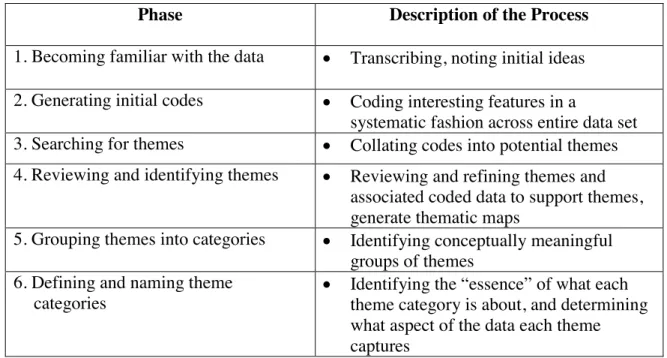
Table 5.1. Phases of Analysis
Phase Description of the Process
1. Becoming familiar with the data Transcribing, noting initial ideas 2. Generating initial codes Coding interesting features in a
systematic fashion across entire data set 3. Searching for themes Collating codes into potential themes 4. Reviewing and identifying themes Reviewing and refining themes and
associated coded data to support themes, generate thematic maps
5. Grouping themes into categories Identifying conceptually meaningful groups of themes
6. Defining and naming theme categories
Identifying the “essence” of what each theme category is about, and determining what aspect of the data each theme captures
Modified from (Braun & Clarke, 2006)
40
The second step involved generating initial codes. Codes served to initially break down the large amount of data collected in this study into manageable segments
(Schwandt, 2007). These codes emerged directly from the data rather than being generated prior to analysis. Codes identify common ideas at the most basic and
descriptive level, in preparation for identifying broader themes that served to represent the data in total. The process of coding was informed by a grounded method strategy called constant comparison in which an a posteriori inductive process was used to “constantly comparing and contrasting various successive segments of data and
subsequently categorizing them” (Schwandt, 2007, p. 32). A line-by-line coding process of all interviews was used for this first round of analysis in order to identify emergent codes in the data in addition to those generated through the process of field notes. Recurring ideas were identified in the process of recording field notes and reviewing interviews to generate a list of ‘initial codes and ideas’ list that served as the starting point for the ATLAS.ti coding scheme for the process of coding the interview transcripts. Eighty-six codes were identified in the first ‘round’ of coding. Throughout the process, the ‘notes’ feature was used in ATLAS.ti in order to reflect on the codes themselves and to identify possible points of convergence through the constant comparison process. A second round of coding involved a review of previously coded segments of data and a combining of codes that represented comparable ideas as well as noting the beginning emergence of groups of codes that would later serve to support the themes. The final coding list after codes were combined resulted in a total of 56 codes.
setting and expressed by the participants” (p. 159). These themes were differentiated using an evolving process of hand drawn concept maps in order to visually identify relationships between various codes and broader descriptive themes. A review of these themes served to recognize the emergence of meaningful categories that were both internally consistent as well as distinct from other themes (Guba, 1978). This process generated 26 themes, which were then grouped into meaningful categories. Six theme categories were identified, two of which described concepts related to ‘context’ and the other four relating to embedded ‘components’. All six categories of themes revealed characteristics of both descriptive content as well as relational processes.
Following identification of theme categories, they were then named (Step 5). ATLAS.ti was used to filter quotes that had been coded under each theme category in order to generate examples of supporting evidence directly from the data to further review and consider the meaning and properties of each category. Theme categories were named such that they could communicate to the reader a meaningful summary of the data that the theme represents (Bazeley, 2009). Theme categories evolved throughout the process of reviewing theme properties, and even through the process of writing up
findings as details of the properties themes were further refined. Category names resulted in brief and straightforward names to ensure that neither the content or process
characteristics were given weight in the theme name alone.
42
think of broader, more abstract ideas that are generated from an interpretation of the identified themes to generate study findings. Findings were integrated back into the existing literature by identifying previous literature that was supported by the finding as well as the contributions that the current study findings made to existing literature.
5.7 Trustworthiness and Researcher Identity
The concept of trustworthiness in qualitative research serves to describe what is traditionally recognized in quantitative research as internal and external validity and reliability (Lincoln & Guba, 1985). These authors suggest that trustworthiness of data can be evaluated through consideration of the credibility, transferability, dependability and confirmability of the data.
Credibility can be assessed by the extent to which a qualitative study clarifies and describes its goals, boundaries, and limitations. This consists of the qualitative researcher explicating the parameters and limitations of the study in the context of a particular time and place with a focus on a specific subject matter, to include recognition of study limitations (Marshall & Rossman, 2006). Broadly, the current study addressed the issue of credibility by 1) clarifying the goals and parameters of the study; 2) outlining the limitations of study findings; and 3) providing an ongoing description of the
“complexities of process and interactions” with study participants that aims to be “so embedded with data derived from the setting that it is convincing to readers” (p. 201).
Transferability is similar to the quantitative concept of external validity in that it describes the extent to which a study design can be replicated or findings can be
this one, the inherent concern surrounding generalizability of the current study is recognized as a limitation due in part to the fact that I am focusing on a particular population in a unique historical time and place. However, an explicit description of the theoretical orientation of the current study does allow for a starting point for future studies to consider the as well as demonstrating how study findings may be tied back to the literature (Marshall & Rossman, 2006).
Dependability is similar to the traditionally quantitative concept of reliability (Lincoln & Guba, 1985). Dependability is a problematic concept in the realm of qualitative inquiry, in that the basic assumptions underlying ‘replicability’ assume an unchanging context under investigation based on a positivistic view of reality (Marshall & Rossman, 2006). Therefore, in order to address the concept of dependability, a review of the epistemological considerations of the current study is necessary.
Quantitative research can be described as maintaining an underlying positivist paradigm, which can be described generally as objectivist. This epistemological assumption holds that there exists an external reality, and ‘Truth’, about which hypotheses can be proved or disproved through a deductive and objective process of measurement and analysis (Daly, 2007). Such an assumption also holds that there is one Truth that applies to all individuals and groups, and therefore clear conclusions can be made surrounding the relationships of variables, including identification of independent and dependent variables, can be made (Daily, 2007). Conversely, qualitative
44
nuances are revealed through the subjective interpretation of individuals or groups. Hammersly (1991) suggested that there are many social realities, not just a single one. The concept of dependability, therefore, is addressed in the current study with an identified underlying epistemology that supports the use of qualitative methods as an optimal mode of inquiry for the identified research questions targeting a specific population.
Finally, the concept of confirmability can be related to that of ‘objectivity’ and addresses the question of whether the interpretations of the qualitative researcher are clear to other researchers or to the reader (Lincoln & Guba 1985). To address the issue of confirmability, my advisor and other available committee members participated in
ongoing review of data through transcript reviews as well discussions surrounding
research experiences and interpretation of data. In addition, I periodically checked in with an identified ‘critical friend’ who was a fellow doctoral student familiar with the target population in order to de-brief following interviews as well as to discuss ongoing interpretations surrounding interview content and experiences.
In addition to the above criteria for assessing trustworthiness of data, an ongoing awareness of my role as researcher and interpretations surrounding data based on my own world-view are necessary for strengthening the trustworthiness of my study. Dean,
ourselves and with multiple identities that represent the fluid self in the research setting” (p. 183). The process of reflexivity called on me to reflect on my past experiences, my personal biases, strengths and weaknesses of my own character, and on-going awareness of aspects of my own world view that would potentially to arise or cloud my perception or interpretation of data or my interactions with my participants.
As a trained counselor, I found myself having to remain acutely aware of my role as researcher, particularly in speaking with participants whose experiences were laden with emotion. Additionally, as the wife of a service member myself, I often times found myself in an interesting position of interfacing with a population with whom I can
somewhat relate based on my own personal experiences. For example, my experiences as a military spouse over the past eleven years have taken us to multiple duty stations where my husband has been deployed several times into combat zones. Many of the families talked about their experiences at the beginning of combat operations in Iraq in 2002, during which time I was also experiencing separation from my spouse and navigating military culture for the first time. Throughout the interview process, although I did recall my own experiences in my mind, I was able to maintain awareness of these experiences as being potentially related to, but also separate from those of my participants and therefore used opportunities to clarify participant stories by not interjecting specific information about my own experiences. Generally, I found that my experiences as a military spouse facilitated my entrée into the culture and context of this particular
population. I chose to disclose this information about my own life at various points in the process of interacting with my participants, depending on their questioning or my
46
me directly whether I am affiliated with the military, and this often times came up in the first interview in terms of whether or not they needed to clarify the acronyms that they used in talking about military related or autism related concepts. I was also asked on some occasions which branch of service my husband was in, but was not ever questioned about his job or rank. In addition, I was asked on several occasions whether or not I had a child with a disability. Although I do not, I found that simply offering the fact that I was also a mother facilitated my ability to further connect with the participants.
Overall, my experiences as a counselor facilitated my ability to quickly build rapport through providing empathetic and attentive responses to the participant’s stories. Similarly, I found that my journey as a military spouse, having lived on various bases and having been through deployments, allowed me to connect with my participants as an ‘insider’. I had to maintain a consistent awareness of the role that I played as a researcher, maintaining a boundary between understanding the broader aspects military culture, while at the same time creating a space free of preconceived notions in which the participant will feel free to tell his/her story.
CHAPTER 6 Findings
6.1 Overview
This study aimed to explore resilience processes for military families raising a child with autism and the role that family routines play in this process. The overarching research question was: “How do families characterize the resilience process and what role do family routines play in this process?”. Concepts stemming from previous resilience models (McCubbin & McCubbin, 1997; Patterson, 2002) guided the interviews, with questions addressing caregivers’ (a) stressors; (b) coping and resources; (c) resiliency outcomes; and (d) meanings. In addition, questions also focused on the structure and nature of family routines.
This chapter will review the participant demographics as well as a review of the findings that emerged from the process of analysis. Six theme categories were identified in the process of analysis, which represented meaningful groups of themes. Moving a step beyond a simple descriptive analysis, an integration of themes will be presented in a visual model in order to optimally demonstrate the complex relational aspects and transactional nature of the resilience process.
48
this was not a specific inclusion criterion. In three instances, the service members
themselves also participated in the second face-to-face interview, with the understanding that the focus of the current project is to gain the perspective of the primary caregiver.
Families represented four branches of the Uniformed Services, including Army (n=13), Marine (n=2), Navy (n=2), and Air Force (n=1). Families included both Officer (n=13) and Enlisted (n=5) personnel. At the time of interviews, families were stationed at various installations across the country, representing bases in nine different states (North Carolina, Virginia, Florida, Georgia, Kentucky, Colorado, Pennsylvania, California, Hawaii) and in the District of Columbia. Mothers worked primarily in the home, with some holding both part-time and full time paid positions outside of the home (n=4) and several additionally serving in volunteer positions. Four participants were enrolled as part-time or full time students at the time of interview. Additionally, two of the mothers were homeschooling one or more of their children. Three of the spouses were prior service military personnel (Army, Navy and Air Force). Fourteen of the families had multiple children, with four of those having more than one child with autism.
6.3 Identified Themes and Categories
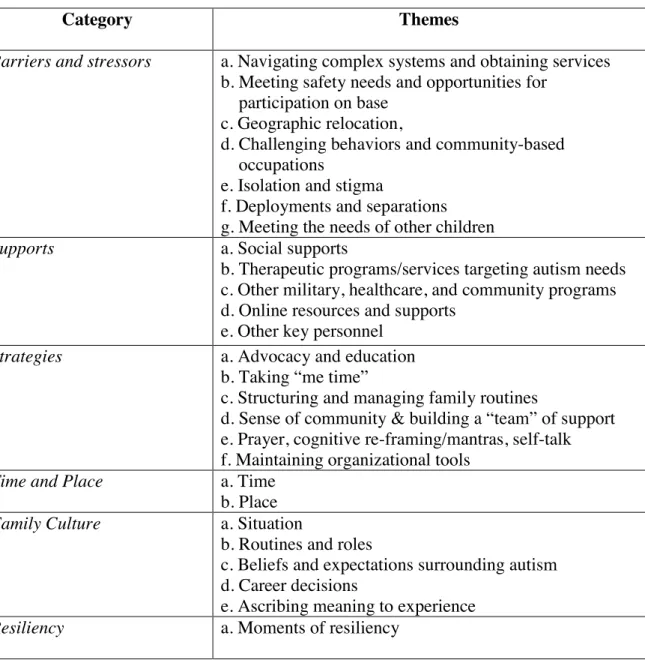
barriers and stressors that families face to then set the stage for a description of the resources and strategies that are enacted. An understanding of these resilience components provides an optimal starting point for understanding the more complex contexts in which these components and their processes are embedded. The content of each theme is described in this chapter, ending with a description of the relational processes within and between resilience components as depicted in the visual model. Table 6.1 Identified Categories and Themes
Category Themes
Barriers and stressors a. Navigating complex systems and obtaining services b. Meeting safety needs and opportunities for
participation on base c. Geographic relocation,
d. Challenging behaviors and community-based occupations
e. Isolation and stigma
f. Deployments and separations g. Meeting the needs of other children
Supports a. Social supports
b. Therapeutic programs/services targeting autism needs c. Other military, healthcare, and community programs d. Online resources and supports
e. Other key personnel Strategies a. Advocacy and education
b. Taking “me time”
c. Structuring and managing family routines
d. Sense of community & building a “team” of support e. Prayer, cognitive re-framing/mantras, self-talk f. Maintaining organizational tools
Time and Place a. Time b. Place Family Culture a. Situation
b. Routines and roles
c. Beliefs and expectations surrounding autism d. Career decisions
50 6.4 Theme Category 1: Barriers and Stressors
Throughout the interviews, caregivers identified the barriers and stressors they encountered while raising a child with autism in the context of a military lifestyle. These barriers and stressors most often fell into one of the following themes: (a) navigating complex systems and obtaining services; (b) meeting safety needs and opportunities for participation on base; (c) geographic relocation; (d) challenging behaviors and
community-based occupations; (e) isolation and stigma; (f) deployments and separations; and (g) meeting the needs of other children.
(a) Caregivers engaged in an ongoing process of navigating complex systems in order to obtain services to meet the needs of their child with autism. These systems were described as disjointed, creating barriers to continuity of services or care across duty stations. Following their child’s diagnosis, caregivers found themselves lost in a complex system in which they had to find their way. This navigation served the purpose of