Application of Distance Learning to Interactive Seminar Instruction in Orthodontic Residency Programs
Eric David Bednar, DDS
A thesis submitted to the faculty of the University of North Carolina in partial fulfillment of the requirements for the degree of Master of Science in the Department of Orthodontics of the School of Dentistry
Chapel Hill 2007
Approved by:
© 2007
ABSTRACT
ERIC DAVID BEDNAR: Application of Distance Learning to Interactive Seminar Instruction in Orthodontic Residency Programs
(Under the direction of Dr. William Proffit, Dr. Wallace Hannum and Dr. James Ackerman)
A series of experiments involving 3 orthodontic departments has shown that distance learning can be acceptable to residents and effective in teaching concepts that are
fundamental to orthodontic practice. The improvement from pre- to post-test scores after observing a sequence of distance seminars was similar to direct instruction. Orthodontic residents rated the educational experiences very positively. Live participation in seminars via video conferencing was preferred to live observation or later observation of a recording, but observation provided similar improvement in test scores. The acceptability of the
ACKNOWLEDGEMENTS
TABLE OF CONTENTS
LIST OF TABLES………..…vi
LIST OF FIGURES………vii
Chapter I. LITERATURE REVIEW……….1
Development and effectiveness of distance education………...2
Application of distance learning and interactive videoconferencing in health care professions ………...………...7
Application of distance learning and interactive videoconferencing in dentistry and orthodontics………14
II MANUSCRIPT………..….17
Methods……….………..19
Results……….………23
Discussion………...……26
LIST OF TABLES
Table
1. Pre-test, post-test and improvement scores for each
school and each sequence of the concept seminars………..…………36 2. Concept seminar evaluation results for the individual concept
seminar evaluations and the seminar sequence evaluations……….…37 3. Concept seminar overall evaluation – responses
to open-ended questions………...38 4. Evaluation results of the dentofacial preconference overall
evaluation and the clinical conferences………39 5. Clinical seminar evaluation results for the individual
LIST OF FIGURES
Figure
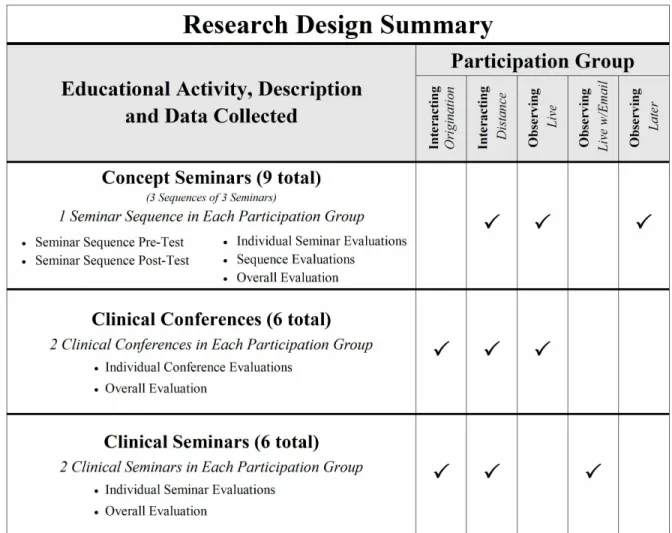
1. Summary of the research design, showing the
different seminar settings and the types of interaction………...…….….31 2. Comparison of mean pre- and post-test scores
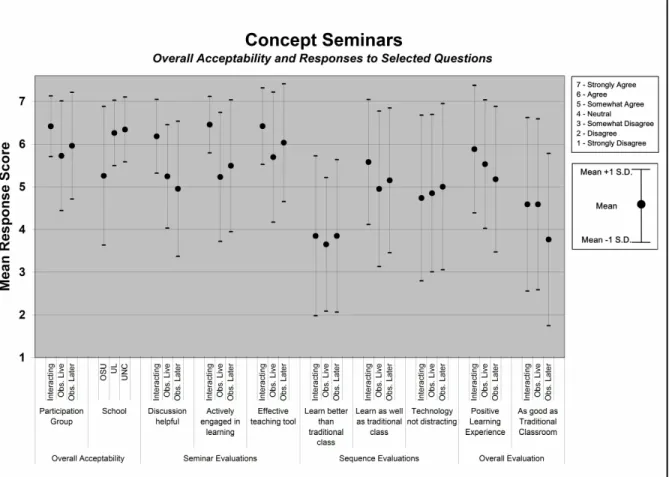
during the concept seminars by participation group and school………..…….32 3. Overall acceptability of concept seminars and
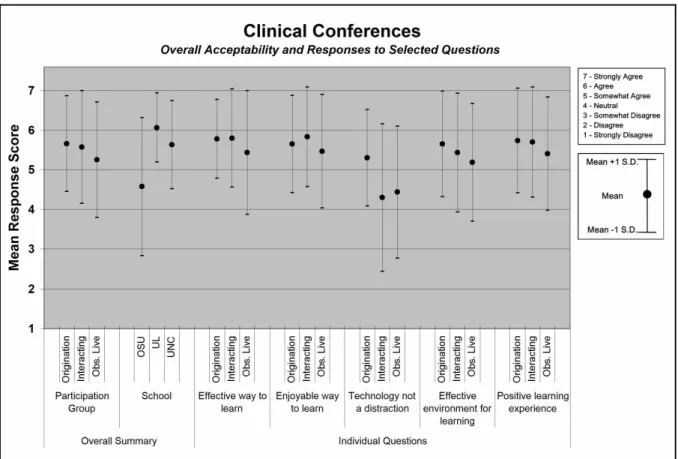
responses to selected questions from different evaluations……….….33 4. Overall acceptability of clinical conferences
and responses to selected questions………..…34 5. Overall acceptability of clinical seminars and
CHAPTER I
LITERATURE REVIEW
With the retiring baby-boomer generation, many fields of education face an impending shortage of faculty members. Although many fields face problems with
recruitment and retention of faculty, this is a serious problem facing dentistry. In 2004-2005 there were 250 funded yet unfilled full-time faculty positions at dental schools across the country, with 19 of which were vacancies in orthodontic programs.1 Many faculty members leave academics due to a lack of salary, departmental support, and control over their work2 and many students forgo careers in academic dentistry and orthodontics citing as major causes the low faculty salaries combined with increased educational debt burden upon graduation.3With a shortage of people entering careers in academics and other faculty members leaving academics due to retirement and other factors there is concern about how decreasing faculty resources can keep up with the demand to train and educate future specialists.
Although technology is not likely to be able to completely eliminate the problems associated with a faculty shortage, new uses of technology may prove helpful in alleviating
1 Chmar JE, Weaver RG, Valachovic RW. Dental School Vacant Budgeted Faculty Positions: Academic Year 2004–05; J Dent Educ. 2006 70: 188-198.
2 Kula K, Glaros A, Larson B, and Tuncay O. Reasons that orthodontic faculty teach and consider leaving teaching; J Dent Educ. 2000 64: 755-762.
some of the problems and providing some potential solutions. Distance education, specifically interactive videoconferencing, is one such technology with the potential to provide students and residents with excellent educational opportunities while simultaneously lessening the burden on faculty members.
Distance education has the possibility of enhancing and improving the educational experience in several ways. It has the potential to increase access to instructors that are not locally available. Using interactive videoconferencing, students can have exposure to and interaction with experts in the field from whom students would otherwise not have the opportunity to learn. When students are able to learn from a more experienced expert in a particular field, the students potentially have a better and more diverse learning experience. In addition the local faculty has a decreased teaching burden in terms of class preparation
Distance education also allows multiple groups to participate from distant locations, providing an opportunity to educate more people with fewer instructors. This has the potential for greater educational cost-effectiveness, with many people in distant locations benefiting from the instruction of a distant instructor.
DEVELOPMENT AND EFFECTIVENESS OF DISTANCE EDUCATION
Distance education has evolved over the years with the development of new technologies.4 Distance education initially started using asynchronous (one-way)
communication. Such distance education methodologies were initially based on the use of print material, television and radio, but progressed to incorporate audiocassettes, videotapes, fax and more recently CD-ROM to disseminate information. All of these methods had the
ability to distribute information to people at a distance, but lacked the ability for interaction. More recently we have seen the development of synchronous (simultaneous, real-time) communication using computers, the internet, audioconferencing and videoconferencing. These new technologies allow real-time interaction and communication between an instructor and students.
Interactive videoconferencing technology allows the creation of a virtual classroom where an instructor and students can interact with each other much as they would while physically together. Videoconference connections allow audio, video and data to be transmitted in real-time, and most closely reproduce at a distance the environment of the traditional classroom environment to which students are accustomed.
The history of videoconferencing actually begins back in the 1920’s when researchers were able to establish the first crude videoconference between Washington, D.C. and New York City. Study and research continued until finally in 1964, AT&T unveiled Picturephone at the World’s Fair in New York. The Picturephone weighed 26 pounds, used a separate signal for audio and video, and had poor resolution on a screen that was 5.25 inches by 4.75 inches. Initial videoconferencing attempts such as the Picturephone were originally intended for personal use, but were too large and cost-prohibitive for the majority of individuals. As videoconferencing technology continued to evolve, it was incorporated first by businesses with significant resources.
More recently, improved technology, widespread use of personal computers and the development of the internet have made it more affordable and easy to use videoconferencing applications for personal use.5 Improved networking capabilities have improved the quality of videoconferences over the internet, but there are still limitations. Interactive
videoconferences over the traditional internet often suffer from poor video resolution, poor audio clarity and a lag due to the slow and limited transmission speeds over the congested internet.
In 1996, Internet2 was founded as a consortium of over 200 universities collaborating with government and industry. Their main mission was to develop advanced network
technology and create a network to be used for research and education. The network they created, called the Abilene Network, began operation in 1999 with capability to transmit 2.5 gigabits per second (Gbps), and was upgraded in 2004 to transmit 10 Gbps. This network now allows information to be transmitted 15,000 times faster than a typical home broadband connection.6
The establishment of Internet2 and the Abilene network has enabled
videoconferencing to overcome many of the limitations that have hindered the use of videoconferencing in the past. This is very important for the use of videoconferencing for distance education. The improvements in computer and videoconferencing technology combined with the creation of the Abilene network open up a variety of new possibilities, including the ability to transmit high quality audio, video and data in real time. Teachers are now able to conduct classes, and students are able to clearly hear and see the instructor and teaching materials all in real time. Now a virtual classroom can be established that is more classroom and less virtual.
While interactive videoconferencing over Internet2 allows a teacher to conduct a class with students at a distance, the obvious question about such distance education is whether it is as good as traditional instruction with the teacher present in the room. Some people feel that studies comparing distance education to traditional classroom instruction are
useful, but note that researchers must do a better job carefully and meticulously documenting all the many similarities and differences between the two methods, including the types of media used. This is the only way that valid comparisons can be made between distance education and traditional classroom instruction. Others feel the comparison between distance education and traditional classroom instruction is not necessary, and that the most important investigations are between different types of distance education methodologies.7
Recently, a meta-analysis was conducted of the research of comparing distance education to traditional classroom instruction.8 They examined the two learning methods to arrive at conclusions about student achievement, attitude and retention. Overall, when comparing distance education and traditional classroom instruction, they found small but significant differences between the two, with distance education producing higher
achievement, and students having better attitudes and retention with traditional classroom instruction. While the meta-analysis ultimately concluded that one method was better in each of these areas, the authors noted the wide variability and differing conclusions for many individual studies. Some studies showed the distance education group outperforming the traditional classroom instruction group by more than 50%, while others found the exact opposite. Due to the many factors and the variability, it is impossible to distinctly conclude that one is better than the other. The authors of this meta-analysis, noting the wide variability between similar studies, concluded that distance education works very well sometimes and
7 Clark RE. Evaluating distance education: Strategies and cautions. Quarterly Review of Distance Education, 2000; 1, 3-16. as quoted in Bernard R, Abrami PL, Lou Y, Borokhovski E. How does distance education compare with classroom instruction? a meta-analysis of the empirical literature. Rev Educ Res. 2004; 74(3):379–439.
very poorly other times, noting that the instructional design, instructional strategies and degree of learner engagement were more important than the media or technology used.
When evaluating the effectiveness of instruction, whether at a distance or face-to-face, it is important to recognize the role of interaction, participation and discussion in the learning process. Many in the educational system use the traditional lecture to deliver content to students. This is particularly true in classes with large numbers of students. This often manifests itself with the instructor teaching a class and the students listening and taking notes with little interaction between the instructor and students. While the traditional lecture format is useful for helping students gain knowledge of basic information and acquainting students with new concepts, discussions and active participation are more helpful in
developing students’ abilities to reason, analyze and problem-solve. Interactive seminars are generally conceded to be the most effective method for education at graduate and post-professional levels where the focus is on evaluating uncertainty and making decisions in spite of incomplete information.9 Johnson et al. concluded that when the purpose of a class is to develop problem-solving skills and abilities, the least efficient discussion is superior to most lectures.10
Graduate residency programs frequently involve small group discussions to develop such thinking abilities, especially in relation to orthodontic problems and solutions. While traditional lectures are more convenient in large group settings, residency programs with smaller numbers are more conducive to the group discussions and the type of interaction that fosters higher levels of learning. Previous experiments have shown that in large classes
(46-9 McKeachie WJ. Teaching Tips: Strategies, Research, and Theory for College and University Teachers. (46-9th ed. Lexington, Mass.: D.C. Heath; 1994.
300 students) the median intellectual activity of students was recall, while in smaller classes (15 or fewer students) the median cognitive level was analysis.11
Because interactive videoconferencing allows for small group interaction, such as is found in orthodontic residency programs with smaller numbers of residents, interactive videoconferencing has the potential to be a valuable component of graduate resident education.
APPLICATION OF DISTANCE LEARNING AND INTERACTIVE VIDEOCONFERENCING IN HEALTH CARE PROFESSIONS
The health care literature contains several examples and uses of interactive
videoconferencing. The literature most frequently describes videoconferencing technology being used in the following ways: 1) providing continuing education and support to
practicing professionals and health care providers, 2) providing direct patient care to patients and 3) educating students and graduate residents.
Videoconferencing technology can be used to provide health-care providers with information that will better educate them in proper care and treatment of patients.12 Although such technology can be beneficial for providers in all geographic locations, distance education and specifically interactive videoconferencing have specific advantages for health care providers in remote or rural areas. Much of the distance learning research in health care literature has been done in geographic areas suffering from a misdistribution of health care providers. Limited contact with other providers makes it more difficult for rural
11 Fischer CG, and Grant GE. “Intellectual Levels in College Classrooms.” In Studies of College Teaching: Experimental Results, Theoretical Interpretations, and New Perspectives, edited by C. L. Ellner and C. P. Barnes. Lexington, Mass.: D.C. Heath.; 1983.
providers to stay current with practices and technologies, hinders professional development and contributes to their professional isolation.
Distance learning has been used to help reduce this professional isolation and aid in the professional development of rural specialists.13 It can also be an important part of an overall tele-education system for rural health-care professionals. A combination of audio, video and computer can be used to help in the education of these rural providers. Audio technologies include things such as phone conferencing, and audio cassettes. Video technologies include video conferencing, and videotapes or video discs. Computer
technologies include email, the internet, and interactive multimedia CDs.14Interactive CDs are able to provide learners with video and presentation slides to providers that are not able to attend professional meetings.15 While all of these methods provide information, ideally the technologies used should maximize interactivity.16 Audioconferencing, videoconferencing, email and the internet all have the capability to encourage interactivity.
Rural health-care providers participating in interactive videoconferences have rated them positively and found them helpful in overcoming the large distances separating
physicians.17 Interactive videoconferencing increases the availability of continuing education for rural providers. It allows providers, who likely would not otherwise participate, to
13 McLean R. Continuing professional development for rural physicians: an oxymoron or just non-existent? Intern Med J. 2006 Oct; 36(10):661-4.
14 Curran VR. Tele-education. J Telemed Telecare. 2006; 12(2):57-63.
15 Kurzydlo AM, Casson C, Shumack S. Reducing professional isolation: Support Scheme for Rural Specialists. Australas J Dermatol. 2005 Nov; 46(4):242-5.
16 Sheppard L, Mackintosh S. Technology in education: what is appropriate for rural and remote allied health professionals? Aust J Rural Health. 1998 Nov; 6(4):189-93.
benefit from participation in such educational programs, while avoiding costs in money and time associated with travel to such educational meetings.18
Interactive videoconferencing has also been evaluated in a variety of health care fields as a means for delivering care directly to patients. In certain fields, health care providers can diagnose, treat and consult patients from a distant location using videoconferencing technology.
The fields of psychiatry and psychology were some of the earliest to implement videoconferencing technology in patient care.19 Psychiatry and psychology can effectively be done with patients at a distance since therapy depends so heavily on discussion and communication between a patient and provider.
Using interactive videoconferencing, providers are able to make accurate psychiatric assessments and diagnoses.20 They are also able to provide effective treatment of many psychological disorders through appropriate therapy.21 Videoconferencing has also be used for psychiatric treatment for incarcerated youth22, psychiatric consultation of patients in a general practice23, psychological consultations to children by state family services
18 Callas PW, Ricci MA, Caputo MP. Improved rural provider access to continuing medical education through interactive videoconferencing. Telemed J E Health. 2000 Winter; 6(4):393-9.
19 McLaren P, Ball CJ, Summerfield AB, Watson JP, Lipsedge M. An evaluation of the use of interactive television in an acute psychiatric service. J Telemed Telecare. 1995; 1(2):79-85.
20 Shore JH, Savin D, Orton H, Beals J, Manson SM. Diagnostic reliability of telepsychiatry in american Indian veterans. Am J Psychiatry. 2007 Jan; 164(1):115-8.
21 Cowain T. Cognitive-behavioural therapy via videoconferencing to a rural area. Aust N Z J Psychiatry. 2001 Feb; 35(1):62-4.
22 Myers K, Valentine J, Morganthaler R, Melzer S. Telepsychiatry with incarcerated youth. J Adolesc Health. 2006 Jun;38(6):643-8.
departments24, psychiatric therapy to patients in rural locations25, psychiatric family therapy and occupational counseling26.
Health care providers in other fields have also used videoconferencing technology to provide direct patient care. Interactive videoconferencing has been used to provide pharmacy services to underserved rural and urban populations with general acceptability by patients.27 It has also been used to allow rural cancer patients to consult periodically with their
oncologists, saving them the costs associated with travel.28 The state of Maine has widespread use and general acceptability by physicians and patients of telemedicine to provide consultation for patients in a variety of fields. Patients use interactive
videoconferencing to get help with problems such as psychiatric issues, diabetes management and other endocrine problems, genetic counseling, dermatologic consultation, and
consultation in specialty pediatrics.29
Other examples of patient care being delivered via videoconferencing include a group tele-exercise program for elderly people30, therapy for patients with traumatic brain
24 Keilman P. Telepsychiatry with child welfare families referred to a family service agency. Telemed J E Health. 2005 Feb; 11(1):98-101.
25 Cowain T. Cognitive-behavioural therapy via videoconferencing to a rural area. Aust N Z J Psychiatry. 2001 Feb; 35(1):62-4.
26 Mielonen ML, Ohinmaa A, Moring J, Isohanni M. The use of videoconferencing for telepsychiatry in Finland. J Telemed Telecare. 1998; 4(3):125-31.
27 Clifton GD, Byer H, Heaton K, Haberman DJ, Gill H. Provision of pharmacy services to underserved populations via remote dispensing and two-way videoconferencing. Am J Health Syst Pharm. 2003 Dec 15; 60(24):2577-82.
28 Allen A, Hayes J. Patient satisfaction with teleoncology: a pilot study. Telemed J. 1995 Spring; 1(1):41-6.
29 Edwards MA, Patel AC. Telemedicine in the state of Maine: a model for growth driven by rural needs. Telemed J E Health. 2003 Spring; 9(1):25-39.
injuries31, asthma health education to inner-city immigrants32, speech-language services to children who stutter33, communication with social workers.34
Videoconferencing technology has also been used to give health care providers access to expert assistance while treating patients. Such technology has allowed surgeons to interact and consult with expert surgeons during surgery35such as craniofacial surgery.36, 37 It has also allowed physicians to share and discuss medical records such as computerized
tomography images38and obtain second opinions from colleagues for difficult cases in fields such as orthopedics39, ophthalmology40, and dermatology.41
Interactive videoconferencing has also been used in the education of students and graduate residents. Many of the early videoconferences were not interactive, but participants 31 Wade SL, Wolfe CR, Pestian JP. A web-based family problem-solving intervention for families of children with traumatic brain injury. Behav Res Methods Instrum Comput. 2004 May;36(2):261-9.
32 Reznik M, Sharif I, Ozuah PO. Use of interactive videoconferencing to deliver asthma education to inner-city immigrants. J Telemed Telecare. 2004; 10(2):118-20.
33 Sicotte C, Lehoux P, Fortier-Blanc J, Leblanc Y. Feasibility and outcome evaluation of a telemedicine application in speech-language pathology. J Telemed Telecare. 2003; 9(5):253-8.
34 McCarty D, Clancy C. Telehealth: implications for social work practice. Soc Work. 2002 Apr; 47(2):153-61.
35 Midiri G, Papaspiropoulos V, Coppola M, Eleuteri E, Tucci G, Conte S, Marino G, Luzzatto L, Angelini L. [Telementoring in surgery] G Chir. 2003 Oct; 24(10):382-4.
36 Ewers R, Schicho K, Wagner A, Undt G, Seemann R, Figl M, Truppe M. Seven years of clinical experience with teleconsultation in craniomaxillofacial surgery. J Oral Maxillofac Surg. 2005 Oct; 63(10):1447-54.
37 Knol A, Damstra RJ, van den Akker TW, de Haan J. [Teledermatological consultation] Ned Tijdschr Geneeskd. 2004 Feb 14; 148(7):314-8.
38 Zatari DI. Design of a centralized telemedicine model in Palestine. J Telemed Telecare. 2002; 8 Suppl 2:96-7.
39 Baruffaldi F, Mattioli P, Toni A, Klutke PJ, Englmeier KH. Low-cost ISDN videoconferencing equipment for orthopaedic second opinions. J Telemed Telecare. 1999;5 Suppl 1:S37-8.
40 Tuulonen A, Ohinmaa T, Alanko HI, Hyytinen P, Juutinen A, Toppinen E. The application of teleophthalmology in examining patients with glaucoma: a pilot study. J Glaucoma. 1999 Dec; 8(6):367-73.
did show significant improvement in test scores, especially when self-study materials were also provided.42
More recently in the health care literature, studies have tried to compare the
effectiveness and acceptability of classes and seminars taught in person and those taught at a distance using interactive videoconferencing. In evaluating the effectiveness and
acceptability, it is not surprising that the studies have come to varying conclusions. In comparing the educational effectiveness of classes conducted in person versus at a distance via interactive videoconferencing, some studies show slightly higher course grades when participating in person43while other studies show no significant differences in quiz scores while at a distance44. When comparing acceptability of these two methods, some studies show that students rate their experience using interactive videoconferencing higher45while others rate their experience higher while participating in the lecture in person46.
Some have also evaluated the acceptability of using interactive videoconferencing for oral examinations of students as opposed to face-to-face contact and found that although students prefer examination in person, student scores are similar.47
42 Rosner E, Gould B, Gaschler L, Howard S, Rarick B. Evaluation of a satellite educational program. Clin Lab Sci.1996 Jan-Feb; 9(1):30-4.
43 Kidd RS, Stamatakis MK. Comparison of students' performance in and satisfaction with a clinical pharmacokinetics course delivered live and by interactive videoconferencing. Am J Pharm Educ. 2006 Feb 15; 70(1):10.
44 Stain SC, Mitchell M, Belue R, Mosley V, Wherry S, Adams CZ, Lomis K, Williams PC. Objective assessment of videoconferenced lectures in a surgical clerkship. Am J Surg. 2005 Jan; 189(1):81-4.
45 Kidd RS, Stamatakis MK. Comparison of students' performance in and satisfaction with a clinical pharmacokinetics course delivered live and by interactive videoconferencing. Am J Pharm Educ. 2006 Feb 15; 70(1):10.
46 Callas PW, Bertsch TF, Caputo MP, Flynn BS, Doheny-Farina S, Ricci MA. Medical student evaluations of lectures attended in person or from rural sites via interactive videoconferencing. Teach Learn Med. 2004 Winter; 16(1):46-50.
Although researchers come to differing conclusions about whether interactive videoconferencing is better or worse than traditional classroom instruction, many studies conclude that even when interactive videoconferencing is rated lower it is usually still acceptable to participants.
Other researchers have described how interactive videoconferencing has enhanced the educational experience for students in various parts of the world. Interactive
videoconferencing has been used to create a virtual interactive classroom in Turkey between a teacher and students at two universities 1,500 miles apart.48 In addition to transmitting images of the instructor, PowerPoint presentation and student, they also conducted a “boardcast” which uses a digital whiteboard and transfers “writing” onto the screen. Seminars were recorded and stored and were available to students at any time.
Interactive videoconferencing allows students access to resources not available at their institution. Some have used interactive videoconferencing to conduct seminars with experts in their field. Such seminars with experts have judged as acceptable by the participants.49 Interactive videoconferencing has also been used to teach cadaver instruction in areas of the world where post-mortems are not available due to cultural reasons50.
Interactive videoconferencing also has had application in live mentoring of hands-on procedures. Videoconferencing and computer-assisted navigation technology have been combined and used to support treatments in craniomaxillofacial surgery, with the researchers
48 Oz HH. Synchronous distance interactive classroom conferencing. Teach Learn Med. 2005 Summer; 17(3):269-73.
49 Cook A, Salle JL, Reid J, Chow KF, Kuan J, Razvi H, Farhat WA, Bagli DJ, Khoury AE. Prospective evaluation of remote, interactive videoconferencing to enhance urology resident education: the genitourinary teleteaching initiative. J Urol. 2005 Nov; 174(5):1958-60.
noting that most transmissions took place without complication and were helpful in successful completion of the procedure.51
APPLICATIONS OF DISTANCE LEARNING AND INTERACTIVE VIDEOCONFERENCING IN DENTISTRY AND ORTHODONTICS
Relatively little has been documented in the dental literature about the use of distance learning in general, and interactive videoconferencing in particular. What little is present in the literature discusses videoconferencing, but not necessarily the interactive
videoconferencing that should be typical in small group classes and discussions.
The literature to this point contains uses of distance education and videoconferencing much as has been used in medicine. The literature contains instances of continuing dental education courses being broadcast to professionals in distant locations via
videoconferencing.52 Often, these sessions contain little or limited interaction restricted to designated question and answer sessions following a one-way presentation or lecture. Continuing education programs via videoconferencing have been helpful for providers who live in remote areas where access to continuing education programs is a problem, especially when the courses do not include a hands-on component.53There are also examples of dentists
51 Ewers R, Schicho K, Wagner A, Undt G, Seemann R, Figl M, Truppe M. Seven years of clinical experience with teleconsultation in craniomaxillofacial surgery. J Oral Maxillofac Surg. 2005 Oct; 63(10):1447-54.
52 Odell EW, Francis CA, Eaton KA, Reynolds PA, Mason RD. A study of videoconferencing for postgraduate continuing education in dentistry in the UK--the teachers' view. Eur J Dent Educ. 2001 Aug; 5(3):113-9.
using videoconferencing and clinical images or radiographs to consult with specialists on certain cases for better diagnosis and treatment planning.54,55
The use of distance learning in dental education has also evolved over time, starting with one-way communication and moving to two-way interaction using videoconferencing. Today, distance learning used in dental education can be divided into two main categories: web-based self-instruction and interactive videoconferencing.56
Some programs have used a combination of computer assisted learning with faculty-led interactive seminars in predoctoral orthodontic education.57 Interactive multimedia can be an effective medium for transmitting information and facilitating learning. Interactive seminars with faculty and instructors allow discussion to take place and can help students solidify concepts and evaluate information at higher levels. Such formats provide adequate instruction and information for students with less time required by the faculty member. In addition, recorded seminars followed by videoconference discussion with instructors could be another potential adjunct to classroom teaching.
To this point, we have found no studies in the health care literature that have studied the use of interactive videoconferencing using Internet2 for small group seminar instruction in graduate resident education. Researchers have documented their experiences establishing videoconferences over Internet2, but have not documented the acceptability or effectiveness
54 Chen RS, Chen SK. Teledentistry using videoconferencing and a DICOM image management system. J Telemed Telecare. 2002; 8(4):244-6.
55 Scuffham PA, Steed M. An economic evaluation of the Highlands and Islands teledentistry project. J Telemed Telecare. 2002; 8(3):165-77.
56 Chen JW, Hobdell MH, Dunn K, Johnson KA, Zhang J. Teledentistry and its use in dental education. J Am Dent Assoc. 2003 Mar; 134(3):342-6.
of learning in this way. Interactive videoconference seminars with faculty could have much benefit, and may very well play an important part of the future of graduate resident
CHAPTER II
MANUSCRIPT
APPLICATION OF DISTANCE LEARNING TO INTERACTIVE SEMINAR INSTRUCTION IN ORTHODONTIC RESIDENCY PROGRAMS
Increasing interest in the application of distance learning is occurring in all areas of education1. This is driven by three main factors: the prospect of (1) improved instruction that incorporates elements unavailable locally, (2) greater educational cost-effectiveness by making resources more widely available, and (3) better utilization of faculty in highly specialized areas. The major technical obstacles to distance learning now have been largely overcome with the availability of high-speed Internet-2 connections among major
universities, and the development of dual-streaming equipment so that images and data can be transmitted simultaneously.2Prior research has demonstrated that distance learning is an effective alternative to traditional classroom instruction.3Measures of learning achievement as well as student satisfaction typically show very small, if any, differences between distance learning and traditional instruction.4Often these measures favor distance learning. Emphasis
1 Allen IE, Seaman J. Making the Grade: Online education in the United States. Needham, MA: The Sloan Consortium. 2006.
2 Engilman WD, Cox TN, Bednar E , Proffit WR. Equipping orthodontic departments for interactive distance learning. Am J Orthod Dentofac Orthop, submitted, in press.
has now shifted from comparing distance learning with traditional instruction to comparisons of different ways or modes of using distance learning. Among others, Clark5,6 has argued that media in itself does not produce learning effects. Hannum7indicated that what matters when learning through technology is the pedagogy, not the technology.
Interactive seminars are generally conceded to be the most effective method for education at graduate and post-professional levels where the focus is on evaluating
uncertainty and making decisions in spite of incomplete information.8Teaching by discussion can be an extremely effective means of helping students apply abstract ideas and think
critically about what they are learning. Johnson et al concluded that when the purpose of a class is to develop problem-solving skills and abilities, the least efficient discussion is superior to most lectures.9 However, fostering effective discussion is difficult, even for experienced faculty, and especially difficult when class size exceeds 20. This has an impact on the type of learning that takes place in a classroom, with smaller class sizes being related to higher levels of learning.10 Through a series of experiments this study evaluated the
acceptability (to both orthodontic residents and faculty) and effectiveness in terms of learning gains of several modes of instruction, using a distant instructor and high-speed Internet links
4 Bernard RM, Abrami PC, Lou Y., Borokhovski E, Wade A, Wozney L, Wallet PA., Fiset M., Huang B. How does distance education compare with classroom instruction? A meta-analysis of the empirical literature. Rev Educ Res. 2004; 3(74), 379-439.
5 Clark, R.E. Media will never influence learning. Educational Technology Research and Development. 1994; 42(2), 21-29.
6 Clark, R.E. Research on web-based instruction: A half-full glass. In Bruning, R., Horn, C., and PytlikZillig, L. (Eds.) Web-based Learning: Where do we Know? Where Do We Go? Greenwich, CT: Information Age Publishers; 2003.
7 Hannum, Wallace. When Computers Teach: A Review of the Instructional Effectiveness of Computers. Educational Technology. 2007.
8 McKeachie, WJ. Teaching Tips: Strategies, Research, and Theory for College and University Teachers. 9th ed. Lexington, Mass.: D.C. Heath; 1994.
9 Johnson DW, Johnson RT, Smith KA. Active Learning: Cooperation in the College Classroom; Interaction Book Co.: Edina, MN. 1991.
to participating resident groups at the University of North Carolina (UNC), Ohio State University (OSU) and the University of Louisville (UL).
Methods
1. Research Design
The experiments involved three types of seminars: (1) concept seminars presenting didactic instruction of basic concepts and clinical application of underlying principles, (2) clinical conferences to evaluate patients and develop treatment plans, and (3) clinical seminars to develop a theme and discuss treatment of a type of problem using case reports. For all three types of seminars, both data and video images of presenters and participants were exchanged via Internet-2 connections, and residents participated and interacted in various ways and degrees with the seminar leader. In addition, internal clinical conferences with a distant part-time faculty member were evaluated. The research design is outlined in Figure 1.
2. Concept Seminars
it occurred without being able to interact. However they were given an opportunity for further discussion with the instructor at the conclusion of the seminar. The third group
watched a recording of the seminar at a later point in time and could discuss it with their own faculty, but did not interact with the other resident groups. The research design allowed each resident group to experience each of the three teaching modes for one of the seminar
sequences to control for any possible student effects. Any possible faculty effects were controlled for by having the same instructor in each condition.
To compare the educational effectiveness of the different instructional approaches, residents took a pre-test before and post-test immediately after each sequence of 3 seminars. To evaluate the acceptability of the seminars and the overall approach, residents completed three types of evaluation forms, one following each individual seminar, another following each seminar sequence of three seminars, and a third overall evaluation after the final seminar was completed. Evaluation forms contained a set of statements that were rated on a 7-point Likert scale. The final overall evaluation contained a similar set of statements evaluated on a Likert scale, and also open-ended questions for residents to answer.
3.Clinical Conferences
Clinical conferences were evaluated in two settings. First, we used the UNC
VPN allowed the faculty member and residents to simultaneously see the same diagnostic records on the faculty member’s office computer and projected in the residents’ seminar room. The UNC residents completed three evaluations: one following the 8 sessions with the faculty physically present, a second following the 8 sessions with the faculty member
participating at a distance, and a third overall evaluation at the conclusion of the 16 sessions. For the overall evaluation, a 7-point Likert scale was used.
Second, the three schools participated in a series of 6 clinical conferences in which residents from each school used dual data and video streaming to present
surgical-orthodontic cases for discussion among the other groups. At each school, residents
participated twice in each of three participation groups: one group was in their seminar room during a case presentation by a classmate, the second group was live and interactive from a distant classroom, and the third group observed the conference and had an opportunity to interact with the other residents following the conference. Residents and faculty completed evaluation forms at the conclusion of each clinical conference, and an overall evaluation followed the last of the 6 clinical conferences. All evaluation forms contained a set of statements that were rated on a 7-point Likert scale, and the final overall evaluation also contained open-ended questions for residents to answer.
4. Clinical Seminars
seminar in a similar fashion as if the question was asked by one of the residents interacting with the instructor. Residents and faculty completed evaluation forms at the conclusion of each clinical conference, and an overall evaluation followed the last of the 6 clinical
conferences. All evaluation forms contained a set of statements that were rated on a 7-point Likert scale, and the final overall evaluation also contained open-ended questions for residents to answer.
5. Statistical procedures
Pre-test and post-test data from the concept seminars were evaluated using a linear model for the post-test score, with the pre-test scores as a baseline evaluation. This model included the main effects of sequence and participation group. The effects of school and students nested within school were modeled by incorporating random effects. These linear models were fit using PROC MIXED with the RANDOM and REPEATED statements in SAS release 9.1.
The interaction effect between the sequence and condition was not statistically significant in the model added to the main effects model (F-statistic= 0.86, DF= (4, 33), and P= .5003). This indicated that the effect of sequence of a seminar on the post-test score was not significantly dependent on the condition.
Results
1, Basic concept seminars
a. Effectiveness. Changes in pre- to post-test scores for residents at each school are
shown in Table 1 and displayed graphically in Figure 2. There was statistically significant increase in test scores for participants in all groups. Note that the greatest improvements for each school occurred while in the interacting group. Overall, when controlling for sequence of participation and participation group there was significantly more improvement in the interacting group than both observing groups (live and later). There was no statistical difference between the groups who observed the seminar live or later, but both were below the interacting group. When comparing the differences by school, UL had the lowest mean pre-test scores, but had the greatest improvement. UNC and OSU had similar improvement, but UNC had higher pre- and post-test scores.
b. Acceptability. Questions and responses from the concept seminar evaluations are
shown in Table 2 and displayed graphically in Figure 3. Overall, there was high acceptability in all three groups. Residents judged interacting to be better than observing, both live and later. It is interesting that observing live was judged slightly less positively than observing a recording later, although this difference was not considerable. UNC and UL rated each of the three participation groups highly positive, over 6 on the 7-point scale. OSU residents
participated in the interactive group first and were equally positive about that, but were less positive about the subsequent observation groups, both live and later.
Responses to the open-ended questions also were quite positive (Table 3), and revealed differences and similarities between residents’ experiences in each of the
interaction; however, they felt that technical difficulties were a limitation of this type of instruction. Residents felt observing live (watching the seminar then having a brief opportunity to interact with the instructor) was positive because it eliminated the stress of having to actively participate during the seminar while still providing the opportunity to ask questions and get clarification at the conclusion of a seminar; however, they also felt the lack of interaction was a limitation of learning in this way. Residents felt observing later
(watching a recorded DVD of the seminar) allowed them to watch and learn at their own convenience and to watch again at a later time; however, the lack of interaction was seen as a limitation of learning in this way. One common response about all three learning methods was that each can provide opportunities they may not otherwise have to learn from experts in the field. While most of the responses were quite positive about the experience, two
participants did state that in the future they would not like to learn using any of the distance education methodologies evaluated.
2. Clinical conferences
a. Audio vs live contact. The evaluation scores for the series of conferences with a
faculty member present at the conference, versus those with the same faculty member distant and in audio and computer contact, are shown in Table 4. For all attributes, the ratings were higher with the faculty member present, and it is clear that the residents preferred this, but the ratings for the faculty member at a distance were positive.
b. Video conferencing: interactive vs observing. Data for the 3-school clinical
observing. The overall score for observing live was lower than for the interacting groups, but only very slightly. Responses to many individual questions reflected this same tendency for the experience in all groups to be rated similarly. Residents at the origination site did feel that technology was less of a distraction than those at interacting and observing at distant sites.
There were noticeable differences among the schools, with OSU ratings substantially lower than the other two. OSU residents rated the experience lower than the other schools when they were the origination site, and considerably lower when they were only observing. At all 3 schools, the faculty (who did not evaluate the basic concept seminars) were even more positive about the conference sessions than the residents.
3. Clinical seminars
Discussion
1. Influences on Outcomes
a. Concept seminars. Overall, the concept seminars were judged by residents to be
very acceptable. Residents found all three instructional approaches effective as a teaching tool. Residents felt that discussion was helpful, and that they were more actively engaged in learning while in the interactive group. They agreed they were able to learn as well as they would have in a traditional classroom, though they did not report that they were able to learn better. Technology was not generally noted to be a distraction, and there were no differences in the technical distractions reported at the three schools.
It is interesting that there appeared to be a relationship between acceptance of the distance learning method and improvement in test scores. The UL residents gave the concept seminars the most favorable rating (whatever their type of interaction), and also showed the most improvement between pre- and post-test scores (Figure 5). It has been noted many times that student performance is affected by whether they have a positive or negative attitude toward the way they are being taught. That is likely to be as true, perhaps even more true, for distance learning.
It is quite possible that having one instructor for the 9 concept seminars, all dealing with clinical application of basic concepts, contributed to the relatively higher ratings for these sessions. While it is quite apparent that the use of videoconferencing equipment will not magically transform a poor teacher into a great teacher, we did find that teaching and learning in this way can be effective as well as acceptable.
observation than those who started without it. Direct interaction always was perceived as better. Perhaps moving up rather than down in quality was perceived as a better experience.
b. Clinical conferences. One possible influence on the clinical conference scores was
resident burnout. The majority of the residents saw participating in the concept seminars and doing the evaluations as positive and beneficial, but toward the end of the experiments a few did not. It appeared that as the series of experimental sessions continued that their novelty wore off and a few residents became more critical. This has been noted before in research on technology-based instruction. The same groups of residents that participated in the 9 concept seminars also participated in the 6 clinical conferences, so their responses for the clinical conferences may have been biased somewhat by their experience in the previous concept seminars. OSU residents were less positive about the experience than residents at the other two schools during the concept seminars. At UNC and UL, the seminars were in the dental school, while OSU residents had to finish early in clinic and walk across campus (several times in bad weather) to the room where their seminars were held. From their comments, this was a negative factor and may have contributed to their lower ratings.
c. Clinical seminars. In contrast to the conferences the clinical seminars could be, and
sometimes were, more like lectures, which probably affected their perception of involvement and participation. Observing a seminar with email interaction may have potential as an acceptable way to learn, although this type of interaction was not rated highly in our study. Such an approach requires a willingness by observers to send questions, but more
importantly requires an instructor that is able to respond to email questions in a timely manner as part of the seminar. Since this was new for most of the faculty members, there was a steep learning curve in incorporating email questions from students who were not visible nor audible to the instructor.
In the ratings of acceptability, a common trend was seen for all three types of
seminars: being live and interactive at a distance was judged almost as good as being face-to-face, while just observing was not. A number of variables could have influenced perceptions of acceptability as well as effectiveness of these experimental seminars. These include the instructor’s personality and teaching style especially as this relates to encouraging interaction with students, the seminar subject, the comfort level in dealing with distance learning
technology, the sequence for interaction vs observation, and possibly other unidentified factors as well.
2. Applications to Future Orthodontic Education
setting. There are two benefits from using distance learning. It can enhance the experience of residents by exposing them to a variety of different thoughts, ideas and other residents and instructors, and it can alleviate problems associated with decreasing numbers of experienced full-time faculty.
For clinical faculty, videoconferencing technology has made it now fairly easy to originate seminars from locations outside of academic institutions. Part-time clinical faculty can conduct interactive seminars from a computer at their private practice, which would mean that their time while physically in the orthodontic department could focus more completely on treating patients there. The result could be more productive use of clinical time by faculty and residents.
A greater need in most orthodontic departments is full-time faculty who can provide continuity and clinical application in basic courses like diagnosis / treatment planning, biomechanics, and growth and development. For this type of instruction, it is particularly interesting that after appropriate preparation, viewing a recorded seminar later is
educationally effective and generally acceptable. It appears that if recorded seminars were combined with live discussion afterward, a useful supplement to existing courses could be developed. We suggest that a possible role for AAO in accomplishing this should be explored in the near future.
Acknowledgements
Figure 4. Overall acceptability of clinical conferences and responses to selected questions. The participants in the clinical conferences previously participated in the concept seminars. Note the overall difference between schools, and the similarity between participation groups for perceived effectiveness and acceptability despite the difference in distraction by
REFERENCES
Allen A, Hayes J. Patient satisfaction with teleoncology: a pilot study. Telemed J. 1995 Spring; 1(1):41-6.
Allen IE, Seaman J. Making the Grade: Online education in the United States. Needham, MA: The Sloan Consortium. 2006.
Allen M, Mabry E, Mattery M, Bourhis J, Titsworth S, Burrell N. Evaluating the Effectiveness of Distance Learning: A Comparison Using Meta-Analysis. Journal of Communications. 2004; 54(3), 402-420.
Baruffaldi F, Mattioli P, Toni A, Klutke PJ, Englmeier KH. Low-cost ISDN
videoconferencing equipment for orthopaedic second opinions. J Telemed Telecare. 1999;5 Suppl 1:S37-8.
Bernard R, Abrami PL, Lou Y, Borokhovski E. How does distance education compare with classroom instruction? a meta-analysis of the empirical literature. Rev Educ Res. 2004; 74(3):379–439.
Bose U, McLaren P, Riley A, Mohammedali A. The use of telepsychiatry in the brief counselling of non-psychotic patients from an inner-London general practice. J Telemed Telecare. 2001; 7 Suppl 1:8-10.
Brebner EM, Brebner JA, Norman JN, Brown PA, Ruddick-Bracken H, Lanphear JH. A pilot study in medical education using interactive television. J Telemed Telecare. 1997; 3 Suppl 1:10-2.
Callas PW, Bertsch TF, Caputo MP, Flynn BS, Doheny-Farina S, Ricci MA. Medical student evaluations of lectures attended in person or from rural sites via interactive
videoconferencing. Teach Learn Med. 2004 Winter; 16(1):46-50.
Callas PW, Ricci MA, Caputo MP. Improved rural provider access to continuing medical education through interactive videoconferencing. Telemed J E Health. 2000 Winter; 6(4):393-9.
Chen JW, Hobdell MH, Dunn K, Johnson KA, Zhang J. Teledentistry and its use in dental education. J Am Dent Assoc. 2003 Mar; 134(3):342-6.
Chen RS, Chen SK. Teledentistry using videoconferencing and a DICOM image management system. J Telemed Telecare. 2002; 8(4):244-6.
Chmar JE, Weaver RG, Valachovic RW. Dental School Vacant Budgeted Faculty Positions: Academic Year 2004–05; J Dent Educ. 2006 70: 188-198.
Clark, R.E. Media will never influence learning. Educational Technology Research and Development. 1994; 42(2), 21-29.
Clark, R.E. Research on web-based instruction: A half-full glass. In Bruning, R., Horn, C., and PytlikZillig, L. (Eds.) Web-based Learning: Where do we Know? Where Do We Go? Greenwich, CT: Information Age Publishers; 2003.
Clifton GD, Byer H, Heaton K, Haberman DJ, Gill H. Provision of pharmacy services to underserved populations via remote dispensing and two-way videoconferencing. Am J Health Syst Pharm. 2003 Dec 15; 60(24):2577-82.
Cook A, Salle JL, Reid J, Chow KF, Kuan J, Razvi H, Farhat WA, Bagli DJ, Khoury AE. Prospective evaluation of remote, interactive videoconferencing to enhance urology resident education: the genitourinary teleteaching initiative. J Urol. 2005 Nov; 174(5):1958-60. Cowain T. Cognitive-behavioural therapy via videoconferencing to a rural area. Aust N Z J Psychiatry. 2001 Feb; 35(1):62-4.
Curran VR. Tele-education. J Telemed Telecare. 2006; 12(2):57-63.
Discenza R, Howard C, Schenk K. The Design and Management of Effective Distance Learning Programs. Hershey [Pa.] Idea Group Publishing, 2002.
Eaton KA, Francis CA, Odell EW, Reynolds PA, Mason RD. Participating dentists' assessment of the pilot regional online videoconferencing in dentistry (PROVIDENT) project. Br Dent J. 2001 Sep 22;191(6):330-5.
Edwards MA, Patel AC. Telemedicine in the state of Maine: a model for growth driven by rural needs. Telemed J E Health. 2003 Spring; 9(1):25-39.
Engilman WD, Cox TN, Bednar E , Proffit WR. Equipping orthodontic departments for interactive distance learning. Am J Orthod Dentofac Orthop, submitted, in press.
Ewers R, Schicho K, Wagner A, Undt G, Seemann R, Figl M, Truppe M. Seven years of clinical experience with teleconsultation in craniomaxillofacial surgery. J Oral Maxillofac Surg. 2005 Oct; 63(10):1447-54.
Fischer CG, and Grant GE. “Intellectual Levels in College Classrooms.” In Studies of College Teaching: Experimental Results, Theoretical Interpretations, and New Perspectives, edited by C. L. Ellner and C. P. Barnes. Lexington, Mass.: D.C. Heath.; 1983.
Hannum, Wallace. When Computers Teach: A Review of the Instructional Effectiveness of Computers. Educational Technology. 2007.
Johnson DW, Johnson RT, Smith KA. Active Learning: Cooperation in the College Classroom; Interaction Book Co.: Edina, MN.; 1991.
Kidd RS, Stamatakis MK. Comparison of students' performance in and satisfaction with a clinical pharmacokinetics course delivered live and by interactive videoconferencing. Am J Pharm Educ. 2006 Feb 15; 70(1):10.
Klein D, Davis P, Hickey L. Videoconferences for rural physicians' continuing health education. J Telemed Telecare. 2005; 11 Suppl 1:97-9.
Knol A, Damstra RJ, van den Akker TW, de Haan J. [Teledermatological consultation] Ned Tijdschr Geneeskd. 2004 Feb 14; 148(7):314-8.
Kula K, Glaros A, Larson B, and Tuncay O. Reasons that orthodontic faculty teach and consider leaving teaching; J Dent Educ. 2000 64: 755-762.
Kurzydlo AM, Casson C, Shumack S. Reducing professional isolation: Support Scheme for Rural Specialists. Australas J Dermatol. 2005 Nov; 46(4):242-5.
Lindauer SJ, Peck SL, Tufekci E, Coffey T, Best AM. The crisis in orthodontic education: goals and perceptions. Am J Orthod Dentofacial Orthop. 2003 Nov; 124(5):480-7.
Mattheos N, Nattestad A, Attstrom R. Feasibility of and satisfaction with the use of low-bandwidth videoconferencing for examination of undergraduate students. J Telemed Telecare. 2003; 9(5):278-81.
McCarty D, Clancy C. Telehealth: implications for social work practice. Soc Work. 2002 Apr; 47(2):153-61.
McKeachie WJ. Teaching Tips: Strategies, Research, and Theory for College and University Teachers. 9th ed. Lexington, Mass.: D.C. Heath; 1994.
McLaren P, Ball CJ, Summerfield AB, Watson JP, Lipsedge M. An evaluation of the use of interactive television in an acute psychiatric service. J Telemed Telecare. 1995; 1(2):79-85. McLean R. Continuing professional development for rural physicians: an oxymoron or just non-existent? Intern Med J. 2006 Oct; 36(10):661-4.
Midiri G, Papaspiropoulos V, Coppola M, Eleuteri E, Tucci G, Conte S, Marino G, Luzzatto L, Angelini L. [Telementoring in surgery] G Chir. 2003 Oct; 24(10):382-4.
Mielonen ML, Ohinmaa A, Moring J, Isohanni M. The use of videoconferencing for telepsychiatry in Finland. J Telemed Telecare. 1998; 4(3):125-31.
Myers K, Valentine J, Morganthaler R, Melzer S. Telepsychiatry with incarcerated youth. J Adolesc Health. 2006 Jun;38(6):643-8.
Oz HH. Synchronous distance interactive classroom conferencing. Teach Learn Med. 2005 Summer; 17(3):269-73.
Phillips CM, Burke WA, Shechter A, Stone D, Balch D, Gustke S. Reliability of dermatology teleconsultations with the use of teleconferencing technology. J Am Acad Dermatol. 1997 Sep; 37(3 Pt 1):398-402.
Proffit WR. Multicenter, Internet based orthodontic education: A research proposal. Am J Orthod Dentofacial Orthop. 2005 Feb;127(2):164-7.
Reznik M, Sharif I, Ozuah PO. Use of interactive videoconferencing to deliver asthma education to inner-city immigrants. J Telemed Telecare. 2004; 10(2):118-20.
Rosner E, Gould B, Gaschler L, Howard S, Rarick B. Evaluation of a satellite educational program. Clin Lab Sci.1996 Jan-Feb; 9(1):30-4.
Scuffham PA, Steed M. An economic evaluation of the Highlands and Islands teledentistry project. J Telemed Telecare. 2002; 8(3):165-77.
Sheppard L, Mackintosh S. Technology in education: what is appropriate for rural and remote allied health professionals? Aust J Rural Health. 1998 Nov; 6(4):189-93.
Shore JH, Savin D, Orton H, Beals J, Manson SM. Diagnostic reliability of telepsychiatry in american Indian veterans. Am J Psychiatry. 2007 Jan; 164(1):115-8.
Sicotte C, Lehoux P, Fortier-Blanc J, Leblanc Y. Feasibility and outcome evaluation of a telemedicine application in speech-language pathology. J Telemed Telecare. 2003; 9(5):253-8.
Stain SC, Mitchell M, Belue R, Mosley V, Wherry S, Adams CZ, Lomis K, Williams PC. Objective assessment of videoconferenced lectures in a surgical clerkship. Am J Surg. 2005 Jan; 189(1):81-4.
Tetterton M, Parham IA, Coogle CL, Cash K, Lawson K, Benghauser K, Owens MG. The development of an educational collaborative to address comprehensive pressure ulcer prevention and treatment. Gerontol Geriatr Educ. 2004; 24(3):53-65.
Tuulonen A, Ohinmaa T, Alanko HI, Hyytinen P, Juutinen A, Toppinen E. The application of teleophthalmology in examining patients with glaucoma: a pilot study. J Glaucoma. 1999 Dec; 8(6):367-73.
Wade SL, Wolfe CR, Pestian JP. A web-based family problem-solving intervention for families of children with traumatic brain injury. Behav Res Methods Instrum Comput. 2004 May;36(2):261-9.
Wu G, Keyes LM. Group tele-exercise for improving balance in elders. Telemed J E Health. 2006 Oct; 12(5):561-70.