Primary Ciliary Dyskinesia: First Health-related Quality-of-Life
Measures for Pediatric Patients
Sharon D. Dell*1,2,3,4, Margaret W. Leigh*5Jane S. Lucas*6,7, Thomas W. Ferkol8, Michael R. Knowles9, Adrianne Alpern10, Laura Behan5,6,11, Anjana M. Morris10, Claire Hogg12, Audrey DunnGalvin11, and Alexandra L. Quittner*10
1
Division of Respiratory Medicine and2Child Health Evaluative Sciences, Hospital for Sick Children, Toronto, Ontario, Canada;3Department of Pediatrics and4Institute of Health Policy, Management and Education, University of Toronto, Toronto, Ontario, Canada;5Department of Pediatrics, University of North Carolina, Chapel Hill, North Carolina;6Primary Ciliary Dyskinesia Centre, University Hospital Southampton, National Health Service Foundation Trust, Southampton, United Kingdom;7Academic Unit of Clinical and Experimental Sciences, Faculty of Medicine, University of Southampton, Southampton, United Kingdom;8Department of Pediatrics, Washington University, St. Louis, Missouri;9Department of Medicine, University of North Carolina, Chapel Hill, North Carolina;10Department of Psychology, University of Miami, Coral Gables, Florida;11Department of Applied Psychology, University College Cork, Cork, Ireland; and12Primary Ciliary Dyskinesia Centre, Department of Paediatrics, Royal Brompton and Harefield Foundation Trust, London, United Kingdom
Abstract
Rationale:Primary ciliary dyskinesia (PCD) is a rare disease. There are no available data on disease-specific pediatric patient–reported outcomes.
Objectives:Our objective was to create developmentally appropriate, health-related quality-of-life questionnaires (QOL-PCD) for children (6–12 yr) and adolescents (13–17 yr) with PCD and a parent proxy measure.
Methods:The QOL-PCD was developed using a cross-cultural protocol-driven approach satisfying both North American and European drug regulatory agency guidelines. A conceptual framework was generated by literature review, focus groups (expert clinicians and patients/parents), and open-ended interviews with children, adolescents, and parents of patients with PCD. We recruited participants from international research consortiums, PCD clinics, and patient advocacy groups, aiming for representation of a wide spectrum of disease severity, sociodemographic status, and ethnicity. Qualitative interviews were conducted by trained and experienced research assistants and psychologists. Transcripts were content-analyzed with Atlas.ti/ NVivo to assess saturation of content. A self-completed item relevance survey was administered to E.U. participants. Qualitative and quantitative data were used to construct draft instruments. Questionnaires were further refined after cognitive interviews.
Measurements and Main Results:Focus groups (n = 62 experts; n = 20 patients/parents) and open-ended interviews with patients/parents (n = 69; 34 males; age at diagnosis, 0–15 yr; FEV1, 58–118% predicted) revealed a wide spectrum of issues unique to this population. Content analysis of transcripts identified the following domains, depending on age: Respiratory Symptoms, Physical Functioning, Emotional Functioning, Treatment Burden, Ears and Hearing, Sinus Symptoms, Social Functioning, Role Functioning, Vitality, Health Perceptions, School Functioning, and Eating and Weight. Various items were retained in questionnaires, based on age and role of respondent: 37, 43, and 41 items for children, adolescents, and parent proxy, respectively. The item relevance survey (n = 57) yielded results similar to those of open-ended interviews. Cognitive testing (n = 47; 20 males; age at diagnosis, 0–11 yr; FEV1, 49–124% predicted) confirmed that items and response choices were clear and understood by respondents, and that all relevant items were included.
Conclusions:The QOL-PCD measures, developed using rigorous, protocol-driven methods and international collaborations, have demonstrated content validity and cross-cultural equivalence for implementation in English-speaking populations. Psychometric testing is underway to determine their measurement properties for evaluating clinical interventions and informing quality of care.
Keywords:primary ciliary dyskinesia; health-related quality of life; patient-reported outcomes; pediatric; parent proxy
(Received in original form March 21, 2016; accepted in final form July 11, 2016 )
*S.D.D., M.W.L., J.S.L., and A.L.Q. contributed equally to this publication.
Supported by grants to M.R.K., S.D.D., T.W.F., and M.W.L.: U54HL096458 from the National Institutes of Health (NIH) through the Genetic Disorders of Mucociliary Clearance Consortium (GDMCC), an initiative of the NIH Office of Rare Diseases Research (ORDR) at the National Center for Advancing Translational Science (NCATS), and the National Heart, Lung, and Blood Institute (NHLBI); A.L.Q. was supported by an investigator-initiated grant, Gilead Sciences; S.D.D. received grant funding from Maya’s March, SickKids Foundation; J.S.L., A.L.Q., and M.W.L. received grant funding from the European Union’s Seventh Framework Program under EC-GA No. 305404 BESTCILIA. The National PCD Centres in Southampton and London are commissioned and funded by NHS England. Research in Southampton is supported by the NIHR Southampton Respiratory Biomedical Research Unit, NIHR Wellcome Trust Clinical Research Facility, and AAIR Charity. Members of the PCD European Group provided expert opinion; J.S.L., M.W.L., C.H., and L.B. are members of the ERS Task Force for PCD Diagnostics (ERS TF-2014-04) and EU-funded COST Action BEAT-PCD (BM1407). Members of the PCD Foundation, North America (Director, Michele Manion) and PCD Support Group, UK (Chair, Fiona Copeland) contributed to all aspects of study conduct.
Prior abstract publication/presentation: Dell S, Leigh M, Ferkol T, Knowles M, Alpern A, Behan L, Hogg C, DunnGalvin A, Lucas JS, Quittner AL. Development of the QOL-PCD: cross-cultural pediatric patient–reported outcome measures for global clinical trials. European Respiratory Society Congress, Munich, September 2014.
Author Contributions: S.D.D., J.S.L., M.W.L., and A.L.Q. guarantee the integrity of the work from inception to the published article. S.D.D., J.S.L., M.W.L., and A.L.Q. conceived and
designed the study. S.D.D., J.S.L., M.W.L., M.R.K., T.W.F., and C.H. recruited patients. A.A., L.B., A.M.M., and A.L.Q. conducted interviews. A.L.Q. and J.S.L. conducted qualitative analyses. J.S.L., M.W.L., L.B., A.D., and A.L.Q. participated in teleconferences to develop and modify prototypes and the final version of QOL-PCD. S.D.D. and A.L.Q. wrote the manuscript. All authors contributed to the study design, interpretation of data, and manuscript writing.
Correspondence and requests for reprints should be addressed to Sharon D. Dell, B.Eng., M.D., Division of Respiratory Medicine, Room 4543, Hospital for Sick Children, 555 University Avenue, Toronto, ON, M5G 1X8 Canada. E-mail: [email protected]
This article has an online supplement, which is accessible from this issue’s table of contents at www.atsjournals.org
Primary ciliary dyskinesia (PCD) is a rare inherited lung disease affecting motile cilia, such that mucociliary clearance is impaired. Individuals with PCD often present with unexplained respiratory symptoms in the
first few days of life, develop persistent sinopulmonary symptoms in infancy, bronchiectasis during childhood, and a progressive decline in lung function over time, which can lead to end-stage lung disease by early to mid-adulthood (1). To date, no medications to treat PCD have been approved by regulatory bodies (2), and a major obstacle to monitoring disease progression and evaluating new treatments is the lack of disease-specific outcome measures (3). Current outcome measures, such as spirometry, chest computed tomography, and lung clearance index all have limitations in terms of their sensitivity and feasibility for evaluating new therapies or disease progression (4–7). Importantly, these physiological measures do not reflect the impact of the disease on patients’daily symptoms or functioning (e.g., physical, respiratory, social) as required by the Food and Drug Administration (FDA) (8) and the European Medicines Agency (EMA) (9, 10).
Thus, measures are needed to assess the impact of PCD, from the patient perspective, on all domains of daily functioning. Health-related quality-of-life (HRQoL) measures are valid, reliable, and informative indices of symptoms and functioning and sensitive to patient concerns (11–14). Both the FDA and EMA support the development and use of disease-specific patient-reported outcome measures for evaluation of new medications and treatments (12). At present there are no validated HRQoL measures available for pediatric patients with PCD.
Developing a new patient-reported outcomes measure requires concept elicitation from patients, using rigorous qualitative methods, to achieve content validity, which is a challenge when patients are geographically disparate with a rare disease. Once a measure with content validity is developed, it can be subjected to psychometric testing to determine its measurement properties (reliability, construct validity, and responsiveness), with item reduction as needed.
Our goal was to develop harmonized (North America and Europe) pediatric PCD-specific HRQoL instruments informed by guidance from the FDA and EMA (8–10),
to be used as primary or secondary outcomes in clinical trials. In addition, because patient-reported outcome measures demonstrate optimal reliability and validity when they are specific to the respondent’s developmental stage (15), we developed three separate
age-appropriate versions of this instrument: children (aged 6–12 yr), adolescents (aged 13–17 yr), and parent proxy (for children aged 6–12 yr). This article reports on the development process and qualitative research results for these three instruments. Some of the results of this research have been previously reported in the form of an abstract (16).
Methods
Conceptual Framework and Study Design
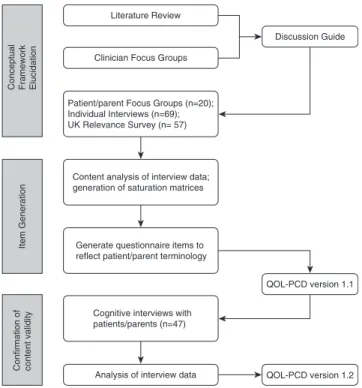
We followed the patient-reported outcomes measure development process outlined by the FDA (8) and EMA (10) to design the study, procedures, and analytic plan (Figure 1). The study was approved by the Research Ethics Board at the Hospital for Sick Children (Toronto, ON, Canada); the Institutional Review Boards at the
University of North Carolina (Chapel Hill, NC), Washington University (St. Louis, MO), and the University of Miami (Miami, FL); and the National Research Ethics Service (London, UK) (UK 07/Q1702/109). Informed consent and assent, as
appropriate, were obtained before interviews.
Literature Review and Clinician Focus Groups
First, a systematic literature review was conducted to identify key symptoms and effects of PCD on patient functioning. MEDLINE and EMBASE were searched and additional references were sought through citations in reviewed studies. Next, expert physicians (e.g., pulmonologists,
otolaryngologists), allied health professionals, and researchers met to discuss their own perceptions of the impact of PCD on pediatric patients at the American Thoracic Society Conference and European Respiratory Society Congress. These literature reviews and discussions led to the development of the conceptual framework, which guided the open-ended interviews subsequently conducted with patients with PCD and parent caregivers.
Conceptual Framework Elucidation
Item Generation
Confirmation of content validity
QOL-PCD version 1.1 Discussion Guide
Patient/parent Focus Groups (n=20); Individual Interviews (n=69); UK Relevance Survey (n= 57)
Content analysis of interview data; generation of saturation matrices
Generate questionnaire items to reflect patient/parent terminology
QOL-PCD version 1.2 Cognitive interviews with
patients/parents (n=47)
Analysis of interview data Clinician Focus Groups
Literature Review
Participants with PCD and Setting English-speaking children with PCD, ages 6–17 years, and parent caregivers, were recruited from the North American (United States and Canada) GDMCC (Genetic Diseases of Mucociliary Clearance Consortium) sites and European (United Kingdom and Ireland) BESTCILIA (Better Experimental Screening and Treatment for Primary Ciliary Dyskinesia) sites during periods of clinical stability. Participants in North America were recruited from a patient conference sponsored by the North American PCD Foundation, and patients with PCD were evaluated at the University of North Carolina, Washington University, and the Hospital for Sick Children.
In Europe, participants were recruited from PCD clinics in the United Kingdom and Ireland and via an announcement circulated through the PCD Family Support Group UK. We used convenience sampling, but aimed to recruit patients of various ethnic backgrounds, socioeconomic status, and disease severity to increase the representativeness of the sample.
To avoid bias associated with diagnostic misclassification, criteria for participation in the open-ended and cognitive interviews included a confirmed diagnosis of PCD through the GDMCC or BESTCILIA specialized PCD research centers. North American participants were diagnosed on the basis of a compatible clinical phenotype plus defect in ciliary ultrastructure and/or identification of biallellic disease-causing mutations in one of the PCD genes (17). UK and Irish participants had a multidisciplinary diagnostic decision based on clinical phenotype, nasal nitric oxide, and reproducible“hallmark”abnormalities of ciliary function assessed by high-speed video analysis and/or assessment of ciliary ultrastructure by electron microscopy (18).
Item Generation: PCD Patient/Parent Focus Groups and Individual
Interviews; UK Relevance Survey We conducted focus groups with children, adolescents, and parents at a PCD Family Day sponsored by the North American PCD Foundation in Buffalo, New York.
Individual, semistructured, open-ended interviews were then conducted in person with children and adolescents with PCD and parent caregivers at multiple sites in North America and Europe to elicit the effects of
PCD from the patient and parent
perspectives. All interviews were conducted in North America by A.L.Q., A.A., and other research assistants, and in the United Kingdom by L.B. All interviewers were psychologists, had extensive training and experience in conducting qualitative interviews, and had no preexisting relationships with the study participants. The framework (interview guide) underpinning the interviews was prospectively and jointly (between North American and European sites) developed after the expert focus groups and literature review.
In addition, a postal survey with a list of potential items generated from the clinician and patient/parent focus groups was circulated by the Family Support Group in the United Kingdom, to rate item relevance and importance by patients. Participants were asked to rate each item on afive-point Likert scale (1, not relevant; 5, highly relevant). Responses were analyzed according to age group, examining means and response distributions for each item for the child, adolescent, and parent samples.
Content Analysis of Patient/Parent Interview Data
All interviews were audiotaped and transcribed for content analysis, using either Atlas.ti in North America (version 7.0; Scientific Software Development, Berlin, Germany) or NVivo in the United Kingdom (version 8.0; QSR International Pty Ltd, Doncaster, Victoria, Australia). Thematic coding was used to identify key symptoms and psychosocial impacts. These data were then analyzed for their frequency of endorsement and level of impact. Saturation matrices were derived to inform item generation and to ensure that data saturation was achieved (i.e., no new themes arose with new interviewees) (19). Frequently endorsed items were written using patient and parent language from the original transcripts. This ensured that the items captured the meaning, language level, and context of their experiences.
Construction of Prototype Questionnaires
Agreement on item selection and wording was achieved during multidisciplinary, multinational conference calls using a modified Delphi approach (20). We discussed the specific quotes and saturation grids from the interviews, and results from
the item relevance survey. Selected items were written using patient language and phrases obtained in the qualitative interviews and were then combined into scales based on our conceptual framework (e.g., frequency and severity of respiratory symptoms, perceptions of treatment burden). Items were written to ensure conceptual, cultural, and linguistic equivalence for North America, Ireland, and the United Kingdom by researchers from both regions. We also adhered to both the FDA and EMA guidances (8–10), and used a short recall period (i.e., 1 wk).
Cognitive Testing of Prototype Questionnaires
Cognitive interviews were conducted using a “think aloud”procedure (21) to evaluate the clarity, interpretation, relevance, and comprehensiveness of the draft instruments. In particular, we asked about the instructions, interpretation of items, and use of the rating scales. We also asked whether any relevant items were missing. First, participants completed the prototype questionnaire independently. Next, they were interviewed either in-person or by phone (older adolescents, parents), using specific cognitive probes. All interviews were audio-recorded and transcribed. The results were discussed during a series of teleconferences to determine whether revisions were required in the formatting, instructions, items, or rating scale options. The measures were refined on the basis of these cognitive interviews andfinalized to form the draft instruments for psychometric validation.
Results
Conceptual Framework Elucidation Items were initially generated from the literature review and focus groups with expert clinicians treating PCD in North American (n = 12) and Europe (n = 40). Clinicians outlined a number of symptoms related to respiratory and upper airway pathophysiology, and problems with chronic otitis media and its sequelae (e.g., difficulty hearing, speech delays). A conceptual framework was then developed representing key quality-of-life domains: physical functioning, emotional
and weight, and body image (seeAppendix E1 in the online supplement).
Three separate focus groups at a North American PCD family day provided information on the effects of PCD from the patient and parent perspectives (n = 9, parents of children under age 12; n = 4 adolescent ages 12 and older; n = 7 parents of adolescents), which facilitated our refinement of the conceptual framework. In addition to symptoms, questions were asked about how PCD impacted physical functioning, energy level, and social and emotional functioning.
Although not as well established as the cysticfibrosis (CF) treatment regimen, a number of treatments are currently prescribed by pulmonologists treating patients with PCD. Therefore, we asked several questions about treatment burden. Social functioning was also affected by embarrassment about coughing, sputum production, and ear drainage. All of these concepts were included in the preliminary conceptual framework underlying the patient/parent open-ended interview guide.
Patient/Parent Individual Interviews and UK Relevance Survey
The North American focus groups were composed of pediatric patients with PCD (n = 9), parents of children under age 12 years (n = 7), and parents of adolescents, ages 12 years and older (n = 4). North American and European Union participants who completed the open-ended interviews included children (n = 20), adolescents (n = 20), and parents (n = 29), representing a wide range of disease severity (FEV1, 58–118% predicted) and ethnic groups (Table 1). Similar numbers of boys and girls participated, but the majority of parent respondents were mothers. As expected, nearly all informants described a chronic cough and sinonasal symptoms. Selected patient quotes from the open-ended interview phase in North America and the European Union are presented in Table 2.
The UK relevance postal survey consisted of a list of 78 potential items for inclusion and was scored for relevance by 24 children, 9 teenagers, and 24 parent-proxies.
Item Generation: Content Analysis of Patient/Parent Interview Data and Relevance Survey
Content analysis of the transcripts yielded key items for each of 12 HRQoL domains,
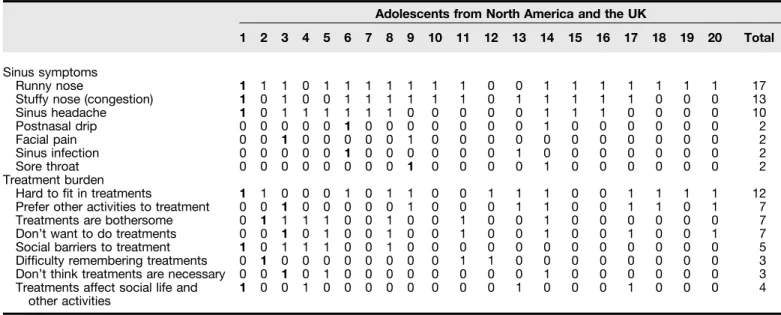
based on the frequency with which they were mentioned across respondents and the severity of their impact. Saturation of content across domains was confirmed when no new themes emerged (seeTable 3 for an example saturation grid for
adolescents). Overall, we achieved saturation of content by the third to twentieth interview, depending on the respondent and specific content area. Results of the relevance survey (Appendices E2–E4) overlapped closely with the issues discussed during open-ended interviews and the frequency distributions identified in the saturation matrices.
Development of Prototype Questionnaire
Thefirst draft measure (QOL-PCD version 1.1) contained the following: (1) child version (9 scales, 43 items), (2) parent proxy version (10 scales, 50 items), and (3) adolescent version (11 scales, 52 items). We subjected all three measures to the Flesch– Kincaid Readability Index with the following results: (1) the child measure for those 6–12 years of age was at the fourth grade level (ages 9–10); to increase the readability and response effort for young children, we developed a pictorial version of the items, presented and“read”to the child by computer (Figure 2); (2) the adolescent version (13–17 yr) had a readability index of sixth grade (6.6), which is about 11 years; and (3) the parent version was at a 6.5 grade reading level.
Cognitive Testing of Prototype Questionnaire
Cognitive interviews were conducted with 14 children, 16 adolescents, and 17 parents (Table 2). Review of these transcripts indicated that all respondents found the items clear and comprehensive, with rating scale options that were easy to use. However, some items were not viewed as relevant or important (e.g.,“you thought you were too thin”; Body Image). These items were removed from each prototype questionnaire, based on patient/parent input after the cognitive testing phase (Table 4). Specifically, six items were removed from the child questionnaire; nine items were removed from the parent proxy questionnaire; and nine items were removed from the adolescent questionnaire.
Because of lack of endorsement, items assessing domains such as body image, eating and weight were removed from the
child and adolescent instruments (e.g.,“I think I look different from others my age,” “I think I am smaller than others my age,” “I have to push myself to eat,”and“Have you had trouble gaining weight?”). Thus, thefinal prototype instruments (QOL-PCD version 1.2) contained the following numbers of items: (1) child version (37 items), (2) parent proxy version (41 items), and (3) adolescent version (43 items) (Table 5).
Discussion
The primary goal of this study was to develop thefirst HRQoL instruments for pediatric patients with PCD and parent caregivers, following guidelines on the development of patient-reported outcome measures established by the FDA and EMA. Using data from both North America and the United Kingdom, we conducted an expert clinician panel, focus groups, and individual open-ended interviews, followed by item generation and cognitive testing. This process yielded separate instruments for school-age children, adolescents, and parents. Similar processes were used to develop an HRQoL measure for adults with PCD (22). These instruments can be used to document the progression of disease, monitor patients clinically, and serve as an outcome measure for clinical trials on the impact of new therapies from the patient perspective. In PCD, this is particularly important given that there are few physiologic end points that can be used for these purposes.
The key principle governing all phases of instrument development was our inclusion of patient and parent input at each phase. To ensure the generalizability and validity of these measures, we developed them cross-culturally in English-speaking countries (Canada, the United States, the United Kingdom, Ireland) and found few differences in critical item content across countries, despite using slightly different methodology for questionnaire
Table 1. Characteristics of patients with primary ciliary dyskinesia participating in open-ended interviews and cognitive testing Open-En ded Interviews Cogni tiv e Interviews Chi ld Parent Proxy Ado lescen t Child Parent Proxy Ado lescent UK /I ( n = 4 ) North
America (n
= 16 ) UK /I ( n = 6 ) ( 9 childre n ) North Am erica ( n = 23 ) ( 20 childre n )
UK/I (n=
4
)
North
America (n
= 16 ) UK/I ( n = 10 ) Nor th
America (n
= 4 ) UK /I ( n = 10 ) Nor th Am erica ( n = 7 ) ( 6 children ) UK /I ( n = 8 ) Nor th
America (n
conditions, such as CF and bronchiectasis (23, 24).
Open-ended and cognitive interviews highlighted the importance of the impact of respiratory and sinus symptoms on patients’ daily functioning. These symptoms were similar to those reported by patients with
CF and bronchiectasis (12, 25) and included chronic cough, mucus production, trouble breathing, and sinus headaches. However, several items that appear on the
final QOL-PCD measures reflect symptoms and functioning that are unique to PCD, such as runny nose, congestion in the nose,
chronic otitis media, difficulty hearing, speech delays, and in some cases, a need for special accommodations in the classroom. These distinct symptoms are attributable to the abnormal functioning of the cilia, which disrupts normal mucus clearance from the lungs, nose, sinuses, and middle ear (1). In contrast, CF is characterized by predominantly lower respiratory tract and gastrointestinal symptoms, and ear disease is not a feature of CF.
Furthermore, unlike individuals with CF, patients with PCD did not endorse symptoms related to body image, gastrointestinal discomfort, or eating and weight problems. Patients with PCD are pancreatic sufficient, and although their appetite may decrease when they are ill (i.e., during a pulmonary exacerbation), they do not have the primary nutritional and growth issues associated with CF. Hence, thisfinding provides additional support for the content validity of our measures.
Importantly, this study demonstrated differences in HRQoL based on respondent age. Younger children did not mention more abstract concepts, such as health perceptions, vitality, and role functioning, which is typical across disease-specific patient-reported outcomes (22). In contrast, adolescents reported that PCD affected their energy levels and functioning at school. Thesefindings underscore the
Table 3. Saturation grids from open-ended interviews for North American and UK adolescents with primary ciliary dyskinesia: sinus
symptoms and treatment burden
Adolescents from North America and the UK
1 2 3 4 5 6 7 8 9 10 11 12 13 14 15 16 17 18 19 20 Total
Sinus symptoms
Runny nose 1 1 1 0 1 1 1 1 1 1 1 0 0 1 1 1 1 1 1 1 17
Stuffy nose (congestion) 1 0 1 0 0 1 1 1 1 1 1 0 1 1 1 1 1 0 0 0 13
Sinus headache 1 0 1 1 1 1 1 1 0 0 0 0 0 1 1 1 0 0 0 0 10
Postnasal drip 0 0 0 0 0 1 0 0 0 0 0 0 0 1 0 0 0 0 0 0 2
Facial pain 0 0 1 0 0 0 0 0 1 0 0 0 0 0 0 0 0 0 0 0 2
Sinus infection 0 0 0 0 0 1 0 0 0 0 0 0 1 0 0 0 0 0 0 0 2
Sore throat 0 0 0 0 0 0 0 0 1 0 0 0 0 1 0 0 0 0 0 0 2
Treatment burden
Hard tofit in treatments 1 1 0 0 0 1 0 1 1 0 0 1 1 1 0 0 1 1 1 1 12
Prefer other activities to treatment 0 0 1 0 0 0 0 0 1 0 0 0 1 1 0 0 1 1 0 1 7
Treatments are bothersome 0 1 1 1 1 0 0 1 0 0 1 0 0 1 0 0 0 0 0 0 7
Don’t want to do treatments 0 0 1 0 1 0 0 1 0 0 1 0 0 1 0 0 1 0 0 1 7
Social barriers to treatment 1 0 1 1 1 0 0 1 0 0 0 0 0 0 0 0 0 0 0 0 5
Difficulty remembering treatments 0 1 0 0 0 0 0 0 0 0 1 1 0 0 0 0 0 0 0 0 3
Don’t think treatments are necessary 0 0 1 0 1 0 0 0 0 0 0 0 0 1 0 0 0 0 0 0 3
Treatments affect social life and other activities
1 0 0 1 0 0 0 0 0 0 0 0 1 0 0 0 1 0 0 0 4
Note: Participant endorsement of row item indicated by “1.” Boldface “1” indicates first endorsement of item by any participant. Saturation was reached by
the end of the ninth interview for sinus symptoms and by the end of the third interview for treatment burden.
You had to stop having fun to do your treatments
Always
Often
Sometimes
Never
Play Again
Question 11 of 37 QUESTIONNAIRE
QOL-PCD
And in the past week, click how often:
Table
4.
Cognitive
testing
results
for
quality
of
life-primary
ciliary
dyskinesia
questionnaires:
fi
nal
items
and
scales
Child
Adolescent
Parent
Proxy
Scales
Items
Scales
Items
Scales
Items
Version
1.1
9
4
3
1
1
5
2
1
0
5
0
Version
1.2*
7
3
7
9
43
9
4
1
Deleted
items
Vitality
You
had
trouble
falling
asleep.
Emotional
Functioning
You
felt
frustrated
about
having
PCD.
Physical
Functioning
Carrying
or
lifting
heavy
objections
such
as
books,
a
school
bag,
or
backpack.
Eating
and
Weight
You
had
trouble
eating.
Ears
and
Hearing
You
felt
pressure
in
your
ears.
Emotional
Functioning
Seemed
short-tempered.
Body
Image
d
You
thought
you
were
too
short.
Respiratory
Symptoms
You
had
tightness
in
your
chest.
Ears
and
Hearing
My
child
had
pressure
in
his/her
ears.
d
You
thought
you
were
too
thin.
Social
Functioning
I
feel
lonely.
Respiratory Symptoms
My
child
had
chest
tightness.
d
You
thought
you
looked
different
from
others
your
age.
d
How
do
you
feel
about
eating?
Sinus
Symptoms
My
child
woke
up
during
the
night
because
his/
her
nose
was
blocked
up.
Eating
and
Weight
d
I
have
to
push
myself
to
eat.
Social
Functioning
My
child
tends
to
be
withdrawn.
d
You
had
a
poor
appetite.
Eating
and
Weight
My
child
has
less
fun
than
usual.
d
Have
you
had
trouble
gaining
weight?
Body
Image
My
child
has
trouble
concentrating.
Body
Image
d
I
think
I
look
different
from
others
my
age.
My
child
has
had
trouble
gaining
weight.
d
I
feel
bad
about
my
physical
appearance.
My
child
feels
small
compared
to
other
kids
the
same
age.
d
I
think
I
a
m
smaller
than
others
my
age.
My
child
feels
physically
different
from
other
kids
the
same
age.
My
child
thinks
that
he/
she
is
too
thin.
Deleted
scales
d
Eating
and
Weight
d
Eating
and
Weight
d
Body
Image
d
Body
Image
d
Body
Image
Defini
tion
of
abb
reviation
:
PCD
=
prima
ry
ciliary
dys
kinesia.
*Versi
on
1.2
developed
after
cogniti
ve
testing
of
versi
on
1.1
and
n
o
w
being
importance of using developmentally appropriate HRQoL instruments that reflect the respondent’s cognitive and developmental stage, and that will optimize sensitivity and specificity (15, 23, 26). It is also advantageous to have both child and parent proxy versions of these measures for younger children to facilitate comparisons between parent–child dyads, and to identify a fuller picture of the effects of PCD on daily functioning, allowing us to evaluate children’s HRQoL from the earliest possible age (26).
Strengths and Limitations
A strength of this study was our success in recruiting a large and geographically disparate sample of patients with this rare disease from North America and Europe. These samples represented different ethnic groups, including Pakistani and Irish travelers (a European minority group). However, because participants were required to understand and speak English, we likely oversampled white participants. Although we did not have African Americans in our samples, to date, PCD has been described in only a few patients from this race (17).
A limitation of our study is that we used convenience sampling methods, but importantly, we used a wide range of recruiting strategies, including advertisements in patient advocacy newsletters, national PCD education days, and patients seen in clinic settings. This enabled us to include a sociodemographically diverse patient population. In the next phase of instrument development, national psychometric testing, we will systematically evaluate the
generalizability of these instruments.
Summary
QOL-PCD measures have now been developed using the most recent guidance from the FDA and EMA, and have undergone cognitive testing in pediatric patients from several English-speaking countries. Despite the rarity of this disease, we used two key collaborative projects (GDMCC [National Institutes of Health, Bethesda, MD] and European Union BESTCILIA) to recruit a substantial number of patients with a confirmed diagnosis of PCD.
These instruments have already been translated into Dutch, German, Danish, French, and Greek with plans to develop additional translations for other North
American populations (Latin American Spanish) and major countries in Europe and the Middle East. A multinational, psychometricfield study is underway to assess item and scale reliability, convergent
and divergent validity, and responsiveness. These questionnaires are expected to be useful as end points in clinical trials, for monitoring health outcomes in prognostic studies, for generating quality improvement
initiatives, and for improving clinical decision-making.n
Author disclosuresare available with the text of this article at www.atsjournals.org.
References
1 Knowles MR, Daniels LA, Davis SD, Zariwala MA, Leigh MW. Primary ciliary dyskinesia: recent advances in diagnostics, genetics, and characterization of clinical disease.Am J Respir Crit Care Med2013; 188:913–922.
2 Shapiro AJ, Zariwala MA, Ferkol T, Davis SD, Sagel SD, Dell SD, Rosenfeld M, Olivier KN, Milla C, Daniel SJ,et al.; Genetic Disorders of Mucociliary Clearance Consortium. Diagnosis, monitoring, and treatment of primary ciliary dyskinesia: PCD foundation consensus recommendations based on state of the art review.Pediatr Pulmonol
2016;51:115–132.
3 Quittner AL, Modi A, Cruz I. Systematic review of health-related quality of life measures for children with respiratory conditions.Paediatr Respir Rev2008;9:220–232.
4 Maglione M, Bush A, Montella S, Mollica C, Manna A, Esposito A, Santamaria F. Progression of lung disease in primary ciliary dyskinesia: is spirometry less accurate than CT?Pediatr Pulmonol
2012;47:498–504.
5 Green K, Buchvald FF, Marthin JK, Hanel B, Gustafsson PM, Nielsen KG. Ventilation inhomogeneity in children with primary ciliary dyskinesia.Thorax2012;67:49–53.
6 Irving SJ, Ives A, Davies G, Donovan J, Edey AJ, Gill SS, Nair A, Saunders C, Wijesekera NT, Alton EW,et al. Lung clearance index and high-resolution computed tomography scores in primary ciliary dyskinesia.Am J Respir Crit Care Med2013;188:545–549. 7 Boon M, Vermeulen FL, Gysemans W, Proesmans M, Jorissen M, De
Boeck K. Lung structure–function correlation in patients with primary ciliary dyskinesia.Thorax2015;70:339–345.
8 U.S. Department of Health and Human Services; Food and Drug Administration. Guidance for industry: patient-reported outcome measures: use in medical product development to support labeling claims. 2009 Dec [updated 2009 Dec; accessed 2015 September 24]. Available from: http://www.fda.gov/downloads/Drugs/ Guidances/UCM193282.pdf
9 Apolone G, De Carli G, Brunetti M, Garattini S. Health-related quality of life (HR-QOL) and regulatory issues: an assessment of the European Agency for the Evaluation of Medicinal Products (EMEA)
recommendations on the use of HR-QOL measures in drug approval.
Pharmacoeconomics2001;19:187–195.
10 European Medicines Agency; Committee for Medicinal Products for Human Use (CMHP). Reflection paper on the regulatory guidance for the use of health related quality of life (HRQL) measures in the evaluation of medicinal products. 2005 [accessed 2015 August 4]. Available from: http://www.ema.europa.eu/ema/index.jsp? curl=pages/regulation/general/general_content_001238. jsp&mid=WC0b01ac0580032ec4
11 Willke RJ, Burke LB, Erickson P. Measuring treatment impact: a review of patient-reported outcomes and other efficacy endpoints in approved product labels.Control Clin Trials2004;25:535–552. 12 Quittner AL, Buu A, Messer MA, Modi AC, Watrous M. Development
and validation of the Cystic Fibrosis Questionnaire in the United
States: a health-related quality-of-life measure for cysticfibrosis.
Chest2005;128:2347–2354.
13 Goss CH, Quittner AL. Patient-reported outcomes in cysticfibrosis.
Proc Am Thorac Soc2007;4:378–386.
14 McCoy KS, Quittner AL, Oermann CM, Gibson RL, Retsch-Bogart GZ, Montgomery AB. Inhaled aztreonam lysine for chronic airway
Pseudomonas aeruginosain cysticfibrosis.Am J Respir Crit Care Med2008;178:921–928.
15 Landgraff J, Abetz L. Measuring health outcomes in pediatric populations: issues in psychometrics and application. In: Spilker B, editor. Quality of life and pharmacoeconomics in clinical trials. Philadelphia: Lippincott-Raven; 1996. pp. 793–802.
16 Dell S, Leigh M, Ferkol T, Knowles M, Alpern A, Behan L, Hogg C, DunnGalvin A, Lucas JS, Quittner AL. Development of pediatric cross-cultural patient-reported outcome measures: QOL-PCD [abstract]. Presented at the European Respiratory Society Annual Congress, September 2014, 44.
17 Davis SD, Ferkol TW, Rosenfeld M, Lee HS, Dell SD, Sagel SD, Milla C, Zariwala MA, Pittman JE, Shapiro AJ,et al. Clinical features of childhood primary ciliary dyskinesia by genotype and ultrastructural phenotype.Am J Respir Crit Care Med2015;191:316–324. 18 Barbato A, Frischer T, Kuehni CE, Snijders D, Azevedo I, Baktai G,
Bartoloni L, Eber E, Escribano A, Haarman E,et al. Primary ciliary dyskinesia: a consensus statement on diagnostic and treatment approaches in children.Eur Respir J2009;34:1264–1276.
19 O’Reilly M, Parker N.“Unsatisfactory saturation”: a critical exploration of the notion of saturated sample sizes in qualitative research.Qual Res2013;13:190–197.
20 Jones J, Hunter D. Consensus methods for medical and health services research.BMJ1995;311:376–380.
21 Beatty PC, Willis GB. Research synthesis: the practice of cognitive interviewing.Public Opin Q2007;71:287–311.
22 Lucas JS, Behan L, Dunn Galvin A, Alpern A, Morris AM, Carroll MP, Knowles MR, Leigh MW, Quittner AL. A quality-of-life measure for adults with primary ciliary dyskinesia: QOL-PCD.Eur Respir J2015; 46:375–383.
23 Quittner AL, Sawicki GS, McMullen A, Rasouliyan L, Pasta DJ, Yegin A, Konstan MW. Psychometric evaluation of the Cystic Fibrosis Questionnaire-Revised in a national sample.Qual Life Res2012;21: 1267–1278.
24 Quittner AL, O’Donnell AE, Salathe MA, Lewis SA, Li X, Montgomery AB, O’Riordan TG, Barker AF. Quality of Life Questionnaire-Bronchiectasis:final psychometric analyses and determination of minimal important difference scores.Thorax2015;70:12–20. 25 Quittner AL, Marciel KK, Salathe MA, O’Donnell AE, Gotfried MH,
Ilowite JS, Metersky ML, Flume PA, Lewis SA, McKevitt M,et al. A preliminary Quality of Life Questionnaire-Bronchiectasis: a patient-reported outcome measure for bronchiectasis.Chest2014;146: 437–448.