Revealing the role of the product metal in DNA
polymerase

catalysis
Lalith Perera
1,*, Bret D. Freudenthal
1,2, William A. Beard
1, Lee G. Pedersen
1,3and Samuel
H. Wilson
11Genome Integrity and Structural Biology Laboratory, National Institute of Environmental Health Sciences, National
Institutes of Health, P.O. Box 12233, Research Triangle Park, NC 27709-2233, USA,2Department of Biochemistry and Molecular Biology, The University of Kansas Medical Center, 3901 Rainbow Boulevard, 1080 HLSIC, Mailstop 3030, Kansas City, KS 66160-7421, USA and3Department of Chemistry, University of North Carolina at Chapel Hill, P.O. Box 3290, Chapel Hill, NC 27517, USA
Received November 29, 2016; Revised December 22, 2016; Editorial Decision December 26, 2016; Accepted December 28, 2016
ABSTRACT
DNA polymerases catalyze a metal-dependent nu-cleotidyl transferase reaction during extension of a DNA strand using the complementary strand as a template. The reaction has long been considered to require two magnesium ions. Recently, a third ac-tive site magnesium ion was identified in some DNA polymerase product crystallographic structures, but its role is not known. Using quantum mechanical/ molecular mechanical calculations of polymerase, we find that a third magnesium ion positioned near the newly identified product metal site does not al-ter the activation barrier for the chemical reaction indicating that it does not have a role in the for-ward reaction. This is consistent with time-lapse crystallographic structures following insertion ofSp
-dCTP␣S. Although sulfur substitution deters product metal binding, this has only a minimal effect on the rate of the forward reaction. Surprisingly, monovalent sodium or ammonium ions, positioned in the prod-uct metal site, lowered the activation barrier. These calculations highlight the impact that an active site water network can have on the energetics of the for-ward reaction and how metals or enzyme side chains may interact with the network to modulate the reac-tion barrier. These results also are discussed in the context of earlier findings indicating that magnesium at the product metal position blocks the reverse py-rophosphorolysis reaction.
INTRODUCTION
The multiple isoforms of DNA polymerase (pol) found in nature are categorized among several families (1), but
are believed to utilize a common two-metal ion mediated nucleotidyl transferase reaction to insert or remove nu-cleotides at the 3-end of a DNA strand (2). These reac-tions are template base directed, but occur with varying ef-ficiencies depending on the specialized biological function of each DNA polymerase (3). The replicative DNA poly-merases, for example, exhibit rapid nucleotide insertion for correct incoming nucleotides, whereas repair and transle-sion bypass DNA polymerases are significantly slower. This range in insertion rates for DNA synthesis among DNA polymerases presumably reflects differences in the respec-tive interactions with substrates, cofactors and products. Another important factor is the microscopic equilibrium between the forward and reverse reactions of nucleotidyl transfer, since the observed DNA synthesis rate reflects both the forward and reverse reactions around the transi-tion state as well as enzyme strategies (i.e. conformatransi-tional changes) to facilitate the forward reaction.
The reaction path of the nucleotidyl transfer reaction by polwas characterized in previous work (4,5). A bimetal-lic reaction scaffold was identified in the active site involving two closely positioned magnesium ions. One of these metals, the catalytic metal (Me(c)) or metal A, lowers the pKaof the primer terminus O3while the other metal, the nucleotide-binding metal (Me(n)) or metal B, facilitates incoming nu-cleoside 5-triphosphate binding (5). In the beginning of the reaction path, deprotonation of O3occurs with a low en-ergy cost of∼3 kcal/mol (6). Since this proton transfer step leads to a local energy minimum within the reaction path, the overall reaction proceeds through a two-phase pathway where the O3proton transfer precedes the second phase of chemistry. The activation barrier for the overall reaction is ∼18 kcal/mol, and the experimentally measured rate con-stant that is in the range of 1–10 s−1corresponds to an acti-vation barrier of∼16–17 kcal/mol (6). Both experimentally and computationally, Asp256 functions as the Lewis base in the proton transfer from O3(7). Once the proton moves
*To whom correspondence should be addressed. Tel: +1 919 541 2635; Fax: +1 919 541 0779; Email: [email protected]
Published by Oxford University Press on behalf of Nucleic Acids Research 2017.
from O3to Asp256, chemistry occurs through an in-line at-tack by the newly formed primer O3oxyanion on P␣of the incoming nucleotide involving a penta-coordinated transi-tion state. This transitransi-tion state is unstable, and the reactransi-tion proceeds to completion with formation of the new O3–P␣ bond and breaking of the substrate P␣–O␣bond, generat-ing pyrophosphate (PPi) and the DNA strand extended by
one deoxyribonucleotide monophosphate (dNMP) residue. Recently, time-lapse crystallography studies of the Y-family pol (8) and X-family pol  (9) have identified a transient product-associated magnesium ion in the active site (Figure 1B). This product metal (Me(p)) was not ob-served at the beginning of the reaction and dissociated from the enzyme prior to product dissociation. Importantly, the observed product metal coordinates oxygens of the reaction products, the inserted dNMP and PPi. Accordingly, there is
a renewed interest in roles of divalent metal ions in the DNA polymerase nucleotidyl transfer reaction, since the reaction has long been thought to be mediated by two closely spaced magnesium ions (2) (Figure 1A). The product-associated metal has been proposed to play an essential chemical role for the forward reaction in pol (8,10). In contrast, com-putational analyses suggested that the role of this product metal in polis to deter the reverse pyrophosphorolysis re-action, thereby driving the net reaction forward (11). Since these prior computational studies (6,7,12) did not consider the influence of this metal ion on the forward reaction, the first part of the present study evaluates the possibility of a direct catalytic role of the product-associated metal in the polforward reaction.
MATERIALS AND METHODS
Computational procedure for QM/MM calculations
Initial structures for theoretical calculations were prepared using a high-resolution crystallographic structure of the ternary reaction complex (PDB ID: 4KLE) where both cat-alytic and nucleotide (dCTP) binding metal sites are oc-cupied by magnesium ions (13). This structure was ob-tained by first crystallizing the ternary substrate complex with Ca2+which does not support catalysis and then flash
freezing the system after immersing the crystal in a solu-tion containing Mg2+ions for 10 s. Since the reaction was
allowed to proceed for only a short time, 70% of the sys-tem remains in a reactive substrate state and the rest is con-verted to product with PPi occupying the positions
occu-pied by the corresponding atoms in dCTP. Using the prod-uct metal position from the crystal strprod-ucture after 40 s of re-action (PDB ID: 4KLE), the product metal was introduced into the initial configuration of the system. Molecular dy-namics (MD) simulations were carried out in a completely solvated aqueous medium after hydrogens and neutralizing sodium ions were added. Positions of all crystallographic water molecules were preserved initially. The total charge on dCTP was taken to be−3 with only one oxygen on the
␥-phosphate protonated and this choice was due to the fact that the pKa value of H(dTTP)3− in solution is 6.52 (14).
All MD trajectory calculations were carried out with the Amber12SB force-field using the PMEMD module of Am-ber.12 (15). Water molecules were represented by the TIP3P
B Product State
A Reactant StateC MD Reactant State
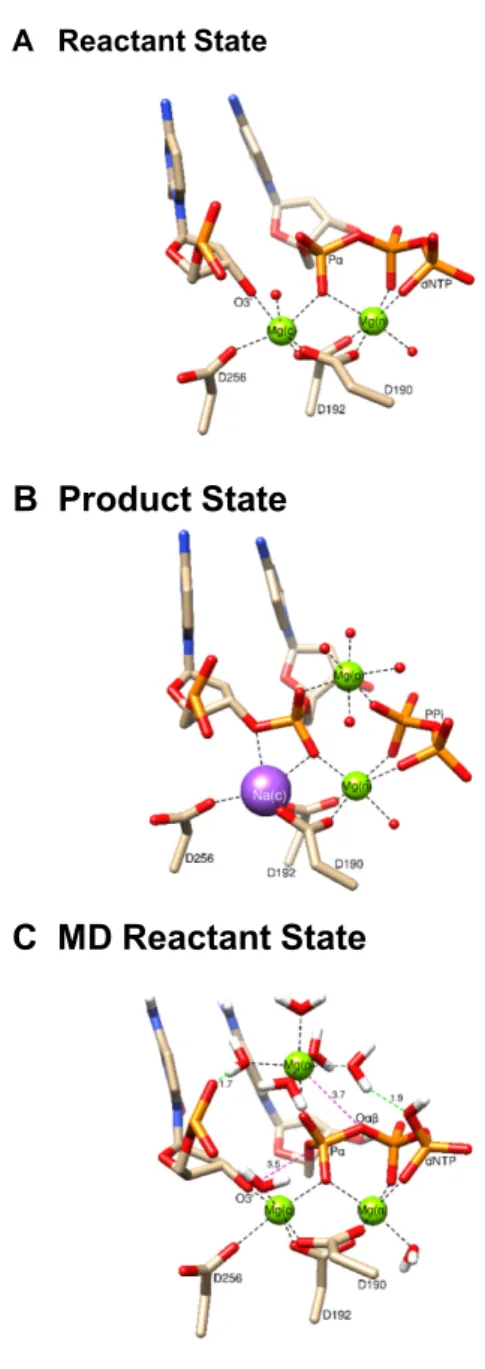
Figure 1.Active site structure of the ternary complexes of pol. (A) Re-actant state from crystallographic structure (PDB ID: 4KLE) having mag-nesium ions in the catalytic and nucleotide binding sites; (B) product state from crystallographic structure (PDB ID: 4KLG) having magnesium ions in the nucleotide and product metal sites and a sodium ion in the catalytic metal site; (C) reactant state from the final point of a lengthy well equili-brated MD trajectory calculation based on the structure in panel (A) where the product metal ion was initially introduced to the system based on the location of this metal in a crystallographic product structure (PDB ID: 4KLG). Important distances ( ˚A) are indicated (red dashed lines) as are metal coordination (black dashed lines). Two water molecules solvating the product metal make hydrogen bonds with phosphate oxygens of the primer terminal nucleotide and P␥of the incoming dCTP (green dashed lines).
model (16). Long range interactions were treated with the particle mesh Ewald method (17). The ground metal ion (i.e. Mg2+ introduced at the potential product metal site
con-stant volume/concon-stant temperature (T =300 K) equilib-rium simulation with the sequentially decreasing harmonic constraint force constants (from 50 to 0.1 kcal/mol/nm) ap-plied to the protein, DNA and metal ions in the crystallo-graphic structure ensures that the system coordinates repre-sent a pre-catalytic state. Prior to QM/MM calculations, we optimized several configurations selected from MD simula-tions and used the lowest energy system as the starting con-figuration for the reaction path calculation; other configura-tions are within 3 kcal/mol to this lowest energy conforma-tion. A two metal system originated from this system where the ground metal and a distal water molecule exchange their positions and the geometry re-optimized.
The QM/MM systems were prepared from the final opti-mized structures of the above systems. The quantum region included parts of Asp190, Asp192 and Asp256, the primer terminal nucleotide including the 5-phosphate group cluding the base), the incoming nucleotide triphosphate (ex-cluding the base), and the three metal ions in the catalytic, nucleotide and product metal positions. In addition, there were eight water molecules solvating the metal ions included in the QM region. This system contained 100 QM atoms; in the two metal system, there were 99 QM atoms. Atoms within 10 ˚A of the quantum atoms were treated using the Amber force field and allowed to move. The rest of the atoms remained frozen during optimizations. Each system contained over 10 000 atoms in the MM region.
The reaction scheme for bond formation (and bond breaking) was studied using the hybrid QM/MM potential with the ONIOM(MO:MM) framework (18) implemented in the Gaussian-09-D1 (19). The QM region was treated us-ing B3LYP exchange-correlation function and 6-31g* ba-sis set. The classical region was handled using the Amber ff12SB force-field (15). Calculations were performed within the electronic embedding scheme (18,19) to accommodate the polarization of the QM region by the partial charges in the MM region. The QM/MM boundary is treated with the pseudo-atom approach (18) when the boundary involves a covalent bond and in the present work, each system con-sisted with such such pseudo-atoms. The only reaction co-ordinate present in the current protocol was the distance be-tween the␣-phosphorous atom of the incoming nucleotide triphosphate and the primer terminus 3-oxygen atom, since the path calculation was started with the O3-proton trans-ferred to Asp256 in the optimized structures.
Protein purification and crystallization
Human wild-type pol  was overexpressed in Escherichia coliand purified as previously described (20). Binary com-plex crystals with a templating guanine in a one-nucleotide gapped DNA were grown as previously described (21). The time-lapse crystallography approach was performed as described previously to generate the inserted Sp-dCTP␣S
product complex and briefly summarized here (9). A binary pol:DNA complex crystal was soaked withSp-dCTP␣S
(Trilink) in the presence of calcium for 30 min and then transferred to a cryo-solution containing 200 mM MnCl2to
initiate the reaction. After 120 s, the reaction was stopped by flash freezing and data collected at the home source, 1.54
˚
A to observe the anomalous signal after phasing. Data were
processed and scaled using the HKL2000 software (22). An initial model was determined using 2FMS (PDB ID), re-finement using PHENIX, and model building using Coot (23,24). Figure3 was prepared in PyMol and all density maps were generated after performing simulated annealing (25).
RESULTS AND DISCUSSION
Since a third magnesium ion observed duringin crystallo
structural analysis has been suggested to lower the activa-tion barrier for the forward reacactiva-tion (10), we undertook a computational approach to investigate the influence of this adjunct metal on the forward reaction. Previously, we showed that this metal deters pyrophosphorolysis (i.e. the reverse reaction) (11). The location of the product magne-siumdoes notpermit it to be present prior to breaking the P␣and O␣bond. In the current study, to locate the po-sition for the third metal at the beginning of the reaction, we employed unconstrained molecular dynamics to obtain a set of coordinates with Mg2+bound in a region proximal to the product metal site. This magnesium will be denoted as Mg(p) (i.e. product metal). By this process, the Mg2+finds
a stable position that is∼2.0 ˚A from the observed product metal site and 3.7 ˚A from the bridging oxygen between P␣ and Pof the incoming dNTP (Figure1C). In this position, the pro-Sp oxygen of P␣coordinates Mg(p) along with a
shell of five water molecules. One of these water molecules makes a strong hydrogen bond with a phosphate oxygen of the primer terminal nucleotide (1.7 ˚A) while another water molecule from this coordination shell makes a strong hydro-gen bond with an oxyhydro-gen on P␥ of the incoming nucleotide (1.9 ˚A). We initiated the forward reaction path calculations with the O3 proton located on Asp256, and in this opti-mized conformation, the O3–P␣distance is∼3.5 ˚A.
Part A
QM/MM calculations with the three-magnesium ion system.
Previous polQM/MM reaction path calculation (6,7,12) had shown that the bond to be broken (i.e. P␣–O␣bond) begins to stretch early in the reaction path and when the O3–P␣ distance is∼2.3 ˚A, the bond has been stretched by 0.2 ˚A (to 1.8 ˚A), and the penta-coordinated transition state begins to appear. With three magnesium ions, the reac-tion path yields an activareac-tion barrier between 16.6 and 18.1 kcal/mol (Figure2A). A comparison of the reactant struc-ture with the product strucstruc-ture fails to display differences in most atomic positions, except near PPi(Figure2B). The
new adjunct magnesium ion maintains its coordination with the five water molecules of the starting conformation (2.10– 2.15 ˚A). The Mg(p)–O␣ distance has shortened slightly in the product structure (from 3.7 to 3.5 ˚A) while two of the water molecules in the coordinating shell of Mg(p) es-tablish hydrogen bonds with the newly created oxyanion of PPi(1.7–1.8 ˚A); the protons participating in these hydrogen
Figure 2. Energy profiles for the polnucleotidyl transfer reaction. (A) Profile obtained from QM/MM calculations with either two (blue) or three (red) magnesium ions. The reaction coordinate is chosen to be the distance between the primer terminal nucleophile O3and P␣of the incoming dCTP; the distance is reduced from right to left. In the designated transition state region (TS), the dissociating P␣–O␣bond has been stretched by 0.2 ˚A over its equilibrium distance. Also, the reactant (RS) and product states (PS) are indicated. (B) The starting (gray) and final (color) configurations of the QM sub-system (100 atoms) in the three magnesium calculation. Magnesium ions are represented by solid spheres (gray or green). All quantum waters are shown. Key water and O␣interactions in the final state are indicated with red dashed lines. (C) The starting and final configurations of the QM sub-system (99 atoms) with two magnesium ions. A water interaction with O␣in the final state is highlighted (red dashed line).
magnesium directly interacts with the newly formed primer terminus and PPi.
The use of B3LYP/6-31G* facilitates direct compar-ison of the results from the present calculations with the reported data in the literature for similar systems with varying environments (6,7,12). It should be noted that single point calculations performed with diffuse and larger basis sets (ONIOM/(B3LYP/6-31+g*/Amber) and ONIOM(B3LYP/6-311++G**/Amber) resulted in quite comparable energy barriers of about∼20 kcal/mol for this system (results not shown).
Comparative QM/MM calculations with the two-magnesium ion system
en-able direct comparison with the corresponding three-metal system.
These calculations revealed a similar activation barrier as that found for the three-metal system, i.e. 17.5–18.6 kcal/mol (Figure2A). Compared to the results with the three-metal system, the reaction path and product positions in the two-metal system were similar, except for a small number of atoms around PPi (Figure 2C). Several
addi-tional water molecules were included in the QM sub-system in this calculation to allow compatibility with the three-metal system and to maintain the hydrogen-bonding net-work that extends from the primer terminus phosphate and triphosphate of the incoming nucleotide. These added water molecules mimic the water molecules solvating Mg(p) in the three-metal system. Notably, none of these water molecules is in contact with O␣in the reactive state. After the reac-tion, a water molecule moves to make a strong hydrogen bond (1.6 ˚A) with the oxyanion on PPi. As in the
three-metal system, the P␣–O␣bond distance (1.7 ˚A) expands to 1.8 ˚A as the O3–P␣distance contracts from 2.2 to 2.0
˚
A. Thus, a very similar transition region is observed for the two- and three-metal systems.
As the reaction path approaches the transition state (O3– P␣distance closes from 2.7 to 2.4 ˚A), the presence of Mg(p) assists the reaction (2–3 kcal/mol, Figure 2A). However, this advantage disappears as the system achieves the tran-sition state. There are competitive events in the three-metal system, as Mg(p) struggles to maintain its octahedral coor-dination shell while adjustments are required in the atomic positions around the newly formed PPidue to its new
elec-tronic structure. In other words, there is a competition be-tween the product metal and the PPioxyanion for specific
water molecules. This indicates that the energy gains seen at the earlier part of the reaction path are neutralized by these competing forces around the oxyanion site of PPi. Overall,
the two- and three-metal systems give rise to similar activa-tion barriers, and the adjunct product Mg2+remains locked at its binding site and does not hasten nucleotidyl transfer.
Effect of an incoming phosphorothioate on the nucleotidyl transfer reaction
To experimentally evaluate a potential role of a divalent metal ion in the product metal position, we made use of an incoming dNTP phosphorothioate analog. Phosphoroth-ioate nucleotide analogs, where a non-bridging oxygen on P␣is substituted with sulfur, have been used to determine reaction stereochemistry (26), metal coordination (26), and whether enzyme conformational steps limit the observed nucleotide insertion rate (26). In the second case, it is recog-nized that Mg2+is thio-phobic preferring binding to oxygen
rather than sulfur (27). In addition, the larger van der Waals radius of sulfur (1.89 ˚A) compared to that of oxygen (1.50
˚
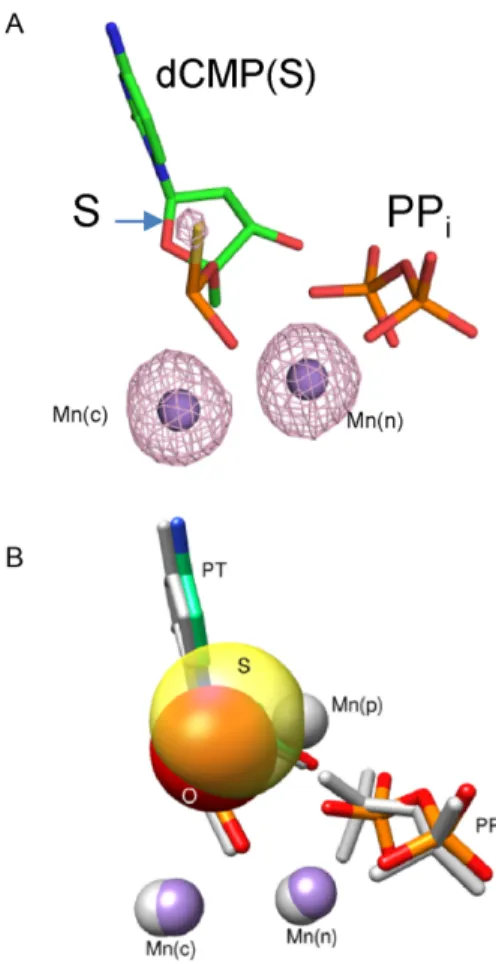
A) (28) and the 30–35% longer phosphate–sulfur bond (29) physically limits metal ligand binding to theSp-sulfur on P␣ (Figure3).
The observed rate of insertion of the Sp-isomer of
dCTP␣S is only 3-fold slower (<1 kcal/mol in activation energy) than dCTP (30) suggesting that the product metal is not essential for the forward reaction. Additionally, time-lapse crystallography fails to observe a product metal
dur-Figure 3. Crystallographic structure of a product complex formed after insertion of theSp-isomer of dCTP␣S. (A) Active site after insertion of theSp-isomer of dCTP␣S. An anomalous density map contoured to 5 is shown indicating that Mn2+occupies the catalytic and nucleotide metal binding sites. (B) Polactive site structural comparison of the products of dCTP (PDB ID 4KLH) andSp-dCTP␣S (PDB ID 5U9H) insertion. A product metal is observed only during the incorporation of a natural nucleotide. Sulfur (transparent yellow) appears to exclude product metal binding. The equivalent oxygen of dCTP (i.e. pro-Sp) is red (appears or-ange in the overlap with the sulfur van der Waals radius). Three Mn2+ (gray) are observed during insertion of dCTP whereas only two man-ganese ions (purple) are detected during the insertion of theSp-isomer of dCTP␣S.
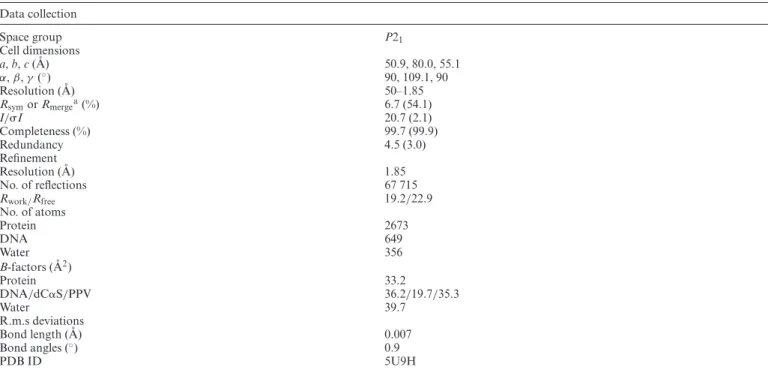
ing insertion of Sp-dCTP␣S (Table 1; Figure 3A).
Fig-ure 3 illustrates a structure of pol incorporating dCTP (PDB ID: 4KLH) (9) superimposed with one that hasSp
Table 1. Data collection and refinement statistics of a ternary pol:DNA co-complex with the insertedSp-isomer of dCTP(␣S)
Data collection
Space group P21
Cell dimensions
a,b,c( ˚A) 50.9, 80.0, 55.1
α,β,γ(◦) 90, 109.1, 90
Resolution ( ˚A) 50–1.85
RsymorRmergea(%) 6.7 (54.1)
I/I 20.7 (2.1)
Completeness (%) 99.7 (99.9)
Redundancy 4.5 (3.0)
Refinement
Resolution ( ˚A) 1.85
No. of reflections 67 715
Rwork/Rfree 19.2/22.9
No. of atoms
Protein 2673
DNA 649
Water 356
B-factors ( ˚A2)
Protein 33.2
DNA/dC␣S/PPV 36.2/19.7/35.3
Water 39.7
R.m.s deviations
Bond length ( ˚A) 0.007
Bond angles (◦) 0.9
PDB ID 5U9H
aHighest resolution shell is shown in parentheses.
Part B
Effect of a sodium ion in the product metal site. Time-lapse crystallographic snapshots of polrevealed that the prod-uct magnesium ion appeared at the end of the nucleotidyl transfer reaction path and strictly correlated with product formation (9), and as described above, computational anal-ysis indicated that a magnesium ion in the nearby site plays no role in the forward reaction. Nevertheless, we further ex-plored the influence of occupancy of the adjunct product metal site on the nucleotidyl transfer reaction. Previously, while analyzing the reverse reaction (pyrophosphorolysis) by pol, we examined Na+instead of Mg2+ at the
prod-uct metal site (11). This use of Na+ softened the
coordi-nation sphere around the metal, capturing features of its potentially dynamic water network. As noted above, calcu-lations in the presence of the tightly coordinated Mg2+, in fact, failed to yield a reverse reaction; however, changing the product metal from Mg2+to Na+resulted in a
biologi-cally viable reaction barrier. Thus, employing Na+
permit-ted coordinating water molecules to have greater freedom as the reaction proceeded, whereas Mg2+resulted in structural
rigidity at this position that retains solvating waters. In this situation, when Na+ occupies the ground state
product metal site, rather than Mg2+, the reaction path
displays a significantly lower activation barrier (11.6–13.2 kcal/mol) (Figure4A). The transition state in this case oc-curs with the O3-P␣ distance between 2.3 and 2.1 ˚A. In the early part of the reaction path, the energy profile fol-lows that of the three-magnesium system until the reaction approaches the transition state region. Around the transi-tion state, the paths diverge with the Na+case yielding a 5
kcal/mol lower energy barrier. Once again, there are min-imal deviations in most QM atoms during the path except
for water molecules near PPi(Figure4B). The Na+
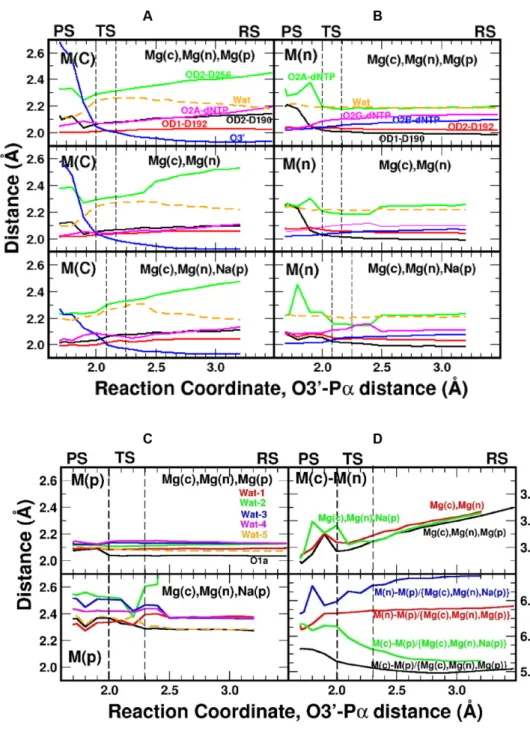
coordi-nation distances of the water molecules are 2.3–2.5 ˚A, sig-nificantly longer than those of the three-magnesium system (∼2.1 ˚A) (Figure5C). Only one water molecule coordinat-ing Na+ makes a strong hydrogen bond (1.8 ˚A) with the
oxyanion on PPi(Figure4B); prior to product formation,
this water was the nearest sodium-coordinating ligand. Key coordination distances to the various metals along the reaction path are given in Figure5for all three systems. All three systems display the largest range in coordinat-ing distances with Mg(c) even at the beginncoordinat-ing of the reac-tion (1.9–2.5 ˚A), where the distance between Asp256(OD2) and Mg(c) is the greatest. Also, progression of the reac-tion results in the atoms coordinated with Mg(c) moving nearer to it, except O3that moves away from Mg(c) dur-ing product formation. The deviation in coordinatdur-ing dis-tances is much narrower for Mg(n) (2.0–2.2 ˚A). Once prod-ucts are formed, the coordinating ligand distances undergo dramatic changes for both Mg(c) and Mg(n) (Figure5A-B). In contrast, the product Mg2+ displays the smallest vari-ations in coordination distances (Figure5C), and the wa-ter coordination shell remains rigid throughout the reaction path. When product metal site is occupied by Na+,
varia-tions and fluctuavaria-tions are found for water molecules around this site. A shortening of the Mg(c)–Mg(n) distance (∼0.2
˚
A) is observed during the approach leading to the transition state of all three systems (Figure5D). Assuming a 2+ charge on each magnesium ion, a simple application of Coulomb’s law predicts a∼20 kcal/mol increase in repulsion energy between the two magnesium ions, i.e. very small changes in the Mg(c)–Mg(n) distance results in large energy changes. For the system with Na+, variations in the distances for
Figure 4. Energy profiles for the polnucleotidyl transfer reaction. (A) Profile obtained from QM/MM calculations with a sodium ion in the product metal site (green). The two- (blue) and three-metal (red) site pro-files are also shown for comparison (see Figure2). This system is used to account for an ion near the product metal binding site that could poten-tially exhibit the transient behavior during catalysis. The transition (TS, described in the text), reactant (RS), and product states (PS) are indicated. (B) The starting (gray) and final (color) QM sub-system configurations (100 atoms) of the three-metal system with a sodium ion at the product metal site are shown. Metal ions are represented by solid spheres (gray or green). The red dashed line represents a newly formed interaction between a Na(p)-bound water and O␣in the final state.
observed, whereas the corresponding distances in the three-magnesium case do not change appreciably (Figure5D).
Since Mg2+- and Mn2+-dependent nucleotide insertion
rates are similar for pol(31,32), the effect of replacing the product metal ion with manganese on the reaction barrier was evaluated. This was tested by replacing the magnesium at the product metal site with a manganese ion and then
re-optimizing each point along the reaction path. No appre-ciable change in the reaction barrier was observed when a manganese ion occupied the product metal site when com-pared the three-magnesium profile (results not shown).
A water network around the product metal site modulates the reaction barrier
The calculated activation barriers for the cases considered are between 13 and 18 kcal/mol, and the reaction leads to the expected products, i.e. extended primer and PPi(Figure
4A). The two- and three-metal systems where the metal sites are occupied by magnesium ions generate nearly identical activation barriers (Figure2A). However, when a monova-lent metal ion with relaxed coordination properties is intro-duced into the ground state product metal site, a decrease in the activation barrier of∼5 kcal/mol is observed (Fig-ure4A). This lower barrier provides support for the possible role of a metal in the product metal site in modulating DNA polymerase catalyzed nucleotidyl transfer reactions. An ex-amination of the molecular architecture around the prod-uct metal site is useful in finding clues as to how the enzyme might modulate charge transfer near the leaving group.
In Figure 6, we focus on the initial reactant and final product metal coordination with an extended hydrogen bond and water network for each system. The five water molecules coordinating Mg(p) in the initial state are shown (Figure6A,∼2.1 ˚A). The remaining coordinating oxygen (pro-Spof P␣, dNTP) is 2.0 ˚A away from this metal. Two of
these water molecules also make hydrogen bonds with the oxygens of the primer terminus phosphate group. One of these oxygens also makes a hydrogen bond to a water sol-vating Mg(c). Another water, coordinating Mg(p), makes a hydrogen bond with a non-bridging oxygen of P␥ (dNTP). The nearest Mg(p)-coordinating water hydrogen bonds to O␣, that becomes the PPi oxyanion, is between 2.7 and
2.9 ˚A from the metal. A closer look at the product struc-ture reveals that the coordination of Mg(p) is not altered and includes two water molecules strongly interacting with the primer terminal phosphate. The major difference be-tween the reactant and product states is that two waters from the Mg(p) coordination shell now participate in hy-drogen bonds with the PPi oxyanion. Importantly, one of
these two water molecules that had coordinated P␥(1.9 ˚A), now hydrogen bonds with an oxygen on P giving rise to one of the two hydrogen bonds with the oxyanion. Since this represents an initial phase of product formation, there still exists a strong hydrogen bond network that bridges phos-phate groups at the primer terminus and PPi via product
state metal coordination.
In the two-magnesium scenario (Figure6B), a network of water molecules links the primer terminus phosphate group with the incoming dNTP. This network becomes stronger during product formation. A water molecule within this network makes a stronger hydrogen bond (1.6 ˚A) during product formation with the oxyanion on PPi,
sur-Figure 5. Metal coordination distance variations along the reaction coordinate. (A) Coordination distances for the catalytic, (B) nucleotide binding, and (C) product metal sites. (D) Metal–metal distances along the reaction coordinates (top panel, Mg(c)–(Mg(n) for all cases; bottom panel, Mg(c)–M(p) and Mg(n)–M(p) with M being magnesium or sodium). In (A) and (B), the Mg(c)Mg(n), Mg(p) system is in the top panel, the Mg(c)Mg(n) system is in the middle panel, and the Mg(c)Mg(p)Na(p) system is in the bottom panel. The same color scheme for the top panel is followed for the other panels in (A–C).
rounding sodium vary, suggesting a weaker interacting net-work compared to the other two systems; only a single water molecule makes a strong hydrogen bond with the oxyanion of PPiand this water has the shortest metal–ligand distance
in the product state (2.3 ˚A).
A product metal site in other DNA polymerases
In ternary substrate complex crystallographic structures of A- and B-family DNA polymerases, a conserved lysine residue is located in the vicinity of the triphosphate of
dNTP. The positively charged N+is found in the position
sepa-Figure 6. Hydrogen-bond network that connects the phosphate group on the primer terminus with the dNTP (or PPi). Involvement of the product metal in strengthening the network is apparent. (A) Mg(c)Mg(n)Mg(p), (B) Mg(c)Mg(n), and (C) Mg(c)Mg(n)Na(p). Hydrogen bonds are indicated in purple dashed lines and the product metal coordination is shown in blue.
rate QM/MM calculation with NH4+at the product metal
site as a reasonable approximation to model the influence of a lysine side chain. The resultant energy profile for the reaction path is shown in Figure7. It is evident that the re-action occurs at a relatively low energy barrier, and the bar-rier occurs at an earlier point (2.4–2.5 ˚A) along the reaction path (Figure7). In a comparison of the reactant and prod-uct state strprod-uctures, this system has a more relaxed water structure solvating NH4+ than in the case of Mg(p)
(Sup-porting Information, Supplementary Figure S1); the waters also exhibit larger coordination distances from the nitrogen (2.7–3.2 ˚A, Supporting Information, Supplementary Figure S2). Meanwhile, the coordination distances of the catalytic and nucleotide-binding metals remain similar to those in the other systems (Supporting Information, Supplementary Figure S3). As described in Supporting Information, charge variations are also quite comparable with the Na+
counter-part (Supplementary Figures S4–S6).
As noted in Figure7, reaction energies are also altered at different magnitudes, when different metals are present at the product metal site. The reaction energy is exoergic in the
Figure 7.Energy profiles for the polnucleotidyl transfer reaction. The profile (black) calculated with an ammonium ion is used to mimic a charged lysine residue found in the position of Mg(p) (13). This lysine residue is conserved in A- and B-family DNA polymerases. The energy profiles of the other three systems are included to facilitate comparison.
absence of the product metal, while the system with a mag-nesium ion at the product metal site, the reaction energy is decreased by∼2 kcal/mol. In the system with a sodium ion at the product metal site, the reaction energy is neither en-doergic nor exoergic, but in the model system with the prod-uct metal site occupied by an ammonium ion, the reaction energy is found to be endoergic, by∼2 kcal/mol. However, these reaction energies correspond to the final stage of only the bond formation and further research is needed to fully estimate the reaction energy differences.
SUMMARY
QM/MM calculations reveal that the pol  nucleotidyl transfer forward reaction in a two-Mg2+ system proceeds
with an energy barrier approximating the observed forward rate of insertion in solution. Interestingly, a virtually iden-tical energy barrier, and reaction path, was observed with a three-Mg2+system, including a Mg2+bound near the
prod-uct metal site. Thus, the prodprod-uct metal was neither required for nor able to facilitate the forward reaction. This observa-tion was consistent with crystallography and kinetic exper-iments carried out with a phosphorothioate dCTP that de-ters Mg2+ and Mn2+binding at the product metal site. On
the other hand, the presence of a monovalent cation (e.g. Na+or NH
4+) at the product metal site resulted in a
SUPPLEMENTARY DATA
Supplementary Data are available at NAR Online.
FUNDING
Research Project [Z01-ES043010 to L.P., Z01-ES050158 and Z01-ES050159 to S.H.W] in the Intramural Research Program of the US National Institutes of Health, US Na-tional Institute of Environmental Health Sciences and in as-sociation with the US National Institutes of Health Grant [U19CA105010]. Funding for open access charge: Intra-mural Research Program of the US National Institutes of Health, US National Institute of Environmental Health Sciences.
Conflict of interest statement.None declared.
REFERENCES
1. Bebenek,K. and Kunkel,T.A. (2004) Functions of DNA polymerases.
Adv Protein Chem.,69, 137–165.
2. Beese,L.S. and Steitz,T.A. (1991) Structural basis for the 3-5 exonuclease activity of Escherichia-coli DNA-polymerase-I – a 2 metal-ion mechanism.EMBO J.,10, 25–33.
3. Beard,W.A., Shock,D.D., Vande Berg,B.J. and Wilson,S.H. (2002) Efficiency of correct nucleotide insertion governs DNA polymerase fidelity.J. Biol. Chem.,277, 47393–47398.
4. Pelletier,H., Sawaya,M.R., Kumar,A., Wilson,S.H. and Kraut,J. (1994) Structures of ternary complexes of rat DNA polymerase beta, a DNA template-primer, and ddCTP.Science,264, 1891–1903. 5. Steitz,T.A. and Steitz,J.A. (1993) A general two-metal-ion mechanism
for catalytic RNA.Proc. Natl. Acad. Sci. U.S.A.,90, 6498–6502. 6. Lin,P., Pedersen,L.C., Batra,V.K., Beard,W.A., Wilson,S.H. and
Pedersen,L.G. (2006) Energy analysis of chemistry for correct insertion by DNA polymerase beta.Proc. Natl. Acad. Sci. U.S.A.,
103, 13294–13299.
7. Batra,V.K., Perera,L., Lin,P., Shock,D.D., Beard,W.A.,
Pedersen,L.C., Pedersen,L.G. and Wilson,S.H. (2013) Amino acid substitution in the active site of DNA Polymerase beta explains the energy barrier of the nucleotidyl transfer reaction.J. Am. Chem. Soc.,
135, 8078–8088.
8. Nakamura,T., Zhao,Y., Yamagata,Y., Hua,Y.J. and Yang,W. (2012) Watching DNA polymerase eta make a phosphodiester bond.Nature,
487, 196–201.
9. Freudenthal,B.D., Beard,W.A., Shock,D.D. and Wilson,S.H. (2013) Observing a DNA polymerase choose right from wrong.Cell,154, 157–168.
10. Gao,Y. and Yang,W. (2016) Capture of a third Mg (2) (+) is essential for catalyzing DNA synthesis.Science,352, 1334–1337.
11. Perera,L., Freudenthal,B.D., Beard,W.A., Shock,D.D., Pedersen,L.G. and Wilson,S.H. (2015) Requirement for transient metal ions revealed through computational analysis for DNA polymerase going in reverse.Proc. Natl. Acad. Sci. U.S.A.,112, E5228–E5236. 12. Lin,P., Batra,V.K., Pedersen,L.C., Beard,W.A., Wilson,S.H. and
Pedersen,L.G. (2008) Incorrect nucleotide insertion at the active site of a G:A mismatch catalyzed by DNA polymerase beta.Proc. Natl. Acad. Sci. U.S.A.,105, 5670–5674.
13. Freudenthal,B.D., Beard,W.A., Shock,D.D. and Wilson,S.H. (2013) Observing a DNA polymerase choose right from wrong.Cell,154, 157–168.
14. Sigel,H. and Griesser,R. (2005) Nucleoside 5-triphosphates: self-association, acid-base, and metal ion-binding properties in solution.Chem. Soc. Rev.,34, 875–900.
15. Case,D.A., Darden,T.A., Cheatham,T.E. III, Simmerling,C.L., Wang,J., Duke,R.E., Luo,R., Walker,R.C., Zhang,W., Merz,K.M.
et al.(2012). University of California, San Francisco.
16. Jorgensen,W.L., Chandrasekhar,J., Madura,J.D., Impey,R.W. and Klein,M.L. (1983) Comparison of simple potential functions for simulating liquid water.J. Chem. Phys.,79, 926–935.
17. Essmann,U., Perera,L., Berkowitz,M.L., Darden,T., Lee,H. and Pedersen,L.G. (1995) A smooth particle mesh ewald method.J. Chem. Phys.,103, 8577–8593.
18. Vreven,T., Byun,K.S., Komaromi,I., Dapprich,S., Montgomery,J.A., Morokuma,K. and Frisch,M.J. (2006) Combining quantum mechanics methods with molecular mechanics methods in ONIOM.
J. Chem. Theory Comput.,2, 815–826.
19. Frisch,M.J., Trucks,G.W., Schlegel,H.B., Scuseria,G.E., Robb,M.A., Cheeseman,J.R., Scalmani,G., Barone,V., Mennucci,B.,
Petersson,G.A.et al.(2009). Gaussian, Inc., Wallingford, CT. 20. Beard,W.A. and Wilson,S.H. (1995) Purification and
domain-mapping of mammalian DNA polymerase beta.DNA Replic.,262, 98–107.
21. Batra,V.K., Beard,W.A., Shock,D.D., Krahn,J.M., Pedersen,L.C. and Wilson,S.H. (2006) Magnesium-induced assembly of a complete DNA polymerase catalytic complex.Structure,14, 757–766. 22. Otwinowski,Z. and Minor,W. (1997) Processing of X-ray diffraction
data collected in oscillation mode.Methods Enzymol.,276, 307–326. 23. Adams,P.D., Afonine,P.V., Bunkoczi,G., Chen,V.B., Davis,I.W.,
Echols,N., Headd,J.J., Hung,L.W., Kapral,G.J.,
Grosse-Kunstleve,R.W.et al.(2010) PHENIX: a comprehensive Python-based system for macromolecular structure solution.Acta Crystallogr. D, Biol. Crystallogr.,66, 213–221.
24. Emsley,P. and Cowtan,K. (2004) Coot: model-building tools for molecular graphics.Acta Crystallogr. D, Biol. Crystallogr.,60, 2126–2132.
25. Schr ¨odinger,LLC (2010) The AxPyMOL Molecular Graphics Plugin for Microsoft Powerpoint. Version 1.0. Schrodinger LLC.
26. Burgers,P.M. and Eckstein,F. (1979) A study of the mechanism of DNA polymerase I from Escherichia coli with diastereomeric phosphorothioate analogs of deoxyadenosine triphosphate.J. Biol. Chem.,254, 6889–6893.
27. Pecoraro,V.L., Hermes,J.D. and Cleland,W.W. (1984) Stability constants of Mg2+and Cd2+complexes of adenine nucleotides and thionucleotides and rate constants for formation and dissociation of MgATP and MgADP.Biochemistry,23, 5262–5271.
28. Alvarez,S. (2013) A cartography of the van der Waals territories.
Dalton Trans.,42, 8617–8636.
29. Liang,C.X. and Allen,L.C. (1987) Sulfur does not form double-bonds in phosphorothioate anions.J. Am. Chem. Soc.,109, 6449–6453. 30. Berg,B.J.V., Beard,W.A. and Wilson,S.H. (2001) DNA structure and
aspartate 276 influence nucleotide binding to human DNA polymerase beta – Implication for the identity of the rate-limiting conformational change.J. Biol. Chem.,276, 3408–3416.
31. Liu,J. and Tsai,M.D. (2001) DNA polymerase beta: pre-steady-state kinetic analyses of dATP alpha S stereoselectivity and alteration of the stereoselectivity by various metal ions and by site-directed mutagenesis.Biochemistry,40, 9014–9022.
32. Batra,V.K., Beard,W.A., Shock,D.D., Pedersen,L.C. and Wilson,S.H. (2008) Structures of DNA polymerase beta with active-site